Science & Chemistry
Amino Acid Chart
Compare the 20 standard amino acids by sequence code, side-chain chemistry, molar mass, essentiality, charge behavior, and the structural features that matter in proteins.
Amino-acid classifications are context-dependent teaching tools. Aromatic, polar, sulfur-containing, charged, and nutritional categories overlap, and protonation states can change with pH and protein environment.
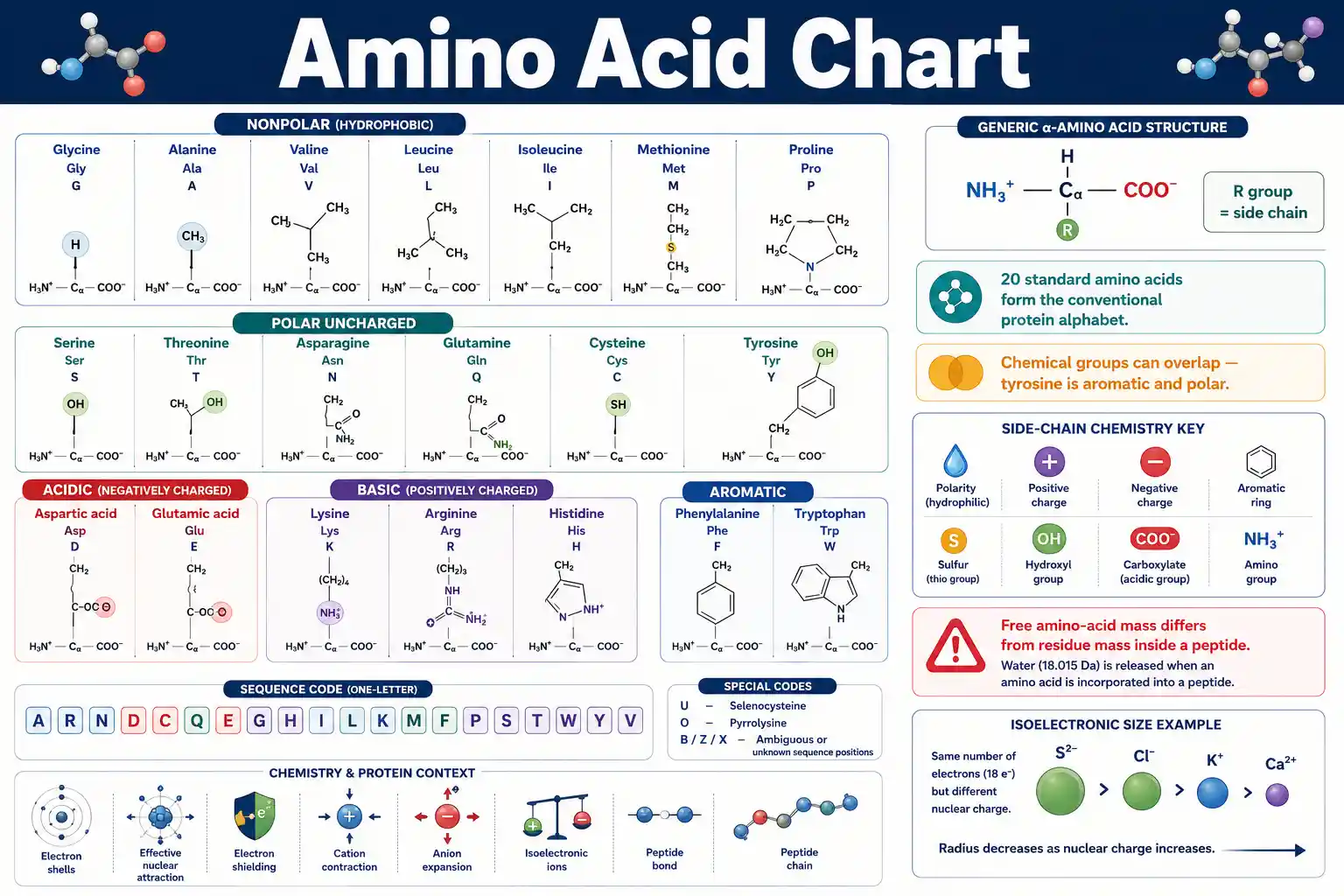
What does an amino acid chart show?
An amino acid chart connects each amino acid’s name to its one-letter and three-letter symbols, side-chain chemistry, and other reference properties. The IUPAC-IUBMB one-letter system standardizes compact sequence symbols such as A for alanine, D for aspartic acid, K for lysine, and W for tryptophan.
Standard set
20 amino acids
The standard protein alphabet contains 20 common amino acids, each with a unique side chain and standardized sequence codes.
Codes
1-letter + 3-letter
Sequence notation uses symbols such as A/Ala for alanine, K/Lys for lysine, and W/Trp for tryptophan.
Main difference
The R group
The side chain controls much of an amino acid residue’s polarity, charge, size, shape, and chemical reactivity.
Charge
Depends on pH
Acidic and basic groups change protonation state with pH, and protein microenvironments can shift their behavior.
Direct answers to common amino acid questions
How many standard amino acids are there?
There are 20 standard amino acids in the conventional protein alphabet.
What is the one-letter code for lysine?
Lysine uses K. The letter L belongs to leucine.
What are the acidic amino acids?
Aspartic acid (D) and glutamic acid (E) have acidic side-chain carboxyl groups and are usually negative near neutral pH.
What are the basic amino acids?
Lysine (K), arginine (R), and histidine (H) are the standard basic amino acids.
Which amino acids are aromatic?
Phenylalanine (F), tyrosine (Y), and tryptophan (W) contain aromatic side chains.
Which amino acids contain sulfur?
Cysteine (C) and methionine (M) contain sulfur, but their chemistry differs because cysteine has a thiol and methionine has a thioether.
What are the branched-chain amino acids?
Valine (V), leucine (L), and isoleucine (I) are the three branched-chain amino acids.
Which amino acids are essential in adult human nutrition?
Histidine, isoleucine, leucine, lysine, methionine, phenylalanine, threonine, tryptophan, and valine are essential.
Why is glycine unusual?
Glycine has hydrogen as its side chain, so it is the smallest standard amino acid and its alpha carbon is not chiral.
Why is proline unusual?
Proline’s side chain bonds back to the backbone nitrogen, which restricts backbone motion and changes its structural behavior.
Do leucine and isoleucine have the same mass?
Yes. Leucine and isoleucine have the same molecular formula and molar mass but different atom connectivity.
Is free-amino-acid mass the same as residue mass in a protein?
No. Peptide-bond formation changes composition through net loss of water, so a residue in a peptide has lower mass than the isolated free amino acid.
20 Standard Amino Acids Reference Chart
Compare the standard amino acids used in proteins by code, dominant side-chain class, approximate free-amino-acid molar mass, and adult essentiality.
Swipe horizontally inside the table to view every column.
| Amino acid | 3-letter | 1-letter | Side-chain class | Approx. molar mass (g/mol) | Adult nutrition |
|---|---|---|---|---|---|
| Alanine | Ala | A | Nonpolar aliphatic | 89.09 | Generally nonessential |
| Arginine | Arg | R | Basic; positively charged | 174.20 | Conditionally essential in some contexts |
| Asparagine | Asn | N | Polar uncharged; amide | 132.12 | Generally nonessential |
| Aspartic acid | Asp | D | Acidic; negatively charged | 133.10 | Generally nonessential |
| Cysteine | Cys | C | Polar uncharged; sulfur-containing | 121.16 | Conditionally essential in some contexts |
| Glutamine | Gln | Q | Polar uncharged; amide | 146.14 | Conditionally essential in some contexts |
| Glutamic acid | Glu | E | Acidic; negatively charged | 147.13 | Generally nonessential |
| Glycine | Gly | G | Nonpolar; smallest side chain | 75.07 | Conditionally essential in some contexts |
| Histidine | His | H | Basic; imidazole | 155.16 | Essential |
| Isoleucine | Ile | I | Nonpolar branched-chain | 131.17 | Essential |
| Leucine | Leu | L | Nonpolar branched-chain | 131.17 | Essential |
| Lysine | Lys | K | Basic; positively charged | 146.19 | Essential |
| Methionine | Met | M | Nonpolar; sulfur-containing | 149.21 | Essential |
| Phenylalanine | Phe | F | Aromatic; largely nonpolar | 165.19 | Essential |
| Proline | Pro | P | Nonpolar; cyclic secondary amino group | 115.13 | Generally nonessential |
| Serine | Ser | S | Polar uncharged; hydroxyl | 105.09 | Generally nonessential |
| Threonine | Thr | T | Polar uncharged; hydroxyl | 119.12 | Essential |
| Tryptophan | Trp | W | Aromatic; largely nonpolar | 204.23 | Essential |
| Tyrosine | Tyr | Y | Aromatic; polar phenol | 181.19 | Conditionally essential in some contexts |
| Valine | Val | V | Nonpolar branched-chain | 117.15 | Essential |
Molar masses are approximate average masses for free amino-acid molecular formulas, not residue masses inside a peptide.
- • Side-chain categories are teaching classifications and can overlap.
- • Nine amino acids are essential in adult human nutrition: His, Ile, Leu, Lys, Met, Phe, Thr, Trp, and Val. Conditional essentiality depends on physiology and clinical context.
Download or export
Use the side chain to predict chemical behavior
The amino and carboxyl groups form the common alpha-amino-acid framework, while the R group differentiates one amino acid from another. An NCBI biochemistry reference groups amino acids broadly by nonpolar, polar, acidic, and basic side-chain properties. More detailed chemistry adds overlapping labels such as aromatic, branched-chain, hydroxyl-containing, or sulfur-containing.
Amino Acid Side-Chain Groups
Side-chain chemistry drives many differences in solubility, charge, hydrogen bonding, packing, and protein structure.
Swipe horizontally inside the table to view every column.
| Group | Amino acids | Typical property | Important overlap |
|---|---|---|---|
| Nonpolar aliphatic | Gly, Ala, Val, Leu, Ile, Met, Pro | Mostly hydrophobic side chains | Met contains sulfur; Gly and Pro have unusual backbone effects |
| Aromatic | Phe, Tyr, Trp | Aromatic rings can participate in hydrophobic and stacking interactions | Tyr also has a polar phenolic OH |
| Polar uncharged | Ser, Thr, Asn, Gln, Cys | Can form favorable polar interactions with water or other groups | Cys can form disulfide bonds; Ser and Thr contain hydroxyl groups |
| Acidic | Asp, Glu | Side-chain carboxylates are usually negative near neutral pH | Charge depends on pH and local environment |
| Basic | Lys, Arg, His | Side chains can accept protons and may carry positive charge | His is often only partly protonated near neutral pH |
| Branched-chain | Val, Leu, Ile | Hydrophobic aliphatic side chains with branching | This is a structural subgroup of nonpolar residues |
| Sulfur-containing | Cys, Met | Contain sulfur atoms | Cys is polar and reactive; Met is usually classified as nonpolar |
| Hydroxyl-containing | Ser, Thr, Tyr | Contain side-chain OH groups | Tyr is also aromatic |
One amino acid can belong to more than one useful chemical subgroup.
- • There is no single universal classroom grouping that captures every chemical property.
- • The NCBI reference groups side chains broadly as nonpolar, polar, acidic, and basic.
Download or export
Side-Chain Functional Groups and Chemistry
Recognizing functional groups makes it easier to predict polarity, acid-base behavior, and common reactions.
Swipe horizontally inside the table to view every column.
| Functional motif | Amino acids | Chemical consequence | Typical interaction |
|---|---|---|---|
| Alkyl / hydrocarbon-rich | Ala, Val, Leu, Ile | Low polarity | Hydrophobic packing |
| Hydroxyl | Ser, Thr, Tyr | Hydrogen-bond donor and acceptor behavior | Hydrogen bonding; some residues can be phosphorylated |
| Amide | Asn, Gln | Polar but normally uncharged side chain | Hydrogen bonding |
| Carboxylate | Asp, Glu | Acidic side chain; usually negative near neutral pH | Salt bridges and metal coordination |
| Amine / guanidinium | Lys, Arg | Strongly basic side chains; commonly positive near neutral pH | Salt bridges and binding to anionic groups |
| Imidazole | His | Acid-base behavior near physiological pH range | Proton transfer and metal binding in proteins |
| Thiol | Cys | Nucleophilic sulfur; oxidizable | Disulfide bond formation |
| Thioether | Met | Sulfur without thiol acidity | Hydrophobic packing; oxidation is possible |
| Phenyl / indole | Phe, Trp | Large aromatic systems | Hydrophobic and aromatic stacking interactions |
| Cyclic backbone-linked side chain | Pro | Restricts backbone conformation | Can introduce turns or disrupt regular secondary structure |
Chemical behavior varies with pH, solvent exposure, neighboring residues, and protein structure.
- • This table describes common tendencies, not guaranteed behavior in every protein.
- • Tyrosine combines an aromatic ring with a phenolic hydroxyl group.
Download or export
Essential Amino Acids in Human Nutrition
Nine amino acids are classified as essential because humans cannot synthesize enough of them to meet normal needs.
Swipe horizontally inside the table to view every column.
| Essential amino acid | Code | Side-chain family | Key distinction |
|---|---|---|---|
| Histidine | H / His | Basic | Imidazole side chain |
| Isoleucine | I / Ile | Nonpolar branched-chain | Structural isomer of leucine |
| Leucine | L / Leu | Nonpolar branched-chain | Branched aliphatic side chain |
| Lysine | K / Lys | Basic | Terminal amino group in side chain |
| Methionine | M / Met | Nonpolar sulfur-containing | Thioether sulfur |
| Phenylalanine | F / Phe | Aromatic | Phenyl side chain |
| Threonine | T / Thr | Polar uncharged | Hydroxyl and side-chain branching |
| Tryptophan | W / Trp | Aromatic | Indole ring |
| Valine | V / Val | Nonpolar branched-chain | Small branched hydrocarbon side chain |
Essentiality is a nutritional category, not a statement that nonessential amino acids are unimportant.
- • Conditionally essential amino acids may require greater dietary contribution in some developmental or clinical states.
- • This chemistry chart does not provide dietary intake targets or supplement advice.
Download or export
Amino acid property finder
Select one of the 20 standard amino acids to review its code, side-chain class, approximate free-amino-acid molar mass, nutritional category, and one structural clue.
Special Structural Features of Selected Amino Acids
Several amino acids have unusual structural features that strongly affect proteins and laboratory interpretation.
Swipe horizontally inside the table to view every column.
| Amino acid | Special feature | Why it matters | Common mistake |
|---|---|---|---|
| Glycine | Side chain is H | Smallest residue; alpha carbon is not chiral | Assuming every standard amino acid is chiral |
| Proline | Side chain connects back to backbone nitrogen | Restricts backbone geometry | Treating Pro like a typical primary alpha-amino acid |
| Cysteine | Thiol side chain | Two cysteines can oxidize to a disulfide linkage | Confusing cysteine with cystine |
| Methionine | Thioether side chain | Sulfur-containing but usually nonpolar | Grouping all sulfur-containing residues together chemically |
| Histidine | Imidazole side chain | Can change protonation state near neutral pH | Treating His as always fully positive |
| Tyrosine | Phenolic OH on aromatic ring | Both aromatic and polar | Classifying Tyr as only hydrophobic |
| Leucine / Isoleucine | Same molecular formula and molar mass | Structural isomers | Assuming equal mass means identical structure |
| Serine / Threonine | Alcohol side chains | Polar and common reaction sites in proteins | Ignoring side-chain hydroxyl chemistry |
Special features help explain protein folding, catalysis, and chemical reactivity.
- • Cystine refers to the oxidized disulfide-linked form of two cysteine residues.
- • Leucine and isoleucine are constitutional isomers.
Download or export
Amino Acid Sequence Codes and Ambiguity Symbols
Protein sequences use standardized one-letter symbols for compact representation and additional symbols for ambiguity or special genetically encoded residues.
Swipe horizontally inside the table to view every column.
| Symbol | Three-letter | Meaning | Use |
|---|---|---|---|
| A–Y standard set | Ala through Tyr | The 20 standard protein amino acids | Routine protein sequence notation |
| B | Asx | Aspartic acid or asparagine | Ambiguous Asp/Asn position |
| Z | Glx | Glutamic acid or glutamine | Ambiguous Glu/Gln position |
| X | Xaa | Unknown or other amino acid | Unspecified residue |
| U | Sec | Selenocysteine | Special genetically encoded amino acid in some proteins |
| O | Pyl | Pyrrolysine | Special genetically encoded amino acid in some organisms |
| Sequence direction | N to C | Protein sequences are conventionally written from N-terminus to C-terminus | Check documentation when a diagram uses another orientation |
| Three-letter capitalization | Ala, Gly, Lys | Capital first letter followed by lowercase letters | Formal three-letter residue notation |
Always check the sequence format or database specification before interpreting nonstandard symbols.
- • IUPAC formally defines B, Z, and X in the one-letter system.
- • UniProt uses U for selenocysteine and O for pyrrolysine.
Download or export
Keep free-amino-acid mass separate from peptide residue mass
Reference tables often report the molar mass of the isolated amino acid. The ExPASy molecular-weight scale lists values for the common amino acids. Once amino acids join through peptide bonds, the incorporated residues no longer have the same elemental composition as separate free amino acids.
Amino Acids, Peptide Bonds, and Residue Mass
Amino acids join through peptide bonds, so a residue inside a peptide is chemically different from the isolated free amino acid.
Swipe horizontally inside the table to view every column.
| Concept | What happens | Chemical result | Why it matters |
|---|---|---|---|
| Free amino acid | Has amino and carboxyl functionalities not tied into peptide bonds | Independent molecule | Reference molar mass describes this form |
| Peptide-bond formation | Carboxyl group of one residue links to amino group of another | Amide bond forms with net loss of H2O | Peptide mass is not a simple sum of free-amino-acid masses |
| Residue | Amino-acid unit incorporated into a peptide | Backbone atoms participate in peptide bonds | Residue mass is lower than free-amino-acid mass |
| N-terminus | End with free or modified amino terminus | Defines one direction of sequence | Protein sequences are conventionally written N to C |
| C-terminus | End with free or modified carboxyl terminus | Defines opposite sequence end | Sequence direction matters in notation |
| Dipeptide | Two residues joined by one peptide bond | One net water loss relative to two free amino acids | Useful mass-check example |
| Tripeptide | Three residues joined by two peptide bonds | Two net water losses | Number of peptide bonds is residues minus one for a simple linear peptide |
| Modified peptide | Residues may be chemically modified after translation | Mass and charge can change | Sequence alone may not predict final protein mass exactly |
For a simple linear peptide of n free amino acids, formation of n − 1 peptide bonds corresponds to net loss of n − 1 water molecules.
- • This is a stoichiometric bookkeeping rule for simple peptide formation.
- • Post-translational modifications, terminal modifications, disulfides, and processing can alter observed mass.
Download or export
Amino Acid Side-Chain Charge Near Neutral pH
Acid-base state depends on pH and the local chemical environment, but these broad tendencies are useful starting points.
Swipe horizontally inside the table to view every column.
| Group | Amino acids | Typical side-chain state near neutral pH | Interpretation caution |
|---|---|---|---|
| Acidic | Asp, Glu | Usually negatively charged | Local environment can shift pKa values |
| Strongly basic | Lys, Arg | Usually positively charged | Exact protonation still depends on pH and environment |
| Histidine | His | Mixture of neutral and protonated forms can be relevant | Do not treat as always positive |
| Polar uncharged | Ser, Thr, Asn, Gln | Usually no formal side-chain charge | Still strongly polar and hydrogen-bonding |
| Cysteine | Cys | Usually neutral thiol | Can deprotonate or form disulfides depending on environment |
| Tyrosine | Tyr | Usually neutral phenol | Can deprotonate at sufficiently high pH or altered microenvironments |
| Nonpolar | Ala, Val, Leu, Ile, Met, Phe, Trp, Pro, Gly | No ionizable side-chain group under ordinary biological conditions | Backbone termini can still carry charge in free amino acids or peptide ends |
These are qualitative tendencies, not fixed charge assignments for every protein environment.
- • All free amino acids also contain alpha-amino and alpha-carboxyl groups whose protonation depends on pH.
- • Protein microenvironments can shift acid-base behavior.
Download or export
Common Amino Acid Side-Chain Reactions and Interactions
Different side chains enable distinct covalent modifications and noncovalent interactions in proteins.
Swipe horizontally inside the table to view every column.
| Residue or group | Common chemistry | Protein-level example | Important limitation |
|---|---|---|---|
| Cys | Thiol oxidation / reduction | Disulfide bond formation and cleavage | Not every cysteine forms a disulfide |
| Ser / Thr / Tyr | Hydroxyl modification | Phosphorylation can occur in proteins | Modification requires specific enzymes or chemistry |
| Lys | Amino-group modification | Acetylation or other acylation | Protein context determines whether modification occurs |
| Asp / Glu | Carboxylate coordination and acid-base chemistry | Salt bridges; catalytic residues | Charge and role depend on local pH and structure |
| His | Proton transfer and metal coordination | Catalytic active sites | Histidine behavior is environment-sensitive |
| Phe / Tyr / Trp | Aromatic interactions | Stacking and hydrophobic packing | Tyrosine also contributes polar chemistry |
| Lys / Arg | Electrostatic attraction to anionic groups | Binding to phosphate-rich molecules | Electrostatics depend on solvent and ionic strength |
| Asn / Gln / Ser / Thr | Hydrogen bonding | Surface and active-site interactions | Hydrogen bonding is geometry-dependent |
Examples describe common biochemical chemistry, not guaranteed modifications or functions for every occurrence of a residue.
- • Protein function depends on three-dimensional context, not amino-acid identity alone.
- • Covalent modifications are often enzyme-controlled.
Download or export
Common Amino Acid Chart Errors
These checks prevent frequent mistakes when reading amino-acid tables, sequences, and chemistry diagrams.
Swipe horizontally inside the table to view every column.
| Mistake | Why it is wrong | Better rule | Example |
|---|---|---|---|
| Treating one classification as absolute | Groups overlap | State the property being classified | Tyr is both aromatic and polar |
| Calling all 20 amino acids essential | Essential is a nutritional category | Only nine are essential in normal adult human nutrition | Leu is essential; Ala is not |
| Using free-amino-acid mass as peptide residue mass | Peptide bonds involve net water loss | Specify free mass versus residue mass | Ala free mass is about 89.09 g/mol |
| Reading sequences C to N by default | Standard sequence notation runs N to C | Read left to right as N-terminus to C-terminus unless stated otherwise | Ala-Gly is Ala then Gly |
| Assuming His is always positive | Its protonation is sensitive near neutral pH | Treat charge as pH- and environment-dependent | His can be neutral or protonated |
| Confusing cysteine and cystine | Cystine is a disulfide-linked pair | Use Cys for the reduced amino acid residue | Cys-S-S-Cys is cystine linkage |
| Assuming Leu and Ile are the same because mass matches | They are structural isomers | Use structure and sequence code, not mass alone | Leu = L; Ile = I |
| Treating U and O as part of the standard 20 | They are special genetically encoded amino acids | Distinguish standard 20 from Sec and Pyl | U = Sec; O = Pyl |
Always identify the convention, chemical form, pH context, and sequence direction used by a chart.
- • Mass spectrometry can have difficulty distinguishing isomeric residues without additional evidence.
- • Database symbol rules can extend beyond the basic IUPAC 20-letter set.
Download or export
Frequently asked questions
How many standard amino acids are used to build proteins?
Twenty amino acids form the standard set commonly used to describe protein sequences. Selenocysteine and pyrrolysine are special genetically encoded amino acids outside that standard 20.
What is the one-letter code for alanine?
Alanine uses A as its one-letter code and Ala as its three-letter code.
What is the one-letter code for lysine?
Lysine uses K, not L. L is the one-letter code for leucine.
Which amino acids are acidic?
Aspartic acid and glutamic acid are the two standard amino acids with acidic carboxylate side chains and are usually negatively charged near neutral pH.
Which amino acids are basic?
Lysine, arginine, and histidine are commonly grouped as basic amino acids. Histidine is less consistently protonated near neutral pH than lysine or arginine.
Which amino acids are aromatic?
Phenylalanine, tyrosine, and tryptophan are the main aromatic amino acids. Tyrosine is also polar because it has a phenolic hydroxyl group.
Which amino acids contain sulfur?
Cysteine and methionine contain sulfur. Cysteine has a thiol, while methionine has a thioether.
Which amino acids are branched-chain amino acids?
Valine, leucine, and isoleucine are the three branched-chain amino acids.
Which amino acids are essential in adults?
Histidine, isoleucine, leucine, lysine, methionine, phenylalanine, threonine, tryptophan, and valine are the nine essential amino acids in normal adult human nutrition.
Are amino-acid groups mutually exclusive?
No. A residue can fit more than one useful category. Tyrosine, for example, is aromatic and polar, while methionine is sulfur-containing and usually classified as nonpolar.
Why do leucine and isoleucine have the same mass?
Leucine and isoleucine have the same molecular formula but different atom connectivity, so they are structural isomers with the same molar mass.
Why is glycine special?
Glycine has hydrogen as its side chain, making it the smallest standard amino acid and the only one whose alpha carbon is not chiral.
Why is proline special?
Proline has a side chain that bonds back to the backbone nitrogen, which restricts backbone geometry and gives it unusual conformational effects.
What is the difference between cysteine and cystine?
Cysteine is the reduced sulfur-containing amino acid. Cystine is the oxidized form created when two cysteine residues are linked by a disulfide bond.
Why is residue mass lower than free amino-acid mass?
When amino acids form peptide bonds, water is lost overall. A residue inside a peptide therefore does not have the same composition as an isolated free amino acid.
What direction are protein sequences written?
Protein sequences are conventionally written from the N-terminus to the C-terminus unless another direction is explicitly stated.
Sources
These nomenclature, sequence, molecular-mass, side-chain, and nutritional references support the tables and explanations on this page.
IUPAC-IUBMB Joint Commission on Biochemical Nomenclature — Nomenclature and Symbolism for Amino Acids and Peptides — One-Letter System
https://iupac.qmul.ac.uk/AminoAcid/A2021.html
Defines the standard one-letter and three-letter symbols used for common amino acids and ambiguous sequence positions.
IUPAC-IUBMB Joint Commission on Biochemical Nomenclature — Nomenclature and Symbolism for Amino Acids and Peptides — Three-Letter System
https://iupac.qmul.ac.uk/AminoAcid/A1416.html
Defines capitalization and use of three-letter amino-acid symbols and residue notation.
National Center for Biotechnology Information — The Molecular Composition of Cells — The Amino Acids
https://www.ncbi.nlm.nih.gov/books/NBK9879/figure/
Groups amino acids by side-chain properties and describes nonpolar, polar, acidic, and basic side chains.
National Center for Biotechnology Information — Biochemistry, Essential Amino Acids
https://www.ncbi.nlm.nih.gov/books/NBK557845/
Lists the nine amino acids considered essential in human nutrition and explains the essential, nonessential, and conditionally essential categories.
SIB Swiss Institute of Bioinformatics — ExPASy — ProtScale: Molecular Weight of Each Amino Acid
https://web.expasy.org/protscale/pscale/Molecularweight.html
Provides standard molecular-weight values for the 20 common amino acids.
UniProt — Sequences — Amino Acid Codes
https://www.uniprot.org/help/sequences
Uses official IUPAC one-letter codes and documents U for selenocysteine and O for pyrrolysine in protein sequences.