Languages & Communication · Writing Systems
Arabic Alphabet Chart: Letters, Joining Forms and Sounds
Learn all 28 Arabic letters in order. Compare names, broad Modern Standard Arabic sounds, isolated and joined forms, vowel marks, hamza, numerals, example words, and safe Unicode handling.
Use sound labels as learning approximations. Modern Standard Arabic is the baseline here, but dialect, recitation tradition, neighboring sounds, and speaker background can change pronunciation. This page does not replace a teacher, grammar reference, or the ChartsLoom Disclaimer.
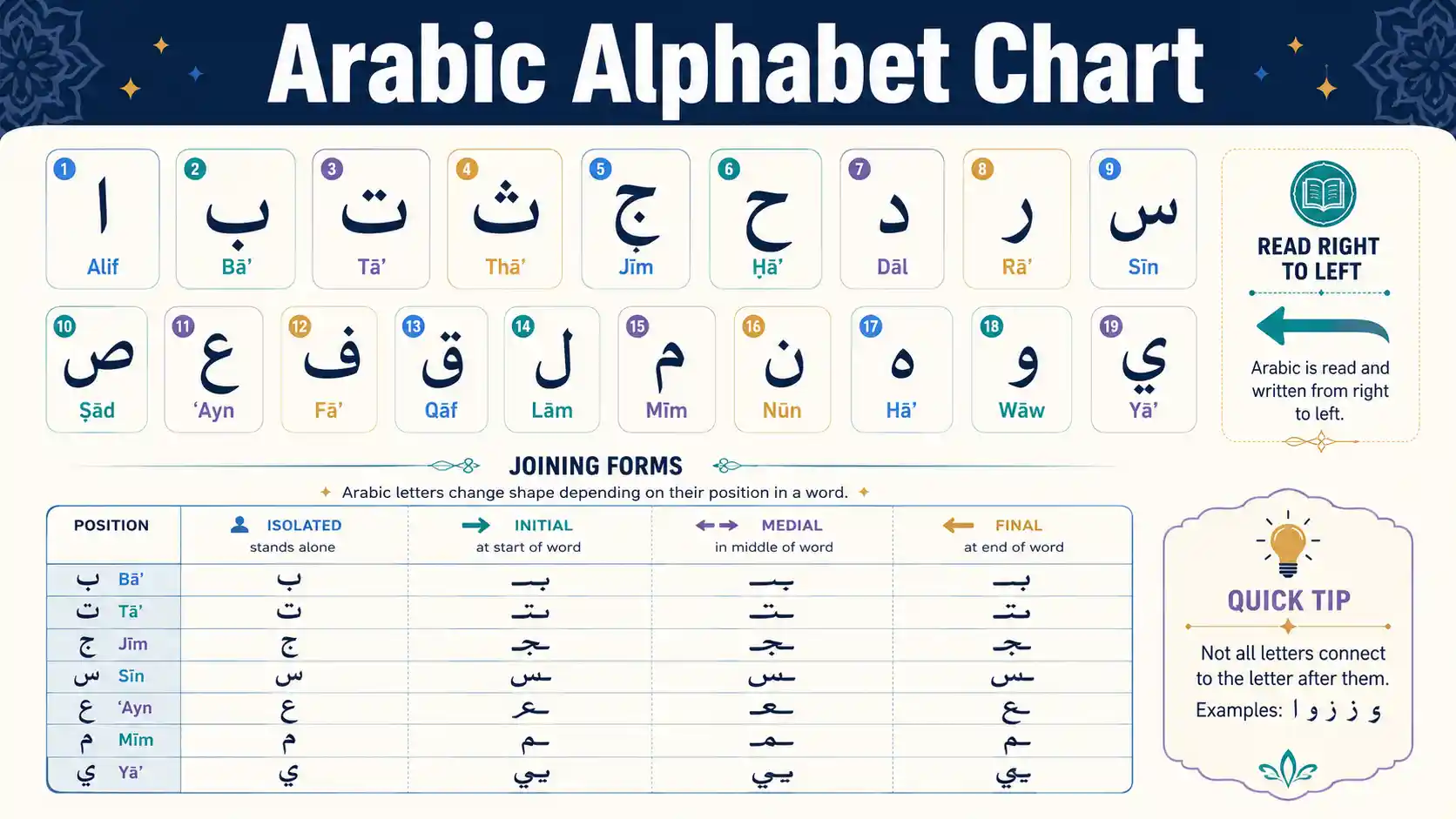
What should you learn first in the Arabic alphabet?
Learn the 28 base letters from right to left, then memorize the six connection breakers: ا د ذ ر ز و. Treat initial, medial, final, and isolated shapes as contextual forms of the same letter. After that, add fatḥa, ḍamma, kasra, sukūn, shadda, and the long-vowel patterns.
Arabic text shaping belongs to the font and shaping engine. In digital text, store base Unicode characters, set semantic right-to-left direction, and avoid assembling words from presentation-form glyph characters.
Base alphabet
28 letters
Hamza is essential to Arabic spelling but is normally treated separately from the 28-letter base order.
Connection breakers
ا د ذ ر ز و
These six letters can connect to the preceding letter but do not connect onward to the following letter.
Writing direction
Right to left
Arabic words run right to left, while digit sequences commonly preserve left-to-right ordering.
Reference coverage
17 tables
233 rows cover letters, forms, sounds, vowels, Unicode, examples, and troubleshooting.
Arabic alphabet questions at a glance
How many letters are in Arabic?
The standard alphabet contains 28 base letters. Hamza is normally taught and encoded separately.
Which way do I start reading?
Start at the right edge of an Arabic word and move left. Read number runs in the order that the surrounding bidirectional layout presents them.
Do joined shapes create new letters?
No. Isolated, final, initial, and medial shapes are contextual glyphs of the same base character.
Which letters break a connection?
Alif, dāl, dhāl, rāʾ, zāy, and wāw break the next connection: ا د ذ ر ز و.
Are vowel marks required?
Not in most everyday text. Readers usually infer omitted short vowels from vocabulary and grammar.
What are the three short vowels?
Fatḥa, ḍamma, and kasra commonly mark short a, u, and i after a consonant.
How are long vowels written?
Common patterns use fatḥa plus alif for ā, kasra plus yāʾ for ī, and ḍamma plus wāw for ū.
What does shadda do?
Shadda marks a doubled or geminated consonant. It can combine with a vowel mark.
What are sun letters?
Before a sun letter, the lām of the definite article ال assimilates in speech even though the spelling remains unchanged.
Is ل + ا one letter?
No. Lām–alif is a two-letter sequence that fonts often display as a ligature.
Why does qāf sound different?
Formal Arabic broadly uses /q/, while regional dialects can realize qāf differently. Label the language variety when precision matters.
How should software store Arabic?
Store ordinary base characters in Unicode, set semantic text direction, and let a shaping engine select contextual glyphs.
Read Arabic as letters, connections, and word patterns
A letter’s identity does not change when its glyph joins a neighbor. Start with the base letter, predict its connections, then read the vowel information that is written or recoverable from the word.
1 · Base letter
Recognize
Identify the letter skeleton and distinguish its dot pattern from related shapes.
2 · Neighbors
Predict joining
Check whether the letter joins on both sides or breaks the connection after itself.
3 · Sound
Read in context
Combine consonants, written vowel marks, long-vowel letters, and known word patterns.
Worked example: كِتاب (kitāb, “book”)
Read the logical letters ك + ت + ا + ب. Kāf, tāʾ, and bāʾ are dual-joining. Alif accepts a connection from the preceding tāʾ but breaks the connection before bāʾ. Kasra gives the short i, and alif marks the long ā.
Start with identity and joining behavior
Dots distinguish several letter families, while neighboring letters determine the displayed joining form. The six right-joining letters accept a connection from an eligible preceding letter but stop the connection before the next letter. A dash in the forms chart means that connected positional form does not exist.
Arabic Alphabet Chart
All 28 base letters in standard alphabet order, with a broad Modern Standard Arabic reading and a searchable example.
Swipe horizontally inside the table to view every column.
| # | Letter | Name | Romanization | Broad IPA | Sound guide | Example | Meaning |
|---|---|---|---|---|---|---|---|
| 1 | ا | alif | ā / carrier | /aː/ or carrier | long a or vowel carrier | كتاب — kitāb | book |
| 2 | ب | bāʾ | b | /b/ | b as in bed | بيت — bayt | house |
| 3 | ت | tāʾ | t | /t/ | t as in top | تمر — tamr | dates |
| 4 | ث | thāʾ | th | /θ/ | th as in thin | ثوب — thawb | garment |
| 5 | ج | jīm | j | /d͡ʒ/ | j as in jam in formal Arabic | جبل — jabal | mountain |
| 6 | ح | ḥāʾ | ḥ | /ħ/ | strong breathy pharyngeal h | حليب — ḥalīb | milk |
| 7 | خ | khāʾ | kh | /x/ | voiceless velar or uvular fricative | خبز — khubz | bread |
| 8 | د | dāl | d | /d/ | d as in dog | دار — dār | house |
| 9 | ذ | dhāl | dh | /ð/ | th as in this | ذهب — dhahab | gold |
| 10 | ر | rāʾ | r | /r ~ ɾ/ | tapped or trilled r | رجل — rajul | man |
| 11 | ز | zāy | z | /z/ | z as in zoo | زهرة — zahra | flower |
| 12 | س | sīn | s | /s/ | s as in sun | سمك — samak | fish |
| 13 | ش | shīn | sh | /ʃ/ | sh as in ship | شمس — shams | sun |
| 14 | ص | ṣād | ṣ | /sˤ/ | emphatic s | صباح — ṣabāḥ | morning |
| 15 | ض | ḍād | ḍ | /dˤ/ | emphatic d in broad MSA | ضوء — ḍawʾ | light |
| 16 | ط | ṭāʾ | ṭ | /tˤ/ | emphatic t | طائر — ṭāʾir | bird |
| 17 | ظ | ẓāʾ | ẓ | /ðˤ/ | emphatic dh in broad MSA | ظل — ẓill | shade |
| 18 | ع | ʿayn | ʿ | /ʕ/ | voiced pharyngeal fricative | عين — ʿayn | eye |
| 19 | غ | ghayn | gh | /ɣ/ | voiced velar or uvular fricative | غرفة — ghurfa | room |
| 20 | ف | fāʾ | f | /f/ | f as in fine | فم — fam | mouth |
| 21 | ق | qāf | q | /q/ | voiceless uvular stop in formal Arabic | قمر — qamar | moon |
| 22 | ك | kāf | k | /k/ | k as in kit | كتاب — kitāb | book |
| 23 | ل | lām | l | /l/ | l as in lamp | ليل — layl | night |
| 24 | م | mīm | m | /m/ | m as in moon | ماء — māʾ | water |
| 25 | ن | nūn | n | /n/ | n as in name | نجم — najm | star |
| 26 | ه | hāʾ | h | /h/ | h as in hat | هواء — hawāʾ | air |
| 27 | و | wāw | w / ū | /w/ or /uː/ | w or long oo | ورد — ward | roses |
| 28 | ي | yāʾ | y / ī | /j/ or /iː/ | y or long ee | يد — yad | hand |
- • Sound values are broad Modern Standard Arabic guides, not dialect guarantees.
- • Alif, wāw, and yāʾ can participate in long-vowel spelling; context determines their role.
Download or export
Arabic Joining Forms Chart
Compare each letter when isolated, final, initial, or medial. A dash means the letter does not take that connected form.
Swipe horizontally inside the table to view every column.
| Letter | Name | Joining type | Isolated | Final | Initial | Medial | Code point |
|---|---|---|---|---|---|---|---|
| ا | alif | Right-joining | ا | ـا | — | — | U+0627 |
| ب | bāʾ | Dual-joining | ب | ـب | بـ | ـبـ | U+0628 |
| ت | tāʾ | Dual-joining | ت | ـت | تـ | ـتـ | U+062A |
| ث | thāʾ | Dual-joining | ث | ـث | ثـ | ـثـ | U+062B |
| ج | jīm | Dual-joining | ج | ـج | جـ | ـجـ | U+062C |
| ح | ḥāʾ | Dual-joining | ح | ـح | حـ | ـحـ | U+062D |
| خ | khāʾ | Dual-joining | خ | ـخ | خـ | ـخـ | U+062E |
| د | dāl | Right-joining | د | ـد | — | — | U+062F |
| ذ | dhāl | Right-joining | ذ | ـذ | — | — | U+0630 |
| ر | rāʾ | Right-joining | ر | ـر | — | — | U+0631 |
| ز | zāy | Right-joining | ز | ـز | — | — | U+0632 |
| س | sīn | Dual-joining | س | ـس | سـ | ـسـ | U+0633 |
| ش | shīn | Dual-joining | ش | ـش | شـ | ـشـ | U+0634 |
| ص | ṣād | Dual-joining | ص | ـص | صـ | ـصـ | U+0635 |
| ض | ḍād | Dual-joining | ض | ـض | ضـ | ـضـ | U+0636 |
| ط | ṭāʾ | Dual-joining | ط | ـط | طـ | ـطـ | U+0637 |
| ظ | ẓāʾ | Dual-joining | ظ | ـظ | ظـ | ـظـ | U+0638 |
| ع | ʿayn | Dual-joining | ع | ـع | عـ | ـعـ | U+0639 |
| غ | ghayn | Dual-joining | غ | ـغ | غـ | ـغـ | U+063A |
| ف | fāʾ | Dual-joining | ف | ـف | فـ | ـفـ | U+0641 |
| ق | qāf | Dual-joining | ق | ـق | قـ | ـقـ | U+0642 |
| ك | kāf | Dual-joining | ك | ـك | كـ | ـكـ | U+0643 |
| ل | lām | Dual-joining | ل | ـل | لـ | ـلـ | U+0644 |
| م | mīm | Dual-joining | م | ـم | مـ | ـمـ | U+0645 |
| ن | nūn | Dual-joining | ن | ـن | نـ | ـنـ | U+0646 |
| ه | hāʾ | Dual-joining | ه | ـه | هـ | ـهـ | U+0647 |
| و | wāw | Right-joining | و | ـو | — | — | U+0648 |
| ي | yāʾ | Dual-joining | ي | ـي | يـ | ـيـ | U+064A |
- • The form samples use ordinary base letters and a visible connector line; a shaping engine selects glyphs in real words.
- • Store base characters rather than Arabic Presentation Forms characters.
Download or export
Six Arabic Letters That Break the Next Connection
These right-joining letters may connect to the preceding letter but do not connect onward to the following letter.
Swipe horizontally inside the table to view every column.
| Letter | Name | Final example | Connection after it | Memory cue |
|---|---|---|---|---|
| ا | alif | ـا | Break | ا has no initial or medial connected form |
| د | dāl | ـد | Break | د has no initial or medial connected form |
| ذ | dhāl | ـذ | Break | ذ has no initial or medial connected form |
| ر | rāʾ | ـر | Break | ر has no initial or medial connected form |
| ز | zāy | ـز | Break | ز has no initial or medial connected form |
| و | wāw | ـو | Break | و has no initial or medial connected form |
- • Right and left describe joining properties in logical text processing; the script itself displays right to left.
Download or export
Browser-only learning tool
Arabic Letter and Vowel Explorer
Pick a base letter, compare its contextual forms, then add one common mark. The tool works locally in your browser and sends no text to a server.
Marked sample
بَ
fatḥa: Short /a/ after the consonant
ب
bāʾ
b · /b/ · U+0628
- Isolated
- ب
- Final
- ـب
- Initial
- بـ
- Medial
- ـبـ
Joining: joins to eligible neighbors on both sides.
Example: بيت (bayt, “house”).
This is a deterministic shape and mark reference. It does not pronounce audio, infer missing vowels, grade handwriting, model every font, or represent dialect-specific speech. Use a teacher or trusted recording to verify articulation.
Vowel marks add information that everyday text may omit
Fatḥa, ḍamma, and kasra mark short vowels. Sukūn suppresses a following short vowel, while shadda marks consonant doubling. Long vowels commonly use alif, wāw, or yāʾ with the preceding vowel pattern. Hamza has separate seating rules, and several word-final forms require grammatical context.
Arabic Short Vowels and Reading Marks
Add these combining marks to a consonant. Everyday text often omits many short-vowel marks.
Swipe horizontally inside the table to view every column.
| Mark | Name | Reading | Example | Function |
|---|---|---|---|---|
| َ | fatḥa | a | بَ | Short /a/ after the consonant |
| ُ | ḍamma | u | بُ | Short /u/ after the consonant |
| ِ | kasra | i | بِ | Short /i/ after the consonant |
| ْ | sukūn | no vowel | بْ | No short vowel follows |
| ّ | shadda | double consonant | بّ | Gemination; combine with a vowel mark when needed |
| ً | fatḥatān | an | ـًا | Indefinite accusative ending in fully marked text |
| ٌ | ḍammatān | un | ـٌ | Indefinite nominative ending in fully marked text |
| ٍ | kasratān | in | ـٍ | Indefinite genitive ending in fully marked text |
- • A shadda and vowel mark may occur together; font placement varies.
- • Diacritics are combining characters and normally follow the base letter in encoded text.
Download or export
Arabic Long Vowels and Diphthongs
Read the preceding short vowel together with alif, wāw, or yāʾ to identify common long-vowel and diphthong patterns.
Swipe horizontally inside the table to view every column.
| Pattern | Typical reading | Example | Romanization | Meaning | Caution |
|---|---|---|---|---|---|
| َا | ā | باب | bāb | door | Alif lengthens preceding fatḥa |
| ِي | ī | كبير | kabīr | big | Yāʾ lengthens preceding kasra |
| ُو | ū | نور | nūr | light | Wāw lengthens preceding ḍamma |
| َيْ | ay | بَيْت | bayt | house | Yāʾ has sukūn after fatḥa |
| َوْ | aw | يَوْم | yawm | day | Wāw has sukūn after fatḥa |
| ى | ā | فتى | fatā | young man | Final alif maqṣūra |
| آ | ʾā | آدم | ʾādam | Adam | Madda represents hamza plus long ā |
- • Vowel analysis depends on the word and grammatical context; unvowelled spelling can be ambiguous.
Download or export
Arabic Hamza Forms Chart
Hamza represents a glottal stop. Its seat depends on position and spelling rules; hamza itself is not counted among the 28 base letters.
Swipe horizontally inside the table to view every column.
| Form | Name or position | Example | Romanization | Encoding note |
|---|---|---|---|---|
| ء | hamza on the line | شيء | shayʾ | U+0621 |
| أ | hamza above alif | أَكَلَ | akala | U+0623 |
| إ | hamza below alif | إِلى | ilā | U+0625 |
| ؤ | hamza on wāw | سؤال | suʾāl | U+0624 |
| ئ | hamza on yāʾ seat | بيئة | bīʾa | U+0626 |
| آ | alif with madda | آن | ʾān | U+0622 |
| ٱ | alif waṣla | ٱسْم | ism | U+0671; specialized marked text |
| ـٔ | combining hamza above | contextual sequence | ʾ | U+0654 after a base |
- • Hamza seating is an orthographic topic; use a grammar or spelling reference for production text.
Download or export
Special Arabic Letter Forms and Endings
Recognize frequent forms that learners meet outside the basic 28-letter list.
Swipe horizontally inside the table to view every column.
| Form | Name | Typical role | Example | Reading note |
|---|---|---|---|---|
| ة | tāʾ marbūṭa | often feminine ending | مدرسة | usually -a/-ah in pause; -t in some connected grammar |
| ى | alif maqṣūra | final long ā | فتى | looks like dotless final yāʾ |
| لا | lām–alif | letter sequence ل + ا | لا | often rendered as a ligature |
| ﻻ | presentation-form ligature | legacy compatibility character | avoid for storage | encode ل then ا instead |
| ـ | taṭwīl / kashīda | visual elongation | ســلام | not a letter or word space |
| ٰ | dagger alif | specialized long ā mark | هٰذا | common in Qurʾanic and carefully marked text |
| ـٔ | hamza above | combining hamza | context-dependent | combines with a base |
| ـٕ | hamza below | combining hamza | context-dependent | combines with a base |
- • Presentation-form characters are included only as a warning; ordinary text should use base letters.
Download or export
Arabic Sun and Moon Letters Chart
The written definite article remains ال. Before a sun letter, its lām assimilates in pronunciation; before a moon letter, the lām is pronounced.
Swipe horizontally inside the table to view every column.
| Letter | Class | Definite example | What you hear | What stays written |
|---|---|---|---|---|
| ا | Moon | الأَسَد — al-asad | Pronounced lām | ال |
| ب | Moon | البَيْت — al-bayt | Pronounced lām | ال |
| ت | Sun | التُّفّاح — at-tuffāḥ | Assimilated consonant; often shown with shadda | ال |
| ث | Sun | الثَّلْج — ath-thalj | Assimilated consonant; often shown with shadda | ال |
| ج | Moon | الجَبَل — al-jabal | Pronounced lām | ال |
| ح | Moon | الحَليب — al-ḥalīb | Pronounced lām | ال |
| خ | Moon | الخُبْز — al-khubz | Pronounced lām | ال |
| د | Sun | الدَّرس — ad-dars | Assimilated consonant; often shown with shadda | ال |
| ذ | Sun | الذَّهَب — adh-dhahab | Assimilated consonant; often shown with shadda | ال |
| ر | Sun | الرَّجُل — ar-rajul | Assimilated consonant; often shown with shadda | ال |
| ز | Sun | الزَّهْرَة — az-zahra | Assimilated consonant; often shown with shadda | ال |
| س | Sun | السَّمَك — as-samak | Assimilated consonant; often shown with shadda | ال |
| ش | Sun | الشَّمْس — ash-shams | Assimilated consonant; often shown with shadda | ال |
| ص | Sun | الصَّباح — aṣ-ṣabāḥ | Assimilated consonant; often shown with shadda | ال |
| ض | Sun | الضَّوء — aḍ-ḍawʾ | Assimilated consonant; often shown with shadda | ال |
| ط | Sun | الطَّريق — aṭ-ṭarīq | Assimilated consonant; often shown with shadda | ال |
| ظ | Sun | الظِّلّ — aẓ-ẓill | Assimilated consonant; often shown with shadda | ال |
| ع | Moon | العَيْن — al-ʿayn | Pronounced lām | ال |
| غ | Moon | الغُرْفَة — al-ghurfa | Pronounced lām | ال |
| ف | Moon | الفَم — al-fam | Pronounced lām | ال |
| ق | Moon | القَمَر — al-qamar | Pronounced lām | ال |
| ك | Moon | الكِتاب — al-kitāb | Pronounced lām | ال |
| ل | Sun | اللَّيْل — al-layl | Assimilated consonant; often shown with shadda | ال |
| م | Moon | الماء — al-māʾ | Pronounced lām | ال |
| ن | Sun | النَّجْم — an-najm | Assimilated consonant; often shown with shadda | ال |
| ه | Moon | الهَواء — al-hawāʾ | Pronounced lām | ال |
| و | Moon | الوَرْد — al-ward | Pronounced lām | ال |
| ي | Moon | اليَد — al-yad | Pronounced lām | ال |
- • Assimilation affects pronunciation, not the spelling of the definite article.
Download or export
Separate right-to-left layout from character storage
Logical text order, visual display order, joining, glyph selection, and encoding solve different problems. Set the direction on the semantic container, isolate embedded runs when needed, keep base letters in storage, and test real Arabic with digits and punctuation. Do not reverse strings to imitate right-to-left layout.
Arabic-Indic Numerals Chart
Compare European digits, Arabic-Indic digits used in many Arabic locales, and Extended Arabic-Indic digits common in Persian and Urdu contexts.
Swipe horizontally inside the table to view every column.
| Value | European | Arabic-Indic | Extended Arabic-Indic | Arabic-Indic code point | Locale rendering example |
|---|---|---|---|---|---|
| 0 | 0 | ٠ | ۰ | U+0660 | ٠ |
| 1 | 1 | ١ | ۱ | U+0661 | ١ |
| 2 | 2 | ٢ | ۲ | U+0662 | ٢ |
| 3 | 3 | ٣ | ۳ | U+0663 | ٣ |
| 4 | 4 | ٤ | ۴ | U+0664 | ٤ |
| 5 | 5 | ٥ | ۵ | U+0665 | ٥ |
| 6 | 6 | ٦ | ۶ | U+0666 | ٦ |
| 7 | 7 | ٧ | ۷ | U+0667 | ٧ |
| 8 | 8 | ٨ | ۸ | U+0668 | ٨ |
| 9 | 9 | ٩ | ۹ | U+0669 | ٩ |
- • Digit style varies by locale, platform, publisher, and user preference.
Download or export
Arabic Punctuation and Direction Chart
Use Arabic punctuation where appropriate and isolate mixed-direction fragments in software interfaces.
Swipe horizontally inside the table to view every column.
| Mark | Name | Use | Direction note | Code point |
|---|---|---|---|---|
| ، | Arabic comma | clause or list separator | mirrored visual convention | U+060C |
| ؛ | Arabic semicolon | strong clause separator | Arabic-specific shape | U+061B |
| ؟ | Arabic question mark | question ending | Arabic-specific shape | U+061F |
| . | full stop | sentence ending | shared character | U+002E |
| : | colon | label or explanation | shared character | U+003A |
| « » | quotation marks | quotation | style varies by publisher | U+00AB / U+00BB |
| ٪ | Arabic percent sign | percentage | placement varies | U+066A |
| ؍ | Arabic date separator | date notation | Arabic block | U+060D |
| | Arabic letter mark | bidi control near weak characters | invisible formatting | U+061C |
| | RTL isolate / pop isolate | contain embedded RTL text | invisible controls | U+2067 / U+2069 |
- • Prefer semantic HTML direction controls such as dir and bdi before inserting invisible controls manually.
Download or export
Arabic Unicode and Web Implementation Chart
Keep characters, shaping, direction, and visual glyphs as separate layers when building Arabic interfaces.
Swipe horizontally inside the table to view every column.
| Task | Recommended approach | Avoid | Why |
|---|---|---|---|
| Store letters | Use base Arabic characters | Presentation Forms blocks | Fonts and shaping engines choose contextual glyphs |
| Set paragraph direction | dir="rtl" on the semantic container | CSS alignment alone | Direction affects bidi ordering and punctuation |
| Embed Latin text | Use bdi or directional isolates | guessing with spaces | Keeps mixed runs contained |
| Normalize | Choose and document NFC where appropriate | blind compatibility folding | Equivalent sequences can differ in code points |
| Search | Define diacritic and normalization policy | raw byte equality only | Marks may be optional or decomposed |
| Count letters | Iterate code points or graphemes for the goal | UTF-16 string length | Combining marks change counts |
| Choose font | Test Arabic shaping and mark placement | assuming all fonts cover Arabic | Glyph quality and coverage differ |
| Build a word | Let the shaping engine join characters | manual positional glyph selection | Joining depends on neighbors |
| Use kashīda | Treat as typography under editorial rules | use it as a space | It changes visual elongation, not word boundaries |
| Test UI | Use real mixed Arabic, digits, paths, and punctuation | letters in isolation only | Bidi bugs appear at run boundaries |
- • Normalization, search folding, and bidi policies must match the product's language and security requirements.
Download or export
Use romanization briefly, then return to Arabic script
Romanization can point to contrasts that English spelling lacks, but no Latin-letter shortcut teaches the joining system or reliably supplies omitted vowels. Practice letter families, connection breakers, vowel patterns, and real words. Verify unfamiliar articulation with a teacher or trusted audio source.
Arabic Sound Families Chart
Group letters by a broad place or manner of articulation to focus pronunciation practice.
Swipe horizontally inside the table to view every column.
| Family | Letters | Broad sound focus | Useful contrast | Caution |
|---|---|---|---|---|
| Stops | ب ت د ك ق | complete closure then release | ك /k/ versus ق /q/ | ق varies by dialect |
| Interdentals | ث ذ ظ | tongue near or between teeth | ث /θ/ versus ذ /ð/ | often merge in dialects |
| Sibilants | س ز ش | narrow grooved airflow | س /s/ versus ش /ʃ/ | keep ز voiced |
| Emphatics | ص ض ط ظ | secondary pharyngealized quality | س/ص and ت/ط | quality spreads in context |
| Pharyngeals | ح ع | constriction in the pharynx | ح /ħ/ versus ه /h/ | no exact English equivalent |
| Velar/uvular fricatives | خ غ | back frication | خ /x/ versus غ /ɣ/ | voicing is the key contrast |
| Nasals | م ن | air through the nose | م /m/ versus ن /n/ | assimilation may occur |
| Liquids | ل ر | lateral and tap/trill | ل versus ر | ر quality varies |
| Glides | و ي | w and y glides | consonant versus long vowel | context decides function |
| Glottal | ه ء | breath /h/ versus closure /ʔ/ | ه versus hamza | hamza is outside the base 28 |
| Labiodental | ف | lower lip at upper teeth | ف /f/ | single core letter |
| Long-vowel carriers | ا و ي | ā, ū, ī patterns | glide or consonant role | short vowels may be omitted |
- • IPA and descriptions are broad Modern Standard Arabic targets; dialects and phonetic contexts differ.
Download or export
Arabic Letter Example Words
Use one familiar word per letter to connect shape, transliteration, and meaning.
Swipe horizontally inside the table to view every column.
| Letter | Word | Romanization | Meaning | Where to notice the letter |
|---|---|---|---|---|
| ا | كتاب | kitāb | book | Inside or final |
| ب | بيت | bayt | house | Initial |
| ت | تمر | tamr | dates | Initial |
| ث | ثوب | thawb | garment | Initial |
| ج | جبل | jabal | mountain | Initial |
| ح | حليب | ḥalīb | milk | Initial |
| خ | خبز | khubz | bread | Initial |
| د | دار | dār | house | Initial |
| ذ | ذهب | dhahab | gold | Initial |
| ر | رجل | rajul | man | Initial |
| ز | زهرة | zahra | flower | Initial |
| س | سمك | samak | fish | Initial |
| ش | شمس | shams | sun | Initial |
| ص | صباح | ṣabāḥ | morning | Initial |
| ض | ضوء | ḍawʾ | light | Initial |
| ط | طائر | ṭāʾir | bird | Initial |
| ظ | ظل | ẓill | shade | Initial |
| ع | عين | ʿayn | eye | Initial |
| غ | غرفة | ghurfa | room | Initial |
| ف | فم | fam | mouth | Initial |
| ق | قمر | qamar | moon | Initial |
| ك | كتاب | kitāb | book | Initial |
| ل | ليل | layl | night | Initial |
| م | ماء | māʾ | water | Initial |
| ن | نجم | najm | star | Initial |
| ه | هواء | hawāʾ | air | Initial |
| و | ورد | ward | roses | Initial |
| ي | يد | yad | hand | Initial |
- • Examples are vocabulary aids, not full pronunciation or grammar lessons.
Download or export
Arabic Alphabet Learning Sequence
Build recognition, joining, reading, and typing in small verified steps.
Swipe horizontally inside the table to view every column.
| Step | Practice | Goal | Self-check | Common mistake |
|---|---|---|---|---|
| 1 | Learn 28 names in order | alphabet recall | point and name | memorizing Latin labels only |
| 2 | Group dotted families | shape discrimination | read ب ت ث | ignoring dot count |
| 3 | Mark the six breakers | joining prediction | circle ا د ذ ر ز و | joining through them |
| 4 | Read isolated and final forms | word endings | match each pair | treating forms as new letters |
| 5 | Read initial and medial forms | connected words | trace the baseline | counting connector strokes |
| 6 | Add fatḥa, ḍamma, kasra | short syllables | read بَ بُ بِ | reading marks before the base |
| 7 | Add sukūn and shadda | clusters and doubling | contrast بَ / بَّ | skipping gemination |
| 8 | Learn long vowels | syllable length | contrast short and long | assuming و and ي are always vowels |
| 9 | Practice real words | automatic recognition | read without transliteration | over-relying on Roman letters |
| 10 | Type and proof mixed text | digital fluency | test RTL and digits | using visual glyph forms as text |
- • A teacher or high-quality audio source is the best check for articulation and rhythm.
Download or export
Arabic Handwriting and Font Differences
Expect the same encoded letter to change shape across fonts, handwriting styles, and neighboring letters.
Swipe horizontally inside the table to view every column.
| Feature | What changes | What stays stable | Check | Do not infer |
|---|---|---|---|---|
| Stroke thickness | pen or font contrast | letter identity | dots and skeleton | different code point |
| Loop openness | hand and style | joining behavior | neighboring letters | different pronunciation |
| Baseline length | spacing and justification | word order | letter sequence | extra letter |
| Dot shape | round, diamond, or stroke | dot count and placement | family contrast | decorative dot is optional |
| Final tails | font-specific length | final letter identity | word boundary | new punctuation |
| Lām–alif | ligated or decomposed glyph | two-letter text sequence | copy code points | one alphabet letter |
| Diacritic position | mark stacking and font anchors | mark identity | zoom and font support | different vowel automatically |
| Kāf form | print or regional style | letter ك | name and code point | Persian ک is identical |
| Yāʾ dots | language-specific final conventions | language orthography | Arabic versus Persian context | all forms are interchangeable |
| Justification | kashīda and spacing | logical order | selectable text | visual width equals letter count |
- • Representative glyphs are not prescriptions for handwriting or typeface design.
Download or export
Arabic Text Troubleshooting Chart
Diagnose direction, shaping, font, encoding, and data-model problems separately.
Swipe horizontally inside the table to view every column.
| Symptom | Likely layer | Check first | Safer fix | Avoid |
|---|---|---|---|---|
| Letters appear disconnected | shaping or font | same text in a known Arabic font | enable proper text shaping | manual ligature characters |
| Word order looks reversed | bidi/container | HTML dir value | set dir="rtl" semantically | reversing the string |
| Digits jump around | mixed bidi runs | number and punctuation boundaries | use bdi or isolates | inserting random spaces |
| Marks float badly | font anchors | font and mark sequence | use a tested Arabic font | rasterizing all text |
| Search misses a word | normalization/marks | NFC and diacritic policy | normalize consistently | strip marks without product rules |
| Copied text changes | presentation characters | inspect code points | store base letters | visual-form code points |
| Boxes replace letters | font coverage | font fallback | load Arabic-capable fonts | changing encoding blindly |
| Punctuation is misplaced | bidi context | paragraph direction | contain directional runs | manual character reversal |
| Lām–alif will not join | neighbor or control | characters and ZWJ/ZWNJ | use ل + ا normally | forcing a compatibility ligature |
| Two strings look same | normalization | show code points | compare normalized forms | assume glyph equality |
| A word is unreadable | missing vowels/context | source and domain | consult a dictionary or teacher | invent short vowels |
| A sound differs | dialect | speaker and register | label MSA versus dialect | mark one dialect as universally wrong |
- • Security-sensitive identifiers need a product-specific Unicode, bidi, and confusable-text policy.
Download or export
Arabic Romanization Symbols Chart
Read the symbols used on this page as pronunciation signposts, not as a replacement for Arabic script.
Swipe horizontally inside the table to view every column.
| Symbol | Arabic | Meaning here | Plain-key fallback | Caution |
|---|---|---|---|---|
| ā | ا / ى | long a | aa | not every alif is a sounded ā |
| ī | ي | long i | ii / ee | yāʾ can also be /j/ |
| ū | و | long u | uu / oo | wāw can also be /w/ |
| ḥ | ح | pharyngeal h | h | distinct from ه |
| kh | خ | voiceless back fricative | kh | not /k/ + /h/ |
| dh | ذ | voiced th | dh | dialect variation is common |
| ṣ ḍ ṭ ẓ | ص ض ط ظ | emphatic consonants | s d t z | plain fallback hides contrasts |
| ʿ | ع | ʿayn | 3 in informal Arabizi | not an apostrophe sound |
| ʾ | ء | hamza/glottal stop | ' | seating varies |
| gh | غ | voiced back fricative | gh | not hard English g |
- • Romanization systems differ; apply one named system consistently in formal cataloging or scholarship.
Download or export
This chart cannot determine every pronunciation or spelling
Arabic dialects, formal register, recitation conventions, grammatical endings, omitted short vowels, lexical knowledge, regional typography, handwriting, font shaping, and bidirectional context can change what a reader hears or sees. The explorer does not analyze arbitrary words, infer grammar, play audio, grade handwriting, or certify a software implementation. Use a dictionary, teacher, pronunciation source, and product-specific Unicode policy when the context requires them.
Frequently asked questions
How many letters are in the Arabic alphabet?
The standard Arabic alphabet has 28 base letters. Hamza is an important character, but it is usually treated separately rather than counted as a twenty-ninth base letter.
Is Arabic written from right to left?
Yes. Arabic words and paragraphs run right to left, while number runs commonly retain left-to-right ordering inside bidirectional text.
Why do Arabic letters change shape?
A shaping engine selects contextual glyphs according to each letter’s position and joining neighbors. The underlying base character normally stays the same.
Which Arabic letters do not connect to the next letter?
Alif, dāl, dhāl, rāʾ, zāy, and wāw do not connect onward to the following letter: ا د ذ ر ز و.
Does every Arabic letter have four forms?
No. Dual-joining letters can show isolated, final, initial, and medial forms. The six right-joining letters lack connected initial and medial forms.
Are short vowels always written in Arabic?
No. Ordinary Arabic usually omits many short-vowel marks because readers infer them from vocabulary and grammar. Learning, religious, and disambiguating texts may mark more vowels.
What do fatḥa, ḍamma, and kasra mean?
They are combining marks that commonly indicate short a, u, and i after a consonant.
What is shadda?
Shadda marks consonant gemination, meaning the consonant is held or doubled. A vowel mark can appear with it.
Is hamza an Arabic letter?
Hamza represents the glottal stop and appears alone or on several seats. It is essential to Arabic spelling but is not normally counted among the 28 base alphabet letters.
What is tāʾ marbūṭa?
Tāʾ marbūṭa, ة, is a frequent word-final form often associated with feminine nouns and adjectives. Its pronunciation changes with grammatical context and pausing.
What are sun and moon letters?
They describe pronunciation of the definite article ال. Its lām assimilates before a sun letter but remains pronounced before a moon letter; the spelling stays ال.
Are Arabic-Indic digits written right to left?
Arabic text is right to left, but digit sequences commonly display left to right. The Unicode bidirectional algorithm resolves them within their surrounding text.
Should software store isolated and medial presentation forms?
Usually no. Store base Arabic characters and let the font and shaping engine choose contextual glyphs. Presentation Forms characters mainly exist for compatibility.
Why does Arabic pronunciation differ between speakers?
Modern Standard Arabic provides a shared formal reference, while regional dialects can change sounds such as jīm and qāf. Context, register, and speaker region matter.
Sources
Unicode 17.0 character, shaping, normalization, and bidirectional documents support the encoding guidance. W3C Arabic layout requirements support Web direction and typography guidance. The Library of Congress table supports the formal letter and romanization reference.
Unicode Consortium — The Unicode Standard 17.0 — Arabic
Defines Arabic script behavior, contextual shaping, joining, transparent marks, and character-encoding principles.
Unicode Consortium — Arabic Code Chart, U+0600–U+06FF
Provides normative code points, character names, annotations, digits, punctuation, and combining marks in the Arabic block.
Unicode Consortium — ArabicShaping-17.0.0
Provides Joining_Type and Joining_Group properties used by shaping implementations.
Unicode Consortium — UAX #9: Unicode Bidirectional Algorithm
Defines display ordering for mixed right-to-left and left-to-right text, numbers, punctuation, isolates, and embeddings.
https://www.unicode.org/reports/tr9/
Unicode Consortium — UAX #15: Unicode Normalization Forms
Defines canonical and compatibility normalization for equivalent encoded sequences.
https://www.unicode.org/reports/tr15/
World Wide Web Consortium — Arabic & Persian Layout Requirements
Explains Arabic-script direction, shaping, joining, punctuation, numbers, spacing, and layout requirements for the Web.
https://www.w3.org/TR/alreq/
Library of Congress — Arabic Romanization Table
Supplies a formal Arabic letter order, contextual-form reference, transliteration symbols, vowels, and special-letter rules.
https://www.loc.gov/catdir/cpso/romanization/arabic.pdf