Science & Chemistry
Oxidation States Chart
Compare oxidation-state rules, representative element values, oxygen and hydrogen exceptions, worked formulas, polyatomic ions, redox changes, and Stock names, then solve an unknown value with the interactive finder.
Oxidation state is formal electron bookkeeping. It is extremely useful for redox chemistry and nomenclature, but it should not automatically be interpreted as a measured atomic charge or as formal charge.
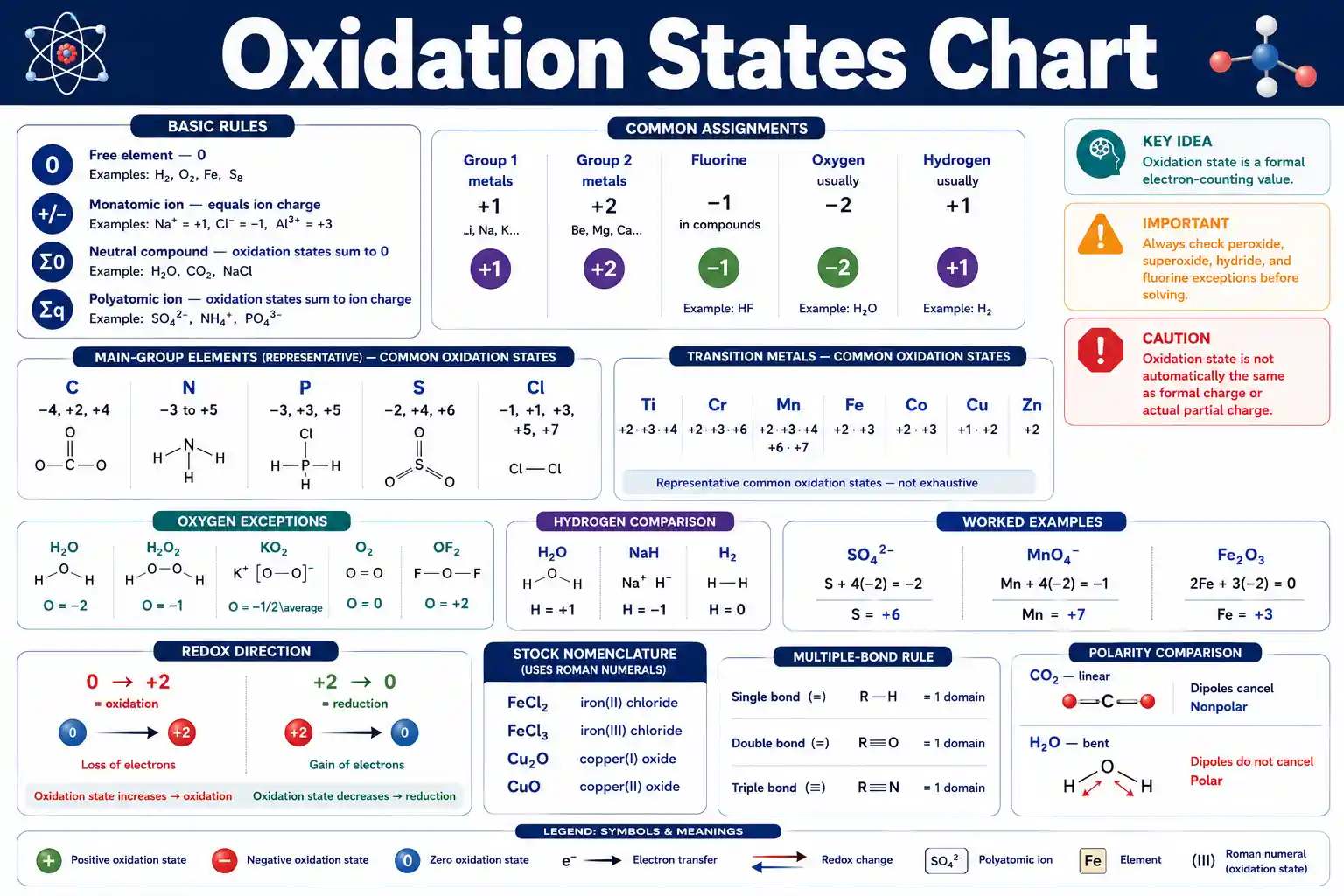
How oxidation states work
The IUPAC Gold Book defines oxidation state through an ionic approximation: electrons in heteronuclear bonds are formally assigned according to bond-electron allegiance. In everyday general chemistry, shortcut rules reproduce the familiar assignments for many common compounds.
A free element has oxidation state 0. A monatomic ion has an oxidation state equal to its charge. In a neutral compound, all oxidation states add to 0; in a polyatomic ion, they add to the ion charge. Those four facts solve a large fraction of introductory problems.
Oxidation means an oxidation state increases, while reduction means it decreases. The IUPAC 2016 recommendations emphasize oxidation state as a numerical attribute that tracks chemical changes and systematizes descriptive chemistry.
Free element
Oxidation state 0
Atoms in Fe metal, O₂, H₂, Cl₂, S₈, and other uncombined elemental substances are assigned 0.
Neutral compound
Sum = 0
Multiply each oxidation state by its atom count; all contributions in a neutral formula add to zero.
Polyatomic ion
Sum = ion charge
Sulfate totals −2, ammonium totals +1, and every atom must be included in that algebraic sum.
Redox direction
Increase = oxidation
A higher oxidation state means oxidation; a lower oxidation state means reduction.
Oxidation State Rules Chart
A practical order of rules for assigning introductory oxidation states in common molecules and ions.
Swipe horizontally inside the table to view every column.
| Rule | Typical assignment | Example | Important exception or note |
|---|---|---|---|
| Free element | 0 | Fe, O₂, S₈ | Every atom in an uncombined element has oxidation state 0 |
| Monatomic ion | Equal to ion charge | Na⁺ = +1; S²⁻ = −2 | Here oxidation state and ionic charge coincide |
| Sum in neutral compound | Total = 0 | H₂O: 2(+1) + (−2) = 0 | Use the algebraic sum to solve an unknown state |
| Sum in polyatomic ion | Total = ion charge | SO₄²⁻ totals −2 | The sum is not zero unless the ion is neutral |
| Fluorine in compounds | −1 | HF, CF₄ | Fluorine is the most electronegative element and is assigned −1 in ordinary compounds |
| Oxygen in most compounds | −2 | H₂O, MgO, CO₂ | Peroxides, superoxides, elemental oxygen, and O–F compounds are exceptions |
| Hydrogen in most compounds | +1 | H₂O, HCl, NH₃ | Hydrogen is −1 in many binary metal hydrides |
| Group 1 metals | +1 in compounds | NaCl, K₂SO₄ | Elemental metal is 0 |
| Group 2 metals | +2 in compounds | MgO, CaCl₂ | Elemental metal is 0 |
| Aluminium | Usually +3 | Al₂O₃ | Introductory problems normally use +3 |
| Halogens Cl, Br, I | Often −1 | NaCl, HBr, KI | Positive states occur with oxygen or more electronegative halogens |
Oxidation states are dimensionless bookkeeping values. Signs are written before the number, such as +3 or −2.
- • These classroom rules are useful shortcuts; the modern IUPAC definition is based on assigning bond electrons by ionic approximation.
Download or export
Start with the rules that are least ambiguous
Elemental substances and monatomic ions are direct assignments. Fluorine is −1 in compounds. Group 1 and Group 2 metals are strongly patterned. Oxygen and hydrogen are also predictable most of the time, but they must be checked for well-known exceptions before solving the remaining unknown.
Common Main-Group Oxidation States
Representative oxidation states encountered frequently in introductory inorganic and general chemistry. The list is useful, not exhaustive.
Swipe horizontally inside the table to view every column.
| Element | Symbol | Common states | Representative examples | Pattern note |
|---|---|---|---|---|
| Hydrogen | H | −1, +1 | NaH; H₂O | +1 is usual; −1 occurs in many metal hydrides |
| Lithium | Li | +1 | LiCl | Group 1 metal |
| Sodium | Na | +1 | Na₂O | Group 1 metal |
| Potassium | K | +1 | KMnO₄ | Group 1 metal |
| Beryllium | Be | +2 | BeCl₂ | Group 2 metal |
| Magnesium | Mg | +2 | MgO | Group 2 metal |
| Calcium | Ca | +2 | CaCO₃ | Group 2 metal |
| Aluminium | Al | +3 | Al₂O₃ | Common fixed state in introductory chemistry |
| Carbon | C | −4, +2, +4 | CH₄; CO; CO₂ | Wide range because carbon forms many covalent compounds |
| Nitrogen | N | −3 to +5 | NH₃; N₂O; NO; HNO₂; NO₂; HNO₃ | Several integer states occur across nitrogen chemistry |
| Oxygen | O | Usually −2 | H₂O; CO₂ | See the oxygen-exception chart for −1, −1/2, +1, and +2 cases |
| Fluorine | F | −1 | HF; OF₂ | Assigned −1 in its compounds |
| Silicon | Si | −4, +4 | Mg₂Si; SiO₂ | +4 is especially common |
| Phosphorus | P | −3, +3, +5 | PH₃; PCl₃; H₃PO₄ | +3 and +5 are common positive states |
| Sulfur | S | −2, +4, +6 | H₂S; SO₂; SO₃ | Intermediate states also occur |
| Chlorine | Cl | −1, +1, +3, +5, +7 | Cl⁻; ClO⁻; ClO₂⁻; ClO₃⁻; ClO₄⁻ | Positive states commonly occur in oxyanions |
| Bromine | Br | −1, +1, +3, +5, +7 | Br⁻ and bromine oxyanions | Positive states occur with oxygen or fluorine |
| Iodine | I | −1, +1, +3, +5, +7 | I⁻ and iodine oxyanions | Iodine supports several positive states |
Representative common oxidation states; not a list of every reported or formally assignable state.
- • Free elements such as H₂, N₂, O₂, Cl₂, graphite, sulfur, and metallic sodium are all oxidation state 0.
Download or export
Common Transition-Metal Oxidation States
Representative states commonly encountered in compounds and coordination chemistry. Transition metals can support more states than this compact chart lists.
Swipe horizontally inside the table to view every column.
| Element | Symbol | Common states | Representative species | Quick note |
|---|---|---|---|---|
| Scandium | Sc | +3 | Sc³⁺ | +3 dominates common chemistry |
| Titanium | Ti | +2, +3, +4 | Ti²⁺, Ti³⁺, TiO₂ | +4 is especially common |
| Vanadium | V | +2, +3, +4, +5 | V²⁺, V³⁺, VO²⁺, VO₂⁺ | Multiple accessible states are a classic redox example |
| Chromium | Cr | +2, +3, +6 | Cr²⁺, Cr³⁺, CrO₄²⁻ | +3 and +6 are widely encountered |
| Manganese | Mn | +2, +3, +4, +6, +7 | Mn²⁺, MnO₂, MnO₄²⁻, MnO₄⁻ | +7 occurs in permanganate |
| Iron | Fe | +2, +3 | Fe²⁺, Fe³⁺ | The two common states support Stock names iron(II) and iron(III) |
| Cobalt | Co | +2, +3 | Co²⁺, Co³⁺ | Both are common in coordination chemistry |
| Nickel | Ni | +2, +3 | Ni²⁺, Ni³⁺ | +2 is especially common |
| Copper | Cu | +1, +2 | Cu₂O, CuO | Copper(I) and copper(II) are common |
| Zinc | Zn | +2 | Zn²⁺, ZnO | +2 strongly dominates ordinary chemistry |
| Molybdenum | Mo | +2, +3, +4, +5, +6 | MoO₂, MoO₃ | +6 is common in oxo chemistry |
| Ruthenium | Ru | +2, +3, +4, +8 | Ru²⁺ complexes; RuO₄ | High state +8 occurs in RuO₄ |
| Palladium | Pd | +2, +4 | Pd²⁺, Pd(IV) compounds | +2 is especially common |
| Silver | Ag | +1 | Ag⁺, AgCl | +1 dominates familiar silver chemistry |
| Tungsten | W | +4, +5, +6 | WO₂, WO₃ | +6 is common in oxides and tungstates |
| Platinum | Pt | +2, +4 | Pt(II), Pt(IV) complexes | Both are important in coordination chemistry |
| Gold | Au | +1, +3 | Au(I), Au(III) compounds | +1 and +3 are the familiar states |
| Mercury | Hg | +1, +2 | Hg₂²⁺; Hg²⁺ | Hg(I) commonly occurs as the dimeric ion Hg₂²⁺ |
Representative common oxidation states only.
- • Oxidation state is a formal electron-counting attribute and should not automatically be read as a localized ionic charge in a covalent complex.
Download or export
Common oxidation states are not rigid limits
A compact chart shows the states most useful for routine chemistry, not every state reported for every element. Transition metals are especially variable, and bonding context can make simplistic fixed-charge thinking misleading.
Interactive oxidation-state tool
Oxidation State Finder
Solve one unknown oxidation state from the total known contribution, number of unknown atoms, and overall species charge.
Known total means the sum of every already assigned oxidation state multiplied by its atom count. Example: in H₂SO₄, hydrogen contributes +2 and oxygen contributes −8, so the known total is −6.
Solved state
X = +6
Equation
1x + (-6) = 0
x = (charge − known contribution) ÷ unknown-atom count
The calculator solves the algebra only. You still need the correct chemistry assignments first, including peroxide, superoxide, hydride, fluorine, mixed-valence, and other special cases.
Oxygen Oxidation-State Exceptions
Oxygen is usually −2, but several important compound classes require a different assignment.
Swipe horizontally inside the table to view every column.
| Species or class | Oxidation state of O | Why | Example |
|---|---|---|---|
| Most oxides and oxygen compounds | −2 | Standard introductory assignment | H₂O, MgO, CO₂ |
| Peroxides | −1 | O–O unit has overall −2 charge | H₂O₂, Na₂O₂ |
| Superoxides | −1/2 average | O₂⁻ unit shares −1 over two equivalent O atoms | KO₂ |
| Elemental oxygen | 0 | Uncombined element | O₂, O₃ |
| Oxygen difluoride | +2 | F is assigned −1, forcing O to +2 | OF₂ |
| Dioxygen difluoride | +1 average | Two F atoms total −2, so O₂ totals +2 | O₂F₂ |
Fractional values can be average oxidation states for equivalent atoms in a multi-atom unit.
- • Do not apply oxygen = −2 before checking whether the formula is a peroxide, superoxide, elemental form, or oxygen–fluorine compound.
Download or export
Hydrogen and Halogen Oxidation-State Exceptions
Hydrogen and the halogens have strong default patterns, but bonding partners determine when those shortcuts fail.
Swipe horizontally inside the table to view every column.
| Element or class | Usual assignment | Exception | Example |
|---|---|---|---|
| Hydrogen | +1 | −1 in many binary metal hydrides | NaH: H = −1 |
| Hydrogen element | 0 | Free elemental state | H₂: H = 0 |
| Fluorine | −1 in compounds | No routine positive oxidation states in ordinary compounds | OF₂: F = −1 |
| Chlorine | Usually −1 | Can be positive with O or F | ClO₄⁻: Cl = +7 |
| Bromine | Usually −1 | Can be positive with O or F | BrO₃⁻: Br = +5 |
| Iodine | Usually −1 | Can be positive with O or more electronegative partners | IO₄⁻: I = +7 |
| Interhalogen example | More electronegative halogen is negative | Assign by relative electronegativity | ClF₃: F = −1, Cl = +3 |
Use electronegativity and the total-charge rule when simple defaults conflict.
- • The modern IUPAC approach assigns heteronuclear bond electrons to the more electronegative partner, subject to specified exceptions in the formal algorithm.
Download or export
Oxygen = −2 is a default, not a universal law
Peroxide oxygen is −1, superoxide oxygen averages −1/2, elemental oxygen is 0, oxygen is +2 in OF₂, and it averages +1 in O₂F₂. Hydrogen likewise changes from its usual +1 to −1 in many metal hydrides. Checking these exceptions before doing algebra prevents the most common wrong answers.
Worked Oxidation-State Examples
Representative compounds showing how the sum rule and common assignments reveal the unknown oxidation state.
Swipe horizontally inside the table to view every column.
| Species | Known contribution | Equation | Solved oxidation state | Interpretation |
|---|---|---|---|---|
| NaCl | Na = +1 | +1 + x = 0 | Cl = −1 | Neutral compound totals 0 |
| H₂O | 2 H = +2 | +2 + x = 0 | O = −2 | Usual oxygen state |
| H₂O₂ | 2 H = +2 | +2 + 2x = 0 | O = −1 | Peroxide exception |
| NaH | Na = +1 | +1 + x = 0 | H = −1 | Metal-hydride exception |
| OF₂ | 2 F = −2 | x − 2 = 0 | O = +2 | Fluorine forces positive oxygen |
| CO₂ | 2 O = −4 | x − 4 = 0 | C = +4 | Carbon in an oxidized state |
| CO | O = −2 | x − 2 = 0 | C = +2 | Same element can have multiple states |
| CH₄ | 4 H = +4 | x + 4 = 0 | C = −4 | Carbon in a highly reduced state |
| NH₃ | 3 H = +3 | x + 3 = 0 | N = −3 | Common reduced nitrogen state |
| HNO₃ | H = +1; 3 O = −6 | +1 + x − 6 = 0 | N = +5 | Nitrate-level nitrogen state |
| SO₂ | 2 O = −4 | x − 4 = 0 | S = +4 | Sulfur(IV) oxide |
| SO₃ | 3 O = −6 | x − 6 = 0 | S = +6 | Sulfur(VI) oxide |
| H₂SO₄ | 2 H = +2; 4 O = −8 | +2 + x − 8 = 0 | S = +6 | Sulfuric acid |
| KMnO₄ | K = +1; 4 O = −8 | +1 + x − 8 = 0 | Mn = +7 | Permanganate |
| K₂Cr₂O₇ | 2 K = +2; 7 O = −14 | +2 + 2x − 14 = 0 | Cr = +6 | Dichromate |
| Fe₂O₃ | 3 O = −6 | 2x − 6 = 0 | Fe = +3 | Iron(III) oxide |
| Fe₃O₄ | 4 O = −8 | Total Fe contribution = +8 | Average Fe = +8/3 | Mixed Fe(II)/Fe(III); average is not one identical integer state |
x denotes the unknown oxidation state. Neutral formulas sum to 0.
- • An average oxidation state does not prove that every atom has that fractional value; mixed-valence compounds can contain atoms in different integer states.
Download or export
Oxidation States in Common Polyatomic Ions
The oxidation states of central atoms in familiar ions, solved by making the total equal the ionic charge.
Swipe horizontally inside the table to view every column.
| Ion | Ion charge | Central or highlighted atom | Oxidation state | Check |
|---|---|---|---|---|
| NH₄⁺ | +1 | N | −3 | N + 4(+1) = +1 |
| NO₂⁻ | −1 | N | +3 | N + 2(−2) = −1 |
| NO₃⁻ | −1 | N | +5 | N + 3(−2) = −1 |
| CO₃²⁻ | −2 | C | +4 | C + 3(−2) = −2 |
| SO₃²⁻ | −2 | S | +4 | S + 3(−2) = −2 |
| SO₄²⁻ | −2 | S | +6 | S + 4(−2) = −2 |
| PO₄³⁻ | −3 | P | +5 | P + 4(−2) = −3 |
| ClO⁻ | −1 | Cl | +1 | Cl − 2 = −1 |
| ClO₂⁻ | −1 | Cl | +3 | Cl + 2(−2) = −1 |
| ClO₃⁻ | −1 | Cl | +5 | Cl + 3(−2) = −1 |
| ClO₄⁻ | −1 | Cl | +7 | Cl + 4(−2) = −1 |
| CrO₄²⁻ | −2 | Cr | +6 | Cr + 4(−2) = −2 |
| Cr₂O₇²⁻ | −2 | Cr | +6 each | 2Cr + 7(−2) = −2 |
| MnO₄⁻ | −1 | Mn | +7 | Mn + 4(−2) = −1 |
| C₂O₄²⁻ | −2 | C | +3 each | 2C + 4(−2) = −2 |
| S₂O₃²⁻ | −2 | S | +2 average | Two sulfur atoms total +4; they are chemically inequivalent in thiosulfate |
For an ion, the algebraic sum of all oxidation states equals the net ion charge.
- • Average oxidation states can conceal inequivalent atoms, as in thiosulfate.
Download or export
Fractional values can be averages
Fe₃O₄ has an average iron oxidation state of +8/3, but the useful chemical description is mixed Fe(II)/Fe(III), not three identical iron atoms each carrying a literal +8/3 charge. Thiosulfate also demonstrates why an average state can hide inequivalent atomic sites.
Oxidation-State Changes in Redox Reactions
An increase in oxidation state signals oxidation; a decrease signals reduction. The numerical change tracks formal electron loss or gain per atom.
Swipe horizontally inside the table to view every column.
| Change | Direction | Classification | Formal electron change | Example context |
|---|---|---|---|---|
| Zn: 0 → +2 | Increase by 2 | Oxidation | Loss of 2 e⁻ per Zn | Zn → Zn²⁺ |
| Cu: +2 → 0 | Decrease by 2 | Reduction | Gain of 2 e⁻ per Cu | Cu²⁺ → Cu |
| Fe: +2 → +3 | Increase by 1 | Oxidation | Loss of 1 e⁻ per Fe | Fe²⁺ → Fe³⁺ |
| Mn: +7 → +2 | Decrease by 5 | Reduction | Gain of 5 e⁻ per Mn | Permanganate reduction in acidic solution |
| Cl: −1 → 0 | Increase by 1 per Cl | Oxidation | Loss of 1 e⁻ per Cl atom | Chloride → chlorine |
| O: 0 → −2 | Decrease by 2 per O | Reduction | Gain of 2 e⁻ per O atom | O₂ converted to oxide-level oxygen |
| C: −4 → +4 | Increase by 8 | Oxidation | Formal loss of 8 e⁻ per C | CH₄ → CO₂ |
| S: −2 → +6 | Increase by 8 | Oxidation | Formal loss of 8 e⁻ per S | H₂S → sulfate-level sulfur |
Oxidation = higher oxidation state; reduction = lower oxidation state.
- • Oxidation-state changes are bookkeeping for electron assignment; they are invaluable for recognizing and balancing redox chemistry.
Download or export
Oxidation-state change reveals redox direction immediately
Zn going from 0 to +2 is oxidized. Cu going from +2 to 0 is reduced. Multiply the change per atom by the number of atoms that change when using oxidation states to balance electron transfer.
Oxidation States in Stock Nomenclature
Roman numerals in Stock-style names identify the oxidation state of the named element, not the number of atoms in the formula.
Swipe horizontally inside the table to view every column.
| Formula | Oxidation state | Stock name | Calculation clue |
|---|---|---|---|
| FeCl₂ | Fe = +2 | iron(II) chloride | 2 Cl at −1 require Fe +2 |
| FeCl₃ | Fe = +3 | iron(III) chloride | 3 Cl at −1 require Fe +3 |
| Cu₂O | Cu = +1 | copper(I) oxide | O = −2, shared by 2 Cu |
| CuO | Cu = +2 | copper(II) oxide | O = −2 |
| CoCl₂ | Co = +2 | cobalt(II) chloride | 2 Cl at −1 |
| CoCl₃ | Co = +3 | cobalt(III) chloride | 3 Cl at −1 |
| SnCl₂ | Sn = +2 | tin(II) chloride | 2 Cl at −1 |
| SnCl₄ | Sn = +4 | tin(IV) chloride | 4 Cl at −1 |
| PbO | Pb = +2 | lead(II) oxide | O = −2 |
| PbO₂ | Pb = +4 | lead(IV) oxide | 2 O total −4 |
| MnO₂ | Mn = +4 | manganese(IV) oxide | 2 O total −4 |
| Cr₂O₃ | Cr = +3 | chromium(III) oxide | 3 O total −6, shared by 2 Cr |
Roman numerals are written without a plus sign in the compound name: iron(III), not iron(+3).
- • Stock nomenclature is especially useful when an element forms compounds in more than one oxidation state.
Download or export
Common Oxidation-State Mistakes
Troubleshooting rules for avoiding the most frequent oxidation-number errors in formulas, ions, redox questions, and names.
Swipe horizontally inside the table to view every column.
| Mistake | Why it fails | Better approach |
|---|---|---|
| Setting every compound sum to zero | Polyatomic ions sum to the ion charge | Use 0 for neutral species and the stated charge for ions |
| Always assigning oxygen −2 | Peroxides, superoxides, and O–F compounds are exceptions | Identify the compound class before applying the oxygen shortcut |
| Always assigning hydrogen +1 | Metal hydrides commonly assign H = −1 | Check the bonding partner and compound type |
| Giving fluorine a positive state in a compound | Fluorine receives the bonding electrons in ordinary heteronuclear bonds | Use F = −1 in compounds |
| Confusing oxidation state with formal charge | They use different electron-assignment rules | Calculate each quantity by its own definition |
| Confusing oxidation state with actual partial charge | Oxidation state is formal bookkeeping, not a measured charge distribution | Treat it as an electron-counting descriptor |
| Forgetting atom subscripts | Every atom contributes to the algebraic sum | Multiply each oxidation state by its atom count |
| Reading a Roman numeral as atom count | Stock numerals identify oxidation state | iron(III) means Fe oxidation state +3 |
| Assuming fractional average means identical fractional atoms | Mixed-valence or inequivalent atoms can produce an average | Inspect structure and site equivalence when it matters |
| Calling oxidation state an SI unit | It is a dimensionless formal attribute | Write the signed value without a unit |
| Assuming a higher positive value means more atoms | The value describes formal oxidation of one atom | Compare the same element across species |
| Balancing redox without multiplying by atom count | Electron change depends on both state change and number of atoms | Multiply ΔOS by the number of changing atoms |
Use formula charge, atom counts, electronegativity conventions, and known exceptions together.
- • For advanced or ambiguous bonding, use the full IUPAC bond-assignment framework rather than relying only on elementary shortcuts.
Download or export
How to determine an oxidation state step by step
First identify whether the species is neutral or charged. Assign the strongest standard values that apply, including elemental 0, monatomic-ion charge, F = −1, common metal states, and the correct oxygen or hydrogen rule. Multiply each known state by its atom count, add those contributions, set the result equal to the species charge, and solve for the unknown.
For routine introductory exercises, this algebraic method is efficient. The Chemistry LibreTexts oxidation-state guide presents the same familiar framework for recognizing redox changes and handling common exceptions.
1. Read the species charge
Neutral formula → sum 0. Polyatomic ion → sum equals its written charge.
2. Assign reliable known states
Apply elemental, monatomic-ion, fluorine, metal, oxygen, hydrogen, and halogen rules in context.
3. Multiply by atom counts
Two H atoms at +1 contribute +2; four O atoms at −2 contribute −8.
4. Solve the algebra
Unknown atoms × x + known contribution = total species charge.
5. Check special chemistry
Peroxides, superoxides, hydrides, mixed valence, and unusual bonding can change the simple shortcut result.
6. Use the result correctly
Compare changes for redox, or write Roman numerals where Stock nomenclature requires them.
Oxidation states FAQs
What is an oxidation state?
An oxidation state is a formal numerical attribute assigned to an atom after bonds are treated by an ionic electron-assignment model. It helps track oxidation, reduction, naming, and periodic chemistry.
Is oxidation state the same as oxidation number?
In English, oxidation number is largely synonymous with oxidation state. IUPAC notes that oxidation number may be preferred when the value is being used simply as a numerical parameter.
What is the oxidation state of a free element?
An atom in an uncombined elemental substance has oxidation state 0. Examples include Fe metal, O₂, H₂, Cl₂, S₈, and elemental carbon.
What is the oxidation state of a monatomic ion?
For a monatomic ion, the oxidation state equals the ion charge. Na⁺ is +1, Mg²⁺ is +2, and Cl⁻ is −1.
What must oxidation states add to in a neutral compound?
The algebraic sum of all oxidation states in a neutral compound is 0.
What must oxidation states add to in a polyatomic ion?
The algebraic sum of all oxidation states in a polyatomic ion equals the net charge of that ion.
What is oxygen usually assigned?
Oxygen is usually −2 in compounds. Important exceptions include peroxides at −1, superoxides at an average −1/2, elemental oxygen at 0, and positive oxygen in compounds with fluorine.
What is hydrogen usually assigned?
Hydrogen is usually +1 when bonded to nonmetals, but it is commonly −1 in binary metal hydrides such as NaH.
What oxidation state does fluorine have?
Fluorine is assigned −1 in its compounds. In OF₂, this forces oxygen to +2.
How do you find an unknown oxidation state?
Multiply each known oxidation state by its atom count, add those contributions, set the total equal to the species charge, and solve the resulting equation for the unknown state.
What is the oxidation state of sulfur in sulfate?
Sulfur is +6 in SO₄²⁻ because x + 4(−2) = −2, so x = +6.
What is manganese in permanganate?
Manganese is +7 in MnO₄⁻ because x + 4(−2) = −1, giving x = +7.
Does oxidation mean oxidation state increases?
Yes. Oxidation corresponds to an increase in oxidation state, while reduction corresponds to a decrease.
Is oxidation state the same as formal charge?
No. Formal charge and oxidation state use different electron-assignment conventions and can give different values for the same atom.
Can an oxidation state be fractional?
An average oxidation state can be fractional when a formula contains equivalent atoms sharing a total formal contribution or when mixed-valence behavior is summarized by an average. A fraction does not necessarily mean every atom carries that exact state.
What do Roman numerals mean in names such as iron(III) chloride?
The Roman numeral identifies the oxidation state of the named element. Iron(III) chloride contains iron assigned oxidation state +3.
Sources
Primary terminology and the advanced definition come from IUPAC. The educational rule sequence and introductory examples are cross-checked against Chemistry LibreTexts. Final source URLs are shown as plain text.
International Union of Pure and Applied Chemistry — IUPAC Gold Book — oxidation state
Defines oxidation state through the ionic approximation of bonds and explains practical bond-assignment and bond-order algorithms.
https://goldbook.iupac.org/terms/view/O04365
International Union of Pure and Applied Chemistry — Comprehensive definition of oxidation state
IUPAC Recommendations 2016 describing oxidation state as a numerical attribute used to track chemistry and defining it through bond-electron allegiance.
https://iupac.org/recommendation/comprehensive-definition-of-oxidation-state/
Chemistry LibreTexts — Oxidation States (Oxidation Numbers)
Educational reference for introductory oxidation-state rules, common exceptions, redox interpretation, and compound naming.
https://chem.libretexts.org/Bookshelves/Analytical_Chemistry/Supplemental_Modules_%28Analytical_Chemistry%29/Electrochemistry/Redox_Chemistry/Oxidation_States_%28Oxidation_Numbers%29