Health & Medical
Allergy Seasons Chart by Month and Trigger
Compare typical tree, grass, weed, ragweed, and outdoor mold seasons across the year. The tables explain when each allergen usually becomes active, how weather changes exposure, and why local pollen counts matter more than a national calendar.
This allergy calendar offers general planning information. It cannot diagnose an allergy, identify your exact trigger, predict a local pollen count, or replace medical care. Severe breathing difficulty requires urgent help. Read the Disclaimer.
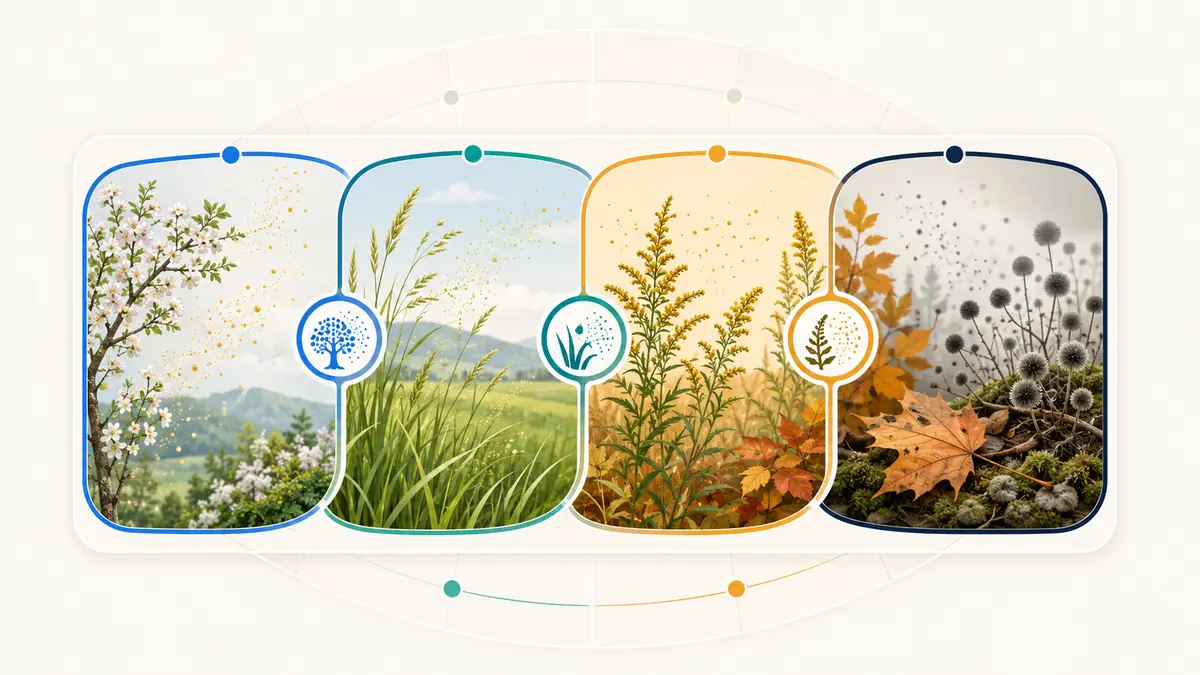
When is allergy season?
Allergy season usually starts with tree pollen in late winter or spring, shifts to grass in late spring and summer, and moves to weeds and ragweed in late summer and fall.
Outdoor mold often spans a longer period, especially during warm, humid weather and around damp leaves. Warm climates may have pollen or mold exposure during most of the year. Your personal symptoms depend on sensitization, exposure, location, weather, and other health factors.
- Tree pollen season
- Late winter through spring
- Grass pollen season
- Late spring through summer
- Ragweed and weed season
- Late summer through fall
- Outdoor mold season
- Spring through fall, sometimes all year
Tree pollen usually starts the outdoor allergy cycle and can begin during winter in mild climates.
Grass commonly overlaps with the end of tree season and often becomes dominant around May and June.
Ragweed commonly runs from August to November and often peaks around mid-September in many U.S. areas.
Warmth, moisture, humidity, decaying leaves, and local climate shape outdoor mold-spore activity.
How to use this seasonal allergy chart
- Start with the monthly chart to identify the allergen groups that commonly circulate during your symptom months.
- Compare the national pattern with the regional table because latitude, frost, elevation, rain, and local plants shift each season.
- Check a local species-specific pollen count or forecast before making daily exposure decisions.
- Record symptoms, location, weather, and exposure. Repeated timing can guide a clinical discussion but cannot prove an allergy.
Monthly allergy seasons chart for pollen and mold
A planning calendar for common outdoor allergens in a temperate U.S. or Northern Hemisphere climate. Local weather, altitude, plant species, and latitude can shift every season.
Swipe horizontally inside the table to view every column.
| Allergen | Jan | Feb | Mar | Apr | May | Jun | Jul | Aug | Sep | Oct | Nov | Dec |
|---|---|---|---|---|---|---|---|---|---|---|---|---|
| Tree pollen | Regional | Building | Peak | Peak | Waning | Usually low | Usually low | Usually low | Usually low | Usually low | Usually low | Regional |
| Grass pollen | Usually low | Usually low | Regional | Building | Peak | Peak | Waning | Regional | Usually low | Usually low | Usually low | Usually low |
| Weed and ragweed pollen | Usually low | Usually low | Usually low | Usually low | Usually low | Regional | Building | Peak | Peak | Waning | Regional | Usually low |
| Outdoor mold spores | Regional | Regional | Building | Building | Building | Building | Peak | Peak | Peak | Peak | Waning | Regional |
Season labels describe typical activity, not a measured pollen count.
- • Tree pollen usually leads the spring season, grass follows in late spring and early summer, and weed pollen dominates late summer and fall.
- • Outdoor mold can remain active for a much longer period than pollen and may occur year-round in warm climates.
- • Use a certified local pollen count or a reputable local forecast for day-to-day decisions.
Download or export
Visual allergy season timeline
The timeline shows the usual sequence of outdoor allergens. Every cell includes a text label, so the chart does not rely on color alone.
Tree pollen
Often the first major outdoor pollen season; timing shifts earlier in warm regions.
Grass pollen
Usually follows tree pollen and can overlap with it in late spring.
Weed and ragweed pollen
The main late-summer and fall pollen group; ragweed often peaks around early fall.
Outdoor mold spores
Increase with warmth and moisture; local peaks differ between warm and cold regions.
Summary: tree pollen usually arrives first, grass follows, weeds and ragweed dominate late summer and fall, and outdoor mold spans the longest period.
Chart sources: AAAAI — Outdoor Allergens; ACAAI — Seasonal Allergies; NIEHS — Pollen.
Check likely allergy triggers by month
Select a month to see the outdoor allergens that commonly matter in a temperate U.S. climate. The result stays in your browser and does not identify a personal allergy.
April allergy outlook
April is often an overlap month: tree pollen remains active while grass pollen starts building.
Likely triggers
- Tree pollen
- Building grass pollen
- Outdoor mold
Planning note: Overlapping allergens can make symptoms feel stronger even when one count is only moderate.
Allergy season timing by outdoor trigger
Use this comparison table to identify when each major allergen group usually starts, peaks, and fades, and which attributes change the timing.
Swipe horizontally inside the table to view every column.
| Trigger | Typical season | Common high-activity period | Examples | Attributes that change timing |
|---|---|---|---|---|
| Tree pollen | Late winter through spring | Often February through May; trees may start in January in the South and continue into May or June in the North | Alder, ash, birch, cedar, elm, juniper, maple, oak, olive, walnut | Latitude, mild winters, tree species, elevation, temperature, and wind |
| Grass pollen | Late spring through summer | Often April through early June; may continue longer in cool regions | Bermuda, fescue, Kentucky blue, orchard, rye, timothy | Climate, rainfall, mowing, grass species, temperature, and humidity |
| Weed and ragweed pollen | Late summer through fall | Ragweed commonly runs from August until the first hard frost | Ragweed, mugwort, pigweed, sagebrush, tumbleweed, Russian thistle | First-frost timing, disturbed land, drought, wind, and local weed species |
| Outdoor mold spores | Spring through fall; sometimes year-round | Often highest in summer and fall; common peaks occur around July in warmer states and October in colder states | Spores from fungi growing on soil, plants, wood, leaves, and other organic material | Heat, humidity, rainfall, leaf decay, drainage, and local climate |
- • Bright, insect-pollinated flowers are usually less important for airborne pollen allergy than wind-pollinated trees, grasses, and weeds.
- • An individual reacts only to allergens to which they are sensitized; a high count does not affect everyone equally.
Download or export
Why allergy season dates vary
Plants release pollen according to species and local growing conditions. Temperature, daylight, rainfall, wind, frost, elevation, and latitude all influence when pollen enters the air. Climate trends can also lengthen pollen seasons and increase exposure in some areas.
A person in a warm southern climate may encounter tree pollen while a northern location is still frozen. Coastal, mountain, desert, and subtropical areas also follow different patterns. Treat the chart as a baseline, then use local measurements for the final decision.
How allergy seasons shift by climate and region
The same allergen can start weeks or months earlier in a warm climate than in a cold one. These patterns explain why a national calendar cannot replace local counts.
Swipe horizontally inside the table to view every column.
| Climate or location | Likely season shift | Common pattern | Best interpretation rule |
|---|---|---|---|
| Warm southern or mild-winter climate | Earlier start and longer season | Some trees can pollinate in winter; grass and mold may remain active for much of the year | Begin watching local counts before the national spring season starts. |
| Temperate Northeast or Midwest | Distinct spring, summer, and fall waves | Trees lead, grasses follow, then ragweed and other weeds continue until frost | Use frost dates and local plant reports to judge the end of weed season. |
| Cool northern or high-elevation area | Later start and compressed season | Tree and grass peaks may occur later, with a shorter growing season | Do not transfer low-elevation dates directly to mountain or northern locations. |
| West Coast or Mediterranean climate | Regional winter or early-spring tree activity; long mold exposure | Local rain cycles and mild temperatures can create patterns unlike inland regions | Follow local species-specific counts rather than a national average. |
| Tropical or subtropical climate | Less distinct seasons | Grass, mold, and some plant pollens may occur during much of the year | Track rainfall, humidity, and local pollen data instead of relying on four-season labels. |
- • Climate change can alter the start, end, duration, and intensity of pollen seasons over time.
- • Urban planting choices, local vegetation, air movement, and land use also change exposure.
Download or export
Weather effects on pollen, mold, and allergy exposure
Weather changes airborne allergen levels from day to day. This table explains the direction of change without treating weather as a diagnosis.
Swipe horizontally inside the table to view every column.
| Weather condition | Likely pollen effect | Likely mold effect | Practical meaning |
|---|---|---|---|
| Warm, dry, windy day | Often increases airborne pollen movement | Varies by moisture and local spore sources | Outdoor exposure may feel stronger even within the same calendar month. |
| Calm or windless day | Less long-distance pollen movement | Local spores may still be present | A lower wind speed does not guarantee a symptom-free day. |
| Steady rain | Often removes pollen from the air temporarily | Can support later mold growth where moisture persists | Counts may fall during rain but change again after conditions dry. |
| Heat and high humidity | Can support plant growth and prolonged seasons | Often favors mold growth and spore production | People sensitive to mold may have symptoms outside classic pollen peaks. |
| Mild winter or early warming | Can start tree pollination earlier | May extend outdoor mold activity | Past symptom dates may no longer predict the exact start each year. |
| First hard frost | Usually reduces ragweed and many weed pollens | Does not remove every outdoor or indoor mold source | Fall pollen may end while mold-related symptoms continue. |
- • A pollen forecast estimates future conditions; a pollen count measures sampled airborne pollen.
- • Symptoms depend on the allergen type, concentration, exposure time, sensitivity, and other respiratory triggers.
Download or export
Seasonal allergies versus year-round allergy symptoms
Seasonal allergic rhinitis follows periods when specific outdoor pollen or mold levels rise. Perennial allergy symptoms can continue throughout the year because indoor triggers such as dust mites, pet allergens, cockroach particles, rodents, or indoor mold do not follow one short season.
Symptoms outside the expected pollen window do not automatically rule out allergy. They may reflect indoor exposure, an extended local season, infection, irritants, asthma, medicine effects, or nonallergic rhinitis. A healthcare professional can assess the full pattern.
Pattern suggests a seasonal trigger
Symptoms return during similar months, rise with local pollen, worsen outdoors, and improve after the season ends.
Pattern suggests broader evaluation
Symptoms continue all year, occur mainly indoors or at work, or include persistent cough, wheeze, fever, or facial pain.
Pollen count versus pollen forecast
A pollen count reports particles collected from the air at a monitoring site. A pollen forecast estimates future levels from weather, plant cycles, past measurements, and modeling. Both are more useful when they identify the allergen type rather than showing only one combined number.
Check the nearest reliable monitoring location and compare it with your symptom log. A high total count may not affect you if the dominant pollen is not one of your triggers, while a lower count of a strongly relevant allergen may still matter.
Allergy exposure planning chart
Practical actions for preparing before exposure, reducing pollen brought indoors, and recognizing when a calendar is not enough.
Swipe horizontally inside the table to view every column.
| Situation | What to check | Useful action | Limit or safety note |
|---|---|---|---|
| Before a high-pollen day | Local allergen type, count or forecast, wind, planned outdoor time, and personal symptom pattern | Follow the treatment plan provided by a clinician and adjust outdoor plans when feasible. | Do not change prescription timing or dose without professional guidance. |
| After outdoor activity | Time spent outside, clothing, hair, skin, and open windows | Change clothes, shower, wash hair, and avoid transferring pollen to bedding. | Exposure reduction helps but cannot remove all airborne allergens. |
| At home during pollen season | Window position, HVAC filter compatibility, indoor air flow, and visible dampness | Keep windows closed during high counts and use an appropriate high-efficiency HVAC filter if the system supports it. | A filter cannot correct an active moisture or mold problem. |
| When symptoms repeat each year | Start month, end month, likely trigger, location, weather, medicines, and symptom severity | Keep a brief symptom-and-exposure record and discuss testing or a preventive plan with an allergist. | A calendar suggests timing; it cannot identify the exact allergen. |
| When symptoms occur all year | Indoor exposures, damp areas, pets, workplace factors, medicines, infection, and nonallergic triggers | Ask a healthcare professional to evaluate causes beyond seasonal pollen. | Persistent congestion or cough should not automatically be labeled seasonal allergy. |
| When breathing symptoms appear | Wheezing, chest tightness, shortness of breath, rapid worsening, or poor response to a prescribed rescue plan | Follow the asthma or emergency action plan and seek urgent help for severe breathing difficulty. | Seasonal pollen can trigger asthma; a chart is not emergency guidance. |
- • The CDC recommends checking pollen forecasts, limiting outdoor time during high levels, showering after outdoor exposure, changing clothes, and keeping windows closed during pollen season.
- • Mold control starts with correcting moisture because damp materials allow indoor mold growth.
Download or export
When should seasonal allergy symptoms be evaluated?
Arrange medical evaluation when symptoms repeatedly disturb sleep, school, work, exercise, or daily activities; when the current treatment plan does not help; or when you cannot identify whether the problem is allergy, infection, asthma, or another condition.
Seek urgent care for severe breathing symptoms
Severe shortness of breath, blue or gray lips, faintness, rapidly worsening wheeze, throat swelling, or difficulty speaking in full sentences needs urgent assessment. Follow any prescribed asthma or emergency action plan.
Allergy seasons chart frequently asked questions
What months are usually the worst for seasonal allergies?
There is no single worst month everywhere. Tree pollen often peaks in early spring, grass in late spring or early summer, and ragweed in late summer or early fall. Mold may remain active across several seasons.
When does spring allergy season start?
Spring allergy season can start in winter in warm regions. Across much of the United States, tree pollen becomes important from February through April, followed by grass pollen.
When is ragweed season?
Ragweed commonly releases pollen from August until the first hard frost. In many areas, levels are highest around early to mid-September.
Can allergy season last all year?
Yes. Warm climates may support long pollen and mold seasons, and indoor or perennial allergens can cause symptoms outside the main outdoor pollen months.
Why does my allergy season change each year?
Temperature, rainfall, wind, frost timing, plant growth, local species, and climate trends can move the start, peak, and end of a pollen season.
Does rain make pollen allergies better or worse?
Steady rain often lowers airborne pollen temporarily. Counts can change again after rain, and persistent moisture can support mold growth.
Is a pollen count the same as a pollen forecast?
No. A count measures pollen captured from the air, while a forecast estimates future pollen conditions using past data, weather, and other inputs.
How can I identify my seasonal allergy trigger?
Compare symptom timing with local species-specific counts and discuss recurring patterns with an allergist. A calendar cannot confirm sensitization by itself.
Can mold cause seasonal allergy symptoms?
Yes. Outdoor mold spores often rise with warmth, humidity, damp vegetation, and leaf decay. Indoor mold can also cause allergy or irritation when moisture supports growth.
When should seasonal allergy symptoms be medically evaluated?
Seek evaluation when symptoms are persistent, disrupt sleep or daily activities, do not respond to the current plan, or include coughing, wheezing, chest tightness, or shortness of breath.
Sources
The page uses five authoritative references. URLs appear as plain text to keep the source section transparent without adding a large group of outbound links.
1. American Academy of Allergy, Asthma & Immunology (AAAAI)
Outdoor Allergens
General timing for tree, grass, weed, and outdoor mold exposure, plus weather and location effects.
https://www.aaaai.org/tools-for-the-public/conditions-library/allergies/outdoor-allergens-ttr
2. American College of Allergy, Asthma & Immunology (ACAAI)
Seasonal Allergies
Regional season shifts, ragweed timing, weather effects, exposure reduction, and guidance on evaluation.
https://acaai.org/allergies/allergic-conditions/seasonal-allergies/
3. National Institute of Environmental Health Sciences (NIEHS)
Pollen
Common tree, grass, and weed pollen triggers, including the August-to-November ragweed season and its usual September peak.
https://www.niehs.nih.gov/health/topics/agents/allergens/pollen
4. Centers for Disease Control and Prevention (CDC)
Pollen and Your Health
Pollen-related symptoms, practical exposure-reduction steps, and climate-related changes in season length.
https://www.cdc.gov/climate-health/php/effects/pollen-health.html
5. National Institute of Environmental Health Sciences (NIEHS)
Mold
Outdoor mold patterns, warm-season and fall exposure, and the role of damp materials and humidity in indoor mold growth.
https://www.niehs.nih.gov/health/topics/agents/mold