Health & Medical · Veterinary reference
Apoquel Dosing Chart for Dogs by Weight
Find the current Apoquel tablet combination for a dog’s weight, compare the twice-daily and once-daily treatment phases, and review age limits, missed-dose steps, side effects, storage, and veterinary monitoring.
Apoquel is a prescription veterinary medicine. Use this page only to understand a veterinarian’s instructions. Never start, increase, extend, share, or restart the medicine from an online chart. Compare every result with the dispensing label and read the ChartsLoom Disclaimer.
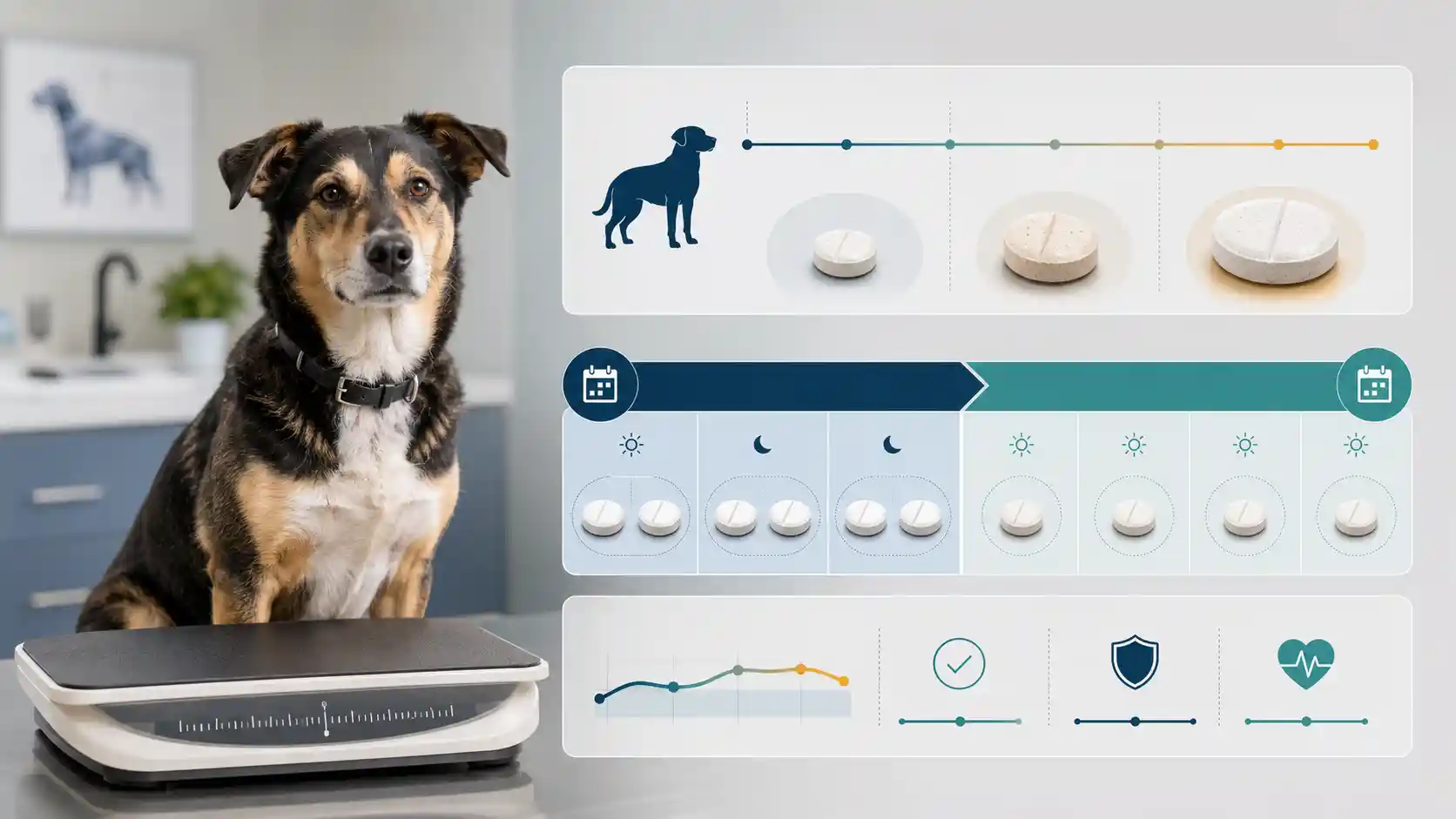
What is the standard Apoquel dosage for dogs?
The labeled Apoquel dose is 0.4–0.6 mg/kg, or 0.18–0.27 mg/lb, by mouth per dose. It is given twice daily for up to 14 days, then once daily for maintenance.
Apoquel contains oclacitinib, a Janus kinase inhibitor that reduces itch- and inflammation-related signaling. The U.S. indication covers pruritus associated with allergic dermatitis and control of atopic dermatitis in dogs at least 12 months old. A veterinarian must confirm the diagnosis, weight, tablet strength, duration, and safety of treatment.
- Labeled amount per dose
- 0.4–0.6 mg/kg
- Initial schedule
- Twice daily for up to 14 days
- Maintenance schedule
- Once daily after the initial phase
- Labeled age
- Dogs at least 12 months old
This equals 0.18–0.27 mg per pound of current body weight for each prescribed dose.
The short initial phase is usually spaced about 12 hours apart and must not be extended independently.
The frequency falls to once daily while the per-dose tablet combination normally remains weight based.
The canine dosing chart does not apply to puppies under one year, cats, people, or other species.
How to use the Apoquel dosing chart safely
- 1. Confirm the dog is at least 12 months old. The label does not cover younger dogs.
- 2. Use a current measured weight. A growing, losing, or gaining dog may move into a different tablet range.
- 3. Match the exact strength. Apoquel comes in 3.6 mg, 5.4 mg, and 16 mg tablets; the same number of tablets can deliver very different doses.
- 4. Separate amount from frequency. The chart shows one dose. The prescription determines whether it is given twice daily or once daily.
- 5. Check the veterinary label. Call the clinic before giving a dose if the chart, bottle, refill, or prior instructions do not agree.
Apoquel dosing schedule: initial and maintenance phases
The labeled per-dose amount stays within 0.4–0.6 mg/kg. The frequency changes after the short initial phase; the tablet amount does not automatically change.
Swipe horizontally inside the table to view every column.
| Treatment phase | Amount per dose | Frequency | Typical duration | Main instruction |
|---|---|---|---|---|
| Initial itch-control phase | 0.4–0.6 mg/kg (0.18–0.27 mg/lb) | Twice daily, ideally about 12 hours apart — Short initial frequency | Up to 14 days | Use only for the number of days prescribed by the veterinarian. |
| Maintenance phase | 0.4–0.6 mg/kg (0.18–0.27 mg/lb) | Once daily — Maintenance frequency | After the initial phase, as prescribed | Do not continue twice-daily dosing beyond 14 days unless a veterinarian gives a different, legally valid direction. |
| Stopping treatment | No taper is required by the manufacturer | Stop on the veterinarian’s instruction | Depends on the treatment plan | Itch may return if the underlying allergy remains active, so reassessment may be needed. |
Dose units: milligrams of oclacitinib per kilogram or pound of body weight, per dose.
- • Apoquel is a prescription veterinary medicine. This schedule summarizes the U.S. label and does not replace the directions on the dispensed label.
- • The labeled indication applies to dogs at least 12 months of age.
Download or export
Visual Apoquel dosing timeline
The labeled plan uses a short twice-daily phase followed by once-daily maintenance. The veterinarian decides the exact start date, stop date, and tablet combination.
Up to 14 days
0.4–0.6 mg/kg per dose, twice daily
Give the prescribed tablet combination about every 12 hours. Do not extend twice-daily dosing beyond the instructed period without veterinary direction.
Day 15 onward
0.4–0.6 mg/kg per dose, once daily
Continue only as prescribed. The per-dose tablet amount usually stays weight based even though the frequency decreases.
Chart sources: Zoetis dosing guide and AAHA allergic skin disease guidance.
Apoquel dosing chart for dogs by weight
Use the dog’s current measured weight to locate the manufacturer’s tablet combination. Each row shows one dose; the veterinarian determines whether that dose is given twice daily or once daily.
Swipe horizontally inside the table to view every column.
| Dog weight | Approximate metric weight | 3.6 mg tablets | 5.4 mg tablets | 16 mg tablets | Total oclacitinib per dose |
|---|---|---|---|---|---|
| 6.6–9.9 lb | about 3.0–4.5 kg | ½ tablet | — | — | 1.8 mg |
| 10.0–14.9 lb | about 4.5–6.8 kg | — | ½ tablet | — | 2.7 mg |
| 15.0–19.9 lb | about 6.8–9.0 kg | 1 tablet | — | — | 3.6 mg |
| 20.0–29.9 lb | about 9.1–13.6 kg | — | 1 tablet | — | 5.4 mg |
| 30.0–44.9 lb | about 13.6–20.4 kg | — | — | ½ tablet | 8 mg |
| 45.0–53.9 lb | about 20.4–24.4 kg | ½ tablet | — | ½ tablet | 9.8 mg |
| 54.0–59.9 lb | about 24.5–27.2 kg | — | ½ tablet | ½ tablet | 10.7 mg |
| 60.0–89.9 lb | about 27.2–40.8 kg | — | — | 1 tablet | 16 mg |
| 90.0–129.9 lb | about 40.8–58.9 kg | — | — | 1½ tablets | 24 mg |
| 130.0–175.9 lb | about 59.0–79.8 kg | — | — | 2 tablets | 32 mg |
The metric ranges are approximate pound-to-kilogram conversions. Tablet selections follow the current manufacturer dosing guide.
- • Do not estimate a dose between rows or combine strengths differently unless the prescribing veterinarian directs it.
- • Dogs below 6.6 lb, above 175.9 lb, under 12 months old, or outside the label’s standard use require direct veterinary instructions.
- • The standard tablet and chewable tablet use the same labeled weight chart, but flavored chewables require secure storage.
Download or export
Apoquel weight-range dose lookup
Enter a dog’s current weight and age to locate the matching row in the manufacturer chart. The tool does not calculate an off-label dose, change a prescription, or transmit the values anywhere.
Initial phase
½ of one 16 mg tablet per dose
- Matched weight range
- 30.0–44.9 lb
- about 13.6–20.4 kg
- Total per dose
- 8 mg
- oclacitinib
- Label schedule
- Twice daily for the veterinarian-directed initial period, up to 14 days
Prescription check: Compare this lookup with the veterinary dispensing label. If they differ, do not guess which one to follow—call the prescribing clinic.
Apoquel tablet strengths and common label combinations
Apoquel tablets and chewable tablets are supplied in 3.6 mg, 5.4 mg, and 16 mg strengths. The scored tablets support the half-tablet combinations shown in the official chart.
Swipe horizontally inside the table to view every column.
| Tablet strength | Whole-tablet amount | Half-tablet amount | Where it appears in the weight chart | Handling point |
|---|---|---|---|---|
| 3.6 mg | 3.6 mg | 1.8 mg | Used alone for 6.6–9.9 lb and 15.0–19.9 lb; combined with ½ of 16 mg for 45.0–53.9 lb | Split only as directed and keep unused portions away from pets and children. |
| 5.4 mg | 5.4 mg | 2.7 mg | Used alone for 10.0–14.9 lb and 20.0–29.9 lb; combined with ½ of 16 mg for 54.0–59.9 lb | Confirm that the dispensed strength matches the prescription before dosing. |
| 16 mg | 16 mg | 8 mg | Used from 30.0 lb upward, either alone or in label combinations | The 16 mg tablet may be prescribed as ½, 1, 1½, or 2 tablets per dose. |
Strength means the amount of oclacitinib in one whole tablet.
- • Do not substitute a different strength by visual size alone. Read the pharmacy label and tablet strength every time.
Download or export
How to give Apoquel safely
These practical steps help owners follow the prescription accurately. The dispensed veterinary label always takes priority over a general chart.
Swipe horizontally inside the table to view every column.
| Situation | What to do | What to avoid | Why it matters |
|---|---|---|---|
| With or without food | Give the tablet with or without food. Use food if an empty-stomach dose causes stomach upset. | Do not hide a missed dose inside an extra meal and then repeat it later. | Consistent administration improves adherence and helps separate medication effects from feeding changes. |
| Twice-daily phase | Use the prescribed tablet combination about every 12 hours for no more than the instructed initial period. | Do not keep using twice-daily dosing past 14 days on your own. | The label limits the twice-daily phase to reduce unnecessary exposure. |
| Once-daily phase | Give the same prescribed per-dose tablet amount once each day at a consistent time. | Do not halve the prescribed dose merely because the frequency changed. | The schedule changes from twice daily to once daily; the labeled per-dose amount remains weight based. |
| Missed dose | Give it when remembered unless the next dose is close; then skip the missed dose and resume the regular schedule. | Never give two doses at once. | Doubling can increase adverse-effect and overdose risk. |
| Vomiting after a dose | Contact the veterinary clinic for instructions, especially if vomiting repeats or other signs appear. | Do not automatically redose because the absorbed amount is unknown. | The safest next step depends on timing, symptoms, and the individual dog. |
| Storage | Keep tablets in original packaging inside a secured cabinet that pets cannot access. | Do not leave flavored chewables on a counter, in a bag, or near pet food. | Chewable tablets can attract dogs and cats and have caused accidental overdoses. |
Administration guidance is general; follow the prescription label and veterinary instructions.
- • Apoquel may be discontinued without tapering, but the veterinarian should decide when to stop or reassess treatment.
Download or export
What Apoquel treats—and what it does not treat
Apoquel controls itching associated with allergic dermatitis and helps manage atopic dermatitis. It can reduce the itch signal quickly, but it does not identify the allergen, remove fleas, kill mites, cure a food allergy, or treat a bacterial or yeast infection.
What it can control
- • Pruritus, meaning the sensation that causes scratching, licking, chewing, and rubbing
- • Inflammation linked to allergic and atopic dermatitis
- • Acute itch flares and, when appropriate, long-term symptom management
What still needs diagnosis or treatment
- • Flea infestation, mites, bacterial pyoderma, yeast dermatitis, and ear infection
- • Food allergy, contact reaction, environmental allergen exposure, and other skin disease
- • New masses, systemic illness, or a reason the expected itch response has not occurred
Direct answer: Apoquel is an itch-control medicine, not a complete allergy diagnosis. A dog that remains itchy needs reassessment rather than an owner-adjusted dose.
Apoquel eligibility and safety screening chart
A dog’s age, infection status, cancer history, reproductive status, and other medicines can change whether Apoquel is appropriate.
Swipe horizontally inside the table to view every column.
| Dog or treatment factor | Label or guideline position | Required action before use |
|---|---|---|
| Younger than 12 months | Not for use under the labeled indication | Ask the veterinarian about another approach; do not use a household supply from an older dog. |
| Serious active infection | Do not use | Treat or evaluate the infection and let the veterinarian reassess itch control. |
| Recurrent serious infection or demodicosis | Requires a careful risk–benefit decision | Share the full infection and parasite history before the first dose. |
| Current cancer, previous cancer, or new unexplained mass | May exacerbate neoplastic conditions; new neoplasms have been observed and reported | Discuss the history and examine new lumps before starting or continuing treatment. |
| Breeding, pregnant, or lactating dog | Not for use; safety has not been established | Use only an alternative plan selected by the veterinarian. |
| Glucocorticoid, cyclosporine, or another systemic immunosuppressive drug | Long-term combination safety has not been established | Provide a complete medication list and never combine therapies without veterinary direction. |
| Cat or another species | Apoquel is not approved for cats and the canine chart does not apply | Do not use dog dosing data for another species. |
This table is a screening aid, not a diagnosis or prescribing decision.
- • Apoquel modulates the immune system and may increase susceptibility to infection.
- • The veterinarian may need to investigate fleas, mites, bacterial or yeast infection, food allergy, and environmental allergy before or during treatment.
Download or export
Apoquel side effects and response chart
Reported signs range from temporary stomach upset to infections, neurologic signs, and new masses. The seriousness depends on the dog, duration, and associated findings.
Swipe horizontally inside the table to view every column.
| Observed sign or change | Possible concern | Recommended response |
|---|---|---|
| Single mild episode of vomiting or soft stool | Possible gastrointestinal adverse effect | Monitor closely and contact the clinic if it repeats, worsens, or affects eating and drinking. |
| Repeated vomiting, diarrhea, poor appetite, or marked lethargy | Medication reaction, illness, dehydration, or infection | Call the veterinarian promptly for individualized instructions. |
| Skin, ear, urinary, respiratory, or other infection signs | Apoquel may increase susceptibility to infection | Arrange veterinary evaluation; itch medicine does not treat the infection itself. |
| New lump, wart-like growth, enlarged lymph node, or changing mass | Benign or malignant neoplastic conditions have been reported | Book an examination rather than waiting for the next routine visit. |
| Fever, breathing difficulty, collapse, seizure, or severe weakness | Potential serious illness or adverse event | Seek urgent veterinary care. |
| Unexpected increased thirst, balance change, or other unusual behavior | Post-approval adverse events include several systemic and neurologic signs | Contact the veterinarian and report the timing relative to each dose. |
The table does not establish that Apoquel caused a sign; it identifies changes that deserve monitoring or veterinary review.
- • Do not stop, restart, or change the dose solely from an online symptom list unless an emergency professional directs immediate action.
Download or export
Infection and neoplasia warnings need context
Apoquel modulates immune signaling. The FDA labeling warns that it may increase susceptibility to infection, including demodicosis, and may exacerbate neoplastic conditions. New benign and malignant neoplasms have been observed in clinical studies and reported after approval.
This warning does not mean every treated dog will develop cancer. It means the veterinarian should weigh benefits and risks in dogs with recurrent serious infections, recurrent demodicosis, current or previous neoplasia, or a new unexplained mass.
Apoquel monitoring and veterinary recheck chart
Monitoring checks whether itch improves, whether the underlying allergic disease is controlled, and whether infections or other safety concerns appear.
Swipe horizontally inside the table to view every column.
| Time point | What the owner can track | What the veterinary team may assess | Reason for review |
|---|---|---|---|
| Before the first dose | Current weight, age, itch severity, skin changes, all medicines and supplements | Skin and ear examination, infection and parasite evaluation, cancer and medical history | Confirms that the dog fits the labeled use and identifies problems that Apoquel will not treat. |
| During the first 14 days | Dose times, scratching, licking, sleep, stomach signs, appetite, energy | Response to twice-daily treatment and any emerging adverse effects | Determines whether the initial plan is effective and tolerated. |
| At the switch to once daily | Whether itch returns between doses or after the schedule change | Need for maintenance therapy, additional diagnostics, or treatment of secondary infection | The frequency change can reveal incomplete control of the underlying disease. |
| During long-term use | Recurrent flares, infections, new masses, weight change, refill timing | Periodic examination and laboratory testing when clinically indicated | Long-term allergic disease usually needs more than symptom suppression alone. |
| Any sudden deterioration | Exact dose, time given, new signs, possible extra tablets eaten | Urgent examination, poison consultation, or adverse-event reporting | Rapid information improves overdose and emergency decisions. |
The veterinarian sets the recheck and laboratory schedule for the individual dog.
- • A stable daily dose does not eliminate the need to reassess recurrent itch, infection, flea control, food exposure, or environmental triggers.
Download or export
Does seasonal itching change the Apoquel dose?
Seasonal symptoms do not create a separate Apoquel dose. The labeled tablet amount still depends on body weight, while the veterinarian decides whether a short flare plan, maintenance treatment, environmental management, testing, or another therapy fits the dog.
Pollen and mold patterns can help explain why scratching returns during certain months. Review the general allergy seasons chart by month and trigger for environmental timing, but remember that it describes broad outdoor patterns and cannot diagnose a dog’s allergen.
A complete canine allergy plan may include flea control, skin and ear cytology, treatment of secondary infections, a strict elimination diet trial, environmental management, allergen-specific immunotherapy, or another prescription therapy. Apoquel can control symptoms while that work continues.
What to do after an accidental Apoquel overdose
Call a veterinarian or emergency animal hospital immediately. Do not wait for symptoms and do not induce vomiting unless a veterinary professional instructs you.
Flavored Apoquel Chewable tablets can attract dogs and cats. An overdose may cause vomiting, diarrhea, lethargy, eye redness or swelling, and effects involving the heart, brain, kidneys, or liver. Cats may develop particularly serious effects.
Have these details ready
- The animal’s current weight and species
- Tablet or chewable strength
- Estimated number of tablets eaten
- Likely time of ingestion and current signs
Apoquel dosing questions and direct answers
What is the standard Apoquel dose for dogs?
The labeled dose is 0.4–0.6 mg/kg, or 0.18–0.27 mg/lb, by mouth per dose. It is usually given twice daily for up to 14 days and then once daily for maintenance, exactly as prescribed by a veterinarian.
How many Apoquel tablets should a dog take?
The number depends on the dog’s current weight and the dispensed tablet strength. The official chart uses 3.6 mg, 5.4 mg, and 16 mg tablets in whole- or half-tablet combinations. Do not calculate a new combination without the prescribing veterinarian.
Does the Apoquel dose change after 14 days?
The labeled frequency changes from twice daily to once daily after the initial phase. The per-dose tablet amount normally stays based on the same 0.4–0.6 mg/kg range unless the veterinarian changes the prescription.
Can Apoquel be given with food?
Yes. Apoquel may be given with or without food. If the dog develops stomach upset after an empty-stomach dose, a veterinarian may recommend giving future doses with food.
What should I do if I miss an Apoquel dose?
Give the missed dose when remembered unless it is almost time for the next scheduled dose. In that case, skip it and resume the normal schedule. Never give two doses at once.
Can puppies take Apoquel?
The U.S. label states that Apoquel is not for dogs younger than 12 months. A puppy with severe itching needs veterinary diagnosis and an age-appropriate treatment plan.
Can cats take Apoquel using the dog dosing chart?
No. Apoquel is not FDA-approved for cats, and the canine weight chart must not be used to dose a cat. Cats can develop serious effects after accidental ingestion, especially from flavored chewables.
Can a dog stay on Apoquel long term?
Apoquel is used for long-term management in some dogs, but continued use requires veterinary oversight. The plan should account for infections, cancer history, recurring flares, other medicines, and the underlying allergy diagnosis.
Does Apoquel need to be tapered?
The manufacturer states that Apoquel may be discontinued without tapering. Itching may return when treatment stops, so owners should follow the veterinarian’s plan rather than stopping and restarting it independently.
What happens if a dog eats too many Apoquel chewables?
An Apoquel Chewable overdose can be life-threatening. Contact a veterinarian or emergency animal hospital immediately, even if the dog looks normal. Keep the package and report the dog’s weight, amount eaten, and likely time of ingestion.
Why is my dog still itchy while taking Apoquel?
Persistent itch can reflect an untreated skin or ear infection, fleas or mites, food allergy, environmental exposure, an incorrect diagnosis, missed doses, or insufficient response. A veterinary recheck is more useful than increasing the dose at home.
Is Apoquel a steroid?
No. Oclacitinib is a Janus kinase inhibitor that reduces signaling from itch- and inflammation-related cytokines. It still modulates immune pathways, so it has important infection and neoplasia warnings.
Sources
This page uses five veterinary and regulatory sources. External links open the original material so readers can verify the dosing table, label warnings, clinical context, missed-dose guidance, and overdose precautions.
Zoetis
How to Dose Apoquel: Tablet and Chewable Tablet Dosing GuideManufacturer dosing table, tablet strengths, administration schedule, and safety information.
U.S. Food and Drug Administration
Apoquel Safety-Related Labeling ChangesFDA summary of immune-system, infection, neoplasia, and post-approval safety warnings.
U.S. Food and Drug Administration
Preventing Accidental Apoquel Chewable OverdosesCurrent storage, overdose signs, and urgent-response guidance for flavored chewable tablets.
American Animal Hospital Association
2023 Management of Allergic Skin Diseases in Dogs and Cats GuidelinesClinical context for oclacitinib in acute flares and long-term allergic skin disease management.
VCA Animal Hospitals
Oclacitinib: Administration, Missed Doses, Side Effects, and Risk FactorsVeterinary client guidance for giving tablets, missed doses, monitoring, and when to contact a veterinarian.
Apoquel is a registered trademark of Zoetis. ChartsLoom is an independent reference site and is not affiliated with or endorsed by the manufacturer.