Science & Chemistry
Atomic Radius Chart
Compare atomic-size definitions, representative covalent-radius values, periodic trends, ionic-size rules, units, exceptions, and the reasons different radius tables can disagree.
Atomic radius is not one universal physical edge. Covalent, non-bonded, metallic, ionic, and theoretical radii answer different questions, so exact values should only be compared within a consistent definition and dataset.
What does an atomic radius chart show?
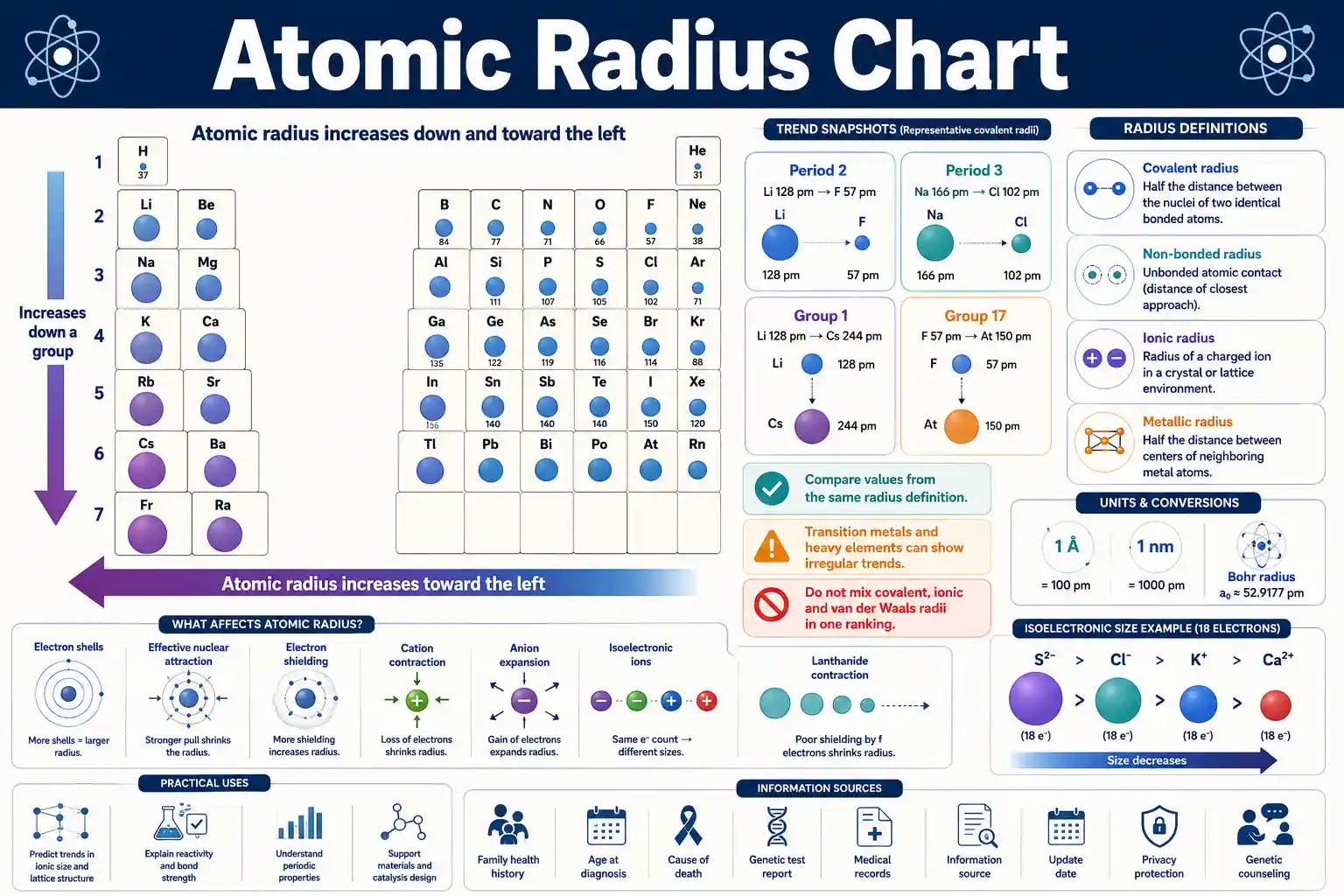
An atomic radius chart shows how effective atomic size changes across the periodic table. For a defensible numerical chart, first choose a radius convention. This page uses the crystallography-derived Cordero covalent-radius set for its representative element values, while separate sections explain other radius types. The Royal Society of Chemistry also presents atomic radius as a periodic trend and defines covalent and non-bonded radii separately on its element pages. Explore the RSC periodic trend.
Broad trend
Larger down + left
Comparable neutral-atom radii generally increase down a group and decrease from left to right across a period.
No hard boundary
Radius is operational
Electron density fades gradually, so chemists infer atomic size from bonds, contacts, crystal structures, or models.
Common unit
pm or Å
One ångström equals 100 picometres. A radius of 128 pm equals 1.28 Å.
Best practice
Compare like with like
Keep covalent, ionic, metallic, calculated, and non-bonded radius systems separate unless a source explicitly relates them.
Atomic radius answers at a glance
These short answers cover the most common periodic-trend, unit, and definition questions.
Which way does atomic radius increase?
Atomic radius generally increases down a group and toward the left across a period when comparable neutral-atom definitions are used.
Why does atomic radius decrease across a period?
Effective nuclear attraction generally increases across a period while added electrons occupy the same principal shell, pulling the electron distribution inward.
Why does atomic radius increase down a group?
Each new period adds a higher principal electron shell, and additional shielding lets the outer electron distribution extend farther from the nucleus.
Is atomic radius a directly measured edge?
No. Atoms have diffuse electron density, so radius values are inferred using defined bonding, contact, crystal, or theoretical conventions.
What is covalent radius?
Covalent radius is an effective atomic size derived from internuclear distances in covalent bonds.
What is a non-bonded radius?
A non-bonded radius describes effective atomic size from close contacts where the atoms are not covalently bonded.
Are cations smaller than their atoms?
Cations are usually smaller than the corresponding neutral atom because electron loss reduces repulsion and can remove an outer shell.
Are anions larger than their atoms?
Anions are usually larger than the corresponding neutral atom because added electrons increase electron-electron repulsion.
How do isoelectronic species rank by radius?
Among isoelectronic species, more protons generally means a smaller radius because the same electron count feels stronger nuclear attraction.
How many picometres are in one ångström?
One ångström equals exactly 100 picometres.
Is the Bohr radius the same as atomic radius?
No. The Bohr radius is a fundamental atomic unit of length, about 52.9177 pm, not a universal measured radius for every element.
Why do atomic radius tables disagree?
Tables can disagree because they use different radius definitions, structural datasets, bond orders, coordination states, or theoretical models.
Atomic Radius Definitions Compared
Atomic radius is an operational size measure. The correct value depends on how the atoms are interacting and how the distance was derived.
Swipe horizontally inside the table to view every column.
| Radius type | How it is defined or inferred | Best use | Key limitation |
|---|---|---|---|
| Covalent radius | About half an internuclear distance for covalently bonded atoms; modern sets use many structures | Bond lengths and molecular structure | Depends on bond order, coordination, oxidation state, and dataset |
| Non-bonded radius | About half the distance between non-bonded atoms at an equilibrium contact | Comparing non-bonded atomic size | Method and chemical environment affect the contact distance |
| van der Waals radius | Effective contact radius for atoms interacting without a covalent bond | Packing, steric contacts, molecular models | Different parameter sets use different criteria and data |
| Metallic radius | Commonly related to half a nearest-neighbour distance in a metallic structure | Metal crystals and metallic bonding | Crystal structure and coordination matter |
| Ionic radius | Effective size assigned to an ion in a crystal environment | Ionic solids and coordination chemistry | Charge, coordination number, and spin state can change the value |
| Bohr radius | Fundamental atomic unit of length: about 52.9177 pm | Atomic-unit calculations and hydrogenic theory | It is a physical constant, not a universal measured radius for every atom |
1 Å = 100 pm. Atomic-radius tables should state the radius definition before values are compared.
- • Do not combine covalent, non-bonded, metallic, and ionic radii in one ranking as if they measure the same thing.
- • Atoms have diffuse electron distributions, not hard spherical surfaces.
Download or export
Why the radius definition changes the number
An atom does not end at a sharp spherical boundary. Its electron density extends outward continuously, so chemists infer a useful radius from a measurable situation such as a covalent bond, a non-bonded contact, or a crystal lattice.
The RSC defines a non-bonded atomic radius as half the distance between two unbonded atoms of the same element when electrostatic forces are balanced, while its covalent radius is based on bonded atoms. That distinction is why two legitimate tables can assign different values to the same element.
The Cordero covalent-radius study compiled crystallographic data for most elements through atomic number 96 and was designed to produce a consistent periodic set. Read the covalent-radius study.
Period 2 Covalent Radius Chart
The Cordero covalent-radius set shows the strong left-to-right contraction across period 2, with noble-gas values treated as interpolated estimates in that dataset.
Swipe horizontally inside the table to view every column.
| Element | Symbol | Atomic number | Covalent radius (pm) | Trend note |
|---|---|---|---|---|
| Lithium | Li | 3 | 128 | Largest in this period subset |
| Beryllium | Be | 4 | 96 | Sharp contraction from Li |
| Boron | B | 5 | 84 | Radius decreases |
| Carbon | C | 6 | 76 | Radius decreases |
| Nitrogen | N | 7 | 71 | Radius decreases |
| Oxygen | O | 8 | 66 | Radius decreases |
| Fluorine | F | 9 | 57 | Small covalent radius |
| Neon | Ne | 10 | 58 | Interpolated covalent-radius value in the Cordero set |
Picometres (pm), Cordero et al. covalent radii.
- • Across a period, electrons enter the same principal shell while effective nuclear attraction generally rises.
- • Noble gases are especially sensitive to which radius definition is used.
Download or export
Period 3 Covalent Radius Chart
Period 3 repeats the broad contraction from the alkali metal toward the right side of the periodic table.
Swipe horizontally inside the table to view every column.
| Element | Symbol | Atomic number | Covalent radius (pm) | Trend note |
|---|---|---|---|---|
| Sodium | Na | 11 | 166 | Large radius at the start of period 3 |
| Magnesium | Mg | 12 | 141 | Contracts from Na |
| Aluminium | Al | 13 | 121 | Contracts further |
| Silicon | Si | 14 | 111 | Continues general decrease |
| Phosphorus | P | 15 | 107 | Slightly smaller |
| Sulfur | S | 16 | 105 | Slightly smaller |
| Chlorine | Cl | 17 | 102 | Small covalent radius |
| Argon | Ar | 18 | 106 | Interpolated covalent-radius value in the Cordero set |
Picometres (pm), Cordero et al. covalent radii.
- • The periodic trend is a general pattern rather than a rule that every radius dataset follows monotonically.
- • Compare values from the same radius definition and source.
Download or export
Why atomic radius generally decreases across a period
Across the main-group portions of a period, each element adds a proton and an electron while the valence electrons remain in the same principal shell. Shielding does not rise enough to cancel the increasing nuclear charge, so the outer electron distribution generally contracts.
This rule describes a broad pattern. Transition metals, noble-gas radius conventions, and detailed structural datasets can produce plateaus or local reversals.
Group 1 Covalent Radius Trend
Covalent radius grows strongly down group 1 as each new period introduces a higher principal electron shell.
Swipe horizontally inside the table to view every column.
| Element | Symbol | Period | Covalent radius (pm) | Change from previous listed element |
|---|---|---|---|---|
| Hydrogen | H | 1 | 31 | Reference starting point; chemically unusual in group 1 |
| Lithium | Li | 2 | 128 | +97 pm |
| Sodium | Na | 3 | 166 | +38 pm |
| Potassium | K | 4 | 203 | +37 pm |
| Rubidium | Rb | 5 | 220 | +17 pm |
| Caesium | Cs | 6 | 244 | +24 pm |
Picometres (pm), Cordero et al. covalent radii.
- • Hydrogen is listed for completeness but does not behave like an alkali metal under ordinary conditions.
- • The increase down a group reflects added shells plus shielding, with detailed values shaped by electronic structure.
Download or export
Group 17 Covalent Radius Trend
The halogens show the expected increase in covalent radius as the principal shell number rises down the group.
Swipe horizontally inside the table to view every column.
| Element | Symbol | Period | Covalent radius (pm) | Trend |
|---|---|---|---|---|
| Fluorine | F | 2 | 57 | Smallest listed halogen |
| Chlorine | Cl | 3 | 102 | Larger than F |
| Bromine | Br | 4 | 120 | Larger than Cl |
| Iodine | I | 5 | 139 | Larger than Br |
| Astatine | At | 6 | 150 | Large heavy-halogen covalent radius |
Picometres (pm), Cordero et al. covalent radii.
- • Heavier elements can show relativistic and contraction effects that make detailed trends less simple than shell counting alone.
- • Use the same radius definition when comparing group trends.
Download or export
Why atomic radius generally increases down a group
Moving down a group adds a new principal shell. Although nuclear charge also rises, added inner electrons shield the outer electrons and the valence shell occupies a region farther from the nucleus. That shell effect dominates the broad group trend.
The increase is not uniform. d- and f-electron shielding, lanthanide contraction, and relativistic effects alter the detailed size pattern for heavier elements.
Selected Period 4 Transition-Metal Covalent Radii
Transition-metal radii change more gradually and irregularly than the strong s- and p-block contractions taught in introductory periodic trends.
Swipe horizontally inside the table to view every column.
| Element | Symbol | Atomic number | Covalent radius (pm) | Interpretation |
|---|---|---|---|---|
| Scandium | Sc | 21 | 170 | Large early transition-metal radius |
| Titanium | Ti | 22 | 160 | Contracts |
| Vanadium | V | 23 | 153 | Contracts |
| Chromium | Cr | 24 | 139 | Marked contraction in this set |
| Manganese | Mn | 25 | 139 | Similar listed radius to Cr |
| Iron | Fe | 26 | 132 | Smaller mid-series value |
| Cobalt | Co | 27 | 126 | Smaller |
| Nickel | Ni | 28 | 124 | Near the minimum in this subset |
| Copper | Cu | 29 | 132 | Small rebound |
| Zinc | Zn | 30 | 122 | Dataset-specific value; not a simple monotonic series |
Picometres (pm), Cordero et al. covalent radii.
- • d-electron shielding, bonding, oxidation state, spin state, and coordination can affect transition-metal radii.
- • The Cordero study explicitly discusses transition-metal contractions and spin-state differences.
Download or export
Atomic radius comparison explorer
Compare two representative Cordero covalent radii. The tool keeps one radius definition and one unit so the numerical comparison is meaningful.
Atomic Radius vs Ionic Radius Patterns
Ionic size follows useful qualitative rules, but an ionic radius is not interchangeable with a neutral-atom radius.
Swipe horizontally inside the table to view every column.
| Situation | Expected size relation | Why | Important condition |
|---|---|---|---|
| Neutral atom → cation | Cation is usually smaller | Electron loss reduces electron-electron repulsion; loss of an outer shell can shrink size strongly | Magnitude depends on charge and electronic structure |
| Neutral atom → anion | Anion is usually larger | Added electrons increase electron-electron repulsion while nuclear charge is unchanged | Magnitude depends on charge and environment |
| Isoelectronic ions | More protons → smaller ion | The same electron count experiences stronger nuclear attraction | Compare species with the same number of electrons |
| Higher positive charge, same element | Usually smaller radius | Electrons are held more strongly and fewer may remain | Compare the same coordination framework when possible |
| Higher negative charge, same element | Usually larger radius | More electron repulsion expands the electron distribution | Stable oxidation states and crystal environment matter |
| Higher coordination number | Tabulated ionic radius can be larger | The effective radius assigned from crystal geometry changes with coordination | Use one internally consistent ionic-radius table |
| Transition-metal spin state | High-spin ions can be larger than low-spin ions | Different d-electron occupancy changes metal–ligand distances | Relevant only for ions and configurations where spin alternatives exist |
Qualitative comparison. Numerical ionic radii must state ion charge, coordination number, and the radius convention used.
- • Never compare a neutral covalent radius directly with an ionic radius as though both came from the same measurement.
- • Isoelectronic ordering is one of the most reliable qualitative size rules.
Download or export
Atomic radius and ionic radius are different reference systems
A neutral atom changes electron count when it becomes an ion. Cations usually contract and anions usually expand relative to the neutral species, but exact ionic radii also depend on coordination and crystal environment. For an isoelectronic series, the species with more protons is generally smaller.
Use ionic-radius tables for ionic solids and coordination chemistry. Use a neutral-atom covalent or non-bonded dataset for neutral periodic trends.
Atomic Radius Unit Conversion Chart
Atomic sizes are commonly expressed in picometres or ångströms; atomic-unit calculations may use the Bohr radius.
Swipe horizontally inside the table to view every column.
| Quantity | Equivalent | Example | Use |
|---|---|---|---|
| 1 picometre (pm) | 10⁻¹² m | 100 pm = 1.00 × 10⁻¹⁰ m | Common tabulated atomic-size unit |
| 1 ångström (Å) | 10⁻¹⁰ m = 100 pm | 1.28 Å = 128 pm | Common structural-chemistry length unit |
| 1 nanometre (nm) | 10⁻⁹ m = 1000 pm = 10 Å | 0.128 nm = 128 pm | Useful for larger molecular dimensions |
| 1 Bohr radius (a₀) | ≈ 52.9177 pm ≈ 0.529177 Å | 2 a₀ ≈ 105.835 pm | Atomic units and quantum calculations |
| 100 pm | 1 Å | C radius 76 pm ≈ 0.76 Å | Fast classroom conversion |
| 200 pm | 2 Å = 0.2 nm | K radius 203 pm ≈ 2.03 Å | Fast scale comparison |
Length conversions are exact for SI prefixes and ångström definition; the displayed Bohr-radius conversion is rounded.
- • Do not confuse pm with nm: 1 nm equals 1000 pm.
- • A radius value of 128 pm equals 1.28 Å, not 12.8 Å.
Download or export
What is the Bohr radius?
The Bohr radius, a₀, is an atomic fundamental physical constant used as the atomic unit of length. IUPAC gives it as about 5.29177 × 10⁻¹¹ m, or about 52.9177 pm. It is a natural length scale in atomic physics, but it is not the same thing as a tabulated covalent radius for each element. See the IUPAC definition.
Factors That Change or Complicate Atomic Size
Periodic position explains the broad trend, but several physical and chemical factors control the numerical radius reported in a specific dataset.
Swipe horizontally inside the table to view every column.
| Factor | Typical effect | Why it matters | Where it is most visible |
|---|---|---|---|
| Principal shell number | Larger n generally increases size | Outer electrons occupy shells farther from the nucleus | Down groups |
| Effective nuclear charge | Greater attraction generally contracts size | Valence electrons are pulled inward more strongly | Across periods |
| Electron shielding | More shielding favors larger outer-electron extent | Inner electrons reduce the attraction felt by valence electrons | Down groups and inner-shell effects |
| d- and f-electron shielding | Produces contractions and irregular trends | d and especially f electrons shield imperfectly | Transition metals and lanthanides |
| Bond order | Higher bond order can correspond to shorter bond distances | Covalent radius parameterizations can depend on bonding context | Molecules and covalent-radius sets |
| Oxidation state | Higher positive oxidation often shortens metal–ligand distances | Fewer electrons and stronger effective attraction can contract the ion | Transition-metal ions |
| Coordination number | Changes effective ionic and metallic radii | Geometry changes nearest-neighbour distances | Crystals and coordination compounds |
| Spin state | High-spin may be larger than low-spin | Orbital occupancy changes ligand-field bonding distances | Some transition-metal ions |
| Relativistic effects | Can contract or expand particular orbitals | Very heavy nuclei alter electron motion and orbital energies | Heavy elements |
| Radius definition | Can change the numerical value dramatically | Covalent and non-bonded contacts represent different physical situations | All elements, especially noble gases |
Conceptual effects; direction and magnitude can depend on the chosen radius model.
- • Periodic-trend questions usually assume comparable neutral-atom radius definitions.
- • Detailed research comparisons require the exact dataset and chemical environment.
Download or export
Common Atomic Radius Mistakes and Corrections
Most radius errors come from mixing definitions, ignoring ion charge, or treating a periodic trend as an exception-free numerical law.
Swipe horizontally inside the table to view every column.
| Mistake | Why it fails | Better approach | Example |
|---|---|---|---|
| Calling one number the absolute size of an atom | Atoms have diffuse electron density without a hard edge | State the operational radius definition | Say “covalent radius” or “non-bonded radius” |
| Mixing covalent and van der Waals radii | They come from different contact situations | Compare values from one radius system | A noble-gas non-bonded radius should not be ranked against a halogen covalent radius |
| Assuming radius always falls perfectly left to right | d-block and dataset-specific irregularities occur | Use the broad trend, then check actual values | Cu can deviate from a simple monotonic d-block sequence |
| Assuming heavier always means larger | Nuclear attraction and shell structure matter more than mass alone | Use period, group, and electronic structure | Cl is heavier than Na but has a smaller covalent radius |
| Ignoring ion charge | Ions can differ strongly from neutral atoms | Identify the charge before ranking | Na⁺ is much smaller than neutral Na |
| Ranking isoelectronic ions by mass | Same electron count makes nuclear charge decisive | More protons generally means smaller radius | S²⁻ > Cl⁻ > K⁺ > Ca²⁺ |
| Confusing pm and Å | The units differ by a factor of 100 | Use 1 Å = 100 pm | 128 pm = 1.28 Å |
| Treating Bohr radius as each element’s measured radius | a₀ is an atomic unit and physical constant | Use it as a scale or unit, not a universal elemental radius | a₀ ≈ 52.9177 pm |
Use a clearly labeled radius type, unit, charge state, and source for defensible numerical comparisons.
- • Trend questions and numerical lookup questions are different tasks.
- • For exact work, preserve the original source’s radius convention.
Download or export
Atomic Radius Study and Comparison Checklist
Use this sequence before answering a radius-ranking question or copying a numerical value into a calculation.
Swipe horizontally inside the table to view every column.
| Step | Question to ask | Action | Reason |
|---|---|---|---|
| 1 | What species are being compared? | Separate neutral atoms from ions | Charge changes size |
| 2 | What radius type is given? | Keep covalent, non-bonded, metallic, and ionic datasets separate | Definitions are not interchangeable |
| 3 | Are values in the same unit? | Convert Å, pm, and nm before ranking | Prevents factor-of-10 or factor-of-100 errors |
| 4 | Are the elements in one period? | Expect a broad decrease toward the right | Effective nuclear attraction generally rises across a period |
| 5 | Are the elements in one group? | Expect a broad increase downward | Higher principal shells increase size |
| 6 | Are the species isoelectronic? | Rank higher proton count as smaller | Nuclear attraction changes while electron count stays fixed |
| 7 | Is a transition or heavy element involved? | Check the actual data instead of relying only on arrows | d/f contraction and relativistic effects complicate trends |
| 8 | Is an exact number required? | Cite the dataset and chemical context | Different accepted radius tables can disagree |
Workflow for educational and reference use.
- • The periodic trend is strongest as a conceptual guide within comparable datasets.
- • For crystallographic modeling, use the radius convention appropriate to the structure and method.
Download or export
When the simple periodic trend is not enough
Use trend arrows for qualitative introductory questions. Use actual source values when a question involves transition metals, noble gases, heavy elements, ions, bond-order changes, or different coordination environments. The exact radius convention matters as much as the element name.
For advanced molecular or crystal modeling, select the radius parameter set intended for that method rather than copying a generic periodic-table value.
Frequently asked questions
What is atomic radius?
Atomic radius is an operational measure of atomic size. Because an atom has no hard electron-cloud boundary, chemists define radii from bonding distances, non-bonded contacts, metallic structures, or other models.
Does atomic radius increase or decrease across a period?
Atomic radius generally decreases from left to right across a period when comparable radius definitions are used, because effective nuclear attraction increases while electrons enter the same principal shell.
Why does atomic radius increase down a group?
Atomic radius generally increases down a group because each new period adds a higher principal electron shell and more shielding.
What is covalent radius?
Covalent radius is an effective radius derived from internuclear distances in covalent bonds. Modern datasets commonly combine many structural measurements rather than relying on one molecule.
What is a van der Waals or non-bonded radius?
A non-bonded or van der Waals radius describes the effective size of an atom in close contact without a covalent bond. It is normally larger than a covalent radius for the same element.
Are cations smaller than neutral atoms?
Cations are usually smaller than their neutral atoms because electron removal lowers electron-electron repulsion and can remove the outermost occupied shell.
Are anions larger than neutral atoms?
Anions are usually larger than their neutral atoms because added electrons increase electron-electron repulsion while nuclear charge stays the same.
How do you rank an isoelectronic series by radius?
For species with the same number of electrons, the species with more protons is generally smaller because its electrons experience stronger nuclear attraction.
What unit is used for atomic radius?
Picometres are common for atomic radii. Ångströms are also common, and 1 Å equals exactly 100 pm.
Is the Bohr radius the atomic radius of hydrogen?
The Bohr radius is a fundamental atomic unit of length, about 52.9177 pm. It is not a universal elemental-radius definition and should not replace experimentally derived covalent or non-bonded radii.
Why do different atomic radius charts give different values?
Different charts may use covalent, non-bonded, metallic, calculated, or empirical radii, and each method samples a different physical situation.
Why are noble-gas radii confusing?
Noble gases rarely form ordinary covalent bonds, so covalent-radius datasets may estimate or interpolate values while non-bonded radius tables use intermolecular contacts.
Why are transition-metal radius trends irregular?
Transition-metal radii reflect d-electron shielding, bonding, oxidation state, coordination, and sometimes spin state, so the left-to-right trend is less simple than in the main-group blocks.
What is lanthanide contraction?
Lanthanide contraction is the gradual decrease in size across the lanthanide series caused largely by imperfect shielding by 4f electrons as nuclear charge increases.
Can atomic radius predict bond length?
Covalent radii can help estimate bond distances because many models treat a bond length as approximately the sum of two covalent radii, but bond order and chemical environment can shift the actual distance.
Which direction does atomic radius increase on the periodic table?
The broad classroom trend is toward the lower-left corner: radii usually increase down groups and toward the left across periods.
Related ChartsLoom reference
Review the Amino Acid Chart for a chemistry reference that compares molecular building blocks by standardized codes and chemical properties.
Sources
Royal Society of Chemistry — Periodic Table — Atomic Radius Trend
Provides an interactive periodic-table view of atomic-radius trends and element property data.
https://periodic-table.rsc.org/trends/atomic-radius
Royal Society of Chemistry — Hydrogen — Atomic Data and Radius Definitions
Defines non-bonded atomic radius and covalent radius and reports both as operational measurements rather than a single hard atomic boundary.
https://periodic-table.rsc.org/element/1/hydrogen
Royal Society of Chemistry Publishing — Covalent Radii Revisited — Cordero et al. (2008)
Reports a crystallography-derived covalent-radius set for most elements through atomic number 96 and discusses periodic trends and contractions.
https://doi.org/10.1039/B801115J
International Union of Pure and Applied Chemistry — IUPAC Gold Book — Bohr Radius
Defines the Bohr radius as an atomic fundamental physical constant used as the atomic unit of length.
https://goldbook.iupac.org/terms/view/B00693
International Union of Pure and Applied Chemistry — IUPAC Gold Book — Atomic Units
Gives the atomic unit of length and its relationship to metres and ångströms.
https://goldbook.iupac.org/terms/view/A00504
National Institute of Standards and Technology — SI Units and Prefixes
Supports SI length-unit interpretation, including metre-based submultiples such as picometres.
https://www.nist.gov/pml/owm/si-units-length
International Union of Pure and Applied Chemistry — IUPAC Gold Book — van der Waals Forces
Defines van der Waals forces, relevant to non-bonded atomic-contact distances.
https://goldbook.iupac.org/terms/view/V06597