Animals & Pets · Birds
Bird Species Chart by Taxonomy, Habitat, Shape and Field Marks
Explore global bird orders and representative companion, backyard, water, forest, grassland, tropical, seabird, raptor, owl, parrot, and flightless species. Compare silhouettes, bills, feet, flight adaptations, migration patterns, and practical identification clues.
Do not disturb a bird to confirm an identification. Keep away from nests, colonies, roosts, display grounds, injured birds, and stressed wildlife. Local wildlife authorities or licensed rehabilitators should handle emergencies. Read the ChartsLoom Disclaimer.
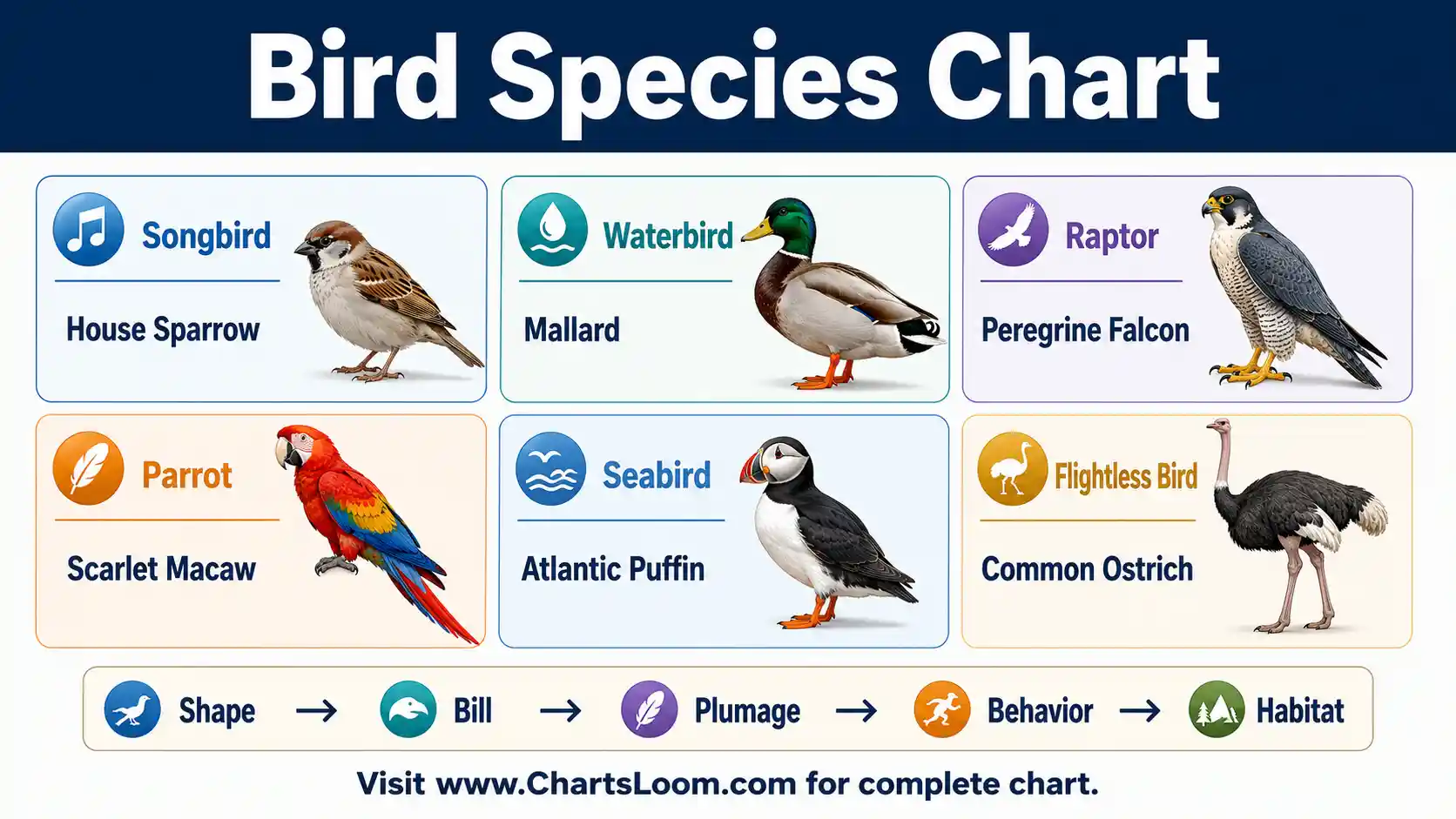
How are bird species organized and identified?
Bird species are organized into taxonomic orders, families, genera, and species. In the field, the fastest reliable approach is to combine size and shape, overall color pattern, behavior, and habitat, then confirm range, season, voice, and detailed field marks.
No single chart can contain every plumage, subspecies, hybrid, domestic form, juvenile, or regional name. Use the tables to narrow the group, record what you actually saw, and verify the result against a current local checklist or field guide.
Published global checklist
11,131 species
AviList v2025b recognizes 46 orders, 252 families, and 2,376 genera.
Largest bird order
Passeriformes
Perching birds account for 6,705 recognized species in AviList v2025b.
Best identification rule
Combine four keys
Use size and shape, color pattern, behavior, and habitat together.
Critical limitation
A chart is not confirmation
Range, season, age, sex, voice, molt, and local look-alikes still matter.
Bird species questions at a glance
These concise answers cover common taxonomy and identification searches. The detailed tables add representative species, examples, interpretation notes, and limitations.
How many bird species are recognized worldwide?
AviList v2025b recognizes 11,131 species in 46 orders and 252 families.
Which bird order has the most species?
Passeriformes is the largest order, with 6,705 recognized species in AviList v2025b.
What should I notice first on an unknown bird?
Start with overall size, body shape, bill, legs, wing proportions, tail, and posture.
Can color alone identify a bird?
No. Light, age, sex, season, molt, wear, wet feathers, and cameras can alter color.
What is a bird field mark?
A field mark is a useful feature such as an eye ring, wing bar, crest, bib, or tail band.
How can I estimate bird size?
Compare it with a familiar nearby bird such as a sparrow, pigeon, crow, duck, or goose.
What does bill shape tell me?
Bill shape suggests feeding mechanics, but most birds use several foods across seasons.
How do I separate a hawk from a falcon?
Many hawks have broader rounded wings; falcons often have long pointed wings and faster flight.
How do I separate a heron from a crane in flight?
Herons usually retract the neck, while cranes usually fly with the neck extended.
Are pigeons and doves separate taxonomic groups?
No. Both names are used within Columbidae and do not define a strict biological division.
Why do bird names and species totals change?
Taxonomy changes when new genetic, vocal, behavioral, geographic, or nomenclatural evidence is assessed.
Can the finder identify a photo or recording?
No. It only filters a representative dataset by traits selected manually by the user.
Global Bird Orders and Species Counts
AviList v2025b is the current published global consensus checklist as of July 2026. It recognizes 11,131 species in 46 orders and 252 families; counts can change when later versions split, lump, add, or rename taxa.
Swipe horizontally inside the table to view every column.
| Order | Recognized species | Families | Major groups | Fast recognition clue |
|---|---|---|---|---|
| Struthioniformes | 2 | 1 | Ostriches | Very large flightless runners with long legs and two-toed feet. |
| Casuariiformes | 4 | 1 | Emu and cassowaries | Large flightless birds with powerful legs; cassowaries have a casque. |
| Apterygiformes | 5 | 1 | Kiwis | Nocturnal, flightless birds with long bills and nostrils near the tip. |
| Rheiformes | 2 | 1 | Rheas | Large South American flightless runners with three-toed feet. |
| Tinamiformes | 46 | 1 | Tinamous | Ground birds with compact bodies and short rounded wings. |
| Anseriformes | 176 | 3 | Ducks, geese, swans and screamers | Webbed feet, broad bodies, and bills adapted for aquatic feeding. |
| Galliformes | 307 | 5 | Pheasants, quail, grouse and allies | Heavy-bodied ground birds with short rounded wings and strong feet. |
| Phoenicopteriformes | 6 | 1 | Flamingos | Long-legged waders with sharply bent filter-feeding bills. |
| Podicipediformes | 22 | 1 | Grebes | Diving waterbirds with lobed toes and legs set far back. |
| Musophagiformes | 23 | 1 | Turacos | African tree birds with crests, long tails, and strong climbing feet. |
| Otidiformes | 26 | 1 | Bustards | Large terrestrial birds of open country with long legs and necks. |
| Cuculiformes | 156 | 1 | Cuckoos, coucals and anis | Long-tailed birds; many have zygodactyl feet and some are brood parasites. |
| Mesitornithiformes | 3 | 1 | Mesites | Ground-dwelling Malagasy birds with long tails and short wings. |
| Pterocliformes | 16 | 1 | Sandgrouse | Desert and steppe birds with pointed wings and rapid direct flight. |
| Columbiformes | 350 | 1 | Pigeons and doves | Plump bodies, small heads, and soft cooing voices. |
| Opisthocomiformes | 1 | 1 | Hoatzin | Leaf-eating tropical bird with a crest and distinctive wing-clawed chicks. |
| Gruiformes | 185 | 6 | Cranes, rails, coots and allies | Diverse marsh and ground birds, often with long toes or legs. |
| Charadriiformes | 392 | 19 | Shorebirds, gulls, terns, auks and allies | Highly varied water-associated birds, from probing waders to oceanic flyers. |
| Eurypygiformes | 2 | 2 | Sunbittern and kagu | Two distinctive terrestrial or waterside species with display plumage. |
| Phaethontiformes | 3 | 1 | Tropicbirds | White oceanic birds with long central tail streamers. |
| Gaviiformes | 5 | 1 | Loons or divers | Large diving birds with spear-like bills and rear-set legs. |
| Sphenisciformes | 19 | 1 | Penguins | Flightless marine swimmers with flipper-like wings. |
| Procellariiformes | 146 | 4 | Albatrosses, petrels and shearwaters | Oceanic tube-nosed birds with long-distance soaring flight. |
| Ciconiiformes | 20 | 1 | Storks | Large long-legged waders with long, heavy, straight bills. |
| Suliformes | 54 | 4 | Cormorants, boobies, frigatebirds and allies | Fish-eating waterbirds, many with webbed feet and diving or aerial hunting. |
| Pelecaniformes | 120 | 5 | Herons, ibises, spoonbills and pelicans | Long-legged or large-billed aquatic birds with varied fishing methods. |
| Caprimulgiformes | 98 | 1 | Nightjars and nighthawks | Camouflaged nocturnal aerial insect eaters with wide mouths. |
| Steatornithiformes | 1 | 1 | Oilbird | Nocturnal cave-nesting fruit eater that uses echolocation. |
| Nyctibiiformes | 7 | 1 | Potoos | Nocturnal sit-and-wait insect eaters with cryptic upright posture. |
| Podargiformes | 16 | 1 | Frogmouths | Broad-billed nocturnal birds with bark-like camouflage. |
| Aegotheliformes | 10 | 1 | Owlet-nightjars | Small nocturnal birds with rounded heads and insect-eating bills. |
| Apodiformes | 472 | 3 | Swifts, treeswifts and hummingbirds | Small aerial specialists with long wings; hummingbirds can hover. |
| Strigiformes | 245 | 2 | Owls | Mostly nocturnal raptors with facial discs and forward-facing eyes. |
| Cathartiformes | 7 | 1 | New World vultures | Large soaring scavengers with broad wings and often bare heads. |
| Accipitriformes | 252 | 3 | Eagles, hawks, kites, osprey and allies | Diurnal raptors with hooked bills and strong grasping talons. |
| Coliiformes | 6 | 1 | Mousebirds | African climbing birds with long tails and flexible outer toes. |
| Leptosomiformes | 1 | 1 | Cuckoo-roller | Large-headed Madagascan forest bird with broad wings. |
| Trogoniformes | 47 | 1 | Trogons and quetzals | Colorful forest birds with short bills and soft plumage. |
| Bucerotiformes | 75 | 3 | Hornbills, hoopoes and wood hoopoes | Long-billed birds; hornbills often have a casque. |
| Coraciiformes | 185 | 6 | Kingfishers, bee-eaters, rollers and allies | Brightly colored sit-and-wait hunters, often with strong pointed bills. |
| Galbuliformes | 55 | 2 | Jacamars and puffbirds | Tropical American perch hunters with long or stout bills. |
| Piciformes | 385 | 7 | Woodpeckers, toucans, barbets and allies | Many have zygodactyl feet; woodpeckers use chisel-like bills. |
| Cariamiformes | 2 | 1 | Seriemas | Long-legged South American ground predators. |
| Falconiformes | 65 | 1 | Falcons and caracaras | Fast diurnal raptors with notched hooked bills. |
| Psittaciformes | 406 | 4 | Parrots and cockatoos | Strong curved bills, zygodactyl feet, and highly mobile tongues. |
| Passeriformes | 6705 — Largest bird order by recognized species | 145 | Perching birds or songbirds | The largest order; feet usually have three toes forward and one back. |
Counts refer to AviList v2025b, not a permanent total for all future taxonomic versions.
- • Taxonomy is evidence-based and changes when new genetic, vocal, behavioral, and geographic evidence is assessed.
- • Common names can vary by region; scientific names and checklist version make comparisons clearer.
- • Extinct and recently extinct taxa may be handled differently across data products, so always state the checklist used.
Download or export
Interactive tool
Bird species trait finder
Filter a representative set of birds by broad region, habitat, size, body group, bill, and behavior. The tool is useful for learning how clues narrow possibilities. It does not analyze a photograph, sound, date, precise location, plumage, age, or sex and cannot confirm a real-world identification.
Choose observed traits
Leave uncertain fields blank. Strong identification comes from several independent clues rather than forcing every field.
Finder result
1 representative match fit every selected trait. Confirm location, season, voice, age, sex, and detailed field marks before identifying a real bird.
Exact dataset matches
Red-vented Bulbul
Pycnonotus cafer
Black head, scaled brown body and red vent.
Nearest examples
Common Bulbul · 3/4 traits
Grey-brown bulbul with dark head and prominent voice.
Common Myna · 3/4 traits
Brown body, black hood and yellow eye patch.
Great Tit · 3/4 traits
Black head, white cheeks and yellow belly with dark stripe.
House Sparrow · 3/4 traits
Brown, compact, thick bill; males often show a black bib.
Purple Sunbird · 3/4 traits
Small curved-billed nectar feeder; male glossy dark in breeding plumage.
American Robin · 2/4 traits
Orange breast, grey-brown back, upright lawn foraging.
Common Sandpiper · 2/4 traits
Tail bobbing and low stiff-winged flight.
Eurasian Magpie · 2/4 traits
Black-and-white with very long iridescent tail.
What it does
Compares selected traits against 72 representative species and ranks exact or nearest examples deterministically.
Why it helps
It demonstrates why habitat and behavior can narrow a list more reliably than color alone.
How to use it
Select only clues you observed, review the candidates, then verify with a local guide, current range, voice, season, and detailed field marks.
Shape before detail
Learn the silhouette before memorizing plumage
A long-legged wader, compact seed eater, broad-winged raptor, climbing woodpecker, and streamlined swallow remain recognizable when color is hidden by distance or poor light. Shape also helps exclude impossible groups quickly.
Bird Shape and Silhouette Identification Chart
Start with overall shape before focusing on small color marks. Body proportions, wing length, tail shape, bill form, leg length, posture, and movement often narrow the group quickly.
Swipe horizontally inside the table to view every column.
| Shape group | Typical families or groups | Key silhouette clues | Common habitats | Typical behavior |
|---|---|---|---|---|
| Tiny hovering birds | Hummingbirds | Very small body, long or specialized bill, rapid wingbeats | Flowers, forest edges, gardens | Hovering, nectar feeding, aerial insects |
| Small upright songbirds | Robins, chats, flycatchers | Compact body, medium tail, alert upright posture | Woodland edges, gardens, scrub | Perching, hopping, short sallies |
| Small cone-billed birds | Finches, sparrows, buntings | Short neck, compact body, thick triangular bill | Grassland, farmland, gardens | Seed feeding, flocking, ground foraging |
| Small climbing birds | Nuthatches, treecreepers | Short legs, strong toes, pointed or curved bill | Tree trunks and branches | Climbing bark, probing crevices |
| Long-tailed perching birds | Magpies, drongos, monarchs | Tail conspicuously longer than body depth | Woodland, open country, towns | Perching, aerial pursuit, display |
| Crow-shaped birds | Crows, ravens, jays | Large head, sturdy bill, strong legs | Many habitats | Walking, problem solving, varied diet |
| Swallow-shaped birds | Swallows, martins | Streamlined body, long pointed wings, small bill | Open air near water or fields | Continuous aerial insect feeding |
| Swift-shaped birds | Swifts, treeswifts | Very long swept wings, tiny feet, short tail or forked tail | Open sky, cliffs, towns | Fast aerial flight, rarely landing on ground |
| Woodpecker-shaped birds | Woodpeckers, piculets | Straight chisel bill, stiff tail, upright trunk posture | Forest, woodland, parks | Climbing and hammering bark |
| Parrot-shaped birds | Parrots, parakeets, cockatoos | Large curved bill, broad head, strong grasping feet | Forest, savanna, urban areas | Climbing, chewing, social calls |
| Pigeon-shaped birds | Pigeons, doves | Plump chest, small head, short bill | Woodland, towns, farmland | Direct flight, ground feeding, cooing |
| Game-bird shape | Quail, pheasants, grouse | Heavy body, small head, short rounded wings | Ground cover, grassland, forest floor | Walking, scratching, explosive takeoff |
| Duck-shaped birds | Ducks, geese, swans | Broad body, webbed feet, flattened or stout bill | Lakes, rivers, coasts | Swimming, dabbling, grazing or diving |
| Grebe and loon shape | Grebes, loons | Low body in water, pointed bill, rear-set legs | Lakes and coasts | Diving and underwater pursuit |
| Long-legged waders | Herons, storks, cranes | Long legs and neck, straight or dagger-like bill | Wetlands, rivers, grasslands | Slow walking, stalking, spearing |
| Shorebird shape | Plovers, sandpipers, stilts | Long or medium legs, compact body, probing or short bill | Mudflats, beaches, wet grass | Running, probing, pecking |
| Gull and tern shape | Gulls, terns, skimmers | Long wings, webbed feet, medium to pointed bill | Coasts, lakes, rivers | Soaring, plunge-diving, surface feeding |
| Tube-nosed seabirds | Albatrosses, petrels, shearwaters | Long narrow wings, hooked bill with external tubes | Open ocean | Dynamic soaring, gliding, surface feeding |
| Raptor shape | Hawks, eagles, falcons | Hooked bill, broad chest, strong talons | Open country, forest, mountains | Soaring, stooping, active pursuit |
| Owl shape | Owls | Large head, facial disc, forward-facing eyes | Forest, grassland, desert, towns | Silent flight, nocturnal hunting |
| Flamingo shape | Flamingos | Very long legs and neck, downward-bent bill | Shallow saline or alkaline wetlands | Filter feeding, wading, flocking |
| Penguin shape | Penguins | Upright body, flipper-like wings, short legs | Southern coasts and ocean | Swimming and diving; flightless |
| Ratite shape | Ostriches, emu, rheas, cassowaries | Very large body, long strong legs, reduced wings | Open country or forest floor | Running; flightless |
| Nightjar shape | Nightjars, potoos, frogmouths | Large eyes, broad mouth, cryptic plumage | Woodland, scrub, open country | Nocturnal insect hunting or sit-and-wait |
Shape names are practical field categories, not formal taxonomic ranks.
- • Size and shape remain useful when light, molt, sex, age, or distance makes color unreliable.
- • Compare the unknown bird with a familiar reference such as sparrow, pigeon, crow, goose, or heron.
- • Use several clues together; convergent evolution can make unrelated birds look similar.
Download or export
Common Companion Bird Species Chart
These frequently kept species differ greatly in adult size, lifespan, noise, social behavior, flight needs, diet, legal status, and veterinary requirements. The table is a species overview, not a care prescription.
Swipe horizontally inside the table to view every column.
| Common name | Scientific name | Broad group | Native range | Typical traits | Critical ownership consideration |
|---|---|---|---|---|---|
| Budgerigar | Melopsittacus undulatus | Small parakeet | Australia | Social, active, highly vocal | Needs flight space, flock interaction, varied diet and enrichment |
| Cockatiel | Nymphicus hollandicus | Small cockatoo | Australia | Crested, gentle, whistles and contact calls | Dusty plumage; needs social time, flight and foraging enrichment |
| Peach-faced Lovebird | Agapornis roseicollis | Small parrot | Southwestern Africa | Compact, energetic, strong pair bonds | Can be territorial; provide space, chewing material and careful introductions |
| Canary | Serinus canaria | Finch | Macaronesian origin; domesticated worldwide | Males are noted for song; agile flier | Best identified and housed by breed, sex and individual social needs |
| Zebra Finch | Taeniopygia guttata | Estrildid finch | Australia | Small, social, rapid calls and hopping flight | Keep socially with room for horizontal flight and multiple feeding points |
| Society Finch | Lonchura striata domestica | Domesticated munia | Domestic form | Calm, social, often used as foster parents | Requires compatible groups, flight space and a balanced finch diet |
| African Grey Parrot | Psittacus erithacus | Large parrot | Central and western Africa | Grey body, red tail, complex vocal learning | Long-lived and cognitively demanding; trade and legal status must be checked |
| Blue-and-yellow Macaw | Ara ararauna | Large macaw | Tropical South America | Blue upperparts, yellow underparts, powerful bill | Requires very large space, durable enrichment and specialist care |
| Green-cheeked Parakeet | Pyrrhura molinae | Small conure | South America | Long tail, dark head, green body with scalloped breast | Active and social; needs flight, chewing and noise-tolerant housing |
| Sun Parakeet | Aratinga solstitialis | Medium conure | Northeastern South America | Bright yellow-orange body with green and blue wings | Very loud; needs social care, large flight space and legal sourcing |
| Rose-ringed Parakeet | Psittacula krameri | Medium parakeet | Africa and South Asia | Long pointed tail; adult males may show neck ring | Intelligent, active and vocal; requires training and substantial flight space |
| Alexandrine Parakeet | Psittacula eupatria | Large parakeet | South and Southeast Asia | Long tail, large red bill, maroon wing patch | Powerful chewer; needs robust enclosure and frequent enrichment |
| Yellow-naped Amazon | Amazona auropalliata | Amazon parrot | Central America | Green body with yellow nape; strong voice | Long-lived, loud and demanding; conservation and trade rules matter |
| Black-headed Caique | Pionites melanocephalus | Medium parrot | Northern South America | Black cap, orange-yellow neck, green body | Highly active; needs close supervision, movement and foraging outlets |
| Blue-headed Parrot | Pionus menstruus | Pionus parrot | Central and South America | Blue head, green body, red undertail coverts | Usually less shrill than many parrots but still needs social and flight time |
| Moluccan Eclectus | Eclectus roratus | Large parrot | Maluku Islands | Strong sexual color difference: green males, red-blue females | Diet and social management require species-specific veterinary guidance |
| Senegal Parrot | Poicephalus senegalus | Medium parrot | West Africa | Grey head, green body, yellow-orange vest | Can become strongly bonded; requires varied handling and enrichment |
| Bourke’s Parrot | Neopsephotus bourkii | Small grass parrot | Australia | Muted brown-pink plumage and gentle flight | Often crepuscular; needs quiet flight space and compatible companions |
Native range describes wild origin, not where domestic or captive populations are now kept.
- • Parrots are intelligent, social, destructive chewers and can require decades of care.
- • A cage should not be treated as a substitute for safe daily movement, social contact and enrichment.
- • Check wildlife-trade rules, permits, breeder records and local restrictions before acquisition.
Download or export
Backyard and Urban Bird Species Chart
Representative birds that commonly use human-modified environments around the world. Local abundance and native status differ, so region, season, voice, and behavior remain important.
Swipe horizontally inside the table to view every column.
| Common name | Scientific name | Bird group | Broad range | Typical setting | Key field marks |
|---|---|---|---|---|---|
| House Sparrow | Passer domesticus | Old World sparrow | Europe, Asia, Africa; introduced widely | Towns, farms, gardens | Small brown bird; males have black bib and grey crown |
| European Starling | Sturnus vulgaris | Starling | Europe and western Asia; introduced widely | Towns, farmland, grassland | Short tail, pointed bill, glossy spotted plumage |
| Rock Pigeon | Columba livia | Pigeon | Native to Eurasia and North Africa; feral worldwide | Buildings, cliffs, squares | Plump body, two dark wing bars in common form |
| Common Myna | Acridotheres tristis | Myna | South Asia; introduced widely | Towns, farms, open woodland | Brown body, black hood, yellow eye patch and legs |
| American Robin | Turdus migratorius | Thrush | North America | Lawns, gardens, woodland edges | Grey-brown above with orange breast and upright stance |
| Northern Cardinal | Cardinalis cardinalis | Cardinal | North America | Thickets, gardens, woodland edges | Crest, thick red bill; adult male bright red |
| Blue Jay | Cyanocitta cristata | Jay | Eastern and central North America | Woodland, parks, gardens | Blue crest, white face, black necklace, barred wings |
| Black-capped Chickadee | Poecile atricapillus | Tit or chickadee | Northern North America | Woodland, parks, gardens | Black cap and bib, white cheeks, small active body |
| House Finch | Haemorhous mexicanus | Finch | Western North America; introduced eastward | Towns, farms, dry open areas | Streaked brown body; males often red on head and breast |
| Mourning Dove | Zenaida macroura | Dove | North America | Open woodland, towns, fields | Slim dove with long pointed tail and soft brown plumage |
| Eurasian Blackbird | Turdus merula | Thrush | Europe, North Africa and Asia | Gardens, woodland, parks | Adult male black with yellow-orange bill; female brown |
| Great Tit | Parus major | Tit | Europe, North Africa and Asia | Woodland, parks, gardens | Black head, white cheeks, yellow belly with dark stripe |
| Eurasian Magpie | Pica pica | Magpie | Europe, North Africa and Asia | Open country, towns, farmland | Black-and-white body with very long iridescent tail |
| Common Woodpigeon | Columba palumbus | Pigeon | Europe and western Asia | Woodland, farms, towns | Large grey pigeon with white neck and wing patches |
| Rose-ringed Parakeet | Psittacula krameri | Parakeet | Africa and South Asia; introduced populations | Towns, parks, woodland | Bright green, red bill, long pointed tail |
| Red-vented Bulbul | Pycnonotus cafer | Bulbul | South Asia; introduced widely | Gardens, scrub, towns | Black head, brown scaled body, red vent |
| Oriental Magpie-Robin | Copsychus saularis | Chat or flycatcher | South and Southeast Asia | Gardens, woodland, towns | Black-and-white with long tail often held upright |
| House Crow | Corvus splendens | Crow | South Asia; introduced around ports | Towns, coasts, settlements | Grey neck and breast contrast with black head and wings |
| Laughing Kookaburra | Dacelo novaeguineae | Kingfisher | Eastern Australia; introduced locally | Woodland, parks, suburbs | Large head, heavy bill, brown-and-white plumage, loud laugh |
| Australian Magpie | Gymnorhina tibicen | Bellmagpie | Australia and southern New Guinea | Lawns, parks, farmland | Black-and-white, long pale bill, ground-walking posture |
| Noisy Miner | Manorina melanocephala | Honeyeater | Eastern and southern Australia | Open woodland, parks, suburbs | Grey body, black face, yellow bill and eye patch |
| Japanese White-eye | Zosterops japonicus | White-eye | East Asia; introduced on islands | Gardens, woodland, scrub | Small olive bird with clear white eye-ring |
| Village Weaver | Ploceus cucullatus | Weaver | Sub-Saharan Africa | Villages, savanna, wetlands | Breeding male yellow-black; woven hanging nests |
| Common Bulbul | Pycnonotus barbatus | Bulbul | Africa and parts of the Middle East | Gardens, scrub, towns | Grey-brown, dark head, pale or yellowish vent depending region |
Broad ranges are simplified and do not replace a local checklist or live range map.
- • Introduced species can be common in cities far outside their native range.
- • Juveniles, females, nonbreeding plumage and domestic color forms can look different from textbook adults.
- • Observe feeding level, flock size, tail movement and voice before relying on color alone.
Download or export
Waterbird and Shorebird Species Chart
Compare representative ducks, geese, swans, grebes, loons, herons, rails, waders and shorebirds by body plan, feeding zone and field marks.
Swipe horizontally inside the table to view every column.
| Common name | Scientific name | Bird group | Broad range | Typical habitat | Key field marks |
|---|---|---|---|---|---|
| Mallard | Anas platyrhynchos | Dabbling duck | Northern Hemisphere; introduced widely | Lakes, rivers, marshes | Broad bill; male green head, female mottled brown |
| Canada Goose | Branta canadensis | Goose | North America; introduced elsewhere | Lakes, lawns, wetlands | Black head and neck with white cheek patch |
| Mute Swan | Cygnus olor | Swan | Europe and Asia; introduced elsewhere | Lakes, slow rivers, coasts | Large white swan with orange bill and black knob |
| Mandarin Duck | Aix galericulata | Perching duck | East Asia; introduced populations | Wooded lakes and rivers | Male ornate orange sails; female grey with eye stripe |
| Common Eider | Somateria mollissima | Sea duck | Northern Atlantic and Arctic coasts | Rocky coasts and shallow sea | Large sloping bill; male black-white with pale green nape |
| Great Crested Grebe | Podiceps cristatus | Grebe | Europe, Asia, Africa and Australasia | Lakes and reservoirs | Long neck, pointed bill, black-orange head crests in breeding plumage |
| Common Loon | Gavia immer | Loon | Northern North America; winters on coasts | Deep lakes and marine coasts | Heavy dagger bill, low water posture, checkered breeding back |
| Great Blue Heron | Ardea herodias | Heron | North and Central America | Wetlands, shores, fields | Very large grey-blue heron with long dagger bill |
| Grey Heron | Ardea cinerea | Heron | Europe, Africa and Asia | Wetlands, coasts, rivers | Large grey heron with black head stripe |
| Great Egret | Ardea alba | Egret | Nearly worldwide | Wetlands and shallow water | Large all-white heron with yellow bill and black legs |
| Little Egret | Egretta garzetta | Egret | Europe, Africa, Asia and Australasia | Shallow wetlands and coasts | Small white heron with black bill, black legs, yellow feet |
| Black-crowned Night Heron | Nycticorax nycticorax | Night heron | Nearly worldwide | Marshes, wooded wetlands | Stocky grey-black heron with red eyes; often active at dusk |
| Eurasian Spoonbill | Platalea leucorodia | Spoonbill | Europe, Africa and Asia | Shallow wetlands and coasts | White wader with long flat spoon-shaped bill |
| White Ibis | Eudocimus albus | Ibis | Southeastern North America and Caribbean | Marshes, mudflats, lawns | White body, red face and downcurved bill |
| Greater Flamingo | Phoenicopterus roseus | Flamingo | Africa, southern Europe and South Asia | Saline lagoons and shallow lakes | Tall pink-white bird with kinked neck and bent bill |
| Common Moorhen | Gallinula chloropus | Rail | Europe, Africa and Asia | Vegetated wetlands | Dark body, red-yellow bill, white flank stripe |
| Eurasian Coot | Fulica atra | Coot | Europe, Africa, Asia and Australasia | Lakes and marshes | Black body, white bill and frontal shield, lobed toes |
| Grey-headed Swamphen | Porphyrio poliocephalus | Swamphen | South and Southeast Asia | Reedbeds and marshes | Large blue-purple rail with red bill and long red legs |
| Killdeer | Charadrius vociferus | Plover | North and Central America | Bare ground, fields, shorelines | Two black breast bands and loud repeated call |
| Black-winged Stilt | Himantopus himantopus | Stilt | Europe, Africa and Asia | Shallow wetlands | Very long pink legs, thin black bill, black-and-white body |
| Pied Avocet | Recurvirostra avosetta | Avocet | Europe, Africa and Asia | Shallow saline wetlands | Black-and-white body and long upcurved bill |
| Common Sandpiper | Actitis hypoleucos | Sandpiper | Europe, Africa and Asia | Riverbanks, lake edges, coasts | Constant tail bobbing and stiff-winged low flight |
| Eurasian Oystercatcher | Haematopus ostralegus | Oystercatcher | Europe, Africa and Asia | Coasts and some inland wetlands | Black-and-white body with long orange-red bill |
| African Jacana | Actophilornis africanus | Jacana | Sub-Saharan Africa | Floating vegetation in wetlands | Extremely long toes, chestnut body, blue frontal shield |
Waterbird groups overlap in habitat but differ in feet, bills, posture, swimming and feeding behavior.
- • Check whether the bird swims, dives, wades, probes, grazes or runs along the shore.
- • Bill length and shape often indicate feeding depth and method.
- • Tide, season and water level can change where a species is seen.
Download or export
Raptor and Owl Species Chart
Representative eagles, hawks, kites, falcons, vultures and owls. Identification depends on wing and tail shape, flight style, head pattern, size, habitat and behavior.
Swipe horizontally inside the table to view every column.
| Common name | Scientific name | Raptor group | Broad range | Typical habitat | Key field marks |
|---|---|---|---|---|---|
| Golden Eagle | Aquila chrysaetos | Eagle | Northern Hemisphere | Mountains, cliffs, open country | Large dark eagle with golden nape and long broad wings |
| Bald Eagle | Haliaeetus leucocephalus | Sea eagle | North America | Lakes, rivers, coasts | Adult white head and tail, massive yellow bill |
| White-tailed Eagle | Haliaeetus albicilla | Sea eagle | Europe and northern Asia | Coasts, lakes, rivers | Very large broad-winged eagle with pale tail in adults |
| Red-tailed Hawk | Buteo jamaicensis | Buteo hawk | North America | Open country, roadsides, woodland edges | Broad wings; adults often show reddish upper tail |
| Common Buzzard | Buteo buteo | Buteo hawk | Europe and western Asia | Woodland and open country | Broad rounded wings; highly variable brown plumage |
| Black Kite | Milvus migrans | Kite | Europe, Africa, Asia and Australasia | Open country, wetlands, towns | Long angled wings and shallow forked tail |
| Osprey | Pandion haliaetus | Fish eagle | Nearly worldwide | Lakes, rivers, coasts | White underparts, dark eye stripe, wings bent in flight |
| Peregrine Falcon | Falco peregrinus | Falcon | Nearly worldwide | Cliffs, coasts, cities, open country | Pointed wings, dark hood, powerful high-speed stoop |
| Common Kestrel | Falco tinnunculus | Kestrel | Europe, Africa and Asia | Open country and towns | Small falcon that often hovers; long tail |
| Secretarybird | Sagittarius serpentarius | Terrestrial raptor | Sub-Saharan Africa | Savanna and grassland | Very long legs, crest feathers, ground-walking hunter |
| Turkey Vulture | Cathartes aura | New World vulture | Americas | Open country, forests, towns | Long wings in shallow V, small red head in adults |
| Andean Condor | Vultur gryphus | New World vulture | Andes and Pacific coast of South America | Mountains and cliffs | Huge black soaring bird with white collar and wing patches |
| Barn Owl | Tyto alba | Barn owl | Nearly worldwide | Farmland, grassland, buildings | Heart-shaped pale face and long-legged appearance |
| Great Horned Owl | Bubo virginianus | Eagle-owl | Americas | Forest, desert, towns | Large owl with ear tufts and yellow eyes |
| Eurasian Eagle-Owl | Bubo bubo | Eagle-owl | Europe and Asia | Cliffs, forest, rocky country | Very large owl with orange eyes and prominent ear tufts |
| Snowy Owl | Bubo scandiacus | Eagle-owl | Arctic; winters southward | Tundra and open country | Large mostly white owl; often active by day |
| Little Owl | Athene noctua | Small owl | Europe, North Africa and Asia | Farmland, villages, rocky areas | Small squat owl with yellow eyes and white-spotted brown plumage |
| Burrowing Owl | Athene cunicularia | Small owl | Americas | Grassland, desert, farmland | Long-legged ground owl using burrows |
| Tawny Owl | Strix aluco | Wood owl | Europe and western Asia | Woodland, parks, towns | Rounded head without ear tufts; dark eyes |
| Short-eared Owl | Asio flammeus | Open-country owl | Nearly worldwide | Marshes, grassland, tundra | Long-winged owl often hunting low by day or dusk |
Apparent size is strongly affected by distance; compare proportions and flight style before estimating scale.
- • Juvenile raptors can differ sharply from adults and may lack iconic head or tail colors.
- • Owls are not all strictly nocturnal; several hunt at dawn, dusk or in daylight.
- • Do not approach nests, roosts or injured raptors; use local wildlife professionals.
Download or export
Forest and Woodland Bird Species Chart
Representative woodland birds from several continents, including bark climbers, flycatchers, parrots, corvids, trogons, kingfishers, bee-eaters, hornbills and toucans.
Swipe horizontally inside the table to view every column.
| Common name | Scientific name | Bird group | Broad range | Typical habitat | Key field marks |
|---|---|---|---|---|---|
| Great Spotted Woodpecker | Dendrocopos major | Woodpecker | Europe and Asia | Woodland, parks, gardens | Black-white-red pattern and strong drumming |
| Pileated Woodpecker | Dryocopus pileatus | Woodpecker | North America | Mature forest and wooded suburbs | Very large black woodpecker with red crest |
| Eurasian Nuthatch | Sitta europaea | Nuthatch | Europe and Asia | Mature woodland and parks | Blue-grey above, black eye stripe, climbs headfirst downward |
| Brown Creeper | Certhia americana | Treecreeper | North America | Woodland | Mottled brown, thin curved bill, spirals upward on trunks |
| Common Chaffinch | Fringilla coelebs | Finch | Europe, North Africa and western Asia | Woodland, gardens, farmland | White wing bars; male has blue-grey crown and reddish breast |
| Wood Thrush | Hylocichla mustelina | Thrush | North and Central America | Deciduous forest | Warm brown head and bold dark spots on white underparts |
| European Robin | Erithacus rubecula | Chat | Europe, North Africa and western Asia | Woodland, gardens, hedges | Small upright bird with orange face and breast |
| Spotted Flycatcher | Muscicapa striata | Flycatcher | Europe, Africa and western Asia | Open woodland, gardens | Plain grey-brown bird making repeated sallies from a perch |
| Asian Paradise-Flycatcher | Terpsiphone paradisi | Monarch flycatcher | South and Southeast Asia | Forest and wooded gardens | Crested head; adult males may have extremely long tail streamers |
| Common Iora | Aegithina tiphia | Iora | South and Southeast Asia | Woodland, scrub, gardens | Small green-yellow bird; males often black-yellow in breeding plumage |
| Black-naped Monarch | Hypothymis azurea | Monarch flycatcher | South and Southeast Asia | Tropical forest and woodland | Bright blue male with black nape patch |
| Grey-headed Canary-Flycatcher | Culicicapa ceylonensis | Flycatcher | South and Southeast Asia | Montane and evergreen forest | Small yellow bird with grey head and active flycatching |
| Rainbow Lorikeet | Trichoglossus moluccanus | Lorikeet | Eastern Australia | Forest, woodland, towns | Blue head, orange breast, green wings; fast noisy flocks |
| Superb Fairywren | Malurus cyaneus | Fairywren | Southeastern Australia | Dense scrub and woodland edges | Tiny long-tailed bird; breeding male bright blue-black |
| Satin Bowerbird | Ptilonorhynchus violaceus | Bowerbird | Eastern Australia | Forest and woodland | Adult male glossy blue-black; males build decorated bowers |
| Rufous Treepie | Dendrocitta vagabunda | Treepie | South Asia | Woodland, gardens, towns | Long graduated tail, rufous body, black head |
| Green Jay | Cyanocorax luxuosus | Jay | North and Central America | Tropical and subtropical woodland | Green body, blue-black head pattern, stout bill |
| Resplendent Quetzal | Pharomachrus mocinno | Quetzal | Central America | Cloud forest | Iridescent green-red; males have long upper tail coverts |
| Collared Trogon | Trogon collaris | Trogon | Central and South America | Tropical forest | Upright perch, broad tail with barred underside, red belly in male |
| White-throated Kingfisher | Halcyon smyrnensis | Kingfisher | Middle East and South Asia | Woodland, wetlands, towns | Blue back, chestnut head, white throat and heavy red bill |
| European Bee-eater | Merops apiaster | Bee-eater | Europe, Africa and western Asia | Open woodland, riverbanks, farmland | Colorful slender bird with long curved bill and central tail streamers |
| Eurasian Hoopoe | Upupa epops | Hoopoe | Europe, Africa and Asia | Open woodland, farmland, gardens | Fan-like crest, long downcurved bill, black-white wings |
| Oriental Pied Hornbill | Anthracoceros albirostris | Hornbill | South and Southeast Asia | Forest, woodland, towns | Black-white hornbill with pale casque and long bill |
| Toco Toucan | Ramphastos toco | Toucan | South America | Woodland, savanna, forest edges | Huge orange bill, black body, white throat |
Forest strata matter: canopy, midstory, understory, trunks, ground and forest edge support different birds.
- • Listen for calls and drumming because dense foliage can hide birds for long periods.
- • Watch how a bird moves: creeping, sallying, gleaning, climbing and ground scratching are strong clues.
- • Tropical common names may cover closely related look-alike species; confirm local range.
Download or export
Grassland, Farmland and Desert Bird Species Chart
Open habitats favor runners, ground nesters, soaring raptors, cranes, bustards, larks, quail and birds adapted to sparse cover or seasonal water.
Swipe horizontally inside the table to view every column.
| Common name | Scientific name | Bird group | Broad range | Typical habitat | Key field marks |
|---|---|---|---|---|---|
| Common Ostrich | Struthio camelus | Ostrich | Africa | Savanna and semi-desert | Largest living bird; long bare legs and neck, two-toed feet |
| Greater Rhea | Rhea americana | Rhea | South America | Grassland and open scrub | Large grey flightless bird with three-toed feet |
| Emu | Dromaius novaehollandiae | Emu | Australia | Open woodland, grassland, arid country | Large shaggy brown flightless bird with long legs |
| Kori Bustard | Ardeotis kori | Bustard | Africa | Savanna and dry grassland | Very large heavy ground bird with long neck and legs |
| Great Bustard | Otis tarda | Bustard | Europe and Asia | Steppe and farmland | Massive ground bird; male much larger than female |
| Indian Peafowl | Pavo cristatus | Pheasant | South Asia; introduced elsewhere | Open woodland, farmland, villages | Male blue with long eye-spotted train |
| Grey Partridge | Perdix perdix | Partridge | Europe and western Asia | Farmland and grassland | Round grey-brown bird with orange face; ground dwelling |
| Northern Bobwhite | Colinus virginianus | New World quail | North America | Grassland, farmland, scrub | Small round quail with striped face and whistled call |
| Sandhill Crane | Antigone canadensis | Crane | North America and northeastern Asia | Wet grassland, marshes, fields | Tall grey crane with red crown and bugling call |
| Demoiselle Crane | Anthropoides virgo | Crane | Europe, Africa and Asia | Steppe and open country | Small elegant crane with black neck and white ear plumes |
| Southern Lapwing | Vanellus chilensis | Lapwing | South America | Grassland, wetlands, towns | Grey-brown plover with black breast and sharp calls |
| Eurasian Stone-curlew | Burhinus oedicnemus | Thick-knee | Europe, Africa and Asia | Dry open ground | Large yellow eyes, long yellow legs, cryptic plumage |
| Greater Roadrunner | Geococcyx californianus | Ground cuckoo | North America | Desert and scrub | Long-legged, long-tailed runner with shaggy crest |
| Cactus Wren | Campylorhynchus brunneicapillus | Wren | North America | Desert scrub and cactus | Large spotted wren with bold white eyebrow |
| Greater Sage-Grouse | Centrocercus urophasianus | Grouse | Western North America | Sagebrush steppe | Large grouse; males display with pointed tail and air sacs |
| Horned Lark | Eremophila alpestris | Lark | Northern Hemisphere | Open fields, tundra, desert | Ground bird with black-yellow face pattern and small horn-like feathers |
| Secretarybird | Sagittarius serpentarius | Terrestrial raptor | Sub-Saharan Africa | Savanna and grassland | Long-legged raptor that hunts while walking |
| Black-bellied Sandgrouse | Pterocles orientalis | Sandgrouse | Europe, North Africa and Asia | Semi-desert and steppe | Compact bird with pointed wings and fast direct flight |
Open-country birds may be easier to see but harder to judge for size because there are few scale references.
- • Use gait, posture, flock spacing and takeoff style to separate similar brown ground birds.
- • Many grassland birds nest on the ground and are vulnerable to disturbance, mowing and vehicles.
- • Heat shimmer can distort shape and color at long distance.
Download or export
Tropical Bird Species Chart
Representative tropical forest and savanna birds from the Americas, Africa, Asia and Australasia. Bright color is useful, but bill shape, posture, voice, canopy level and range are usually more reliable.
Swipe horizontally inside the table to view every column.
| Common name | Scientific name | Bird group | Broad range | Typical habitat | Key field marks |
|---|---|---|---|---|---|
| Scarlet Macaw | Ara macao | Macaw | Central and South America | Tropical forest | Large red parrot with yellow-blue wings and long tail |
| Keel-billed Toucan | Ramphastos sulfuratus | Toucan | Central America | Tropical forest | Black body, yellow throat, multicolored large bill |
| Blue-capped Motmot | Momotus coeruliceps | Motmot | Mexico | Tropical and subtropical forest | Long tail with racket tips and blue crown |
| Amazon Kingfisher | Chloroceryle amazona | Kingfisher | Central and South America | Tropical rivers and lakes | Green upperparts, long bill, white underparts |
| Hoatzin | Opisthocomus hoazin | Hoatzin | Amazon and Orinoco basins | Swamp forest and river margins | Crested leaf eater; chestnut wing panels and blue facial skin |
| Harpy Eagle | Harpia harpyja | Eagle | Central and South America | Lowland tropical forest | Very large forest eagle with broad crest and massive talons |
| Rhinoceros Hornbill | Buceros rhinoceros | Hornbill | Southeast Asia | Tropical forest | Large black-white hornbill with red-orange upcurved casque |
| Great Argus | Argusianus argus | Pheasant | Southeast Asia | Lowland tropical forest | Large pheasant; male has extremely long patterned wing feathers |
| Oriental Dwarf Kingfisher | Ceyx erithaca | Kingfisher | South and Southeast Asia | Tropical forest streams | Tiny vivid orange-purple-blue kingfisher |
| Green Broadbill | Calyptomena viridis | Broadbill | Southeast Asia | Lowland tropical forest | Bright green compact bird with broad bill |
| African Grey Parrot | Psittacus erithacus | Parrot | Central and western Africa | Tropical forest | Grey body, red tail, pale face and black bill |
| Great Blue Turaco | Corythaeola cristata | Turaco | Central and western Africa | Tropical forest | Large blue-green crested bird with yellow-red bill |
| African Pygmy Kingfisher | Ispidina picta | Kingfisher | Sub-Saharan Africa | Woodland and forest edge | Tiny orange-blue kingfisher, often away from water |
| Lilac-breasted Roller | Coracias caudatus | Roller | Eastern and southern Africa | Savanna and open woodland | Lilac breast, turquoise wings, long tail streamers |
| Northern Red-billed Hornbill | Tockus erythrorhynchus | Hornbill | Sub-Saharan Africa | Savanna and dry woodland | Grey-brown hornbill with long curved red bill |
| Victoria’s Riflebird | Ptiloris victoriae | Bird-of-paradise | Northeastern Australia | Tropical rainforest | Male velvet black with iridescent throat; dramatic wing display |
| Southern Cassowary | Casuarius casuarius | Cassowary | New Guinea and northeastern Australia | Tropical rainforest | Large flightless black bird with blue neck and casque |
| Palm Cockatoo | Probosciger aterrimus | Cockatoo | New Guinea and northern Australia | Tropical forest | Large black cockatoo with red cheek patch and huge bill |
| Moluccan Eclectus | Eclectus roratus | Parrot | Maluku Islands | Tropical forest | Males green; females red-blue, both with large curved bills |
| Papuan Frogmouth | Podargus papuensis | Frogmouth | New Guinea and northern Australia | Tropical forest and woodland | Large nocturnal bird with broad bill and bark-like camouflage |
Tropical regions contain many localized and visually similar species; use a regional checklist.
- • Color can look very different in shade, backlight and wet plumage.
- • Record the exact habitat and vertical layer, such as river edge, understory, canopy or emergent trees.
- • Playback and close approach can disturb territorial or nesting birds; follow local ethics.
Download or export
Seabird and Flightless Bird Species Chart
Compare oceanic flyers, diving auks, penguins and large terrestrial flightless birds. Wing structure, colony location, hemisphere and movement separate look-alike forms.
Swipe horizontally inside the table to view every column.
| Common name | Scientific name | Bird group | Broad range | Typical habitat | Key field marks |
|---|---|---|---|---|---|
| Emperor Penguin | Aptenodytes forsteri | Penguin | Antarctica | Sea ice and Southern Ocean | Very large penguin with yellow-orange neck patches |
| King Penguin | Aptenodytes patagonicus | Penguin | Subantarctic islands | Coasts and Southern Ocean | Tall penguin with orange head and upper-breast patches |
| Little Penguin | Eudyptula minor | Penguin | Australia and New Zealand | Coasts and nearshore waters | Small blue-grey penguin, nocturnal at colonies |
| Wandering Albatross | Diomedea exulans | Albatross | Southern Ocean | Open ocean and remote islands | Enormous wingspan, mostly white adult, effortless soaring |
| Black-browed Albatross | Thalassarche melanophris | Albatross | Southern Ocean | Open ocean and islands | Dark eyebrow, yellow-orange bill, black upperwings |
| Northern Fulmar | Fulmarus glacialis | Fulmar | North Atlantic and North Pacific | Open ocean and cliffs | Stiff-winged glider with thick tube-nosed bill |
| Manx Shearwater | Puffinus puffinus | Shearwater | Atlantic Ocean | Open ocean and island burrows | Black above, white below, rapid banking flight close to waves |
| Atlantic Puffin | Fratercula arctica | Auk | North Atlantic | Ocean and cliff colonies | Black-white body and colorful triangular breeding bill |
| Common Murre | Uria aalge | Auk | Northern oceans | Ocean and sea cliffs | Dark upperparts, white below, narrow pointed bill |
| Razorbill | Alca torda | Auk | North Atlantic | Ocean and sea cliffs | Deep black bill with white line and blunt shape |
| Northern Gannet | Morus bassanus | Gannet | North Atlantic | Open ocean and cliffs | Large white seabird with black wingtips; plunge-dives |
| Brown Booby | Sula leucogaster | Booby | Tropical oceans | Open ocean and islands | Brown upper body and white belly; direct flight and plunge-diving |
| Magnificent Frigatebird | Fregata magnificens | Frigatebird | Tropical Atlantic and eastern Pacific | Coasts and open ocean | Very long pointed wings and deeply forked tail; males have red throat pouch |
| Brown Pelican | Pelecanus occidentalis | Pelican | Americas | Coasts, bays and estuaries | Large pouch bill; often plunge-dives |
| Arctic Tern | Sterna paradisaea | Tern | Arctic breeding; oceans worldwide | Coasts and open ocean | Slender grey-white tern with red bill and long tail streamers |
| Black Skimmer | Rynchops niger | Skimmer | Americas | Coasts and large rivers | Lower mandible longer; skims water surface in flight |
| Ostrich | Struthio camelus | Ratite | Africa | Savanna and semi-desert | Very large flightless runner with two toes |
| Southern Brown Kiwi | Apteryx australis | Kiwi | New Zealand | Forest and scrub | Small flightless nocturnal bird with long sensory bill |
Flightlessness evolved independently in several bird lineages and does not indicate close relationship by itself.
- • Auks can resemble penguins but can fly and live in northern oceans.
- • Seabird plumage often changes with age and season; bill pattern can be decisive.
- • Observe colonies from designated distances to avoid nest abandonment or trampling.
Download or export
Form and function
Bills, feet, wings and tails reveal how a bird lives
Structure suggests how a bird feeds and moves. A hooked bill, probing bill, webbed foot, climbing toe arrangement, soaring wing, hovering wing, or stiff supporting tail is useful evidence, but behavior must confirm the interpretation.
Bird Bill Shape and Feeding Method Chart
Bill shape reflects feeding mechanics, but most species use more than one food and can change diet by season, age or habitat.
Swipe horizontally inside the table to view every column.
| Bill shape | Common feeding use | Typical groups | Examples | Interpretation |
|---|---|---|---|---|
| Short conical bill | Cracking seeds | Finches, sparrows, buntings | House Sparrow; Common Chaffinch | A deep triangular bill produces strong crushing force. |
| Massive conical bill | Large hard seeds and nuts | Grosbeaks, some parrots | Hawfinch; macaws | Do not infer diet from bill alone; many also eat fruit or insects. |
| Thin pointed bill | Picking small insects | Warblers, wrens, tits | Common Chiffchaff; Cactus Wren | Often paired with active foliage or bark searching. |
| Broad flat bill | Straining, dabbling or grazing | Ducks | Mallard; Northern Shoveler | Lamellae along the bill edges help filter food. |
| Spoon-shaped bill | Sweeping shallow water | Spoonbills | Eurasian Spoonbill | The flattened tip detects and captures aquatic prey. |
| Downcurved probing bill | Probing mud or soil | Ibises, curlews | White Ibis; Eurasian Curlew | Length and curve relate to prey depth and substrate. |
| Upcurved probing bill | Sweeping and probing | Avocets | Pied Avocet | The bill sweeps side to side through shallow water. |
| Dagger-like bill | Spearing or grabbing fish | Herons, kingfishers, loons | Great Blue Heron; Common Loon | A sharp straight bill supports rapid strikes. |
| Pouched bill | Scooping fish | Pelicans | Brown Pelican | The pouch captures water and prey but does not store fish long term. |
| Hooked raptor bill | Tearing flesh | Eagles, hawks, falcons, owls | Golden Eagle; Peregrine Falcon | Talons usually seize prey; the bill tears food. |
| Hooked parrot bill | Cracking, cutting and climbing | Parrots and cockatoos | Budgerigar; African Grey Parrot | The upper bill is strongly curved and works with a muscular tongue. |
| Chisel bill | Excavating wood and bark | Woodpeckers | Great Spotted Woodpecker | Skull, neck and tongue adaptations support repeated strikes. |
| Long nectar bill | Reaching flowers | Hummingbirds and sunbirds | Ruby-throated Hummingbird; Purple Sunbird | Bill shape often matches flower depth; insects also supply protein. |
| Wide gape | Catching insects in flight | Swallows, nightjars, swifts | Barn Swallow; Common Nighthawk | The visible bill may be small while the mouth opens very wide. |
| Crossed bill tips | Extracting conifer seeds | Crossbills | Red Crossbill | Crossed mandibles pry apart cone scales. |
| Large lightweight display bill | Fruit, small animals and display | Toucans and hornbills | Toco Toucan; Rhinoceros Hornbill | Large bills can aid feeding, display and heat exchange. |
Bill labels describe broad functional patterns, not exclusive diets.
- • A bird with a seed bill may feed nestlings insects; a nectar feeder may also catch arthropods.
- • Bill length should be judged relative to head size.
- • Behavior confirms function better than shape alone.
Download or export
Bird Feet, Wings and Tail Adaptation Chart
Feet, wing planform and tail shape reveal how birds perch, climb, swim, run, soar, hover, dive and maneuver.
Swipe horizontally inside the table to view every column.
| Adaptation | Typical groups | Main function | Examples | Important note |
|---|---|---|---|---|
| Webbed feet | Ducks, geese, gulls, pelicans | Swimming propulsion and steering | Mallard; Brown Pelican | Webbing varies in extent and does not prove a bird is a strong diver. |
| Lobed toes | Grebes and coots | Efficient swimming with individually expanded toes | Great Crested Grebe; Eurasian Coot | Lobes fold during the recovery stroke and spread during the power stroke. |
| Very long toes | Jacanas and some rails | Spreads weight over floating vegetation | African Jacana | Long toes are not webbed and are used for walking on leaves. |
| Long wading legs | Herons, storks, flamingos, cranes | Moves through shallow water while keeping body dry | Great Egret; Greater Flamingo | Leg length and bill method divide feeding niches. |
| Raptorial talons | Eagles, hawks, owls, falcons | Grasps and restrains prey | Golden Eagle; Barn Owl | Falcons also use speed and impact during pursuit. |
| Zygodactyl feet | Parrots, woodpeckers, cuckoos | Two toes forward and two back for gripping or climbing | Budgerigar; Great Spotted Woodpecker | The same toe arrangement supports different behaviors. |
| Anisodactyl perching feet | Most songbirds | Three toes forward, one back around branches | Great Tit; American Robin | This is the common passerine perching arrangement. |
| Powerful running legs | Ostriches, emu, rheas | Fast terrestrial locomotion | Common Ostrich; Emu | Reduced wings and large leg muscles accompany flightlessness. |
| Stiff tail support | Woodpeckers and treecreepers | Braces body against vertical trunks | Pileated Woodpecker; Brown Creeper | Tail stiffness works with strong feet and claws. |
| Long narrow soaring wings | Albatrosses and some seabirds | Efficient gliding over ocean winds | Wandering Albatross | Excellent for soaring but less suited to tight woodland turns. |
| Broad slotted wings | Eagles, vultures, storks | Low-speed soaring and thermal use | Bald Eagle; Turkey Vulture | Separated primary tips reduce induced drag. |
| Long pointed high-speed wings | Falcons, swifts, terns | Fast flight and efficient long-distance travel | Peregrine Falcon; Arctic Tern | Pointed wings trade tight maneuverability for speed and efficiency. |
| Short rounded wings | Quail, pheasants and forest birds | Explosive takeoff and maneuvering in cover | Northern Bobwhite; Grey Partridge | Often paired with limited sustained flight. |
| Flipper-like wings | Penguins | Underwater propulsion | Emperor Penguin | The rigid wing acts as a hydrofoil and cannot support aerial flight. |
| Hovering wing motion | Hummingbirds | Sustained feeding in place and reverse flight | Ruby-throated Hummingbird | The shoulder permits a figure-eight wing path. |
| Forked tail | Swallows, terns, frigatebirds and kites | Steering and rapid directional control | Barn Swallow; Black Kite | Fork depth varies and can also function in display. |
| Graduated long tail | Magpies, pheasants, paradise-flycatchers | Balance, maneuvering and display | Eurasian Magpie; Asian Paradise-Flycatcher | Long tails can increase drag and require habitat-specific control. |
| Facial disc and fringed feathers | Owls | Directs sound and reduces flight noise | Barn Owl; Tawny Owl | Not all owl species have equally obvious facial discs. |
Adaptation labels are simplified; each structure works with muscles, skeleton, feathers and behavior.
- • Examine feet only from a safe distance or photographs; never handle wild birds solely for identification.
- • Wing shape in active flight may look different from a folded wing.
- • Molting or damaged feathers can temporarily alter tail and wing shape.
Download or export
Bird Migration and Residency Pattern Chart
Bird movement includes regular migration, partial migration, nomadism, dispersal, irruptions and daily commuting. The same species can show different patterns in different populations.
Swipe horizontally inside the table to view every column.
| Movement pattern | What it means | Typical driver | Examples | Key limitation |
|---|---|---|---|---|
| Resident | Remains in broadly the same region year-round | Territory, food and climate remain suitable | House Sparrow; Australian Magpie | Local movements still occur and populations can differ. |
| Short-distance migrant | Moves within a continent or climatic zone | Seasonal food, snow cover or breeding habitat | American Robin; Common Kestrel | Some populations are resident while others migrate. |
| Long-distance migrant | Travels between distant breeding and non-breeding regions | Seasonal productivity and breeding opportunity | Arctic Tern; Barn Swallow | Routes, timing and stopovers are species- and population-specific. |
| Altitudinal migrant | Moves uphill and downhill seasonally | Snow, temperature, fruiting or flowering | Himalayan and Andean species | A bird may move only tens of kilometers but change elevation greatly. |
| Partial migrant | Only part of the population migrates | Age, sex, latitude, food and weather | European Robin; Blue Jay | Migration behavior can vary among years and individuals. |
| Irruptive migrant | Moves unpredictably in response to food or conditions | Seed crops, prey cycles or severe weather | Crossbills; Snowy Owl | Irruptions are not regular annual migrations. |
| Nomadic | Moves without a fixed seasonal route | Patchy rain, flowering, water or food | Budgerigar; some desert birds | Movements can cover large areas after rainfall. |
| Dispersive juvenile | Young birds leave natal area after fledging | Competition and search for future territory | Many raptors and seabirds | Dispersal is different from repeated seasonal migration. |
| Molt migrant | Moves to a special area to replace feathers | Safe habitat and concentrated food | Some ducks | A flightless molt period can make suitable refuge critical. |
| Loop migrant | Uses different routes in spring and autumn | Winds, food and seasonal geography | Some shorebirds and raptors | The route forms a broad loop rather than retracing exactly. |
| Leapfrog migrant | Northern populations migrate beyond southern populations | Competition and winter climate | Some geese and shorebirds | Population origin matters when interpreting winter range. |
| Chain migrant | Populations retain the same north-to-south order | Latitude and inherited routes | Many songbirds | Neighboring breeding populations may winter in neighboring regions. |
| Transect migrant | Populations from different breeding areas mix across winter range | Broad winter habitat availability | Some passerines | Winter location may not predict breeding origin. |
| Pelagic wanderer | Spends long periods over ocean outside breeding season | Marine food and wind systems | Albatrosses; shearwaters | Ocean movements can cross several political boundaries. |
| Local commuter | Makes repeated daily feeding flights | Separated roosting, nesting and feeding areas | Gulls; herons; crows | Daily commuting is not seasonal migration. |
| Introduced or expanding resident | Occupies areas beyond historical native range | Human transport, urban habitat or climate | Rose-ringed Parakeet; Common Myna | Range presence does not prove native status. |
Movement status should be assigned to a population and season, not assumed from the species name alone.
- • A resident bird can still make local or altitudinal movements.
- • Weather can delay, accelerate or divert migration without changing the underlying strategy.
- • Use dated local observations because seasonal presence changes rapidly.
Download or export
Bird Conservation Status Category Chart
The IUCN Red List categories communicate global extinction risk using quantitative criteria. They do not directly measure local abundance, legal protection or whether a bird is easy to see.
Swipe horizontally inside the table to view every column.
| Category | Core meaning | How to interpret it | Practical implication |
|---|---|---|---|
| Not Evaluated (NE) | No published Red List assessment | Do not assume the species is secure | Taxonomy or data may be incomplete |
| Data Deficient (DD) | Available information is insufficient to assess risk | Signals a knowledge gap, not low risk | Research on population, range and threats is needed |
| Least Concern (LC) | Does not meet thresholds for a threatened or Near Threatened category | Some LC species can still decline locally or rapidly | Population trend and regional status still matter |
| Near Threatened (NT) | Close to qualifying for a threatened category | Small changes could move the species into higher risk | Monitor threats and population trend |
| Vulnerable (VU) | Faces a high risk of extinction in the wild | Meets one or more quantitative Red List criteria | Habitat protection and threat reduction are priorities |
| Endangered (EN) | Faces a very high risk of extinction in the wild | Risk is higher than Vulnerable | Urgent species-specific recovery action may be required |
| Critically Endangered (CR) — Highest extinction-risk category for species surviving in the wild | Faces an extremely high risk of extinction in the wild | The most severe category for extant wild populations | Immediate action and close monitoring are critical |
| Extinct in the Wild (EW) | Survives only in captivity, cultivation or outside former range | Reintroduction may be considered when threats are controlled | Captive population management is essential |
| Extinct (EX) | No reasonable doubt that the last individual has died | Declared only after exhaustive surveys | Prevention depends on earlier action in other categories |
Categories are global unless a regional assessment is explicitly named.
- • A species can be common in one place and declining globally, or rare locally while secure globally.
- • Assessments change as taxonomy, population estimates, threats and new evidence change.
- • Use the current species factsheet rather than copying an old status from a static image.
Download or export
Similar Bird Groups Comparison Chart
Use these contrasts as starting points, not rigid rules. Exact species, age, sex, season and region can overturn a single visual shortcut.
Swipe horizontally inside the table to view every column.
| Comparison | Typical clue for first group | Typical clue for second group | Best checks |
|---|---|---|---|
| Crow vs raven | Ravens are usually larger with heavier bills and wedge-shaped tails | Crows often have fan-shaped tails and steadier rowing flight | Voice, local range, flock behavior and tail shape |
| Hawk vs falcon | Many hawks have broader rounded wings and soar more | Falcons often have long pointed wings and faster direct flight | Wing shape, head pattern, hunting style and proportions |
| Eagle vs vulture | Eagles usually have fully feathered heads and powerful hunting talons | Many vultures have bare heads and specialize in scavenging | Head, flight posture, wing shape and feeding behavior |
| Owl vs nightjar | Owls have facial discs, strong talons and hooked bills | Nightjars have very wide mouths, tiny feet and cryptic plumage | Head shape, bill, feet, posture and flight pattern |
| Swallow vs swift | Swallows perch readily and often show visible forked tails | Swifts have sickle-shaped wings and cling rather than perch normally | Wing shape, flight style, tail and landing behavior |
| Sparrow vs finch | Sparrows often have subdued streaked patterns and medium conical bills | Finches often show deeper bills or brighter colors | Bill depth, wing bars, call, flocking and habitat |
| Robin vs thrush | Robin is a common name used for unrelated regional birds | True thrushes often have spotted juveniles and upright ground foraging | Scientific family, region, song and body pattern |
| Duck vs grebe | Ducks have webbed feet and usually broader bills | Grebes sit low, have pointed bills and lobed toes | Body position, bill shape, diving style and feet |
| Heron vs crane | Herons usually fly with neck retracted | Cranes usually fly with neck extended | Flight posture, call, feeding and flock structure |
| Stork vs heron | Storks are generally heavier with straighter neck flight | Herons often have dagger bills and retract the neck in flight | Neck posture, bill, foot color and foraging method |
| Egret vs white heron | Egret is a common name for several mostly white herons | Some herons are white in certain species or color morphs | Bill color, leg and foot color, size and breeding plumes |
| Sandpiper vs plover | Sandpipers often probe continuously with longer bills | Plovers often stop, look and run before pecking | Foraging rhythm, bill length, eye size and posture |
| Gull vs tern | Gulls are usually heavier with broader wings and thicker bills | Terns are often slimmer with pointed wings and forked tails | Body build, bill shape, flight and feeding method |
| Cormorant vs anhinga | Cormorants have hooked bills and swim with head and neck visible | Anhingas have spear-like bills and very long snake-like necks | Bill tip, tail, neck thickness and swimming posture |
| Pigeon vs dove | The names overlap taxonomically and do not define separate groups | “Dove” often refers to smaller or more delicate species | Use exact species, size, tail and voice rather than the label |
| Parrot vs parakeet | Parakeet usually means a small-to-medium long-tailed parrot | Parrot is the broader group name | Tail length, body size, exact species and bill proportions |
| Macaw vs Amazon parrot | Macaws usually have very long tails and bare facial skin | Amazon parrots have shorter square tails and stockier bodies | Tail, face, size, voice and geographic range |
| Woodpecker vs nuthatch | Woodpeckers have chisel bills and often brace with stiff tails | Nuthatches have pointed bills and can climb headfirst downward | Bill, tail support, climbing direction and drumming |
| Penguin vs auk | Penguins are flightless and occur mainly in the Southern Hemisphere | Auks fly and occur in northern oceans | Hemisphere, wing function, posture and colony location |
| Ostrich vs emu | Ostriches have two toes and often bare necks and legs | Emus have three toes and shaggy brown plumage | Toe number, body plumage, range and neck appearance |
Common-name categories can overlap and are not always taxonomic opposites.
- • Confirm at least three independent features before assigning a species.
- • Voice and local range often resolve pairs that look similar.
- • Photographs can flatten size, color and posture, so note behavior at the time of observation.
Download or export
Worked method
A six-step bird identification workflow
1 · Record context
Write the date, broad location, habitat, weather, light and whether the bird was alone or in a flock.
2 · Set a size anchor
Compare it with a familiar bird seen at a similar distance rather than guessing centimeters.
3 · Describe shape
Note body bulk, bill, neck, legs, wings, tail, crest, posture and the way it sits or swims.
4 · Watch behavior
Record hopping, walking, climbing, hovering, soaring, diving, probing, tail pumping or feeding level.
5 · Add pattern and voice
Describe light and dark areas, wing bars, face pattern, rump, tail flashes, call rhythm and song quality.
6 · Verify locally
Check current range, season, age, sex, molt and similar species in a local guide before deciding.
Worked example
A medium bird is walking on an urban lawn in South Asia. It has a brown body, black hood, bright yellow bill, yellow eye patch and yellow legs. Shape, habitat, ground-walking behavior, and facial pattern together point toward Common Myna more strongly than a brown thrush, bulbul, or starling.
Limits of a bird species chart
Taxonomy is versioned
Species can be split, lumped, renamed, moved between genera, or reordered. Always state the checklist and version when comparing totals or scientific names.
Representative lists are incomplete
The species tables illustrate major groups and common examples. They do not list all 11,000-plus species, subspecies, hybrids, domestic forms, or regional names.
Appearance changes
Juveniles, females, males, seasonal plumages, molts, wear, leucism, melanism, hybrids, wet feathers and poor light can alter expected field marks.
The finder cannot inspect evidence
It cannot process images or audio, read coordinates, know the date, or distinguish every regional look-alike. It teaches filtering rather than confirming identity.
Frequently asked questions
How many bird species are there in the world?
AviList v2025b recognizes 11,131 species in 46 orders and 252 families. The total changes when taxonomic evidence supports splits, lumps, additions, or corrections.
What is the largest bird order?
Passeriformes is the largest order. AviList v2025b recognizes 6,705 perching-bird species in that order.
What are the four main keys to bird identification?
Use size and shape, overall color pattern, behavior, and habitat. Voice, range, bill form, leg color, wing pattern, and season refine the result.
Should I identify a bird by color alone?
No. Light, molt, age, sex, wear, wet feathers, and camera settings can change apparent color. Combine color with shape, behavior, habitat, and range.
What is the difference between a bird order and family?
An order is a broader taxonomic group containing one or more families. A family contains more closely related genera and species.
Why do bird scientific names change?
Names can change when new evidence alters species limits, relationships, genus placement, spelling, or nomenclatural priority.
What is a field mark?
A field mark is a useful visible feature such as a wing bar, eye ring, breast band, tail pattern, bill color, crest, or leg color.
How can I estimate a bird’s size?
Compare it with a familiar bird in the same setting, such as a sparrow, pigeon, crow, duck, or goose. Avoid judging size from an isolated photo without scale.
How do I identify a bird of prey in flight?
Start with wing width and tip shape, tail length and shape, head projection, soaring posture, flap pattern, and habitat before using plumage details.
How do I tell a shorebird from a wading bird?
Shorebirds such as plovers and sandpipers are usually smaller and forage by running or probing. Herons, storks, and cranes are generally taller long-legged birds.
Does the same common name always mean the same species?
No. Robin, blackbird, buzzard, sparrow, and parakeet can refer to unrelated or multiple species in different regions. Use scientific names and local range.
Can this chart identify a bird from a photo or sound?
No. The finder only filters a representative list by selected traits. It cannot analyze an image, audio recording, location, date, or live observation.
What does Least Concern mean?
Least Concern means the species does not currently meet global thresholds for a higher-risk Red List category. It can still decline locally or require protection.
Are all parrots suitable pets?
No. Parrot species differ greatly in size, noise, lifespan, behavior, legal status, social needs, and care complexity. Wild-caught trade and unsuitable housing cause serious harm.
What should I record when I see an unknown bird?
Record location, date, habitat, approximate size, shape, colors, bill, legs, tail, behavior, flight, voice, flock size, and any photos taken without disturbance.
Sources
These sources support the global taxonomy, scientific names, field-identification method, range and habitat context, movement terms, and conservation categories. URLs are displayed as plain text.
AviList — The Global Avian Checklist, v2025b
https://www.avilist.org/checklist/
Provides the current published consensus taxonomy used for the global order, family, genus, species, and scientific-name references. AviList v2025b recognizes 11,131 species in 46 orders and 252 families.
Cornell Lab of Ornithology — The Four Keys to Bird Identification
https://www.allaboutbirds.org/news/building-skills-the-4-keys-to-bird-identification/
Explains the practical identification sequence based on size and shape, color pattern, behavior, and habitat, supported by field marks, bill shape, posture, and flight style.
BirdLife International — BirdLife DataZone and IUCN Red List Authority for Birds
https://datazone.birdlife.org/
Provides global species factsheets, range and habitat context, population trends, threats, and conservation categories as the IUCN Red List Authority for birds.