Finance & Money · Federal Taxes and Investments
2026 Capital Gains Tax Chart, Rates and Calculator
Compare 2026 federal long-term capital-gain thresholds by filing status, distinguish short-term and long-term treatment, calculate adjusted-basis gain, review NIIT and special rates, and estimate tax for a supported standard long-term asset.
This chart provides general U.S. federal tax education, not a tax-return calculation or legal advice. Basis, losses, asset type, state law, elections, exclusions, other income, and filing facts can change the result. Read the ChartsLoom Disclaimer.
How are capital gains taxed in 2026?
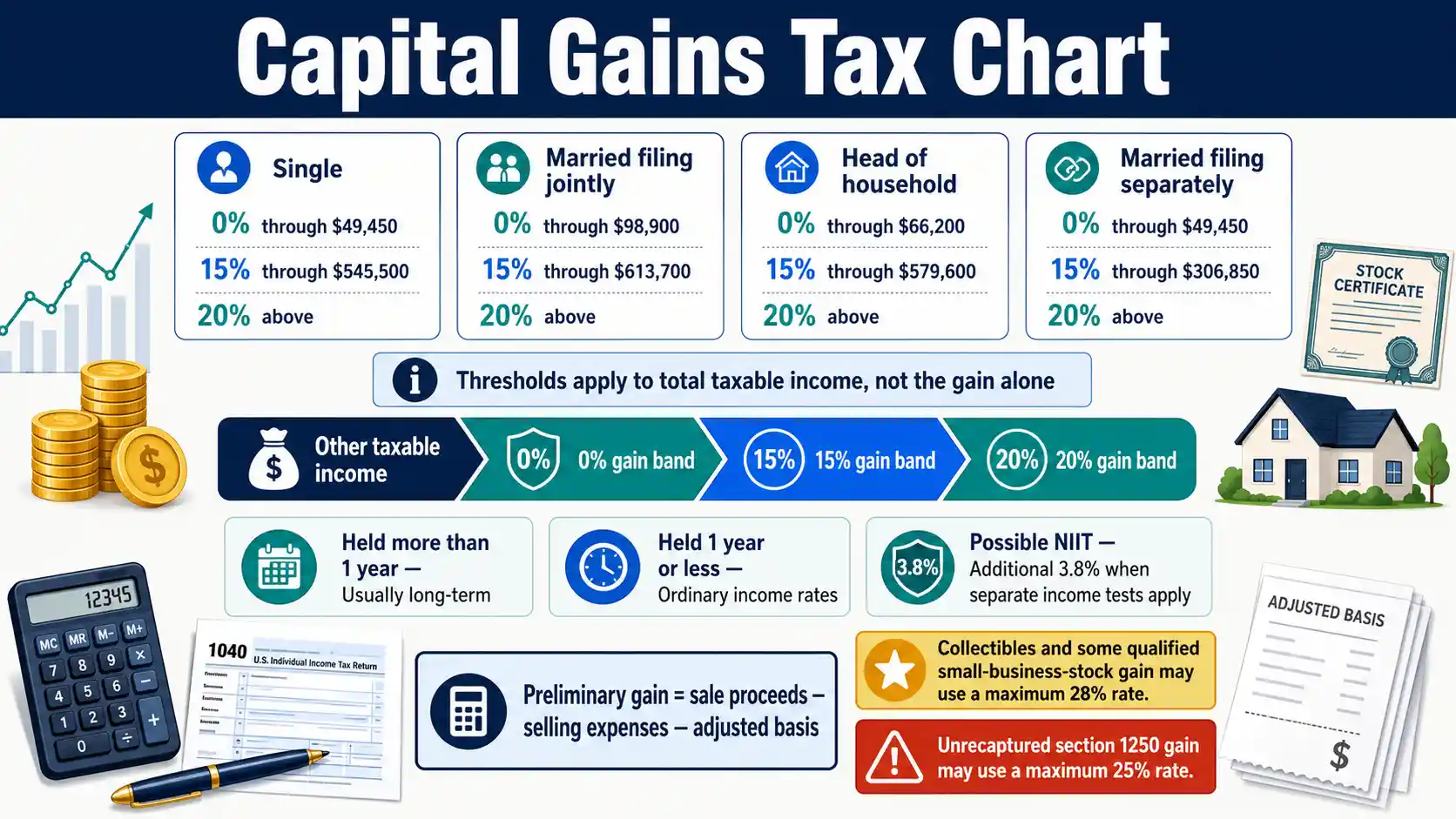
A net short-term capital gain is generally taxed as ordinary income. Most net long-term capital gains use 0%, 15%, or 20% federal rates, with the gain stacked above other taxable income. Special assets and the 3.8% NIIT can require separate calculations.
The IRS 2026 inflation-adjustment revenue procedure sets the maximum zero-rate and 15% rate amounts used in the bracket chart below.
Long-term holding period
More than 1 year
A standard capital asset held longer than one year generally enters long-term treatment.
Standard long-term rates
0% · 15% · 20%
The applicable portions depend on filing status and total taxable income, not the gain alone.
Short-term treatment
Ordinary income rates
A net gain on an asset held one year or less generally does not use the long-term rate chart.
Possible additional tax
3.8% NIIT
A separate net investment income tax can apply when investment income and MAGI tests are met.
Quick answers to capital gains tax questions
These answers describe federal rules for individuals. A final return must account for the transaction, tax year, filing status, netting rules, exclusions, and other income.
What are the 2026 long-term capital gains tax rates?
Most net long-term capital gains use 0%, 15%, or 20% federal rates.
What is the 2026 zero-rate limit for a single filer?
The maximum zero-rate taxable-income amount for a single filer is $49,450.
What is the 2026 zero-rate limit for joint filers?
The maximum zero-rate taxable-income amount for married filing jointly is $98,900.
Does the rate apply to the gain alone?
No. Long-term gain is stacked above other taxable income when the rate bands are applied.
How are short-term capital gains taxed?
Net short-term capital gains are generally taxed as ordinary income.
When does a gain become long-term?
A gain is generally long-term when the asset was held for more than one year.
How do you calculate a preliminary capital gain?
Subtract allowable selling expenses and adjusted basis from gross sale proceeds.
Can a capital gain be partly taxed at different rates?
Yes. Portions of one gain can fall into the 0%, 15%, and 20% bands.
What is the annual capital-loss deduction limit?
The federal limit is generally $3,000, or $1,500 for married filing separately.
What rate can apply to collectibles gain?
Net collectibles gain can be taxed at a maximum federal rate of 28%.
What rate can apply to unrecaptured section 1250 gain?
Unrecaptured section 1250 gain can be taxed at a maximum federal rate of 25%.
Does this chart include state tax?
No. State and local capital-gain rules can differ from federal treatment.
2026 Federal Long-Term Capital Gains Tax Brackets
These thresholds apply to most net long-term capital gains for individuals. The rate depends on total taxable income after the gain is stacked above other taxable income.
Swipe horizontally inside the table to view every column.
| Filing status | 0% rate applies through | 15% rate applies through | 20% rate begins above |
|---|---|---|---|
| Single | $49,450 — Single filer zero-rate ceiling | $545,500 | $545,500 |
| Married filing jointly | $98,900 — Joint filer zero-rate ceiling | $613,700 | $613,700 |
| Qualifying surviving spouse | $98,900 | $613,700 | $613,700 |
| Married filing separately | $49,450 | $306,850 — Separate-return 15% ceiling | $306,850 |
| Head of household | $66,200 | $579,600 | $579,600 |
Amounts are 2026 taxable-income thresholds in U.S. dollars. They are not limits on the gain alone.
- • The 0% band covers the portion of net long-term gain that fits below the maximum zero-rate amount after other taxable income is counted.
- • The 15% band covers the next portion through the maximum 15% rate amount. Any remaining standard net long-term gain generally enters the 20% band.
- • Collectibles, certain qualified small business stock, unrecaptured section 1250 gain, short-term gains, and NIIT can follow different rules.
Download or export
Capital gains brackets use a stacking calculation
Ordinary taxable income occupies the lower taxable-income bands first. Standard net long-term capital gain is then placed above it. The part below the zero-rate ceiling is taxed at 0%, the next part through the 15% ceiling is taxed at 15%, and the remaining part is generally taxed at 20%.
The IRS capital gains and losses topic explains the holding-period classification, net capital gain, special maximum rates, annual capital-loss deduction, reporting, and possible estimated-tax requirements.
Stacking example
A single filer with $35,000 of taxable income before a $40,000 standard net long-term gain has $14,450 of room below the 2026 zero-rate ceiling of $49,450. The first $14,450 of gain enters the 0% band, and the remaining $25,550 enters the 15% band. This simplified example excludes NIIT, special-rate gain, and other return interactions.
2026 long-term capital gains tax estimator
Estimate the federal 0%, 15%, and 20% tax bands for one standard long-term capital gain, then see a separate approximate NIIT amount. Calculations stay in your browser.
Preliminary gain
$40,000.00
Taxable income after gain
$75,000.00
Gain in 0% band
$0.00
Gain in 15% band
$0.00
Gain in 20% band
$0.00
Regular capital-gain tax
$0.00
Estimated NIIT base
$0.00
Estimated 3.8% NIIT
$0.00
Estimated federal total: $0.00
Formula: gain = proceeds − selling expenses − adjusted basis. The gain is stacked above existing taxable income across the 2026 0%, 15%, and 20% bands. NIIT is estimated as 3.8% of the lesser of net investment income or MAGI above the filing-status threshold.
Short-Term vs Long-Term Capital Gains
The holding period usually determines whether a gain enters ordinary income rates or the preferential long-term capital-gain system.
Swipe horizontally inside the table to view every column.
| Situation | Typical classification | Federal rate framework | Important detail |
|---|---|---|---|
| Asset held 1 year or less | Short-term | Ordinary income tax rates — Ordinary income rates | Count from the day after acquisition through the disposal date |
| Asset held more than 1 year | Long-term | Usually 0%, 15%, or 20% — Preferential long-term rates | Rate bands depend on total taxable income and filing status |
| Net short-term loss exceeds short-term gain | Net short-term loss | Offsets net long-term gain under Schedule D netting rules | Unused net loss may affect the annual deduction and carryover |
| Net long-term gain exceeds net short-term loss | Net capital gain | Preferential rates may apply | Special-rate categories must be separated before final tax is computed |
| Gift, inheritance, partnership interest, futures, or other special property | Special rule may apply | Do not assume the standard holding-period rule | Review the rule for the asset and transaction type — Special rule check |
Holding period is measured in calendar time; “more than one year” is longer than one full year, not exactly one year.
- • Short-term gains do not receive the 0%, 15%, or 20% long-term rate solely because the asset is an investment.
- • Netting gains and losses occurs before the final capital-gain rate calculation.
- • Some transactions have special holding-period rules, so confirm the classification before relying on a rate chart.
Download or export
Adjusted basis determines the starting gain or loss
Capital gain generally begins with the amount realized from the sale minus adjusted basis. Basis often starts with cost, but gifts, inheritances, reinvested distributions, stock splits, returns of capital, depreciation, casualty adjustments, and property improvements can change it. Preserve records for every adjustment.
A broker statement can help, but the taxpayer remains responsible for verifying the reported basis and holding period. The preliminary gain is not always the final taxable gain because exclusions, losses, depreciation, installment rules, and special asset treatment may apply afterward.
Capital Gain and Adjusted Basis Calculation Chart
Capital gain starts with the amount realized from the sale and the asset’s adjusted basis. Records determine whether additions, reductions, and selling expenses are supported.
Swipe horizontally inside the table to view every column.
| Calculation item | Typical effect | Example | Record to keep |
|---|---|---|---|
| Gross sale proceeds | Starts the amount realized | Broker or closing-statement proceeds | Form 1099-B, Form 1099-S, or settlement statement |
| Selling expenses | Reduce amount realized when allowed | Broker commission or qualifying closing cost | Broker confirmation, invoice, or closing disclosure |
| Original cost or other starting basis | Starts adjusted basis | Purchase price or basis determined under gift/inheritance rules | Purchase confirmation, deed, appraisal, or transfer records |
| Basis additions | Increase adjusted basis when allowed | Certain acquisition costs or capital improvements | Invoices, receipts, contracts, permits, and proof of payment |
| Basis reductions | Decrease adjusted basis when required — Basis reduction | Depreciation, return of capital, or casualty adjustments | Tax returns, account statements, and depreciation schedules |
| Preliminary gain or loss | Amount realized minus adjusted basis | $120,000 realized − $80,000 basis = $40,000 gain — Gain formula example | Calculation worksheet and supporting documents |
Preliminary gain or loss = gross proceeds − allowable selling expenses − adjusted basis. Final taxable gain can differ after exclusions and netting.
- • Broker-reported basis can be incomplete or wrong when shares were transferred, inherited, gifted, split, or acquired through reinvestment.
- • A main-home basis may include qualifying capital improvements but not ordinary repairs that merely maintain condition.
- • Do not use the preliminary gain as final taxable gain when exclusions, depreciation, installment rules, or capital-loss netting apply.
Download or export
Capital Gains Special Rates and Exceptions
Several categories do not fit the standard 0%, 15%, and 20% chart. A maximum rate does not mean every dollar is automatically taxed at that rate.
Swipe horizontally inside the table to view every column.
| Gain or tax category | Federal treatment | Maximum or additional rate | Planning check |
|---|---|---|---|
| Most net long-term capital gain | Stacked above other taxable income | 0%, 15%, or 20% | Use the filing-status thresholds for the tax year |
| Net short-term capital gain | Taxed as ordinary income | Ordinary graduated rates | Include the gain with other taxable ordinary income |
| Collectibles gain | Separate special-rate category | Maximum 28% — Collectibles maximum rate | Identify coins, art, and other collectible property correctly |
| Taxable section 1202 qualified small business stock gain | Separate special-rate category | Maximum 28% | Eligibility and exclusion rules are fact-specific |
| Unrecaptured section 1250 gain | Applies to certain depreciation-related real-property gain | Maximum 25% — Section 1250 maximum rate | Separate this portion from other long-term gain |
| Net Investment Income Tax | Separate tax on the lesser statutory base | Additional 3.8% — Possible additional tax | Check MAGI and net investment income thresholds |
| Qualified main-home gain exclusion | Eligible gain may be excluded from income | Up to $250,000 or $500,000 on a qualifying joint return | Ownership, use, prior exclusion, and business-use rules matter |
Rates are federal. State and local treatment can differ, and a maximum rate is not a flat rate applied without the statutory calculation.
- • The 28% and 25% labels are maximum federal rates for the specified categories, not universal capital-gain rates.
- • NIIT can apply in addition to regular capital-gain tax when its separate income tests are met.
- • Home-sale gain exclusion requires eligibility; depreciation and nonqualified use can leave taxable gain.
Download or export
NIIT is separate from the regular capital-gain rate
The Net Investment Income Tax is 3.8% of the lesser applicable base when a taxpayer has net investment income and MAGI above the filing-status threshold. The NIIT thresholds are statutory and are not indexed for inflation.
The IRS Net Investment Income Tax guidance lists the MAGI thresholds and explains income commonly included in net investment income.
Net Investment Income Tax Thresholds
The 3.8% NIIT can apply when a taxpayer has net investment income and modified adjusted gross income above the statutory filing-status threshold.
Swipe horizontally inside the table to view every column.
| Filing status | MAGI threshold | NIIT rate | Tax base in general |
|---|---|---|---|
| Single | $200,000 — Single NIIT threshold | 3.8% | Lesser of net investment income or MAGI above the threshold |
| Head of household | $200,000 | 3.8% | Lesser of net investment income or MAGI above the threshold |
| Married filing jointly | $250,000 — Joint NIIT threshold | 3.8% | Lesser of net investment income or MAGI above the threshold |
| Qualifying surviving spouse | $250,000 | 3.8% | Lesser of net investment income or MAGI above the threshold |
| Married filing separately | $125,000 — Separate-return NIIT threshold | 3.8% | Lesser of net investment income or MAGI above the threshold |
Thresholds are modified adjusted gross income amounts in U.S. dollars and are not indexed for inflation.
- • Capital gains can be included in net investment income unless a separate exclusion applies.
- • Excluded main-home gain is also excluded from net investment income for NIIT purposes.
- • The NIIT calculation uses MAGI, which is different from taxable income used for the 0%, 15%, and 20% rate bands.
Download or export
Net capital losses can offset gains and carry forward
Capital gains and losses are first separated into short-term and long-term groups, then netted under Schedule D rules. When the final net capital loss exceeds gains, the annual deduction against other income is generally limited to $3,000, or $1,500 for married filing separately. Unused net loss can carry forward.
Most sales are reported through Form 8949 and Schedule D, but the correct form path depends on the asset and how the transaction was reported. A significant gain can also create an estimated-tax obligation before the annual return is filed.
Capital Loss Deduction, Carryover and Reporting Chart
Capital gains and losses are netted by holding-period category before the annual loss deduction and carryover are determined.
Swipe horizontally inside the table to view every column.
| Situation | Federal rule in general | Amount or form | Important caution |
|---|---|---|---|
| Capital gains exceed capital losses | Net gain remains taxable | Form 8949 and Schedule D commonly apply | Rate depends on holding period, category, and total income |
| Capital losses exceed gains — most individuals | Deduct limited excess against other income | Up to $3,000 per year — General annual loss limit | Carry forward unused net capital loss |
| Capital losses exceed gains — married filing separately | Lower annual deduction limit | Up to $1,500 per year — Married filing separately limit | Carry forward unused net capital loss |
| Loss on personal-use property | Generally not deductible — Personal-use loss not deductible | No capital-loss deduction | A personal car or main-home loss is not treated like an investment loss |
| Sale reported by a broker | Taxpayer still verifies proceeds, basis, adjustments, and holding period | Form 1099-B may feed Form 8949 or Schedule D | Broker reporting does not replace taxpayer records |
| Large taxable gain during the year | Estimated tax may be required | Review withholding and estimated-payment rules | Waiting until filing can create an underpayment issue |
Annual loss limits are federal amounts. Carryover keeps its short-term or long-term character under the applicable rules.
- • The $3,000 and $1,500 limits apply after capital gains and losses have been netted, not to each sale separately.
- • Special wash-sale and other loss-disallowance rules can postpone or change a claimed investment loss.
- • Complex sales, business property, partnerships, options, crypto transactions, and foreign assets may require additional forms and rules.
Download or export
Common capital gains tax mistakes
Applying the rate to gain alone
Use total taxable income because ordinary income fills the lower bands before long-term gain.
Using purchase price as final basis
Account for supported additions and reductions, then preserve the records behind each adjustment.
Calling a one-year holding long-term
The standard rule requires more than one year, subject to special property rules.
Ignoring special-rate categories
Separate collectibles, section 1202 gain, unrecaptured section 1250 gain, and other special items.
Forgetting NIIT
Check MAGI and net investment income separately from the regular capital-gain bracket calculation.
Assuming every home-sale gain is excluded
Verify ownership, use, prior exclusion, business use, depreciation, and nonqualified-use rules.
Claiming every investment loss immediately
Loss netting, wash-sale rules, annual deduction limits, and carryovers can delay the benefit.
Waiting until filing to plan payment
A large gain can require withholding changes or estimated payments during the tax year.
Limits and transactions needing individual review
Real estate and depreciation
Rental, business, and mixed-use property can involve depreciation recapture, unrecaptured section 1250 gain, suspended losses, and allocation rules.
Main-home sales
The $250,000 or $500,000 exclusion is conditional. Prior exclusions, nonqualified use, rental activity, depreciation, and partial exclusions can change the result.
Gifts, inheritances and transferred assets
Basis and holding period can depend on donor basis, fair market value, estate rules, dates, appraisals, and transfer documents.
Options, crypto and complex securities
Lots, fees, forks, staking, exercises, assignments, section 1256 treatment, straddles, wash sales, and trader elections can require transaction-level analysis.
Business and partnership interests
Ordinary-income recharacterization, debt allocation, hot assets, installment sales, and entity-level information can affect the taxable gain.
State, local and international rules
Residence, property location, source rules, foreign tax, treaties, and state-specific exclusions or rates can materially change the total tax.
Frequently asked questions
What are the federal long-term capital gains tax rates for 2026?
Most net long-term capital gains use 0%, 15%, or 20% federal rates. The applicable portions depend on filing status and total taxable income after the gain is stacked above other taxable income.
How much long-term capital gain can a single filer have at 0% in 2026?
The 2026 maximum zero-rate taxable-income amount for a single filer is $49,450. Other taxable income uses that band first, so the gain alone can be smaller than $49,450 and still partly enter the 15% band.
What is the 2026 zero-rate threshold for married filing jointly?
The 2026 maximum zero-rate taxable-income amount for married filing jointly is $98,900. The same amount applies to a qualifying surviving spouse.
Are short-term capital gains taxed at 0%, 15%, or 20%?
No. Net short-term capital gains are generally taxed as ordinary income at the taxpayer’s graduated federal income-tax rates.
How long must I hold an asset for a long-term capital gain?
You generally must hold the asset for more than one year. Count from the day after acquisition through and including the disposal date, while checking for special asset rules.
Does the 0% capital gains rate mean the sale is tax-free?
Not necessarily. Only the portion of standard net long-term gain that fits in the 0% band receives that rate, and state tax, NIIT, special-rate gain, or other tax effects may still apply.
How is capital gain calculated?
Capital gain generally equals the amount realized from the sale minus adjusted basis. Selling expenses, basis additions, basis reductions, exclusions, and loss netting can change the final taxable amount.
What is adjusted basis?
Adjusted basis is the asset’s starting basis increased or decreased by tax-law adjustments. Purchase records, improvements, depreciation, returns of capital, gifts, inheritances, and corporate actions can affect it.
What is the capital loss deduction limit?
The annual federal deduction for net capital loss against other income is generally limited to $3,000, or $1,500 for married filing separately. Unused net capital loss can carry forward.
What capital gains are taxed at a maximum 28% rate?
Net collectibles gain and the taxable part of certain section 1202 qualified small business stock gain can be taxed at a maximum 28% rate. The final calculation can be lower depending on the taxpayer’s circumstances.
What is unrecaptured section 1250 gain?
It is a depreciation-related portion of certain gain from section 1250 real property. It can be taxed at a maximum 25% federal rate and must be separated from other long-term capital gain.
When does the 3.8% Net Investment Income Tax apply?
NIIT can apply when a taxpayer has net investment income and modified adjusted gross income above the statutory filing-status threshold. The tax is 3.8% of the lesser applicable base.
Can I exclude gain from selling my main home?
A qualifying taxpayer may exclude up to $250,000 of main-home gain, or up to $500,000 on many qualifying joint returns. Ownership, use, prior exclusion, depreciation, and business-use rules can limit the exclusion.
Do I report capital gains on Form 8949 and Schedule D?
Most capital transactions are reported on Form 8949 and summarized on Schedule D, although exceptions exist. Verify the forms required for the transaction and tax year.
Does this chart include state capital gains tax?
No. The chart covers U.S. federal rules. State and local treatment can use different rates, deductions, exclusions, sourcing rules, and filing requirements.
Sources
These Internal Revenue Service materials support the 2026 rate thresholds, holding-period treatment, special rates, NIIT thresholds, adjusted-basis concepts, capital-loss rules, reporting guidance, and main-home exclusion information.
Internal Revenue Service — Revenue Procedure 2025-32 — 2026 Inflation-Adjusted Tax Items
https://www.irs.gov/pub/irs-drop/rp-25-32.pdf
Provides the 2026 maximum zero-rate and 15% rate amounts for net capital gains by filing status.
Internal Revenue Service — Topic No. 409, Capital Gains and Losses
https://www.irs.gov/taxtopics/tc409
Explains capital assets, adjusted basis, holding periods, short-term and long-term treatment, special maximum rates, capital-loss limits, reporting, and estimated-tax considerations.
Internal Revenue Service — Net Investment Income Tax
https://www.irs.gov/individuals/net-investment-income-tax
Explains the separate 3.8% net investment income tax, statutory modified adjusted gross income thresholds, and the types of income commonly included.
Internal Revenue Service — Publication 523, Selling Your Home
https://www.irs.gov/publications/p523
Explains adjusted basis, eligibility tests, home-sale gain exclusions, business or rental use, depreciation, and reporting for a main-home sale.