Finance & Money · Budgeting and Cash Flow
Budget Allocation Chart for Income, Expenses and Savings
Divide monthly take-home income among needs, wants, savings, minimum debt payments, extra debt reduction, and irregular expenses. Compare starter ratios, classify costs, calculate dollar targets, and rebalance a plan that does not fit.
A budget ratio is an educational planning aid, not individualized financial advice. Required expenses, benefits, taxes, debt terms, legal obligations, and household risks differ. Read the ChartsLoom Disclaimer.
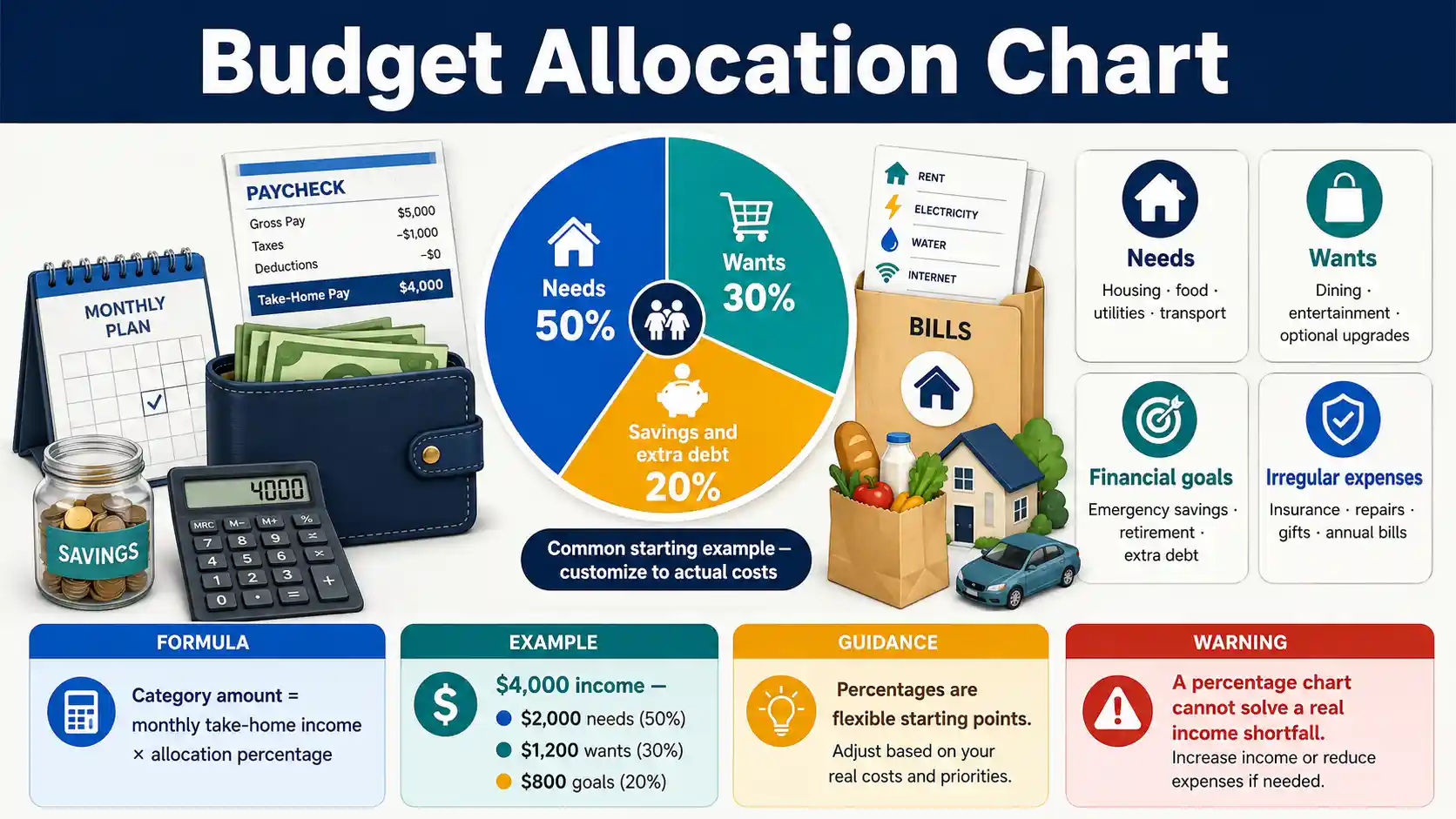
How should monthly income be allocated?
Start with take-home income. Fund required needs and minimum obligations. Choose a realistic amount for flexible wants. Assign money to savings, extra debt payments, and reserves for known non-monthly expenses. Make the full plan total 100%.
The Consumer Financial Protection Bureau spending-rule worksheet presents 50% for needs, 20% for savings and debt payments, and no more than 30% for wants as a common rule of thumb. Treat it as a starting example and replace it when real costs require a different split.
Income base
Use take-home income
Build the allocation from money actually available after payroll deductions and other withheld amounts.
Starter model
50% · 30% · 20%
The common example assigns needs, wants, and financial goals, but households can use different percentages.
Complete plan
Categories total 100%
Include spending, savings, debt, and reserves so every planned dollar has a clear role.
Critical limit
Ratios do not create income
When required expenses exceed available income, solve the dollar gap before optimizing category percentages.
Quick answers to common budget allocation questions
These answers use monthly household cash flow. Use the same income period, currency, and category definitions throughout the plan.
What income should a monthly budget use?
Use monthly take-home income because it reflects money actually available to allocate.
What does 50/30/20 mean?
It assigns 50% to needs, 30% to wants, and 20% to savings goals or extra debt payments.
Must every budget follow 50/30/20?
No. The ratio is a starter example, not a universal requirement or affordability test.
Where do minimum debt payments belong?
Minimum debt payments are required obligations; extra principal payments belong with financial goals.
Where does emergency savings belong?
Emergency-fund contributions belong in savings or financial goals.
How do you budget an annual bill?
Divide the expected amount by the months until it is due and reserve that amount monthly.
What is a sinking fund?
A sinking fund is money reserved gradually for a known future expense.
What if needs exceed 50%?
Use the actual required amount and adjust the rest of the plan instead of hiding essential costs.
What does a negative budget balance mean?
A negative balance means planned spending and saving exceed available income.
Does zero-based budgeting mean zero savings?
No. It means every dollar is assigned, including dollars assigned to savings.
How often should a budget be reviewed?
Compare planned and actual totals monthly and rebuild the plan after major financial changes.
Can irregular income use a percentage budget?
Yes, but use a conservative income baseline and reserve higher-income months for future shortfalls and goals.
Budget Allocation Models Compared
These models are starting structures, not universal rules. Use take-home income and adapt the percentages to fixed costs, debt obligations, household size, benefits, and local prices.
Swipe horizontally inside the table to view every column.
| Model | Needs | Wants | Savings and extra debt | Best use |
|---|---|---|---|---|
| 50/30/20 example — Widely used starter example | 50% | 30% | 20% | A simple first-pass allocation when essential costs fit within half of take-home income |
| Needs-heavy example | 60% | 20% | 20% | A temporary structure when housing, transportation, insurance, or caregiving costs are higher |
| Debt-focus example | 55% | 15% | 30% | A custom plan that directs more cash toward emergency savings or extra principal payments |
| Low-income priority plan | Fund essentials first — Fund required costs before optional categories | Use only after required costs | Save any available margin | When percentages hide the fact that required costs already consume most income |
| Zero-based plan | Assign exact dollars | Assign exact dollars | Assign exact dollars | When every dollar needs a named job and income is reasonably predictable |
| Custom allocation | Your percentage | Your percentage | Your percentage | When irregular income, benefits, seasonal work, or unusual obligations require a tailored plan |
Percentages apply to monthly take-home income unless a row states otherwise. A complete plan should total 100% after irregular-expense reserves are included.
- • The 50/30/20 structure is an example, not a pass-or-fail standard.
- • Minimum required debt payments normally belong with essential obligations; extra payments belong with financial goals.
- • A high needs percentage may reflect local housing costs, disability expenses, childcare, medical costs, or limited income rather than overspending.
Download or export
Classify expenses by function before setting percentages
A need supports basic living, work, care, safety, or a required obligation. A want is flexible, even when it improves comfort or quality of life. Savings and extra debt payments move money toward future resilience or a defined goal. Sinking funds spread known future bills across several months.
Consumer.gov recommends listing bills and other expenses, writing down monthly income, and subtracting expenses from income. Its making-a-budget guidance provides a simple cash-flow foundation before category ratios are applied.
Budget Category Classification Chart
Classify each expense by its role in the household plan. The same item can move between categories when the amount, purpose, contract, or available alternative changes.
Swipe horizontally inside the table to view every column.
| Category | Typical items | Allocation treatment | Important distinction |
|---|---|---|---|
| Take-home income | Pay after payroll deductions, benefits received, support, reliable side income | Use as the amount available to allocate | Do not budget from gross salary when that money never reaches the household account — Use available income |
| Core housing | Rent or mortgage, required property charges, basic utilities | Needs | Optional upgrades and premium services can be wants |
| Food | Basic groceries and necessary household staples | Needs | Restaurant meals and convenience delivery usually belong with wants |
| Transportation | Required commuting, fuel, transit, insurance, minimum vehicle payment | Needs when required for work or daily living | A more expensive vehicle choice can contain both a need and a want component |
| Health and care | Insurance, prescriptions, medically necessary care, disability supports, childcare needed for work | Needs | These costs may justify a higher needs percentage |
| Minimum debt payments | Contractual minimums on credit cards, loans, or other debts | Required obligation | Extra principal payments are financial goals rather than current minimums — Separate minimum and extra debt payments |
| Wants | Entertainment, optional subscriptions, dining out, hobbies, upgrades | Flexible spending | A want can still be meaningful; the label only shows flexibility |
| Emergency savings | Cash reserved for unexpected essential expenses or income disruption | Financial goal | The appropriate target depends on job stability, insurance, dependents, and risk |
| Long-term goals | Retirement, education, home purchase, planned major purchases | Financial goal | Use separate accounts or labels when goals have different timelines |
| Sinking funds | Annual insurance, repairs, gifts, school costs, travel, registrations | Monthly reserve for irregular expenses | Known future costs are not emergencies — Plan known future costs monthly |
Classifications describe budgeting function, not moral value. Use consistent labels so planned and actual spending can be compared month to month.
- • Split mixed expenses when the distinction changes a decision, such as basic internet service versus premium add-ons.
- • Use the actual required minimum for debt obligations; do not estimate it from the current balance.
- • Irregular expenses should be converted to a monthly reserve instead of ignored until the bill arrives.
Download or export
Monthly budget allocation calculator
Enter monthly take-home income and percentages that total 100%. The calculator converts each percentage into a monthly dollar amount in your browser.
Use money available after payroll deductions. Do not enter account or card numbers.
Starter examples
Allocation check
The categories total 100% of monthly take-home income.
Needs and minimum obligations
50.0% of income
$2,000.00
Flexible wants
30.0% of income
$1,200.00
Savings and extra debt
20.0% of income
$800.00
Irregular expense reserve
0.0% of income
$0.00
Calculation example
Needs: $4,000.00 × 50.0% = $2,000.00
This is an educational allocation tool. It does not assess affordability, debt strategy, taxes, benefits eligibility, investment suitability, or emergency-fund needs.
50/30/20 Monthly Income Allocation Examples
This table applies the CFPB example percentages to several take-home income amounts. It shows the arithmetic only and does not establish an affordable or recommended budget for a specific household.
Swipe horizontally inside the table to view every column.
| Monthly take-home income | Needs at 50% | Wants at 30% | Savings and extra debt at 20% | Total allocated |
|---|---|---|---|---|
| $2,000 | $1,000 | $600 | $400 | $2,000 |
| $2,500 | $1,250 | $750 | $500 | $2,500 |
| $3,000 | $1,500 | $900 | $600 — Twenty percent example | $3,000 |
| $3,500 | $1,750 | $1,050 | $700 | $3,500 |
| $4,000 | $2,000 — Half of take-home income | $1,200 | $800 | $4,000 |
| $5,000 | $2,500 | $1,500 | $1,000 | $5,000 |
| $6,000 | $3,000 | $1,800 | $1,200 | $6,000 |
| $8,000 | $4,000 | $2,400 | $1,600 | $8,000 |
Formula: category amount = monthly take-home income × category percentage. For example, $3,000 × 20% = $600.
- • Use net income that is actually available for spending and saving.
- • If essential costs exceed the example amount, build a custom plan instead of hiding required bills.
- • Include irregular-expense reserves within the category that best matches the purpose or show them as a separate fourth category.
Download or export
Convert irregular expenses into monthly reserves
Annual premiums, vehicle fees, school costs, gifts, maintenance, and planned travel do not occur every month, but they still belong in the budget. Divide the estimated cost by the months until payment and reserve that amount regularly.
The FDIC saving and spending guidance recommends reviewing recent spending and adjusting recurring expenses to support financial goals. A separate reserve makes future known costs visible.
Irregular Expense Monthly Reserve Chart
Convert predictable non-monthly costs into monthly amounts. This prevents annual, quarterly, or seasonal bills from appearing as unexpected overspending.
Swipe horizontally inside the table to view every column.
| Expected expense | Timing | Estimated total | Monthly reserve | Calculation |
|---|---|---|---|---|
| Vehicle registration | Every 12 months | $240 | $20 | $240 ÷ 12 |
| Annual insurance premium | Every 12 months | $1,200 | $100 | $1,200 ÷ 12 |
| Holiday and gift spending | Annual plan | $900 | $75 | $900 ÷ 12 |
| School supplies and fees | Annual plan | $600 | $50 | $600 ÷ 12 |
| Quarterly utility surge | Four times yearly | $480 annual difference | $40 | $480 ÷ 12 |
| Home maintenance | Annual planning estimate | $1,800 — Replace estimate with household-specific planning amount | $150 | $1,800 ÷ 12 |
| Professional fees or licenses | Annual | $360 | $30 | $360 ÷ 12 |
| Planned travel | Trip in 10 months | $2,000 | $200 | $2,000 ÷ 10 — Use months remaining before the goal |
Monthly reserve = expected amount ÷ number of months until payment. Example amounts are fictional and should be replaced with the household estimate.
- • Use the remaining months until the due date when starting midyear.
- • Keep known costs separate from emergency savings because their timing or purpose is already anticipated.
- • Review estimates after each bill and update the next reserve amount.
Download or export
A budget shortfall requires a dollar solution
When required costs exceed take-home income, a different chart label cannot close the gap. Measure the shortage, protect essentials, review major fixed costs, reduce flexible spending, and seek reputable assistance early when contractual payments cannot be met. Be cautious with any service that promises guaranteed debt relief or asks for sensitive financial information before explaining its terms.
How to Rebalance a Budget That Does Not Fit
A negative balance means planned expenses exceed available income. Correct the dollar gap first; changing labels or percentages does not make the shortage disappear.
Swipe horizontally inside the table to view every column.
| Budget result | First check | Practical response | Avoid |
|---|---|---|---|
| Income minus expenses is positive | Confirm every recurring and irregular cost is included | Assign the remaining amount to a goal, buffer, or planned category | Leaving the surplus unnamed and spending it unintentionally |
| Income minus expenses equals zero | Confirm reserves and savings are already included | Use the plan and compare it with actual spending | Treating zero-based budgeting as having no savings |
| Small monthly shortfall | Review flexible and recurring costs | Reduce, cancel, renegotiate, or delay lower-priority spending | Relying on credit without a repayment plan |
| Large monthly shortfall | Check housing, transportation, care costs, debt minimums, and income | Prioritize essentials and contact qualified assistance or creditors early when needed — Structural shortfall | Trying to solve a structural gap only by cutting minor items |
| Irregular income | Use a conservative baseline and separate higher-income months | Fund required costs first and build a buffer for low-income periods | Budgeting every month from the best recent paycheck |
| Unexpected essential expense | Identify whether cash reserves or insurance apply | Use the least damaging available source and revise future categories | Calling every predictable annual cost an emergency |
| Debt payment is unaffordable | Verify the required amount and due date | Contact the lender or a reputable nonprofit counselor before missing payments when possible | Paying an unverified third party that promises guaranteed relief — Avoid guaranteed debt-relief claims |
| Repeated overspending in one category | Compare the plan with three months of actual transactions | Use a realistic amount or change the behavior causing the variance | Copying an ideal percentage that never matches actual costs |
Budget balance = total monthly take-home income − total monthly planned expenses and savings. A negative result needs a dollar adjustment.
- • Pay housing, utilities, food, transportation needed for work, insurance, and other essential obligations before optional spending.
- • When income cannot cover basic needs, percentages are less useful than a priority-based cash-flow plan and qualified local assistance.
- • Debt, tax, investment, and insolvency decisions can have legal or financial consequences; use appropriate professional advice for individual cases.
Download or export
Common Budget Allocation Mistakes and Fixes
Budget accuracy improves when categories reflect real cash flow, required dates, and actual spending rather than an idealized month.
Swipe horizontally inside the table to view every column.
| Mistake | Why it causes trouble | Better method | Check |
|---|---|---|---|
| Using gross income | Taxes and payroll deductions are unavailable for monthly allocation | Start with take-home income — Use take-home income | Match the amount deposited or otherwise available |
| Ignoring annual bills | The budget looks balanced until the bill arrives | Create monthly sinking funds | List every known non-monthly expense |
| Treating minimum and extra debt payments as one category | Required obligations and optional acceleration become unclear | Record minimums separately from extra principal | Verify statements and due dates |
| Forcing needs below actual required costs | The chart hides a real affordability gap — Do not hide required costs | Use actual essentials and rebalance the whole plan | Compare with contracts and recent bills |
| Setting savings as whatever remains | Flexible spending often consumes the intended amount | Schedule a realistic savings transfer or named goal | Confirm the transfer fits essential cash flow |
| Making wants equal to waste | The plan becomes too restrictive to maintain | Choose deliberate flexible spending within the available amount | Review value and tradeoffs |
| Failing to track actual spending | The plan cannot reveal category variances | Compare planned and actual totals regularly | Use statements, receipts, or transaction exports |
| Using the same budget during a major life change | Income and obligations no longer match the plan | Rebuild after moving, job changes, caregiving changes, or new debt | Update amounts and due dates |
| Rounding every category too aggressively | Small errors can create a material monthly gap | Use exact bill amounts and reasonable variable estimates | Reconcile the final total to available income |
| Assuming one ratio suits every household | Cost structures, goals, and risks differ | Use ratios as prompts, then customize — Customize the ratio | Check whether the plan is feasible and sustainable |
A useful budget is internally consistent: income, expense, savings, and reserve totals use the same monthly period and currency.
- • Reviewing several months of transactions can produce a more reliable baseline than memory.
- • A category can be adjusted without changing the household values behind the spending decision.
- • The plan should be updated when income, fixed costs, debt terms, benefits, or family responsibilities change.
Download or export
Limits and special cases
Irregular or seasonal income
Use a conservative baseline, track cash by due date, and reserve strong-month income for low-income periods before increasing recurring spending.
Benefits and restricted funds
Some benefits, reimbursements, grants, or account withdrawals have eligibility, documentation, tax, or permitted-use rules that a general chart cannot evaluate.
High-cost essential needs
Disability supports, medical care, childcare, dependent care, housing, or transport can make a higher needs percentage reasonable and necessary.
Debt, tax, and investment decisions
Interest rates, tax treatment, penalties, creditor rights, and investment risk require account-specific facts and may justify advice from a qualified professional.
Frequently asked questions
What is a budget allocation chart?
A budget allocation chart divides available income among categories such as needs, wants, savings, debt payments, and irregular expenses. It helps compare a planned distribution with actual spending, but the percentages must fit the household’s real obligations.
Should I use gross income or take-home income?
Use take-home income for a household spending plan because it reflects money actually available after payroll deductions. Add other reliable income that the household can use, and keep irregular income conservative until received.
What is the 50/30/20 budget rule?
The 50/30/20 rule is a starter example that assigns 50% of take-home income to needs, 30% to wants, and 20% to savings goals or extra debt payments. It is not a legal limit or a universal affordability standard.
What if my needs are more than 50% of income?
Use the actual amount required for housing, food, transportation, insurance, care, and minimum obligations. Then reduce flexible categories, review major costs, or address an income gap instead of pretending required expenses fit an arbitrary percentage.
Are minimum debt payments needs or savings?
Minimum required debt payments are current obligations. Extra payments above the minimum are financial goals because they accelerate repayment. Keeping the two amounts separate makes the budget easier to audit.
Where should an emergency fund go in a budget?
Emergency-fund contributions belong with savings or financial goals. The target should reflect income stability, insurance, dependents, essential expenses, and access to other resources rather than one universal amount.
How do I budget for annual bills?
Divide the expected bill by the number of months until it is due and reserve that amount each month. This creates a sinking fund for a known cost and prevents the payment from being mistaken for an emergency.
What is zero-based budgeting?
Zero-based budgeting assigns every dollar of available income to spending, saving, debt, or a buffer. A zero balance means income has been fully assigned; it does not mean the household has no savings.
How often should I review my budget allocation?
Compare planned and actual amounts at least monthly and rebuild the plan after a meaningful change in income, housing, debt, insurance, caregiving, or household size. More frequent checks can help when cash flow is tight or income varies.
How do I budget with irregular income?
Build required spending from a conservative income baseline, then assign higher-income amounts to future low-income months, irregular bills, debt, or savings. Do not commit recurring expenses based only on the strongest recent month.
What should I do when expenses exceed income?
Measure the exact monthly shortfall, protect essential costs, reduce flexible spending, review major fixed expenses, and seek qualified help early when obligations cannot be met. A new percentage split cannot eliminate a real cash deficit.
Are wants always unnecessary spending?
No. Wants are flexible rather than morally bad. A sustainable plan can include recreation, convenience, and personal priorities after essential obligations and realistic financial goals are addressed.
Can I use different percentages than 50/30/20?
Yes. Use any allocation that totals 100% and accurately covers required costs, irregular reserves, and chosen goals. The best ratio is one the household can actually fund and maintain.
Does this budget calculator store my financial data?
No. The calculator runs in the browser and does not need to transmit or store the entered values. Avoid entering account numbers, card numbers, tax identifiers, or other sensitive information into any general budgeting tool.
Sources
These U.S. consumer-finance and financial-education resources support the budgeting process, starter allocation example, spending review, and saving guidance.
Consumer Financial Protection Bureau — My Spending Rule to Live By
https://files.consumerfinance.gov/f/201603_cfpb_rules-to-live-by_my-spending-rule-to-live-by.pdf
Presents a common rule of thumb using 50% of take-home pay for needs, 20% for savings and debt payments, and no more than 30% for wants, while encouraging a personal rule that fits the household.
Consumer.gov — Making a Budget
https://consumer.gov/your-money/making-budget
Explains the basic monthly process of listing bills and other expenses, recording income, and subtracting expenses from income.
Federal Deposit Insurance Corporation — Saving for the Unexpected and Your Future
https://www.fdic.gov/consumer-resource-center/2025-01/saving-unexpected-and-your-future
Encourages reviewing recent spending, creating a monthly spending and saving plan, and adjusting recurring costs to support financial goals.