Music · Woodwind Fingerings
Clarinet Fingering Chart for Boehm-System Notes
Find common written fingerings from low E3 through high C6, decode thumb and finger-hole symbols, cross the clarinet break, compare alternate routes, and distinguish written pitch from concert pitch on a B♭ clarinet.
Match the chart to the instrument’s key system. These fingerings describe common Boehm-system soprano clarinet keywork. Öhler, Albert, bass, basset, and extended-range instruments can use different levers or additional keys.
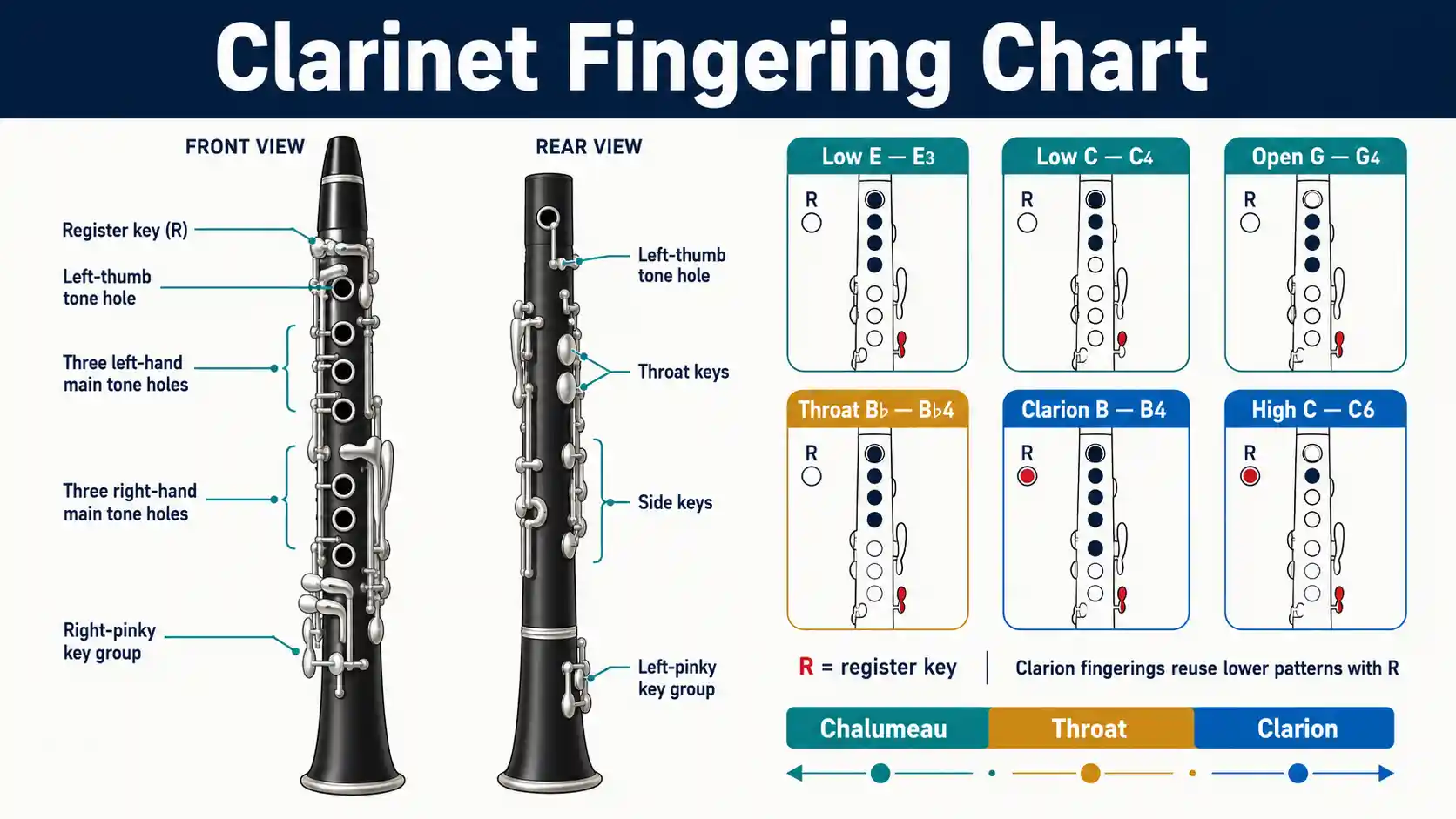
How do you read a clarinet fingering chart?
Close every filled tone-hole symbol, leave every open symbol released, and press only the named accessory keys. T represents the left-thumb hole, R represents the register key, and the two 123 groups represent the left and right index, middle, and ring fingers.
The Yamaha Boehm-system fingering reference shows primary and alternate diagrams across the instrument’s written range. Use a primary fingering first, then test alternates for a specific transition, pitch, or tone problem.
Chart system
Boehm fingering
The page follows the keywork used on most modern school and orchestral clarinets outside German-system traditions.
Core written range
E3 through C6
The lookup covers the standard low, throat, and clarion notes before advanced altissimo choices become highly variable.
Register relation
Overblows a twelfth
Adding the register key to many lower patterns produces a note one octave plus a fifth higher.
B♭ transposition
Sounds a whole step lower
Written C on a B♭ clarinet sounds concert B♭, so concert and written labels must not be confused.
Essential answers before using the chart
These statements cover standard written-note conventions. An instrument’s pad condition, key system, reed, mouthpiece, and player technique still affect response and tuning.
Which hand belongs on top?
The left hand covers the upper joint, and the right hand covers the lower joint.
What is the lowest common written note?
Written E3 is the lowest standard note on a typical soprano B♭ clarinet.
How do you finger open G?
Release the thumb hole, register key, six main holes, and accessory keys for written G4.
What does T mean?
T means close the rear left-thumb tone hole.
What does R mean?
R means press the register key with the left thumb while maintaining the required thumb-hole seal.
Where is the clarinet break?
The main break lies between throat B♭4 and clarion B4.
Does the register key raise a note one octave?
No. The clarinet normally overblows at the twelfth, not the octave.
What is a throat tone?
G4 through B♭4 use short upper-joint vents and are commonly called throat tones.
Do enharmonic notes use different fingerings?
Enharmonic pairs such as F♯ and G♭ normally use the same physical fingering.
Why are there duplicate pinky keys?
Duplicate keys let the player choose a smoother left- or right-pinky route through a passage.
Does written C sound as concert C?
No. Written C on B♭ clarinet sounds concert B♭.
Can one chart give every altissimo fingering?
No. Altissimo choices depend strongly on the instrument, reed, mouthpiece, voicing, pitch, and musical context.
Clarinet Fingering Symbols and Hand Positions
Use this legend to translate the shorthand in the note charts. The left hand stays above the right hand on a standard soprano clarinet.
Swipe horizontally inside the table to view every column.
| Symbol | Meaning | What the player does | Why it matters |
|---|---|---|---|
| T | Left-thumb tone hole | Seal the rear thumb hole | Controls most chalumeau notes and remains closed through much of the clarion register |
| R | Register key — Register key definition | Press the small rear register lever with the left thumb | Vents the air column so a lower fingering speaks a twelfth higher |
| 123 before | | Left index, middle, and ring fingers | Cover the three upper-joint main holes | These fingers shape the upper part of the air column |
| 123 after | | Right index, middle, and ring fingers | Cover the three lower-joint main holes | These fingers extend the closed tube toward the bell |
| – | Open main hole | Lift that finger cleanly without moving the hand | A partially covered hole causes unstable pitch and response |
| Accessory key | Pinky, throat, or side key | Press the named lever while holding the main pattern | Chromatic notes and alternate routes depend on these keys |
Example: T 123 | 12– means thumb closed, all three left fingers down, right index and middle down, and right ring lifted.
- • Filled or closed symbols mean a hole or key is pressed; open symbols mean it remains released.
- • Key shapes and duplicate pinky options differ slightly by instrument model.
- • The chart describes common Boehm-system soprano clarinet keywork, not Öhler-system fingering.
Download or export
Seal tone holes with relaxed finger pads
A correct fingering fails when even one main hole leaks. Center the soft pad of each finger over its hole, keep the fingers curved and close to the instrument, and avoid pressing harder than needed. Heavy pressure slows movement and does not repair a leaking pad or misregulated key.
Chalumeau and Throat Note Fingering Chart
This chart covers the standard written range from low E3 through throat B♭4. Learn natural notes first, then add the named chromatic key without disturbing the main hand position.
Swipe horizontally inside the table to view every column.
| Written note | Register | Fingering shorthand | Accessory key or action | Playing cue |
|---|---|---|---|---|
| E3 — Lowest standard written note | Chalumeau | T 123 | 123 + E/B | Low E/B key; use the left- or right-pinky option available on the instrument | Lowest standard written note on a typical soprano B♭ clarinet. |
| F3 | Chalumeau | T 123 | 123 + F/C | Low F/C key | Keep every main tone hole sealed while the little finger presses the F/C key. |
| F♯3 / G♭3 | Chalumeau | T 123 | 123 + F♯/C♯ | F♯/C♯ key; many Boehm clarinets provide alternate pinky choices | Choose the pinky version that avoids an awkward slide in the passage. |
| G3 | Chalumeau | T 123 | 123 | None | Seal all six main tone holes and the left-thumb hole. |
| G♯3 / A♭3 | Chalumeau | T 123 | 123 + G♯/E♭ | G♯/E♭ key | Keep the main holes closed and add the G♯/E♭ little-finger key. |
| A3 | Chalumeau | T 123 | 12– | None | Lift the right ring finger while the right index and middle fingers remain down. |
| B♭3 / A♯3 | Chalumeau | T 123 | 1–– + side B♭ | Side B♭/F key; forked alternatives may suit some passages | Use the standard side-key fingering first; alternate fingerings trade tone, pitch, or motion. |
| B3 | Chalumeau | T 123 | 1–– | None | Only the right index finger remains on a main right-hand hole. |
| C4 | Chalumeau | T 123 | ––– | None | Cover the thumb and three left-hand holes; leave the right-hand holes open. |
| C♯4 / D♭4 | Chalumeau | T 123 | ––– + C♯/G♯ | C♯/G♯ key | Add the C♯/G♯ little-finger key to the written C fingering. |
| D4 | Chalumeau | T 12– | ––– | None | Lift the left ring finger; keep the left index and middle fingers down. |
| E♭4 / D♯4 | Chalumeau | T 12– | ––– + E♭/B♭ | E♭/B♭ key | Add the E♭/B♭ key to the D fingering. |
| E4 | Chalumeau | T 1–– | ––– | None | Cover the thumb hole and left index-finger hole only. |
| F4 | Chalumeau | T ––– | ––– | None | Cover only the left-thumb hole. |
| F♯4 / G♭4 | Chalumeau | T ––– | ––– + F♯ | F♯ key | Add the upper-joint F♯ key while keeping the main finger holes open. |
| G4 | Throat | Open G — Open G fingering | None | Open G uses no main finger holes and no register key. |
| A♭4 / G♯4 | Throat | Open + G♯/A♭ | G♯/A♭ throat key | Press the throat G♯/A♭ key without closing the main holes. |
| A4 | Throat | A key | A key | Use the left-index A key; avoid squeezing the hand toward the instrument. |
| B♭4 / A♯4 | Throat | A + R | A key plus register key; side B♭ is a common alternate | The A-plus-register fingering is standard; side B♭ can improve selected transitions. |
Pitch labels are written clarinet notes in scientific pitch notation; middle C is C4.
- • Open G4, A4, and B♭4 are often called throat tones because they vent through short sections near the upper joint.
- • A note may have several legitimate alternate fingerings. Start with the primary fingering, then choose an alternate for intonation, tone, or movement.
- • Use flat or sharp note names according to the notation; the physical fingering is normally the same for enharmonic pairs.
Download or export
Interactive clarinet fingering lookup
Choose a written note from E3 through C6. The lookup shows the thumb, register key, six main finger holes, accessory action, and shorthand for a common Boehm-system fingering.
How to use this result
Open G uses no main finger holes and no register key.
Written note
G4
Rear controls
Left hand
Right hand
Accessory action
None
Open G
The register key connects lower patterns to clarion notes
The clarinet overblows at approximately a perfect twelfth. Written low E3 becomes B4 when the register key is added, low F3 becomes C5, and low G3 becomes D5. The Yamaha comparison of Boehm and Öhler systems explains why the fingering system itself must match the chart.
1
Hold steady air
Do not stop the air before moving through the break.
2
Move fingers together
Close the six main holes as one coordinated shape.
3
Add the register key
Use the side of the left thumb without uncovering its hole.
4
Keep the jaw stable
Excess biting makes response and pitch less reliable.
Clarion Register Fingering Chart from B4 to C6
The register key makes the clarinet overblow at the twelfth rather than the octave. Most clarion fingerings therefore reuse a lower-register pattern with R added.
Swipe horizontally inside the table to view every column.
| Written note | Lower pattern reused | Clarion shorthand | Accessory key | Relationship |
|---|---|---|---|---|
| B4 | Low E3 | R + T 123 | 123 + E/B — Clarion break entry | E/B key | A perfect twelfth above E3 |
| C5 | Low F3 | R + T 123 | 123 + F/C | F/C key | A perfect twelfth above F3 |
| C♯5 / D♭5 | Low F♯3 / G♭3 | R + T 123 | 123 + F♯/C♯ | F♯/C♯ key | A perfect twelfth above F♯3 |
| D5 | Low G3 | R + T 123 | 123 | None | A perfect twelfth above G3 |
| E♭5 / D♯5 | Low G♯3 / A♭3 | R + T 123 | 123 + G♯/E♭ | G♯/E♭ key | A perfect twelfth above G♯3 |
| E5 | Low A3 | R + T 123 | 12– | None | A perfect twelfth above A3 |
| F5 | Low B♭3 / A♯3 | R + T 123 | 1–– + side F | Side B♭/F key | A perfect twelfth above B♭3 |
| F♯5 / G♭5 | Low B3 | R + T 123 | 1–– | None | A perfect twelfth above B3 |
| G5 | Low C4 | R + T 123 | ––– | None | A perfect twelfth above C4 |
| A♭5 / G♯5 | Low C♯4 / D♭4 | R + T 123 | ––– + C♯/G♯ | C♯/G♯ key | A perfect twelfth above C♯4 |
| A5 | Low D4 | R + T 12– | ––– | None | A perfect twelfth above D4 |
| B♭5 / A♯5 | Low E♭4 / D♯4 | R + T 12– | ––– + E♭/B♭ | E♭/B♭ key | A perfect twelfth above E♭4 |
| B5 | Low E4 | R + T 1–– | ––– | None | A perfect twelfth above E4 |
| C6 — Top of core clarion chart | Low F4 | R + T ––– | ––– | None | A perfect twelfth above F4 |
A perfect twelfth equals one octave plus a perfect fifth, or 19 semitones in twelve-tone equal temperament.
- • Do not merely blow harder. Use steady air, a stable embouchure, complete hole coverage, and coordinated register-key motion.
- • The throat B♭4-to-B4 break requires many fingers to close together. Practice the motion slowly without biting.
- • Fingerings above written C6 enter the altissimo register and vary more by player, instrument, pitch, and musical context.
Download or export
Clarinet Registers, Written Ranges and Fingering Behavior
Register names describe acoustical and tonal regions. Boundaries can be described slightly differently in teaching materials, especially around the throat tones and first altissimo notes.
Swipe horizontally inside the table to view every column.
| Region | Typical written range | Main fingering behavior | Typical character | Practice priority |
|---|---|---|---|---|
| Chalumeau | E3 to F♯4 | Main tone holes shorten the fundamental air column | Dark, full, and low | Seal holes completely and keep fingers close |
| Throat tones | G4 to B♭4 | Short upper-joint vents and throat keys | Less resonant and more exposed | Support the tone and match pitch across A and B♭ |
| Clarion | B4 to C6 | Register key plus lower-register patterns — Register-key relationship | Clear, projecting, and singing | Coordinate the break and avoid excess jaw pressure |
| Altissimo | C♯6 and above | Cross-fingerings, venting, voicing, and instrument-specific alternatives | Brilliant and increasingly sensitive | Use a teacher-approved chart and tune each fingering |
Ranges are written, not concert, pitches for a standard soprano clarinet part.
- • Some teachers include G4 through B♭4 in the upper chalumeau range; “throat tones” is a practical fingering label.
- • Altissimo boundaries and usable upper limits vary with the player, instrument, mouthpiece, reed, and repertoire.
- • A fingering diagram cannot replace embouchure, air support, voicing, and listening.
Download or export
Written pitch and concert pitch answer different questions
A fingering chart tells the player which written note to finger. A transposition chart tells the ensemble which concert pitch will sound. On B♭ clarinet, every written note sounds one major second lower, so written D4 produces concert C4.
Written and Concert Pitch Chart for B♭ Clarinet
A standard B♭ clarinet sounds one major second lower than its written note. To sound a requested concert pitch, write or play one whole step higher.
Swipe horizontally inside the table to view every column.
| Written clarinet note | Sounding concert pitch | Interval | Practical example |
|---|---|---|---|
| C4 | B♭3 | Major second lower | Written C sounds concert B♭ |
| D4 | C4 — Concert middle C example | Major second lower | Written D sounds concert middle C |
| E4 | D4 | Major second lower | Written E sounds concert D |
| F4 | E♭4 | Major second lower | Written F sounds concert E♭ |
| G4 | F4 | Major second lower | Written open G sounds concert F |
| A4 | G4 | Major second lower | Written A sounds concert G |
| B4 | A4 | Major second lower | Written clarion B sounds concert A |
| C5 | B♭4 | Major second lower | Written C sounds concert B♭ |
One major second equals two semitones.
- • Fingering charts label written notes unless they explicitly say concert pitch.
- • A clarinet in A, E♭, C, or another key uses the same written fingering labels but produces a different concert pitch.
- • Transposition changes the sounding pitch, not which fingering matches the written note on the page.
Download or export
Choose an alternate fingering for a defined reason
An alternate can reduce motion, improve a trill, correct one note’s pitch, or change resistance. The Woodwind Fingering Guide clarinet index separates primary, alternate, trill, and register-specific charts. Compare options at the intended dynamic and tempo rather than assuming the easiest shape will sound best.
When to Use Alternate Clarinet Fingerings
Alternate fingerings solve specific musical problems. They are not universally better than the primary fingering, and their pitch and tone must be tested on the actual instrument.
Swipe horizontally inside the table to view every column.
| Situation | Useful alternate approach | Potential benefit | Trade-off to check |
|---|---|---|---|
| Repeated B♭ around A or B | Side B♭, A-plus-register, or forked B♭ according to the neighboring notes | Reduces finger collisions | Pitch, resistance, and tone color can change |
| Pinky-key passage | Choose left- or right-pinky duplicate keys before the passage begins | Avoids sliding one pinky between distant levers | The chosen route must remain anatomically comfortable |
| Fast trill or tremolo | Use a dedicated trill key or simplified vented fingering | Creates a smaller, faster motion | The alternate may be less stable when sustained |
| Soft throat tone | Add resonance fingers below the open throat fingering | Can improve focus or pitch | Extra fingers may slow the next transition |
| Altissimo note | Compare several venting and cross-fingering options | Matches pitch and response to the instrument | Results vary strongly by setup and voicing — Altissimo variability |
| Intonation correction | Add or remove a resonance finger after checking with a tuner and drone | Adjusts a specific note in context | A correction at one dynamic may fail at another |
“Alternate” means a secondary fingering for the same written pitch, not an enharmonic respelling.
- • Test alternates at the intended dynamic, articulation, tempo, and interval.
- • Mark the chosen fingering in the music when switching options within one piece.
- • A teacher or experienced clarinetist can identify which alternates fit a specific instrument and passage.
Download or export
A fingering chart cannot diagnose every failed note
The diagram cannot show pad leaks, bent keys, a chipped reed, poor assembly, unstable air, biting, tongue position, or a finger that only partly covers a hole. Do not force keys or continue through persistent hand pain. A teacher can evaluate technique, while a qualified repair technician can test pad sealing and regulation.
Clarinet Fingering Problems and Practical Checks
Many failed notes come from air leaks or coordination rather than a wrong chart. Check the simplest physical cause before changing the fingering.
Swipe horizontally inside the table to view every column.
| Problem | Likely cause | First check | When to get help |
|---|---|---|---|
| Low note will not speak | One main hole is leaking or a pinky key is not fully pressed | Flatten the finger pads and inspect each seal slowly — Start with hole sealing | Ask a teacher or repair technician if one key still leaks |
| Clarion note cracks down | Register key, air, or fingers arrive at different times | Practice the lower fingering, then add R with steady air | Get guidance if biting or throat tension persists |
| Throat B♭ sounds thin or sharp | A-plus-register fingering needs support or a different route | Compare side B♭ and resonance fingers at the same dynamic | Ask a teacher to evaluate embouchure and voicing |
| Pinky transition feels impossible | The fingering route forces one pinky to slide between keys | Plan a left-right alternate sequence before increasing tempo | Confirm the instrument has the expected duplicate keywork |
| Squeak during a finger change | A hole opens early, the reed is unstable, or the tongue hits unevenly | Move fingers together and keep air continuous | Inspect reed, pads, and key regulation if squeaks remain |
| Upper note is badly out of tune | Altissimo fingering, voicing, reed, and instrument interact | Test several established alternatives with a tuner and drone | Use a teacher-approved chart; seek service if tuning is unusually erratic |
Do not force a painful hand position. Stop and adjust posture, thumb support, or fingering choice when pain develops.
- • A fingering chart assumes the instrument is assembled correctly and the pads seal.
- • Cold instruments tend to play flatter until warmed; temperature can change response and tuning.
- • Persistent pain, numbness, or weakness requires rest and appropriate professional evaluation rather than more force.
Download or export
Frequently asked questions
What clarinet does this fingering chart cover?
This chart covers common Boehm-system soprano clarinet fingerings, especially the B♭ clarinet used in many school bands. Öhler- and Albert-system instruments use different keywork and fingerings.
What do filled circles mean on a clarinet fingering diagram?
A filled circle means the player closes that tone hole or presses that key. An open circle means the hole or key remains open.
Which hand goes on top of the clarinet?
The left hand goes on the upper joint, and the right hand goes on the lower joint. The right thumb supports the instrument at the thumb rest.
What is the lowest standard note on a B-flat clarinet?
Written E3 is the lowest standard note on a typical soprano B♭ clarinet. Some extended instruments add lower notes, but those keys are not standard on ordinary student clarinets.
What is open G on clarinet?
Written G4 is open G. Release the six main finger holes, thumb hole, register key, and accessory keys.
How do I finger throat B-flat on clarinet?
The standard throat B♭4 fingering uses the A key with the register key. Side and forked alternatives can make certain transitions easier.
What does the clarinet register key do?
The register key vents the clarinet so a lower fingering speaks approximately a perfect twelfth higher. It does not simply raise the note by one octave.
Why does clarinet overblow at the twelfth?
The clarinet behaves approximately like a cylindrical stopped pipe, so the register vent favors the next strong odd harmonic. That relationship places the clarion note a twelfth above the lower fingering.
Where is the break on clarinet?
The main break lies between throat B♭4 and clarion B4. The transition changes from a nearly open fingering to a heavily closed fingering with the register key.
Are clarinet fingerings the same for B-flat and A clarinet?
The written fingerings are generally the same on standard Boehm B♭ and A clarinets. Their sounding concert pitches differ because the instruments transpose by different intervals.
Does written C sound as concert C on B-flat clarinet?
No. Written C on a B♭ clarinet sounds concert B♭, one major second lower.
Why are there two pinky fingerings for some clarinet notes?
Duplicate left- and right-pinky keys let the player avoid awkward slides during fast passages. Choose the side that prepares the next note efficiently.
Are alternate clarinet fingerings always in tune?
No. Alternate fingerings can change resistance, tone, and pitch. Test them on the actual clarinet at the intended dynamic and musical context.
Why does a correct clarinet fingering still squeak?
A correct fingering can squeak when a hole leaks, fingers move unevenly, the reed is unstable, or air and voicing are poorly coordinated. Check sealing and timing before changing the fingering.
Can this chart teach altissimo clarinet fingerings?
The chart explains where altissimo begins but does not prescribe one universal set above C6. Altissimo fingerings vary by pitch, instrument, reed, mouthpiece, voicing, and musical context.
Sources
These fingering and instrument references support the Boehm-system scope, written-note patterns, register relationships, and alternate-fingering cautions used on this page.
Yamaha Corporation — Fingering Diagram for the Clarinet
https://www.yamaha.com/en/musical_instrument_guide/clarinet/play/play002.html
Interactive and downloadable Boehm-system clarinet fingering diagrams with primary and alternate fingerings.
Yamaha Corporation — The Boehm System and the Öhler System
https://www.yamaha.com/en/musical_instrument_guide/clarinet/mechanism/mechanism003.html
Explains the main clarinet key systems and notes that most modern clarinets use Boehm-system keywork.
Yamaha Corporation — The Saxophone Is a Transposing Instrument
https://www.yamaha.com/en/musical_instrument_guide/saxophone/play/play003.html
Explains that B♭ soprano and tenor saxophones, like B♭ clarinets, sound B♭ when written C is played.
Woodwind Fingering Guide — Clarinet Fingering Charts
https://www.wfg.woodwind.org/clarinet/
Register-based Boehm, Albert, and Oehler fingering references, including alternate and trill fingerings.