Science & Chemistry
Metric Prefix Chart
Compare every recognized SI metric prefix from quetta to quecto, read the correct symbols and powers of ten, convert between prefixed units, and avoid common mistakes involving capitalization, kilograms, area, volume, and binary prefixes.
SI prefix symbols are exact and case-sensitive. A lowercase or uppercase change can alter a factor by many orders of magnitude, so copy symbols exactly when recording measurements.
How SI metric prefixes work
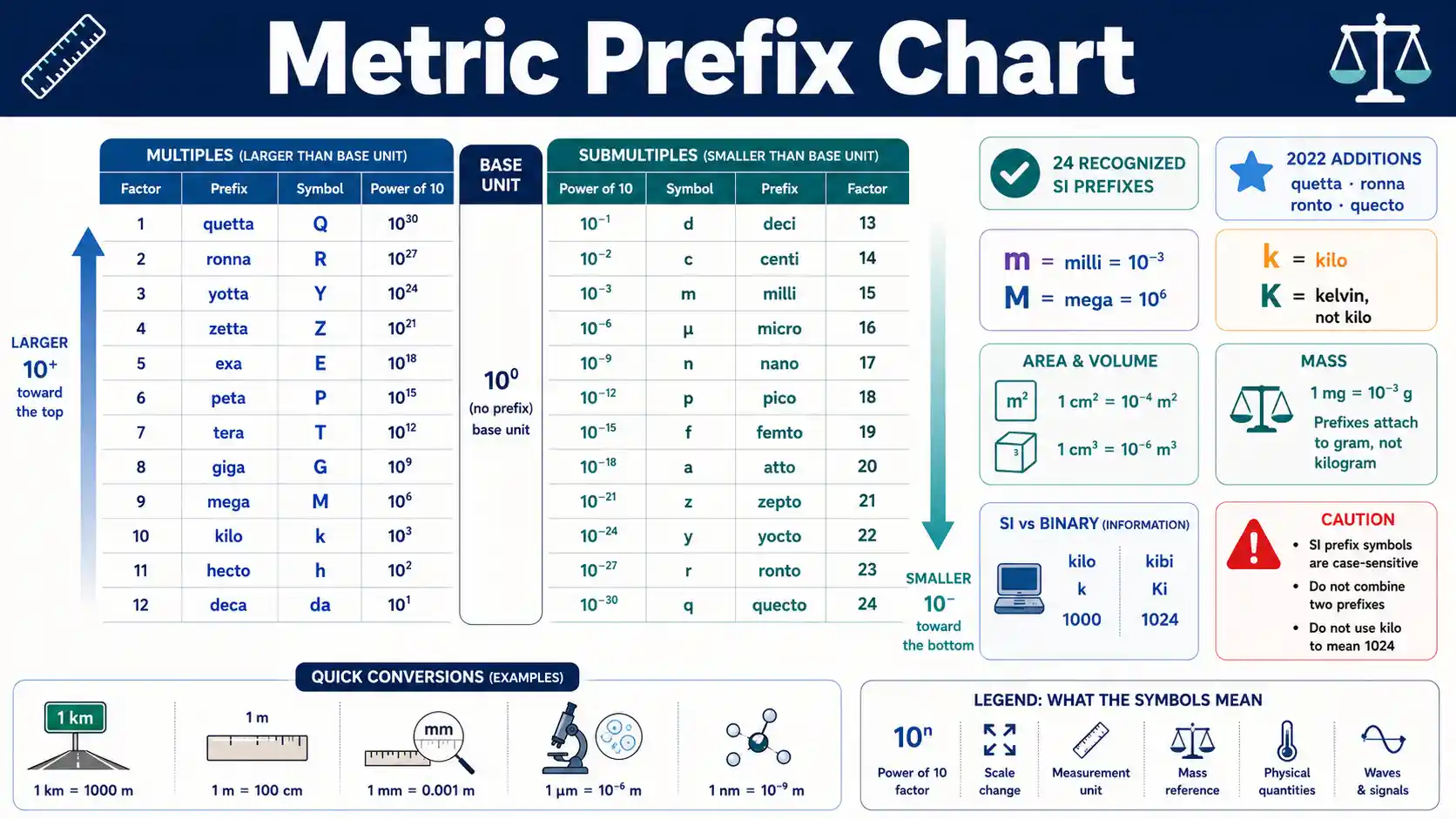
An SI prefix attaches to a unit to represent an exact decimal multiple or submultiple. Kilo means 10³, milli means 10⁻³, micro means 10⁻⁶, and giga means 10⁹. The BIPM prefix list currently spans quetta at 10³⁰ through quecto at 10⁻³⁰.
There are 24 recognized SI prefixes. The set expanded in 2022 when quetta (Q), ronna (R), ronto (r), and quecto (q) were adopted. These additions extended the available decimal range by another six orders of magnitude in both directions.
Current range
10⁻³⁰ to 10³⁰
The recognized SI set runs from quecto (q) through quetta (Q) and contains 24 prefixes.
Symbols
Case changes meaning
m means milli (10⁻³), while M means mega (10⁶). Kilo is lowercase k.
Conversions
Compare exponents
For linear units, multiply by 10 raised to source-prefix exponent minus target-prefix exponent.
Digital units
SI is decimal
kilo, mega, and giga mean powers of 10. Kibi, mebi, and gibi are the distinct binary prefixes.
A prefix modifies the magnitude of the unit, not the physical quantity. One kilometre and 1000 metres represent the same length. One nanometre and 10⁻⁹ metre represent the same length at a much smaller scale.
Complete SI Metric Prefix Chart
The 24 SI prefixes currently recognized for decimal multiples and submultiples of units, ordered from the largest factor to the smallest.
Swipe horizontally inside the table to view every column.
| Power of ten | Prefix | Symbol | Decimal factor | Plain-language scale |
|---|---|---|---|---|
| 10^30 | quetta | Q | 1 000 000 000 000 000 000 000 000 000 000 | nonillion |
| 10^27 | ronna | R | 1 000 000 000 000 000 000 000 000 000 | octillion |
| 10^24 | yotta | Y | 1 000 000 000 000 000 000 000 000 | septillion |
| 10^21 | zetta | Z | 1 000 000 000 000 000 000 000 | sextillion |
| 10^18 | exa | E | 1 000 000 000 000 000 000 | quintillion |
| 10^15 | peta | P | 1 000 000 000 000 000 | quadrillion |
| 10^12 | tera | T | 1 000 000 000 000 | trillion |
| 10^9 | giga | G | 1 000 000 000 | billion |
| 10^6 | mega | M | 1 000 000 | million |
| 10^3 | kilo | k | 1 000 | thousand |
| 10^2 | hecto | h | 100 | hundred |
| 10^1 | deca | da | 10 | ten |
| 10^-1 | deci | d | 0.1 | tenth |
| 10^-2 | centi | c | 0.01 | hundredth |
| 10^-3 | milli | m | 0.001 | thousandth |
| 10^-6 | micro | µ | 0.000 001 | millionth |
| 10^-9 | nano | n | 0.000 000 001 | billionth |
| 10^-12 | pico | p | 0.000 000 000 001 | trillionth |
| 10^-15 | femto | f | 0.000 000 000 000 001 | quadrillionth |
| 10^-18 | atto | a | 0.000 000 000 000 000 001 | quintillionth |
| 10^-21 | zepto | z | 0.000 000 000 000 000 000 001 | sextillionth |
| 10^-24 | yocto | y | 0.000 000 000 000 000 000 000 001 | septillionth |
| 10^-27 | ronto | r | 0.000 000 000 000 000 000 000 000 001 | octillionth |
| 10^-30 | quecto | q | 0.000 000 000 000 000 000 000 000 000 001 | nonillionth |
SI prefixes represent exact powers of 10.
- • There is no prefix for 10^0; an unprefixed unit represents the unit itself.
- • Quetta, ronna, ronto, and quecto were adopted in 2022, expanding the SI prefix set from 20 to 24.
Download or export
The fastest prefixes to recognize
Kilo is one thousand, centi is one hundredth, milli is one thousandth, micro is one millionth, and nano is one billionth. Mega and giga scale upward by millions and billions. These few prefixes cover a large share of everyday, laboratory, engineering, and electronics measurements.
Common Metric Prefixes in Everyday and Scientific Use
A compact reference to prefixes frequently encountered in measurement, chemistry, physics, electronics, medicine, and engineering.
Swipe horizontally inside the table to view every column.
| Prefix | Symbol | Factor | Example | Meaning of example |
|---|---|---|---|---|
| kilo | k | 10^3 | 1 km | 1 000 m |
| centi | c | 10^-2 | 1 cm | 0.01 m |
| milli | m | 10^-3 | 1 mL | 0.001 L |
| micro | µ | 10^-6 | 1 µm | 0.000 001 m |
| nano | n | 10^-9 | 1 nm | 0.000 000 001 m |
| pico | p | 10^-12 | 1 ps | 10^-12 s |
| mega | M | 10^6 | 1 MHz | 1 000 000 Hz |
| giga | G | 10^9 | 1 GHz | 1 000 000 000 Hz |
| tera | T | 10^12 | 1 TW | 10^12 W |
Examples use decimal SI factors.
- • Uppercase and lowercase symbols are not interchangeable: m is milli, while M is mega.
Download or export
Convert prefixes by comparing their powers of ten
For a linear unit, subtract the target prefix exponent from the source prefix exponent. Converting 5 micrometres to nanometres compares 10⁻⁶ with 10⁻⁹, a difference of 3, so 5 µm equals 5000 nm. Converting 2500 kilopascals to megapascals compares 10³ with 10⁶, so the numerical value becomes 2.5.
Moving to a smaller unit increases the numerical value because more small units fit into the same quantity. Moving to a larger unit decreases the numerical value.
Metric Prefix Conversion Examples
Convert between prefixed units by comparing their powers of ten. Moving to a smaller unit increases the numerical value; moving to a larger unit decreases it.
Swipe horizontally inside the table to view every column.
| Starting quantity | Target unit | Exponent change | Result | Reason |
|---|---|---|---|---|
| 2.5 km | m | 10^3 → 10^0 | 2 500 m | Multiply by 10^3 |
| 450 cm | m | 10^-2 → 10^0 | 4.50 m | Multiply by 10^-2 |
| 0.003 m | mm | 10^0 → 10^-3 | 3 mm | Multiply numerical value by 10^3 |
| 7.2 mg | g | 10^-3 → 10^0 | 0.0072 g | Multiply by 10^-3 |
| 5 µm | nm | 10^-6 → 10^-9 | 5 000 nm | Exponent difference is 3 |
| 3.4 GHz | MHz | 10^9 → 10^6 | 3 400 MHz | Exponent difference is 3 |
| 2500 kPa | MPa | 10^3 → 10^6 | 2.5 MPa | Target prefix is 10^3 larger |
| 0.75 ns | ps | 10^-9 → 10^-12 | 750 ps | Exponent difference is 3 |
For linear units, conversion factor = 10^(source exponent − target exponent).
- • Keep the physical quantity unchanged; only the numerical value and unit scale change.
Download or export
Interactive conversion
Metric Prefix Converter
Enter a value, choose the source and target SI prefixes, and convert by the exact power-of-ten difference.
Converted value
1,000 m
1 km × 10^(3 − 0)
Exponent difference
3
Multiplier
10^3
This converter handles linear prefixed units. For area or volume, square or cube the prefix factor. For mass, attach prefixes to gram rather than stacking a second prefix onto kilogram.
Capitalization is part of the measurement
Prefix symbols are case-sensitive. Lowercase m is milli, but uppercase M is mega—a difference of 10⁹ between the two prefix factors. Kilo is lowercase k, while uppercase K is the unit symbol for kelvin. NIST notes that submultiple symbols are lowercase, while most large-multiple symbols are uppercase except kilo, hecto, and deka. See NIST metric prefix guidance.
A prefix symbol joins directly to the unit symbol, while the numerical value is separated from the complete unit symbol by a space: 5 km, 20 µm, and 3 GHz.
SI Prefix Symbols and Writing Rules
Prefix symbols are case-sensitive and join directly to unit symbols. A prefixed unit symbol behaves as one inseparable unit symbol.
Swipe horizontally inside the table to view every column.
| Rule | Correct | Incorrect or risky | Why it matters |
|---|---|---|---|
| Prefix joins unit symbol | 5 km | 5 k m | k and m form the unit symbol km |
| Space separates value from unit | 5 km | 5km | SI style uses a space between number and unit symbol |
| Case is significant | 1 MHz | 1 mhz | M means mega; unit symbols also have defined case |
| Kilo symbol is lowercase | kg, km | Kg, Km | k is the official symbol for kilo |
| Micro symbol | µm | um in plain SI typography | µ is the SI prefix symbol for micro |
| No plural unit symbols | 8 kg | 8 kgs | Unit symbols do not take plural endings |
| No period after symbols | 12 cm | 12 cm. | Unit symbols are not abbreviations unless punctuation ends the sentence |
| One prefix at a time | 1 nm | 1 mµm | Compound prefixes are not permitted |
Typography and symbol rules follow SI usage conventions.
- • Prefix names may be written out in prose, but prefix symbols must retain their defined case.
Download or export
Mass uses gram as the prefix attachment point
The kilogram is the SI base unit of mass, but it already contains the historical prefix kilo. SI therefore forms mass multiples and submultiples by attaching prefixes to gram. Milligram (mg), microgram (µg), and megagram (Mg) are the proper constructions; compound prefixes are not used.
One milligram equals 10⁻³ gram and 10⁻⁶ kilogram. This is why writing mg is preferred over stacking another prefix onto kg.
Metric Prefixes with Grams and Kilograms
Mass needs special attention because kilogram is the SI base unit, yet decimal multiples and submultiples are formed by attaching prefixes to gram.
Swipe horizontally inside the table to view every column.
| Mass unit | Meaning in grams | Meaning in kilograms | Correct SI construction |
|---|---|---|---|
| 1 kg | 1 000 g | 1 kg | kilogram is the SI base unit of mass |
| 1 g | 1 g | 0.001 kg | gram is used as the prefix attachment point |
| 1 mg | 0.001 g | 10^-6 kg | milli + gram |
| 1 µg | 10^-6 g | 10^-9 kg | micro + gram |
| 1 ng | 10^-9 g | 10^-12 kg | nano + gram |
| 1 Mg | 1 000 000 g | 1 000 kg | mega + gram |
Mass prefixes attach to g, not to kg.
- • Use 1 mg rather than a compound-prefix form such as 1 µkg.
Download or export
Square or cube the prefix factor with the unit
A centimetre is 10⁻² metre, but a square centimetre is (10⁻²)² square metres, or 10⁻⁴ m². A cubic centimetre is (10⁻²)³ cubic metres, or 10⁻⁶ m³. The prefix is part of the unit symbol, so the exponent applies to the prefix factor too.
Prefixes in Squared and Cubed Units
When a prefixed unit is squared or cubed, the prefix factor is raised to the same power. This is why area and volume conversions need more than a simple decimal shift.
Swipe horizontally inside the table to view every column.
| Unit relation | Prefix factor | After exponent | Equivalent |
|---|---|---|---|
| 1 cm | 10^-2 m | linear | 0.01 m |
| 1 cm² | (10^-2)² m² | 10^-4 | 0.0001 m² |
| 1 cm³ | (10^-2)³ m³ | 10^-6 | 0.000001 m³ |
| 1 mm² | (10^-3)² m² | 10^-6 | 0.000001 m² |
| 1 mm³ | (10^-3)³ m³ | 10^-9 | 0.000000001 m³ |
| 1 km² | (10^3)² m² | 10^6 | 1 000 000 m² |
| 1 km³ | (10^3)³ m³ | 10^9 | 1 000 000 000 m³ |
The exponent applies to the entire prefixed unit symbol.
- • 1 cm² is not 0.01 m²; it is 0.0001 m².
Download or export
Metric Prefixes and Scientific Notation
Prefixes provide a compact way to absorb powers of ten into a unit symbol, often making scientific measurements easier to read.
Swipe horizontally inside the table to view every column.
| Scientific notation | Prefixed form | Reading | Useful context |
|---|---|---|---|
| 3.2 × 10^9 Hz | 3.2 GHz | 3.2 gigahertz | radio / electronics |
| 6.5 × 10^6 W | 6.5 MW | 6.5 megawatts | power |
| 4.0 × 10^-3 L | 4.0 mL | 4.0 millilitres | volume |
| 8.5 × 10^-6 m | 8.5 µm | 8.5 micrometres | microscopy |
| 550 × 10^-9 m | 550 nm | 550 nanometres | visible wavelength scale |
| 2.1 × 10^-12 s | 2.1 ps | 2.1 picoseconds | ultrafast time |
| 7.0 × 10^-15 m | 7.0 fm | 7.0 femtometres | nuclear length scale |
Examples use standard decimal SI prefixes.
- • Choose a prefix that keeps the numerical value readable; engineering practice often favors powers in steps of 10^3.
Download or export
SI prefixes are decimal, not binary
Kilo always means 10³ in SI, so 1 kHz is exactly 1000 Hz. It must not be redefined to mean 1024. Binary powers use separate prefixes such as kibi (Ki), mebi (Mi), and gibi (Gi). The NIST Guide to the SI explicitly separates these decimal and binary systems.
SI Decimal Prefixes vs Binary Prefixes
SI prefixes are powers of 10. Binary prefixes such as kibi and mebi are separate names and symbols used for powers of 2.
Swipe horizontally inside the table to view every column.
| Decimal SI | Factor | Binary prefix | Factor | Difference |
|---|---|---|---|---|
| kilo (k) | 10^3 = 1 000 | kibi (Ki) | 2^10 = 1 024 | 24 units |
| mega (M) | 10^6 = 1 000 000 | mebi (Mi) | 2^20 = 1 048 576 | 48 576 units |
| giga (G) | 10^9 = 1 000 000 000 | gibi (Gi) | 2^30 = 1 073 741 824 | 73 741 824 units |
| tera (T) | 10^12 | tebi (Ti) | 2^40 | Binary factor is larger |
SI prefix symbols must not be redefined as binary powers.
- • 1 kB means 1000 bytes when k is used as the SI prefix; 1 KiB means 1024 bytes.
Download or export
SI Prefix Expansion Timeline
The SI prefix range expanded over time as science and technology needed concise names for progressively larger and smaller decimal scales.
Swipe horizontally inside the table to view every column.
| Year | Prefixes added or changed | Resulting recognized set | Why it matters |
|---|---|---|---|
| 1960 | mega, giga, tera; micro, nano, pico | 12 active prefixes after obsolete historical forms were removed | Extended practical range in both directions |
| 1964 | femto, atto | 14 | Added smaller submultiples |
| 1975 | peta, exa | 16 | Added matching large multiples |
| 1991 | zetta, yotta; zepto, yocto | 20 | Extended range to ±24 powers |
| 2022 | ronna, quetta; ronto, quecto | 24 | Extended range to ±30 powers |
Current recognized SI prefix total: 24.
- • The 2022 additions were adopted by the 27th General Conference on Weights and Measures.
Download or export
Common Metric Prefix Mistakes
Most prefix errors come from case, exponent direction, compound prefixes, or forgetting that squared and cubed units scale differently.
Swipe horizontally inside the table to view every column.
| Mistake | Wrong idea | Correct rule | Example |
|---|---|---|---|
| Confusing m and M | m = mega | m is milli; M is mega | 1 mm = 10^-3 m; 1 Mm = 10^6 m |
| Using K for kilo | 1 Km | kilo symbol is lowercase k | 1 km |
| Treating kilo as 1024 | 1 k = 2^10 | SI kilo is exactly 10^3 | 1 kHz = 1000 Hz |
| Stacking prefixes | µkg | Use one prefix attached to gram | mg instead of µkg |
| Ignoring area exponent | 1 cm² = 0.01 m² | Square the prefix factor | 1 cm² = 10^-4 m² |
| Ignoring volume exponent | 1 cm³ = 0.01 m³ | Cube the prefix factor | 1 cm³ = 10^-6 m³ |
| Moving decimal the wrong way | smaller unit → smaller number | smaller unit → larger numerical value | 1 m = 1000 mm |
| Writing prefixes alone as units | 5 k | Prefix modifies a unit | 5 km or 5 kW |
Case-sensitive symbols are part of the measurement meaning.
- • Always identify both the source and target prefix powers before converting.
Download or export
How to choose and use the right prefix
1. Identify the base unit
Know whether the quantity is being expressed in metres, seconds, hertz, watts, pascals, grams, or another unit. For mass-prefix construction, work from gram.
2. Read the prefix symbol exactly
Case matters. Distinguish m from M, k from K, and q from Q before doing any arithmetic.
3. Translate prefixes to exponents
Replace each prefix mentally with its power of ten. Then conversion becomes exponent arithmetic instead of a memorized decimal-point trick.
4. Check unit powers
If the unit is squared or cubed, apply the exponent to the prefix factor. This catches common cm² and cm³ conversion errors.
A well-chosen prefix makes the value easier to read without changing the quantity. For example, 0.000 000 550 m can be written as 550 nm. Scientific notation remains equally valid, and the best representation depends on context and field conventions.
Related chart
Metric prefixes appear throughout measurement tables. The Density Chart shows how prefixes and unit conversions interact with g/mL, g/cm³, kg/m³, and related density expressions.
Metric prefix FAQs
How many SI prefixes are there?
There are 24 recognized SI prefixes, spanning quetta at 10^30 through quecto at 10^-30.
What is the largest SI prefix?
Quetta, symbol Q, is the largest currently recognized SI prefix and represents 10^30.
What is the smallest SI prefix?
Quecto, symbol q, is the smallest currently recognized SI prefix and represents 10^-30.
What does kilo mean?
Kilo, symbol k, multiplies a unit by 10^3, so one kilometre equals 1000 metres.
What does milli mean?
Milli, symbol m, multiplies a unit by 10^-3, so one millimetre is 0.001 metre.
What does micro mean?
Micro, symbol µ, represents 10^-6, or one millionth of the unprefixed unit.
Is M mega or milli?
Uppercase M means mega, 10^6. Lowercase m means milli, 10^-3. SI prefix symbols are case-sensitive.
Is kilo k or K?
The SI symbol for kilo is lowercase k. Uppercase K is the symbol for kelvin.
Does kilo mean 1000 or 1024?
In SI, kilo means exactly 1000. The binary prefix kibi, symbol Ki, represents 1024.
Can two SI prefixes be used together?
No. Compound prefixes are not permitted; use a single prefix chosen for the required power of ten.
Why is milligram used instead of microkilogram?
The kilogram already contains a prefix in its historical name, so prefixes for mass are attached to gram. One milligram equals one microkilogram numerically, but mg is the SI construction.
How do you convert between metric prefixes?
Subtract the target prefix exponent from the source prefix exponent and multiply the numerical value by the corresponding power of ten.
Why is 1 cm squared equal to 0.0001 m squared?
Centi contributes 10^-2 to the metre, and squaring the unit squares that factor: (10^-2)^2 = 10^-4.
When were quetta and quecto added?
Quetta, ronna, ronto, and quecto were adopted in 2022, extending the SI prefix range to powers of 10 from 10^-30 to 10^30.
Is there a prefix for 10 to the zero power?
No. A factor of 10^0 equals one, so the unprefixed unit itself is used.
Can SI prefixes be used with derived units?
Yes. SI prefixes can be combined with many base and derived unit names and symbols, subject to SI writing rules and specific conventions such as the mass exception.
Sources
Official SI and U.S. metrology references used to verify prefix names, symbols, factors, writing conventions, the kilogram exception, binary-prefix distinction, and the 2022 expansion.
Bureau International des Poids et Mesures — SI prefixes
Official SI prefix names, symbols, and decimal multiplying factors from quetta (10^30) through quecto (10^-30).
https://www.bipm.org/en/measurement-units/si-prefixes
National Institute of Standards and Technology — Metric (SI) Prefixes
Lists the 24 recognized SI prefixes and explains capitalization, writing practice, the kilogram exception, and the 2022 additions.
https://www.nist.gov/pml/owm/metric-si-prefixes
National Institute of Standards and Technology — NIST Guide to the SI — SI Prefixes
Explains SI prefix use, powers of ten, prohibition of alternative meanings, and the distinction between decimal SI prefixes and binary prefixes.
https://www.nist.gov/pml/special-publication-811/nist-guide-si-chapter-4-two-classes-si-units-and-si-prefixes