Science & Chemistry
Density Chart
Compare density values for common materials, elements, liquids, and gases; convert units; calculate mass per unit volume; and understand how temperature, pressure, and measurement method affect density.
Density values are meaningful only with the correct material, phase, composition, and measurement conditions. Treat rounded chart values as reference values, not precision specifications.
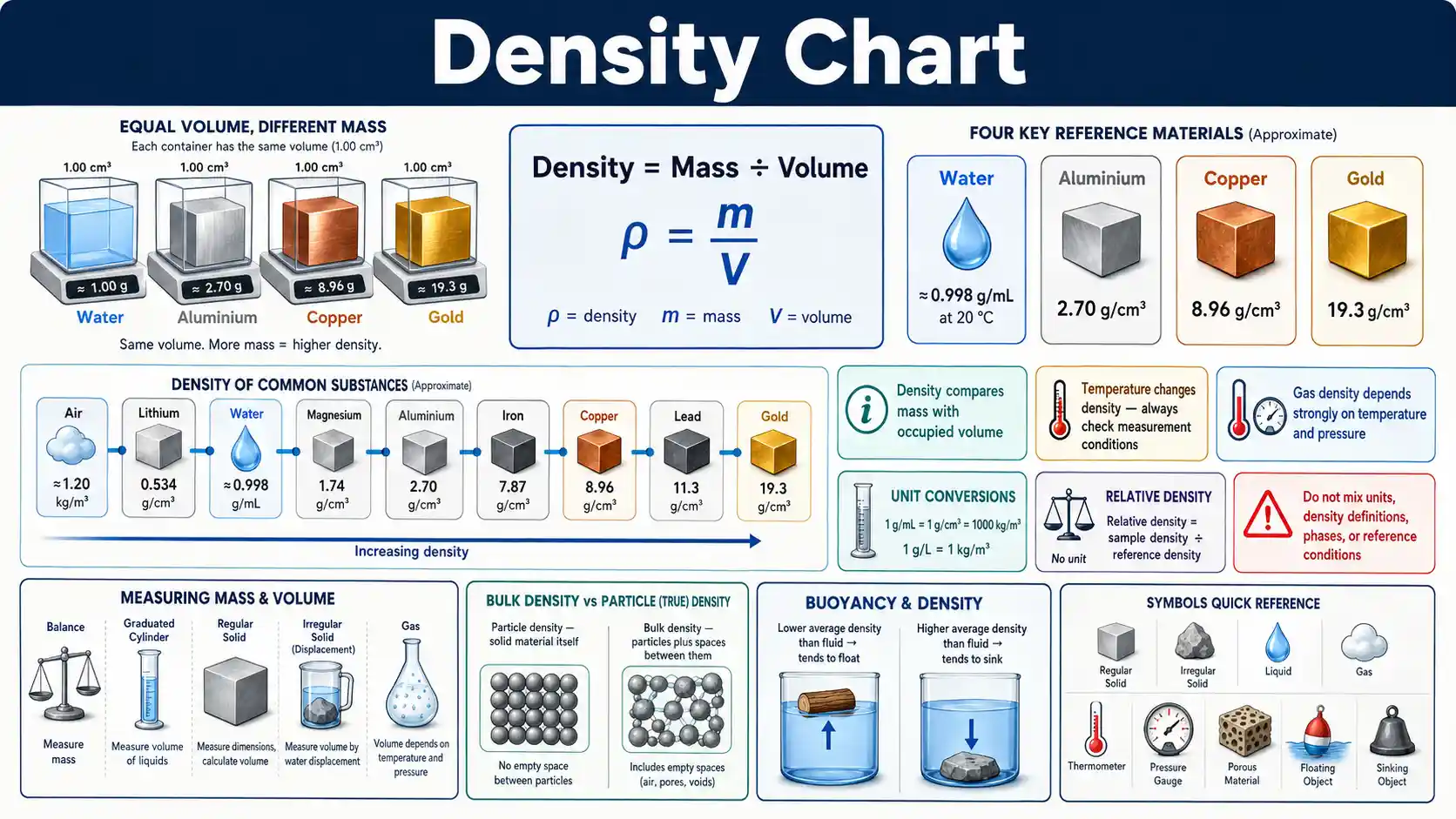
What is density?
Density is the mass of a sample divided by its volume. IUPAC defines density this way, and NIST gives the coherent SI unit as kg/m³. In laboratory work, g/mL and g/cm³ are also common and numerically equivalent. See the IUPAC definition.
Definition
ρ = m ÷ V
Mass density is the mass of a sample divided by the volume occupied by that same sample.
SI unit
kg/m³
Kilogram per cubic meter is the coherent SI unit for mass density.
Lab shortcut
1 g/mL = 1 g/cm³
Because one millilitre equals one cubic centimetre, these laboratory units have the same numerical value.
Conditions matter
State T and P
Temperature affects most density values, and pressure is especially important for gases.
Key density facts
What is density?
Density is mass divided by volume. It tells you how much mass occupies a given volume.
What is the SI unit of density?
The coherent SI unit of mass density is kilogram per cubic meter, written kg/m³.
What symbol represents density?
The Greek letter rho, ρ, is commonly used for mass density.
Is g/mL equal to g/cm³?
Yes. One millilitre equals one cubic centimetre, so the numerical values are identical.
How do you convert g/cm³ to kg/m³?
Multiply by 1000. A density of 2.70 g/cm³ equals 2700 kg/m³.
What is the density of water at room temperature?
Fresh water is about 0.998 g/mL near 20 °C. Use the exact temperature when precision matters.
Does density change with temperature?
Yes. Most materials expand as temperature rises, so their density usually decreases when mass remains constant.
Why does gas density change so much?
Gas volume responds strongly to both temperature and pressure, so gas density can vary much more than solid or liquid density.
What is relative density?
Relative density is a material density divided by a specified reference density. It is dimensionless.
What is bulk density?
Bulk density is mass divided by the total bulk volume of a powder or granules, including spaces between particles.
Will an object float if its density is below water?
An object with average density below the surrounding water tends to float in a simple buoyancy comparison, although shape and trapped gas can matter.
Why can two density tables give different values?
They may use different temperatures, pressures, compositions, material grades, phases, or measurement methods.
Common Density Reference Chart
Representative densities for familiar substances and materials. Values are approximate and conditions matter, especially for liquids, gases, porous solids, alloys, and natural materials.
Swipe horizontally inside the table to view every column.
| Material | State or form | Approx. density | Equivalent kg/m³ | Reference condition / note |
|---|---|---|---|---|
| Air | Gas | 0.00120 g/cm³ | 1.20 | Near 20 °C and 1 atm; varies strongly with temperature, pressure, humidity, and composition |
| Ice | Solid | 0.917 g/cm³ | 917 | Near 0 °C; crystal form and temperature affect value |
| Fresh water | Liquid | 0.998 g/mL | 998 | About 20 °C; density varies with temperature |
| Seawater | Liquid | ≈1.02–1.03 g/mL | ≈1020–1030 | Depends on salinity, temperature, and pressure |
| Ethanol | Liquid | ≈0.789 g/mL | ≈789 | Near 20 °C; purity and temperature matter |
| Glycerol | Liquid | ≈1.26 g/mL | ≈1260 | Near room temperature; water content changes density |
| Lithium | Solid element | 0.534 g/cm³ | 534 | RSC room-temperature element value |
| Magnesium | Solid element | 1.74 g/cm³ | 1740 | RSC at 20 °C |
| Aluminium | Solid element | 2.70 g/cm³ | 2700 | RSC at 20 °C |
| Iron | Solid element | 7.87 g/cm³ | 7870 | RSC at 20 °C |
| Copper | Solid element | 8.96 g/cm³ | 8960 | RSC at 20 °C |
| Lead | Solid element | 11.3 g/cm³ | 11300 | RSC at 20 °C |
| Mercury | Liquid element | ≈13.5 g/cm³ | ≈13500 | Near room temperature; temperature dependent |
| Gold | Solid element | 19.3 g/cm³ | 19300 | RSC at 20 °C |
1 g/cm³ = 1 g/mL = 1000 kg/m³.
- • Use these values for orientation, not precision metrology.
- • For a calculation or specification, use density at the stated temperature, pressure, composition, phase, and material grade.
Download or export
Selected Element Densities at Room Temperature
These values use the Royal Society of Chemistry periodic-table convention for density at room temperature and show how widely elemental densities vary.
Swipe horizontally inside the table to view every column.
| Element | Symbol | State at 20 °C | Density (g/cm³) | Density (kg/m³) |
|---|---|---|---|---|
| Lithium | Li | Solid | 0.534 | 534 |
| Sodium | Na | Solid | 0.97 | 970 |
| Magnesium | Mg | Solid | 1.74 | 1740 |
| Aluminium | Al | Solid | 2.70 | 2700 |
| Silicon | Si | Solid | 2.3296 | 2329.6 |
| Iron | Fe | Solid | 7.87 | 7870 |
| Copper | Cu | Solid | 8.96 | 8960 |
| Zinc | Zn | Solid | 7.134 | 7134 |
| Silver | Ag | Solid | 10.5 | 10500 |
| Lead | Pb | Solid | 11.3 | 11300 |
| Gold | Au | Solid | 19.3 | 19300 |
RSC element values; g/cm³ converted to kg/m³ by multiplying by 1000.
- • Crystal structure, temperature, pressure, purity, and allotrope can affect solid density.
- • Do not substitute a pure-element density for an alloy density.
Download or export
Pure-element density is not alloy density
The Royal Society of Chemistry lists aluminium at 2.70 g/cm³, iron at 7.87 g/cm³, copper at 8.96 g/cm³, and gold at 19.3 g/cm³ at room-temperature reference conditions. Alloy composition and processing can produce different values. Explore RSC element data.
Common Liquid Density Chart
Approximate liquid densities near room temperature. Liquid density is temperature dependent, and solution concentration or purity can materially change the result.
Swipe horizontally inside the table to view every column.
| Liquid | Approx. density (g/mL) | Relative to water near room temperature | Important condition |
|---|---|---|---|
| Fresh water | 0.998 | Reference-like | About 20 °C |
| Ethanol | 0.789 | Less dense | Near 20 °C; purity matters |
| Methanol | 0.792 | Less dense | Near 20 °C; purity matters |
| Acetone | 0.79 | Less dense | Near 20 °C; volatile |
| Vegetable oils | ≈0.91–0.93 | Less dense | Composition and temperature vary |
| Seawater | ≈1.02–1.03 | More dense | Salinity and temperature vary |
| Glycerol | ≈1.26 | More dense | Water content and temperature matter |
| Mercury | ≈13.5 | Much more dense | Temperature dependent; toxic metal |
Approximate g/mL values; 1 g/mL = 1000 kg/m³.
- • Never assume a liquid has one exact density without conditions.
- • Mixture density cannot generally be found by simply averaging component densities.
Download or export
Gas Density Reference Chart
Gas density changes strongly with temperature and pressure. These orientation values are near ordinary laboratory conditions and should not replace an equation of state or reference database.
Swipe horizontally inside the table to view every column.
| Gas | Approx. density (kg/m³) | Why it varies | Use note |
|---|---|---|---|
| Hydrogen | ≈0.084 | Temperature and pressure | Very low-density gas |
| Helium | ≈0.166 | Temperature and pressure | Less dense than air |
| Methane | ≈0.67 | Temperature and pressure | Composition and conditions matter |
| Nitrogen | ≈1.16 | Temperature and pressure | Major component of air |
| Air | ≈1.20 | Temperature, pressure, humidity, composition | Use atmospheric conditions explicitly |
| Oxygen | ≈1.33 | Temperature and pressure | Denser than dry air under like conditions |
| Carbon dioxide | ≈1.83 | Temperature and pressure | Denser than dry air under like conditions |
Approximate kg/m³ near 20–25 °C and about 1 atm.
- • For gases, specify temperature and pressure whenever density is reported.
- • The ideal-gas relationship can provide a first approximation for dilute gases, but real-gas corrections may matter.
Download or export
Temperature and pressure are part of the density value
NIST treats liquid density as a function of temperature and pressure. For gases the condition dependence is even stronger, so a gas density without temperature and pressure is incomplete for quantitative work. See NIST liquid-density guidance.
Density Calculator
Enter a positive mass and volume. The calculator converts both to compatible units and applies density = mass ÷ volume.
Calculated density
2 g/mL
Equivalent: 2,000 kg/m³.
Calculation: (100 g) ÷ (50 mL) after unit conversion.
For experimental work, report the material, phase, temperature, pressure when relevant, measurement method, and uncertainty. The calculator does not correct for thermal expansion, gas compressibility, porosity, or buoyancy.
Density Unit Conversion Chart
The most common laboratory density units are directly related because 1 mL equals 1 cm³ and 1 L equals 1000 cm³.
Swipe horizontally inside the table to view every column.
| Starting unit | Equals | Conversion rule | Example |
|---|---|---|---|
| 1 g/cm³ | 1 g/mL | Numerically identical | 2.70 g/cm³ = 2.70 g/mL |
| 1 g/cm³ | 1000 kg/m³ | Multiply by 1000 | 8.96 g/cm³ = 8960 kg/m³ |
| 1 kg/m³ | 0.001 g/cm³ | Divide by 1000 | 998 kg/m³ = 0.998 g/cm³ |
| 1 g/L | 1 kg/m³ | Numerically identical | 1.20 g/L = 1.20 kg/m³ |
| 1 mg/mL | 1 g/L | Numerically identical | 5 mg/mL = 5 g/L |
| 1 kg/L | 1 g/mL | Numerically identical | 1.00 kg/L = 1.00 g/mL |
Volume identities: 1 mL = 1 cm³; 1 L = 1000 mL; 1 m³ = 1000 L.
- • Convert mass and volume units separately when unsure.
- • A density conversion changes units, not the physical material or its stated conditions.
Download or export
How Temperature and Pressure Affect Density
Density depends on state variables because temperature and pressure can change volume. The size of the effect differs greatly among solids, liquids, and gases.
Swipe horizontally inside the table to view every column.
| Material state | Heating at roughly constant pressure | Increasing pressure | Main reason |
|---|---|---|---|
| Most solids | Density usually decreases slightly | Density usually increases slightly | Thermal expansion and low compressibility |
| Most liquids | Density usually decreases | Density usually increases modestly | Thermal expansion and limited compressibility |
| Water near 0–4 °C | Shows anomalous behavior | Condition dependent | Liquid water has a density maximum near 4 °C |
| Gases | Density decreases strongly | Density increases strongly | Gas volume responds strongly to T and P |
| Phase change | Can change density abruptly | Can shift phase boundaries | Particle arrangement changes between phases |
Qualitative trends; exact behavior requires substance-specific property data.
- • Do not compare two liquid or gas density values unless their temperature and pressure conditions are compatible.
- • Thermal expansion can also matter in high-precision solid measurements.
Download or export
Density Measurement Methods Chart
Choose a density method that matches the material form and required precision. Mass and volume must refer to the same sample and conditions.
Swipe horizontally inside the table to view every column.
| Material | Typical method | Volume determination | Key limitation |
|---|---|---|---|
| Regular solid | Balance + dimensions | Geometric dimensions | Shape and dimension uncertainty |
| Irregular nonporous solid | Balance + displacement | Liquid displacement | Trapped bubbles and liquid interaction |
| Liquid | Pycnometer | Calibrated fixed volume | Temperature control and cleanliness |
| Liquid | Hydrometer | Buoyancy / calibrated float | Composition range and temperature correction |
| Liquid | Oscillating U-tube densimeter | Instrument calibration | Temperature, viscosity, bubbles, calibration |
| Powder or granules | Bulk-density vessel | Occupied bulk volume | Packing history changes result |
| Porous solid | Method-specific particle or skeletal density | Displacement / pycnometry | Open and closed pores must be defined |
| Gas | Known volume + mass or equation of state | Calibrated vessel or thermodynamic model | Pressure, temperature, composition, buoyancy |
Report method and conditions with precision density measurements.
- • Bulk density and particle density answer different questions for powders and porous materials.
- • Remove bubbles and stabilize temperature when those factors affect the chosen method.
Download or export
Relative Density and Specific Gravity Chart
Relative density is a ratio of a material density to a stated reference density. Because it is a ratio of like quantities, it has no unit.
Swipe horizontally inside the table to view every column.
| Concept | Definition | Unit | Interpretation |
|---|---|---|---|
| Relative density | ρsample / ρreference | 1 (dimensionless) | State the reference substance and conditions |
| Specific gravity | Older/common name for relative density | Dimensionless | Often referenced to water for liquids and solids |
| Relative density < 1 vs water | Sample is less dense than the water reference | Dimensionless | May float if other conditions permit |
| Relative density = 1 vs water | Same density as reference | Dimensionless | Neutral buoyancy is possible in an idealized comparison |
| Relative density > 1 vs water | Sample is more dense than the water reference | Dimensionless | May sink if other conditions permit |
Relative density is dimensionless.
- • The reference temperature matters because density changes with temperature.
- • IUPAC notes that water at 4 °C is a common reference in older conventions.
Download or export
Density and Buoyancy Interpretation Chart
For a simple object fully compared with a fluid, average object density helps predict whether it tends to rise or sink. Shape, trapped gas, surface effects, and fluid motion can change real behavior.
Swipe horizontally inside the table to view every column.
| Object average density | Compared with fluid | Ideal tendency | Important caveat |
|---|---|---|---|
| Lower | ρobject < ρfluid | Rise / float | Floating equilibrium depends on displaced fluid volume |
| Equal | ρobject = ρfluid | Neutral buoyancy | Small temperature or composition changes can shift behavior |
| Higher | ρobject > ρfluid | Sink | Gas pockets or attached buoyant structures can alter average density |
| Hollow object | Material density may exceed fluid density | Can still float | Average density includes enclosed volume |
| Porous object | Apparent density can change after wetting | Behavior may change over time | Fluid can enter pores and displace trapped air |
| Powder bed | Bulk density differs from particle density | Simple float/sink rule may not apply | Particles, wetting, and trapped air matter |
Conceptual comparison of average density under the same conditions.
- • Density alone does not describe every surface, capillary, or hydrodynamic effect.
- • Use average object density when analyzing hollow or composite objects.
Download or export
Common Density Errors and Corrections
Most density mistakes come from unit mismatches, missing conditions, inappropriate reference values, or confusing material density with bulk or average density.
Swipe horizontally inside the table to view every column.
| Mistake | Why it fails | Better approach |
|---|---|---|
| Divide mass by a volume in incompatible units | The numeric result carries the wrong scale | Convert mass and volume to compatible units first |
| Treat 1 g/mL as different from 1 g/cm³ | 1 mL equals 1 cm³ | Recognize the units as numerically equivalent |
| Use water as exactly 1.000 g/mL at every temperature | Water density changes with temperature | Use the reference temperature needed for the task |
| Report gas density without T and P | Gas density changes strongly with both | State temperature, pressure, and composition |
| Use pure-metal density for an alloy | Alloy composition changes density | Use the actual grade or measured density |
| Use material density for a hollow object | Enclosed volume changes average density | Use total mass divided by external displaced volume when appropriate |
| Treat bulk density as particle density | Packing and voids are included in bulk volume | Name the density type and measurement method |
| Assume mixture density is the simple average | Volumes can be non-additive and composition basis matters | Use measured data or a valid mixture model |
| Round early in a multi-step calculation | Rounding error accumulates | Keep guard digits and round final result appropriately |
| Ignore uncertainty | Measurements have finite precision | Report meaningful significant figures and uncertainty when required |
Use consistent units and stated measurement conditions.
- • A density chart is a reference, not a substitute for a specification sheet or calibrated measurement.
- • When sources disagree, compare conditions and definitions before comparing numbers.
Download or export
Density, relative density, and bulk density answer different questions
Mass density describes mass per volume. Relative density compares one density with a stated reference and has no unit. Bulk density describes the mass of powders or granules per bulk volume, including voids between particles. Always name the quantity you actually measured.
Frequently asked questions
What is density?
Density is mass divided by volume. The coherent SI unit for mass density is kilogram per cubic meter (kg/m³).
What is the density formula?
Use ρ = m/V, where ρ is density, m is mass, and V is volume.
Is 1 g/mL the same as 1 g/cm³?
Yes. One millilitre equals one cubic centimetre, so the numerical density is identical in g/mL and g/cm³.
How do I convert g/cm³ to kg/m³?
Multiply the g/cm³ value by 1000. For example, 2.70 g/cm³ equals 2700 kg/m³.
What is the density of water?
Water is about 0.998 g/mL near 20 °C, but its density changes with temperature and pressure. Use the required reference condition for precise work.
Why does density change with temperature?
Temperature changes a material’s volume. Most materials expand as they warm, so their density usually decreases when mass stays constant.
Why must gas density include temperature and pressure?
Gas volume responds strongly to temperature and pressure, so gas density can change substantially even when composition stays the same.
What is relative density?
Relative density is the ratio of a sample density to a specified reference density. It is dimensionless.
Is specific gravity the same as relative density?
Specific gravity is an older and still common term for relative density, usually with water used as the reference for liquids and solids.
What is bulk density?
Bulk density is the mass of a powder or granular material divided by the bulk volume it occupies, including spaces between particles.
Does a denser object always sink?
An object whose average density exceeds the surrounding fluid usually sinks in a simple buoyancy comparison, but shape, trapped gas, wetting, and other forces can affect real behavior.
Can two samples of the same material have different density?
Yes. Temperature, pressure, composition, porosity, crystal form, impurities, and measurement method can produce different reported density values.
How do you measure density of an irregular solid?
Measure its mass and determine volume by a suitable displacement method when the solid does not dissolve, react, absorb the liquid, or trap significant bubbles.
How do you calculate mass from density?
Rearrange the density equation to m = ρV and use compatible units.
How do you calculate volume from density?
Rearrange the density equation to V = m/ρ and use compatible units.
Why do density tables disagree?
Tables may use different temperatures, pressures, material grades, compositions, phases, measurement methods, or definitions. Compare those conditions before comparing the numbers.
Related ChartsLoom references
Use the Atomic Radius Chart for another periodic-property comparison, or the Amino Acid Chart for molecular and biochemical reference data.
Sources
International Union of Pure and Applied Chemistry — Gold Book — density
Defines density as mass of a sample or body divided by its volume.
https://goldbook.iupac.org/terms/view/D01590
National Institute of Standards and Technology — NIST Guide to the SI — Mass density
Gives the quantity symbol rho, formula rho = m/V, coherent SI unit kg/m3, and the reciprocal relation with specific volume.
https://www.nist.gov/pml/special-publication-811/nist-guide-si-chapter-8
National Institute of Standards and Technology — WTT User Guide — Density (Liquid)
Describes liquid mass density as a function of temperature and pressure and reports it in kg/m3.
https://wtt-pro.nist.gov/wtt-pro/help/properties/density_liq.html
International Union of Pure and Applied Chemistry — Gold Book — relative density
Defines relative density as the ratio of a material density to a reference density; older literature commonly calls it specific gravity.
https://goldbook.iupac.org/terms/view/R05262
International Union of Pure and Applied Chemistry — Gold Book — bulk density
Defines bulk density for powders and notes that packing changes bulk density while true particle density is different.
https://goldbook.iupac.org/terms/view/15158
Royal Society of Chemistry — Periodic Table — element density data
Provides room-temperature density values and states for elements, including aluminium, iron, copper, zinc, silver, gold, lead, lithium, magnesium, and silicon.
https://periodic-table.rsc.org/