Food & Nutrition
Air Fryer Cooking Chart: Times, Temperatures, Safety and Examples
Find starting settings for fresh vegetables, potatoes, chicken, seafood, beef, pork, and frozen foods. Then connect each time range to basket technique, an early progress check, and the correct internal-temperature endpoint.
General home-cooking reference only. Follow the product package, recipe, and appliance manual when they differ. Use a food thermometer for foods with a safe minimum internal temperature and read the disclaimer.
Use time to plan, but use doneness to decide
Match the food, amount, thickness, and starting state before using a row. Begin at the low end of its time range. Shake or turn when useful. Remove vegetables and fully cooked snacks when their texture is ready. For raw meat, poultry, seafood, egg dishes, casseroles, and leftovers, verify the required internal endpoint with a food thermometer.
Reference foods
46 foods
Fresh produce, poultry, seafood, meat, and frozen foods use defined amounts and preparations.
USDA broad range
5–25 min
Many foods fit this broad range at 350–400°F, but dense and large foods can take longer.
Safety rule
Time ≠ temperature
Use elapsed time to plan and internal food temperature to verify a safety endpoint.
Reference coverage
16 tables
181 rows cover settings, conversions, safety, workflow, examples, variables, and fixes.
Fast answers for air-fryer time, heat, and doneness
What is a good general air-fryer range?
USDA says many foods cook at 350–400°F for about 5–25 minutes.
Does every food fit that range?
No. Whole beets, large potatoes, and thick proteins can take longer.
How do I convert an oven recipe?
Reduce the conventional-oven temperature by 25°F as a starting point and check frequently.
Do I need to reduce the recipe time?
No fixed reduction works for every food or appliance, so start checking early.
How long do boneless chicken breasts take?
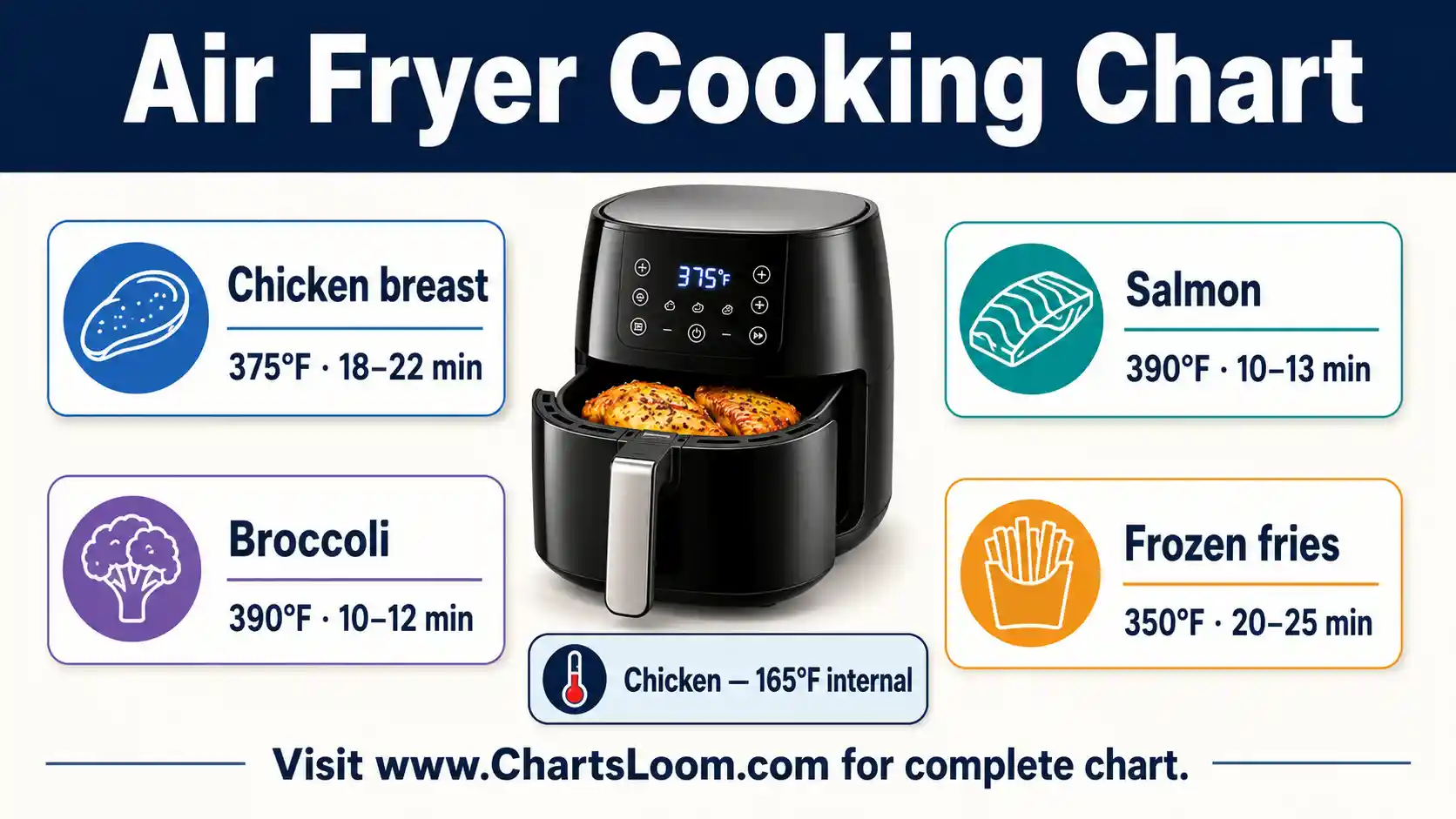
Two ½-to-¾-pound breasts start at 375°F for 18–22 minutes and must reach 165°F.
How long do chicken wings take?
Two pounds of wings start at 390°F for 22–26 minutes and must reach 165°F.
How long does salmon take?
Two 4-ounce fillets start at 390°F for 10–13 minutes and need 145°F or an approved visual endpoint.
How long do frozen fries take?
One pound starts at 350°F for 20–25 minutes; shake during cooking.
Should frozen food be thawed first?
Only when the package, recipe, or appliance guide requires thawing.
Why does basket shaking matter?
Shaking moves shielded surfaces into the hot airflow for more even browning.
Can browned meat still be unsafe?
Yes. Exterior color cannot verify the temperature at the center.
Which temperature is the appliance setting?
The air-fryer setting controls the cooking air; it is not the food's internal temperature.
Three-part cooking model
Match the food, start the range, and verify doneness
A useful air-fryer row combines a specific amount and preparation with an appliance setting. The last step is always a real finish check, because elapsed time cannot measure internal temperature.
Match the food
amount · cut · state
Choose a row with the same food form, size, and starting state.
Start the range
setting · time
Use the low end first, then shake, turn, and inspect progress.
Verify the finish
texture · internal °F
Use a thermometer whenever a safe internal endpoint applies.
Start with food-specific amounts and preparations
Air Fryer Quick Reference
Use these popular entries as starting settings, then verify texture and the applicable safe internal temperature.
Swipe horizontally inside the table to view every column.
| Food | Air-fryer setting | Time | Reference amount | Finish check |
|---|---|---|---|---|
| Broccoli | 390°F (199°C) | 10–12 min | 1 head | Tender-crisp with browned edges |
| Brussels sprouts | 390°F (199°C) | 15–20 min | 1 lb | Tender centers and browned outer leaves |
| Fresh hand-cut fries, thin | 390°F (199°C) | 20–24 min | 1 lb | Golden and crisp |
| Chicken breast, boneless | 375°F (191°C) | 18–22 min | 2 breasts (½–¾ lb each) | 165°F (74°C) in the thickest part |
| Chicken thighs, bone-in | 390°F (199°C) | 22–28 min | 4 thighs (6–10 oz each) | 165°F (74°C) in the thickest part |
| Chicken wings | 390°F (199°C) | 22–26 min | 2 lb | 165°F (74°C); crisp skin |
| Salmon fillets | 390°F (199°C) | 10–13 min | 2 fillets (4 oz each) | 145°F (63°C) or opaque and flakes easily |
| Shrimp, large | 390°F (199°C) | 7–10 min | 16 large shrimp | Flesh pearly or white and opaque |
| Beef burgers | 375°F (191°C) | 8–10 min | 4 quarter-pound patties | 160°F (71°C) for ground beef |
| Pork chops, boneless | 375°F (191°C) | 14–17 min | 4 chops (8 oz each) | 145°F (63°C), then rest 3 minutes |
| Frozen chicken nuggets | 390°F (199°C) | 10–13 min | 12 oz | Hot throughout; follow package directions |
| Frozen French fries, 1 lb | 350°F (177°C) | 20–25 min | 1 lb | Golden and crisp |
- • Times assume the listed amount and preparation in the AF100 cooking chart.
- • Appliance temperature is not the same as food internal temperature.
Download or export
Air Fryer Vegetables and Potatoes
Compare source-chart amounts, cut sizes, oil, temperatures, and time ranges for fresh vegetables and potatoes.
Swipe horizontally inside the table to view every column.
| Food | Amount | Preparation | Oil | Temperature | Time | Finish check |
|---|---|---|---|---|---|---|
| Asparagus | 1 bunch | Whole; stems trimmed | 2 tsp | 390°F (199°C) | 8–12 min | Tender-crisp and browned at the tips |
| Beets, whole | 6 small or 4 large (about 2 lb) | Whole | None | 390°F (199°C) | 45–60 min | Knife enters the center with little resistance |
| Bell peppers for roasting | 4 peppers | Whole | None | 400°F (204°C) | 25–30 min | Skin blistered; flesh softened |
| Broccoli | 1 head | Cut into 1-inch florets | 1 Tbsp | 390°F (199°C) | 10–12 min | Tender-crisp with browned edges |
| Brussels sprouts | 1 lb | Halved; stems removed | 1 Tbsp | 390°F (199°C) | 15–20 min | Tender centers and browned outer leaves |
| Butternut squash | 1–1½ lb | Cut into 1–2-inch pieces | 1 Tbsp | 390°F (199°C) | 20–25 min | Fork-tender with browned edges |
| Carrots | 1 lb | Peeled; cut into ½-inch pieces | 1 Tbsp | 390°F (199°C) | 13–16 min | Tender with caramelized edges |
| Cauliflower | 1 head | Cut into 1-inch florets | 2 Tbsp | 390°F (199°C) | 15–20 min | Tender-crisp with browned edges |
| Corn on the cob | 4 ears | Whole ears; husks removed | 1 Tbsp | 390°F (199°C) | 12–15 min | Hot kernels with light browning |
| Green beans | 12 oz | Trimmed | 1 Tbsp | 390°F (199°C) | 8–10 min | Tender-crisp and blistered |
| Kale chips | 6 packed cups | Torn into pieces; stems removed | None in source chart | 300°F (149°C) | 8–10 min | Dry and crisp; not scorched |
| Mushrooms | 8 oz | Cleaned; quartered | 1 Tbsp | 390°F (199°C) | 7–9 min | Tender and browned |
| Russet potato wedges | 1½ lb | Cut into 1-inch wedges | 1 Tbsp | 390°F (199°C) | 18–20 min | Tender centers and crisp edges |
| Fresh hand-cut fries, thin | 1 lb | Soak 30 minutes; drain and pat very dry | ½–3 Tbsp canola oil | 390°F (199°C) | 20–24 min | Golden and crisp |
| Fresh hand-cut fries, thick | 1 lb | Soak 30 minutes; drain and pat very dry | ½–3 Tbsp canola oil | 390°F (199°C) | 23–26 min | Golden with tender centers |
| Russet potatoes, whole | 4 potatoes (6–8 oz each) | Pierce each potato three times | None | 390°F (199°C) | 30–35 min | Soft center; crisp skin |
| Sweet potato chunks | 1½ lb | Cut into 1-inch chunks | 1 Tbsp | 390°F (199°C) | 15–20 min | Fork-tender with browned edges |
| Sweet potatoes, whole | 4 potatoes (6–8 oz each) | Pierce each potato three times | None | 390°F (199°C) | 30–35 min | Soft through the center |
| Zucchini | 1 lb | Quarter lengthwise; cut into 1-inch pieces | 1 Tbsp | 390°F (199°C) | 15–18 min | Tender with browned cut faces |
- • Dry washed produce before cooking when surface moisture would inhibit browning.
- • Shake or toss loose pieces and check at the low end of each range.
Download or export
Air Fryer Chicken Times
Use the listed amounts and cut types as starting points for chicken breasts, thighs, and wings.
Swipe horizontally inside the table to view every column.
| Food | Amount | Preparation | Oil | Temperature | Time | Required endpoint |
|---|---|---|---|---|---|---|
| Chicken breast, bone-in | 2 breasts (¾–1½ lb each) | Bone-in | Brush with oil | 375°F (191°C) | 25–35 min | 165°F (74°C) in the thickest part |
| Chicken breast, boneless | 2 breasts (½–¾ lb each) | Boneless | Brush with oil | 375°F (191°C) | 18–22 min | 165°F (74°C) in the thickest part |
| Chicken thighs, bone-in | 4 thighs (6–10 oz each) | Bone-in | Brush with oil | 390°F (199°C) | 22–28 min | 165°F (74°C) in the thickest part |
| Chicken thighs, boneless | 4 thighs (4–8 oz each) | Boneless | Brush with oil | 390°F (199°C) | 18–22 min | 165°F (74°C) in the thickest part |
| Chicken wings | 2 lb | Drumettes and flats | 1 Tbsp | 390°F (199°C) | 22–26 min | 165°F (74°C); crisp skin |
- • All poultry must reach 165°F (74°C) in the thickest part.
- • Do not let bone contact the thermometer sensor.
Download or export
Air Fryer Fish and Seafood Times
Compare starting settings for crab cakes, lobster tails, salmon, and shrimp.
Swipe horizontally inside the table to view every column.
| Food | Amount | Preparation | Oil | Temperature | Time | Required endpoint |
|---|---|---|---|---|---|---|
| Crab cakes | 2 cakes (6–8 oz each) | Chilled, formed cakes | Brush with oil | 350°F (177°C) | 12–15 min | Hot center; browned exterior |
| Lobster tails | 4 tails (3–4 oz each) | Whole | None | 375°F (191°C) | 5–8 min | Flesh pearly or white and opaque |
| Salmon fillets | 2 fillets (4 oz each) | Whole fillets | Brush with oil | 390°F (199°C) | 10–13 min | 145°F (63°C) or opaque and flakes easily |
| Shrimp, large | 16 large shrimp | Peeled; tails on | 1 Tbsp | 390°F (199°C) | 7–10 min | Flesh pearly or white and opaque |
- • Finfish needs 145°F (63°C), or an approved opaque, easy-flaking endpoint.
- • Shrimp, lobster, crab, and scallops should become pearly or white and opaque.
Download or export
Air Fryer Beef, Pork, Bacon, and Sausage
Use time as a planning range and internal temperature as the safety endpoint for burgers, steaks, chops, tenderloin, and sausage.
Swipe horizontally inside the table to view every column.
| Food | Amount | Preparation | Oil | Temperature | Time | Required endpoint |
|---|---|---|---|---|---|---|
| Beef burgers | 4 quarter-pound patties | 80% lean; 1 inch thick | None | 375°F (191°C) | 8–10 min | 160°F (71°C) for ground beef |
| Beef steaks | 2 steaks (8 oz each) | Whole steaks | None | 390°F (199°C) | 10–20 min | At least 145°F (63°C), then rest 3 minutes |
| Bacon | 4 strips | Cut in half | None | 350°F (177°C) | 8–10 min | Cooked to the preferred crispness |
| Pork chops, bone-in | 2 chops (10–12 oz each) | Thick-cut; bone-in | Brush with oil | 375°F (191°C) | 15–17 min | 145°F (63°C), then rest 3 minutes |
| Pork chops, boneless | 4 chops (8 oz each) | Boneless | Brush with oil | 375°F (191°C) | 14–17 min | 145°F (63°C), then rest 3 minutes |
| Pork tenderloin | 2 tenderloins (1–1½ lb each) | Whole | Brush with oil | 375°F (191°C) | 25–35 min | 145°F (63°C), then rest 3 minutes |
| Sausages | 4 sausages | Whole | None | 390°F (199°C) | 8–10 min | 160°F (71°C); poultry sausage needs 165°F (74°C) |
- • Whole beef and pork cuts need 145°F (63°C) plus a 3-minute rest.
- • Ground beef and pork sausage need 160°F (71°C); poultry sausage needs 165°F (74°C).
Download or export
Air Fryer Frozen Food Times
Use these model-specific starting settings for common frozen foods, while following package directions when they differ.
Swipe horizontally inside the table to view every column.
| Food | Amount | Preparation | Oil | Temperature | Time | Finish check |
|---|---|---|---|---|---|---|
| Frozen chicken cutlets | 5 cutlets | Cook from frozen; follow package directions when different | None | 390°F (199°C) | 18–21 min | 165°F (74°C) if raw; package-defined if fully cooked |
| Frozen chicken nuggets | 12 oz | Single layer; shake during cooking | None | 390°F (199°C) | 10–13 min | Hot throughout; follow package directions |
| Frozen fish fillets | 6 fillets | Cook from frozen | None | 390°F (199°C) | 14–16 min | 145°F (63°C) if raw; package-defined if fully cooked |
| Frozen fish sticks | 18 sticks (11 oz) | Single layer; shake or turn | None | 390°F (199°C) | 10–13 min | Hot and crisp; follow package directions |
| Frozen French fries, 1 lb | 1 lb | Cook from frozen; shake at least once | None | 350°F (177°C) | 20–25 min | Golden and crisp |
| Frozen French fries, 2 lb | 2 lb | Cook from frozen; shake frequently | None | 360°F (182°C) | 28–32 min | Golden and crisp |
| Frozen mozzarella sticks | 11 oz | Cook from frozen in a single layer | None | 375°F (191°C) | 8–10 min | Crisp exterior; remove before cheese leaks |
| Frozen pot stickers | 24 oz (about 20) | Cook from frozen; turn or shake | None | 390°F (199°C) | 12–14 min | Hot center and crisp edges |
| Frozen pizza rolls | 20 oz (about 40) | Cook from frozen; shake during cooking | None | 390°F (199°C) | 12–15 min | Hot center; let filling cool before eating |
| Frozen popcorn shrimp | 14–16 oz | Cook from frozen; shake during cooking | None | 390°F (199°C) | 9–11 min | Hot and crisp; follow package directions |
| Frozen tater tots | 1 lb | Cook from frozen; shake during cooking | None | 360°F (182°C) | 18–22 min | Golden and crisp |
- • Do not assume every breaded frozen product is fully cooked.
- • Package directions account for the product formulation and should take priority when different.
Download or export
Deterministic browser-only tool
Air Fryer Cooking Planner
Search the cited chart, choose a supported food, and copy its starting amount, preparation, temperature, time range, and finish check. The converter also subtracts 25°F from a conventional-oven setting. All calculations run locally in your browser.
Find a supported food
Poultry
Chicken breast, boneless
- Amount
- 2 breasts (½–¾ lb each)
- Preparation
- Boneless
- Oil
- Brush with oil
- Air-fryer setting
- 375°F (191°C)
- Starting time
- 18–22 minutes
- Finish check
- 165°F (74°C) in the thickest part
Convert a conventional-oven temperature
Enter 200–550°F or 93–288°C. The result applies the cited model-specific rule: subtract 25°F, then check progress frequently. It does not calculate a universal time reduction.
Air-fryer starting setting
375°F · 191°C
Converted from 400°F. Check food frequently.
What it does
It retrieves a fixed source-chart row and converts its displayed temperature to Celsius.
Why it helps
It keeps amount, cut, oil, setting, time, and endpoint together in one copyable plan.
Example use
Select salmon to see the 4-ounce fillet reference and its 145°F safety endpoint.
Tool boundary
It cannot scale time by weight, test temperature, or certify that food is safe.
Separate appliance heat from food temperature
Safe Internal Temperature Chart
Match each food type to its U.S. minimum internal temperature, rest time, and thermometer guidance.
Swipe horizontally inside the table to view every column.
| Food | Type | Internal endpoint | Rest | How to apply it |
|---|---|---|---|---|
| Beef, bison, veal, goat, and lamb | Steaks, roasts, and chops | 145°F (63°C) | 3 minutes | Measure the thickest part; avoid bone, fat, and gristle. |
| Ground meat and sausage | Beef, pork, veal, goat, and lamb | 160°F (71°C) | None specified | Check the center of the thickest patty or sausage. |
| Poultry | Chicken, turkey, duck, and other poultry | 165°F (74°C) | None specified | Applies to breasts, thighs, wings, ground poultry, giblets, and stuffing. |
| Raw ham | Fresh or cook-before-eating ham | 145°F (63°C) | 3 minutes | Check the thickest portion. |
| Precooked ham | Reheating | 165°F (74°C) | None specified | USDA-inspected packaged cooked ham may be reheated to 140°F (60°C). |
| Pork | Steaks, roasts, and chops | 145°F (63°C) | 3 minutes | Time alone does not establish doneness. |
| Rabbit and venison | Wild or farm-raised | 160°F (71°C) | None specified | Check the thickest edible section. |
| Finfish | Whole fish or fillets | 145°F (63°C) | None specified | Alternative visual cue: opaque flesh that separates easily with a fork. |
| Shrimp, lobster, crab, and scallops | Shellfish flesh | Visual endpoint | None specified | Cook until the flesh is pearly or white and opaque. |
| Clams, oysters, and mussels | Shellfish in shell | Visual endpoint | None specified | Cook until shells open; discard shells that remain closed. |
| Raw eggs | Whole eggs | Visual endpoint | None specified | Cook until both yolk and white are firm. |
| Egg dishes | Frittata, quiche, and similar dishes | 160°F (71°C) | None specified | Measure near the center of the dish. |
| Casseroles | Meat and meatless casseroles | 165°F (74°C) | None specified | Check the coolest central area. |
| Leftovers | Any reheated leftovers | 165°F (74°C) | None specified | Verify the center, especially in dense portions. |
- • Measure internal food temperature with a food thermometer before serving.
- • A browned exterior does not prove the center reached a safe temperature.
Download or export
Air Fryer Fahrenheit to Celsius Chart
Convert common air-fryer settings from degrees Fahrenheit to rounded degrees Celsius.
Swipe horizontally inside the table to view every column.
| Fahrenheit | Celsius | Typical use |
|---|---|---|
| 250°F | 121°C | gentle drying or warming range |
| 275°F | 135°C | gentle drying or warming range |
| 300°F | 149°C | gentle drying or warming range |
| 320°F | 160°C | gentle drying or warming range |
| 325°F | 163°C | moderate air-frying range |
| 340°F | 171°C | moderate air-frying range |
| 350°F | 177°C | moderate air-frying range |
| 360°F | 182°C | moderate air-frying range |
| 365°F | 185°C | moderate air-frying range |
| 375°F | 191°C | high-heat browning range |
| 380°F | 193°C | high-heat browning range |
| 390°F | 199°C | high-heat browning range |
| 400°F | 204°C | very high heat; check frequently |
| 410°F | 210°C | very high heat; check frequently |
| 425°F | 218°C | very high heat; check frequently |
| 450°F | 232°C | very high heat; check frequently |
Formula: °C = (°F − 32) × 5 ÷ 9.
- • Celsius values are rounded to the nearest whole degree.
- • Use the exact increments supported by your appliance.
Download or export
Conventional Oven to Air Fryer Conversion
Apply the AF100 guide's 25°F temperature reduction as a starting point for recipes suitable for circulating hot air.
Swipe horizontally inside the table to view every column.
| Conventional oven | Air-fryer starting setting | Time approach |
|---|---|---|
| 250°F (121°C) | 225°F (107°C) | Start with the same recipe time, but check progress early and often. |
| 275°F (135°C) | 250°F (121°C) | Start with the same recipe time, but check progress early and often. |
| 300°F (149°C) | 275°F (135°C) | Start with the same recipe time, but check progress early and often. |
| 325°F (163°C) | 300°F (149°C) | Start with the same recipe time, but check progress early and often. |
| 350°F (177°C) | 325°F (163°C) | Start with the same recipe time, but check progress early and often. |
| 375°F (191°C) | 350°F (177°C) | Start with the same recipe time, but check progress early and often. |
| 400°F (204°C) | 375°F (191°C) | Start with the same recipe time, but check progress early and often. |
| 425°F (218°C) | 400°F (204°C) | Start with the same recipe time, but check progress early and often. |
| 450°F (232°C) | 425°F (218°C) | Start with the same recipe time, but check progress early and often. |
| 475°F (246°C) | 450°F (232°C) | Start with the same recipe time, but check progress early and often. |
| 500°F (260°C) | 475°F (246°C) | Start with the same recipe time, but check progress early and often. |
Starting rule: air-fryer temperature = oven temperature − 25°F.
- • This conversion changes temperature only; it does not guarantee a shorter fixed time.
- • Check food frequently to prevent overcooking.
Download or export
Control airflow, movement, and thermometer placement
How to Use an Air Fryer Cooking Chart
Follow this sequence to connect a chart setting with food preparation, airflow, progress checks, and safe doneness.
Swipe horizontally inside the table to view every column.
| Step | Action | What to do | Why it matters |
|---|---|---|---|
| 1 | Read the recipe, package, and appliance guide | Identify food state, amount, cut size, and model-specific limits. | A package or appliance instruction can override a general chart. |
| 2 | Thaw only when required | Keep food refrigerated while thawing; do not improvise with raw products. | Some frozen foods cook from frozen, while others require thawing. |
| 3 | Cut pieces evenly | Use similar thicknesses so pieces finish together. | Thick pieces generally need more time than thin pieces. |
| 4 | Dry the surface | Pat washed vegetables, potatoes, and proteins dry when appropriate. | Less surface moisture supports browning and reduces steaming. |
| 5 | Preheat when the model or recipe calls for it | The AF100 guide recommends a 3-minute preheat. | Other models may preheat automatically or use different instructions. |
| 6 | Arrange an even layer | Leave room for hot air to move around food. | Overlapping can produce pale, uneven results. |
| 7 | Set the starting time and temperature | Use the amount and preparation shown in the matching row. | A chart value is a starting range, not a guarantee. |
| 8 | Shake, toss, or turn | Redistribute loose food and turn larger pieces during cooking. | Movement exposes new surfaces to circulating air. |
| 9 | Check early | Inspect browning before the top of the range. | Appliance power, basket shape, load, and food thickness change timing. |
| 10 | Verify doneness | Use an instant-read thermometer for meat, poultry, seafood, egg dishes, casseroles, and leftovers. | Safe internal temperature takes priority over elapsed time. |
| 11 | Rest when required | Rest steaks, chops, roasts, and raw ham for 3 minutes after 145°F. | The required rest is part of the safety endpoint. |
| 12 | Remove food promptly | Transfer finished food out of the hot basket. | Residual heat can continue browning and drying food. |
- • The correct sequence varies with the product, recipe, and appliance.
- • Food-safety endpoints override appearance and elapsed time.
Download or export
Basket Loading and Airflow Guide
See how layering, moisture, size, and appliance shape affect hot-air contact and browning.
Swipe horizontally inside the table to view every column.
| Situation | Starting approach | What changes | Practical response |
|---|---|---|---|
| Single even layer | Best starting arrangement | Air reaches more surface area | Turn once if the underside browns slowly |
| Loose fries or tots | Some overlap is common | Pieces shield one another | Shake more than once for a large load |
| Overlapping chicken pieces | Avoid when possible | Skin and breading may stay pale where pieces touch | Cook in batches or rearrange |
| Large vegetable florets | Keep pieces similar in size | Uneven sizes finish at different times | Cut consistently and toss |
| Wet vegetables | Dry before oiling | Surface water promotes steaming | Pat dry, then add a thin oil coating |
| Lightweight food | Can move in strong airflow | Fan may lift bread or loose toppings | Secure safely according to the appliance guide |
| Battered food | Loose wet batter may drip or blow | Air movement does not set liquid batter like deep oil | Use a firmly pressed breading when the recipe supports it |
| Dense whole potato | Longer range | Heat must reach the center | Pierce as directed and verify tenderness |
| Thin fish fillet | Shorter range | Small thickness heats quickly | Check before the upper time |
| Two-basket appliance | Follow model-specific guidance | Each zone can change airflow and power behavior | Do not assume a single-basket chart transfers exactly |
| Air-fryer oven rack | Rotate when the appliance guide recommends it | Top and bottom rack exposure can differ | Swap rack positions and turn food |
| Basket filled above guidance | Not recommended | Restricted circulation slows and unevenly cooks food | Reduce the load or divide it into batches |
- • Never block required vents or exceed appliance fill limits.
- • Use the manual for model-specific rack, basket, and accessory instructions.
Download or export
Where to Check Internal Temperature
Place the thermometer sensor in the thickest edible section without touching bone, the basket, or the pan.
Swipe horizontally inside the table to view every column.
| Food | Probe location | Avoid | Endpoint |
|---|---|---|---|
| Chicken breast | Thickest part from the side | Avoid bone | 165°F (74°C) |
| Chicken thigh | Thickest meat near, but not touching, bone | Check more than one piece | 165°F (74°C) |
| Chicken wings | Meaty section | Small pieces can be difficult to probe | 165°F (74°C) |
| Burger | Insert sideways into the center | Surface color is not a safety test | 160°F (71°C) |
| Steak | Center of the thickest section | Avoid fat and bone | 145°F (63°C), then rest 3 minutes |
| Pork chop | Center of the thickest section | Avoid bone | 145°F (63°C), then rest 3 minutes |
| Pork tenderloin | Center of the thickest portion | Check the coolest point | 145°F (63°C), then rest 3 minutes |
| Sausage | Insert from the end toward the center | Do not rely on casing color | 160°F (71°C), or 165°F (74°C) for poultry sausage |
| Fish fillet | Thickest part | Probe gently to avoid splitting | 145°F (63°C) or approved visual endpoint |
| Egg dish | Near the center | Avoid touching the pan | 160°F (71°C) |
| Casserole | Center and other cool-looking spots | Dense fillings can heat unevenly | 165°F (74°C) |
| Leftovers | Thickest or coolest central area | Check multiple spots in irregular portions | 165°F (74°C) |
- • Check more than one piece when sizes differ.
- • Clean the thermometer probe between foods to prevent cross-contamination.
Download or export
Apply the chart, diagnose the result, and adjust
Worked Air Fryer Cooking Examples
Each example shows how to turn a source-chart row into a starting setting, an early check, and a final endpoint.
Swipe horizontally inside the table to view every column.
| Food | Starting amount | Prepare | Start | Check and finish |
|---|---|---|---|---|
| Boneless chicken breasts | 2 breasts, each ½–¾ lb | Brush with oil; preheat if the appliance guide calls for it. | Start at 375°F for 18 minutes. | Check the thickest part; continue as needed to 165°F. |
| Bone-in chicken thighs | 4 thighs, each 6–10 oz | Brush with oil and arrange without tight overlap. | Start at 390°F for 22 minutes. | Turn or rearrange; continue as needed to 165°F. |
| Chicken wings | 2 lb | Separate drumettes and flats; toss with 1 Tbsp oil. | Start at 390°F for 22 minutes. | Shake or turn; verify 165°F and desired crispness. |
| Salmon | 2 fillets, 4 oz each | Brush lightly with oil. | Start at 390°F for 10 minutes. | Remove at 145°F or when opaque and flaking easily. |
| Shrimp | 16 large, peeled, tails on | Toss with 1 Tbsp oil; spread evenly. | Start at 390°F for 7 minutes. | Continue only until pearly or white and opaque. |
| Beef burgers | 4 quarter-pound patties, 1 inch thick | Arrange patties in one layer. | Start at 375°F for 8 minutes. | Check each patty; ground beef needs 160°F. |
| Boneless pork chops | 4 chops, 8 oz each | Brush with oil and separate the chops. | Start at 375°F for 14 minutes. | Continue to 145°F, then rest for 3 minutes. |
| Broccoli | 1 head cut into 1-inch florets | Dry well; toss with 1 Tbsp oil. | Start at 390°F for 10 minutes. | Toss and remove when tender-crisp and browned. |
| Brussels sprouts | 1 lb, halved and stemmed | Dry well; toss with 1 Tbsp oil. | Start at 390°F for 15 minutes. | Shake; continue toward 20 minutes for softer centers. |
| Fresh thin fries | 1 lb | Soak 30 minutes, drain, pat very dry, then oil. | Start at 390°F for 20 minutes. | Shake repeatedly and continue toward 24 minutes as needed. |
| Frozen chicken nuggets | 12 oz | Use a single layer when possible. | Start at 390°F for 10 minutes. | Shake and follow the package if its directions differ. |
| Frozen fries | 1 lb | Cook from frozen; do not thaw. | Start at 350°F for 20 minutes. | Shake more than once and continue toward 25 minutes for crispness. |
- • Continue cooking when a required internal temperature has not been reached.
- • Stop earlier when quality is complete and no minimum internal temperature applies.
Download or export
Air Fryer Problems and Fixes
Diagnose common texture, browning, timing, loading, and temperature problems without treating time as proof of safety.
Swipe horizontally inside the table to view every column.
| Problem | Likely cause | Adjustment | Safety boundary |
|---|---|---|---|
| Food is pale | Crowded basket or wet surface | Dry food, reduce the load, and expose more surface area | Check doneness before adding more time |
| Food browns unevenly | Pieces overlap or differ in size | Cut evenly and shake, toss, or turn | Rearrange hot food with safe utensils |
| Outside browns before center cooks | Temperature too high for thickness | Lower the setting and continue checking the center | Use a thermometer for protein |
| Food dries out | Cooked past its endpoint | Start checking at the low end of the range | Remove finished food promptly |
| Fresh fries are soft | Excess moisture or starch; insufficient shaking | Soak as directed, pat very dry, oil lightly, and shake | Do not overload the basket |
| Frozen fries are limp | Large load or poor redistribution | Use a smaller batch and shake more than once | Keep them frozen until cooking |
| Breading comes off | Loose coating or strong airflow | Press breading firmly and follow a tested recipe | Avoid unsupported loose wet batter |
| Light food moves | Fan lifts low-mass pieces | Secure only as the appliance guide permits | Never block required airflow |
| Smoke appears | Rendered fat, crumbs, residue, or unsuitable material | Stop safely and follow the appliance manual | Clean the cooled appliance before reuse |
| Raw poultry finishes late | Pieces are thicker, colder, or crowded | Continue cooking and recheck the thickest part | Do not serve below 165°F |
| Meat looks done but reads low | Surface browning occurred before safe center temperature | Continue cooking and verify again | Color alone is not a safety test |
| Package time differs from chart | Product formulation or portion differs | Use package and appliance instructions | Still verify applicable safe temperature |
| Converted oven recipe cooks too fast | Air-fryer convection is more intense | Check earlier and lower heat if the recipe allows | The 25°F rule is a starting adjustment |
| One basket differs from another | Power, geometry, airflow, and load differ | Record the successful setting for that appliance | Do not treat one model chart as universal |
- • Stop the appliance and follow its manual if smoke, electrical issues, or an error message appears.
- • Never serve raw animal food below its applicable safe endpoint.
Download or export
Why Air Fryer Cooking Times Vary
Time changes with the food, load, appliance, airflow, preparation, and desired texture.
Swipe horizontally inside the table to view every column.
| Variable | Effect | Control | Main impact |
|---|---|---|---|
| Food thickness | Thicker pieces need longer for heat to reach the center | Measure the thickest point | Time and thermometer |
| Food amount | A larger mass can slow browning and heating | Match the amount in the source row | Time and airflow |
| Starting temperature | Refrigerated, room-temperature, and frozen food heat differently | Use the stated food state | Time and safety |
| Piece size | Small pieces expose more area to hot air | Cut pieces uniformly | Time and browning |
| Surface moisture | Water delays browning while it evaporates | Pat appropriate foods dry | Crispness |
| Oil coating | A thin coating can improve browning on many vegetables | Use the row or recipe amount | Color and texture |
| Basket crowding | Overlap blocks airflow | Cook an even layer or shake frequently | Time and evenness |
| Appliance wattage | Heat delivery differs across models | Check early on a new appliance | Time |
| Basket geometry | Depth and surface area change exposure | Use model-specific guidance | Time and browning |
| Preheating behavior | Some models preheat manually, automatically, or not at all | Follow the model manual | Starting conditions |
| Turning frequency | Redistribution exposes more surfaces | Shake or turn when safe and useful | Evenness |
| Desired texture | Crisper food may need time beyond safe doneness | Avoid overcooking after the safety endpoint | Quality |
- • A chart cannot normalize every air-fryer model or food size.
- • Record successful settings for your appliance and repeat the same preparation.
Download or export
Air Fryer Functions Compared
Distinguish air fry from roast, reheat, bake, broil, dehydrate, keep-warm, and oven-conversion workflows.
Swipe horizontally inside the table to view every column.
| Function | Purpose | Typical foods | Boundary |
|---|---|---|---|
| Air fry | Crisping and browning with fast circulating air | Fries, wings, vegetables, breaded foods | Use the crisper plate when the model calls for it |
| Roast | Broader roasting function on supported models | Larger proteins and vegetables | Settings differ by model |
| Reheat | Restore heat and some surface crispness | Previously cooked foods | Leftovers must reach 165°F when applicable |
| Bake | Gentler enclosed baking on supported models | Small cakes, breads, and casseroles | Use a compatible pan and tested recipe |
| Broil or max crisp | Very high surface heat on supported models | Final browning or some frozen foods | Not available on every appliance |
| Dehydrate | Low-temperature moisture removal | Fruit, vegetables, herbs, or validated jerky recipes | Not equivalent to the air-fry times on this page |
| Keep warm | Holds cooked food on supported models | Short holding before serving | Follow the appliance manual and food-safety guidance |
| Conventional oven conversion | Adapts an oven recipe as a starting point | Recipes suitable for circulating hot air | Reduce the listed temperature by 25°F and check frequently |
- • Function names and temperature ranges differ across models.
- • This page's food times apply to air fry unless a row states otherwise.
Download or export
A general chart cannot normalize every food or appliance
Time changes with thickness, amount, starting temperature, moisture, basket crowding, wattage, preheating, airflow, and desired texture. The listed cooking values reproduce a specific AF100 guide and may not transfer exactly to another model. The planner does not scale time by weight, inspect food, read a thermometer, evaluate spoilage, or confirm safety. Package directions, tested recipes, appliance instructions, recalls, and measured internal temperature take priority.
Frequently asked questions
What temperature should I use in an air fryer?
Many foods cook between 350°F and 400°F, but the correct setting depends on the food, amount, cut size, and appliance.
How long does food take in an air fryer?
USDA gives a broad 5-to-25-minute range for many foods, while dense vegetables and large proteins can take longer.
Do I need to preheat an air fryer?
Preheating depends on the model and recipe. The Ninja AF100 guide recommends a 3-minute preheat.
How do I convert an oven temperature to an air fryer?
A useful model-specific starting rule is to reduce the conventional-oven temperature by 25°F and check food frequently.
Can I reduce oven cooking time by a fixed percentage?
No universal percentage works for every appliance and food. Keep the time as a planning range and check progress early.
How long do chicken breasts take in an air fryer?
Two boneless ½-to-¾-pound breasts start at 375°F for 18–22 minutes in the cited AF100 chart; each must reach 165°F.
How long do chicken wings take in an air fryer?
Two pounds of wings start at 390°F for 22–26 minutes in the cited chart and must reach 165°F.
How long does salmon take in an air fryer?
Two 4-ounce fillets start at 390°F for 10–13 minutes and need 145°F or opaque flesh that flakes easily.
How long do frozen fries take in an air fryer?
One pound starts at 350°F for 20–25 minutes in the cited chart; shake during cooking and adjust for the appliance.
Should I thaw frozen food before air frying?
It depends on the product. Follow the package and appliance instructions instead of assuming every frozen food cooks the same way.
Do I need oil in an air fryer?
Some foods need none, while many fresh vegetables benefit from a thin coating. Use the chart or tested recipe amount.
Why should I shake the air-fryer basket?
Shaking redistributes loose food so circulating air reaches surfaces that were touching or shielded.
Can color tell me when meat is safe?
No. Browning and color do not prove safety; use a food thermometer and the applicable minimum internal temperature.
What internal temperature does chicken need?
Chicken and all other poultry need 165°F (74°C) in the thickest part.
What internal temperature does pork need?
Pork steaks, roasts, and chops need 145°F (63°C) followed by a 3-minute rest; ground pork needs 160°F (71°C).
Why do air-fryer times vary?
Food thickness, amount, starting temperature, moisture, crowding, basket shape, wattage, and preheating all change cooking time.
Can this chart replace my appliance manual?
No. Use the appliance manual and product package first when they provide specific instructions or safety limits.
Can the cooking planner prove food is safe?
No. It retrieves reference settings and converts temperature; only proper thermometer checks can verify an internal endpoint.
Sources
USDA and FoodSafety.gov establish the safety framework. The SharkNinja guide supplies the model-specific food amounts, preparation, appliance settings, time ranges, and technique used in the cooking tables.
USDA Food Safety and Inspection Service — Air Fryers and Food Safety
Explains that air fryers are countertop convection appliances, gives a broad 350–400°F and 5–25 minute cooking range, and requires thermometer verification for safety.
https://www.fsis.usda.gov/food-safety/safe-food-handling-and-preparation/food-safety-basics/air-fryers-and-food-safety
FoodSafety.gov — Cook to a Safe Minimum Internal Temperature
Provides U.S. safe minimum internal temperatures and rest times for meat, poultry, seafood, eggs, casseroles, ham, and leftovers.
https://www.foodsafety.gov/food-safety-charts/safe-minimum-internal-temperatures
SharkNinja — AF100 Series Ninja Air Fryer Quick Start Guide and Cooking Charts
Supplies model-specific food amounts, preparation, oil, temperatures, time ranges, preheating, shaking, basket-loading, and oven-conversion guidance.
https://support.sharkninja.com/article/AF100-Series-Ninja-Air-Fryer-Quick-Start-Guide