Health & Medical · Hydration reference
Daily Water Intake Chart by Age, Sex and Life Stage
Compare total daily water references for infants, children, teenagers, adults, pregnancy, and breastfeeding. Learn what counts toward hydration, how exercise and heat change losses, and when a medical fluid limit overrides a general chart.
A water chart is not safe for every medical situation. Kidney disease, heart failure, liver disease, low blood sodium, dialysis, tube feeding, infant feeding, and procedure instructions can require a prescribed amount. Read the ChartsLoom Disclaimer.
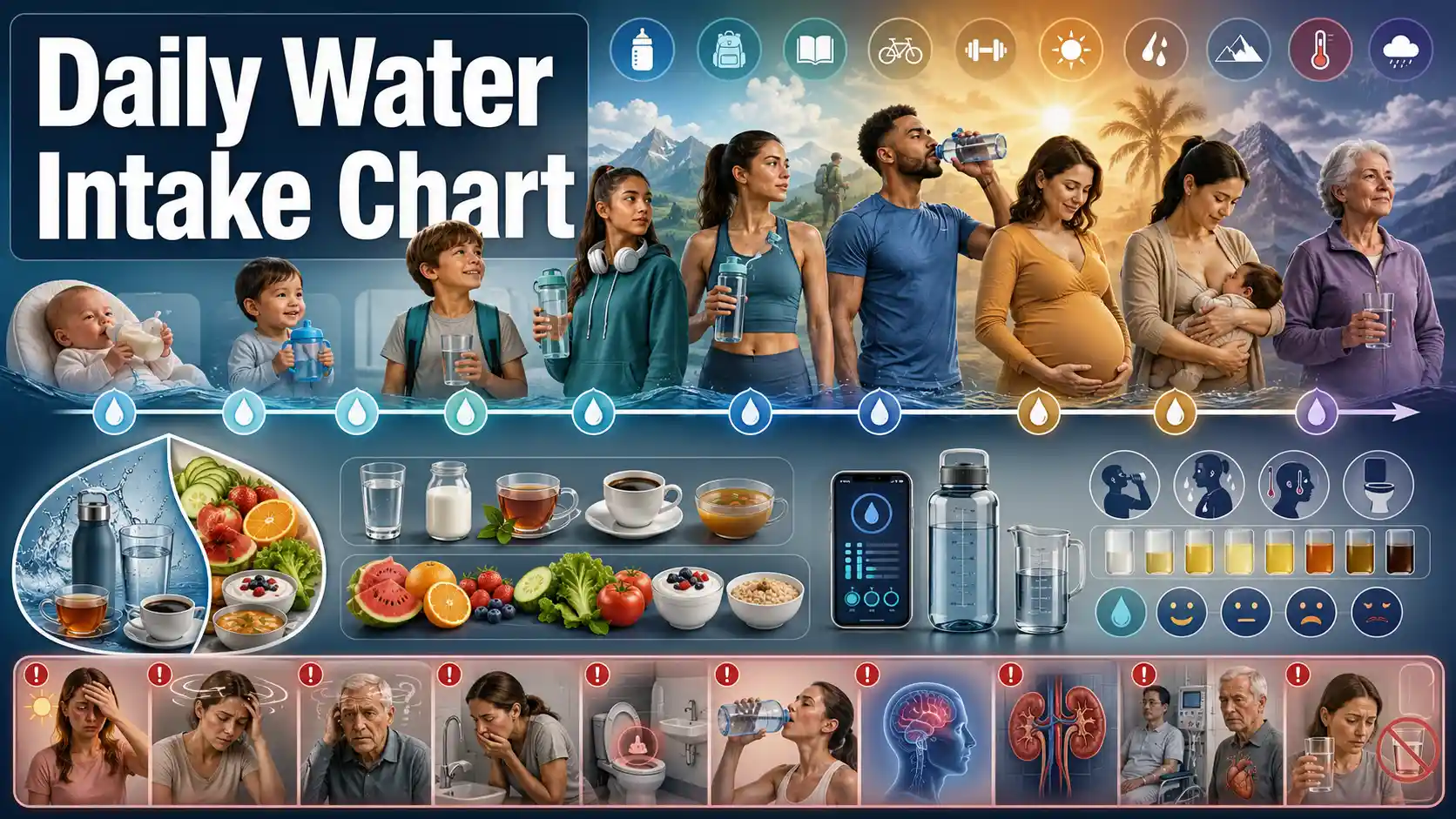
How much water should you have each day?
The National Academies total-water reference is 3.7 litres per day for adult men and 2.7 litres for adult women. Pregnancy raises the reference to 3.0 litres, and breastfeeding raises it to 3.8 litres.
These values include plain water, other beverages, and moisture in food. The National Academies water guidance states that people can be adequately hydrated below or above the Adequate Intake. Activity, climate, diet, pregnancy, breastfeeding, illness, and medical conditions change the practical amount.
- Adult male total water
- 3.7 L/day
- Adult female total water
- 2.7 L/day
- Pregnancy
- 3.0 L/day
- Breastfeeding
- 3.8 L/day
Includes beverages and moisture in food.
Includes beverages and moisture in food.
The total-water reference rises during pregnancy.
Lactation has the highest listed life-stage reference.
Daily total water intake by age, sex, and life stage
National Academies Adequate Intakes describe total water from plain water, all other beverages, and moisture in food. They are population reference values rather than exact minimums for every person.
Swipe horizontally inside the table to view every column.
| Life stage | Sex or context | Total water AI | Approximate 8-oz cups | Important interpretation |
|---|---|---|---|---|
| Birth–6 months | Infant | 0.7 L/day | 3.0 cups | Usually supplied by breast milk or correctly prepared formula; do not add plain water unless directed — No routine plain water before 6 months |
| 7–12 months | Infant | 0.8 L/day | 3.4 cups | Includes breast milk or formula, complementary foods, and small amounts of water |
| 1–3 years | All children | 1.3 L/day | 5.5 cups | Total water includes milk, water, other beverages, and food moisture |
| 4–8 years | All children | 1.7 L/day | 7.2 cups | Needs rise with heat, fever, diarrhea, vomiting, and active play |
| 9–13 years | Male | 2.4 L/day | 10.1 cups | Use thirst, meals, activity, weather, and urine pattern as practical context |
| 9–13 years | Female | 2.1 L/day | 8.9 cups | Use thirst, meals, activity, weather, and urine pattern as practical context |
| 14–18 years | Male | 3.3 L/day | 13.9 cups | Sports and heavy sweating can require additional fluid and electrolyte planning |
| 14–18 years | Female | 2.3 L/day | 9.7 cups | Sports and heavy sweating can require additional fluid and electrolyte planning |
| 19–30 years | Male | 3.7 L/day — Adult male total water reference | 15.6 cups | Total from beverages and food; not a plain-water prescription |
| 19–30 years | Female | 2.7 L/day — Adult female total water reference | 11.4 cups | Total from beverages and food; not a plain-water prescription |
| 31–50 years | Male | 3.7 L/day | 15.6 cups | Individual intake varies with climate, body size, diet, and activity |
| 31–50 years | Female | 2.7 L/day | 11.4 cups | Individual intake varies with climate, body size, diet, and activity |
| 51–70 years | Male | 3.7 L/day | 15.6 cups | Medicines, illness, and reduced thirst can change practical needs |
| 51–70 years | Female | 2.7 L/day | 11.4 cups | Medicines, illness, and reduced thirst can change practical needs |
| Older than 70 | Male | 3.7 L/day | 15.6 cups | Regular access and reminders can help when thirst sensation declines |
| Older than 70 | Female | 2.7 L/day | 11.4 cups | Regular access and reminders can help when thirst sensation declines |
| Pregnancy | Age 14–50 | 3.0 L/day | 12.7 cups | Total water reference; vomiting, heat, and activity may alter needs |
| Breastfeeding | Age 14–50 | 3.8 L/day | 16.1 cups | Lactation increases the total-water reference |
1 litre = 33.8 US fluid ounces. One US cup in this chart equals 8 fluid ounces or about 237 mL.
- • About 20% of total water commonly comes from food, but the percentage varies widely with diet.
- • Adequate Intake is not a strict threshold. Healthy people can remain hydrated below or above the listed value.
Download or export
Total water is more than plain drinking water
The National Academies reference includes plain water, all other beverages, and moisture in food. A commonly cited mixed-diet pattern is roughly 80% from beverages and 20% from food, but the actual split varies.
Age and sex
The official total-water reference changes across childhood and between male and female adolescent and adult groups.
Pregnancy and lactation
Total-water Adequate Intakes rise during pregnancy and rise further during breastfeeding.
Heat and activity
Sweat loss can increase fluid needs far beyond an ordinary temperate-climate day.
Medical limits
Kidney, heart, liver, endocrine, and sodium disorders can require a prescribed amount instead of a general target.
Adequate Intake is a reference, not a dehydration cutoff
Researchers could not establish one exact water requirement that applies to every healthy person, so the values are Adequate Intakes based largely on observed intake in adequately hydrated populations. Thirst, urine pattern, meals, weather, losses, and health status add essential context.
What counts toward daily total water intake
Total water is broader than plain drinking water. Beverages and moisture-rich foods contribute, although plain water is usually the simplest calorie-free option.
Swipe horizontally inside the table to view every column.
| Source | Counts toward total water? | Typical contribution | Important limitation |
|---|---|---|---|
| Plain water | Yes — Plain water counts toward total water | Direct hydration without calories | Tap and bottled-water safety depend on local supply and storage |
| Milk or fortified alternative | Yes | Fluid plus nutrients | Choose age-appropriate products and consider sugar content |
| Tea and coffee | Yes | Fluid; moderate caffeine still contributes | Large caffeine doses can affect sleep, anxiety, heart rhythm, or pregnancy guidance |
| Soup and broth | Yes | Substantial water with food | Sodium can be high |
| Fruit and vegetables | Yes | Food moisture plus fibre and nutrients | Contribution varies by food and portion |
| Yogurt, oatmeal, and cooked grains | Yes | Meaningful food moisture | Recipes and serving sizes differ |
| 100% fruit juice | Yes | Fluid and carbohydrate | Not a substitute for whole fruit; child portions should be limited |
| Sugar-sweetened drinks | Yes | Fluid plus added sugar | Routine use can add substantial calories without improving hydration quality |
| Sports drinks | Yes | Fluid, carbohydrate, and electrolytes | Usually unnecessary for short, light activity |
| Alcoholic drinks | Technically contain water | Unreliable hydration source | Alcohol impairs judgment and can worsen dehydration or heat risk — Alcohol is not a hydration strategy |
| Ice, gelatin, and frozen treats | Yes | Melt to liquid | Sugar and sodium content vary |
| Tube feeds and prescribed liquid nutrition | Yes | Counted in clinical fluid totals | Follow the healthcare plan and include flushes |
Food moisture commonly supplies roughly one-fifth of total water in mixed diets.
- • The beverage share can be much higher or lower than 80% depending on food choices and climate.
- • People following a medical fluid restriction must count all liquids and foods that melt at room temperature according to their care plan.
Download or export
Plain water is useful, but it is not the only source
The CDC water and healthier-drinks guidance explains that water supports normal function and helps prevent dehydration. Replacing sugary drinks with plain water can also reduce calorie intake, but milk, tea, coffee, soups, fruit, vegetables, and other foods still contribute to total water.
Practical hydration guide for infants, children, and teens
This practical guide complements the total-water reference table. It separates infant feeding from ordinary drinking-water advice and adds activity context.
Swipe horizontally inside the table to view every column.
| Age or situation | Practical fluid guidance | Main fluid source | Safety note |
|---|---|---|---|
| Birth–6 months — Infants under six months need no routine plain water | No routine extra plain water | Breast milk or correctly prepared infant formula | Extra water or diluted formula can cause water intoxication and poor nutrition |
| Around 6–12 months | About 4–8 oz plain water daily can be introduced — Small water amounts after about six months | Breast milk or formula remains the main fluid | Offer small amounts with complementary foods in a cup |
| 1–3 years | About 4 cups of fluids daily | Water and milk plus food moisture | Needs increase with heat, illness, and activity |
| 4–8 years | About 5 cups of fluids daily | Water and milk plus food moisture | Make water readily available throughout the day |
| Older children | About 7–8 cups of fluids daily as a practical starting point | Mostly water and other unsweetened fluids | Sex, body size, climate, and activity create variation |
| Age 9–12 during vigorous activity | About 3–8 oz every 20 minutes | Water for most activities | Use breaks and monitor heat symptoms |
| Teen during vigorous sweating | About 34–50 oz per hour in AAP practical guidance | Water; electrolytes may help during prolonged heavy sweating | Avoid forcing intake beyond thirst and context |
| Vomiting or diarrhea | Use age-appropriate oral rehydration guidance | Oral rehydration solution when indicated | Plain water alone may not replace sodium and glucose losses |
AAP practical beverage amounts are not identical to National Academies total-water AIs because food moisture and all beverages count in the AI.
- • Infants with fever, feeding difficulty, fewer wet diapers, vomiting, or diarrhea need pediatric guidance rather than a home water formula.
- • Do not dilute infant formula beyond the manufacturer or clinician instructions.
Download or export
Infants younger than 6 months should not receive routine plain water
The American Academy of Pediatrics hydration guidance states that breast milk or correctly prepared formula supplies infant fluid. Extra water or diluted formula can reduce nutrition and disturb sodium and other electrolytes.
Daily total-water reference checker
Select a life stage to convert the National Academies total-water Adequate Intake into litres, cups, or fluid ounces. The result includes beverages and food moisture and does not prescribe a personal plain-water minimum.
Total-water reference: 2.7 L
This is total water from beverages and food, not a requirement to drink 2.7 litres of plain water.
Rough beverage share: 2.2 L
This estimate assumes food provides about 20% of total water. It is not a plain-water target because milk, tea, coffee, soup, and other beverages also contribute.
Entered amount: 0% of the population reference
This percentage is descriptive only. Being below or above the Adequate Intake does not prove dehydration or overhydration, especially when food moisture is uncertain.
Water intake during exercise, heat, and heavy sweating
Sweat loss varies substantially. Use these ranges as safety context, then adjust to weather, workload, clothing, acclimatization, body size, and individual sweat rate.
Swipe horizontally inside the table to view every column.
| Situation | Practical approach | Electrolyte context | Caution |
|---|---|---|---|
| Light activity in mild weather | Drink normally and respond to thirst | Regular meals usually replace electrolytes | Do not force large volumes |
| Moderate work in heat under 2 hours | About 8 oz every 15–20 minutes — NIOSH heat-work drinking pace | Water is usually adequate with regular meals | NIOSH guidance is for occupational heat exposure |
| Heavy sweating for several hours | Replace fluid steadily during breaks | A balanced electrolyte drink may be useful | Avoid relying on salt tablets without professional guidance |
| Long endurance event | Use a personalized plan based on sweat rate and event conditions | Carbohydrate and sodium may be needed | Overdrinking can cause exercise-associated hyponatremia |
| Hot, humid weather | Start hydrated, schedule rest, and drink more than usual | Meals often replace routine sodium loss | Seek shade or cooling when symptoms appear |
| Cold or high altitude | Keep fluids accessible despite lower thirst | Energy and sodium needs depend on duration and conditions | Respiratory water loss and diuresis can increase |
| After exercise | Replace losses gradually with drinks and meals | Food supports sodium and carbohydrate replacement | Persistent dizziness, vomiting, confusion, or no urination needs assessment |
| Hourly upper caution | NIOSH advises generally not exceeding 6 cups per hour — Hourly upper caution | Excess water can dilute blood sodium | This is a safety ceiling, not an intake target |
8 US fluid ounces = 1 cup ≈ 237 mL. Six cups ≈ 1.4 L.
- • Body-weight change before and after a controlled session can help estimate personal sweat loss, but it should not be used to justify rapid overreplacement.
- • Fluid needs can be restricted in heart, kidney, liver, or endocrine disease even during hot weather.
Download or export
Heat guidance uses paced drinking, not unlimited water
For moderate work in heat lasting less than two hours, CDC and NIOSH recommendations use about one cup every 15–20 minutes and advise that intake generally should not exceed six cups per hour. This occupational guidance is a safety framework, not a universal sports prescription.
Dehydration signs from early clues to emergency symptoms
No single symptom proves dehydration. Interpret thirst, urine, intake, losses, temperature, mental status, medicines, and medical conditions together.
Swipe horizontally inside the table to view every column.
| Sign or symptom | Possible meaning | What to do | Urgency context |
|---|---|---|---|
| Thirst or dry mouth | Early fluid need or dry environment | Drink normally and review recent losses | Usually routine unless severe or persistent |
| Darker yellow urine | More concentrated urine | Increase fluid if no medical restriction | Vitamins, foods, and medicines can change colour |
| Less frequent urination | Lower intake or increased losses | Review heat, sweating, fever, vomiting, or diarrhea | Very little or no urine requires prompt care |
| Headache or fatigue | Can accompany dehydration but is nonspecific | Rest, cool down, and rehydrate gradually | Severe or unusual headache needs assessment |
| Dizziness when standing | Reduced circulating volume or another cause | Sit or lie down and drink if safe | Fainting, chest pain, or persistent dizziness is urgent |
| Rapid heartbeat | Heat strain, volume loss, fever, anxiety, or illness | Stop exertion and cool down | Persistent rapid pulse with weakness needs care |
| Dry skin or reduced tears in a child | Possible pediatric dehydration | Offer appropriate fluids and contact pediatric care | Lethargy or very few wet diapers is urgent |
| Confusion or unusual drowsiness — Confusion requires urgent assessment | Severe dehydration, heat illness, low sodium, infection, or another emergency | Seek emergency medical care | Emergency |
| Repeated vomiting | Ongoing fluid and electrolyte loss | Use medical advice and oral rehydration when appropriate | Inability to keep fluids down needs prompt care |
| High temperature with altered mental state | Possible heat stroke or severe illness | Emergency cooling and emergency services | Emergency — Possible heat-stroke emergency |
Urine colour is a rough clue, not a diagnostic test.
- • Older adults and young children can deteriorate faster and may not report thirst clearly.
- • Tea- or cola-coloured urine with severe muscle pain after exertion can indicate rhabdomyolysis rather than ordinary dehydration.
Download or export
Overhydration and low-sodium warning signs
Drinking far more water than the kidneys can excrete can dilute blood sodium. The risk rises during prolonged exercise, water-drinking challenges, and some medical conditions or medicines.
Swipe horizontally inside the table to view every column.
| Pattern or symptom | Why it matters | Safer response | Urgency |
|---|---|---|---|
| Forced drinking without thirst | Can exceed actual losses | Use paced intake and event-specific guidance | Preventive |
| Rapidly drinking several litres | Kidneys require time to excrete water | Spread intake and avoid challenges | Potentially dangerous |
| Weight gain during endurance exercise | Can indicate fluid intake above losses | Stop forced drinking and seek event medical advice | Prompt review |
| Nausea, bloating, or headache after heavy water intake | Possible early water overload or low sodium | Stop excess intake and obtain medical advice | Prompt review |
| Confusion or marked drowsiness — Possible severe hyponatremia | Possible severe hyponatremia | Emergency medical care | Emergency |
| Seizure | Severe neurological complication | Emergency services immediately | Emergency — Emergency seizure response |
| Kidney, heart, liver, or hormone disorder | Water excretion may be impaired | Follow the prescribed fluid plan | Individualized |
| Diuretic, antidepressant, seizure, or other medicine context | Some medicines can contribute to low sodium | Review symptoms and medicines with a clinician | Do not stop medicine independently |
The National Academies did not establish a daily tolerable upper intake level for water, but rapid excess intake can still be harmful.
- • A lack of an official daily upper limit does not mean unlimited water is safe.
- • Symptoms of dehydration and hyponatremia can overlap; confusion, seizure, or severe illness needs urgent professional assessment.
Download or export
Confusion and seizure can occur with too little or too much water
Severe dehydration, heat illness, infection, and water-induced low sodium can produce overlapping neurological symptoms. Do not keep forcing water into a confused, vomiting, drowsy, or seizing person. Seek emergency medical help.
Factors that raise, lower, or complicate water needs
Daily intake changes with losses, environment, diet, physiology, medicines, and disease. A single body-weight formula cannot represent every situation.
Swipe horizontally inside the table to view every column.
| Factor | Likely effect | Useful clue | Planning note |
|---|---|---|---|
| Hot or humid weather | Usually raises fluid need | More sweat and heat exposure | Increase access, shade, rest, and paced drinking |
| Exercise or physical work | Usually raises fluid need | Duration, intensity, clothing, and sweat rate | Use session-specific planning |
| Fever | Often raises losses | Temperature, breathing rate, and reduced intake | Monitor urine and ability to drink |
| Vomiting or diarrhea | Raises fluid and electrolyte loss | Frequency, duration, age, and urine output | Oral rehydration solution may be preferable to water alone |
| Pregnancy | Raises total-water AI to 3.0 L/day — Pregnancy total water reference | Blood-volume expansion and individual symptoms | Vomiting or heat may require additional care |
| Breastfeeding | Raises total-water AI to 3.8 L/day | Milk production and thirst | Keep water accessible and respond to thirst |
| High-moisture diet | Lowers the beverage share needed | Soup, fruit, vegetables, yogurt, and cooked grains | Count food moisture in total water |
| Dry, salty, or high-protein diet | May increase thirst and fluid demand | Food pattern and urine concentration | Balance with food quality and medical advice |
| Older age | Need may not fall, but thirst response can weaken | Reduced access, cognition, mobility, or medicines | Offer regular opportunities without forcing |
| Diabetes with high glucose | Can increase urination and thirst | Frequent urination, glucose symptoms, or weight loss | Treat the underlying problem rather than only drinking more |
| Kidney, heart, or liver disease | May require restriction or careful adjustment | Swelling, shortness of breath, reduced urine, or prescribed limit | Use the clinician or dietitian plan — Medical fluid restriction context |
| Diabetes insipidus or other endocrine disorder | Can cause very high urine output and thirst | Persistent extreme thirst and urination | Requires medical evaluation |
Changes are directional rather than fixed litre adjustments.
- • A person with ongoing high-volume thirst or urination should not assume the solution is simply more water.
- • Illness-related fluid replacement may require sodium and glucose as well as water.
Download or export
When general water-intake charts should not be used
Some medical plans intentionally limit or precisely prescribe fluid. The correct amount may be lower or higher than a healthy-population reference.
Swipe horizontally inside the table to view every column.
| Situation | Why general advice may be unsafe | What may count as fluid | Best next step |
|---|---|---|---|
| Advanced chronic kidney disease | Damaged kidneys may not remove extra fluid | Drinks, soups, ice, gelatin, and food moisture if instructed | Use the nephrology or renal-dietitian limit — Use individualized kidney fluid limit |
| Dialysis | Fluid can accumulate between treatments | All beverages plus foods that melt | Track according to the dialysis plan |
| Heart failure | Extra fluid can worsen congestion | The care plan may count all liquids | Follow cardiology guidance and daily-weight instructions |
| Cirrhosis with ascites or low sodium | Water handling can be abnormal | All liquids may matter | Use hepatology guidance |
| Hyponatremia or SIADH | Additional water can lower sodium further | Usually all free water sources | Follow the prescribed restriction and laboratory follow-up |
| Diabetes insipidus | Fluid requirements may be unusually high and medicine-dependent | All replacement fluids | Endocrine-directed plan |
| Tube feeding | Formula water and flushes are part of the total | Formula, medicine flushes, water, and other liquids | Use the written feeding plan |
| Infant feeding — Infant water safety | Extra water can dilute sodium and nutrition | Breast milk or correctly mixed formula provides the fluid | Ask a pediatric clinician before adding water |
| Before surgery or a procedure | Fasting and clear-liquid rules are time-sensitive | Depends on the procedure instructions | Follow the facility instructions exactly |
| Medicines that affect sodium or urine | Water balance can change unexpectedly | All drinks and liquid medicines may matter | Review the plan with the prescriber |
A prescribed fluid limit overrides a general chart.
- • Do not deliberately increase fluid during hot weather when a clinician has set a restriction without asking how to adjust safely.
- • Sudden swelling, shortness of breath, confusion, or rapid weight gain can indicate a fluid-balance emergency.
Download or export
Kidney disease can reverse ordinary hydration advice
The NIDDK chronic kidney disease guidance notes that damaged kidneys may not remove extra fluid effectively. Swelling, blood pressure, urine output, dialysis, sodium, and medicines can determine a personalized limit that is lower than a general chart.
How to build a practical daily hydration plan
A useful plan combines a life-stage reference with access, meals, activity, symptoms, and medical instructions rather than chasing one rigid bottle count.
Swipe horizontally inside the table to view every column.
| Step | Action | What to track | Avoid |
|---|---|---|---|
| 1. Check the correct reference | Use age, sex, pregnancy, or lactation context | Total water rather than plain water only | Applying an adult target to a child |
| 2. Count food moisture | Include soups, fruit, vegetables, yogurt, and cooked foods — Food moisture contributes to total water | Diet pattern | Assuming every litre must be drunk |
| 3. Make water accessible | Use a refillable bottle or regular cups | Refills and opportunities | Waiting until late evening to catch up |
| 4. Pair drinks with routines | Drink with meals, medicines, breaks, and activity | Consistency | Large forced boluses |
| 5. Adjust for losses | Add fluid for sweating, fever, vomiting, or diarrhea | Duration and severity of losses | Replacing major electrolyte loss with plain water alone |
| 6. Use thirst and urine as clues | Look for a stable pattern rather than perfection | Thirst, urine frequency, and colour | Treating clear urine all day as the goal |
| 7. Compare similar days | Track hot days, training days, and rest days separately | Context-specific trend | Using one day as proof of chronic dehydration |
| 8. Respect medical limits | Follow kidney, heart, liver, endocrine, or procedure instructions | Prescribed fluid total | Overriding the care plan with an online chart — Do not override a medical fluid restriction |
| 9. Watch for warning signs | Act on confusion, fainting, inability to drink, or very low urine | Symptoms and duration | Delaying urgent care |
| 10. Review the plan | Discuss persistent thirst, swelling, or abnormal sodium with a clinician | Symptoms, medicines, and laboratory results | Self-treating an underlying disorder |
Choose a container size that makes tracking easy, then convert the total into litres, cups, or fluid ounces.
- • The most useful target is one that supports normal function without causing forced overdrinking.
- • Water intake is one part of hydration; sodium balance, illness, temperature control, and kidney function also matter.
Download or export
Frequently asked questions
How much water should an adult drink each day?
The National Academies total-water Adequate Intake is 3.7 litres daily for adult men and 2.7 litres for adult women. These totals include plain water, other beverages, and food moisture. They are reference intakes rather than exact plain-water minimums.
Does the daily water total include coffee and tea?
Yes. Coffee and tea contribute to total water. Moderate caffeine does not erase their fluid contribution, although large caffeine doses may be unsuitable for some people and can affect sleep or symptoms.
Do I need eight glasses of water every day?
Eight glasses can be an easy reminder, but it is not a universal scientific requirement. Needs vary, and total water also comes from other beverages and food.
How much of daily water usually comes from food?
The National Academies notes that food moisture commonly supplies about 20% of total water in a mixed diet. The actual share can differ substantially with soups, fruit, vegetables, and other high-moisture foods.
Should babies drink plain water?
Babies younger than 6 months generally do not need plain water in addition to breast milk or correctly prepared formula unless a pediatric clinician directs it. Small amounts can usually be introduced around 6 months with complementary foods.
How much water is recommended during pregnancy?
The total-water Adequate Intake during pregnancy is 3.0 litres per day from beverages and food. Vomiting, activity, climate, and medical conditions can change the practical amount.
How much water is recommended while breastfeeding?
The total-water Adequate Intake during lactation is 3.8 litres per day. Responding to thirst and keeping water accessible during feeds is often practical.
Does exercise always require a sports drink?
No. Water and regular meals are usually adequate for short or moderate activity. Prolonged heavy sweating may require carbohydrate and electrolyte replacement depending on duration, conditions, and individual losses.
Can drinking too much water be dangerous?
Yes. Rapid or excessive water intake can dilute blood sodium and cause hyponatremia. Headache, nausea, confusion, drowsiness, or seizure after heavy intake requires prompt medical assessment.
Is clear urine the best hydration target?
Not necessarily. Pale yellow urine often fits adequate hydration, but perfectly clear urine all day can reflect very high intake. Medicines, vitamins, foods, and illness also change urine colour.
Why am I always thirsty even after drinking water?
Persistent excessive thirst can occur with high blood glucose, diabetes insipidus, medicines, dry mouth, high losses, or other conditions. It deserves medical evaluation rather than repeated forced drinking.
Should older adults drink less water?
The National Academies adult total-water reference does not decrease after age 70. However, health conditions, medicines, mobility, access, and reduced thirst can require an individualized plan.
Can kidney disease require less fluid?
Yes. Some people with chronic kidney disease or dialysis cannot remove extra fluid efficiently and need a prescribed limit. The kidney-care plan overrides a general daily water chart.
What is the fastest safe way to fix dehydration?
Mild dehydration is usually corrected gradually with fluids and meals. Vomiting, diarrhea, heat illness, severe symptoms, or inability to drink may require oral rehydration solution or medical treatment rather than rapidly consuming plain water.
Sources
Water needs vary more than many nutrition values. The listed Adequate Intakes apply to generally healthy populations in ordinary conditions and do not replace medical fluid prescriptions or illness-specific replacement plans.
1. National Academies of Sciences, Engineering, and Medicine: Dietary Reference Intakes for Water and Electrolytes
Adequate Intakes for total water by age, sex, pregnancy, and lactation; food moisture contribution; normal variation; and water-intoxication context.
https://www.nationalacademies.org/read/10925/chapter/6
2. Centers for Disease Control and Prevention: About Water and Healthier Drinks
Benefits of water, dehydration prevention, beverage choices, and the factors that change daily intake needs.
https://www.cdc.gov/healthy-weight-growth/water-healthy-drinks/index.html
3. American Academy of Pediatrics: Choose Water for Healthy Hydration
Practical fluid guidance for infants, children, teenagers, sports, exercise, and hot weather.
https://www.healthychildren.org/English/healthy-living/nutrition/Pages/Choose-Water-for-Healthy-Hydration.aspx
4. CDC National Institute for Occupational Safety and Health: Workplace Recommendations for Heat Stress
Heat-work hydration pacing, electrolyte context, upper hourly intake caution, rest breaks, and acclimatization.
https://www.cdc.gov/niosh/heat-stress/recommendations/
5. National Institute of Diabetes and Digestive and Kidney Diseases: Healthy Eating for Adults with Chronic Kidney Disease
Why some people with chronic kidney disease require an individualized fluid limit rather than a general hydration target.
https://www.niddk.nih.gov/health-information/kidney-disease/chronic-kidney-disease-ckd/healthy-eating-adults-chronic-kidney-disease
Use a stable daily pattern rather than chasing perfectly clear urine or a rigid bottle count. Total water, food moisture, thirst, losses, urine output, symptoms, weather, medicines, and medical instructions all contribute to a safe hydration plan.