Mathematics & Education · Early literacy
Alphabet Chart for Uppercase, Lowercase, Sounds and Order
Match every uppercase and lowercase letter from A to Z, learn letter names and positions, review common sound cues, distinguish vowels from consonants, and practice alphabetical order.
Use sound examples as teaching cues, not fixed pronunciation rules. English letters can represent different sounds, and pronunciation varies by word and accent. See the ChartsLoom Disclaimer.
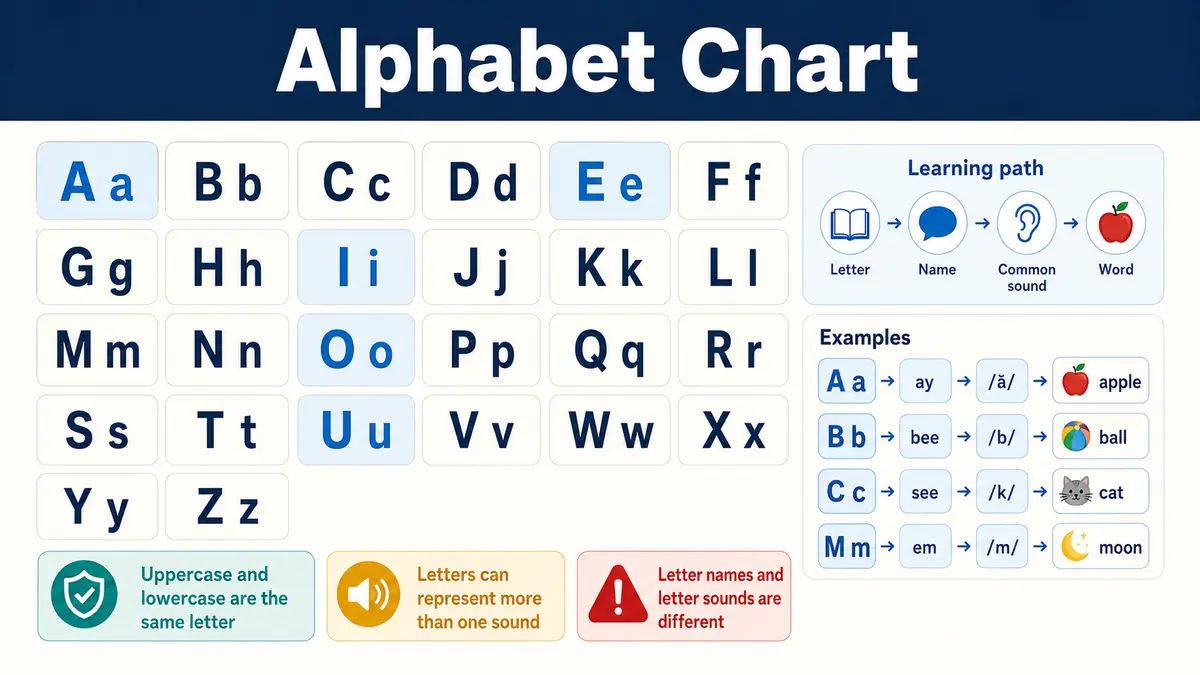
What does an alphabet chart show?
An alphabet chart shows the 26 English letters in order, pairs each uppercase form with its lowercase form, and can add letter names, positions, common sounds, example words, vowel roles, and sorting guidance.
The National Center on Improving Literacy guidance recommends connecting letters with their common sounds in words and moving from simple relationships to more complex spelling patterns. This page keeps letter identity, sound cues, and spelling exceptions clearly separated.
Letter count
26 basic letters
The English alphabet runs from A to Z, with uppercase and lowercase forms for each letter.
Sound principle
Letters represent sounds
A letter can represent different sounds according to the word, spelling pattern, origin, and accent.
Vowel letters
A, E, I, O, U
Y acts as a consonant in yes and as a vowel in words such as gym, happy, and my.
Middle positions
M = 13 · N = 14
A 26-letter sequence has two middle positions because the total number of letters is even.
Core alphabet questions answered
These short answers cover letter count, case, vowels, positions, sounds, ordering, and recognition practice.
How many letters are in the English alphabet?
The English alphabet contains 26 basic letters from A to Z.
Are uppercase and lowercase separate letters?
No. A and a are two case forms of the same letter.
What are the vowel letters?
A, E, I, O, and U are the five core vowel letters in English.
Can Y be a vowel?
Yes. Y represents vowel sounds in words such as gym, happy, and my.
What is the 13th letter?
M is the 13th letter of the English alphabet.
What is the 26th letter?
Z is the 26th and final letter of the English alphabet.
What is the difference between a letter name and sound?
A name identifies a letter; a sound is one speech sound that the letter can represent.
Does every letter make one sound?
No. C differs in cat and city, and many other letters change sound by context.
How do you alphabetize words?
Compare letters from left to right and use the first position where the words differ.
Which word comes first when one is a prefix?
Place the shorter complete word first, as in art before artist.
What are the middle letters?
M and N occupy positions 13 and 14, the two middle positions in a 26-letter alphabet.
How do you check letter recognition?
Ask the learner to identify letters in mixed order, not only recite A to Z.
Complete English Alphabet Chart A–Z
Match each uppercase letter with its lowercase partner, alphabet position, common letter name, and a familiar example word.
Swipe horizontally inside the table to view every column.
| Uppercase | Lowercase | Position | Letter name | Example word |
|---|---|---|---|---|
| A — Vowel letter | a | 1 | ay | apple |
| B | b | 2 | bee | ball |
| C | c | 3 | cee | cat |
| D | d | 4 | dee | dog |
| E — Vowel letter | e | 5 | ee | egg |
| F | f | 6 | ef | fish |
| G | g | 7 | gee | goat |
| H | h | 8 | aitch | hat |
| I — Vowel letter | i | 9 | eye | insect |
| J | j | 10 | jay | jam |
| K | k | 11 | kay | kite |
| L | l | 12 | el | lamp |
| M | m | 13 | em | moon |
| N | n | 14 | en | nest |
| O — Vowel letter | o | 15 | oh | octopus |
| P | p | 16 | pee | pen |
| Q | q | 17 | cue | queen |
| R | r | 18 | ar | rabbit |
| S | s | 19 | ess | sun |
| T | t | 20 | tee | top |
| U — Vowel letter | u | 21 | you | umbrella |
| V | v | 22 | vee | van |
| W | w | 23 | double-u | web |
| X | x | 24 | ex | box |
| Y — Context-dependent classification | y | 25 | why | yes |
| Z | z | 26 | zee in US English; zed in many other varieties | zebra |
The English alphabet uses 26 basic letters. Letter-name pronunciation may vary slightly by region, especially Z.
- • Uppercase and lowercase are two forms of the same letter, not separate letters.
- • Example words support recognition; they do not show every sound or spelling pattern for a letter.
- • Fonts and handwriting styles can change a letter shape while preserving its identity.
Download or export
A practical path from letter recognition to reading
Strong alphabet practice connects a visual form with its case partner, name, common sound, written form, and use in words. Mixed-order review checks recognition instead of memorization of the alphabet song alone.
See the form
Notice the uppercase and lowercase pair in a clear print font.
Say the name
Name the letter without adding an unrelated sound.
Connect a sound
Link the letter to one common sound in a familiar word.
Write or trace
Use the handwriting model taught by the learner’s school or program.
Read in words
Find the letter in initial, middle, and final word positions.
Review in order
Practice recognition both in A–Z order and in mixed order.
Letter names and letter sounds serve different purposes
A letter name identifies the symbol. A letter sound connects that symbol with speech in a particular word. The letter C is named cee, commonly represents /k/ in cat, and represents /s/ in city. One example cannot describe every word.
Beginning instruction often starts with common and useful relationships, then adds digraphs, vowel teams, silent letters, alternative sounds, and irregular spellings.
Common Letter-Sound Cues for Beginning Readers
These cues introduce one frequent sound for each letter and note important alternatives. English spelling contains many additional patterns and exceptions.
Swipe horizontally inside the table to view every column.
| Letter | Common sound cue | Example | Other common behavior |
|---|---|---|---|
| A a | short a, as in apple | apple | long a appears in acorn and cake |
| B b | /b/, as in ball | ball | usually keeps the /b/ sound |
| C c | /k/, as in cat | cat | /s/ appears in city and cent — Hard and soft forms |
| D d | /d/, as in dog | dog | usually keeps the /d/ sound |
| E e | short e, as in egg | egg | long e appears in me and these |
| F f | /f/, as in fish | fish | usually keeps the /f/ sound |
| G g | hard g, as in goat | goat | soft g appears in giant and gem — Hard and soft forms |
| H h | /h/, as in hat | hat | it is silent in some words, including hour |
| I i | short i, as in insect | insect | long i appears in ice and time |
| J j | /j/, as in jam | jam | usually represents the sound heard in jump |
| K k | /k/, as in kite | kite | it is silent before n in some words, including knee |
| L l | /l/, as in lamp | lamp | the sound changes slightly by word position and accent |
| M m | /m/, as in moon | moon | usually keeps the /m/ sound |
| N n | /n/, as in nest | nest | the combination ng represents a different sound pattern |
| O o | short o, as in octopus | octopus | long o appears in open and home |
| P p | /p/, as in pen | pen | the combination ph often represents /f/ |
| Q q | /kw/, as in queen | queen | q usually appears with u in English words — Usually paired with U |
| R r | /r/, as in rabbit | rabbit | r pronunciation varies across English accents |
| S s | /s/, as in sun | sun | /z/ appears in rose and has |
| T t | /t/, as in top | top | letter groups such as th and tion represent other patterns |
| U u | short u, as in umbrella | umbrella | long u appears in unit and music |
| V v | /v/, as in van | van | contrast it with the unvoiced /f/ sound |
| W w | /w/, as in web | web | it is silent in some words, including write |
| X x | /ks/, as in box | box | /z/ appears at the start of xylophone — Position changes sound cue |
| Y y | /y/, as in yes | yes | it acts as a vowel in gym, happy, and my — Consonant or vowel role |
| Z z | /z/, as in zebra | zebra | usually keeps the /z/ sound |
Slash marks show a speech sound cue, while phrases such as short a or long e use common classroom labels rather than a full phonetic transcription.
- • Teach a small, planned set of letter–sound relationships and practice them in real words.
- • A letter name and a letter sound are different: B is named bee but commonly represents /b/.
- • Accent, word origin, neighboring letters, and spelling patterns can change the sound represented by a letter.
Download or export
Vowel letters are not the same as vowel sounds
English conventionally lists A, E, I, O, and U as core vowel letters. Spoken English has more vowel sounds than vowel letters, and the exact sound inventory varies by accent. Y changes role: it begins with a consonant sound in yes but represents vowel sounds in gym, happy, and my.
Vowel and Consonant Letter Classification
English classrooms usually classify A, E, I, O, and U as vowel letters. Y changes role according to its position and the word.
Swipe horizontally inside the table to view every column.
| Group | Letters | What the group means | Examples and limits |
|---|---|---|---|
| Core vowel letters | A, E, I, O, U — Core vowel letters | Letters commonly used to represent vowel sounds | apple, egg, insect, octopus, umbrella |
| Core consonant letters | B, C, D, F, G, H, J, K, L, M, N, P, Q, R, S, T, V, W, X, Z | Letters commonly used to represent consonant sounds | ball, cat, dog, fish, goat |
| Y as a consonant | Y | Represents the /y/ sound at the start of words such as yes | yes, yellow, yard |
| Y as a vowel | Y — Y can act as a vowel | Represents a vowel sound when no other vowel letter fills that syllable position | gym, happy, my |
| Letter versus sound | One letter can represent several sounds | Spelling symbols and speech sounds are related but not identical — Letters and sounds differ | C differs in cat and city |
| Digraph | Two letters working together | A letter pair can represent one main sound pattern | sh, ch, th, ph, ng |
| Vowel team | Two or more letters | A spelling pattern can represent a vowel sound | ai in rain; oa in boat |
This table classifies written letters and common spelling patterns. It does not count the full set of vowel and consonant sounds in spoken English.
- • The number of vowel sounds depends on accent and analysis, so it is not the same as the five core vowel letters.
- • Y is the main context-dependent letter in basic classroom vowel and consonant classification.
- • Digraphs and vowel teams are spelling patterns; they do not add new letters to the alphabet.
Download or export
Browser-only learning tool
Alphabet letter and position finder
Enter one letter or a position from 1 to 26. The tool returns the matching case pair, letter name, classification, neighbors, common sound cue, example word, reverse position, and Unicode values. Inputs stay in the browser.
Letter pair
Aa
Position 1 of 26
Reverse position 26
- Letter name
- ay
- Classification
- Vowel
- Common sound cue
- short a, as in apple
- Example word
- apple
- Previous / next
- None / B
- Unicode
- U+0041 / U+0061
Sound note: long a appears in acorn and cake. This lookup gives a common teaching cue, not every pronunciation or spelling pattern for the letter.
Letter positions support sequencing and code activities
Forward positions count A as 1 and Z as 26. Reverse positions count Z as 1 and A as 26, so the two positions for any letter add to 27. Unicode assigns separate Basic Latin code points to uppercase and lowercase forms while keeping them as related letter pairs.
Alphabet Positions, Reverse Positions and Unicode
Use this chart for letter-number activities, neighboring-letter practice, puzzles, data labels, and Basic Latin character identification.
Swipe horizontally inside the table to view every column.
| Letter pair | Forward position | Reverse position | Previous / next | Upper / lower Unicode |
|---|---|---|---|---|
| A a | 1 — First letter | 26 | None / B | U+0041 / U+0061 |
| B b | 2 | 25 | A / C | U+0042 / U+0062 |
| C c | 3 | 24 | B / D | U+0043 / U+0063 |
| D d | 4 | 23 | C / E | U+0044 / U+0064 |
| E e | 5 | 22 | D / F | U+0045 / U+0065 |
| F f | 6 | 21 | E / G | U+0046 / U+0066 |
| G g | 7 | 20 | F / H | U+0047 / U+0067 |
| H h | 8 | 19 | G / I | U+0048 / U+0068 |
| I i | 9 | 18 | H / J | U+0049 / U+0069 |
| J j | 10 | 17 | I / K | U+004A / U+006A |
| K k | 11 | 16 | J / L | U+004B / U+006B |
| L l | 12 | 15 | K / M | U+004C / U+006C |
| M m | 13 — First middle pair letter | 14 | L / N | U+004D / U+006D |
| N n | 14 — Second middle pair letter | 13 | M / O | U+004E / U+006E |
| O o | 15 | 12 | N / P | U+004F / U+006F |
| P p | 16 | 11 | O / Q | U+0050 / U+0070 |
| Q q | 17 | 10 | P / R | U+0051 / U+0071 |
| R r | 18 | 9 | Q / S | U+0052 / U+0072 |
| S s | 19 | 8 | R / T | U+0053 / U+0073 |
| T t | 20 | 7 | S / U | U+0054 / U+0074 |
| U u | 21 | 6 | T / V | U+0055 / U+0075 |
| V v | 22 | 5 | U / W | U+0056 / U+0076 |
| W w | 23 | 4 | V / X | U+0057 / U+0077 |
| X x | 24 | 3 | W / Y | U+0058 / U+0078 |
| Y y | 25 | 2 | X / Z | U+0059 / U+0079 |
| Z z | 26 — Last letter | 1 | Y / None | U+005A / U+007A |
Forward position counts A as 1. Reverse position counts Z as 1. Unicode values identify encoded characters, not visual font designs.
- • Forward and reverse positions always add to 27 for the 26-letter English alphabet.
- • Uppercase Basic Latin letters run from U+0041 to U+005A; lowercase letters run from U+0061 to U+007A.
- • Unicode code points identify characters consistently, while the displayed glyph can vary by font.
Download or export
Alphabetical order uses the first different position
Compare two words from left to right. When the letters differ, the word containing the earlier alphabet letter comes first. If one word ends after an identical beginning, place the shorter word first. Software can handle case, punctuation, accents, numbers, and spaces differently.
Alphabetical Order Rules and Worked Examples
Alphabetical order compares words from left to right. The first position where the words differ decides which word comes first.
Swipe horizontally inside the table to view every column.
| Situation | Rule | Example order | Important note |
|---|---|---|---|
| Different first letters | Compare the first letter | apple, ball, cat | A comes before B, and B comes before C |
| Same first letter | Compare the second letter | bag, bed, big | A comes before E, and E comes before I |
| Same first two letters | Move to the next differing letter | cap, car, cat | P comes before R, and R comes before T |
| One word is a prefix | Place the shorter complete word first — Shorter prefix first | art, artist, artistic | The shared beginning ends first in art |
| Uppercase and lowercase | Treat matching letters as the same for basic classroom sorting | Anna, apple, atlas | Software may use a different case-sensitive rule |
| Spaces and hyphens | Follow the stated dictionary, classroom, or software rule | ice cream, ice-age, iceberg | Punctuation handling varies — System-dependent rule |
| Accented letters | Use the language-specific collation rule | Order can differ by language | Do not assume every language sorts accents identically — Language-dependent rule |
| Numbers and symbols | Check the tool or style guide | #tag, 2nd, apple | Digital sorting may place nonletters before letters |
The examples use common English classroom letter-by-letter ordering. Dictionaries, libraries, databases, and software can apply more detailed collation rules.
- • Compare one position at a time instead of judging the whole word at once.
- • When every compared letter matches, the shorter word normally comes first in basic classroom ordering.
- • Sorting rules for punctuation, spaces, accents, numbers, and case depend on the chosen system.
Download or export
Letter case changes writing function, not alphabet position
Uppercase A and lowercase a both occupy position 1. Writers use uppercase forms for selected beginnings, proper names, the pronoun I, abbreviations, and other style-defined purposes. Ordinary text uses lowercase for most remaining letters.
Basic Uppercase and Lowercase Usage Chart
Uppercase letters mark selected beginnings and names. Lowercase letters form most of the remaining text in ordinary English writing.
Swipe horizontally inside the table to view every column.
| Use | Typical case | Example | Limit or variation |
|---|---|---|---|
| First word of a sentence | Uppercase first letter | The book is open. | Quoted or stylized text can follow additional rules |
| Personal and place names | Uppercase initial letters | Maya visited Lahore. | Name styling can include internal capitals |
| Days, months, and holidays | Uppercase initial letters | Monday, July, Eid | Seasons are usually lowercase unless part of a name |
| Pronoun I | Always uppercase — Always uppercase pronoun | Sam and I read. | This rule applies wherever the pronoun appears |
| Common nouns | Usually lowercase | teacher, city, river | Capitalize when the word is part of a proper name |
| Titles and headings | Style-dependent capitalization | A Guide to Letter Sounds | Title case and sentence case use different rules — Style-dependent |
| Initialisms and acronyms | Often uppercase | USA, NASA | Established styling can differ by organization |
| All capitals | Use sparingly | STOP | All caps can signal labels, warnings, or emphasis |
These are broad English capitalization conventions, not a complete style manual. Publication and organization styles can differ.
- • Capitalization marks function and identity; it does not change a letter into a different alphabet character pair.
- • A proper noun names a specific person, place, organization, event, or other unique entity.
- • Check the required style guide for titles, headings, brand names, and specialized writing.
Download or export
Similar shapes need more than one recognition cue
Pairs such as b and d or p and q can look similar, especially in unfamiliar fonts. Compare the shape in a consistent print model, say the letter name, connect a common sound, use an example word, and write the form. Do not treat one font as the only correct appearance.
Common Letter Confusions and Practice Cues
Similar shapes can be difficult in some fonts or handwriting styles. Compare each pair in a consistent print model and connect the shape with its name and sound.
Swipe horizontally inside the table to view every column.
| Often-confused forms | What differs | Practice cue | Important limit |
|---|---|---|---|
| b and d | The vertical stem and rounded bowl face opposite directions | Name the letter, trace it, and use it in a word — Use multiple cues | Fonts and handwriting models vary |
| p and q | The descender and bowl face opposite directions | Compare the pair on the same writing line | Do not rely on one decorative font |
| m and n | m usually has one more arch than n | Count the arches while saying the letter name | Cursive forms differ from print |
| u and v | u has a rounded base; v has an angled point | Sort printed examples from several simple fonts | Some typefaces make the difference subtle |
| c and e | e includes an internal horizontal stroke or opening pattern | Trace the opening and say the example word | Lowercase e varies greatly by handwriting style |
| i, l, and I | Dots, height, serifs, and case distinguish the forms | Compare them in a plain sans-serif and a serif font | Some fonts make capital I and lowercase l similar — Font-dependent similarity |
| g and q | Lowercase g and q use different bowls, tails, and descenders | Match each letter to its uppercase partner | Printed g has common one-storey and two-storey forms |
| M and W | The orientation reverses the outer points and center strokes | Rotate attention to top and bottom, not the whole silhouette | Do not teach them as literal rotations in every font |
| N and Z | N uses vertical sides; Z uses horizontal top and bottom strokes | Trace the stroke sequence from a consistent model | Stroke order conventions can differ |
| Letter and sound confusion | A letter name is not the same as its common sound — Name and sound differ | Say: “B is bee and often spells /b/” | One letter can represent more than one sound |
Practice cues support recognition but do not replace a school handwriting model, teacher feedback, vision screening, or reading assessment when those are needed.
- • Use uncluttered print, adequate size, and strong contrast before assuming a learner does not know the letter.
- • Practice should connect the visual form, letter name, common sound, and a meaningful word.
- • Persistent difficulty across settings may justify discussion with the learner’s teacher or a qualified reading specialist.
Download or export
Adapt alphabet practice to the learner
Use clear print, strong contrast, manageable groups of letters, meaningful words, and frequent mixed-order review. Multilingual learners may already know another alphabet or another sound system, so connect new English patterns without treating prior language knowledge as an error.
Discuss persistent letter-name, letter-sound, writing, or decoding difficulties with the learner’s teacher or a qualified reading specialist. A chart supports practice; it does not diagnose a reading, language, hearing, or vision difficulty.
Frequently asked questions
How many letters are in the English alphabet?
The English alphabet has 26 basic letters. Each letter has an uppercase form and a lowercase form, so A and a are two cases of the same letter.
What are the uppercase letters from A to Z?
The uppercase sequence is A, B, C, D, E, F, G, H, I, J, K, L, M, N, O, P, Q, R, S, T, U, V, W, X, Y, Z.
What are the lowercase letters from a to z?
The lowercase sequence is a, b, c, d, e, f, g, h, i, j, k, l, m, n, o, p, q, r, s, t, u, v, w, x, y, z.
What are the five vowel letters?
A, E, I, O, and U are the five core vowel letters in English. Y also represents vowel sounds in words such as gym, happy, and my.
How many consonant letters are there?
There are 21 core consonant letters when A, E, I, O, and U are counted as vowels. Y can function as either a consonant letter or a vowel letter by context.
Is Y a vowel or a consonant?
Y is a consonant in words such as yes and yard. It functions as a vowel in words such as gym, happy, and my.
What is the difference between a letter name and a letter sound?
A letter name identifies the written symbol, while a letter sound is a speech sound that the symbol can represent. B is named bee and commonly represents /b/.
Does each English letter make only one sound?
No. Many letters represent several sounds depending on the word, neighboring letters, origin, and accent. C represents different sounds in cat and city.
Why do uppercase and lowercase letters look different?
Uppercase and lowercase developed as different case forms used for different writing functions. Some pairs look similar, while pairs such as A and a or G and g can look quite different.
What letter is in the middle of the alphabet?
A 26-letter alphabet has two middle positions: M is 13th and N is 14th. There is no single middle letter because 26 is even.
How do you put words in alphabetical order?
Compare words from left to right and stop at the first different letter. If one word ends while every compared letter matches, place the shorter word first.
What is the 20th letter of the alphabet?
T is the 20th letter of the English alphabet. Its lowercase form is t.
What is the reverse position of A?
A has reverse position 26 when Z is counted as 1. A letter’s forward and reverse positions add to 27.
Are accented letters part of the 26-letter English alphabet?
Accented characters can appear in names, loanwords, and other languages, but the basic modern English alphabet is conventionally listed as 26 letters from A to Z.
How should a beginner practice the alphabet?
Practice a manageable group of letters by matching uppercase and lowercase forms, saying names, connecting common sounds, tracing or writing, and reading the letters in real words.
When should a learner get extra help with letter recognition?
Ask a teacher or qualified reading specialist when letter-name and letter-sound difficulties persist despite clear instruction and regular practice. One chart cannot diagnose a reading or vision difficulty.
Sources
These character-encoding and foundational-reading references support the letter inventory, case pairs, Unicode values, letter–sound guidance, and instructional cautions summarized above.
Unicode Consortium — C0 Controls and Basic Latin Code Chart
https://www.unicode.org/charts/PDF/U0000.pdf
Official character chart for the Basic Latin block, including uppercase Latin letters U+0041–U+005A and lowercase Latin letters U+0061–U+007A.
Institute of Education Sciences — Foundational Skills to Support Reading for Understanding in Kindergarten Through 3rd Grade
https://ies.ed.gov/ncee/wwc/docs/practiceguide/wwc_foundationalreading_070516.pdf
Evidence-based practice guide supporting explicit instruction in sound awareness, letter–sound relationships, decoding, word analysis, and connected-text reading.
National Center on Improving Literacy — The Alphabetic Principle: Linking Sounds to Letters
https://improvingliteracy.org/resource/alphabetic-principle-linking-sounds-to-letters/
Instructional guidance explaining how learners connect written letters with common sounds and progress to more complex spelling patterns.