Mathematics & Education · Algebra
Algebra Formula Chart for Equations, Rules and Identities
Review algebra properties, exponent laws, polynomial identities, linear and quadratic formulas, radicals, rational expressions, functions, sequences, and the restrictions that keep each rule valid.
Match the formula to the exact algebraic structure before using it. A correct-looking calculation can still fail after division by zero, invalid cancellation, an excluded denominator, or an extraneous solution. See the ChartsLoom Disclaimer.
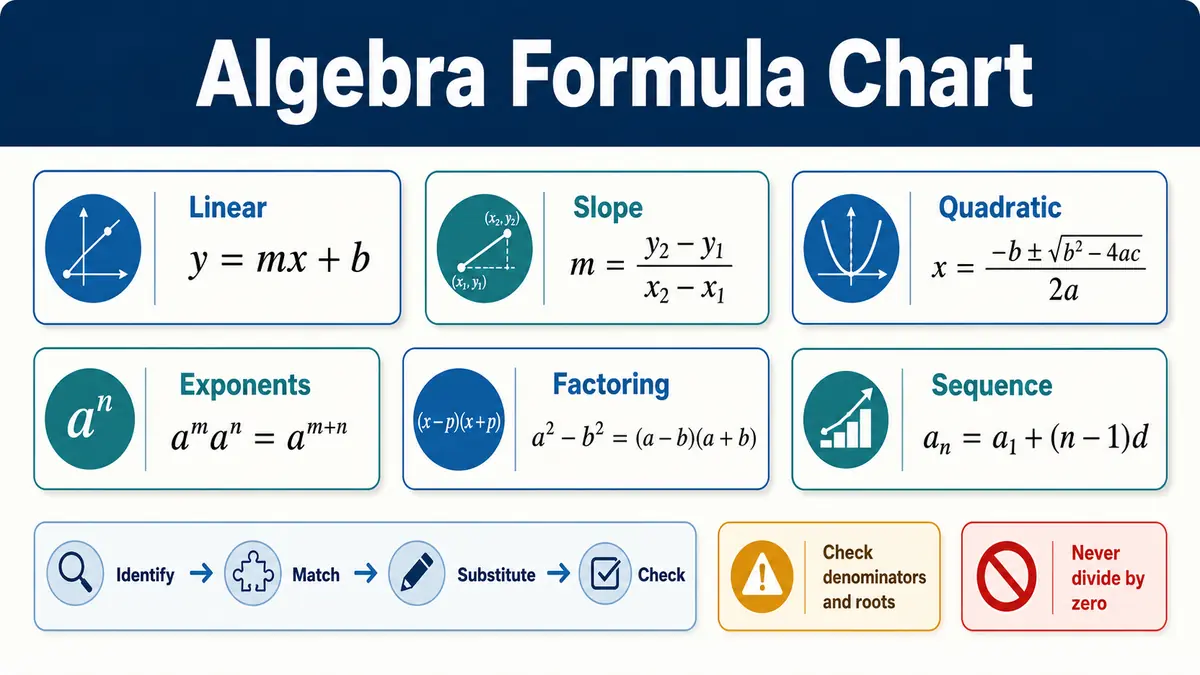
What formulas should an algebra chart include?
A useful algebra formula chart includes number properties, exponent rules, special products, factoring identities, line formulas, the quadratic formula, radical and rational-expression rules, function notation, and arithmetic and geometric sequences.
The OpenStax algebra essentials reference organizes these topics from real-number properties through equations, functions, systems, and sequences. This page adds concise conditions, examples, error checks, and exportable tables so each formula remains connected to its valid use.
Equation rule
Keep both sides balanced
Apply the same valid operation to both sides so the equation keeps the same solution set.
Expression rule
Structure controls the formula
Parentheses, exponents, signs, factors, and denominators determine which algebra rule applies.
Sequence rule
Index and pattern both matter
Arithmetic sequences add a common difference; geometric sequences multiply by a common ratio.
Final check
Substitute into the original
A candidate is valid only when it satisfies the original equation and every domain restriction.
Core algebra questions answered
These short answers cover the rules students most often need while simplifying, factoring, graphing, and solving equations.
How do you solve ax + b = c?
For a ≠ 0, subtract b and divide by a: x = (c − b)/a.
What is the distributive property?
The distributive property is a(b + c) = ab + ac.
How do you multiply powers with the same base?
Add the exponents: aᵐ · aⁿ = aᵐ⁺ⁿ.
How do you divide powers with the same base?
Subtract the exponents: aᵐ/aⁿ = aᵐ⁻ⁿ for a ≠ 0.
How do you factor a² − b²?
Use the difference-of-squares identity: a² − b² = (a − b)(a + b).
What is the quadratic formula?
For a ≠ 0, x = (−b ± √(b² − 4ac))/(2a).
What does a negative discriminant mean?
A negative discriminant gives two complex conjugate roots and no real roots.
What is the slope formula?
Slope is m = (y₂ − y₁)/(x₂ − x₁) when x₂ ≠ x₁.
Can you cancel terms across addition?
No. Factor first, then cancel only common nonzero factors.
Why does √(x²) equal |x|?
The principal square root is nonnegative, so √(x²) equals the magnitude |x|.
What makes a solution extraneous?
An extraneous candidate fails the original equation or violates its domain.
How do you verify an algebra answer?
Substitute it into the original problem and confirm both sides are defined and equal.
Algebra Properties and Identity Rules
These properties justify rearranging, regrouping, expanding, and simplifying expressions. The stated restrictions matter whenever division or a denominator appears.
Swipe horizontally inside the table to view every column.
| Property | Formula | Meaning | Example |
|---|---|---|---|
| Commutative addition | a + b = b + a | Addition order can change | 3 + x = x + 3 |
| Commutative multiplication | ab = ba | Factor order can change | 5y = y · 5 |
| Associative addition | (a + b) + c = a + (b + c) | Addition grouping can change | (x + 2) + 4 = x + (2 + 4) |
| Associative multiplication | (ab)c = a(bc) | Factor grouping can change | (2x)5 = 2(x · 5) |
| Distributive property | a(b + c) = ab + ac | Multiply a factor across each term | 3(x + 4) = 3x + 12 |
| Additive identity | a + 0 = a | Adding zero leaves a value unchanged | n + 0 = n |
| Multiplicative identity | a · 1 = a | Multiplying by one leaves a value unchanged | p · 1 = p |
| Additive inverse | a + (−a) = 0 | Opposites sum to zero | 7x + (−7x) = 0 |
| Multiplicative inverse | a · (1/a) = 1, a ≠ 0 — Nonzero restriction | A nonzero value times its reciprocal equals one | 6 · 1/6 = 1 |
| Zero product property | ab = 0 ⇒ a = 0 or b = 0 — Factoring solution rule | A zero product has at least one zero factor | (x − 2)(x + 5) = 0 |
| Equality addition rule | a = b ⇒ a + c = b + c | Add the same value to both sides | x − 4 = 9 ⇒ x = 13 |
| Equality multiplication rule | a = b ⇒ ac = bc | Multiply both sides by the same value | x/3 = 5 ⇒ x = 15 |
Variables represent values in an allowed domain. A denominator, reciprocal, or division step requires a nonzero divisor.
- • Commutative and associative properties apply to addition and multiplication, not generally to subtraction or division.
- • The distributive property works in both directions: expansion multiplies out, while factoring extracts a common factor.
- • An implication arrow means the statement on the left leads to the statement on the right under the stated conditions.
Download or export
Reliable formula workflow
Use a formula only after you identify the algebraic pattern
1
Identify the structure
Decide whether the problem is an expression, equation, inequality, function, sequence, or system.
2
Match the valid rule
Check the operation, pattern, coefficients, and domain restrictions before using a formula.
3
Substitute carefully
Keep signs, parentheses, exponents, units, and coordinate order intact.
4
Verify the result
Substitute into the original problem and reject undefined or extraneous candidates.
Order of operations controls evaluation
Evaluate grouping symbols first, then exponents, then multiplication and division from left to right, followed by addition and subtraction from left to right. The left-to-right rule matters because multiplication and division share one priority, and addition and subtraction share another.
A fraction bar groups its entire numerator and denominator. An exponent applies to its stated base, so −x² means −(x²), while (−x)² squares the negative base.
Exponent Laws and Scientific Notation Formulas
Exponent rules combine powers with the same base. Negative and zero exponents require a nonzero base because they involve reciprocals.
Swipe horizontally inside the table to view every column.
| Rule | Formula | Condition | Example |
|---|---|---|---|
| Product of powers | aᵐ · aⁿ = aᵐ⁺ⁿ | Same base | x³ · x⁴ = x⁷ |
| Quotient of powers | aᵐ/aⁿ = aᵐ⁻ⁿ | a ≠ 0 | y⁶/y² = y⁴ |
| Power of a power | (aᵐ)ⁿ = aᵐⁿ | Multiply exponents | (x²)³ = x⁶ |
| Power of a product | (ab)ⁿ = aⁿbⁿ | Distribute exponent to factors | (2x)³ = 8x³ |
| Power of a quotient | (a/b)ⁿ = aⁿ/bⁿ | b ≠ 0 | (x/3)² = x²/9 |
| Zero exponent | a⁰ = 1 | a ≠ 0 — Base cannot be zero | 5⁰ = 1 |
| Negative exponent | a⁻ⁿ = 1/aⁿ — Reciprocal form | a ≠ 0 | x⁻³ = 1/x³ |
| Fractional exponent | a¹⁄ⁿ = ⁿ√a | Real-domain restrictions may apply | x¹⁄² = √x |
| General rational exponent | aᵐ⁄ⁿ = ⁿ√(aᵐ) | Use a valid real or complex domain | 16³⁄⁴ = 8 |
| Scientific notation | N = a × 10ⁿ | 1 ≤ |a| < 10 | 45,000 = 4.5 × 10⁴ |
| Scientific multiplication | (a × 10ᵐ)(b × 10ⁿ) = ab × 10ᵐ⁺ⁿ | Renormalize coefficient if needed | (2 × 10³)(4 × 10²) = 8 × 10⁵ |
| Scientific division | (a × 10ᵐ)/(b × 10ⁿ) = (a/b) × 10ᵐ⁻ⁿ | b ≠ 0 | (6 × 10⁷)/(2 × 10³) = 3 × 10⁴ |
Exponents are dimensionless. When a base carries a unit, the exponent applies to that unit as well, such as m² or cm³.
- • Do not add exponents when adding powers: x² + x³ cannot be combined as x⁵.
- • The expression 0⁰ is not covered by the ordinary zero-exponent rule.
- • For even roots in the real numbers, the radicand must be nonnegative.
Download or export
Factoring reverses multiplication
Expansion turns factors into a sum of terms. Factoring turns a matching sum or difference back into a product. Remove the greatest common factor first, then test special products, trinomial patterns, or grouping. Multiply the result to verify it.
Polynomial Products and Factoring Identities
Special-product identities work in both directions. Expand from left to right or recognize the matching pattern and factor from right to left.
Swipe horizontally inside the table to view every column.
| Pattern | Identity | Recognition clue | Example |
|---|---|---|---|
| Square of a sum | (a + b)² = a² + 2ab + b² | First and last terms are squares; middle term is +2ab | (x + 3)² = x² + 6x + 9 |
| Square of a difference | (a − b)² = a² − 2ab + b² | First and last terms are squares; middle term is −2ab | (x − 4)² = x² − 8x + 16 |
| Difference of squares | a² − b² = (a − b)(a + b) — Difference of squares | Two square terms separated by subtraction | x² − 25 = (x − 5)(x + 5) |
| Cube of a sum | (a + b)³ = a³ + 3a²b + 3ab² + b³ | Binomial cube with positive terms | (x + 2)³ = x³ + 6x² + 12x + 8 |
| Cube of a difference | (a − b)³ = a³ − 3a²b + 3ab² − b³ | Alternating signs in a binomial cube | (x − 2)³ = x³ − 6x² + 12x − 8 |
| Sum of cubes | a³ + b³ = (a + b)(a² − ab + b²) | Two perfect cubes added | x³ + 8 = (x + 2)(x² − 2x + 4) |
| Difference of cubes | a³ − b³ = (a − b)(a² + ab + b²) | Two perfect cubes subtracted | x³ − 27 = (x − 3)(x² + 3x + 9) |
| Common factor | ab + ac = a(b + c) | Every term shares factor a | 6x² + 9x = 3x(2x + 3) |
| Grouping | ax + ay + bx + by = (a + b)(x + y) | Pairs produce the same binomial factor | x² + 3x + 2x + 6 = (x + 2)(x + 3) |
| Monic quadratic | x² + bx + c = (x + m)(x + n) | m + n = b and mn = c | x² + 5x + 6 = (x + 2)(x + 3) |
| General quadratic | ax² + bx + c | Find factors whose product is ac and sum is b — Method depends on coefficients | 2x² + 7x + 3 = (2x + 1)(x + 3) |
| Remainder theorem | P(k) = remainder of P(x) ÷ (x − k) | Substitute k into the polynomial | P(2) is the remainder after division by x − 2 |
These are symbolic identities. Verify a factorization by multiplying the factors and checking that the original polynomial returns.
- • A greatest common factor should usually be removed before testing a special-product pattern.
- • The sum of squares a² + b² does not factor over the real numbers by the difference-of-squares rule.
- • Factoring depends on the chosen number system; some real irreducible factors split over the complex numbers.
Download or export
Linear formulas describe constant change
A linear equation has variables only to the first power after simplification. A line has a constant slope unless it is vertical. Systems compare multiple equations, and a valid system solution must satisfy every equation at the same time.
Linear Equations, Lines and Systems Formulas
Linear formulas describe constant rates of change. Keep the coordinate order consistent and check denominator restrictions before calculating a slope.
Swipe horizontally inside the table to view every column.
| Formula or form | Expression | Use | Key condition |
|---|---|---|---|
| One-step linear solution | ax + b = c ⇒ x = (c − b)/a | Solve a one-variable linear equation | a ≠ 0 |
| Slope | m = (y₂ − y₁)/(x₂ − x₁) | Find vertical change per horizontal change | x₂ ≠ x₁ — No zero denominator |
| Slope-intercept form | y = mx + b | Show slope m and y-intercept b | Nonvertical line |
| Point-slope form | y − y₁ = m(x − x₁) | Write a line from one point and its slope | Nonvertical line |
| Standard form | Ax + By = C | Represent a line with coefficients | A and B are not both zero |
| Parallel lines | m₁ = m₂ — Equal slopes | Identify equal slopes | Distinct parallel lines have different intercepts |
| Perpendicular lines | m₁m₂ = −1 — Defined slopes required | Identify negative-reciprocal slopes | Applies when both slopes are defined |
| Midpoint | M = ((x₁ + x₂)/2, (y₁ + y₂)/2) | Find the center of a segment | Keep x-values and y-values paired |
| Distance | d = √((x₂ − x₁)² + (y₂ − y₁)²) | Find straight-line distance in a coordinate plane | d ≥ 0 |
| Two-variable system | a₁x + b₁y = c₁; a₂x + b₂y = c₂ | Find an ordered pair satisfying both equations | May have one, none, or infinitely many solutions |
| Cramer solution for x | x = (c₁b₂ − b₁c₂)/(a₁b₂ − b₁a₂) | Solve a 2 × 2 system by determinants | Denominator ≠ 0 |
| Cramer solution for y | y = (a₁c₂ − c₁a₂)/(a₁b₂ − b₁a₂) | Solve a 2 × 2 system by determinants | Denominator ≠ 0 |
Slope uses output units per input unit. Coordinates and distance should use compatible units before substitution.
- • A vertical line has undefined slope and is written x = constant rather than y = mx + b.
- • A system solution must satisfy every equation in the system.
- • Elimination, substitution, graphing, and matrices can represent the same system-solving task.
Download or export
Browser-only educational tool
Linear and quadratic equation solver
Enter coefficients to see the formula, intermediate steps, root type, and a numerical result. The calculation stays in your browser and does not transmit entered values.
This tool evaluates numeric coefficients only. It does not simplify symbolic expressions, solve inequalities, or prove that a transformed equation is equivalent to the original.
The discriminant predicts the quadratic root type
Calculate D = b² − 4ac before evaluating the quadratic formula. A positive D gives two real roots, zero gives one repeated real root, and a negative D gives a complex conjugate pair. The leading coefficient a must not equal zero.
Quadratic Equation and Parabola Formulas
A quadratic has degree two and a nonzero leading coefficient. The discriminant identifies the real-root pattern before the roots are calculated.
Swipe horizontally inside the table to view every column.
| Concept | Formula | What it gives | Restriction or interpretation |
|---|---|---|---|
| Standard form | ax² + bx + c = 0 | Quadratic equation coefficients | a ≠ 0 — Leading coefficient nonzero |
| Quadratic formula | x = (−b ± √(b² − 4ac))/(2a) — Quadratic formula | All roots of a quadratic equation | a ≠ 0 |
| Discriminant | D = b² − 4ac | Root type from the coefficient values | D > 0: two real; D = 0: one repeated; D < 0: complex pair — Root classification |
| Axis of symmetry | x = −b/(2a) | Vertical line through the vertex | a ≠ 0 |
| Vertex x-coordinate | h = −b/(2a) | Horizontal coordinate of the turning point | Substitute h into f(x) for k |
| Vertex form | y = a(x − h)² + k | Vertex (h, k) and opening direction | a > 0 opens up; a < 0 opens down |
| Factored form | y = a(x − r₁)(x − r₂) | Real zeros r₁ and r₂ when factorable over reals | Repeated root when r₁ = r₂ |
| Sum of roots | r₁ + r₂ = −b/a | Combined root value | Counts multiplicity |
| Product of roots | r₁r₂ = c/a | Root product | Counts multiplicity |
| Completing square | x² + bx = (x + b/2)² − (b/2)² | Convert a monic quadratic toward vertex form | Apply equivalent changes to the full equation |
| Maximum or minimum | f(h) = k where h = −b/(2a) | Extreme function value at the vertex | Minimum if a > 0; maximum if a < 0 |
| Zero-product solution | (x − r₁)(x − r₂) = 0 ⇒ x = r₁ or r₂ | Roots from a factored equation | Equation must equal zero |
The variable and coefficients may carry application-specific units. Terms added in one equation must be dimensionally compatible.
- • A negative discriminant gives no real roots but gives two complex conjugate roots when coefficients are real.
- • The ± sign represents two calculations, one with addition and one with subtraction.
- • Round only after calculating the full expression when an exact radical form is not required.
Download or export
Domain restrictions stay attached to the original expression
Denominators cannot equal zero. Even roots need nonnegative radicands in the real number system. Cancelling a common factor can simplify an expression, but it does not restore any input excluded by the original denominator.
Radical and Rational Expression Formulas
Radical and rational rules require domain checks. Simplification must preserve excluded values even when a common factor cancels.
Swipe horizontally inside the table to view every column.
| Rule | Formula | Condition | Example |
|---|---|---|---|
| Product of square roots | √a · √b = √(ab) | For real numbers, a ≥ 0 and b ≥ 0 | √3 · √12 = √36 = 6 |
| Quotient of square roots | √a/√b = √(a/b) | For real numbers, a ≥ 0 and b > 0 | √18/√2 = √9 = 3 |
| Principal square root | √(a²) = |a| — Absolute value required | Real a | √(x²) = |x| |
| Square-root equation | x² = k ⇒ x = ±√k | For real roots, k ≥ 0 | x² = 49 ⇒ x = ±7 |
| Rational denominator restriction | P(x)/Q(x), Q(x) ≠ 0 | Exclude every zero of the original denominator — Original denominator restriction | (x + 2)/(x − 3), x ≠ 3 |
| Multiply rational expressions | (a/b)(c/d) = ac/bd | b ≠ 0 and d ≠ 0 | (x/3)(6/x) = 2, x ≠ 0 |
| Divide rational expressions | (a/b) ÷ (c/d) = ad/bc | b, c, and d are nonzero | (x/4) ÷ (3/2) = x/6 |
| Add equal denominators | a/c + b/c = (a + b)/c | c ≠ 0 | 2/x + 5/x = 7/x |
| Add unlike denominators | a/b + c/d = (ad + bc)/bd | b ≠ 0 and d ≠ 0 | 1/x + 1/y = (x + y)/xy |
| Rationalize simple denominator | a/√b = a√b/b | b > 0 in real arithmetic | 3/√5 = 3√5/5 |
| Conjugate product | (a + b)(a − b) = a² − b² | Useful for binomial radical denominators | (√x + 2)(√x − 2) = x − 4 |
| Extraneous-solution check | Substitute candidates into the original equation | Required after operations that may change equivalence — Check original equation | Squaring both sides can create invalid candidates |
A domain restriction belongs to the original expression. Cancellation simplifies a form but does not restore an excluded input.
- • The principal square root symbol √a denotes the nonnegative square root when a is real and nonnegative.
- • The equation x² = k needs ±, but the expression √k itself is the principal nonnegative root.
- • Squaring both sides and multiplying by variable expressions can introduce candidates that fail the original equation.
Download or export
Functions and sequences pair a rule with allowed inputs
Function notation records an input-output rule. Composition applies one function inside another. Arithmetic sequences use repeated addition, while geometric sequences use repeated multiplication. Infinite geometric sums converge only when |r| < 1.
Functions, Variation and Sequence Formulas
Function and sequence formulas connect an input rule to outputs. Domain restrictions and starting-index conventions determine which values are valid.
Swipe horizontally inside the table to view every column.
| Concept | Formula | Meaning | Example or condition |
|---|---|---|---|
| Function notation | y = f(x) | f assigns an output to each allowed input x | f(3) means substitute 3 for x |
| Composition | (f ∘ g)(x) = f(g(x)) | Apply g first, then apply f | Order usually matters |
| Inverse function | f⁻¹(f(x)) = x | Undo a one-to-one function — One-to-one requirement | f must be invertible on the chosen domain |
| Direct variation | y = kx | y changes in constant proportion to x | k = y/x when x ≠ 0 |
| Inverse variation | y = k/x | xy remains constant | x ≠ 0 |
| Joint variation | z = kxy | z varies directly with both x and y | k = z/(xy) when xy ≠ 0 |
| Arithmetic nth term | aₙ = a₁ + (n − 1)d | Add common difference d repeatedly | 2, 5, 8, … has d = 3 |
| Arithmetic sum | Sₙ = n(a₁ + aₙ)/2 | Sum the first n arithmetic terms | Also Sₙ = n[2a₁ + (n − 1)d]/2 |
| Geometric nth term | aₙ = a₁rⁿ⁻¹ | Multiply by common ratio r repeatedly | 3, 6, 12, … has r = 2 |
| Finite geometric sum | Sₙ = a₁(1 − rⁿ)/(1 − r) | Sum first n geometric terms | r ≠ 1 |
| Infinite geometric sum | S∞ = a₁/(1 − r) | Sum a convergent infinite geometric series | |r| < 1 — Convergence condition |
| Average rate of change | [f(b) − f(a)]/(b − a) | Output change per input change | a ≠ b |
A rate inherits output units per input unit. Sequence index n is normally a positive integer unless another convention is stated.
- • Function notation f(x) does not mean f multiplied by x.
- • An inverse function is different from the reciprocal 1/f(x).
- • An infinite geometric series has a finite sum only when the absolute value of its ratio is less than one.
Download or export
A familiar-looking rule can still be used incorrectly
Exponent laws do not distribute across addition, square roots do not split sums, and cancellation does not remove separate terms. Keep signs and parentheses visible, then verify the result in the original form.
Common Algebra Mistakes and Correct Rules
Most algebra errors come from applying a valid rule in the wrong operation, dropping a sign, or ignoring a domain restriction.
Swipe horizontally inside the table to view every column.
| Common mistake | Why it fails | Correct rule | Quick check |
|---|---|---|---|
| (a + b)² = a² + b² | The cross term 2ab is missing | (a + b)² = a² + 2ab + b² — Include middle term | Expand by distribution |
| √(a + b) = √a + √b | Square roots do not distribute over addition | Simplify only valid factors or evaluate directly | Try a = 9 and b = 16 |
| aᵐ + aⁿ = aᵐ⁺ⁿ | Exponent addition applies to multiplication, not addition | aᵐ · aⁿ = aᵐ⁺ⁿ | Test with a = 2 |
| Cancel terms across addition | Cancellation applies to common factors, not separate terms | Factor first, then cancel nonzero common factors — Factor before cancelling | (x + 2)/x cannot become 2 |
| Divide by a variable without restriction | The variable may equal zero | State the nonzero condition before division | Check the original equation at zero |
| −(a − b) = −a − b | The negative sign must distribute to both terms | −(a − b) = −a + b | Multiply every term by −1 |
| √(a²) = a | a may be negative | √(a²) = |a| | Try a = −4 |
| Use one branch of ± | A square equation can have two roots | Evaluate both + and − branches | Substitute both candidates |
| Cross-multiply without denominators | Cross multiplication describes an equation of two ratios | Use a valid equality a/b = c/d with nonzero denominators | Write restrictions first |
| Round during intermediate steps | Early rounding can change the final result | Keep exact values or extra digits until the end | Compare exact and rounded substitution |
| Ignore extraneous candidates | Squaring or denominator clearing may alter equivalence | Check every candidate in the original equation — Original-equation check | Reject any undefined or false result |
| Mix unlike terms | Only terms with the same variable part combine | axᵐ + bxᵐ = (a + b)xᵐ | x² and x are unlike terms |
A reliable check substitutes the proposed result into the original expression or equation, not only into a transformed step.
- • Write one algebraic operation per line when sign changes or denominator restrictions are easy to miss.
- • Keep the original equation visible so transformed solutions can be checked.
- • A calculator can verify arithmetic, but it does not decide whether an algebraic transformation was valid.
Download or export
Frequently asked questions
What is the most important algebra formula to learn first?
Learn the distributive property first because it supports expansion, factoring, equation solving, and polynomial work. Pair it with the properties of equality so every equation step preserves the same solution set.
What is the formula for solving a linear equation?
For ax + b = c with a ≠ 0, the solution is x = (c − b)/a. Subtract b from both sides, divide both sides by a, and substitute the result back into the original equation.
What is the quadratic formula?
For ax² + bx + c = 0 with a ≠ 0, use x = (−b ± √(b² − 4ac))/(2a). The plus-minus sign produces the two roots when they are distinct.
What does the discriminant tell you?
The discriminant D = b² − 4ac classifies quadratic roots. A positive value gives two real roots, zero gives one repeated real root, and a negative value gives a complex conjugate pair.
How do exponent rules work?
Multiply powers with the same base by adding exponents, and divide them by subtracting exponents. Power-of-a-power rules multiply exponents, while addition of terms does not combine exponents.
Why is any nonzero number to the zero power equal to one?
The quotient rule gives aⁿ/aⁿ = aⁿ⁻ⁿ = a⁰, while the same nonzero value divided by itself equals one. Therefore a⁰ = 1 for a ≠ 0.
How do you factor a difference of squares?
Use a² − b² = (a − b)(a + b). Both terms must be perfect squares and the operation between them must be subtraction.
Can you cancel terms in a fraction?
You can cancel common nonzero factors, not separate terms joined by addition or subtraction. Factor the numerator and denominator first, then preserve every restriction from the original denominator.
Why does √(x²) equal |x|?
The principal square root must be nonnegative. Both x and −x square to x², so √(x²) equals the nonnegative magnitude |x|.
What is the slope formula?
The slope through two points is m = (y₂ − y₁)/(x₂ − x₁). Use the same point order in both differences, and do not divide when x₂ = x₁ because a vertical line has undefined slope.
How do you check an algebra answer?
Substitute the proposed value into the original equation. A correct solution makes both sides equal and does not violate a denominator, radical, logarithm, or other domain restriction.
What is the difference between an expression and an equation?
An expression combines numbers, variables, and operations without asserting equality. An equation states that two expressions are equal and can have a solution set.
When should you use factoring instead of the quadratic formula?
Use factoring when the quadratic splits cleanly and the factors are easy to recognize. The quadratic formula works for every quadratic with a nonzero leading coefficient, including equations that do not factor neatly over the integers.
What is an extraneous solution?
An extraneous solution satisfies a transformed equation but not the original equation. Squaring both sides, clearing variable denominators, and applying even powers can create these invalid candidates.
Does an algebra formula chart replace learning the steps?
No. A formula chart helps you recall a rule, but you still need to identify the correct pattern, state restrictions, perform valid operations, and check the result.
Sources
These peer-reviewed and technical references support the algebraic properties, equations, identities, restrictions, and quadratic-root formulas summarized above.
OpenStax — College Algebra 2e: Real Numbers and Algebra Essentials
https://openstax.org/books/college-algebra-2e/pages/1-1-real-numbers-algebra-essentials
Peer-reviewed college algebra text covering real-number properties, exponents, radicals, polynomials, factoring, equations, inequalities, functions, systems, and sequences.
OpenStax — Elementary Algebra 2e: Preface and Scope
https://openstax.org/books/elementary-algebra-2e/pages/preface
Foundational algebra text explaining expressions, linear equations, inequalities, polynomials, factoring, rational expressions, radicals, and quadratic equations.
National Institute of Standards and Technology — DLMF Section 1.11: Zeros of Polynomials
https://dlmf.nist.gov/1.11
Reference for polynomial zeros, including the quadratic formula, discriminant, and the sum and product of quadratic roots.