Health & Medical · Alcohol safety reference
BAC Chart: Blood Alcohol Levels, Effects, and Safety
Compare blood alcohol concentration levels, common impairment effects, driving thresholds, test units, standard drink sizes, factors that change BAC, and alcohol-overdose warning signs.
Do not use this chart to decide whether you can drive. If someone cannot be awakened, has a seizure, breathes slowly or irregularly, vomits while barely conscious, or has blue, pale, cold, or clammy skin, call local emergency services immediately. Read the ChartsLoom Disclaimer.
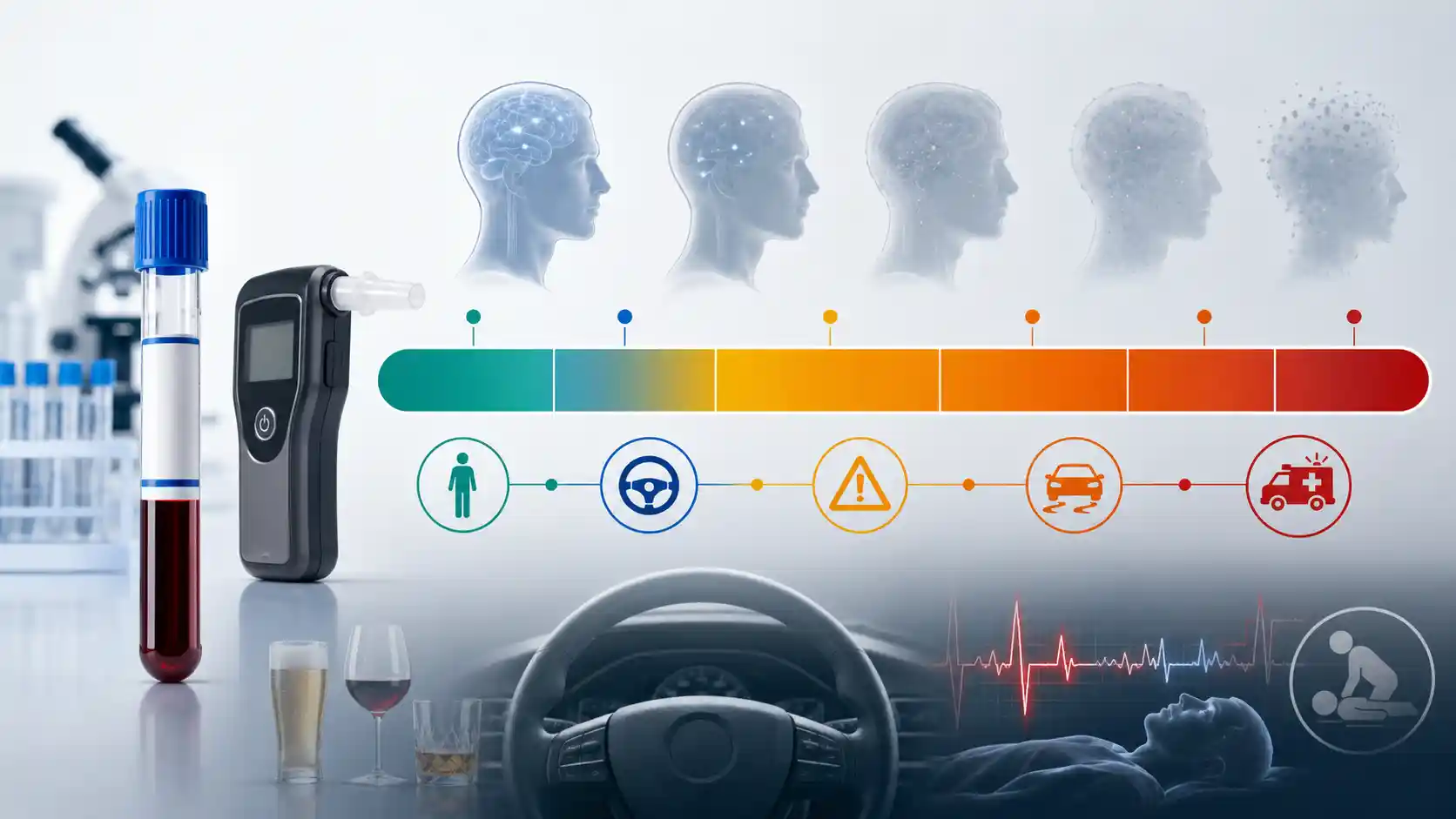
What do BAC numbers mean?
BAC measures the amount of alcohol in a specific volume of blood. A result of 0.08% means 0.08 grams of alcohol per deciliter of blood.
Higher BAC usually produces greater impairment, but the same number does not create identical symptoms in every person. Drinking speed, body water, food, medicines, other drugs, health conditions, and tolerance all influence visible effects and risk. BAC can also continue rising after the last drink because alcohol still in the stomach and intestine keeps entering the bloodstream.
- What BAC measures
- Grams of alcohol per deciliter of blood
- When impairment starts
- Below common legal limits
- Driving safety target
- 0.00% BAC
- Emergency decision
- Symptoms matter more than the number
A BAC of 0.08% means 0.08 g/dL, which also equals 80 mg/dL or 0.8 g/L.
Judgment, attention, visual tracking, and coordination can decline before a person looks or feels drunk.
A legal threshold is not a safe-driving threshold. Do not use a BAC estimate or consumer device as permission to drive.
Call emergency services for inability to wake, seizure, slow or irregular breathing, or blue, pale, cold, or clammy skin.
How to use this BAC reference safely
- 1. Read units first. Confirm whether a result is written as %, g/dL, g/L, mg/dL, or another unit.
- 2. Treat effects as ranges. A person can be more impaired than the chart suggests.
- 3. Separate law from safety. Per se limits define legal thresholds, not safe driving.
- 4. Act on emergency signs. Do not wait for a test result when breathing or consciousness is affected.
BAC level chart: common effects and driving impairment
This chart summarizes effects commonly first observed at selected blood alcohol concentration levels. Individual signs vary, and impairment can occur before a person appears intoxicated.
Swipe horizontally inside the table to view every column.
| BAC level | Commonly observed effects | Likely driving-related impairment | Safety interpretation |
|---|---|---|---|
| 0.00% | No alcohol detected in the measured sample. | No alcohol-related driving impairment is expected, although fatigue, medicines, illness, and other drugs may still impair driving. | A zero reading is the only BAC level that avoids alcohol-related impairment. |
| 0.02% | Some loss of judgment, relaxation, slight body warmth, or altered mood may begin. | Visual tracking and divided attention can decline. | Impairment has started even when the person feels normal or mildly relaxed. |
| 0.05% | Exaggerated behavior, reduced small-muscle control, impaired judgment, lower alertness, and reduced inhibition may occur. | Coordination, moving-object tracking, steering, and response to emergencies become less reliable. | This level is not safe for driving and is the adult per se limit in Utah. |
| 0.08% — Common adult legal threshold | Balance, speech, vision, reaction time, hearing, judgment, self-control, reasoning, and memory can be impaired. | Concentration, speed control, short-term memory, signal detection, visual search, and perception decline. | This is the adult per se driving limit in most U.S. states, not a safe-driving threshold. |
| 0.10% | Reaction time and control deteriorate clearly. Slurred speech, poor coordination, and slowed thinking may be present. | Lane position and braking become harder to control. | Serious impairment is expected. Do not drive, operate machinery, or remain without responsible supervision if symptoms worsen. |
| 0.15% | Muscle control is far below normal. Vomiting and major balance loss may occur. | Vehicle control, attention, and visual and auditory information processing are substantially impaired. | Crash risk is markedly higher, and overdose risk rises as BAC continues upward. |
| Any BAC with overdose signs | Confusion, inability to wake, vomiting, seizure, slow or irregular breathing, clammy skin, or blue or pale skin may signal alcohol overdose. | The person cannot drive or protect themselves safely. | Call local emergency services immediately. Do not wait for every sign or rely on the BAC number alone. — Emergency action required |
BAC is commonly written as percent or grams of alcohol per deciliter of blood. For example, 0.08% equals 0.08 g/dL.
- • Effects differ by age, body composition, drinking speed, food intake, medicines, other substances, health conditions, and alcohol tolerance.
- • Tolerance may reduce visible signs without preventing impaired judgment, organ stress, overdose, or crash risk.
- • A person may be legally impaired or medically unsafe below a listed threshold.
Download or export
Visual BAC impairment scale
The scale shows when common effects may first appear. It does not predict how a particular person will look, feel, or perform.
0.00%
No alcohol detected
No alcohol-related impairment
0.02%
Early impairment
Judgment, tracking, and divided attention may decline
0.05%
Clear driving effects
Coordination, steering, and emergency response decline
0.08%
Major impairment
Common adult per se limit in most U.S. states
0.10%
Serious impairment
Reaction, lane control, braking, speech, and thinking deteriorate
0.15%
Very high risk
Major balance loss, vomiting, and sharply higher crash risk
Alcohol-related driving impairment starts below 0.08%. The legal limit is not a safety target, and 0.00% is the safest BAC for driving.
Call emergency services for inability to wake, seizure, repeated vomiting with reduced consciousness, slow breathing, breathing gaps, or blue, pale, cold, or clammy skin.
Chart sources: NHTSA driving-effects guidance and NIAAA alcohol-overdose guidance.
BAC unit converter
Convert a measured BAC among percent, g/dL, g/L, mg/dL, mg/mL, and mmol/L. This tool does not estimate BAC from drinks or decide whether driving is safe.
Enter a nonnegative value. The converter accepts values up to 1.000% BAC equivalent and uses ethanol molecular weight 46.07 g/mol.
BAC percent
0.080%
Grams per deciliter
0.080 g/dL
Grams per liter
0.80 g/L
Milligrams per deciliter
80 mg/dL
Milligrams per milliliter
0.80 mg/mL
Millimoles per liter
17.4 mmol/L
Safety limit: Unit conversion does not show whether a result is medically safe, legally acceptable, or low enough to drive. When in doubt, do not drive and seek professional help for concerning symptoms.
BAC unit conversion chart
Laboratories, clinical reports, and legal documents may express the same ethanol concentration in different units. This table converts common BAC values without estimating how many drinks produced them.
Swipe horizontally inside the table to view every column.
| BAC percent | g/dL | g/L | mg/dL | mg/mL | mmol/L ethanol |
|---|---|---|---|---|---|
| 0.00% | 0.00 | 0.0 | 0 | 0.0 | 0.0 |
| 0.02% | 0.02 | 0.2 | 20 | 0.2 | 4.3 |
| 0.04% | 0.04 | 0.4 | 40 | 0.4 | 8.7 |
| 0.05% | 0.05 | 0.5 | 50 | 0.5 | 10.9 |
| 0.08% — Common adult per se limit in most states | 0.08 | 0.8 | 80 | 0.8 | 17.4 |
| 0.10% | 0.10 | 1.0 | 100 | 1.0 | 21.7 |
| 0.15% | 0.15 | 1.5 | 150 | 1.5 | 32.6 |
| 0.20% | 0.20 | 2.0 | 200 | 2.0 | 43.4 |
| 0.30% | 0.30 | 3.0 | 300 | 3.0 | 65.1 |
| 0.40% | 0.40 | 4.0 | 400 | 4.0 | 86.8 |
Conversions use ethanol molecular weight 46.07 g/mol. BAC percent is treated as grams per deciliter for this reference.
- • A laboratory may report whole-blood, serum, or plasma ethanol. These sample types are not always interchangeable, so use the report’s stated specimen and reference method.
- • Unit conversion does not determine impairment, legal status, or fitness to drive.
Download or export
BAC units explained in plain language
In common U.S. usage, BAC percent and g/dL display the same numeric value. Therefore, 0.08% equals 0.08 g/dL. Multiplying g/dL by 1,000 converts the result to mg/dL, so 0.08 g/dL becomes 80 mg/dL. Multiplying g/dL by 10 converts it to g/L, so 0.08 g/dL becomes 0.8 g/L.
Laboratories may use different specimens and reporting conventions. Read the specimen type, unit, collection time, and reference notes before comparing two results. A mathematically equivalent unit does not resolve differences between whole blood, serum, plasma, or breath testing.
U.S. BAC driving limits and safety thresholds
Per se limits define when BAC alone can establish an alcohol-driving offense. They do not define a safe level, and local laws can impose stricter rules or penalties.
Swipe horizontally inside the table to view every column.
| Driver or situation | Common threshold | What the threshold means | Important limitation |
|---|---|---|---|
| Adult noncommercial driver in most states, D.C., and Puerto Rico | 0.08% BAC | At or above this level, driving is illegal per se under the general adult limit. | A driver may still be arrested, charged, or unsafe below 0.08% based on impairment and local law. |
| Adult noncommercial driver in Utah | 0.05% BAC | Utah uses a lower adult per se limit. | Any alcohol can impair driving before the legal threshold is reached. |
| CDL commercial motor vehicle operator | 0.04% BAC | Federal commercial-driving rules use 0.04% as the disqualifying alcohol concentration when operating a covered commercial vehicle. | Additional employer, testing, on-duty, and post-violation requirements may apply. |
| Driver younger than 21 | Below 0.02% in zero-tolerance systems | States use zero-tolerance laws with very low thresholds for underage drivers. | Exact thresholds, testing rules, and sanctions vary by state. The safest and lawful target is 0.00%. |
| Any visibly or behaviorally impaired driver | No minimum BAC required for danger | Poor judgment, slowed reaction, unsafe lane control, or other evidence can establish impairment. | Never use a chart, phone app, or consumer breathalyzer to decide that driving is safe. |
Thresholds are expressed as percent BAC, equivalent to grams of alcohol per deciliter of blood.
- • This is a general U.S. reference, not legal advice. Laws vary by jurisdiction, license class, age, probation status, and prior offenses.
- • Arrange a sober driver, public transportation, taxi, rideshare, or overnight stay before drinking.
Download or export
Why the legal BAC limit is not a safe-driving line
A per se limit allows a jurisdiction to establish an offense from the measured BAC. It does not mean driving below that number is safe. Visual tracking and divided attention may decline near 0.02%, while coordination, steering, and emergency response may decline near 0.05%.
The safest plan is simple: arrange transportation before drinking, do not drive after drinking, and do not rely on a friend’s opinion, a phone calculator, or a consumer breathalyzer to clear you for the road.
U.S. standard drink size chart
A U.S. standard drink contains about 0.6 fluid ounces, or 14 grams, of pure alcohol. The container in your hand may contain more than one standard drink.
Swipe horizontally inside the table to view every column.
| Beverage type | Reference serving | Typical alcohol strength | Approximate pure alcohol | What often causes undercounting |
|---|---|---|---|---|
| Regular beer | 12 fl oz (355 mL) | 5% ABV | 14 g | Tall cans, strong ales, and craft beers may contain more alcohol. |
| Malt liquor | 8 fl oz (237 mL) | 7% ABV | 14 g | Common package sizes are often larger than the reference serving. |
| Table wine | 5 fl oz (148 mL) | 12% ABV | 14 g | Large pours and higher-ABV wines can exceed one standard drink. |
| Distilled spirits | 1.5 fl oz (44 mL) | 40% ABV or 80 proof | 14 g | Mixed drinks may contain several shots or high-proof spirits. |
| Cocktail or canned mixed drink | Varies | Varies widely | May be one or several standard drinks | Recipe, can size, proof, and added shots change the alcohol amount. |
ABV means alcohol by volume. Fluid-ounce and milliliter values are approximate equivalents.
- • Standard-drink counting cannot predict an individual BAC because absorption and distribution vary.
- • Binge-drinking patterns can rapidly raise BAC, but the same drink count does not produce the same BAC in every person.
Download or export
Why drink-count BAC charts can be misleading
A “drink” is not a fixed container. A large wine pour, high-ABV beer, double spirit measure, or premixed can may contain two or more standard drinks. Even when pure alcohol is measured correctly, two people can reach different BAC levels after the same amount because absorption and distribution differ.
ChartsLoom therefore does not provide a drinks-by-weight calculator or a countdown to “safe driving.” Those tools can create false precision and encourage dangerous decisions. Use the standard-drink table to understand alcohol quantity, not to predict personal BAC.
Factors that affect BAC and impairment
BAC depends on alcohol dose, absorption, distribution, and time. Visible behavior can differ even when two people have a similar measured concentration.
Swipe horizontally inside the table to view every column.
| Factor | How it affects BAC or impairment | What the chart cannot predict |
|---|---|---|
| Total pure alcohol consumed | More alcohol generally produces a higher BAC. | Container count alone does not show pure alcohol when serving size and ABV vary. |
| Speed of drinking | Faster intake can raise BAC more sharply because absorption outpaces elimination. | A person may continue absorbing alcohol after the last drink. |
| Body size and body water | Alcohol distributes mainly in body water, so concentration can differ at the same alcohol dose. | Weight by itself cannot produce a reliable personal BAC estimate. |
| Sex-related body composition | Average differences in body water and fat can affect alcohol distribution. | Sex categories do not capture every individual’s physiology. |
| Food in the stomach | Food can slow absorption and delay the peak. | Food does not neutralize alcohol or guarantee a low BAC. |
| Medicines and other drugs | Some substances intensify drowsiness, poor coordination, fainting, or breathing suppression. | A medicine may worsen impairment without changing the measured BAC. |
| Time since drinking | Only time allows the body to metabolize alcohol. | A fixed “one drink per hour” rule cannot confirm that BAC is zero or driving is safe. |
| Tolerance | A tolerant person may show fewer outward signs at a dangerous BAC. | Tolerance does not prevent impaired decisions, overdose, or organ injury. |
These factors describe direction and risk, not a personalized BAC formula.
- • Consumer calculators use population assumptions and can be substantially wrong for an individual.
- • When safety matters, use a qualified test and choose not to drive after drinking.
Download or export
When does BAC peak, and how long does it stay elevated?
Alcohol begins entering the bloodstream soon after drinking. The peak depends on drink strength, drinking speed, food, stomach emptying, and individual physiology. Because absorption can continue after the last drink, BAC may still rise while a person is resting or unconscious.
No universal elimination rate can tell an individual exactly when BAC returns to zero. Only time lowers the concentration, and medical or legal testing may be necessary when an accurate result matters. Never use a fixed hourly subtraction rule to decide whether to drive.
BAC testing methods and interpretation chart
Breath and blood tests answer different practical questions. Accuracy depends on timing, specimen type, equipment, calibration, collection, and confirmatory procedures.
Swipe horizontally inside the table to view every column.
| Method | What it measures | Typical use | Key limitation |
|---|---|---|---|
| Blood alcohol test | Alcohol concentration in a collected blood specimen | Medical assessment, hospital care, and legal evidence | The result reflects the collection time and specimen method, not a person’s future BAC. |
| Evidential breath test | Alcohol in exhaled breath used to estimate blood alcohol concentration | Law-enforcement testing with approved equipment and procedures | Results depend on device accuracy, calibration, observation period, and testing protocol. |
| Portable or consumer breathalyzer | A screening estimate from breath alcohol | Personal or preliminary screening | A low or zero display does not prove fitness to drive, and device quality varies. |
| Clinical observation | Consciousness, breathing, coordination, speech, behavior, and vital signs | Emergency triage and assessment of impairment | Symptoms do not map perfectly to one BAC, especially with tolerance, injury, or mixed substances. |
BAC results may be expressed as %, g/dL, g/L, mg/dL, mg/mL, or mmol/L.
- • Alcohol can still be entering the bloodstream after drinking stops, so a later result may be higher.
- • Emergency treatment should follow symptoms and clinical risk rather than waiting for a laboratory number.
Download or export
Alcohol can increase medicine-related impairment
Some medicines can intensify drowsiness, poor balance, fainting, slowed reaction, or breathing suppression without changing the BAC number. Opioids, benzodiazepines, sleep medicines, sedating antihistamines, and other central nervous system depressants deserve particular caution.
People who use antihistamines during high-pollen months can review the Allergy Seasons Chart by month and trigger for exposure timing, but a pharmacist or clinician should answer questions about mixing an allergy medicine with alcohol. Never assume an over-the-counter label means the combination is harmless.
Alcohol overdose warning signs and emergency actions
A person does not need to show every sign before you call for help. BAC can continue rising after drinking stops or after the person loses consciousness.
Swipe horizontally inside the table to view every column.
| Warning sign or situation | Why it is dangerous | What to do now | What not to do |
|---|---|---|---|
| Cannot stay conscious or cannot be awakened | Airway reflexes and brain function may be severely depressed. | Call local emergency services immediately and stay with the person. | Do not assume they will sleep it off. |
| Slow breathing or fewer than 8 breaths per minute | Breathing control may be failing. | Call emergency services, monitor breathing, and follow dispatcher instructions. | Do not give coffee, food, or more fluids. |
| Irregular breathing with gaps of 10 seconds or more | Long pauses can reduce oxygen and signal overdose. | Treat it as an emergency even if breathing restarts. | Do not leave the person alone. |
| Repeated vomiting, especially with reduced consciousness | A weakened gag reflex raises the risk of choking and aspiration. | Keep an awake person leaning forward; place an unconscious breathing person on their side. | Do not place them flat on their back. |
| Seizure | Alcohol, injury, low glucose, or another medical emergency may be involved. | Call emergency services, clear nearby hazards, and protect the head. | Do not restrain the person or put anything in their mouth. |
| Blue, gray, very pale, cold, or clammy skin | Low oxygen or dangerously low body temperature may be present. | Call emergency services and keep the person warm while monitoring breathing. | Do not use a cold shower. |
| Alcohol mixed with opioids, benzodiazepines, sleep medicines, or other sedatives | Combined central nervous system depression can stop breathing. | Call emergency services when marked sleepiness, confusion, or breathing changes occur. | Do not wait for a BAC result before acting. |
Emergency actions are symptom based and apply regardless of the estimated or measured BAC.
- • Provide responders with the type and amount of alcohol, other substances, medicines, allergies, and health conditions if known.
- • If the person is not breathing normally, follow the emergency dispatcher’s CPR instructions.
Download or export
What should you do for suspected alcohol poisoning?
Call local emergency services, stay with the person, monitor breathing, and place an unconscious breathing person on their side to reduce choking risk.
Do not wait for all symptoms. Do not give coffee, force food or fluids, use a cold shower, make the person walk, or leave them alone. Tell responders what was consumed, when it was consumed, and whether medicines or other drugs may be involved.
BAC myths and facts chart
Common shortcuts can make intoxication more dangerous by creating false confidence. Only time lowers the alcohol concentration as the body metabolizes it.
Swipe horizontally inside the table to view every column.
| Claim | Fact | Safer response |
|---|---|---|
| “Coffee will sober me up.” | Caffeine may increase alertness but does not remove alcohol or restore judgment and coordination. | Do not drive. Use sober transportation and allow time. |
| “A cold shower lowers BAC.” | Cold water does not speed alcohol metabolism and can increase fall or temperature risk. | Keep the person safe and warm; seek help for overdose signs. |
| “Walking or exercise burns alcohol off.” | Activity does not meaningfully accelerate BAC clearance and may increase injury risk. | Rest in a supervised safe place and avoid driving or machinery. |
| “Vomiting removes the alcohol.” | Alcohol already absorbed remains in the bloodstream, and vomiting can cause choking. | Monitor consciousness and breathing; call for help when warning signs appear. |
| “If I feel normal, I am under the limit.” | Self-assessment becomes less reliable as alcohol impairs judgment. | Plan transportation before drinking and do not use feelings as a BAC test. |
| “Below the legal limit means safe to drive.” | Driving skills decline below common per se limits. | Choose 0.00% BAC for driving. |
| “A BAC calculator tells me when I can drive.” | Calculators cannot know absorption, body-water distribution, metabolism, drink strength, or device accuracy. | Never use an estimate as clearance to drive. |
BAC myths are corrected using public-health and traffic-safety guidance.
- • No food, drink, supplement, shower, or exercise can rapidly reverse intoxication.
Download or export
Frequently asked questions about BAC
What does a BAC of 0.08 mean?
A BAC of 0.08 means 0.08 grams of alcohol per deciliter of blood, which also equals 80 mg/dL or 0.8 g/L. It is the adult per se driving limit in most U.S. states, but impairment begins below it.
Is 0.05 BAC safe to drive?
No. At 0.05%, coordination, tracking, steering, judgment, and response to emergencies can decline. Utah also uses 0.05% as the adult per se limit.
Can BAC rise after a person stops drinking?
Yes. Alcohol remaining in the stomach and small intestine can continue entering the bloodstream, so BAC may rise after the last drink or after the person becomes unconscious.
What lowers BAC quickly?
Nothing lowers BAC quickly. Only time allows the body to metabolize alcohol. Coffee, water, food, cold showers, vomiting, and exercise do not rapidly remove alcohol from the blood.
How many drinks produce a 0.08 BAC?
There is no reliable universal drink count. BAC varies with pure alcohol amount, drinking speed, body water, food, medicines, other drugs, and individual physiology. A drink-count chart cannot confirm a person’s BAC.
Can someone be impaired below 0.08 BAC?
Yes. Visual tracking and divided attention can decline near 0.02%, while coordination, steering, and emergency response can decline near 0.05%. A driver can also face legal consequences below 0.08% when impairment is evident.
Does alcohol tolerance lower BAC?
No. Tolerance may reduce visible signs or the feeling of intoxication, but it does not lower the measured alcohol concentration or prevent crash risk, overdose, or organ damage.
What is the difference between BAC and BrAC?
BAC refers to alcohol concentration in blood. BrAC refers to alcohol concentration measured in breath and used to estimate BAC. Legal instruments apply specific calibration and testing procedures.
Can food prevent a high BAC?
Food can slow alcohol absorption and delay the peak, but it does not neutralize alcohol. Drinking quickly or consuming high-ABV servings can still produce dangerous concentrations.
When should I call emergency services for alcohol poisoning?
Call immediately if a person cannot be awakened, has a seizure, vomits while barely conscious, breathes fewer than eight times per minute, has ten-second breathing gaps, or has blue, pale, cold, or clammy skin.
Can medicines make alcohol more dangerous without changing BAC?
Yes. Opioids, benzodiazepines, sleep medicines, sedating antihistamines, and other drugs can intensify drowsiness, poor coordination, fainting, and breathing suppression even when the measured BAC is unchanged.
Is a home breathalyzer enough to decide whether to drive?
No. Consumer devices vary in calibration and accuracy, and BAC can continue rising. A low reading does not prove that attention, reaction time, and judgment are safe for driving.
Sources
ChartsLoom uses a limited set of authoritative sources so readers can verify the main BAC values, legal context, standard-drink definitions, testing information, and emergency guidance.
National Highway Traffic Safety Administration
Drunk Driving: Statistics and ResourcesCurrent U.S. impaired-driving limits, factors that affect BAC, crash-risk information, and the effects of alcohol on driving performance.
National Institute on Alcohol Abuse and Alcoholism
Understanding the Dangers of Alcohol OverdoseEmergency warning signs, overdose risk, delayed BAC rise, standard-drink context, and first-aid actions while help is on the way.
Centers for Disease Control and Prevention
About Standard Drink SizesU.S. standard-drink definition and equivalent serving sizes for beer, malt liquor, wine, and distilled spirits.
MedlinePlus, U.S. National Library of Medicine
Blood Alcohol LevelClinical and legal uses of BAC testing, blood and breath testing context, and interpretation limitations.
Federal Motor Carrier Safety Administration
Commercial Driver Alcohol Concentration RulesFederal 0.04% BAC threshold for CDL commercial motor vehicle operators and related licensing context.
The safest BAC for driving is zero
BAC charts help explain measurements and risk. They cannot certify that a person is safe to drive, supervise children, swim, use tools, take medicines, or remain alone. Plan a sober ride before drinking and act quickly when consciousness or breathing changes.