Fitness & Sports · Energy Expenditure
Calories Burned Chart by Exercise, Weight and Time
Compare walking, running, cycling, swimming, strength training, sports, and other activities by MET value, body weight, intensity, and active duration.
A calorie chart estimates energy expenditure; it does not measure it. Do not use one exercise number to diagnose metabolism, prescribe food, or override medical and sports guidance. Read the ChartsLoom Disclaimer.
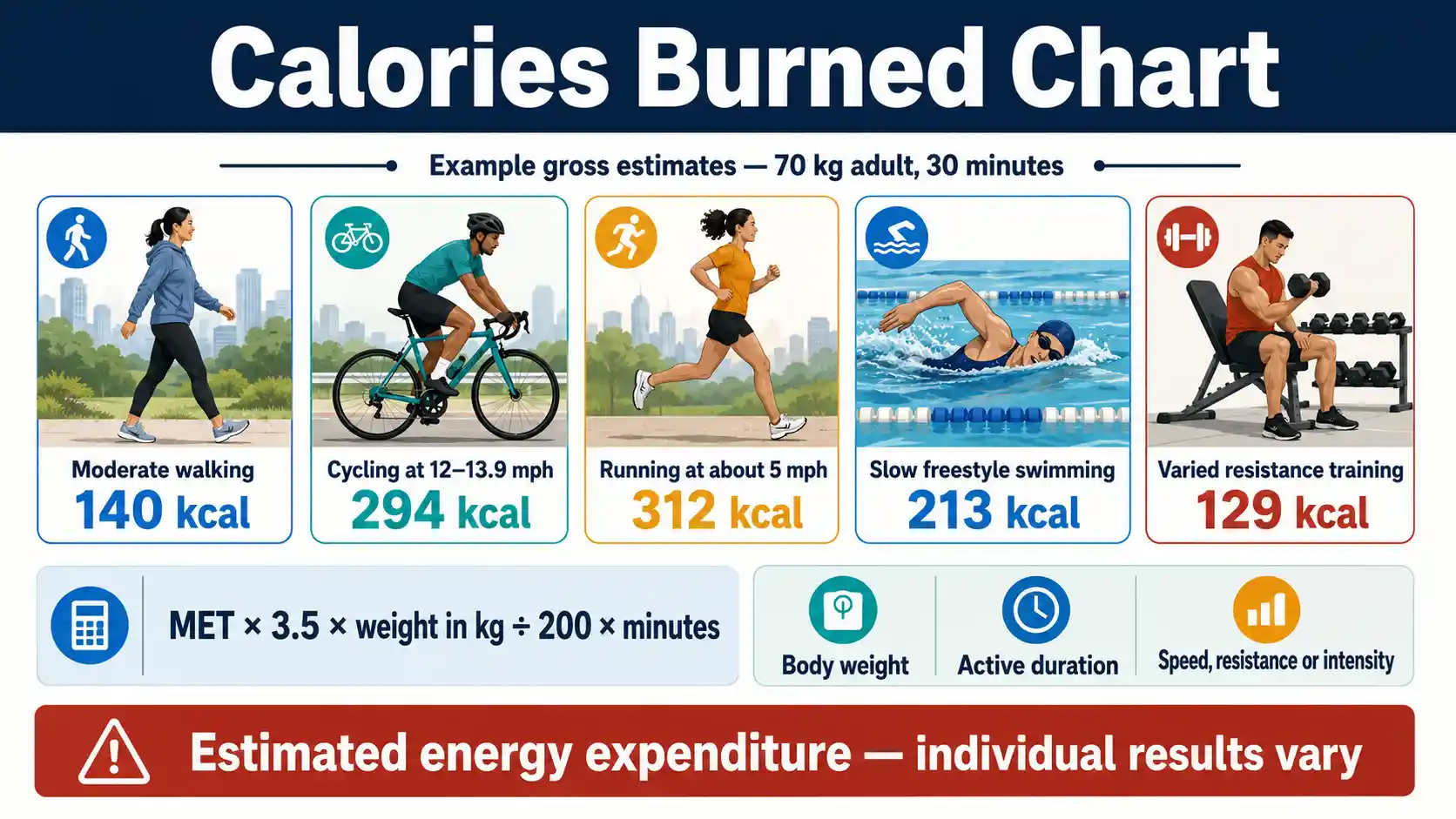
How many calories does exercise burn?
Calories burned depend on the activity MET value, body weight, and active time. A 70 kg (154 lb) adult has gross 30-minute estimates of about 140 kcal for moderate walking, 294 kcal for cycling at 12–13.9 mph, and 312 kcal for running at about 5 mph.
The 2024 Adult Compendium of Physical Activities assigns MET values to specific activity descriptions. Match the description closely. “Cycling” alone is too broad because speed, resistance, terrain, and power can change the energy cost.
Core formula
MET × 3.5 × kg ÷ 200
This gives estimated gross kilocalories per minute.
Body weight
A direct multiplier
At the same MET and time, the standard estimate rises with kilograms.
Duration
Use active minutes
Separate moving time from long breaks when the activity MET assumes continuous work.
Interpretation
Estimate, not a measurement
Actual expenditure varies with performance, physiology, equipment and environment.
Calories burned by activity and body weight
Estimated gross kilocalories for 30 continuous minutes. Values use the listed MET and are rounded to the nearest 5 kcal.
Swipe horizontally inside the table to view every column.
| Activity and intensity | MET | 125 lb / 57 kg | 155 lb / 70 kg | 185 lb / 84 kg | 215 lb / 98 kg |
|---|---|---|---|---|---|
| Walking, 2.8–3.4 mph, level | 3.8 | 115 | 140 | 170 | 195 |
| Walking, 3.5–3.9 mph, brisk | 4.8 | 145 | 175 | 210 | 245 |
| Running, 5.0–5.2 mph | 8.5 | 255 | 310 | 375 | 435 |
| Running, 6.0–6.3 mph | 9.3 | 280 | 340 | 410 | 480 |
| Cycling, 10–11.9 mph | 6.8 | 205 | 250 | 300 | 350 |
| Cycling, 12–13.9 mph | 8.0 | 240 | 295 | 355 | 410 |
| Stationary cycling, 90–100 W | 6.0 | 180 | 220 | 265 | 310 |
| Swimming freestyle, slow | 5.8 | 175 | 215 | 255 | 300 |
| Swimming freestyle, fast | 9.8 | 295 | 360 | 430 | 505 |
| Resistance training, varied exercises | 3.5 | 105 | 130 | 155 | 180 |
| Resistance training, vigorous effort | 6.0 | 180 | 220 | 265 | 310 |
| Calisthenics, vigorous effort | 7.5 | 225 | 275 | 330 | 385 |
| Elliptical trainer, moderate effort | 5.0 | 150 | 185 | 220 | 255 |
| Rowing ergometer, under 100 W | 5.0 | 150 | 185 | 220 | 255 |
| Stair climbing, general | 6.8 | 205 | 250 | 300 | 350 |
| Yoga, general | 2.3 | 70 | 85 | 100 | 120 |
| Recreational ballroom dance | 6.0 | 180 | 220 | 265 | 310 |
| Soccer, casual | 7.0 | 210 | 255 | 310 | 360 |
| Tennis singles | 8.0 | 240 | 295 | 355 | 410 |
| Rope skipping, general | 11.0 | 330 | 405 | 485 | 565 |
Values are estimated gross kilocalories (kcal) per 30 minutes.
- • Gross calories include energy that the body would have used at rest during the same time. They are not the same as above-rest or “active” calories.
- • Speed, grade, power, rest time, stroke, skill, equipment, environment, and individual physiology can change actual energy expenditure.
- • The 2024 Adult Compendium is designed primarily for adults ages 19–59. Population-specific methods may be more appropriate outside that range.
Table sources: Compendium of Physical Activities — 2024 Adult Compendium and activity MET tables; Compendium of Physical Activities — Unit Conversions and MET-to-kilocalorie Formula
Download or export
Calories burned calculator
Choose the activity that best matches your actual speed or effort. Enter body weight and active minutes to estimate both gross calories and calories above the standard resting reference.
Walking, 2.8–3.4 mph, level · 3.8 METs · 70.0 kg · 30 minutes
Gross estimate140 kcal
Above-rest estimate103 kcal
Gross rate4.7 kcal/min
Formula: gross kcal/min = MET × 3.5 × weight in kg ÷ 200. Above-rest calories subtract one MET before applying the formula. Results are estimates, not measurements, and do not include a separate post-exercise recovery value.
How to calculate calories burned from a MET value
Gross kcal = MET × 3.5 × body weight in kg ÷ 200 × active minutes.
- 1. Match the activity. Use the MET for the actual speed, power, stroke, terrain, or effort. Do not average unrelated activities.
- 2. Convert weight if needed. Multiply pounds by 0.45359237 to get kilograms.
- 3. Calculate the rate. Multiply MET × 3.5 × kg, then divide by 200 to estimate gross kcal per minute.
- 4. Apply moving time. Multiply the rate by minutes spent doing that activity. Calculate work and rest segments separately when intensity changes.
- 5. Round last. Keep the unrounded number during the calculation, then round the final estimate to a practical whole number.
Worked example: 30-minute walk
Moderate level walking at 3.8 METs for a 70 kg adult gives 3.8 × 3.5 × 70 ÷ 200 × 30 = 139.65 kcal. Report that as about 140 gross kcal, not as an exact measured value.
The Compendium unit-conversion reference defines the standard MET-to-kcal calculation used here.
Gross calories versus active calories
These labels answer different questions. Check which one a chart, watch, app, or exercise machine reports before comparing numbers.
Gross activity calories
Gross calories estimate all energy used during the session. They include the resting energy you would have used during those minutes. The downloadable charts on this page show gross kcal.
Above-rest or active calories
Above-rest calories estimate the extra energy attributable to the activity. The calculator subtracts one MET: (MET − 1) × 3.5 × kg ÷ 200 × minutes.
For the 3.8-MET walking example above, the calculator estimates about 140 gross kcal and about 103 kcal above rest. Neither number should be added to a device result for the same session.
Calories burned by exercise duration
Estimated gross kilocalories for a 70 kg (154 lb) adult. Continuous time is assumed and values are rounded to the nearest whole kcal.
Swipe horizontally inside the table to view every column.
| Activity and intensity | MET | 10 min | 20 min | 30 min | 45 min | 60 min |
|---|---|---|---|---|---|---|
| Walking, 2.8–3.4 mph, level | 3.8 | 47 | 93 | 140 | 209 | 279 |
| Walking, 3.5–3.9 mph, brisk | 4.8 | 59 | 118 | 176 | 265 | 353 |
| Running, 5.0–5.2 mph | 8.5 | 104 | 208 | 312 | 469 | 625 |
| Running, 6.0–6.3 mph | 9.3 | 114 | 228 | 342 | 513 | 684 |
| Cycling, 10–11.9 mph | 6.8 | 83 | 167 | 250 | 375 | 500 |
| Cycling, 12–13.9 mph | 8.0 | 98 | 196 | 294 | 441 | 588 |
| Swimming freestyle, slow | 5.8 | 71 | 142 | 213 | 320 | 426 |
| Swimming freestyle, fast | 9.8 | 120 | 240 | 360 | 540 | 720 |
| Resistance training, varied exercises | 3.5 | 43 | 86 | 129 | 193 | 257 |
| Calisthenics, vigorous effort | 7.5 | 92 | 184 | 276 | 413 | 551 |
| Rowing ergometer, under 100 W | 5.0 | 61 | 123 | 184 | 276 | 368 |
| Yoga, general | 2.3 | 28 | 56 | 85 | 127 | 169 |
Reference body mass: 70 kg (154 lb). Values are gross kcal.
- • Doubling continuous duration doubles this equation-based estimate. Real sessions may include pauses or changing intensity.
- • For another body weight, use the calculator or multiply a table value by your weight in kilograms divided by 70.
Table sources: Compendium of Physical Activities — 2024 Adult Compendium and activity MET tables; Compendium of Physical Activities — Unit Conversions and MET-to-kilocalorie Formula
Download or export
Common calorie-burn questions answered
Every answer below assumes a 70 kg (154 lb) adult and uses gross MET-based calories. Answers round the calculator result to the nearest whole kcal; the weight chart rounds to the nearest 5 kcal. Change the weight, activity, or duration in the calculator for a different estimate.
How many calories does a 30-minute walk burn?
About 140 kcal
A 70 kg (154 lb) adult walking 2.8–3.4 mph on level ground has a gross estimate of about 140 kcal in 30 minutes.
How many calories does one hour of brisk walking burn?
About 353 kcal
At 70 kg, brisk level walking at 3.5–3.9 mph produces a gross estimate of about 353 kcal in 60 minutes.
How many calories does running at 5 mph burn in 30 minutes?
About 312 kcal
At 70 kg, running 5.0–5.2 mph for 30 continuous minutes produces a gross estimate of about 312 kcal.
How many calories does 30 minutes of cycling burn?
About 250–294 kcal
At 70 kg, cycling 10–11.9 mph estimates about 250 kcal; 12–13.9 mph estimates about 294 kcal.
How many calories does 30 minutes of swimming burn?
About 213–360 kcal
At 70 kg, slow freestyle laps estimate about 213 kcal, while fast freestyle laps estimate about 360 kcal.
How many calories does 30 minutes of weight training burn?
About 129–221 kcal
At 70 kg, varied resistance exercises estimate about 129 kcal; vigorous lifting estimates about 221 kcal.
How many calories does 30 minutes of yoga burn?
About 85 kcal
At 70 kg, a general 2.3-MET yoga session produces a gross estimate of about 85 kcal in 30 minutes.
How many calories does stair climbing burn in 30 minutes?
About 250 kcal
At 70 kg, general stair climbing at 6.8 METs produces a gross estimate of about 250 kcal in 30 minutes.
How many calories does rowing burn in 30 minutes?
About 184 kcal
At 70 kg, rowing on an ergometer below 100 watts estimates about 184 gross kcal in 30 minutes.
How many calories does 30 minutes of soccer burn?
About 257 kcal
At 70 kg, casual soccer at 7.0 METs produces a gross estimate of about 257 kcal in 30 minutes.
How many calories does tennis singles burn in 30 minutes?
About 294 kcal
At 70 kg, tennis singles at 8.0 METs produces a gross estimate of about 294 kcal in 30 minutes.
How many calories does 15 minutes of jumping rope burn?
About 202 kcal
At 70 kg, general rope skipping at 11.0 METs produces a gross estimate of about 202 kcal in 15 minutes.
MET values and exercise intensity chart
A MET compares an activity with the standard resting reference. Adult absolute-intensity bands classify activities by MET value.
Swipe horizontally inside the table to view every column.
| Activity | MET | Absolute intensity | What the label specifies |
|---|---|---|---|
| Household walking | 2.3 | Light | Everyday indoor walking |
| Yoga, general | 2.3 | Light | General session; styles vary |
| Walking the dog | 3.0 | Moderate | Activity description does not set a speed |
| Walking, 2.8–3.4 mph | 3.8 | Moderate | Level, firm surface |
| Walking, 3.5–3.9 mph | 4.8 | Moderate | Brisk, level, firm surface |
| Elliptical trainer | 5.0 | Moderate | Moderate effort |
| Swimming freestyle | 5.8 | Moderate | Slow recreational laps |
| Stationary cycling | 6.0 | Vigorous | 90–100 watts |
| Resistance training | 6.0 | Vigorous | Vigorous effort |
| Recreational ballroom dance | 6.0 | Vigorous | Waltz, foxtrot, cha-cha or swing |
| Stair climbing | 6.8 | Vigorous | General stair climbing |
| Soccer | 7.0 | Vigorous | Casual, general play |
| Calisthenics | 7.5 | Vigorous | Vigorous effort |
| Cycling, 12–13.9 mph | 8.0 | Vigorous | Leisure cycling, moderate effort |
| Running, 5.0–5.2 mph | 8.5 | Vigorous | About a 12-minute mile |
| Swimming freestyle | 9.8 | Vigorous | Fast laps |
| High-intensity interval exercise | 11.0 | Vigorous | Burpees, mountain climbers, squat jumps or Tabata |
| Rope skipping | 11.0 | Vigorous | General rope-skipping exercise |
- • Adult absolute-intensity bands are light below 3.0 METs, moderate from 3.0 through 5.9 METs, and vigorous at 6.0 METs or above.
- • Absolute MET intensity and personal effort are different. The same task may feel easy to one person and very hard to another.
Table sources: Compendium of Physical Activities — 2024 Adult Compendium and activity MET tables; U.S. Department of Health and Human Services — Physical Activity Guidelines for Americans, Second Edition
Download or export
MET intensity is absolute; effort is personal
Adult absolute intensity uses fixed bands: below 3.0 METs is light, 3.0–5.9 METs is moderate, and 6.0 METs or more is vigorous. Relative intensity describes how hard the work is for the individual. A 4-MET task may feel light to a trained athlete and hard to a person with limited exercise capacity.
Use speed, pace, watts, grade, stroke, talk test, perceived effort, or individualized heart-rate guidance when they fit the activity. Do not raise intensity only to chase a larger calorie number.
Factors that change a calorie-burn estimate
Record the variables that materially define the session instead of treating one number as exact.
Swipe horizontally inside the table to view every column.
| Factor | How it changes the estimate | Why | What to record |
|---|---|---|---|
| Body mass | Higher mass raises the standard MET estimate | The equation scales directly with kilograms | Current body weight and unit |
| Duration | More active minutes raise the estimate | The equation scales with time | Moving time, not only elapsed time |
| Speed or pace | Faster movement often raises MET value | Work rate usually increases | Speed, pace, or distance and time |
| Grade and terrain | Uphill, sand, trails, or resistance can raise cost | More force and stabilization may be required | Grade, elevation, surface, or route |
| External load | A pack or carried load may raise cost | More mass is moved | Load weight and carrying method |
| Power output | Watts sharpen cycling or rowing classification | Speed alone can hide resistance and wind effects | Average power when available |
| Rest intervals | Long rests lower session-average expenditure | Exercise METs assume the described activity is occurring | Work and rest time separately |
| Movement economy | Skill and training can alter oxygen cost | People do not perform the same task with identical efficiency | Use the same method for trend comparisons |
| Environment | Heat, cold, wind, water and altitude may alter demand | Thermoregulation and resistance change | Conditions that differ from normal |
| Device algorithm | Watch, machine and app values may disagree | Sensors and proprietary models use different inputs | Device, mode, settings and whether kcal are active or total |
| Physiology and medication | Heart-rate response and energy cost may differ | Age, body composition, health and medicines affect response | Do not override individualized clinical advice |
| Recovery after exercise | Some energy use occurs after the timed session | Recovery cost varies with intensity and duration | Do not add a fixed “afterburn” percentage |
- • A repeatable estimate is useful for comparing similar sessions even when it is not a laboratory measurement.
- • Indirect calorimetry and doubly labeled water answer different energy-expenditure questions and are not replaced by a chart.
Table sources: National Academies of Sciences, Engineering, and Medicine — Dietary Reference Intakes for Energy: Factors Affecting Energy Expenditure; Compendium of Physical Activities — 2024 Adult Compendium and activity MET tables
Download or export
How to track exercise calorie estimates consistently
A consistent estimate can compare similar sessions even when it is not exact. Record enough detail to reproduce the calculation.
- Activity definition: write the mode plus speed, pace, power, grade, stroke, load, or effort.
- Time basis: separate moving minutes from warm-up, recovery, and long rest periods.
- Body weight: use the weight applied to that calculation and retain the unit.
- Estimate type: label gross, above-rest, watch active, watch total, or machine calories.
- Method: compare trends from the same chart or device instead of switching algorithms without noting it.
- Session context: record unusual heat, altitude, terrain, load, illness, or equipment changes.
Do exercise calories predict weight change?
No single workout estimate predicts weight change. Body weight responds to energy intake and total energy expenditure over time, not to one exercise number in isolation.
Total energy expenditure includes resting energy, food-related thermogenesis, daily movement, and planned activity. Exercise estimates can be wrong, appetite can change, and non-exercise movement can rise or fall. Use longer-term weight and performance trends when those outcomes matter.
Physical activity also supports health, function, fitness, sleep, and quality of life without requiring a particular calorie score. The Physical Activity Guidelines for Americans frame aerobic and muscle-strengthening targets by activity and intensity rather than by a universal calorie target.
Safety, age, and population limits
The main activity values on this page come from the Adult Compendium for ages 19–59. Older adults, children, pregnant people, wheelchair users, and people with conditions that alter movement or metabolism may need a population-specific compendium or individualized assessment.
Start at an intensity appropriate for your current capacity. Stop exercise and seek urgent medical help for chest pressure or pain, fainting, severe breathing difficulty, or another acute warning sign. A predicted calorie value cannot show whether an activity is safe for you.
Frequently asked questions
How accurate is a calories-burned chart?
It is an estimate based on a group-average MET value, body weight, and time. Actual energy expenditure can differ because intensity, efficiency, body composition, age, environment, health, rest intervals, and measurement method vary.
What formula estimates calories burned from METs?
Estimated gross kcal per minute equals MET multiplied by 3.5, multiplied by body weight in kilograms, then divided by 200. Multiply that rate by active minutes. The result uses the standard 3.5 mL/kg/min resting reference.
Are the chart values active calories or total calories?
The tables show gross activity calories, which include resting energy during the session. Above-rest calories use the same formula with one MET subtracted. Watches may label these concepts as total and active calories, but definitions can differ by device.
Does a heavier person burn more calories doing the same exercise?
The standard MET equation produces a larger estimate at a higher body weight because kilograms are a direct multiplier. That does not mean two people of the same weight have identical measured energy expenditure.
Why does my fitness watch show a different calorie number?
A watch may use heart rate, motion, age, sex, height, fitness estimates, GPS, and a proprietary model. It may also report active rather than gross calories. A chart uses a fixed MET assumption, so disagreement is expected.
Does being fitter reduce calories burned at the same pace?
Training can improve movement economy, so a trained person may use less oxygen for the same submaximal task. Body mass, technique, terrain, temperature, and physiology also affect the result.
Does the calculator include calories burned after exercise?
No. It estimates energy used during the entered activity time. Recovery energy expenditure varies with the workout and person, so adding a fixed afterburn percentage would create false precision.
Can I subtract exercise calories from my food intake?
Do not assume every estimated exercise calorie creates an equal food allowance. Device and chart errors, normal activity changes, appetite, and the difference between gross and above-rest calories can distort the calculation. Use longer-term trends or individualized professional guidance.
Can adults over 60, children, pregnant people, or wheelchair users use this chart?
Use caution. The main values come from the Adult Compendium for ages 19–59. Older-adult, youth, pregnancy, disability, and wheelchair contexts may need population-specific measurements or compendia.
Sources
Compendium of Physical Activities — 2024 Adult Compendium and activity MET tables
https://pacompendium.com/adult-compendium/
Compendium of Physical Activities — Unit Conversions and MET-to-kilocalorie Formula
https://pacompendium.com/unite-conversions/
U.S. Department of Health and Human Services — Physical Activity Guidelines for Americans, Second Edition
https://odphp.health.gov/sites/default/files/2019-09/Physical_Activity_Guidelines_2nd_edition.pdf
National Academies of Sciences, Engineering, and Medicine — Dietary Reference Intakes for Energy: Factors Affecting Energy Expenditure
https://www.ncbi.nlm.nih.gov/books/NBK591031/