Fitness & Sports · Measurement and Progress
Body Measurement Chart for Accurate Fitness Tracking
Find consistent tape positions for the neck, shoulders, chest, waist, hips, arms, thighs, and calves, then convert units and track changes without overreading normal variation.
Body measurements are estimates and tracking tools, not diagnoses. Sudden unexplained swelling, rapid body-size change, pain, shortness of breath, or other concerning symptoms need medical advice. Read the ChartsLoom Disclaimer.
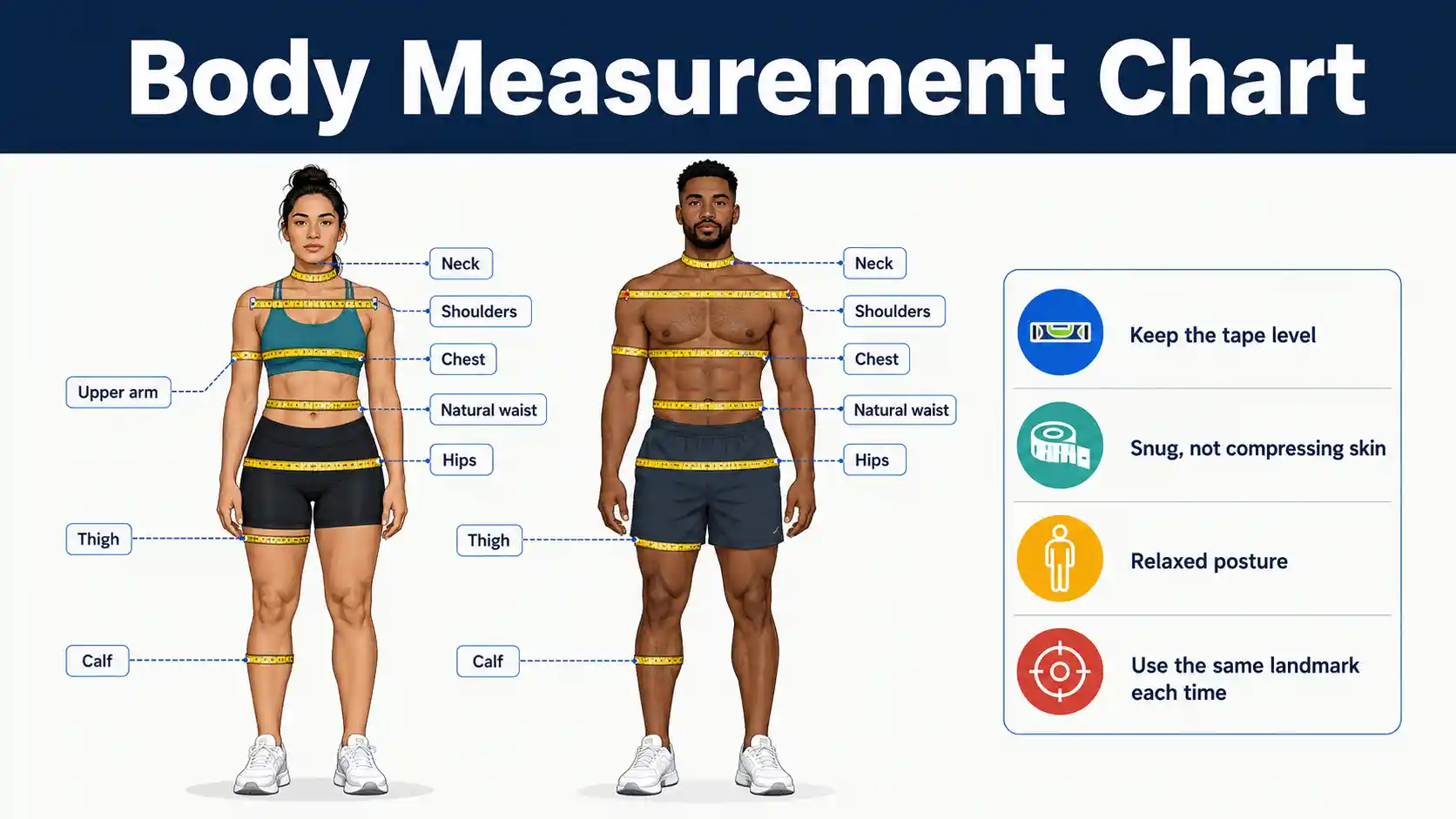
How do you take body measurements correctly?
Place a flexible non-stretch tape around a clearly defined landmark, keep it level and snug without compressing the skin, and repeat the reading under the same conditions.
The CDC NHANES anthropometry manual shows why posture, landmarking, equipment, and recorder checks are central to reliable measurement. A home fitness log can be simpler, but it should still document the method.
Tape
Flexible, non-stretch
Keep it level and snug without indenting skin.
Best method
Repeatable landmarks
Protocol consistency matters more than chasing a smaller reading.
Progress
Use trends
Compare several standardized sessions, not isolated numbers.
Interpretation
One part of context
Circumference cannot directly reveal muscle, fat, fluid, or health status.
Body measurement landmarks chart
Use the same anatomical landmark, posture, tape tension, side of the body, and breathing phase each time.
Swipe horizontally inside the table to view every column.
| Measurement | Landmark and tape path | Position | Tracking note |
|---|---|---|---|
| Neck | Around the neck below the larynx; keep the tape level | Head neutral, shoulders relaxed | Do not compress skin or angle the tape |
| Shoulders | Around the widest point of both shoulders and upper back | Arms relaxed | A helper improves tape alignment |
| Chest | Around the fullest chest level, under the armpits | Stand tall; breathe normally | Record at the same breathing phase |
| Upper arm | Around the midpoint between shoulder tip and elbow | Arm relaxed at side | Mark the midpoint for repeatability |
| Forearm | Around the widest forearm point | Arm relaxed, palm neutral | Use the same arm each session |
| Natural waist | Around the chosen waist landmark; tape horizontal | Abdomen relaxed after a normal exhale | State the protocol because waist sites differ |
| Hips / seat | Around the maximum circumference of buttocks | Feet together, weight balanced | Check the tape in a mirror |
| Thigh | Around a defined point below the groin or at mid-thigh | Leg relaxed, weight evenly distributed | Write down the distance from the landmark |
| Calf | Around the largest calf circumference | Feet flat, leg relaxed | Search gently for the widest point |
| Height | Floor to crown with shoes removed | Heels down, gaze level | Use a wall-mounted stadiometer when possible |
| Weight | Body mass on a calibrated scale | Minimal clothing, no shoes | Measure under similar time and hydration conditions |
- • There is no single universal tape site for every fitness or tailoring measurement. Name the exact protocol in your log.
- • A flexible, non-stretch tape is suitable for circumferences; a rigid height rule or stadiometer is better for stature.
Table sources: CDC National Center for Health Statistics — NHANES Anthropometry Procedures Manual
Download or export
A repeatable body-measurement routine
- 1. Define the purpose. Fitness progress, clothing fit, research, and clinical care may use different landmarks.
- 2. Standardize conditions. Choose a similar time, hydration state, clothing, posture, side, and exercise-recovery state.
- 3. Locate and record the site. Write the anatomical landmark or distance from it instead of relying on memory.
- 4. Position the tape. Keep it flat, untwisted, and horizontal for circumferences unless the protocol says otherwise.
- 5. Repeat the reading. Take two measurements. If they differ meaningfully, reset the tape and take a third.
- 6. Log context. Record the unit, date, protocol, unusual bloating, soreness, swelling, equipment change, or other condition.
Measurement consistency and error-control chart
Small technique changes can be larger than the body change you are trying to detect.
Swipe horizontally inside the table to view every column.
| Variable | Keep consistent | Common error | Better practice |
|---|---|---|---|
| Time | Similar time of day | Comparing morning with evening | Choose a repeatable measurement window |
| Food and fluid | Similar meal and hydration state | Measuring after a large meal one week only | Record unusual meals, fluid intake, or bloating |
| Exercise | Similar recovery state | Measuring a pumped muscle after training | Measure before training or after comparable rest |
| Tape tension | Snug without indentation | Pulling tighter to obtain a smaller number | Use light, repeatable contact |
| Tape angle | Horizontal for circumferences | Tape rises or falls behind the body | Use a mirror or helper |
| Landmark | Same anatomical site | Using navel one time and narrowest waist next time | Mark or describe the site |
| Side | Same right or left limb | Switching sides | Log the side with each unilateral measure |
| Breathing | Same phase for torso measures | Holding the breath or drawing in the abdomen | Relax and measure after a normal exhale |
| Repeat readings | Two readings; a third if they differ | Keeping a rushed single reading | Average close readings and recheck large differences |
| Equipment | Same tape and scale | Changing devices without noting it | Check damage, zero, and calibration |
- • Trend interpretation is strongest when several comparable sessions move in the same direction.
Table sources: CDC National Center for Health Statistics — NHANES Anthropometry Procedures Manual
Download or export
Waist ratio calculator
Enter waist, hip, and height in the same unit. The calculator shows two dimensionless ratios; it does not classify health or body composition.
Enter three positive measurements to calculate the ratios.
Ratios are sensitive to measurement protocol and do not replace clinical assessment. Cutoffs can differ by guideline, population, age, pregnancy status, and purpose.
Waist methods are not interchangeable
The WHO and NHANES protocols use defined but different waist landmarks. Health cutoffs are tied to the protocol and population behind a guideline. State the site you used, compare like with like, and avoid applying an adult threshold to children or pregnancy. The WHO waist and waist–hip report explains the role of measurement protocol in interpretation.
Body measurement unit conversion chart
Convert recorded lengths and weights without rounding too early.
Swipe horizontally inside the table to view every column.
| Convert | Formula | Example | Practical rounding |
|---|---|---|---|
| Inches to centimeters | in × 2.54 | 30 in = 76.2 cm | 0.1 cm for a measurement log |
| Centimeters to inches | cm ÷ 2.54 | 100 cm = 39.37 in | 0.1 in for a measurement log |
| Feet and inches to centimeters | (feet × 12 + inches) × 2.54 | 5 ft 8 in = 172.72 cm | 0.1 cm |
| Pounds to kilograms | lb × 0.45359237 | 150 lb = 68.04 kg | 0.1 kg |
| Kilograms to pounds | kg × 2.20462262 | 70 kg = 154.32 lb | 0.1 lb |
| Waist-to-hip ratio | waist circumference ÷ hip circumference | 80 cm ÷ 100 cm = 0.80 | Two decimal places |
| Waist-to-height ratio | waist circumference ÷ height | 80 cm ÷ 170 cm = 0.47 | Two decimal places |
Use the same unit on both sides of a ratio.
- • Keep full precision during calculation and round only the displayed result.
Table sources: World Health Organization — Waist Circumference and Waist–Hip Ratio
Download or export
How to track body-measurement progress
Create one row per session with the date, measurement, unit, side, protocol, and notes. Keep the raw reading even if you also graph change from baseline. A useful progress statement describes direction and timeframe—for example, “waist using the same landmark decreased across three monthly sessions”—instead of treating one reading as proof of fat loss.
Circumference may change with muscle, fat, posture, food volume, fluid shifts, inflammation, training pump, or technique. Pair tape data with performance, recovery, clothing fit, and health guidance appropriate to your goal.
Body measurement tracking schedule
Choose a schedule that can show a real trend without making normal short-term variation feel important.
Swipe horizontally inside the table to view every column.
| Goal | Useful measures | Example interval | Interpretation |
|---|---|---|---|
| General fitness progress | Waist, hips, selected limbs, weight, photos | Every 2–4 weeks | Look for multi-session direction |
| Strength or muscle gain | Chest, upper arm, thigh, calf, weight, performance | Every 2–4 weeks | A pump is not long-term growth |
| Weight-management support | Weight trend and waist; optional hips | Weight more often; tape every 2–4 weeks | No single measure captures health |
| Clothing or equipment fit | Garment-specific sites | When ordering or after meaningful change | Follow the brand or maker method |
| Clinical monitoring | Only measures requested by clinician | As advised | Use the specified clinical protocol |
- • The intervals are practical examples, not medical requirements.
- • Children, pregnancy, edema, injury, and medical conditions need context-specific interpretation.
Table sources: Centers for Disease Control and Prevention — About Healthy Weight and Growth
Download or export
What body measurements cannot tell you
A tape measure cannot directly separate muscle from fat, detect visceral fat, assess hydration, diagnose a condition, or determine athletic ability. Height, weight, waist, ratios, and circumference equations each answer different questions and have population-specific limitations. Children require age- and sex-specific growth assessment, and pregnancy changes the meaning of waist measurements.
Frequently asked questions
How do I take body measurements accurately?
Use a flexible non-stretch tape, stand in a repeatable relaxed posture, keep the tape level and snug without compressing skin, and measure the same landmark twice. Record the side, site, time, and conditions.
Where should I measure my waist?
Different protocols use different waist sites. Choose a defined method—such as the NHANES landmark at the upper border of the right ilium or the WHO midpoint method—and use that exact site every time. Do not compare values collected with different protocols as though they were identical.
Should I flex when measuring arms and thighs?
Use a relaxed measurement for general circumference tracking unless your program specifically calls for a flexed measure. Label flexed and relaxed readings separately because they are not interchangeable.
How often should I measure my body?
For many fitness goals, every two to four weeks is frequent enough to reveal a trend while reducing attention to day-to-day variation. Use the same conditions each time.
Why did my waist measurement change overnight?
Food volume, hydration, bowel contents, menstrual-cycle effects, posture, breathing, tape placement, and tape tension can all change a short-term reading. Recheck under your normal standardized conditions.
Are body measurements the same as clothing measurements?
Not always. Tailoring and clothing brands may define chest, waist, rise, inseam, and hip sites differently. Follow the garment-specific guide when fit is the purpose.
Can a tape measure calculate body-fat percentage?
Some equations estimate body fat from circumferences, but the result depends on the equation, population, and technique. It is an estimate, not a direct measurement, and should not be mixed with results from another method.
Sources
CDC National Center for Health Statistics — NHANES Anthropometry Procedures Manual
https://wwwn.cdc.gov/nchs/data/nhanes/public/2021/manuals/2021-Anthropometry-Procedures-Manual-508.pdf
World Health Organization — Waist Circumference and Waist–Hip Ratio
https://www.who.int/publications/i/item/9789241501491
Centers for Disease Control and Prevention — About Healthy Weight and Growth
https://www.cdc.gov/healthy-weight-growth/about/index.html
National Heart, Lung, and Blood Institute — Aim for a Healthy Weight
https://www.nhlbi.nih.gov/health/educational/lose_wt/risk.htm