Animals & Pets · Cats
Cat Age Chart: Cat Years, Human Years and Feline Life Stages
Convert cat years to human years, compare kitten, young-adult, mature-adult and senior stages, review development and care priorities, and understand what teeth, eyes, coat, muscle and behavior can—and cannot—reveal about an unknown cat’s age.
Do not dismiss a new change as normal aging. Weight loss, breathing difficulty, pain, reduced mobility, appetite or thirst changes, altered urination, sudden vision loss, disorientation and house-soiling can need veterinary assessment. Read the ChartsLoom Disclaimer.
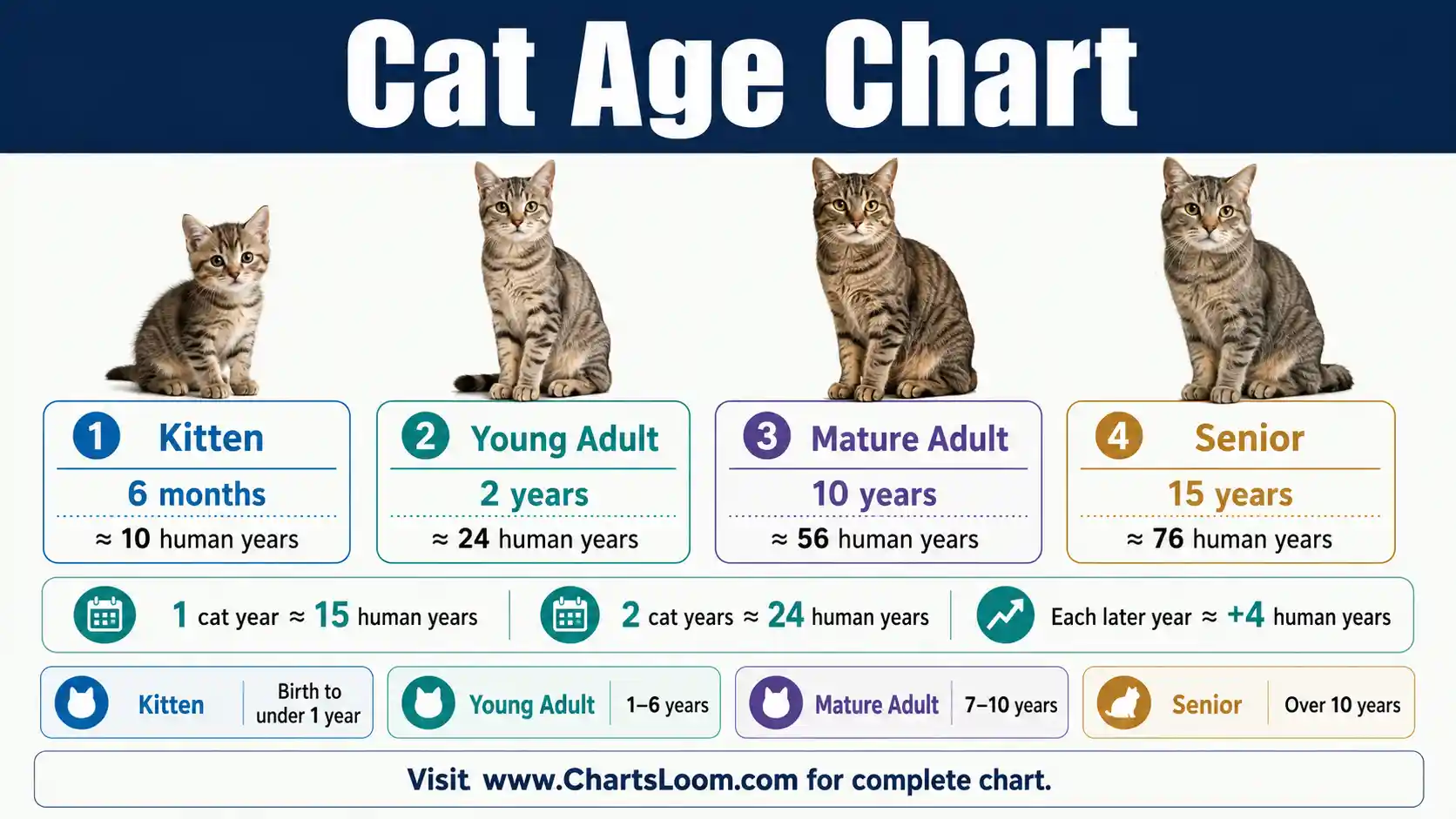
Cat age conversion: the quick answer
A cat’s first year is approximately 15 human years, the second brings the comparison to about 24, and each later cat year adds roughly four. The familiar seven-to-one shortcut is inaccurate because cats develop much faster in their first two years.
Cat age is more useful when it connects calendar years with life stage and care needs. For a quick online calculation using years and months, this tool provides a human-age estimate, while the charts below explain how to interpret the result and why it cannot predict health or lifespan.
One cat year
≈ 15 human years
The first year represents rapid development, not seven human years.
Two cat years
≈ 24 human years
After age two, common comparison charts add about four years per cat year.
Current life stages
4 age-related stages
Kitten, young adult, mature adult and senior, plus end of life at any age.
Important limit
Analogy, not prognosis
Human-age equivalents do not predict lifespan, health or quality of life.
Questions at a glance
How old is a one-year-old cat in human years?
Approximately 15 human years on the AAHA physiological-age chart.
How old is a two-year-old cat in human years?
Approximately 24 human years.
How are later cat years converted?
Add about four human years for each complete cat year after age two.
Is the seven-year rule accurate for cats?
No. It understates how quickly cats develop during the first two years.
When does kittenhood end?
The current AAHA/AAFP framework defines kitten as birth up to one year.
What ages are young adult?
One through six years.
What ages are mature adult?
Seven through ten years.
When is a cat senior?
The detailed guideline defines senior as over ten years, with individual variation.
Can teeth reveal an exact birthday?
Usually not. Tooth eruption helps with kittens; adult wear supports only a broad range.
Can behavior identify age?
No. Temperament, health, stress and environment create too much variation.
Does human age predict lifespan?
No. It is a developmental comparison, not a survival forecast.
How often should a senior cat be examined?
AAHA recommends at least every six months, with more frequent care when needed.
Cat Years to Human Years Chart
A practical physiological-age comparison using AAHA reference points. Human-year equivalents are educational analogies, not a measure of lifespan, intelligence, maturity, or disease risk.
Swipe horizontally inside the table to view every column.
| Cat age | Approximate human age | AAHA life stage | How to interpret it |
|---|---|---|---|
| 6 months | 10 — AAHA reference point | Kitten | Rapid growth; human-age comparison is only approximate |
| 1 year | 15 — AAHA reference point | Young adult | Development and health vary by individual; use calendar age for care decisions |
| 2 years | 24 — AAHA reference point | Young adult | Development and health vary by individual; use calendar age for care decisions |
| 3 years | 28 | Young adult | Development and health vary by individual; use calendar age for care decisions |
| 4 years | 32 | Young adult | Development and health vary by individual; use calendar age for care decisions |
| 5 years | 36 | Young adult | Development and health vary by individual; use calendar age for care decisions |
| 6 years | 40 | Young adult | Development and health vary by individual; use calendar age for care decisions |
| 7 years | 44 | Mature adult | Development and health vary by individual; use calendar age for care decisions |
| 8 years | 48 | Mature adult | Development and health vary by individual; use calendar age for care decisions |
| 9 years | 52 | Mature adult | Development and health vary by individual; use calendar age for care decisions |
| 10 years | 56 | Mature adult | Development and health vary by individual; use calendar age for care decisions |
| 11 years | 60 | Senior | Development and health vary by individual; use calendar age for care decisions |
| 12 years | 64 | Senior | Development and health vary by individual; use calendar age for care decisions |
| 13 years | 68 | Senior | Development and health vary by individual; use calendar age for care decisions |
| 14 years | 72 | Senior | Development and health vary by individual; use calendar age for care decisions |
| 15 years | 76 | Senior | Development and health vary by individual; use calendar age for care decisions |
| 16 years | 80 | Senior | Development and health vary by individual; use calendar age for care decisions |
| 17 years | 84 | Senior | Development and health vary by individual; use calendar age for care decisions |
| 18 years | 88 | Senior | Development and health vary by individual; use calendar age for care decisions |
| 19 years | 92 | Senior | Development and health vary by individual; use calendar age for care decisions |
| 20 years | 96 | Senior | Development and health vary by individual; use calendar age for care decisions |
| 21 years | 100 | Senior | Development and health vary by individual; use calendar age for care decisions |
- • The 6-month through 21-year values follow the AAHA physiological-age poster.
- • A cat does not age at a fixed seven-to-one rate. The first two years represent much faster developmental change than later years.
- • Calendar age and veterinary assessment should guide care; the human-age number is only a communication aid.
Download or export
Interactive tool
Cat years to human years calculator
Enter whole years and remaining months. The calculator uses the AAHA comparison anchors of 6 months = 10 human years, 1 year = 15, 2 years = 24, then about four human years for each later cat year. Months between anchors are interpolated.
For a 3-month-old kitten, enter 0 years and 3 months. For a 4-year-old cat, enter 4 years and 0 months.
Calculated result
Human-age equivalent
34 years
AAHA life stage
Young adult
Care focus: Healthy weight, oral health, enrichment, behavior, lifestyle risk and individualized prevention.
This human-age equivalent is an educational comparison. Calendar age, health history and veterinary assessment should guide care.
What it does
Converts calendar age into an approximate human-age comparison and assigns the current AAHA age-related life stage.
Why it helps
It shows why the first two cat years represent faster development than a fixed seven-to-one rule suggests.
What it cannot do
It cannot estimate an unknown cat’s exact birthday, predict lifespan, diagnose disease, or replace individualized veterinary advice.
Cat Age by Month: Birth to Two Years
Month-by-month estimates interpolate between the AAHA anchors of birth, 6 months, 1 year, and 2 years. They make the rapid first two years easier to visualize.
Swipe horizontally inside the table to view every column.
| Calendar age | Approximate human age | Life stage | Developmental interpretation |
|---|---|---|---|
| Birth | 0 | Kitten | Early kitten development |
| 1 month | 1.7 | Kitten | Early kitten development |
| 2 months | 3.3 | Kitten | Early kitten development |
| 3 months | 5 | Kitten | Early kitten development |
| 4 months | 6.7 | Kitten | Early kitten development |
| 5 months | 8.3 | Kitten | Early kitten development |
| 6 months | 10 | Kitten | Later kitten growth |
| 7 months | 10.8 | Kitten | Later kitten growth |
| 8 months | 11.7 | Kitten | Later kitten growth |
| 9 months | 12.5 | Kitten | Later kitten growth |
| 10 months | 13.3 | Kitten | Later kitten growth |
| 11 months | 14.2 | Kitten | Later kitten growth |
| 12 months | 15 | Young adult | Young adult transition |
| 13 months | 15.8 | Young adult | Young adult transition |
| 14 months | 16.5 | Young adult | Young adult transition |
| 15 months | 17.2 | Young adult | Young adult transition |
| 16 months | 18 | Young adult | Young adult transition |
| 17 months | 18.8 | Young adult | Young adult transition |
| 18 months | 19.5 | Young adult | Physical and social maturation |
| 19 months | 20.2 | Young adult | Physical and social maturation |
| 20 months | 21 | Young adult | Physical and social maturation |
| 21 months | 21.8 | Young adult | Physical and social maturation |
| 22 months | 22.5 | Young adult | Physical and social maturation |
| 23 months | 23.2 | Young adult | Physical and social maturation |
| 24 months | 24 | Young adult | Two-year anchor |
- • Values between published anchor points are linear educational interpolations, not separate biological measurements.
- • Growth, puberty, social development, neuter status, nutrition, illness, and breed can shift individual timing.
- • Use exact months for kittens because a few weeks can represent a meaningful developmental difference.
Download or export
AAHA Feline Life Stage Definitions
The current AAHA/AAFP framework uses four age-related stages plus an end-of-life stage that can occur at any age.
Swipe horizontally inside the table to view every column.
| Stage | Age range | What the stage describes | Typical care emphasis |
|---|---|---|---|
| Kitten | Birth to under 1 year | Rapid growth, learning, socialization, dentition and preventive-care series | Congenital issues, infectious disease, nutrition, handling, oral development |
| Young adult | 1 through 6 years | Physical and social maturity; weight gain can become easier | Body condition, oral health, behavior, enrichment, lifestyle risk |
| Mature adult | 7 through 10 years | Subtle age-related changes may begin even when the cat appears healthy | Weight trend, mobility, pain, appetite, hydration, kidneys, thyroid and cognition |
| Senior | Over 10 years | Individual aging differences widen; chronic disease and mobility issues become more common | At least twice-yearly review, pain, cognition, sensory changes, muscle, kidneys, thyroid and blood pressure |
| End of life | Any age | A clinical and quality-of-life stage, not an age bracket | Comfort, symptom control, caregiver goals and veterinary guidance |
- • Stage boundaries are practical categories along a continuous spectrum, not biological switches.
- • A healthy 11-year-old and a frail 8-year-old may need different plans despite their category.
- • The end-of-life stage is determined by health and quality of life, not by reaching a particular birthday.
Download or export
Growth and development
The first two years contain the fastest change
A kitten moves from neonatal dependence through tooth eruption, weaning, social learning, adolescence and young adulthood in a short period. Exact timing varies, so milestones are best used to organize observations rather than to judge every kitten against a deadline.
Kitten Age and Development Milestones
A practical timeline from birth through two years. Development varies, so milestones should be read as broad patterns rather than deadlines.
Swipe horizontally inside the table to view every column.
| Age | Phase | Typical developmental pattern | Care and observation focus |
|---|---|---|---|
| Birth | Neonatal | Eyes and ears closed; depends on queen for warmth and feeding | Daily weight and nursing; urgent care for chilling, weakness or poor intake |
| 1 week | Neonatal | Limited crawling; sleep and feeding dominate | Warmth, hydration, weight trend and maternal care |
| 2 weeks | Neonatal | Eyes opening; hearing beginning; movement improving | Gentle handling only when safe; monitor eyes and weight |
| 3 weeks | Transition | Standing and early walking; baby teeth begin emerging | Safe low-sided litter and early handling exposure |
| 4 weeks | Transition | More coordinated play; beginning weaning | Kitten food introduction and secure exploration area |
| 5 weeks | Early socialization | Running, pouncing and social play expand | Positive exposure to people, sounds, surfaces and handling |
| 6 weeks | Early socialization | Improving balance and grooming; active play | Structured play, scratching options and litter habits |
| 7 weeks | Early socialization | Social learning continues; increasing independence | Continue varied positive experiences without overwhelming |
| 8 weeks | Kitten | Usually eating kitten food and using litter independently | Veterinary plan, identification and safe carrier routine |
| 9 weeks | Kitten | Coordination and confidence continue improving | Reward calm handling of paws, ears and mouth |
| 10 weeks | Kitten | High activity and curiosity | Prevent access to toxins, cords, falls and small objects |
| 11 weeks | Kitten | Predatory play sequences become more skilled | Use toys rather than hands or feet |
| 12 weeks | Kitten | Rapid growth continues; individual temperament clearer | Continue nutrition, preventive care and social learning |
| 4 months | Kitten | Permanent teeth begin replacing baby teeth | Chewing may increase; inspect mouth and use safe toys |
| 5 months | Kitten | Adolescent behavior may emerge; growth remains active | Discuss sterilization timing and calorie needs with veterinarian |
| 6 months | Kitten | Approximate human-age anchor of 10 years | Recheck body condition, teeth, behavior and preventive plan |
| 7 months | Kitten | Near adult length in many cats but still filling out | Maintain kitten nutrition unless veterinarian advises otherwise |
| 8 months | Kitten | Increasing strength and coordination | Support climbing, hunting play and environmental choice |
| 9 months | Kitten | Social maturity still developing | Monitor intercat relationships and resource competition |
| 10 months | Kitten | Growth rate slowing in many cats | Review portions to prevent excess gain |
| 11 months | Kitten | Approaching adult life-stage boundary | Prepare for adult diet timing and wellness review |
| 12 months | Young adult boundary | AAHA kitten stage ends; approximate human age 15 | Shift care plan to adult weight, oral health and enrichment focus |
| 18 months | Young adult | Physical and social maturation continues | Watch weight, behavior and resource needs |
| 24 months | Young adult | Approximate human-age anchor of 24 years | Use adult preventive care and individualized nutrition plan |
- • Premature, orphaned, ill, undernourished, and unusually large or small kittens may follow a different timeline.
- • This chart cannot determine whether a kitten is thriving; weight trend, hydration, temperature, feeding and examination matter.
- • Socialization must remain positive and should never involve forced or frightening exposure.
Download or export
Care planning
Use life stage to ask better health questions
The stage does not prescribe one identical plan for every cat. It highlights subjects that deserve attention while the veterinarian adjusts for lifestyle, location, history, body condition, muscle, temperament, examination findings and disease risk.
Cat Care Priorities by Life Stage
A stage-by-stage matrix of the topics AAHA recommends performing or discussing across a cat’s lifetime.
Swipe horizontally inside the table to view every column.
| Life stage | Care domain | Main focus | Practical use |
|---|---|---|---|
| Kitten | Medical history | Breed predispositions, congenital concerns and previous illness or treatment | Discuss with the veterinarian and individualize |
| Kitten | Physical examination | Dentition, murmurs, hernias, growth, infectious disease and body condition | Discuss with the veterinarian and individualize |
| Kitten | Nutrition | Growth-appropriate food, measured intake, meal frequency and texture variety | Discuss with the veterinarian and individualize |
| Kitten | Behavior | Positive socialization, carrier training, handling, play and scratching outlets | Discuss with the veterinarian and individualize |
| Kitten | Elimination | Accessible litter boxes, familiar litter, cleaning and normal stool and urine patterns | Discuss with the veterinarian and individualize |
| Kitten | Oral health | Mouth handling, tooth eruption, malocclusion and gentle home-care introduction | Discuss with the veterinarian and individualize |
| Kitten | Vaccination | Core-series timing and risk-based decisions under local law and product labeling | Discuss with the veterinarian and individualize |
| Kitten | Parasites and identification | Lifestyle-based parasite control, microchip and safe identification | Discuss with the veterinarian and individualize |
| Young adult | Medical history | Vomiting, diarrhea, grooming changes, behavior changes and lifestyle exposure | Discuss with the veterinarian and individualize |
| Young adult | Physical examination | Body condition, cardiorespiratory findings, skin and detailed oral examination | Discuss with the veterinarian and individualize |
| Young adult | Nutrition | Prevent excess weight; review calories, treats, play and exercise | Discuss with the veterinarian and individualize |
| Young adult | Behavior | Resource distribution, intercat relationships, handling tolerance and enrichment | Discuss with the veterinarian and individualize |
| Young adult | Elimination | Confirm box number, size, location, substrate and cleaning fit the adult cat | Discuss with the veterinarian and individualize |
| Young adult | Oral health | Look for periodontal disease and tooth resorption; discuss home care | Discuss with the veterinarian and individualize |
| Young adult | Vaccination | Core and non-core decisions based on risk, label instructions and local law | Discuss with the veterinarian and individualize |
| Young adult | Parasites and identification | Continue exposure-based prevention and keep microchip details current | Discuss with the veterinarian and individualize |
| Mature adult | Medical history | Appetite, thirst, urination, vomiting, mobility, vision, grooming and nighttime behavior | Discuss with the veterinarian and individualize |
| Mature adult | Physical examination | Oral, abdominal, eye, heart, lung, muscle, joint, thyroid and kidney focus | Discuss with the veterinarian and individualize |
| Mature adult | Nutrition | Watch both gain and loss; discuss appetite change and therapeutic diets when indicated | Discuss with the veterinarian and individualize |
| Mature adult | Behavior | Make resources easier to reach and treat subtle behavior change as a possible health clue | Discuss with the veterinarian and individualize |
| Mature adult | Elimination | Reduce stair barriers; reassess box entry height, size, location and cleaning | Discuss with the veterinarian and individualize |
| Mature adult | Oral health | Monitor painful disease, eating difficulty, tooth resorption and oral masses | Discuss with the veterinarian and individualize |
| Mature adult | Vaccination | Individual risk-benefit review using health status, exposure and product labeling | Discuss with the veterinarian and individualize |
| Mature adult | Visit frequency | At least annual, with more frequent care based on findings and individual risk | Discuss with the veterinarian and individualize |
| Senior | Medical history | Track appetite, hydration, urination, stool, vomiting, mobility, vision, sleep and vocalization | Discuss with the veterinarian and individualize |
| Senior | Physical examination | Detailed oral, abdominal, eye, heart, lung, muscle, joint, thyroid, kidney and pain assessment | Discuss with the veterinarian and individualize |
| Senior | Nutrition | Monitor weight and muscle closely; investigate unplanned change rather than assuming age | Discuss with the veterinarian and individualize |
| Senior | Behavior | Support easy access, warmth, predictable resources and cognitive monitoring | Discuss with the veterinarian and individualize |
| Senior | Elimination | Provide low-entry boxes near resting areas and avoid unnecessary stairs | Discuss with the veterinarian and individualize |
| Senior | Oral health | Balance dental treatment, pain, eating ability and overall health individually | Discuss with the veterinarian and individualize |
| Senior | Vaccination | Consider overall health and exposure; healthy seniors may still need core protection | Discuss with the veterinarian and individualize |
| Senior | Visit frequency | At least every 6 months, and more often for chronic disease or new changes | Discuss with the veterinarian and individualize |
- • This table summarizes discussion themes; it is not a vaccination, testing, medication, or treatment schedule.
- • Local disease risks, laws, product labels, health history, and examination findings can change recommendations.
- • Sudden changes in eating, drinking, urination, breathing, mobility, behavior, or elimination deserve veterinary attention regardless of age.
Download or export
What to Monitor as a Cat Ages
A practical observation checklist organized by life stage. Trends are more informative than a single impression.
Swipe horizontally inside the table to view every column.
| Life stage | What to monitor | Why it matters | How to use the observation |
|---|---|---|---|
| Kitten | Weight | Frequent trend during rapid growth | Record a baseline and report meaningful change |
| Kitten | Food intake | Amount, frequency and ability to eat | Record a baseline and report meaningful change |
| Kitten | Stool and urine | Frequency, consistency and litter use | Record a baseline and report meaningful change |
| Kitten | Behavior | Energy, socialization and handling response | Record a baseline and report meaningful change |
| Kitten | Mouth | Tooth eruption and bite development | Record a baseline and report meaningful change |
| Kitten | Prevention | Vaccination, parasites, identification and sterilization plan | Record a baseline and report meaningful change |
| Young adult | Weight and body condition | Prevent gradual excess gain | Record a baseline and report meaningful change |
| Young adult | Muscle | Establish a healthy baseline | Record a baseline and report meaningful change |
| Young adult | Mouth | Periodontal disease and tooth resorption | Record a baseline and report meaningful change |
| Young adult | Elimination | Box fit, urine clumps and stool pattern | Record a baseline and report meaningful change |
| Young adult | Behavior | Play, stress, intercat relationships and grooming | Record a baseline and report meaningful change |
| Young adult | Lifestyle exposure | Indoor, outdoor, travel, hunting and new animals | Record a baseline and report meaningful change |
| Mature adult | Weight and muscle | Watch both gain and loss | Record a baseline and report meaningful change |
| Mature adult | Appetite and thirst | Record sustained increases or decreases | Record a baseline and report meaningful change |
| Mature adult | Urination | Notice larger clumps, frequency or accidents | Record a baseline and report meaningful change |
| Mature adult | Mobility | Track jumping, stairs, grooming and posture | Record a baseline and report meaningful change |
| Mature adult | Behavior and sleep | Notice nighttime activity, vocalization or withdrawal | Record a baseline and report meaningful change |
| Mature adult | Examination findings | Oral, abdominal, eye, heart, lung, thyroid, kidney and pain focus | Record a baseline and report meaningful change |
| Senior | Weight and muscle | Use regular measurements and photographs | Record a baseline and report meaningful change |
| Senior | Food and water | Track amount, preference and ability to reach resources | Record a baseline and report meaningful change |
| Senior | Urine and stool | Watch volume, frequency, straining and box access | Record a baseline and report meaningful change |
| Senior | Mobility and pain | Observe jumping, stairs, grooming and resting positions | Record a baseline and report meaningful change |
| Senior | Cognition and senses | Track disorientation, sleep, voice, hearing and vision | Record a baseline and report meaningful change |
| Senior | Visit interval | At least every 6 months, more often when indicated | Record a baseline and report meaningful change |
- • This is a home-observation checklist, not a substitute for examination or laboratory testing.
- • Photographs, videos, weight records and notes can make subtle trends easier to communicate.
- • A normal result at home does not rule out hidden disease.
Download or export
Estimating unknown age
Records beat appearance; kitten teeth beat adult wear
A known birth date or earlier record is strongest. Tooth eruption can narrow a kitten’s range, but adult teeth, eyes, coat, body size and behavior are heavily influenced by genetics, disease, nutrition, dental care, trauma and environment.
Estimating Cat Age From Teeth
Dentition can be informative in kittens because eruption and replacement follow a sequence. Adult tartar and wear are much less precise.
Swipe horizontally inside the table to view every column.
| Observed age range | Dental clue | Age-estimation value | Important limitation |
|---|---|---|---|
| Birth to 2 weeks | No erupted teeth expected | Very broad clue | Age estimate should rely on neonatal development and history |
| 2 to 4 weeks | Incisors begin erupting | Useful in young kittens | Eruption varies by individual and health |
| 3 to 5 weeks | Canines and premolars emerge | Useful in young kittens | Check gently; do not force the mouth open |
| 6 to 8 weeks | Most deciduous teeth present | Useful kitten clue | A complete baby-tooth set supports, but does not prove, this range |
| 3 to 4 months | Permanent incisors begin replacing baby teeth | Useful transition clue | Mixed dentition can narrow age more than adult wear |
| 4 to 5 months | Permanent canines and premolars erupt | Useful transition clue | Temporary double teeth can occur during replacement |
| 5 to 7 months | Permanent dentition usually completing | Useful transition clue | Retained baby teeth need veterinary assessment |
| Around 1 year | Permanent teeth often relatively clean and white | Low to moderate precision | Diet, home care and individual enamel change appearance |
| 1 to 3 years | Mild tartar or early wear may appear | Low precision | Some young cats develop substantial dental disease |
| 3 to 6 years | Tartar, gingivitis, resorption or wear may increase | Low precision | Disease burden is not a reliable clock |
| 7 to 10 years | Dental disease becomes more common, but varies widely | Very low precision | Previous dental procedures can erase apparent age clues |
| Over 10 years | Missing teeth, wear or disease may be present | Very low precision | Old cats can have clean teeth; younger cats can have severe disease |
| Any age after trauma | Broken, worn or missing teeth may reflect injury | Not an age clue | Trauma and chewing habits can mimic age-related wear |
| Any adult age after cleaning | Professionally cleaned teeth may appear younger | Not an age clue | Dental records are more informative than appearance alone |
| Unknown adult | Combine eruption, wear, tartar and records with other evidence | Range only | A veterinarian may estimate a bracket, not an exact birthday |
- • Never use force to inspect a painful or frightened cat’s mouth.
- • Tooth color, tartar and wear are strongly affected by diet, genetics, dental disease, trauma and previous cleaning.
- • Dental appearance cannot distinguish exact adult ages reliably.
Download or export
Estimating Cat Age From Eyes
Eye appearance can provide broad context but is weak evidence for an exact age. Some apparent aging signs can also signal disease.
Swipe horizontally inside the table to view every column.
| Age or context | Possible eye finding | Age-estimation value | Caution |
|---|---|---|---|
| Birth | Eyes closed | Supports neonatal age only | Opening time varies |
| About 1 to 2 weeks | Eyes begin opening | Useful kitten clue | Both eyes may not open on the same day |
| Early kitten period | Blue-gray juvenile iris color common | Broad clue | Final color timing varies and some adults remain blue-eyed |
| Later kitten period | Adult iris color develops | Broad clue | Breed and genetics dominate color |
| Young adult | Clear lenses and crisp iris may be common | Low precision | Eye disease can occur at any age |
| Mature adult | Subtle lens or iris changes may begin | Very low precision | Normal change and disease can look similar without examination |
| Senior | Slight lens haze may occur | Very low precision | Cornell notes this may not substantially reduce vision |
| Senior | Lacy iris appearance may occur | Very low precision | Do not assume every iris change is normal aging |
| Any age | Cloudiness, redness, squinting or discharge | Not an age clue | Potential eye problem requiring prompt assessment |
| Any age | Dilated pupils or sudden vision change | Not an age clue | Can be urgent, including blood-pressure-related disease |
| Unknown cat | Use eyes with teeth, coat, muscle, behavior and records | Range only | No single eye feature proves age |
| Photograph only | Lighting and camera processing alter eye appearance | Poor evidence | In-person examination is more reliable |
- • Sudden eye changes, pain, redness, discharge, cloudiness, unequal pupils or vision loss need veterinary attention.
- • A slight lens haze and lacy iris can occur with aging, but disease must not be dismissed as normal age.
- • Eye color alone does not estimate adult age.
Download or export
Estimating Cat Age From Coat and Body
Coat, skin, claws, muscle and movement can suggest broad age-related patterns, but they are strongly shaped by health, care and genetics.
Swipe horizontally inside the table to view every column.
| Age or context | Possible finding | What it may suggest | Limitation |
|---|---|---|---|
| Young kitten | Soft kitten coat and small body proportions | Broad kitten clue | Nutrition and illness affect coat and size |
| Older kitten | Changing coat texture and rapidly lengthening body | Broad kitten clue | Breed and season alter coat |
| Young adult | Good muscle tone and smooth movement often expected | Low precision | Fitness and health matter more than age alone |
| Young adult | Coat often glossy with effective grooming | Low precision | Diet and disease can change coat at any age |
| Mature adult | Weight gain or early muscle change may appear | Very low precision | Not all cats follow the same pattern |
| Mature adult | Mobility or grooming changes can be subtle | Health clue, not an age clock | Pain and disease should be investigated |
| Senior | Skin may be thinner and less elastic | Broad aging association | Hydration and disease affect skin |
| Senior | Grooming may become less effective | Broad aging association | Pain, obesity, dental disease or illness may contribute |
| Senior | Matting or skin odor may increase | Health clue | Requires care rather than being accepted as inevitable |
| Senior | Claws may become thick, brittle or overgrown | Broad aging association | Regular inspection and safe trimming may be needed |
| Senior | Muscle loss may become visible along spine or hips | Important health clue | Needs veterinary assessment and nutrition review |
| Senior | Jumping or stair use may decline | Important health clue | Arthritis is common and often subtle |
| Any age | Gray hair around face | Poor age clue | Pigment varies by genetics and individual |
| Any age | Thin body or rough coat | Not proof of old age | Can signal parasites, nutrition problems or disease |
| Any age | Large body size | Not proof of adulthood | Breed and growth rate vary |
| Unknown cat | Combine body findings with dentition, records and examination | Range only | Exact age is rarely possible from appearance |
- • Unplanned weight loss, muscle loss, reduced grooming, stiffness or difficulty jumping are medical clues, not simply birthdays.
- • Body-condition score and muscle-condition score are more useful than appearance alone.
- • Never assign an exact age from gray hair, coat texture or body size.
Download or export
Reliability of Cat Age Clues
Age estimation is strongest when records exist. Physical clues are most useful for young kittens and become less precise in adulthood.
Swipe horizontally inside the table to view every column.
| Evidence | Reliability for age | What it can tell you | Main limitation |
|---|---|---|---|
| Known birth or adoption record | High | Direct calendar evidence | Verify date and whether it is exact or estimated |
| Previous veterinary record | High | Often includes age at earlier examination | Records can repeat an original estimate |
| Microchip or shelter record | Moderate to high | May establish a latest possible age or prior estimate | Implant date is not necessarily birth date |
| Mixed dentition in kitten | Moderate to high | Eruption and replacement narrow the range | Variation and retained teeth can confuse |
| Complete baby teeth | Moderate | Supports a young kitten range | Eruption timing varies |
| Adult tooth wear or tartar | Low | Can suggest broad maturity only | Diet, disease and cleaning dominate |
| Body size | Low | May separate very young kitten from adult | Breed and nutrition cause wide variation |
| Eye opening in neonate | Moderate | Useful during the first weeks | Opening time varies |
| Adult eye appearance | Low | May support broad aging context | Disease and genetics confound |
| Coat texture or gray hair | Very low | May suggest maturity in context | Genetics and health dominate |
| Muscle and mobility | Low for age; high for health | Shows function, not birthday | Pain and disease can occur at any age |
| Behavior or activity | Very low | Temperament is highly individual | Stress can suppress normal behavior |
- • Combine independent evidence instead of relying on one feature.
- • For an unknown adult cat, a broad range is usually more honest than a single year.
- • Functional findings may be medically important even when they are poor age indicators.
Download or export
Aging changes are observations, not excuses
Reduced jumping, grooming, interaction or litter-box access may be blamed on age even when pain or disease is involved. Record changes from the cat’s own baseline and seek an assessment rather than comparing the cat only with a generic age stereotype.
Cat Behavior Patterns by Age
Behavior changes across development, but personality and environment create wide variation. New changes deserve more attention than stereotypes.
Swipe horizontally inside the table to view every column.
| Age or context | Common pattern or observation | Interpretation | When to be cautious |
|---|---|---|---|
| Birth to 3 weeks | Sleep, nursing and limited movement dominate | Normal neonatal dependence | Weakness, crying, chilling or poor feeding need urgent help |
| 3 to 8 weeks | Rapid social, motor and play development | Sensitive learning period | Positive exposure should be safe and gradual |
| 2 to 6 months | High activity, exploration and predatory play | Normal kitten development | Use toys, climbing and scratching outlets |
| 6 to 12 months | Adolescent confidence and boundary testing may increase | Still a kitten in AAHA framework | Maintain routines and reward desired behavior |
| 1 to 3 years | High play drive and territorial or social maturity | Young adult pattern | Individual personality varies widely |
| 4 to 6 years | Established routines and preferences | Young adult pattern | Sudden change is more important than baseline style |
| 7 to 10 years | Activity may gradually change | Mature adult context | Reduced play or jumping can reflect pain |
| Over 10 years | Sleep-wake pattern may change | Senior context | Do not assume nighttime waking is normal |
| Over 10 years | Increased vocalization may occur | Possible sensory, cognitive or medical change | Needs assessment if new or persistent |
| Over 10 years | Wandering or disorientation may occur | Possible cognitive dysfunction | Rule out pain, vision, hearing and medical causes |
| Over 10 years | Less social interaction may occur | Possible aging or illness clue | Respect choice but investigate a marked change |
| Any age | House-soiling begins suddenly | Not a normal age marker | Check urinary, gastrointestinal, pain and environmental causes |
| Any age | Aggression begins suddenly | Not a normal age marker | Pain, fear, illness and social stress are possible |
| Any age | Hiding increases | General stress or illness clue | Compare with the cat’s normal behavior |
| Any age | Appetite or thirst changes | Health clue | Age alone does not explain it |
| Any age | Play style differs from another cat | Individual variation | Breed, history and environment influence behavior |
| Unknown adult | Calm behavior does not prove old age | Poor age clue | Temperament can be stable from youth |
| Unknown adult | High play does not prove youth | Poor age clue | Healthy older cats may remain highly playful |
| After adoption | Behavior may be suppressed by stress | Poor early evidence | Allow decompression before interpreting personality |
| Across life | Record trends rather than isolated moments | Best monitoring method | Videos and notes help a veterinarian compare changes |
- • Behavior alone cannot determine a cat’s exact age.
- • New hiding, vocalization, aggression, house-soiling, disorientation or activity loss can reflect pain or disease.
- • Positive reinforcement and accessible resources are appropriate throughout life.
Download or export
Common Changes in Senior Cats
Cornell describes physical and behavioral changes that may accompany aging. The same signs can also reflect treatable disease and should not be dismissed.
Swipe horizontally inside the table to view every column.
| Body system or need | Possible age-related change | Why it matters | Practical response |
|---|---|---|---|
| Immune function | May become less effective | Infections or recovery may be harder | Preventive care and early assessment |
| Hydration | Dehydration risk may rise with common diseases | Reduced circulation and worsening illness | Track water intake, urine and body weight |
| Skin | Can become thinner and less elastic | Greater fragility or infection risk | Gentle grooming and skin checks |
| Coat and grooming | Self-grooming may decline | Mats, odor or inflammation | Assist grooming and assess pain or illness |
| Claws | May become thick, brittle or overgrown | Snagging or paw discomfort | Inspect paws and trim safely |
| Hearing | Loss is more common in advanced age | Startling or altered response | Approach visibly and keep routines predictable |
| Eyes | Lens haze or iris changes can occur | May be normal or may mask disease | Assess sudden or marked changes promptly |
| Brain and cognition | Disorientation, wandering or vocalization may appear | Possible cognitive dysfunction | Rule out medical and sensory causes |
| Kidneys | Age-related change can impair function | Thirst, urination, appetite and weight changes | Routine monitoring and prompt investigation |
| Joints | Degenerative joint disease is common | Reduced jumping, grooming or box access | Low-entry boxes, ramps and pain assessment |
| Muscle | Muscle loss may increase | Weakness and lower resilience | Track muscle condition and nutrition |
| Teeth and mouth | Painful disease may affect eating and grooming | Weight loss or food dropping | Detailed oral examination |
| Thyroid | Disease risk rises in older cats | Weight, appetite, heart or behavior changes | Veterinary testing when indicated |
| Blood pressure | Hypertension can threaten eyes and organs | Sudden vision or neurologic change | Blood-pressure assessment when advised |
| Heart and lungs | Disease can become more clinically important | Breathing or exercise changes | Urgent care for breathing difficulty |
| Digestive system | Vomiting, diarrhea or appetite change need context | Not automatically normal aging | Investigate persistent change |
| Litter access | Stairs or high sides may become barriers | House-soiling or avoidance | Place easy-entry boxes nearby |
| Temperature comfort | Older cats may seek warmth | Comfort preference or illness clue | Provide safe warm resting areas |
| Social interaction | May become more selective or withdrawn | Could reflect pain, hearing or cognition | Compare with baseline and assess change |
| Overall aging | Age is not itself a disease | Treatable conditions can be missed when normalized | Use individualized veterinary evaluation |
- • Senior status increases the need for observation but does not diagnose disease.
- • Breathing difficulty, collapse, sudden blindness, seizures, inability to urinate, severe weakness or acute pain require urgent veterinary care.
- • Small home adaptations can improve access and comfort while medical causes are evaluated.
Download or export
Cat Age Myths and Corrections
Common shortcuts can mislead owners about development and health. These corrections keep the chart in perspective.
Swipe horizontally inside the table to view every column.
| Claim | Verdict | Correction |
|---|---|---|
| One cat year always equals seven human years | False | Cats mature much faster during the first two years; later years add roughly four human years in common comparison charts. |
| A one-year-old cat is still like a seven-year-old child | False | AAHA’s physiological-age chart places one cat year near 15 human years. |
| A two-year-old cat equals 14 human years | False | The common AAHA reference is about 24 human years. |
| Every senior cat is frail | False | Some cats over 10 remain in excellent condition and need individualized assessment. |
| Age itself is a disease | False | Aging is natural; disease should be identified and managed rather than accepted automatically. |
| Gray fur proves a cat is old | False | Pigment is a weak age clue and varies by genetics. |
| Clean teeth prove a cat is young | False | Dental cleaning, diet and individual variation can make adult teeth look cleaner. |
| Heavy tartar proves a cat is old | False | Young cats can have substantial dental disease. |
| A calm cat must be old | False | Temperament and stress can make a young cat quiet. |
| A playful cat must be young | False | Healthy older cats may remain active and playful. |
| Indoor cats do not need age-based preventive care | False | All cats need regular examination and individualized prevention. |
| Behavior change is just old age | False | Pain, disease, sensory loss and cognitive change should be considered. |
| Senior cats should automatically eat less | False | Nutrition depends on body condition, muscle, disease and individual needs. |
| A human-age number predicts lifespan | False | It is an analogy, not a survival forecast. |
| A chart can replace a veterinarian’s age estimate | False | Charts organize clues but cannot examine teeth, body condition, pain, eyes or medical history. |
- • Human-year comparisons are communication tools, not biological equations.
- • Life-stage categories support care planning but do not replace individual assessment.
- • A new symptom deserves attention even when it occurs at an age where it is common.
Download or export
Questions to Ask About a Cat’s Age
Use these questions to turn an age estimate into a practical, individualized care discussion.
Swipe horizontally inside the table to view every column.
| Question | Why it helps |
|---|---|
| Is the birth date known or estimated? | Separates calendar fact from a shelter or visual estimate |
| What evidence supports the estimate? | Clarifies whether records, teeth, growth or appearance were used |
| What life stage applies? | Connects age with the current AAHA care framework |
| What is the body-condition score? | Identifies underweight, ideal or excess condition |
| What is the muscle-condition score? | Detects muscle loss that body weight can hide |
| Are the teeth and gums painful or diseased? | Dental findings affect eating, grooming and age estimates |
| Has weight changed since the last visit? | Trend can reveal health change earlier than appearance |
| Has appetite or thirst changed? | Important across mature and senior stages |
| Has urine volume or frequency changed? | Can signal urinary, kidney or endocrine disease |
| Has jumping, stair use or grooming changed? | May reveal joint pain or weakness |
| Has sleep, vocalization or orientation changed? | Can reflect pain, sensory loss, disease or cognition |
| Are vision or hearing changes present? | Helps adapt the environment and investigate disease |
| How often should examinations occur? | AAHA recommends at least annual visits and at least every 6 months for seniors |
| Which tests are appropriate now? | Testing depends on age, history, examination and local risks |
| Should food or portions change? | Nutrition should follow growth, body condition, muscle and disease |
| What home changes would improve access? | Low-entry boxes, nearby resources, ramps and warmth may help |
- • Bring prior records, medication lists, diet details, weight history, videos and photographs when available.
- • Ask whether an age is exact, a narrow estimate or a broad adult range.
- • The appropriate plan depends on the whole cat, not only the human-year equivalent.
Download or export
Worked cat-age examples
Example 1 · Six-month-old kitten
The AAHA comparison is about 10 human years. The cat is still in the kitten life stage, so growth, nutrition, dentition, social learning and preventive care matter more than the school-age human analogy.
Example 2 · Four-year-old cat
Start with 24 human years at age two, then add two cat years × four. The estimate is 32 human years, and the life stage is young adult.
Example 3 · Ten-year-old cat
Add eight later years × four to the two-year anchor of 24. The estimate is 56 human years. Ten years remains mature adult in the detailed guideline; senior begins over ten.
Example 4 · Unknown adult rescue
Clean teeth and playful behavior do not prove a young age. Combine records, dentition, eyes, coat, muscle and examination findings, then report an honest range such as “young to mature adult” rather than inventing a birthday.
Limits of a cat age chart
Human years are not literal
The conversion compares broad physiological development. It does not map cognition, emotions, disease risk or life expectancy directly to a person of that age.
Stage boundaries are practical
Cats do not change biologically on one birthday. Health, genetics, nutrition, lifestyle and previous care create substantial individual variation.
Unknown adult age is usually a range
Adult tooth wear, eye appearance, coat and behavior cannot establish an exact birth date. Previous records are more reliable than visual guessing.
The calculator cannot assess health
It cannot examine the cat, diagnose disease, measure pain, forecast lifespan, select tests, prescribe food or determine whether a new change is normal.
Frequently asked questions
How old is a one-year-old cat in human years?
The AAHA physiological-age chart places a one-year-old cat at about 15 human years. It is an analogy for development, not an exact biological conversion.
How old is a two-year-old cat in human years?
A two-year-old cat is approximately 24 human years on the AAHA comparison chart.
How do I convert cat years after age two?
A common approximation adds about four human years for each cat year after the second year.
Is one cat year equal to seven human years?
No. Cats mature far faster during their first two years, so a fixed seven-to-one rule understates early development.
When is a cat considered a kitten?
The 2021 AAHA/AAFP framework defines kitten as birth up to one year.
When is a cat a young adult?
Young adult covers ages one through six years in the current AAHA/AAFP framework.
When is a cat a mature adult?
Mature adult covers seven through ten years.
When is a cat considered senior?
The detailed AAHA/AAFP guideline defines senior as over ten years, while care should still be individualized.
Can a veterinarian tell a cat’s exact age?
Usually not for an unknown adult. Records may establish an exact date, while teeth and physical clues generally support only a range.
Are teeth reliable for estimating cat age?
Teeth are most useful in kittens during eruption and replacement. Adult tartar and wear are much less precise.
Can eye color reveal a cat’s age?
Only very broadly in kittens. Adult eye color is mainly genetic and is not a reliable age clock.
Does a human-age equivalent predict lifespan?
No. It does not predict survival, health, intelligence or quality of life.
How often should a senior cat see a veterinarian?
AAHA recommends at least every six months for senior cats, with more frequent visits for individual needs or chronic conditions.
Is slowing down always normal in an older cat?
No. Reduced jumping, grooming, play or mobility can reflect pain or disease and should be assessed.
What is the best way to monitor aging?
Track trends in weight, muscle, appetite, thirst, urine, stool, mobility, grooming, behavior, sleep, hearing and vision, and share changes with a veterinarian.
Sources
These sources support the life-stage definitions, physiological-age anchors, care priorities and descriptions of common senior changes. Source URLs are displayed as plain text.
American Animal Hospital Association and Feline Veterinary Medical Association — 2021 AAHA/AAFP Feline Life Stage Guidelines
https://www.aaha.org/wp-content/uploads/globalassets/02-guidelines/feline-life-stage-2021/2021-aaha-aafp-feline-life-stage-guidelines.pdf
Defines kitten, young adult, mature adult, senior, and age-independent end-of-life stages, and provides life-stage priorities for examinations, behavior, nutrition, oral health, elimination, vaccination, and preventive care.
American Animal Hospital Association — My Pet’s Physiological Age
https://www.aaha.org/wp-content/uploads/globalassets/02-guidelines/canine-life-stage-2019/canine_and_feline_age_chart_poster.pdf
Provides the cat-to-human physiological-age reference points used in the main conversion chart, including 6 months = 10 human years, 1 year = 15, 2 years = 24, and approximately four additional human years per later cat year.
Cornell Feline Health Center — The Special Needs of the Senior Cat
https://www.vet.cornell.edu/departments-centers-and-institutes/cornell-feline-health-center/health-information/feline-health-topics/special-needs-senior-cat
Explains why the seven-to-one myth is inaccurate and describes common age-related changes involving grooming, skin, claws, hearing, eyes, cognition, kidneys, mobility, and other body systems.