Finance & Money · Saving, Interest and Growth
Compound Interest Chart for Rates, Time and Contributions
Compare how principal, interest rate, compounding frequency, time, and recurring deposits change future value. Use the formulas, tables, APY comparison, doubling-time chart, and browser calculator to test transparent savings-growth scenarios.
Compound-interest projections are educational estimates, not guaranteed returns. Rates, fees, taxes, inflation, product terms, market losses, deposits, and withdrawals can change actual results. Read the ChartsLoom Disclaimer.
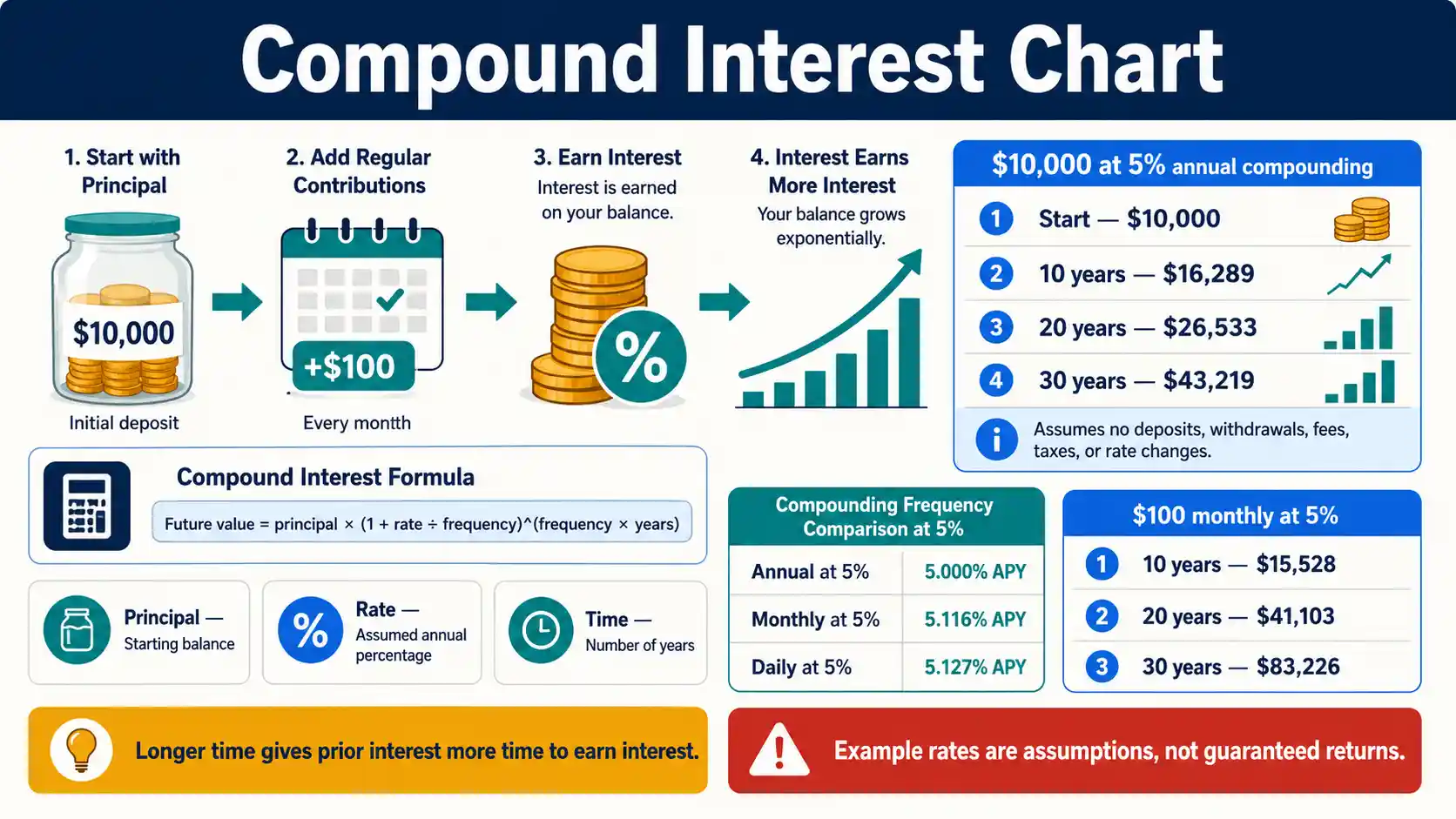
How does compound interest grow money?
Compound interest adds interest to principal, then applies future interest to the larger balance. A higher rate, more time, a larger starting principal, and regular contributions can increase future value. Fees, taxes, withdrawals, inflation, and changing rates can reduce the result.
The U.S. Securities and Exchange Commission’s Investor.gov glossary defines compound interest as interest paid on principal and on accumulated interest. That distinction explains why the gap between simple and compound growth widens over time.
Core effect
Interest earns interest
Compound growth applies the rate to principal and to interest already credited to the balance.
Main drivers
Rate · time · cash flow
Principal, recurring deposits, compounding frequency, and the length of time determine the mathematical result.
Comparable deposit rate
Check the APY
APY expresses the one-year yield after compounding and can be more useful than frequency alone when comparing deposit accounts.
Critical limit
A projection is not a promise
Investment returns, account rates, fees, taxes, inflation, deposits, and withdrawals can all differ from a smooth example.
Quick answers to common compound interest questions
These answers assume a positive rate and consistent time periods. Real accounts and investments can use different crediting, fee, tax, withdrawal, or return rules.
What is compound interest?
Compound interest applies interest to the principal and to interest already added to the balance.
What is the standard compound interest formula?
Use A = P(1 + r/n)^(nt) for one principal with a nominal annual rate and periodic compounding.
How do you calculate interest earned?
Subtract the starting principal and later contributions from the estimated ending balance.
Does monthly compounding beat annual compounding?
Yes, when the nominal annual rate and every other term are identical, but the difference is usually modest at ordinary rates.
What does APY include?
APY includes the one-year effect of the interest rate and compounding frequency under the stated account terms.
Can APY be divided by 12?
Not exactly. Convert APY to an equivalent monthly rate with (1 + APY)^(1/12) − 1.
How do monthly deposits grow?
Each monthly deposit compounds only for the periods remaining after that deposit is made.
Do beginning-of-month deposits earn more?
Yes. A beginning-of-month deposit earns one additional monthly period compared with an equal end-of-month deposit.
What is the Rule of 72?
Divide 72 by the annual rate percentage to estimate doubling time at a moderate positive rate.
How long does money double at 5%?
A balance doubles in about 14.2 years at a constant 5% annual rate with annual compounding.
How is simple interest different?
Simple interest applies the rate only to original principal, while compound interest also grows prior interest.
Does inflation reduce compound growth?
Inflation does not reduce the nominal account balance, but it reduces the future balance’s purchasing power.
Compound Interest Growth Chart by Rate and Time
This chart shows how a one-time $10,000 balance grows with annual compounding and no deposits or withdrawals. Each cell also shows the growth factor applied to the starting principal.
Swipe horizontally inside the table to view every column.
| Years | 3% annual rate | 5% annual rate | 7% annual rate | 10% annual rate |
|---|---|---|---|---|
| 1 | $10,300 (1.030×) | $10,500 (1.050×) | $10,700 (1.070×) | $11,000 (1.100×) |
| 5 | $11,593 (1.159×) | $12,763 (1.276×) | $14,026 (1.403×) | $16,105 (1.611×) |
| 10 | $13,439 (1.344×) | $16,289 (1.629×) — Ten-year result at five percent | $19,672 (1.967×) | $25,937 (2.594×) |
| 20 | $18,061 (1.806×) | $26,533 (2.653×) | $38,697 (3.870×) | $67,275 (6.727×) |
| 30 | $24,273 (2.427×) | $43,219 (4.322×) | $76,123 (7.612×) | $174,494 (17.449×) |
| 40 | $32,620 (3.262×) | $70,400 (7.040×) | $149,745 (14.974×) | $452,593 (45.259×) — Long-horizon estimate is highly sensitive to the assumed rate |
Formula: future value = principal × (1 + annual rate)^years. Values are rounded to the nearest dollar and assume interest remains in the account.
- • Rates are hypothetical constant annual rates, not current offers or promised investment returns.
- • Taxes, fees, inflation, market losses, contribution timing, and withdrawals are excluded.
- • A higher assumed rate creates a much larger long-term result, but higher expected investment returns usually involve greater uncertainty and risk.
Download or export
Match the formula to the cash-flow pattern
A one-time principal uses the periodic compound-growth formula. Equal recurring deposits use an annuity formula. Beginning-of-period deposits earn one extra period. Irregular deposits and withdrawals require a period-by-period cash-flow schedule rather than one shortcut formula.
Keep the units consistent. A monthly rate must be paired with monthly periods, and a quarterly rate must be paired with quarters. Convert percentages to decimals before calculating, so 5% becomes 0.05.
Compound Interest Formulas and Variable Definitions
Choose the formula that matches the cash-flow pattern. A lump sum, recurring deposits, and quoted APY use related but different calculations.
Swipe horizontally inside the table to view every column.
| Use case | Formula | Variables | Important assumption |
|---|---|---|---|
| One-time principal with periodic compounding | A = P(1 + r/n)^(nt) — Standard periodic compounding formula | A = final amount; P = principal; r = nominal annual rate; n = compounds per year; t = years | No deposits or withdrawals during the period |
| Interest earned on a one-time principal | Interest = A − P | A = final amount; P = starting principal | Fees, taxes, and inflation are excluded unless subtracted separately |
| Ordinary annuity with equal end-of-period deposits | FV = PMT × [((1 + i)^N − 1) ÷ i] | PMT = each deposit; i = periodic rate; N = number of deposits | Deposits occur at the end of each equal period |
| Annuity due with equal beginning-of-period deposits | FV due = ordinary annuity FV × (1 + i) | i = periodic rate | Each deposit earns one additional period of growth |
| APY from a nominal annual rate | APY = (1 + r/n)^n − 1 — APY formula | r = nominal annual rate; n = compounds per year | Rate and frequency stay unchanged for one year |
| Exact doubling time with annual compounding | Years = ln(2) ÷ ln(1 + r) | r = annual rate as a decimal | Positive constant annual rate and no cash flows |
Convert percentages to decimals before calculation: 5% = 0.05. Match the rate period to the number of periods.
- • Do not divide an APY by 12 and treat it automatically as a nominal monthly rate; convert it to an equivalent periodic rate when needed.
- • The recurring-deposit formula changes when deposits vary, occur at irregular dates, or are made at the beginning rather than the end of each period.
- • Continuous compounding uses A = Pe^(rt), but most consumer deposit accounts disclose an APY based on their actual terms.
Download or export
Compound interest and monthly contribution calculator
Estimate a future balance from principal, monthly deposits, a nominal annual rate, compounding frequency, and time. Calculations stay in your browser.
Example scenarios
Use a scenario rate, not a guaranteed return. Do not enter account numbers, card numbers, tax identifiers, or other sensitive information.
Estimate check
The inputs form a valid educational compound-growth scenario.
Estimated ending balance
$68,229.77
Estimated interest earned
$34,229.77
Principal and deposits
$34,000.00
Effective annual yield
5.116%
Calculation method
The 5% nominal rate compounded 12 times per year produces an estimated APY of 5.116%. The tool converts that yield to an equivalent monthly rate of 0.4167% for 240 monthly periods.
Principal portion: $27,126.40 · Contribution portion: $41,103.37
This tool models a constant rate and regular monthly deposits. It does not include taxes, fees, inflation, changing rates, market losses, withdrawal rules, or product guarantees.
Compounding frequency changes effective annual yield
More frequent compounding increases the effective annual yield when the nominal annual rate remains unchanged. The gain from moving from monthly to daily compounding is usually much smaller than the gain from a higher rate or a longer savings period.
The Consumer Financial Protection Bureau’s Regulation DD appendix explains that APY measures total interest based on the interest rate and compounding frequency. Compare the disclosed APY and full account terms, not frequency alone.
Compounding Frequency Comparison at a 5% Nominal Rate
This chart holds the nominal annual rate at 5% and compares a $10,000 principal over 10 years. More frequent compounding raises APY and ending value when every other term stays equal.
Swipe horizontally inside the table to view every column.
| Compounding frequency | Compounds per year | Nominal annual rate | Effective APY | $10,000 after 10 years |
|---|---|---|---|---|
| Annual | 1 | 5.000% | 5.000% — Annual compounding equals the nominal rate in this example | $16,288.95 |
| Semiannual | 2 | 5.000% | 5.062% | $16,386.16 |
| Quarterly | 4 | 5.000% | 5.095% | $16,436.19 |
| Monthly | 12 | 5.000% | 5.116% | $16,470.09 |
| Daily | 365 | 5.000% | 5.127% | $16,486.65 — Highest ending value under equal nominal rate assumptions |
APY = (1 + 0.05 ÷ n)^n − 1. Ending value = $10,000 × (1 + 0.05 ÷ n)^(10n).
- • Compare actual APY, fees, balance requirements, withdrawal restrictions, and term conditions rather than compounding frequency alone.
- • The improvement from increasingly frequent compounding becomes smaller as frequency rises.
- • Daily calculations can use different day-count conventions or crediting terms in real products; read the account disclosure.
Download or export
Regular deposits combine saving behavior with compounding
A recurring deposit grows for less time than the original principal because it enters later. The final balance contains starting principal, total deposits, and growth earned by each cash flow. Contribution timing matters when comparing two otherwise equal plans.
The Investor.gov compound interest calculator also lets users explore initial investment, contributions, time, estimated rate, and compounding frequency. Use any calculator output as a scenario rather than a promise.
Monthly Contribution Compound Growth Chart
This example starts at $0 and adds $100 at the end of every month. It assumes a constant 5% nominal annual rate compounded monthly.
Swipe horizontally inside the table to view every column.
| Years | Monthly deposits | Total contributed | Estimated interest | Estimated ending balance |
|---|---|---|---|---|
| 5 | 60 | $6,000 | $801 | $6,801 |
| 10 | 120 | $12,000 | $3,528 | $15,528 |
| 20 | 240 | $24,000 | $17,103 | $41,103 — Twenty-year balance |
| 30 | 360 | $36,000 | $47,226 | $83,226 |
| 40 | 480 | $48,000 | $104,602 — Long-term estimate depends heavily on constant-rate assumptions | $152,602 |
Ordinary-annuity formula: FV = $100 × [((1 + 0.05/12)^(12 × years) − 1) ÷ (0.05/12)]. Values are rounded to the nearest dollar.
- • Deposits made at the beginning of each month would produce a slightly higher result because every deposit earns one extra month.
- • Missing deposits, changing rates, fees, taxes, and withdrawals will change the outcome.
- • Total contributed equals monthly deposit × number of deposits; estimated interest equals ending balance minus total contributed.
Download or export
Rule of 72 and Exact Doubling-Time Chart
The Rule of 72 estimates how long money may take to double. The exact calculation uses logarithms and annual compounding.
Swipe horizontally inside the table to view every column.
| Annual rate | Rule of 72 estimate | Exact doubling time | Approximation difference |
|---|---|---|---|
| 3% | 24.0 years | 23.4 years | +0.6 years |
| 4% | 18.0 years | 17.7 years | +0.3 years |
| 5% | 14.4 years — Five-percent shortcut | 14.2 years | +0.2 years |
| 6% | 12.0 years | 11.9 years | +0.1 years |
| 7% | 10.3 years | 10.2 years | +0.0 years |
| 8% | 9.0 years | 9.0 years | −0.0 years |
| 10% | 7.2 years | 7.3 years | −0.1 years |
| 12% | 6.0 years | 6.1 years | −0.1 years — Approximation only |
Rule of 72 estimate = 72 ÷ annual rate percentage. Exact years = ln(2) ÷ ln(1 + annual rate as a decimal).
- • The shortcut is most useful for moderate positive rates and rough mental estimates.
- • The Rule of 72 does not include deposits, withdrawals, taxes, fees, inflation, or changing returns.
- • A doubling estimate is not a prediction or guarantee for a variable investment.
Download or export
Simple Interest Versus Compound Interest Chart
This example compares a $10,000 principal at 5% per year. Simple interest applies the rate only to the original principal, while compound interest adds growth on prior interest.
Swipe horizontally inside the table to view every column.
| Years | Simple-interest balance | Compound-interest balance | Compound advantage |
|---|---|---|---|
| 1 | $10,500 | $10,500 | $0 — No first-year compounding advantage |
| 5 | $12,500 | $12,763 | $263 |
| 10 | $15,000 | $16,289 | $1,289 |
| 20 | $20,000 | $26,533 | $6,533 |
| 30 | $25,000 | $43,219 | $18,219 — Difference widens over long periods |
Simple balance = $10,000 × (1 + 0.05 × years). Compound balance = $10,000 × 1.05^years.
- • The first-year amounts match because no prior interest exists to compound.
- • The comparison assumes annual crediting, no fees, no taxes, and no cash flows.
- • Loan and deposit contracts may calculate interest using daily balances, amortization, fees, or other terms not represented here.
Download or export
Common Compound Interest Mistakes and Corrections
Small input errors can materially change a long-term estimate. Match the formula, rate basis, timing, and cash-flow pattern to the real account or scenario.
Swipe horizontally inside the table to view every column.
| Mistake | Why it changes the result | Correct approach | Verification check |
|---|---|---|---|
| Entering 5 instead of 0.05 in a formula | The calculation treats 5 as 500% | Convert percentages to decimals — Convert percent to decimal | 5% must appear as 0.05 inside the formula |
| Mixing annual rates with monthly periods | The rate and period count use different time units | Use a monthly periodic rate with monthly periods | Rate period must match the cash-flow period |
| Treating APY as the nominal rate | APY already reflects compounding for one year | Use the disclosed APY directly for annual growth or convert it correctly — Distinguish APY from nominal rate | Do not compound an APY again as though it were nominal |
| Ignoring contribution timing | Beginning deposits earn one more period than ending deposits | Choose ordinary annuity or annuity due | Confirm whether deposits occur before or after interest crediting |
| Assuming a variable return stays constant | Market and account rates can change | Run conservative, middle, and higher scenarios | Label every rate as an assumption |
| Omitting fees and taxes | Net growth can be lower than the gross formula result | Subtract known fees and model tax treatment separately | Compare gross and net outcomes |
| Ignoring inflation | A larger future dollar amount may buy less | Calculate real value with an inflation assumption when relevant | Separate nominal growth from purchasing power |
| Rounding every period | Repeated rounding can create drift | Keep full precision until the final display | Round only the final reported amount |
| Using the formula for irregular cash flows | Uneven dates and amounts require period-by-period calculation | Build a cash-flow schedule or use an appropriate financial function | Confirm each deposit and withdrawal date |
| Reading an estimate as a guarantee | Returns, rates, fees, and behavior may differ | Present a range and state limitations | Treat outputs as scenarios, not promises — No guaranteed outcome |
Use one consistent currency and one consistent time unit throughout each calculation.
- • For a real deposit account, use the institution’s disclosed APY, compounding method, fees, balance rules, and withdrawal terms.
- • For an investment, a smooth constant rate does not represent market volatility or sequence-of-returns risk.
- • For a loan, use the contract’s APR, payment schedule, fees, and amortization method rather than a savings-growth formula.
Download or export
Limits and special cases
Variable investment returns
Investments do not normally grow in a smooth line. Market losses, volatility, and the order of returns can produce a different outcome even when a long-run average is similar.
Changing deposit rates
Savings-account, money-market, and certificate rates can reset or end. Recalculate when the APY, term, balance, fee, or withdrawal condition changes.
Taxes, fees, and inflation
Gross compound growth can overstate usable future value. Account fees, taxes, and inflation can reduce net value and purchasing power.
Loans and credit cards
Debt products can use daily balances, APR, amortization, minimum payments, fees, and grace-period rules. Use the contract and a debt-specific calculator instead of a savings formula.
Frequently asked questions
What is compound interest?
Compound interest is interest calculated on the original principal and on interest already added to the balance. The balance can therefore grow faster than it would under simple interest when the rate and time are positive.
What is the compound interest formula?
For one principal with periodic compounding, use A = P(1 + r/n)^(nt). P is principal, r is the nominal annual rate as a decimal, n is compounding periods per year, and t is years.
How do I calculate interest earned?
Subtract the starting principal and any later contributions from the ending balance. For a one-time principal, interest earned equals final amount minus starting principal.
Does monthly compounding earn more than annual compounding?
Yes, when the nominal annual rate and every other term are identical. Monthly compounding produces a slightly higher APY because interest is added more often.
What is the difference between interest rate and APY?
A stated interest rate describes the rate before the full effect of within-year compounding. APY expresses the total one-year yield produced by the rate and compounding frequency under the account terms.
Can I divide APY by 12 for a monthly rate?
Not exactly. Convert APY to an equivalent monthly rate with (1 + APY)^(1/12) − 1 when a monthly periodic rate is required.
How are monthly contributions compounded?
Each contribution grows for the periods remaining after it is deposited. End-of-month deposits use an ordinary-annuity calculation, while beginning-of-month deposits earn one extra period.
What is the Rule of 72?
The Rule of 72 estimates doubling time by dividing 72 by the annual rate percentage. At 6%, the shortcut gives about 12 years, but it remains an approximation.
How long does money take to double at 5%?
A balance doubles in about 14.2 years at a constant 5% annual rate with annual compounding. The Rule of 72 estimates 14.4 years.
Does compound interest apply to debt?
It can, but loan and credit-card calculations may use daily balances, periodic rates, fees, payments, and contract-specific rules. Do not use a savings-growth chart as a complete loan-cost calculation.
Does this chart include taxes and fees?
No. The examples show gross mathematical growth before taxes, fees, inflation, withdrawals, and other account-specific costs unless a table states otherwise.
Does a higher interest rate always mean a better account?
No. Compare APY, fees, minimum balances, term length, withdrawal restrictions, insurance coverage, liquidity, and risk. For investments, higher expected returns usually involve greater uncertainty.
Can investment returns be compounded at a fixed rate?
A fixed rate can model a scenario, but actual investment returns vary and can be negative. Use several assumptions and avoid treating a smooth projection as a forecast or guarantee.
How does inflation affect compound growth?
Inflation reduces the purchasing power of a future balance. Real growth is approximately the investment or savings growth rate adjusted for inflation, not the nominal account balance alone.
Does the calculator store my information?
No. The calculator runs in the browser and does not need to transmit or store the entered values. Do not enter account numbers, tax identifiers, or other sensitive information.
Sources
These official U.S. investor-education and consumer-finance resources support the definitions, calculator concepts, compounding-frequency discussion, and APY treatment.
U.S. Securities and Exchange Commission — Investor.gov — Compound Interest
https://www.investor.gov/introduction-investing/investing-basics/glossary/compound-interest
Defines compound interest as interest paid on principal and on accumulated interest.
U.S. Securities and Exchange Commission — Investor.gov — Compound Interest Calculator
https://www.investor.gov/financial-tools-calculators/calculators/compound-interest-calculator
Provides a public educational calculator for exploring initial investment, contributions, time, estimated rate, and compounding frequency.
Consumer Financial Protection Bureau — Appendix A to Regulation DD — Annual Percentage Yield Calculation
https://www.consumerfinance.gov/rules-policy/regulations/1030/A
Explains that annual percentage yield measures total interest based on the interest rate and compounding frequency and provides the regulatory APY calculation framework.