Animals & Pets
Horse Weight Chart
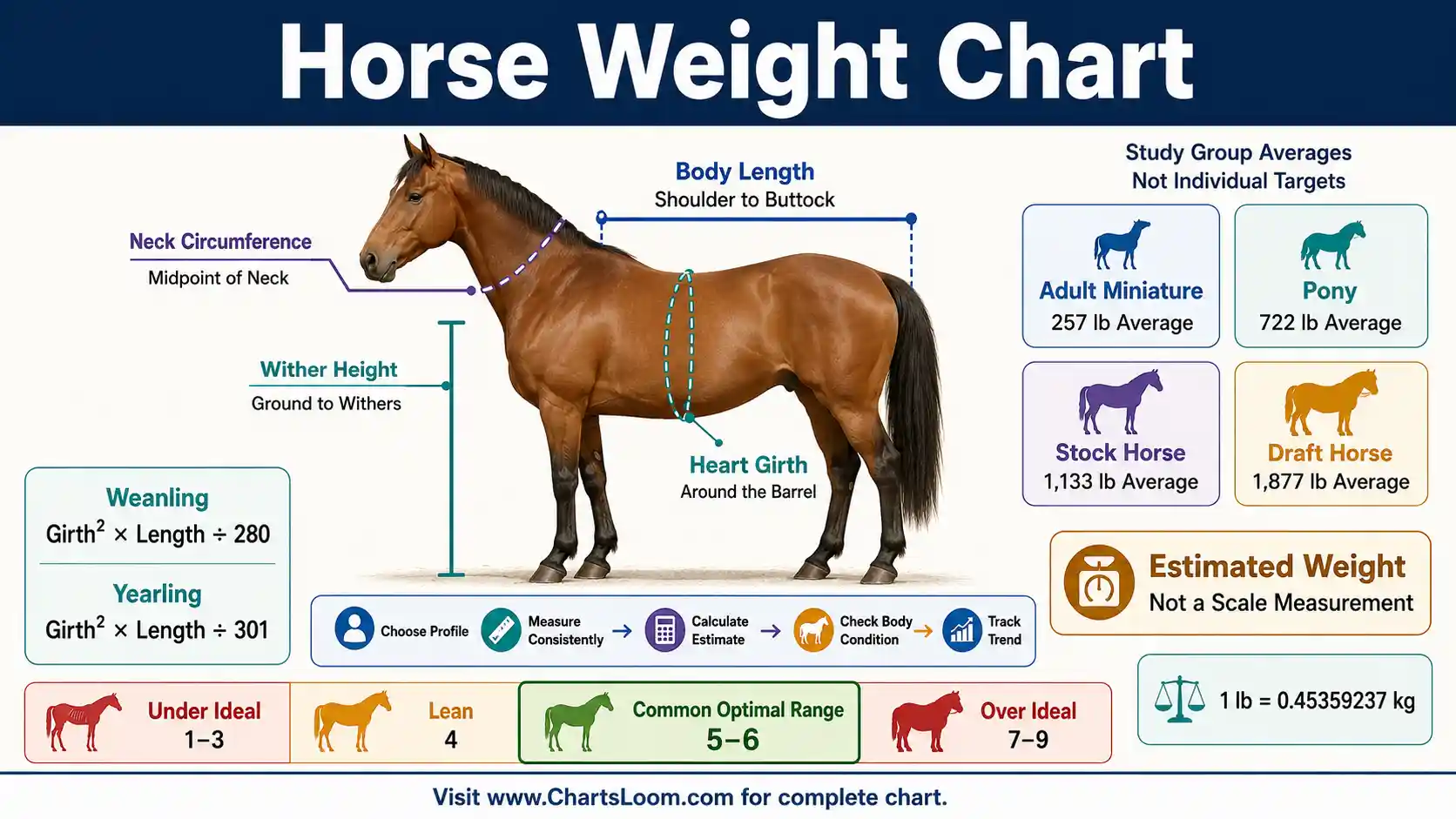
Estimate horse weight from consistent body measurements, compare broad breed-type references, interpret body-condition score, and build a reliable tracking record.
Quick answer
Use a scale when possible; estimate consistently when it is not
A calibrated scale directly measures bodyweight. Research equations and weight tapes provide estimates. Body-condition scoring adds essential context because a pound value alone cannot distinguish fat, muscle, pregnancy, gut fill or illness.
Direct reference
Calibrated scale
A suitable livestock or equine scale provides the most direct bodyweight measurement.
No scale available
Measure consistently
Use heart girth, body length, height and neck with the matching research profile.
Young horses
Age-specific equations
Weanlings use a divisor of 280; yearlings use 301.
Condition context
BCS 1–9
Body-condition scoring evaluates fat cover and does not directly measure pounds.
Questions at a glance
What is the best way to know a horse’s weight?
Use a suitable calibrated scale when direct precision is important.
Can a horse be weighed without a scale?
Yes. Research equations estimate bodyweight from consistently placed measurements.
Which measurements are used?
Adult equations may use heart girth, body length, wither height and neck circumference.
How are weanlings estimated?
Square heart girth in inches, multiply by body length in inches, and divide by 280.
How are yearlings estimated?
Square heart girth in inches, multiply by body length in inches, and divide by 301.
Is a weight tape exact?
No. It is convenient for trends but body shape, tape placement and tension affect the result.
What is a typical healthy BCS?
Scores 5 or 6 are commonly described as optimal for many horses; some athletic horses may be nearer 4.
Does a large abdomen mean excess fat?
Not necessarily. Forage fill, pregnancy and conformation can enlarge the abdomen without a high BCS.
Why should measurements be repeated?
Breathing, posture, coat, gut fill and tape placement can produce short-term variation.
Can this calculator prescribe feed?
No. It estimates weight and provides context; ration changes need individualized professional guidance.
Horse Weight Measurement Methods
No single method answers every question. A scale measures bodyweight directly; equations and tapes estimate it; body-condition scoring evaluates fat cover.
Swipe horizontally inside the table to view every column.
| Method | What it uses | Best use | Good for | Main limitation |
|---|---|---|---|---|
| Livestock scale | Direct measurement | Highest practical reference when calibrated | Clinics, research farms, feed planning | Platform must suit the horse and be level |
| Portable equine scale | Direct measurement | Strong reference for repeat monitoring | Barn visits and mobile veterinary work | Use the same scale when comparing dates |
| Research breed-type equation | Four body measurements | Useful estimate when no scale is available | Adult Arabians, stock horses, ponies and other supported types | Choose the matching type and measure consistently |
| Young-horse equation | Heart girth and body length | Useful trend estimate | Weanlings and yearlings | Use the age-appropriate denominator |
| Commercial weight tape | Heart-girth circumference | Convenient but approximate | Routine barn checks | Tape design and body shape affect results |
| Ordinary tape plus equation | Girth and length or four measurements | More transparent than reading a printed weight tape | Recordkeeping and worked calculations | Do not mix inches and centimetres |
| Body-condition score | Visual and hands-on fat assessment | Does not measure pounds | Monitoring fat cover and welfare | Score six body areas, not belly size |
| Crest assessment | Neck fat observation | Adds context for regional adiposity | Easy keepers and metabolic-risk discussions | Not a replacement for full BCS |
| Girth-to-height ratio | Proportional screening | Supports overweight screening | Repeat measurements over time | Use the same landmarks every time |
| Photo record | Visual comparison | Useful supporting evidence | Monthly condition tracking | Keep angle, distance and lighting consistent |
| Feed-scale record | Weighs feed, not horse | Connects bodyweight estimate to ration calculations | Hay and concentrate planning | Do not estimate flakes or scoops by sight |
| Trailer-scale difference | Vehicle weight subtraction | Can estimate combined horse load | Transport planning | Requires suitable certified scales and safe loading |
| Veterinary examination | Clinical assessment | Interprets weight change with health context | Unexpected loss or gain | Weight alone cannot identify a cause |
| Dental examination | Clinical contributor assessment | Checks one common cause of weight loss | Older horses or quidding | Dental status is not visible from bodyweight alone |
| Parasite-control review | Management assessment | Addresses another possible weight-change factor | Unexplained loss or poor condition | Use veterinarian-directed testing |
| Pasture and hay analysis | Diet assessment | Explains calorie and nutrient supply | Ration adjustment | Forage quality varies by cutting and storage |
| Weekly foal or young-stock record | Growth trend | Detects uneven change | Weanlings and yearlings | Moderate steady growth is preferred |
| Monthly adult record | Maintenance trend | Shows gradual gain or loss | Healthy mature horses | More frequent checks may be needed during change |
| Pre- and post-travel check | Short-term context | Shows hydration and gut-fill effects | Long-distance transport | Short-term weight changes are not all tissue change |
| Professional nutrition consultation | Integrated interpretation | Combines weight, BCS, workload and forage | Complex ration or medical cases | Use current measurements and feed weights |
- • Use the same method, landmarks and units when tracking change.
- • A bodyweight estimate and a body-condition score answer different questions.
Download or export
Interactive estimator
Estimate weight from body measurements
Choose the closest supported profile, measure consistently, and compare the result with hands-on body-condition scoring.
Result
Estimated horse weight
1,122 lb · 509 kg
University of Minnesota breed-type bodyweight equation
- • Estimated current bodyweight: 1,122 lb (509 kg).
- • Frame-based ideal reference: 1,124 lb (510 kg).
- • Estimated difference from the frame reference: -2 lb.
- • BCS 5: common optimal range for many horses
- • This is an estimate, not a scale weight or diagnosis.
- • Interpret the number with body condition, muscle, age, pregnancy, gut fill, hydration and health.
- • Repeat measurements with the same landmarks and method to track a trend.
What it calculates
A research-equation estimate in pounds and kilograms, plus an adult frame reference where supported.
Why BCS matters
The same weight can reflect different fat, muscle, pregnancy, gut-fill and health states.
What it cannot do
It cannot replace a scale, diagnose weight change or prescribe feed, medication or treatment.
Horse Measurement Landmarks
Consistent landmark placement matters more than measuring quickly. Record the conditions that could change girth or scale weight.
Swipe horizontally inside the table to view every column.
| Measurement or condition | Where or what | Technique | Why it matters |
|---|---|---|---|
| Heart girth | Around the barrel at the third thoracic vertebra / just behind the withers and elbow | Tape level and snug without compressing coat | Input for most equations |
| Body length | Point of shoulder to a vertical line at point of buttock | Keep tape straight; do not wrap around the buttock | Input for all equations on this page |
| Wither height | Ground to top of withers | Horse square on level surface; subtract shoe height for draft research equations | Input for adult type equations |
| Neck circumference | Midway between poll and third thoracic vertebra | Use a consistent midpoint and level tape | Input for research adult equations |
| Point of shoulder | Front landmark at shoulder joint | Palpate through coat | Start of body length |
| Point of buttock | Rear-most buttock landmark | Project a vertical line rather than curving tape | End reference for body length |
| Third thoracic vertebra | Early wither landmark | Use same position every session | Research girth and height landmark |
| Poll | Top of head behind ears | Reference only | Helps locate neck midpoint |
| Ground surface | Level, firm, nonslip | Avoid deep bedding or slope | Improves height consistency |
| Horse stance | Square and calm | All four feet bearing weight naturally | Reduces shape distortion |
| Tape tension | Flat and snug | Do not pull into soft tissue | Improves repeatability |
| Coat condition | Smooth hair when possible | Heavy winter coat can change circumference reading | Record clipping or coat changes |
| Breathing phase | Normal quiet breathing | Avoid measuring during a large inhalation | Reduces girth variation |
| Feed timing | Record relation to meals | Gut fill can alter girth and scale weight | Supports interpretation |
| Water access | Record unusual restriction or excess | Hydration changes short-term scale weight | Supports interpretation |
| Exercise timing | Measure at similar time relative to work | Sweat and gut movement affect short-term weight | Supports trend quality |
| Pregnancy status | Record gestation stage | Fetal and fluid weight alter bodyweight | Do not treat pregnancy gain as fat alone |
| Age class | Adult, weanling or yearling | Select the correct equation | Prevents denominator error |
| Breed / type | Use the closest supported research category | Do not choose by color or discipline alone | Selects adult equation |
| Unit system | Inches or centimetres | Convert all measurements before calculation | Prevents large calculation errors |
| Scale calibration | Follow scale instructions | Zero before weighing | Improves direct measurement |
| Recorder | Same person when possible | Write values immediately | Reduces transcription variation |
| Photo angle | Side and rear views on level ground | Use same distance and posture | Supports BCS tracking |
| Measurement date | Exact date | Use consistent interval | Makes trends interpretable |
- • Measure on level ground with the horse standing square.
- • Repeat unexpected measurements before changing feed or management.
Download or export
Adult Horse Breed-Type Measurement Reference
University of Minnesota field-study averages show how body shape and weight differ across broad breed types. They are comparison data, not ideal targets.
Swipe horizontally inside the table to view every column.
| Breed type | Record | Value 1 | Value 2 | Interpretation |
|---|---|---|---|---|
| Arabian | Study group | 62 | Average age 15 yr | Average BCS 5.4 |
| Arabian | Body measurements | Height 58 in | Length 58 in · Girth 70 in | Neck 36 in |
| Arabian | Scale bodyweight | 937 lb | 425 kg | Group average, not a breed target |
| Draft | Study group | 138 | Average age 7 yr | Average BCS 6.3 |
| Draft | Body measurements | Height 70 in | Length 74 in · Girth 89 in | Neck 50 in |
| Draft | Scale bodyweight | 1,877 lb | 851 kg | Group average, not a breed target |
| Adult Miniature | Study group | 261 | Average age 7 yr | Average BCS 6.1 |
| Adult Miniature | Body measurements | Height 36 in | Length 38 in · Girth 45 in | Neck 25 in |
| Adult Miniature | Scale bodyweight | 257 lb | 117 kg | Group average, not a breed target |
| Juvenile Miniature | Study group | 62 | Average age 1 yr | Average BCS 5.4 |
| Juvenile Miniature | Body measurements | Height 35 in | Length 35 in · Girth 41 in | Neck 22 in |
| Juvenile Miniature | Scale bodyweight | 200 lb | 91 kg | Group average, not a breed target |
| Pony | Study group | 53 | Average age 15 yr | Average BCS 6.0 |
| Pony | Body measurements | Height 51 in | Length 54 in · Girth 64 in | Neck 34 in |
| Pony | Scale bodyweight | 722 lb | 327 kg | Group average, not a breed target |
| Saddle-type | Study group | 214 | Average age 11 yr | Average BCS 6.0 |
| Saddle-type | Body measurements | Height 60 in | Length 62 in · Girth 72 in | Neck 36 in |
| Saddle-type | Scale bodyweight | 1,133 lb | 514 kg | Group average, not a breed target |
| Stock | Study group | 493 | Average age 11 yr | Average BCS 5.5 |
| Stock | Body measurements | Height 60 in | Length 62 in · Girth 74 in | Neck 37 in |
| Stock | Scale bodyweight | 1,133 lb | 514 kg | Group average, not a breed target |
| Thoroughbred | Study group | 100 | Average age 10 yr | Average BCS 5.0 |
| Thoroughbred | Body measurements | Height 65 in | Length 68 in · Girth 76 in | Neck 38 in |
| Thoroughbred | Scale bodyweight | 1,184 lb | 537 kg | Group average, not a breed target |
| Warmblood | Study group | 89 | Average age 10 yr | Average BCS 5.2 |
| Warmblood | Body measurements | Height 66 in | Length 67 in · Girth 78 in | Neck 39 in |
| Warmblood | Scale bodyweight | 1,300 lb | 590 kg | Group average, not a breed target |
- • These are averages from measured study groups, not minimums or maximums.
- • Individual horses can differ substantially because of frame, sex, age, muscle and condition.
Download or export
Horse Actual-Weight Equations
Research-derived equations estimate scale bodyweight from consistent measurements. Inputs are inches and outputs are pounds.
Swipe horizontally inside the table to view every column.
| Profile | Equation | Required measurements | Units | Use |
|---|---|---|---|---|
| Arabian | g^1.486 × l^0.554 × h^0.599 × n^0.173 ÷ 119 | Girth, length, height and neck | Inches in · pounds out | Research or age-specific estimate |
| Stock | g^1.486 × l^0.554 × h^0.599 × n^0.173 ÷ 114 | Girth, length, height and neck | Inches in · pounds out | Research or age-specific estimate |
| Pony | g^1.486 × l^0.554 × h^0.599 × n^0.173 ÷ 119 | Girth, length, height and neck | Inches in · pounds out | Research or age-specific estimate |
| Draft | 25.09 × g^1.528 × l^0.574 × h^0.246 × n^0.261 ÷ 1181 | Girth, length, height and neck | Inches in · pounds out | Research or age-specific estimate |
| Warmblood | 25.09 × g^1.528 × l^0.574 × h^0.246 × n^0.261 ÷ 1209 | Girth, length, height and neck | Inches in · pounds out | Research or age-specific estimate |
| Adult Miniature | 30.419396 × g^1.835632 × l^0.562047 × h^0.318683 × n^0.0991582 ÷ 4329 | Girth, length, height and neck | Inches in · pounds out | Research or age-specific estimate |
| Juvenile Miniature | 33.687348 × g^1.637324 × l^0.437474 × h^0.701713 × n^0.148477 ÷ 6534 | Girth, length, height and neck | Inches in · pounds out | Research or age-specific estimate |
| Saddle-type | 26.057987 × g^1.600007 × l^0.544919 × h^0.282744 × n^0.221832 ÷ 1559 | Girth, length, height and neck | Inches in · pounds out | Research or age-specific estimate |
| Thoroughbred | (g × 27.15628) + (n × 9.210477) + (l × 8.505886) − 1790.68 | Girth, length and neck | Inches in · pounds out | Research or age-specific estimate |
| Weanling | g² × l ÷ 280 | Girth and length | Inches in · pounds out | Research or age-specific estimate |
| Yearling | g² × l ÷ 301 | Girth and length | Inches in · pounds out | Research or age-specific estimate |
| Variable g | Heart-girth circumference | Measure consistently | Do not mix units | Definition or selection rule |
| Variable l | Body length | Measure consistently | Do not mix units | Definition or selection rule |
| Variable h | Wither height | Measure consistently | Do not mix units | Definition or selection rule |
| Variable n | Neck circumference | Measure consistently | Do not mix units | Definition or selection rule |
| Variable ² | Square the heart-girth value | Measure consistently | Do not mix units | Definition or selection rule |
| Variable ÷ | Divide only after multiplication | Measure consistently | Do not mix units | Definition or selection rule |
| Variable Exponent | Raise the measurement to the shown power | Measure consistently | Do not mix units | Definition or selection rule |
| Variable Pounds out | Convert to kilograms after estimation | Measure consistently | Do not mix units | Definition or selection rule |
| Variable Type choice | Use the closest supported breed type | Measure consistently | Do not mix units | Definition or selection rule |
| Variable Age choice | Use weanling or yearling only for that growth stage | Measure consistently | Do not mix units | Definition or selection rule |
- • These equations estimate actual bodyweight, not a feeding target.
- • Round only the final result; keep full precision during calculation.
Download or export
Horse Ideal-Weight Equations
Frame-based equations use height and length to estimate an ideal bodyweight reference for supported adult types.
Swipe horizontally inside the table to view every column.
| Profile or term | Equation or meaning | Inputs | Limitation | Interpretation |
|---|---|---|---|---|
| Arabian | (15.58 × height) + (23.52 × length) − 1344 | Height and body length | Inches in · pounds out | Frame-based estimate |
| Stock | (15.58 × height) + (23.52 × length) − 1269 | Height and body length | Inches in · pounds out | Frame-based estimate |
| Pony | (15.58 × height) + (23.52 × length) − 1333 | Height and body length | Inches in · pounds out | Frame-based estimate |
| Draft | (27.55 × height) + (25.98 × length) − 2092 | Height and body length | Inches in · pounds out | Frame-based estimate |
| Warmblood | (27.55 × height) + (25.98 × length) − 2235 | Height and body length | Inches in · pounds out | Frame-based estimate |
| Adult Miniature | 23.248585 × length^0.78635 × height^1.74077 ÷ 868 | Height and body length | Inches in · pounds out | Frame-based estimate |
| Juvenile Miniature | 33.915120 × length^1.91873 × height^1.26055 ÷ 18209 | Height and body length | Inches in · pounds out | Frame-based estimate |
| Saddle-type | 20.342946 × length^1.370407 × height^1.013487 ÷ 359 | Height and body length | Inches in · pounds out | Frame-based estimate |
| Thoroughbred | (length × 10.69073808) + (height × 23.75553796) − 1073.380132 | Height and body length | Inches in · pounds out | Frame-based estimate |
| Actual weight | Estimated current body mass from girth and other measures | Use alongside BCS | Not a diagnosis | Interpretation rule |
| Ideal weight | Frame-based research estimate | Use alongside BCS | Not a diagnosis | Interpretation rule |
| Difference | Actual estimate minus ideal estimate | Use alongside BCS | Not a diagnosis | Interpretation rule |
| Positive difference | Could reflect muscle, pregnancy, gut fill, fat or estimation error | Use alongside BCS | Not a diagnosis | Interpretation rule |
| Negative difference | Could reflect lean frame, low condition, illness or estimation error | Use alongside BCS | Not a diagnosis | Interpretation rule |
| BCS required | Interpret the difference with hands-on condition scoring | Use alongside BCS | Not a diagnosis | Interpretation rule |
| Scale preferred | Use direct weighing when medical dosing or tight precision matters | Use alongside BCS | Not a diagnosis | Interpretation rule |
| Repeatability | Track with the same method and landmarks | Use alongside BCS | Not a diagnosis | Interpretation rule |
| Veterinary context | Unexpected change needs clinical interpretation | Use alongside BCS | Not a diagnosis | Interpretation rule |
| Nutrition context | Change feed gradually with professional guidance | Use alongside BCS | Not a diagnosis | Interpretation rule |
| No young ideal equation | Weanling and yearling formulas estimate current weight only | Use alongside BCS | Not a diagnosis | Interpretation rule |
- • Ideal-weight equations are research references, not automatic feeding prescriptions.
- • Pregnancy, muscle, age, illness and conformation can change the clinical interpretation.
Download or export
Adult Horse Weight Worked Examples
These examples apply the research equations to plausible measurements. They demonstrate calculation, not target weights for named breeds.
Swipe horizontally inside the table to view every column.
| Profile | Measurements in inches | Estimated actual weight | Estimated ideal weight | Difference |
|---|---|---|---|---|
| Arabian | g 68 · l 57 · h 58 · n 35 | 878 lb / 398 kg | 900 lb / 408 kg | -22 lb |
| Arabian | g 70 · l 58 · h 58 · n 36 | 931 lb / 422 kg | 924 lb / 419 kg | +7 lb |
| Arabian | g 72 · l 59 · h 58 · n 37 | 984 lb / 446 kg | 947 lb / 430 kg | +37 lb |
| Draft | g 87 · l 73 · h 70 · n 49 | 1801 lb / 817 kg | 1733 lb / 786 kg | +68 lb |
| Draft | g 89 · l 74 · h 70 · n 50 | 1889 lb / 857 kg | 1759 lb / 798 kg | +130 lb |
| Draft | g 91 · l 75 · h 70 · n 51 | 1979 lb / 898 kg | 1785 lb / 810 kg | +194 lb |
| Adult Miniature | g 43 · l 37 · h 36 · n 24 | 229 lb / 104 kg | 235 lb / 106 kg | -6 lb |
| Adult Miniature | g 45 · l 38 · h 36 · n 25 | 253 lb / 115 kg | 239 lb / 109 kg | +14 lb |
| Adult Miniature | g 47 · l 39 · h 36 · n 26 | 280 lb / 127 kg | 244 lb / 111 kg | +35 lb |
| Juvenile Miniature | g 39 · l 34 · h 35 · n 21 | 185 lb / 84 kg | 143 lb / 65 kg | +42 lb |
| Juvenile Miniature | g 41 · l 35 · h 35 · n 22 | 205 lb / 93 kg | 151 lb / 69 kg | +54 lb |
| Juvenile Miniature | g 43 · l 36 · h 35 · n 23 | 226 lb / 102 kg | 159 lb / 72 kg | +66 lb |
| Pony | g 62 · l 53 · h 51 · n 33 | 674 lb / 306 kg | 708 lb / 321 kg | -34 lb |
| Pony | g 64 · l 54 · h 51 · n 34 | 718 lb / 326 kg | 732 lb / 332 kg | -14 lb |
| Pony | g 66 · l 55 · h 51 · n 35 | 763 lb / 346 kg | 755 lb / 343 kg | +8 lb |
| Saddle-type | g 70 · l 61 · h 60 · n 35 | 985 lb / 447 kg | 1005 lb / 456 kg | -20 lb |
| Saddle-type | g 72 · l 62 · h 60 · n 36 | 1046 lb / 474 kg | 1027 lb / 466 kg | +19 lb |
| Saddle-type | g 74 · l 63 · h 60 · n 37 | 1109 lb / 503 kg | 1050 lb / 476 kg | +59 lb |
| Stock | g 72 · l 61 · h 60 · n 36 | 1063 lb / 482 kg | 1101 lb / 499 kg | -38 lb |
| Stock | g 74 · l 62 · h 60 · n 37 | 1122 lb / 509 kg | 1124 lb / 510 kg | -2 lb |
| Stock | g 76 · l 63 · h 60 · n 38 | 1184 lb / 537 kg | 1148 lb / 521 kg | +36 lb |
| Thoroughbred | g 74 · l 67 · h 65 · n 37 | 1130 lb / 512 kg | 1187 lb / 538 kg | -57 lb |
| Thoroughbred | g 76 · l 68 · h 65 · n 38 | 1202 lb / 545 kg | 1198 lb / 543 kg | +4 lb |
| Thoroughbred | g 78 · l 69 · h 65 · n 39 | 1274 lb / 578 kg | 1208 lb / 548 kg | +65 lb |
| Warmblood | g 76 · l 66 · h 66 · n 38 | 1245 lb / 565 kg | 1298 lb / 589 kg | -53 lb |
| Warmblood | g 78 · l 67 · h 66 · n 39 | 1316 lb / 597 kg | 1324 lb / 601 kg | -8 lb |
| Warmblood | g 80 · l 68 · h 66 · n 40 | 1389 lb / 630 kg | 1350 lb / 612 kg | +39 lb |
| Stock | g 70 · l 60 · h 58 · n 35 | 985 lb / 447 kg | 1046 lb / 474 kg | -61 lb |
| Stock | g 76 · l 64 · h 61 · n 38 | 1206 lb / 547 kg | 1187 lb / 538 kg | +19 lb |
| Stock | g 80 · l 66 · h 62 · n 40 | 1349 lb / 612 kg | 1249 lb / 567 kg | +99 lb |
- • g = heart girth; l = body length; h = wither height; n = neck circumference.
- • A difference from ideal must be interpreted with BCS, muscle, pregnancy, gut fill and health.
Download or export
Weanling Weight Examples
Worked weanling estimates use heart girth squared, multiplied by body length, then divided by 280.
Swipe horizontally inside the table to view every column.
| Example | Heart girth | Body length | Estimated pounds | Estimated kilograms |
|---|---|---|---|---|
| Example 1 | 45 in | 45 in | 325 lb | 148 kg |
| Example 2 | 46 in | 46 in | 348 lb | 158 kg |
| Example 3 | 47 in | 46 in | 363 lb | 165 kg |
| Example 4 | 48 in | 47 in | 387 lb | 175 kg |
| Example 5 | 49 in | 48 in | 412 lb | 187 kg |
| Example 6 | 50 in | 48 in | 429 lb | 194 kg |
| Example 7 | 51 in | 49 in | 455 lb | 206 kg |
| Example 8 | 52 in | 50 in | 483 lb | 219 kg |
| Example 9 | 53 in | 50 in | 502 lb | 228 kg |
| Example 10 | 54 in | 51 in | 531 lb | 241 kg |
| Example 11 | 55 in | 51 in | 551 lb | 250 kg |
| Example 12 | 56 in | 52 in | 582 lb | 264 kg |
| Example 13 | 57 in | 53 in | 615 lb | 279 kg |
| Example 14 | 58 in | 53 in | 637 lb | 289 kg |
| Example 15 | 59 in | 54 in | 671 lb | 305 kg |
| Example 16 | 60 in | 55 in | 707 lb | 321 kg |
| Example 17 | 61 in | 55 in | 731 lb | 332 kg |
| Example 18 | 62 in | 56 in | 769 lb | 349 kg |
| Example 19 | 63 in | 57 in | 808 lb | 366 kg |
| Example 20 | 64 in | 57 in | 834 lb | 378 kg |
| Example 21 | 65 in | 58 in | 875 lb | 397 kg |
| Example 22 | 66 in | 59 in | 918 lb | 416 kg |
| Example 23 | 67 in | 59 in | 946 lb | 429 kg |
| Example 24 | 68 in | 60 in | 991 lb | 449 kg |
| Example 25 | 69 in | 61 in | 1037 lb | 470 kg |
- • Use these rows to check arithmetic, not as an age-based growth target.
- • Track moderate, steady growth and discuss uneven change with an equine professional.
Download or export
Yearling Weight Examples
Worked yearling estimates use heart girth squared, multiplied by body length, then divided by 301.
Swipe horizontally inside the table to view every column.
| Example | Heart girth | Body length | Estimated pounds | Estimated kilograms |
|---|---|---|---|---|
| Example 1 | 52 in | 50 in | 449 lb | 204 kg |
| Example 2 | 53 in | 51 in | 476 lb | 216 kg |
| Example 3 | 54 in | 51 in | 494 lb | 224 kg |
| Example 4 | 55 in | 52 in | 523 lb | 237 kg |
| Example 5 | 56 in | 53 in | 552 lb | 250 kg |
| Example 6 | 57 in | 54 in | 583 lb | 264 kg |
| Example 7 | 58 in | 54 in | 604 lb | 274 kg |
| Example 8 | 59 in | 55 in | 636 lb | 289 kg |
| Example 9 | 60 in | 56 in | 670 lb | 304 kg |
| Example 10 | 61 in | 56 in | 692 lb | 314 kg |
| Example 11 | 62 in | 57 in | 728 lb | 330 kg |
| Example 12 | 63 in | 58 in | 765 lb | 347 kg |
| Example 13 | 64 in | 58 in | 789 lb | 358 kg |
| Example 14 | 65 in | 59 in | 828 lb | 376 kg |
| Example 15 | 66 in | 60 in | 868 lb | 394 kg |
| Example 16 | 67 in | 60 in | 895 lb | 406 kg |
| Example 17 | 68 in | 61 in | 937 lb | 425 kg |
| Example 18 | 69 in | 62 in | 981 lb | 445 kg |
| Example 19 | 70 in | 63 in | 1026 lb | 465 kg |
| Example 20 | 71 in | 63 in | 1055 lb | 479 kg |
| Example 21 | 72 in | 64 in | 1102 lb | 500 kg |
| Example 22 | 73 in | 65 in | 1151 lb | 522 kg |
| Example 23 | 74 in | 65 in | 1183 lb | 536 kg |
| Example 24 | 75 in | 66 in | 1233 lb | 559 kg |
| Example 25 | 76 in | 67 in | 1286 lb | 583 kg |
- • Use these rows to check arithmetic, not as an age-based growth target.
- • Track moderate, steady growth and discuss uneven change with an equine professional.
Download or export
Horse Weight Pounds-to-Kilograms Conversion
Use the exact conversion after estimating or weighing. The two kilogram columns show the same calculation at different precision.
Swipe horizontally inside the table to view every column.
| Pounds | Kilograms to 1 decimal | Kilograms exact display | Formula | Note |
|---|---|---|---|---|
| 100 lb | 45.4 kg | 45.4 kg | lb × 0.45359237 | Rounded display |
| 150 lb | 68.0 kg | 68.0 kg | lb × 0.45359237 | Rounded display |
| 200 lb | 90.7 kg | 90.7 kg | lb × 0.45359237 | Rounded display |
| 250 lb | 113.4 kg | 113.4 kg | lb × 0.45359237 | Rounded display |
| 300 lb | 136.1 kg | 136.1 kg | lb × 0.45359237 | Rounded display |
| 350 lb | 158.8 kg | 158.8 kg | lb × 0.45359237 | Rounded display |
| 400 lb | 181.4 kg | 181.4 kg | lb × 0.45359237 | Rounded display |
| 450 lb | 204.1 kg | 204.1 kg | lb × 0.45359237 | Rounded display |
| 500 lb | 226.8 kg | 226.8 kg | lb × 0.45359237 | Rounded display |
| 550 lb | 249.5 kg | 249.5 kg | lb × 0.45359237 | Rounded display |
| 600 lb | 272.2 kg | 272.2 kg | lb × 0.45359237 | Rounded display |
| 650 lb | 294.8 kg | 294.8 kg | lb × 0.45359237 | Rounded display |
| 700 lb | 317.5 kg | 317.5 kg | lb × 0.45359237 | Rounded display |
| 750 lb | 340.2 kg | 340.2 kg | lb × 0.45359237 | Rounded display |
| 800 lb | 362.9 kg | 362.9 kg | lb × 0.45359237 | Rounded display |
| 850 lb | 385.6 kg | 385.6 kg | lb × 0.45359237 | Rounded display |
| 900 lb | 408.2 kg | 408.2 kg | lb × 0.45359237 | Rounded display |
| 950 lb | 430.9 kg | 430.9 kg | lb × 0.45359237 | Rounded display |
| 1,000 lb | 453.6 kg | 453.6 kg | lb × 0.45359237 | Rounded display |
| 1,050 lb | 476.3 kg | 476.3 kg | lb × 0.45359237 | Rounded display |
| 1,100 lb | 499.0 kg | 499.0 kg | lb × 0.45359237 | Rounded display |
| 1,150 lb | 521.6 kg | 521.6 kg | lb × 0.45359237 | Rounded display |
| 1,200 lb | 544.3 kg | 544.3 kg | lb × 0.45359237 | Rounded display |
| 1,250 lb | 567.0 kg | 567.0 kg | lb × 0.45359237 | Rounded display |
| 1,300 lb | 589.7 kg | 589.7 kg | lb × 0.45359237 | Rounded display |
| 1,350 lb | 612.3 kg | 612.3 kg | lb × 0.45359237 | Rounded display |
| 1,400 lb | 635.0 kg | 635.0 kg | lb × 0.45359237 | Rounded display |
| 1,450 lb | 657.7 kg | 657.7 kg | lb × 0.45359237 | Rounded display |
| 1,500 lb | 680.4 kg | 680.4 kg | lb × 0.45359237 | Rounded display |
| 1,550 lb | 703.1 kg | 703.1 kg | lb × 0.45359237 | Rounded display |
- • 1 lb = 0.45359237 kg.
- • Do not round measurements before running a nonlinear bodyweight equation.
Download or export
Horse Body Condition Score Chart
The Henneke scale runs from 1 to 9. Score fat cover at multiple body areas and follow the trend rather than judging belly size.
Swipe horizontally inside the table to view every column.
| Score | Assessment | Description | Common interpretation | Action |
|---|---|---|---|---|
| 1 | Overall category | Poor / emaciated | Under ideal | Score the whole horse |
| 1 | Ribs and topline | Prominent to easily visible | Backbone prominent | Palpate, do not rely only on sight |
| 1 | Management meaning | Prompt evaluation if unexpected | Professional guidance useful | BCS is not a pound value |
| 2 | Overall category | Very thin | Under ideal | Score the whole horse |
| 2 | Ribs and topline | Prominent to easily visible | Backbone prominent | Palpate, do not rely only on sight |
| 2 | Management meaning | Prompt evaluation if unexpected | Professional guidance useful | BCS is not a pound value |
| 3 | Overall category | Thin | Under ideal | Score the whole horse |
| 3 | Ribs and topline | Prominent to easily visible | Backbone prominent | Palpate, do not rely only on sight |
| 3 | Management meaning | Prompt evaluation if unexpected | Professional guidance useful | BCS is not a pound value |
| 4 | Overall category | Moderately thin | Lean / context dependent | Score the whole horse |
| 4 | Ribs and topline | Ribs increasingly covered | Fat cover increases | Palpate, do not rely only on sight |
| 4 | Management meaning | Often appropriate for some athletic horses | Monitor trend | BCS is not a pound value |
| 5 | Overall category | Moderate | Common optimal range | Score the whole horse |
| 5 | Ribs and topline | Ribs increasingly covered | Fat cover increases | Palpate, do not rely only on sight |
| 5 | Management meaning | Common optimum for many horses | Monitor trend | BCS is not a pound value |
| 6 | Overall category | Moderately fleshy | Common optimal range | Score the whole horse |
| 6 | Ribs and topline | Ribs increasingly covered | Fat cover increases | Palpate, do not rely only on sight |
| 6 | Management meaning | Common optimum for many horses | Monitor trend | BCS is not a pound value |
| 7 | Overall category | Fleshy | Over ideal | Score the whole horse |
| 7 | Ribs and topline | Ribs increasingly covered | Fat cover increases | Palpate, do not rely only on sight |
| 7 | Management meaning | Review weight-management plan | Professional guidance useful | BCS is not a pound value |
| 8 | Overall category | Fat | Over ideal | Score the whole horse |
| 8 | Ribs and topline | Ribs increasingly covered | Fat cover increases | Palpate, do not rely only on sight |
| 8 | Management meaning | Review weight-management plan | Professional guidance useful | BCS is not a pound value |
| 9 | Overall category | Extremely fat | Over ideal | Score the whole horse |
| 9 | Ribs and topline | Ribs increasingly covered | Fat cover increases | Palpate, do not rely only on sight |
| 9 | Management meaning | Review weight-management plan | Professional guidance useful | BCS is not a pound value |
- • University of Kentucky describes 5 or 6 as optimal for many horses, while some athletic horses may be maintained nearer 4.
- • Unexpected low or high scores, rapid change, or illness signs need professional evaluation.
Download or export
Six Body Areas Used for Horse BCS
A complete score combines six areas. One unusual area should not automatically determine the final score.
Swipe horizontally inside the table to view every column.
| Body area | Condition band | What to assess | Technique | Record |
|---|---|---|---|---|
| Neck | Low condition | Bone or structure becomes easier to see or feel | Compare left and right when safe | Record score and notes |
| Neck | Moderate condition | Smooth transition with ribs generally easy to feel | Compare left and right when safe | Record score and notes |
| Neck | High condition | Fat feels soft, thick or bulging and landmarks become harder to feel | Compare left and right when safe | Record score and notes |
| Neck | Repeat check | Use the same hand placement and pressure each session | Compare left and right when safe | Record score and notes |
| Withers | Low condition | Bone or structure becomes easier to see or feel | Compare left and right when safe | Record score and notes |
| Withers | Moderate condition | Smooth transition with ribs generally easy to feel | Compare left and right when safe | Record score and notes |
| Withers | High condition | Fat feels soft, thick or bulging and landmarks become harder to feel | Compare left and right when safe | Record score and notes |
| Withers | Repeat check | Use the same hand placement and pressure each session | Compare left and right when safe | Record score and notes |
| Behind shoulder | Low condition | Bone or structure becomes easier to see or feel | Compare left and right when safe | Record score and notes |
| Behind shoulder | Moderate condition | Smooth transition with ribs generally easy to feel | Compare left and right when safe | Record score and notes |
| Behind shoulder | High condition | Fat feels soft, thick or bulging and landmarks become harder to feel | Compare left and right when safe | Record score and notes |
| Behind shoulder | Repeat check | Use the same hand placement and pressure each session | Compare left and right when safe | Record score and notes |
| Ribs | Low condition | Bone or structure becomes easier to see or feel | Compare left and right when safe | Record score and notes |
| Ribs | Moderate condition | Smooth transition with ribs generally easy to feel | Compare left and right when safe | Record score and notes |
| Ribs | High condition | Fat feels soft, thick or bulging and landmarks become harder to feel | Compare left and right when safe | Record score and notes |
| Ribs | Repeat check | Use the same hand placement and pressure each session | Compare left and right when safe | Record score and notes |
| Loin / back | Low condition | Bone or structure becomes easier to see or feel | Compare left and right when safe | Record score and notes |
| Loin / back | Moderate condition | Smooth transition with ribs generally easy to feel | Compare left and right when safe | Record score and notes |
| Loin / back | High condition | Fat feels soft, thick or bulging and landmarks become harder to feel | Compare left and right when safe | Record score and notes |
| Loin / back | Repeat check | Use the same hand placement and pressure each session | Compare left and right when safe | Record score and notes |
| Tailhead | Low condition | Bone or structure becomes easier to see or feel | Compare left and right when safe | Record score and notes |
| Tailhead | Moderate condition | Smooth transition with ribs generally easy to feel | Compare left and right when safe | Record score and notes |
| Tailhead | High condition | Fat feels soft, thick or bulging and landmarks become harder to feel | Compare left and right when safe | Record score and notes |
| Tailhead | Repeat check | Use the same hand placement and pressure each session | Compare left and right when safe | Record score and notes |
- • The abdomen can look large because of forage fill, pregnancy or conformation and is not the main BCS criterion.
- • Hands-on assessment is especially important under long coats.
Download or export
Scale, Weight Tape and Equation Comparison
Choose the method that fits the decision. Medication and clinical decisions may require greater precision than routine condition tracking.
Swipe horizontally inside the table to view every column.
| Method | Output | Strength | Limitation | Best practice |
|---|---|---|---|---|
| Calibrated livestock scale | Direct mass | Best reference | Higher equipment requirement | Use same protocol |
| Calibrated livestock scale | Quality check | Repeat unexpected result | Record date and conditions | Compare trend, not one number |
| Portable scale | Direct mass | Repeatable when set up correctly | Surface and calibration matter | Use same protocol |
| Portable scale | Quality check | Repeat unexpected result | Record date and conditions | Compare trend, not one number |
| Research equation | Calculated estimate | Type-specific and transparent | Needs accurate landmarks | Use same protocol |
| Research equation | Quality check | Repeat unexpected result | Record date and conditions | Compare trend, not one number |
| Weight tape | Printed estimate | Fast and inexpensive | Body shape and tape design affect result | Use same protocol |
| Weight tape | Quality check | Repeat unexpected result | Record date and conditions | Compare trend, not one number |
| Ordinary tape | Raw circumference | Supports equations and trends | Does not directly show pounds | Use same protocol |
| Ordinary tape | Quality check | Repeat unexpected result | Record date and conditions | Compare trend, not one number |
| Visual guess | No measurement | Fast only | Often inaccurate | Use same protocol |
| Visual guess | Quality check | Repeat unexpected result | Record date and conditions | Compare trend, not one number |
| BCS | Fat-cover score | Essential companion to weight | Not pounds | Use same protocol |
| BCS | Quality check | Repeat unexpected result | Record date and conditions | Compare trend, not one number |
| Photo series | Appearance record | Shows gradual change | Angle and coat can mislead | Use same protocol |
| Photo series | Quality check | Repeat unexpected result | Record date and conditions | Compare trend, not one number |
| Girth trend | Circumference change | Good barn trend | Affected by gut fill | Use same protocol |
| Girth trend | Quality check | Repeat unexpected result | Record date and conditions | Compare trend, not one number |
| Neck trend | Regional shape | Useful with adult equations | Landmark consistency needed | Use same protocol |
| Neck trend | Quality check | Repeat unexpected result | Record date and conditions | Compare trend, not one number |
| Height and length | Frame dimensions | Supports ideal-weight equations | Not current fat or muscle | Use same protocol |
| Height and length | Quality check | Repeat unexpected result | Record date and conditions | Compare trend, not one number |
- • Direct weighing is preferred when an exact bodyweight is clinically important.
- • A consistent imperfect method can still show useful trends, but it should not be described as exact.
Download or export
Horse Weight Monitoring Schedule
The useful interval depends on age, health and management. Repeat the same measurements under comparable conditions.
Swipe horizontally inside the table to view every column.
| Situation | Suggested interval | Record | Context | Main goal |
|---|---|---|---|---|
| Healthy mature horse | Monthly | Weight estimate + BCS | Same day and conditions | Maintenance trend |
| Active weight-change plan | Every 1–2 weeks | Weight estimate + BCS + feed weights | Professional plan | Avoid rapid changes |
| Weanling | Weekly to biweekly | Girth, length and estimate | Growth record | Look for steady growth |
| Yearling | Biweekly to monthly | Girth, length and estimate | Growth record | Use age-specific equation |
| Senior horse | Monthly or more often if concern | Weight, BCS, dental and intake notes | Veterinary context | Early loss can be subtle |
| Pregnant mare | At planned checkpoints | Weight, BCS and gestation notes | Reproductive guidance | Separate pregnancy gain from fat |
| Lactating mare | Frequent planned checks | Weight, BCS and feed intake | High nutrient demand | Watch for condition loss |
| After diet change | 7–14 days initially | Weight trend, manure, intake | Change gradually | Do not overreact to one reading |
| After illness | As directed | Scale or consistent estimate | Veterinary plan | Clinical monitoring |
| Before medication | When dose depends on weight | Best available accurate weight | Veterinarian or label guidance | Avoid guessing |
| Before transport | Before loading | Estimated horse and equipment weight | Trailer limits | Include tack and supplies |
| After long travel | After rehydration and rest | Repeat under comparable conditions | Context notes | Short-term fluid shifts |
| Spring pasture transition | Weekly during change | BCS, crest and weight trend | Pasture access record | Rapid gain risk |
| Winter monitoring | Monthly or more often | Hands-on BCS under coat | Forage and weather notes | Long coat hides loss |
| New horse baseline | First week | Scale or full measurements + BCS | Photo and feed record | Establish starting point |
| Boarding change | Before and 2–4 weeks after | Same measurement method | Feed and turnout record | Detect management effect |
| Training increase | Every 2–4 weeks | Weight, BCS and topline notes | Workload record | Muscle may change shape |
| Retirement | Monthly | Weight, BCS and mobility notes | Dental and forage review | Needs may change |
| Unexpected loss | Repeat promptly | Confirm measurement + clinical signs | Contact veterinarian | Do not wait for severe loss |
| Unexpected gain | Repeat and review pasture/feed | BCS and crest assessment | Professional plan | Avoid abrupt starvation |
- • Intervals are practical planning examples, not treatment schedules.
- • Clinical illness, medication dosing or rapid change requires veterinary direction.
Download or export
How Horse Weight Is Used
Bodyweight informs feeding, dosing, transport and growth records, but each use has its own precision and safety requirements.
Swipe horizontally inside the table to view every column.
| Use | Why weight matters | Measurement step | Context | Caution |
|---|---|---|---|---|
| Forage minimum calculation | Bodyweight helps express forage as a percentage | Weigh hay | Use dry-matter guidance from a qualified source | Do not reduce forage abruptly |
| Concentrate label directions | Usually written by bodyweight and workload | Weigh each meal | Start from label and adjust professionally | Scoops are volume, not weight |
| Medication dosing | Often bodyweight-dependent | Use most accurate available weight | Follow veterinarian or label | Do not dose from visual guess |
| Dewormer dosing | Underestimation can underdose | Use accurate weight | Follow veterinary parasite plan | Do not routinely overuse products |
| Trailer loading | Horse weight is part of payload | Include people, tack, water and gear | Check vehicle ratings | Estimated weight needs safety margin |
| Weight-carrying discussion | Horse weight is one variable | Also consider conformation, fitness and tack | Use welfare guidance | No single percentage fits every case |
| Growth tracking | Young-horse weight trend matters | Use age-specific equation | Moderate steady growth | Do not chase maximum gain |
| Metabolic-risk management | Weight and regional fat provide context | Combine BCS and veterinary tests | Pasture plan may be needed | Weight alone does not diagnose EMS |
| Underweight investigation | Weight confirms trend | Review teeth, diet, parasites and disease | Veterinary exam | Increase feed carefully |
| Senior feeding | Bodyweight supports ration planning | Assess chewing and forage use | Dental and medical review | Senior feed is not automatically required |
| Lactation support | Weight trend shows condition loss | Monitor mare and foal | Professional ration formulation | Demand changes rapidly |
| Pregnancy monitoring | Track planned gain and BCS | Use gestation context | Veterinary/reproductive plan | Do not aim for obesity |
| Performance conditioning | Distinguish weight from muscle development | Use BCS and topline notes | Track workload | Scale gain is not always fat |
| Pasture management | Detect seasonal gain | Record turnout and grass changes | Use gradual restriction methods | Never starve a horse |
| Hay purchasing | Estimate daily and seasonal requirement | Base on weighed intake | Account for waste | Bales vary widely |
| Insurance or sale records | Provides objective baseline | Record method and date | Disclose estimate vs scale | Do not present an estimate as certified |
| Rescue intake | Documents initial condition | Scale if safe, BCS and photos | Veterinary plan | Refeeding must be controlled |
| Post-surgery recovery | Tracks loss or gain | Use clinical schedule | Veterinary direction | Do not prioritize weight over recovery signs |
| Research and herd records | Standardized data improve comparison | Use trained measurers | Record protocol | Avoid mixing methods |
| Routine welfare check | Weight plus BCS reveals gradual change | Monthly record | Act before extremes | One number never tells the whole story |
- • Always distinguish a scale weight from an estimate.
- • Use professional guidance when changing feed for an underweight, overweight, growing, pregnant or ill horse.
Download or export
Horse Weight Worked Scenarios
These scenarios combine measurement estimates with body-condition context to demonstrate why the same number can require different interpretation.
Swipe horizontally inside the table to view every column.
| Scenario | Profile | Girth / length / height / neck | Calculation | Interpretation |
|---|---|---|---|---|
| Scenario 1 | Arabian | 69/57/58/36 in | 902 lb · ideal ref 900 lb | BCS 4: Lean context; assess workload and health |
| Scenario 2 | Stock | 73/61/60/37 in | 1090 lb · ideal ref 1101 lb | BCS 5: Track and maintain |
| Scenario 3 | Pony | 63/53/51/34 in | 694 lb · ideal ref 708 lb | BCS 6: Track and maintain |
| Scenario 4 | Draft | 88/73/70/50 in | 1842 lb · ideal ref 1733 lb | BCS 7: Over-ideal score; review management |
| Scenario 5 | Warmblood | 77/66/66/39 in | 1279 lb · ideal ref 1298 lb | BCS 4: Lean context; assess workload and health |
| Scenario 6 | Adult Miniature | 44/37/36/25 in | 240 lb · ideal ref 235 lb | BCS 5: Track and maintain |
| Scenario 7 | Juvenile Miniature | 40/34/35/22 in | 194 lb · ideal ref 143 lb | BCS 6: Track and maintain |
| Scenario 8 | Saddle-type | 71/61/60/36 in | 1014 lb · ideal ref 1005 lb | BCS 7: Over-ideal score; review management |
| Scenario 9 | Thoroughbred | 75/67/65/38 in | 1166 lb · ideal ref 1187 lb | BCS 4: Lean context; assess workload and health |
| Scenario 10 | Arabian | 70/58/58/36 in | 931 lb · ideal ref 924 lb | BCS 5: Track and maintain |
| Scenario 11 | Stock | 74/62/60/37 in | 1122 lb · ideal ref 1124 lb | BCS 6: Track and maintain |
| Scenario 12 | Pony | 64/54/51/34 in | 718 lb · ideal ref 732 lb | BCS 7: Over-ideal score; review management |
| Scenario 13 | Draft | 89/74/70/50 in | 1889 lb · ideal ref 1759 lb | BCS 4: Lean context; assess workload and health |
| Scenario 14 | Warmblood | 78/67/66/39 in | 1316 lb · ideal ref 1324 lb | BCS 5: Track and maintain |
| Scenario 15 | Adult Miniature | 45/38/36/25 in | 253 lb · ideal ref 239 lb | BCS 6: Track and maintain |
| Scenario 16 | Juvenile Miniature | 41/35/35/22 in | 205 lb · ideal ref 151 lb | BCS 7: Over-ideal score; review management |
| Scenario 17 | Saddle-type | 72/62/60/36 in | 1046 lb · ideal ref 1027 lb | BCS 4: Lean context; assess workload and health |
| Scenario 18 | Thoroughbred | 76/68/65/38 in | 1202 lb · ideal ref 1198 lb | BCS 5: Track and maintain |
| Scenario 19 | Arabian | 71/59/58/36 in | 959 lb · ideal ref 947 lb | BCS 6: Track and maintain |
| Scenario 20 | Stock | 75/63/60/37 in | 1155 lb · ideal ref 1148 lb | BCS 7: Over-ideal score; review management |
| Scenario 21 | Pony | 65/55/51/34 in | 742 lb · ideal ref 755 lb | BCS 4: Lean context; assess workload and health |
| Scenario 22 | Draft | 90/75/70/50 in | 1936 lb · ideal ref 1785 lb | BCS 5: Track and maintain |
| Scenario 23 | Warmblood | 79/68/66/39 in | 1353 lb · ideal ref 1350 lb | BCS 6: Track and maintain |
| Scenario 24 | Adult Miniature | 46/39/36/25 in | 268 lb · ideal ref 244 lb | BCS 7: Over-ideal score; review management |
| Scenario 25 | Juvenile Miniature | 42/36/35/22 in | 216 lb · ideal ref 159 lb | BCS 4: Lean context; assess workload and health |
| Scenario 26 | Saddle-type | 73/63/60/36 in | 1079 lb · ideal ref 1050 lb | BCS 5: Track and maintain |
| Scenario 27 | Thoroughbred | 77/69/65/38 in | 1237 lb · ideal ref 1208 lb | BCS 6: Track and maintain |
| Scenario 28 | Arabian | 72/60/58/36 in | 989 lb · ideal ref 971 lb | BCS 7: Over-ideal score; review management |
| Scenario 29 | Stock | 76/64/60/37 in | 1189 lb · ideal ref 1171 lb | BCS 4: Lean context; assess workload and health |
| Scenario 30 | Pony | 66/56/51/34 in | 767 lb · ideal ref 779 lb | BCS 5: Track and maintain |
- • Worked scenarios are educational examples, not diagnoses or feeding plans.
- • Repeat measurements and seek professional guidance for rapid or unexplained change.
Download or export
Practical limitations
- • Every equation is an estimate and can differ from a scale measurement.
- • Choosing the wrong breed/type or age profile can materially change the result.
- • Coat, tape placement, breathing, stance, pregnancy, gut fill and hydration affect measurements.
- • Ideal-weight equations are frame references, not automatic diet prescriptions.
- • Rapid or unexplained gain or loss, extreme BCS or illness signs require professional assessment.
Frequently asked questions
How much does an average horse weigh?
There is no single average that fits every type. In the University of Minnesota study, group averages ranged from about 200 pounds for juvenile Miniatures to about 1,877 pounds for draft horses.
What is the most accurate way to weigh a horse?
A suitable calibrated livestock or equine scale provides the most direct measurement.
Can I estimate horse weight without a scale?
Yes. Research equations use consistent body measurements, and young-horse equations use heart girth and body length.
Where do I measure heart girth?
Measure around the barrel near the withers and just behind the elbow, keeping the tape level and snug.
How do I measure body length?
Measure from the point of shoulder to a vertical line at the point of buttock without wrapping around the rump.
What is the weanling weight formula?
Heart girth in inches squared, multiplied by body length in inches, divided by 280 estimates pounds.
What is the yearling weight formula?
Heart girth in inches squared, multiplied by body length in inches, divided by 301 estimates pounds.
Is a weight tape exact?
No. It is a convenient estimate and can be affected by body shape, tape design, placement and tension.
What is a healthy horse body-condition score?
University of Kentucky describes scores 5 or 6 as optimal for many horses, while some athletic horses may be maintained nearer 4.
Does a large belly mean a horse is overweight?
Not necessarily. Belly size can reflect forage fill, pregnancy or conformation; Henneke scoring evaluates six fat-cover areas.
How often should I weigh my horse?
Monthly tracking is practical for many healthy adults, while growing, ill or actively managed horses may need more frequent checks.
Should I use kilograms or pounds?
Either is fine if every input uses the required unit. The equations on this page convert centimetres to inches before calculation.
Can weight estimate medication dose?
It may inform dosing, but clinically important dosing should use the most accurate weight available and professional instructions.
Why did my horse weight estimate change suddenly?
Tape placement, breathing, gut fill, hydration, coat and posture can change a reading. Repeat the measurement before assuming true tissue change.
Can this chart diagnose obesity or illness?
No. It provides estimates and educational interpretation; diagnosis requires clinical assessment.
Sources
Authoritative source addresses are displayed as plain text.
University of Minnesota Extension — Estimating Actual and Ideal Bodyweight of Adult Horses
Provides breed-type measurement data plus research-derived equations for estimating actual and ideal bodyweight from girth, length, height and neck measurements.
https://extension.umn.edu/horse-health/estimating-horse-bodyweight
University of Minnesota Extension — Feeding the Weanling and Yearling Horse
Explains consistent growth tracking and gives heart-girth and body-length equations for weanlings and yearlings.
https://extension.umn.edu/horse-nutrition/feeding-weanling-and-yearling-horse
University of Kentucky Equine Programs — Evaluating Your Horse's Body Condition
Explains the nine-point Henneke body-condition scale, consistent scoring technique and common interpretation of scores 1 through 9.
https://equine.mgcafe.uky.edu/news-story/evaluating-your-horses-body-condition