Animals & Pets
Horse Coat Color Chart
Identify chestnut, bay and black base colors, then understand cream, dun, gray, roan, silver, champagne and white-pattern genetics.
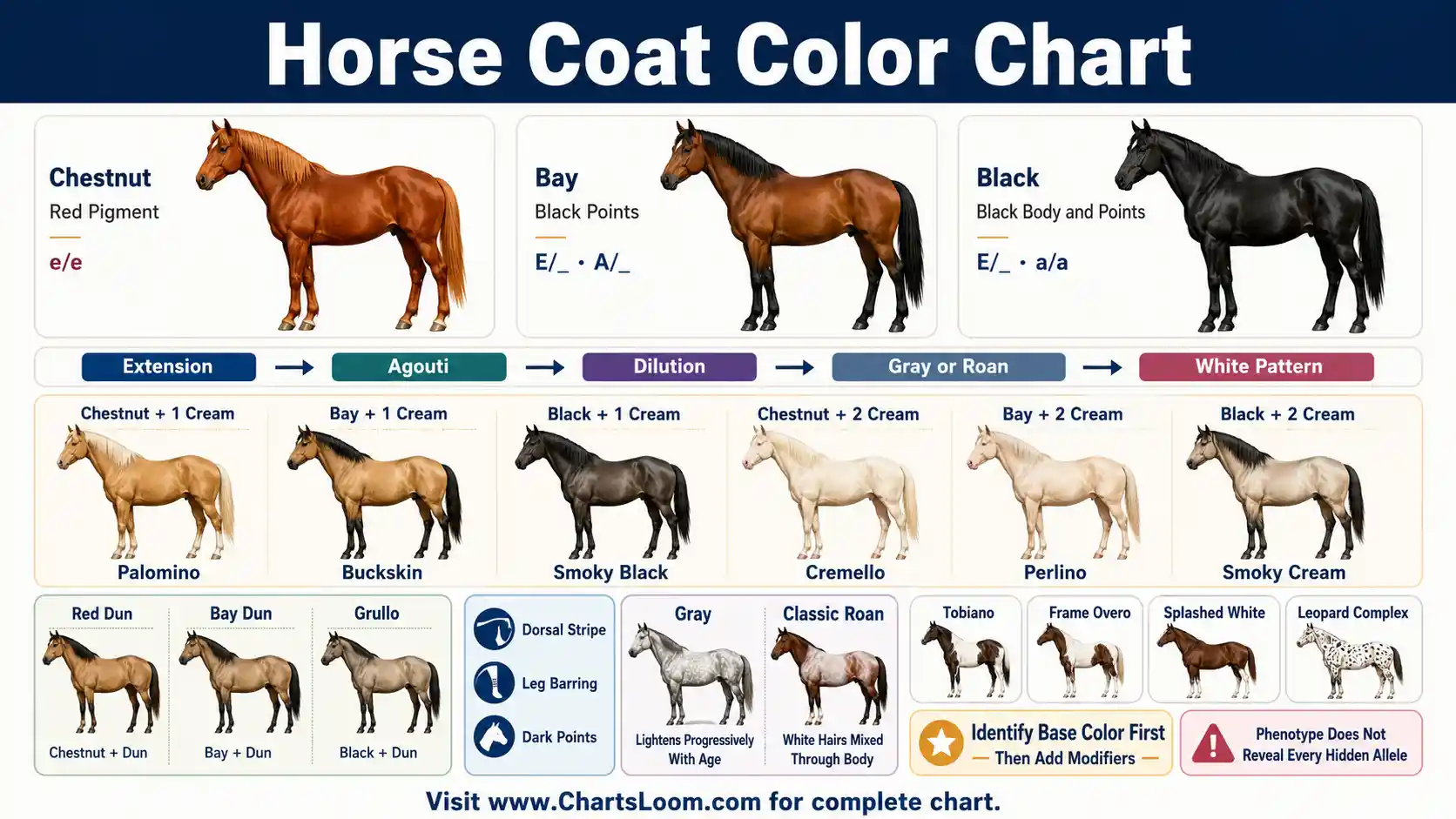
Quick answer
Identify the base first, then add modifiers
Every coat-color description starts with red or black pigment. Extension and Agouti create chestnut, bay or black. Dilution, gray, roan and white-pattern genes then change the visible coat.
Base colors
Chestnut · Bay · Black
Extension and Agouti establish the underlying pigment framework.
Modifiers
Add genes in layers
Cream, dun, gray, roan and white patterns change the visible phenotype.
Hidden information
Phenotype is not genotype
A visually identical horse can carry different recessive alleles.
Best verification
Use DNA testing
Testing resolves hidden alleles and important health-linked variants.
Questions at a glance
What are the three base horse colors?
Chestnut, bay and black are the core genetic base colors.
What makes a horse chestnut?
A chestnut horse has two recessive red-factor alleles and produces red pigment in the hair.
What makes bay different from black?
Agouti restricts black pigment mainly to the points in bay, while a/a permits black across the body.
What creates palomino?
Palomino is a chestnut base with one cream allele.
What creates buckskin?
Buckskin is a bay base with one cream allele.
What creates grullo?
Grullo is a black base with dun dilution and primitive markings.
Is gray a base color?
No. Gray progressively overlays any underlying base color.
Is roan the same as gray?
No. Classic roan mixes white hairs into the body while usually retaining darker head and lower legs.
Can a chestnut carry Agouti?
Yes. Agouti is hidden on chestnut and may need DNA testing.
Can color predict a foal exactly?
No. Accurate probabilities depend on known genotypes from both parents and the loci included.
Are buckskin and dun the same?
No. Buckskin is cream dilution; dun is a separate gene associated with primitive markings.
Why does a foal change color?
The newborn coat sheds, seasonal shade changes occur, and gray or leopard-complex expression may progress with age.
Horse Coat Color Overview
Start with the underlying base color, then add dilution, gray, roan or white-pattern genes. Registry labels and visual shades can differ.
Swipe horizontally inside the table to view every column.
| Color or pattern | Genetic layer | Simplified genotype | Typical appearance | Identification note |
|---|---|---|---|---|
| Chestnut / sorrel — Base color | Red base | e/e | No black pigment in hair | Shade varies from light sorrel to liver chestnut |
| Bay — Base color | Black-pigment base with restricted points | E/_ · A/_ | Black mane, tail, lower legs and ear rims | Body shade ranges from bright bay to dark bay |
| Black — Base color | Black-pigment base with uniform distribution | E/_ · a/a | Black body and points | Sun fading and foal coat can complicate visual ID |
| Brown / seal brown | Dark black-based phenotype | Genetics and terminology vary | Brown areas often appear at muzzle, flank or elbow | Registry definitions differ |
| Palomino | Chestnut + one cream copy | e/e · N/Cr | Gold body with light mane and tail | Cream dosage matters |
| Buckskin | Bay + one cream copy | E/_ · A/_ · N/Cr | Tan or gold body with black points | Not the same as dun |
| Smoky black | Black + one cream copy | E/_ · a/a · N/Cr | May look black or slightly faded | Often difficult to identify visually |
| Cremello | Chestnut + two cream copies | e/e · Cr/Cr | Very pale cream coat, pale skin, light eyes | Double-cream dilution |
| Perlino | Bay + two cream copies | E/_ · A/_ · Cr/Cr | Pale cream with slightly darker points | Double-cream dilution |
| Smoky cream | Black + two cream copies | E/_ · a/a · Cr/Cr | Very pale cream phenotype | Double-cream dilution |
| Red dun | Chestnut + dun | e/e · D/_ | Lightened red body with primitive markings | Dorsal stripe may be prominent |
| Bay dun / dun | Bay + dun | E/_ · A/_ · D/_ | Lightened body, dark points and primitive markings | Commonly called dun |
| Grullo / grulla | Black + dun | E/_ · a/a · D/_ | Mouse-gray body with dark points and primitive markings | A black-based dun |
| Champagne | Dominant dilution | Ch/_ | Dilutes red and black pigment | Often associated with amber eyes and mottled pinkish skin |
| Silver | Black-pigment dilution | Z/_ | Lightens black body or points | Chestnut may carry silver without visible dilution |
| Pearl | Recessive / cream-interacting dilution | Prl/Prl or Cr/Prl | Pale dilution on suitable genotypes | One pearl copy alone is often not visible |
| Mushroom | Red-pigment dilution | Mu/Mu | Sepia-toned red-based coat | Most clearly expressed on chestnut |
| Gray | Progressive depigmentation | G/_ | Born another color and lightens with age | Underlying base remains genetically present |
| Classic roan | Intermixed white and colored hairs | Rn/_ | Head and lower legs usually remain darker | Unlike gray, classic roan does not progressively whiten the whole coat |
| Tobiano | Patch-white pattern | TO/_ | White commonly crosses the topline | Can occur on any base color |
| Frame overo | Patch-white pattern | O/_ | White usually does not cross the topline in classic expression | O/O causes lethal white overo syndrome |
| Splashed white | Patch-white pattern | SW variant | Often resembles white paint rising from below | Expression varies by variant and combination |
| Sabino 1 | Patch-white / roaning pattern | SB1/_ | White legs, facial white and body roaning may occur | Two copies can produce extensive white |
| Leopard complex | Appaloosa-type pattern | LP/_ | Mottled skin, striped hooves and variable spotting | Pattern expression depends on modifiers such as PATN1 |
- • Phenotype cannot reveal every hidden allele.
- • A horse may carry several modifiers at the same time.
Download or export
Interactive genetics guide
Base color and modifier explorer
Select simplified Extension, Agouti and modifier inputs to see how genetic layers can change the visible coat description.
Simplified result
Bay
Base: Bay. Genotype summary: Ee · Aa · cream 0 · dun no · gray no · roan no · silver no
Layers
- • Base: Bay
Inheritance notes
- • This horse can pass E or e at the Extension locus.
- • This horse can pass A or a at the Agouti locus.
- • No cream allele is included in this simplified selection.
- • This explorer layers only Extension, Agouti, cream, dun, gray, classic roan and silver.
- • It does not calculate foal probabilities or include champagne, pearl, leopard complex, frame overo, tobiano, splashed white, sabino or dominant white variants.
- • Phenotype can be altered by shade, age, season, sun bleaching and additional genes.
What it does
Builds a simplified visible description from base color, cream, dun, gray, roan and silver.
Why it helps
It demonstrates why the same base can receive different names after a modifier is added.
What it cannot do
It does not calculate foal probabilities, replace DNA testing or cover every known color locus.
Explore possible foal coat colors
Free online genetics tools can help owners explore possible coat colors for an upcoming foal by combining the known genes of the mare and stallion. To compare likely outcomes and see how parental alleles interact, check out this horse color calculator. Results are educational probabilities, so confirm uncertain genotypes with laboratory testing and use current veterinary guidance for health-linked variants.
Base Color Genetics: Extension and Agouti
Extension controls whether black pigment can be made. Agouti controls where black pigment appears when it is available.
Swipe horizontally inside the table to view every column.
| Genotype or observation | Meaning | Pigment result | Visible base implication | Practical note |
|---|---|---|---|---|
| E/E | A/A | Bay | Black pigment can be produced | Agouti restricts black pigment mainly to points. |
| E/E | A/a | Bay | Black pigment can be produced | Agouti restricts black pigment mainly to points. |
| E/E | a/a | Black | Black pigment can be produced | Black pigment is distributed across body and points. |
| E/E | Unknown Agouti | Bay or black | Black pigment can be produced | Agouti testing is needed to separate the two. |
| E/e | A/A | Bay | Black pigment can be produced | Agouti restricts black pigment mainly to points. |
| E/e | A/a | Bay | Black pigment can be produced | Agouti restricts black pigment mainly to points. |
| E/e | a/a | Black | Black pigment can be produced | Black pigment is distributed across body and points. |
| E/e | Unknown Agouti | Bay or black | Black pigment can be produced | Agouti testing is needed to separate the two. |
| e/e | A/A | Chestnut / sorrel | Red pigment only | Agouti is hidden because no black hair pigment is produced. |
| e/e | A/a | Chestnut / sorrel | Red pigment only | Agouti is hidden because no black hair pigment is produced. |
| e/e | a/a | Chestnut / sorrel | Red pigment only | Agouti is hidden because no black hair pigment is produced. |
| e/e | Unknown Agouti | Chestnut / sorrel | Red pigment only | Agouti is hidden because no black hair pigment is produced. |
| E is present | At least one dominant Extension allele | Black pigment can be produced | Agouti can affect visible base | E/E and E/e look alike at this locus |
| e/e | Two recessive red-factor alleles | Only red pigment in hair | Agouti is not visible | Chestnut can still carry A or a |
| A is present | At least one dominant Agouti allele | Black restricted to points | Bay when E is present | A/A and A/a look alike |
| a/a | Two recessive Agouti alleles | Black not restricted to points | Black when E is present | Hidden on chestnut |
| E/E parent | Passes E to every foal | Cannot produce e/e unless mutation/error | May still produce bay or black | Partner Agouti matters |
| E/e parent | Passes E or e | Can contribute chestnut allele | Phenotype remains black-pigment based | Testing reveals carrier status |
| e/e parent | Passes e to every foal | All foals receive red-factor allele | Foal color depends on other parent | Useful known breeding input |
| A/A parent | Passes A to every foal | Black pigment will be restricted if present | No a/a foal from this locus | Extension still matters |
| A/a parent | Passes A or a | Can produce bay or black with suitable partner | Phenotype itself is bay if E present | Heterozygous |
| a/a parent | Passes a to every foal | Can contribute black base | Chestnut can be a/a invisibly | Extension still matters |
| Visual bay | E/_ and A/_ | Exact zygosity unknown | Could carry e and/or a | DNA testing improves prediction |
| Visual chestnut | e/e | Agouti cannot be seen | Could be A/A, A/a or a/a | Agouti test helps predict black possibility |
- • The underscore in E/_ or A/_ means the second allele may be either form.
- • Chestnut hides Agouti phenotype, so genotype may matter for foal predictions.
Download or export
Cream Dilution Chart
Cream has a dosage effect: one copy creates palomino, buckskin or smoky black; two copies create cremello, perlino or smoky cream.
Swipe horizontally inside the table to view every column.
| Base or example | Underlying base | Cream copies | Genotype or appearance | Result or note |
|---|---|---|---|---|
| Chestnut | e/e | 0 | N/N | Chestnut |
| Chestnut | e/e | 1 | N/Cr | Palomino |
| Chestnut | e/e | 2 | Cr/Cr | Cremello |
| Bay | E/_ · A/_ | 0 | N/N | Bay |
| Bay | E/_ · A/_ | 1 | N/Cr | Buckskin |
| Bay | E/_ · A/_ | 2 | Cr/Cr | Perlino |
| Black | E/_ · a/a | 0 | N/N | Black |
| Black | E/_ · a/a | 1 | N/Cr | Smoky black |
| Black | E/_ · a/a | 2 | Cr/Cr | Smoky cream |
| Palomino | Chestnut | 1 | Gold body; cream or white mane and tail | Shade varies |
| Buckskin | Bay | 1 | Diluted body with black points | Can be confused with dun |
| Smoky black | Black | 1 | Often resembles black | DNA testing may be needed |
| Cremello | Chestnut | 2 | Pale cream coat and light eyes | Not an albino |
| Perlino | Bay | 2 | Pale cream with darker points | Base can be subtle |
| Smoky cream | Black | 2 | Very pale cream | Underlying black base |
| Single cream | Any | 1 | Incomplete dominant dosage effect | Different name by base |
| Double cream | Any | 2 | Stronger dilution | Different name by base |
| Cream + gray | Any | 1 or 2 | Gray progressively overlays diluted base | Record underlying color |
| Cream + roan | Any | 1 or 2 | Roan adds intermixed white hairs | Combination name varies |
| Cream + dun | Any | 1 or 2 | Both dilution systems act together | Use genotype description |
| Cream carrier | N/Cr | 1 | Visible in many base colors | Smoky black may be subtle |
| No cream | N/N | 0 | No cream dilution | Other genes may still dilute |
| Cream / pearl | Cr/Prl | Compound | Pseudo-double-dilute appearance possible | Requires specific testing |
| Foal coat | Any | Any | Can change after shedding | Do not rely on newborn shade alone |
- • Cream is not the same gene as dun, champagne or pearl.
- • Visual identification is easiest when base color and genotype are considered together.
Download or export
Dun Dilution and Primitive Markings
True dun lightens the body while usually preserving darker points and primitive markings. Not every dorsal stripe proves the D allele.
Swipe horizontally inside the table to view every column.
| Base or topic | Color or genotype | Feature | Interpretation | Caution |
|---|---|---|---|---|
| Chestnut | Red dun | Dorsal stripe | Key primitive marking | Expression varies by horse |
| Chestnut | Red dun | Leg barring | Common supporting clue | Expression varies by horse |
| Chestnut | Red dun | Shoulder stripe | Common supporting clue | Expression varies by horse |
| Chestnut | Red dun | Face cobwebbing | Common supporting clue | Expression varies by horse |
| Chestnut | Red dun | Dark ear rims | Common supporting clue | Expression varies by horse |
| Chestnut | Red dun | Undiluted mane and tail | Common supporting clue | Expression varies by horse |
| Bay | Bay dun / dun | Dorsal stripe | Key primitive marking | Expression varies by horse |
| Bay | Bay dun / dun | Leg barring | Common supporting clue | Expression varies by horse |
| Bay | Bay dun / dun | Shoulder stripe | Common supporting clue | Expression varies by horse |
| Bay | Bay dun / dun | Face cobwebbing | Common supporting clue | Expression varies by horse |
| Bay | Bay dun / dun | Dark ear rims | Common supporting clue | Expression varies by horse |
| Bay | Bay dun / dun | Undiluted mane and tail | Common supporting clue | Expression varies by horse |
| Black | Grullo / grulla | Dorsal stripe | Key primitive marking | Expression varies by horse |
| Black | Grullo / grulla | Leg barring | Common supporting clue | Expression varies by horse |
| Black | Grullo / grulla | Shoulder stripe | Common supporting clue | Expression varies by horse |
| Black | Grullo / grulla | Face cobwebbing | Common supporting clue | Expression varies by horse |
| Black | Grullo / grulla | Dark ear rims | Common supporting clue | Expression varies by horse |
| Black | Grullo / grulla | Undiluted mane and tail | Common supporting clue | Expression varies by horse |
| D allele | D/_ | True dun dilution | Lightened body with undiluted points | Dominant |
| nd1 | nd1 present without D | Not true dun dilution | Primitive markings may occur | Can complicate visual ID |
| nd2/nd2 | Non-dun | No dun dilution | Primitive markings generally absent from this locus | Other markings still possible |
| Buckskin vs dun | Cream vs dun | Both can have tan body and dark points | Dun should show primitive markings | Testing separates genes |
| Grullo vs faded black | Dun vs environment | Mouse-gray body with primitive marks | Sun bleaching alone is not dun | Check dorsal stripe continuity |
| Red dun vs light chestnut | Dun vs shade | Primitive marks support dun | Shade alone is insufficient | Foal coat may mislead |
- • Dun, cream and champagne are separate dilution systems.
- • Countershading and nd1-associated primitive marks can mimic parts of the dun pattern.
Download or export
Champagne, Silver, Pearl and Other Dilutions
Several dilution genes act differently on red and black pigment. Similar-looking coats can arise from different genotypes.
Swipe horizontally inside the table to view every column.
| Dilution or shade | Simplified genotype | Question | Answer | Key note |
|---|---|---|---|---|
| Champagne | CH/_ | What it changes | Red and black pigment | Amber eyes and mottled pinkish skin often support ID |
| Champagne | CH/_ | Best visual clue | Gold, amber or classic champagne by base | Amber eyes and mottled pinkish skin often support ID |
| Champagne | CH/_ | Hidden-carrier issue | Phenotype may not reveal zygosity or carrier status | Amber eyes and mottled pinkish skin often support ID |
| Champagne | CH/_ | Testing value | Testing can clarify ambiguous appearance or breeding input | Amber eyes and mottled pinkish skin often support ID |
| Silver | Z/_ | What it changes | Black pigment | Chestnut can carry silver invisibly |
| Silver | Z/_ | Best visual clue | Silver black or silver bay expressions | Chestnut can carry silver invisibly |
| Silver | Z/_ | Hidden-carrier issue | Phenotype may not reveal zygosity or carrier status | Chestnut can carry silver invisibly |
| Silver | Z/_ | Testing value | Testing can clarify ambiguous appearance or breeding input | Chestnut can carry silver invisibly |
| Pearl | Prl/Prl | What it changes | Both pigments on suitable background | One copy alone usually not visible |
| Pearl | Prl/Prl | Best visual clue | Pale apricot-like dilution | One copy alone usually not visible |
| Pearl | Prl/Prl | Hidden-carrier issue | Phenotype may not reveal zygosity or carrier status | One copy alone usually not visible |
| Pearl | Prl/Prl | Testing value | Testing can clarify ambiguous appearance or breeding input | One copy alone usually not visible |
| Cream + pearl | Cr/Prl | What it changes | Both pigments | Compound heterozygous at SLC45A2 |
| Cream + pearl | Cr/Prl | Best visual clue | Pseudo-double-dilute phenotype | Compound heterozygous at SLC45A2 |
| Cream + pearl | Cr/Prl | Hidden-carrier issue | Phenotype may not reveal zygosity or carrier status | Compound heterozygous at SLC45A2 |
| Cream + pearl | Cr/Prl | Testing value | Testing can clarify ambiguous appearance or breeding input | Compound heterozygous at SLC45A2 |
| Mushroom | Mu/Mu | What it changes | Red pigment | Recessive |
| Mushroom | Mu/Mu | Best visual clue | Sepia-toned chestnut-derived color | Recessive |
| Mushroom | Mu/Mu | Hidden-carrier issue | Phenotype may not reveal zygosity or carrier status | Recessive |
| Mushroom | Mu/Mu | Testing value | Testing can clarify ambiguous appearance or breeding input | Recessive |
| Flaxen | Complex / not fully resolved | What it changes | Mane and tail of chestnut | Not the same as silver |
| Flaxen | Complex / not fully resolved | Best visual clue | Light mane and tail | Not the same as silver |
| Flaxen | Complex / not fully resolved | Hidden-carrier issue | Phenotype may not reveal zygosity or carrier status | Not the same as silver |
| Flaxen | Complex / not fully resolved | Testing value | Testing can clarify ambiguous appearance or breeding input | Not the same as silver |
| Sooty | Complex / incompletely understood | What it changes | Dark hair overlay | Degree varies |
| Sooty | Complex / incompletely understood | Best visual clue | Darkened topline or body shading | Degree varies |
| Sooty | Complex / incompletely understood | Hidden-carrier issue | Phenotype may not reveal zygosity or carrier status | Degree varies |
| Sooty | Complex / incompletely understood | Testing value | Testing can clarify ambiguous appearance or breeding input | Degree varies |
- • Silver affects black pigment but not red pigment visibly.
- • Some shade terms describe appearance rather than a single confirmed gene.
Download or export
Gray, Roan and Similar White-Hair Patterns
Gray progressively removes pigment from hair, while classic roan mixes white hairs into a colored body and usually retains darker head and legs.
Swipe horizontally inside the table to view every column.
| Pattern | Question | Answer | Distinguishing note | Verification |
|---|---|---|---|---|
| Gray | Mechanism | Progressive depigmentation | Underlying base remains genetically present | DNA test may help |
| Gray | Base color | Any base | Underlying base remains genetically present | DNA test may help |
| Gray | Change over time | Often lightens with age | Underlying base remains genetically present | DNA test may help |
| Gray | Identification clue | Head commonly lightens early | Underlying base remains genetically present | DNA test may help |
| Classic roan | Mechanism | Intermixed white hairs | Does not equal gray | DNA test may help |
| Classic roan | Base color | Any base | Does not equal gray | DNA test may help |
| Classic roan | Change over time | Usually remains recognizably roan | Does not equal gray | DNA test may help |
| Classic roan | Identification clue | Head and lower legs often stay darker | Does not equal gray | DNA test may help |
| Varnish roan | Mechanism | Leopard complex expression | Not classic roan | DNA test may help |
| Varnish roan | Base color | LP-based | Not classic roan | DNA test may help |
| Varnish roan | Change over time | Can progress with age | Not classic roan | DNA test may help |
| Varnish roan | Identification clue | Mottled skin and other LP traits may occur | Not classic roan | DNA test may help |
| Rabicano | Mechanism | Pattern / modifier | Not classic roan | Use pattern and history |
| Rabicano | Base color | Any base | Not classic roan | Use pattern and history |
| Rabicano | Change over time | White hairs concentrated at flanks or tailhead | Not classic roan | Use pattern and history |
| Rabicano | Identification clue | Often limited distribution | Not classic roan | Use pattern and history |
| Sabino roaning | Mechanism | White-pattern expression | Pattern-specific | Use pattern and history |
| Sabino roaning | Base color | Any base | Pattern-specific | Use pattern and history |
| Sabino roaning | Change over time | Roaning near white markings | Pattern-specific | Use pattern and history |
| Sabino roaning | Identification clue | Irregular edges may occur | Pattern-specific | Use pattern and history |
| Frosting / age hairs | Mechanism | Non-genetic descriptor | Not automatically roan | Use pattern and history |
| Frosting / age hairs | Base color | Any base | Not automatically roan | Use pattern and history |
| Frosting / age hairs | Change over time | Scattered white hairs | Not automatically roan | Use pattern and history |
| Frosting / age hairs | Identification clue | May increase with age or injury | Not automatically roan | Use pattern and history |
- • A gray horse is born another color.
- • Classic roan, varnish roan, rabicano and sabino roaning are different patterns.
Download or export
Horse White Spotting and Distributed-White Patterns
White patterns are layered over an underlying base color. Pattern names describe distribution, but DNA testing may be needed when expressions overlap.
Swipe horizontally inside the table to view every column.
| Pattern | Identification lens | Typical feature | Important note | Base-color relationship |
|---|---|---|---|---|
| Tobiano | Topline / distribution | White usually crosses topline | Can combine with other patterns | Can occur over chestnut, bay or black base |
| Tobiano | Face and legs | Dark head common; legs often white | Can combine with other patterns | Can occur over chestnut, bay or black base |
| Tobiano | Gene label | TO | Can combine with other patterns | Can occur over chestnut, bay or black base |
| Frame overo | Topline / distribution | Horizontal white patches; topline often remains colored | O/O causes lethal white overo syndrome | Can occur over chestnut, bay or black base |
| Frame overo | Face and legs | Face white common | O/O causes lethal white overo syndrome | Can occur over chestnut, bay or black base |
| Frame overo | Gene label | O | O/O causes lethal white overo syndrome | Can occur over chestnut, bay or black base |
| Splashed white | Topline / distribution | White appears to rise from below | Expression and hearing associations vary by variant | Can occur over chestnut, bay or black base |
| Splashed white | Face and legs | Broad blaze, blue eyes possible | Expression and hearing associations vary by variant | Can occur over chestnut, bay or black base |
| Splashed white | Gene label | SW variants | Expression and hearing associations vary by variant | Can occur over chestnut, bay or black base |
| Sabino 1 | Topline / distribution | White legs, facial white and roaning | Two copies can be extensively white | Can occur over chestnut, bay or black base |
| Sabino 1 | Face and legs | Irregular edges | Two copies can be extensively white | Can occur over chestnut, bay or black base |
| Sabino 1 | Gene label | SB1 | Two copies can be extensively white | Can occur over chestnut, bay or black base |
| Dominant white | Topline / distribution | Variable extensive white spotting | Some homozygous combinations are embryonic lethal | Can occur over chestnut, bay or black base |
| Dominant white | Face and legs | May range from markings to nearly white | Some homozygous combinations are embryonic lethal | Can occur over chestnut, bay or black base |
| Dominant white | Gene label | W variants | Some homozygous combinations are embryonic lethal | Can occur over chestnut, bay or black base |
| Leopard complex | Topline / distribution | Mottled skin, striped hooves, white sclera | LP/LP linked with congenital stationary night blindness | Can occur over chestnut, bay or black base |
| Leopard complex | Face and legs | Spots or varnish pattern | LP/LP linked with congenital stationary night blindness | Can occur over chestnut, bay or black base |
| Leopard complex | Gene label | LP | LP/LP linked with congenital stationary night blindness | Can occur over chestnut, bay or black base |
| PATN1 | Topline / distribution | Increases leopard-complex white pattern | Requires LP for Appaloosa expression | Can occur over chestnut, bay or black base |
| PATN1 | Face and legs | Large blanket or near-leopard expression | Requires LP for Appaloosa expression | Can occur over chestnut, bay or black base |
| PATN1 | Gene label | PATN1 | Requires LP for Appaloosa expression | Can occur over chestnut, bay or black base |
| Camarillo white | Topline / distribution | Predominantly white coat | Distinct dominant-white variant | Can occur over chestnut, bay or black base |
| Camarillo white | Face and legs | Pink skin | Distinct dominant-white variant | Can occur over chestnut, bay or black base |
| Camarillo white | Gene label | CW | Distinct dominant-white variant | Can occur over chestnut, bay or black base |
| Roan | Topline / distribution | Intermixed white hairs on body | Distributed-white rather than patch-white | Can occur over chestnut, bay or black base |
| Roan | Face and legs | Head and legs darker | Distributed-white rather than patch-white | Can occur over chestnut, bay or black base |
| Roan | Gene label | Rn | Distributed-white rather than patch-white | Can occur over chestnut, bay or black base |
| Gray | Topline / distribution | Progressive loss of hair pigment | Distributed-white; not a birth marking | Can occur over chestnut, bay or black base |
| Gray | Face and legs | Age-related lightening | Distributed-white; not a birth marking | Can occur over chestnut, bay or black base |
| Gray | Gene label | G | Distributed-white; not a birth marking | Can occur over chestnut, bay or black base |
- • Do not use the word white as a complete genetic diagnosis.
- • More than one white-pattern allele may be present in the same horse.
Download or export
Foal Coat Color Changes by Age
A newborn coat is not always the final adult shade. Base genetics remain, but shedding, gray, varnish roaning and environment can change appearance.
Swipe horizontally inside the table to view every column.
| Stage | Typical time | Factor | What may happen | Best practice |
|---|---|---|---|---|
| Birth coat | Newborn | Base color | Chestnut, bay or black remains the genetic foundation | Do not finalize shade immediately |
| Birth coat | Newborn | Dilution | Cream, dun, champagne, silver or other modifiers may become clearer | Do not finalize shade immediately |
| Birth coat | Newborn | White pattern | Marking distribution usually remains identifiable though roaning can change | Do not finalize shade immediately |
| Birth coat | Newborn | Environment | Sun, nutrition, clipping and season can alter appearance | Do not finalize shade immediately |
| First shed | Weeks to months | Base color | Chestnut, bay or black remains the genetic foundation | Photograph in neutral light |
| First shed | Weeks to months | Dilution | Cream, dun, champagne, silver or other modifiers may become clearer | Photograph in neutral light |
| First shed | Weeks to months | White pattern | Marking distribution usually remains identifiable though roaning can change | Photograph in neutral light |
| First shed | Weeks to months | Environment | Sun, nutrition, clipping and season can alter appearance | Photograph in neutral light |
| Yearling coat | Around one year | Base color | Chestnut, bay or black remains the genetic foundation | Gray progression may become obvious |
| Yearling coat | Around one year | Dilution | Cream, dun, champagne, silver or other modifiers may become clearer | Gray progression may become obvious |
| Yearling coat | Around one year | White pattern | Marking distribution usually remains identifiable though roaning can change | Gray progression may become obvious |
| Yearling coat | Around one year | Environment | Sun, nutrition, clipping and season can alter appearance | Gray progression may become obvious |
| Adult summer coat | Mature | Base color | Chestnut, bay or black remains the genetic foundation | Sun bleaching still matters |
| Adult summer coat | Mature | Dilution | Cream, dun, champagne, silver or other modifiers may become clearer | Sun bleaching still matters |
| Adult summer coat | Mature | White pattern | Marking distribution usually remains identifiable though roaning can change | Sun bleaching still matters |
| Adult summer coat | Mature | Environment | Sun, nutrition, clipping and season can alter appearance | Sun bleaching still matters |
| Winter coat | Seasonal | Base color | Chestnut, bay or black remains the genetic foundation | Compare points and skin |
| Winter coat | Seasonal | Dilution | Cream, dun, champagne, silver or other modifiers may become clearer | Compare points and skin |
| Winter coat | Seasonal | White pattern | Marking distribution usually remains identifiable though roaning can change | Compare points and skin |
| Winter coat | Seasonal | Environment | Sun, nutrition, clipping and season can alter appearance | Compare points and skin |
| Aging gray | Years | Base color | Chestnut, bay or black remains the genetic foundation | Record original color and genotype |
| Aging gray | Years | Dilution | Cream, dun, champagne, silver or other modifiers may become clearer | Record original color and genotype |
| Aging gray | Years | White pattern | Marking distribution usually remains identifiable though roaning can change | Record original color and genotype |
| Aging gray | Years | Environment | Sun, nutrition, clipping and season can alter appearance | Record original color and genotype |
- • Foal color should be reassessed after shedding.
- • Progressive gray and leopard-complex varnishing can continue for years.
Download or export
Horse Markings and Identification Terms
Markings help identify an individual horse but should not be confused with the underlying base color or a confirmed genetic pattern.
Swipe horizontally inside the table to view every column.
| Term | Location | Description | Use | Note |
|---|---|---|---|---|
| Star | Forehead | Small white area | Record | Describe size and side |
| Star | Forehead | Small white area | Interpret | Marking, not base color |
| Stripe | Face | Vertical white line | Record | Describe size and side |
| Stripe | Face | Vertical white line | Interpret | Width and continuity vary |
| Blaze | Face | Broad white stripe | Record | Describe size and side |
| Blaze | Face | Broad white stripe | Interpret | Can extend over muzzle |
| Snip | Muzzle | Small white patch | Record | Describe size and side |
| Snip | Muzzle | Small white patch | Interpret | Often separate from blaze |
| Bald face | Face | Very broad white face | Record | Describe size and side |
| Bald face | Face | Very broad white face | Interpret | May be linked with a white pattern |
| Coronet | Leg | White just above hoof | Record | Describe size and side |
| Coronet | Leg | White just above hoof | Interpret | Registration term |
| Pastern | Leg | White to pastern | Record | Describe size and side |
| Pastern | Leg | White to pastern | Interpret | Height matters |
| Sock | Leg | White above fetlock | Record | Describe size and side |
| Sock | Leg | White above fetlock | Interpret | Boundary terminology varies |
| Stocking | Leg | White extending toward knee or hock | Record | Describe size and side |
| Stocking | Leg | White extending toward knee or hock | Interpret | Not a coat-color gene by itself |
| Dorsal stripe | Topline | Dark stripe along back | Record | Describe size and side |
| Dorsal stripe | Topline | Dark stripe along back | Interpret | Supports dun but can be countershading |
| Zebra bars | Legs | Horizontal dark barring | Record | Describe size and side |
| Zebra bars | Legs | Horizontal dark barring | Interpret | Primitive marking |
| Shoulder stripe | Shoulder | Dark transverse stripe | Record | Describe size and side |
| Shoulder stripe | Shoulder | Dark transverse stripe | Interpret | Primitive marking |
| Ermine spots | White leg marking | Dark spots near coronet | Record | Describe size and side |
| Ermine spots | White leg marking | Dark spots near coronet | Interpret | Pigmented islands |
| Bend-Or spots | Body | Dark spots on chestnut | Record | Describe size and side |
| Bend-Or spots | Body | Dark spots on chestnut | Interpret | Cause not fully resolved |
| Birdcatcher spots | Body | Small white spots | Record | Describe size and side |
| Birdcatcher spots | Body | Small white spots | Interpret | Cause not fully resolved |
- • Registration organizations may define boundaries differently.
- • Photographs should include both sides, face, legs and distinctive marks.
Download or export
Horse Color Identification Checklist
Use a repeatable sequence: identify base pigment first, then evaluate dilution, progressive white hairs, and patch-white pattern.
Swipe horizontally inside the table to view every column.
| Step | Task | What to inspect | Why it matters | Viewing caution |
|---|---|---|---|---|
| 1 | Determine red or black pigment | Look at mane, tail, lower legs and body | Separates chestnut from black-pigment bases | Bright daylight: Avoid strong color casts and wet hair |
| 1 | Determine red or black pigment | Look at mane, tail, lower legs and body | Separates chestnut from black-pigment bases | Winter coat: Long hair can mute points and shade |
| 1 | Determine red or black pigment | Look at mane, tail, lower legs and body | Separates chestnut from black-pigment bases | Clipped coat: Clipping can temporarily change apparent intensity |
| 2 | Check black distribution | Black points only or black across body | Separates bay from black | Bright daylight: Avoid strong color casts and wet hair |
| 2 | Check black distribution | Black points only or black across body | Separates bay from black | Winter coat: Long hair can mute points and shade |
| 2 | Check black distribution | Black points only or black across body | Separates bay from black | Clipped coat: Clipping can temporarily change apparent intensity |
| 3 | Look for cream dosage | Gold, tan or very pale cream | Suggests one or two cream copies | Bright daylight: Avoid strong color casts and wet hair |
| 3 | Look for cream dosage | Gold, tan or very pale cream | Suggests one or two cream copies | Winter coat: Long hair can mute points and shade |
| 3 | Look for cream dosage | Gold, tan or very pale cream | Suggests one or two cream copies | Clipped coat: Clipping can temporarily change apparent intensity |
| 4 | Look for primitive markings | Dorsal stripe, barring, shoulder stripe | Supports dun | Bright daylight: Avoid strong color casts and wet hair |
| 4 | Look for primitive markings | Dorsal stripe, barring, shoulder stripe | Supports dun | Winter coat: Long hair can mute points and shade |
| 4 | Look for primitive markings | Dorsal stripe, barring, shoulder stripe | Supports dun | Clipped coat: Clipping can temporarily change apparent intensity |
| 5 | Assess skin and eyes | Dark, mottled pinkish, pale; dark, amber or blue eyes | Supports some dilutions or white patterns | Bright daylight: Avoid strong color casts and wet hair |
| 5 | Assess skin and eyes | Dark, mottled pinkish, pale; dark, amber or blue eyes | Supports some dilutions or white patterns | Winter coat: Long hair can mute points and shade |
| 5 | Assess skin and eyes | Dark, mottled pinkish, pale; dark, amber or blue eyes | Supports some dilutions or white patterns | Clipped coat: Clipping can temporarily change apparent intensity |
| 6 | Check age-related change | Compare foal and older photos | Identifies progressive gray or varnish | Bright daylight: Avoid strong color casts and wet hair |
| 6 | Check age-related change | Compare foal and older photos | Identifies progressive gray or varnish | Winter coat: Long hair can mute points and shade |
| 6 | Check age-related change | Compare foal and older photos | Identifies progressive gray or varnish | Clipped coat: Clipping can temporarily change apparent intensity |
| 7 | Map white pattern | Topline, face, legs, belly, hips | Narrows tobiano, overo, splash, sabino or LP | Bright daylight: Avoid strong color casts and wet hair |
| 7 | Map white pattern | Topline, face, legs, belly, hips | Narrows tobiano, overo, splash, sabino or LP | Winter coat: Long hair can mute points and shade |
| 7 | Map white pattern | Topline, face, legs, belly, hips | Narrows tobiano, overo, splash, sabino or LP | Clipped coat: Clipping can temporarily change apparent intensity |
| 8 | Review pedigree and test results | Use documented genotypes | Resolves hidden alleles | Bright daylight: Avoid strong color casts and wet hair |
| 8 | Review pedigree and test results | Use documented genotypes | Resolves hidden alleles | Winter coat: Long hair can mute points and shade |
| 8 | Review pedigree and test results | Use documented genotypes | Resolves hidden alleles | Clipped coat: Clipping can temporarily change apparent intensity |
- • Color names should follow the registry or breed organization when registration is the goal.
- • DNA testing is the strongest way to resolve visually ambiguous genotypes.
Download or export
Horse Coat Color Genetic Testing
DNA testing can identify hidden alleles, distinguish similar phenotypes and improve foal-color probability estimates.
Swipe horizontally inside the table to view every column.
| Test or step | Gene / category | What it answers | Sample or action | Why it matters |
|---|---|---|---|---|
| Red Factor / Extension | MC1R | Chestnut vs black-pigment base | Hair roots or approved lab sample | Hidden e carrier status |
| Agouti | ASIP | Bay vs black distribution | Hair roots or approved lab sample | Hidden on chestnut |
| Cream | SLC45A2 | Cream copy count | Hair roots or approved lab sample | Separates single and double cream |
| Dun | TBX3 region | True dun vs non-dun | Hair roots or approved lab sample | Separates D, nd1 and nd2 |
| Gray | STX17 region | Gray presence and sometimes copy/type | Hair roots or approved lab sample | Underlying base still needed |
| Silver | PMEL | Silver dilution | Hair roots or approved lab sample | Health relevance for MCOA |
| Champagne | SLC36A1 | Champagne dilution | Hair roots or approved lab sample | Supports skin and eye clues |
| Pearl | SLC45A2 | Pearl and cream interaction | Hair roots or approved lab sample | One copy may be hidden |
| Roan | KIT region | Classic roan | Hair roots or approved lab sample | Distinguishes from similar roaning |
| Frame overo | EDNRB | Frame pattern and lethal risk | Hair roots or approved lab sample | Avoid O/O mating |
| Leopard complex | TRPM1 | LP status | Hair roots or approved lab sample | Health and pattern implications |
| White pattern panel | Multiple genes | Tobiano, splash, sabino, dominant white variants | Hair roots or approved lab sample | Overlapping patterns |
| Sample step 1 | Workflow | Confirm test scope | Choose base, dilution, white-pattern or full panel | Follow the selected laboratory instructions |
| Sample step 2 | Workflow | Read laboratory instructions | Sample type and quantity vary | Follow the selected laboratory instructions |
| Sample step 3 | Workflow | Pull hairs with roots | Cut hair shafts alone may not provide DNA | Follow the selected laboratory instructions |
| Sample step 4 | Workflow | Use clean paper handling | Avoid contamination and moisture | Follow the selected laboratory instructions |
| Sample step 5 | Workflow | Label each horse | Include registered name or unique identifier | Follow the selected laboratory instructions |
| Sample step 6 | Workflow | Protect root bulbs | Tape or fold as instructed | Follow the selected laboratory instructions |
| Sample step 7 | Workflow | Submit pedigree details | Useful for interpretation | Follow the selected laboratory instructions |
| Sample step 8 | Workflow | Review genotype and phenotype | Both matter | Follow the selected laboratory instructions |
| Sample step 9 | Workflow | Store the report | Keep with breeding and registration records | Follow the selected laboratory instructions |
| Sample step 10 | Workflow | Share with veterinarian | Especially for health-linked variants | Follow the selected laboratory instructions |
| Sample step 11 | Workflow | Use both parents for prediction | Known genotypes improve probabilities | Follow the selected laboratory instructions |
| Sample step 12 | Workflow | Re-test only when justified | Use an accredited laboratory and current panel | Follow the selected laboratory instructions |
- • A visual color label is not a substitute for genotype.
- • Panel contents and laboratory methods can change, so confirm the current test description before submitting.
Download or export
Health-Linked Horse Color Genetics
Some pigmentation variants affect more than appearance. This table supports informed testing and veterinary discussion, not diagnosis.
Swipe horizontally inside the table to view every column.
| Color gene or pattern | Lens | Guidance | Known association | Limit |
|---|---|---|---|---|
| Frame overo | Genetic fact | O/O | Lethal white overo syndrome | Veterinary and laboratory guidance required |
| Frame overo | Owner action | Do not breed two O carriers without informed genetic planning | Lethal white overo syndrome | Veterinary and laboratory guidance required |
| Frame overo | Breeding action | EDNRB testing | Lethal white overo syndrome | Veterinary and laboratory guidance required |
| Frame overo | Clinical limit | Coat color alone cannot diagnose the associated condition | Lethal white overo syndrome | Veterinary and laboratory guidance required |
| Silver | Genetic fact | Z/Z or N/Z | Multiple congenital ocular anomalies; severity can be greater with two copies | Veterinary and laboratory guidance required |
| Silver | Owner action | Include eye assessment and breeding discussion | Multiple congenital ocular anomalies; severity can be greater with two copies | Veterinary and laboratory guidance required |
| Silver | Breeding action | PMEL testing | Multiple congenital ocular anomalies; severity can be greater with two copies | Veterinary and laboratory guidance required |
| Silver | Clinical limit | Coat color alone cannot diagnose the associated condition | Multiple congenital ocular anomalies; severity can be greater with two copies | Veterinary and laboratory guidance required |
| Leopard complex | Genetic fact | LP/LP | Congenital stationary night blindness | Veterinary and laboratory guidance required |
| Leopard complex | Owner action | Manage low-light limitations and discuss breeding | Congenital stationary night blindness | Veterinary and laboratory guidance required |
| Leopard complex | Breeding action | TRPM1 / LP testing | Congenital stationary night blindness | Veterinary and laboratory guidance required |
| Leopard complex | Clinical limit | Coat color alone cannot diagnose the associated condition | Congenital stationary night blindness | Veterinary and laboratory guidance required |
| Gray | Genetic fact | G/_ | Increased melanoma risk | Veterinary and laboratory guidance required |
| Gray | Owner action | Monitor skin and masses with veterinary care | Increased melanoma risk | Veterinary and laboratory guidance required |
| Gray | Breeding action | Gray testing plus clinical exams | Increased melanoma risk | Veterinary and laboratory guidance required |
| Gray | Clinical limit | Coat color alone cannot diagnose the associated condition | Increased melanoma risk | Veterinary and laboratory guidance required |
| Dominant white variants | Genetic fact | Some homozygous combinations | Embryonic lethality for specific variants | Veterinary and laboratory guidance required |
| Dominant white variants | Owner action | Use variant-specific laboratory guidance | Embryonic lethality for specific variants | Veterinary and laboratory guidance required |
| Dominant white variants | Breeding action | White-pattern testing | Embryonic lethality for specific variants | Veterinary and laboratory guidance required |
| Dominant white variants | Clinical limit | Coat color alone cannot diagnose the associated condition | Embryonic lethality for specific variants | Veterinary and laboratory guidance required |
- • Do not infer genotype or disease from appearance alone.
- • Breeding decisions involving health-linked variants require current laboratory and veterinary guidance.
Download or export
Horse Color Terms and Registry Differences
Color terminology is not perfectly universal. Use the target registry’s definitions when a formal registration label is required.
Swipe horizontally inside the table to view every column.
| Term | Lens | Meaning | Genetic context | Best practice |
|---|---|---|---|---|
| Sorrel vs chestnut | Definition | Often shade or registry preference | Same red base in many genetic contexts | Use the registry definition |
| Sorrel vs chestnut | Best practice | Use the registry definition | Photograph and document genotype if known | Avoid assuming all registries use identical labels |
| Grullo vs grulla | Definition | Language or registry preference | Black-based dun | Use accepted local term |
| Grullo vs grulla | Best practice | Use accepted local term | Photograph and document genotype if known | Avoid assuming all registries use identical labels |
| Pinto | Definition | Color-pattern description | May include tobiano, overo or combinations | Not a breed diagnosis |
| Pinto | Best practice | Not a breed diagnosis | Photograph and document genotype if known | Avoid assuming all registries use identical labels |
| Paint | Definition | Breed/registry term in some contexts | May have pinto pattern | Do not use interchangeably everywhere |
| Paint | Best practice | Do not use interchangeably everywhere | Photograph and document genotype if known | Avoid assuming all registries use identical labels |
| White | Definition | Phenotype label | Could involve dominant white, extensive patterns or gray appearance | Skin and genotype matter |
| White | Best practice | Skin and genotype matter | Photograph and document genotype if known | Avoid assuming all registries use identical labels |
| Albino | Definition | Generally inappropriate for horses | Most pale horses are specific dilutions or white patterns | Use precise color genetics |
| Albino | Best practice | Use precise color genetics | Photograph and document genotype if known | Avoid assuming all registries use identical labels |
| Roan | Definition | Specific classic pattern or informal description | Confirm classic roan vs varnish/sabino/rabicano | Avoid broad use |
| Roan | Best practice | Avoid broad use | Photograph and document genotype if known | Avoid assuming all registries use identical labels |
| Dun | Definition | True dilution gene | Primitive markings plus dilution | Buckskin is cream, not dun |
| Dun | Best practice | Buckskin is cream, not dun | Photograph and document genotype if known | Avoid assuming all registries use identical labels |
| Brown | Definition | Registry-dependent dark phenotype | May overlap seal brown or very dark bay terminology | Follow formal standard |
| Brown | Best practice | Follow formal standard | Photograph and document genotype if known | Avoid assuming all registries use identical labels |
| Appaloosa | Definition | Breed name and pattern context | Leopard complex patterns occur beyond one breed | Separate breed from phenotype |
| Appaloosa | Best practice | Separate breed from phenotype | Photograph and document genotype if known | Avoid assuming all registries use identical labels |
- • Genetic phenotype and registration terminology answer different questions.
- • Keep test reports with the horse’s identification records.
Download or export
Horse Coat Genotype Examples
Worked genotype examples show how base color and modifiers are layered. They are educational examples, not a complete inheritance engine.
Swipe horizontally inside the table to view every column.
| Extension / base | Agouti or base | Modifier | Likely description | Interpretation |
|---|---|---|---|---|
| E/e · A/a | Bay | No modifiers | Bay phenotype; carries e and a | Genotype matters for foals |
| e/e · A/a | Chestnut | No modifiers | Chestnut; Agouti hidden | Can pass A or a |
| E/E · a/a | Black | No modifiers | Black | Cannot produce chestnut without e from both parents |
| e/e | Chestnut | N/Cr | Palomino | Single cream |
| E/_ · A/_ | Bay | N/Cr | Buckskin | Single cream |
| E/_ · a/a | Black | N/Cr | Smoky black | Can look nearly black |
| e/e | Chestnut | Cr/Cr | Cremello | Double cream |
| E/_ · A/_ | Bay | Cr/Cr | Perlino | Double cream |
| E/_ · a/a | Black | Cr/Cr | Smoky cream | Double cream |
| e/e | Chestnut | D/_ | Red dun | Primitive markings expected |
| E/_ · A/_ | Bay | D/_ | Bay dun | Primitive markings expected |
| E/_ · a/a | Black | D/_ | Grullo | Primitive markings expected |
| Any base | Any | G/_ | Gray over underlying color | Lightens with age |
| Chestnut | e/e | Rn/_ | Red roan | Classic roan overlay |
| Bay | E/_ · A/_ | Rn/_ | Bay roan | Classic roan overlay |
| Black | E/_ · a/a | Rn/_ | Blue roan | Classic roan overlay |
| Bay | E/_ · A/_ | TO/_ | Bay tobiano | Pattern over base |
| Black | E/_ · a/a | Z/_ | Silver black | Silver affects black pigment |
| Chestnut | e/e | Z/_ | Chestnut carrying silver | Silver not visibly expressed on red pigment |
| Bay | E/_ · A/_ | N/Cr + D/_ | Cream-and-dun combination | Use layered genotype description |
| Any base | Any | LP/_ | Leopard-complex phenotype possible | PATN modifiers affect amount of white |
| Any base | Any | O/_ | Frame-overo pattern possible | Never mate two carriers without testing |
| Any base | Any | SW variant | Splashed-white expression possible | Variant and combination matter |
| Any base | Any | Unknown | Visual label only | Test before precise breeding prediction |
- • Many combinations involve additional loci not shown here.
- • Use known mare and stallion genotypes for probability calculations.
Download or export
Horse Coat Color Worked Examples
These examples practice the sequence base color → dilution or modifier → white pattern → age-related change.
Swipe horizontally inside the table to view every column.
| Example | Base color | Simplified genotype | Modifier | Likely description | Reasoning |
|---|---|---|---|---|---|
| Example 1 | Chestnut | e/e | None | Chestnut — Worked result | Agouti hidden; Base remains visible |
| Example 2 | Bay | E/_ · A/_ | One cream | Buckskin — Worked result | Black restricted to points; Single dilution |
| Example 3 | Black | E/_ · a/a | Two cream | Smoky cream | Black across body; Double dilution |
| Example 4 | Chestnut | e/e | Dun | Red dun | Agouti hidden; Primitive markings expected |
| Example 5 | Bay | E/_ · A/_ | Gray | Gray over bay | Black restricted to points; Progressive depigmentation |
| Example 6 | Black | E/_ · a/a | Classic roan | Blue roan | Black across body; Intermixed white body hairs |
| Example 7 | Chestnut | e/e | Tobiano | Chestnut tobiano | Agouti hidden; Patch white crossing topline |
| Example 8 | Bay | E/_ · A/_ | Silver | Silver bay | Black restricted to points; Affects black pigment |
| Example 9 | Black | E/_ · a/a | Champagne | Black-based champagne phenotype | Black across body; Dilutes red and black pigment |
| Example 10 | Chestnut | e/e | Leopard complex | Chestnut with leopard-complex pattern | Agouti hidden; Mottled skin / spotting clues |
| Example 11 | Bay | E/_ · A/_ | None | Bay | Black restricted to points; Base remains visible |
| Example 12 | Black | E/_ · a/a | One cream | Smoky black | Black across body; Single dilution |
| Example 13 | Chestnut | e/e | Two cream | Cremello | Agouti hidden; Double dilution |
| Example 14 | Bay | E/_ · A/_ | Dun | Bay dun | Black restricted to points; Primitive markings expected |
| Example 15 | Black | E/_ · a/a | Gray | Gray over black | Black across body; Progressive depigmentation |
| Example 16 | Chestnut | e/e | Classic roan | Red roan | Agouti hidden; Intermixed white body hairs |
| Example 17 | Bay | E/_ · A/_ | Tobiano | Bay tobiano | Black restricted to points; Patch white crossing topline |
| Example 18 | Black | E/_ · a/a | Silver | Silver black | Black across body; Affects black pigment |
| Example 19 | Chestnut | e/e | Champagne | Chestnut-based champagne phenotype | Agouti hidden; Dilutes red and black pigment |
| Example 20 | Bay | E/_ · A/_ | Leopard complex | Bay with leopard-complex pattern | Black restricted to points; Mottled skin / spotting clues |
| Example 21 | Black | E/_ · a/a | None | Black | Black across body; Base remains visible |
| Example 22 | Chestnut | e/e | One cream | Palomino | Agouti hidden; Single dilution |
| Example 23 | Bay | E/_ · A/_ | Two cream | Perlino | Black restricted to points; Double dilution |
| Example 24 | Black | E/_ · a/a | Dun | Grullo | Black across body; Primitive markings expected |
| Example 25 | Chestnut | e/e | Gray | Gray over chestnut | Agouti hidden; Progressive depigmentation |
| Example 26 | Bay | E/_ · A/_ | Classic roan | Bay roan | Black restricted to points; Intermixed white body hairs |
| Example 27 | Black | E/_ · a/a | Tobiano | Black tobiano | Black across body; Patch white crossing topline |
| Example 28 | Chestnut | e/e | Silver | Chestnut carrying silver | Agouti hidden; Affects black pigment |
| Example 29 | Bay | E/_ · A/_ | Champagne | Bay-based champagne phenotype | Black restricted to points; Dilutes red and black pigment |
| Example 30 | Black | E/_ · a/a | Leopard complex | Black with leopard-complex pattern | Black across body; Mottled skin / spotting clues |
| Example 31 | Chestnut | e/e | None | Chestnut | Agouti hidden; Base remains visible |
| Example 32 | Bay | E/_ · A/_ | One cream | Buckskin | Black restricted to points; Single dilution |
| Example 33 | Black | E/_ · a/a | Two cream | Smoky cream | Black across body; Double dilution |
| Example 34 | Chestnut | e/e | Dun | Red dun | Agouti hidden; Primitive markings expected |
| Example 35 | Bay | E/_ · A/_ | Gray | Gray over bay | Black restricted to points; Progressive depigmentation |
| Example 36 | Black | E/_ · a/a | Classic roan | Blue roan | Black across body; Intermixed white body hairs |
| Example 37 | Chestnut | e/e | Tobiano | Chestnut tobiano | Agouti hidden; Patch white crossing topline |
| Example 38 | Bay | E/_ · A/_ | Silver | Silver bay | Black restricted to points; Affects black pigment |
| Example 39 | Black | E/_ · a/a | Champagne | Black-based champagne phenotype | Black across body; Dilutes red and black pigment |
| Example 40 | Chestnut | e/e | Leopard complex | Chestnut with leopard-complex pattern | Agouti hidden; Mottled skin / spotting clues |
| Example 41 | Bay | E/_ · A/_ | None | Bay | Black restricted to points; Base remains visible |
| Example 42 | Black | E/_ · a/a | One cream | Smoky black | Black across body; Single dilution |
| Example 43 | Chestnut | e/e | Two cream | Cremello | Agouti hidden; Double dilution |
| Example 44 | Bay | E/_ · A/_ | Dun | Bay dun | Black restricted to points; Primitive markings expected |
| Example 45 | Black | E/_ · a/a | Gray | Gray over black | Black across body; Progressive depigmentation |
| Example 46 | Chestnut | e/e | Classic roan | Red roan | Agouti hidden; Intermixed white body hairs |
| Example 47 | Bay | E/_ · A/_ | Tobiano | Bay tobiano | Black restricted to points; Patch white crossing topline |
| Example 48 | Black | E/_ · a/a | Silver | Silver black | Black across body; Affects black pigment |
| Example 49 | Chestnut | e/e | Champagne | Chestnut-based champagne phenotype | Agouti hidden; Dilutes red and black pigment |
| Example 50 | Bay | E/_ · A/_ | Leopard complex | Bay with leopard-complex pattern | Black restricted to points; Mottled skin / spotting clues |
- • Examples simplify inheritance and do not cover every known allele.
- • A breeding prediction requires both parents’ genotypes and locus-by-locus probability calculations.
Download or export
Practical limitations
- • Shade, season, clipping, sun bleaching and age can alter appearance without changing genotype.
- • A visible phenotype cannot reveal every recessive or hidden allele.
- • Registry terminology may differ from genetic terminology.
- • The interactive explorer covers only a limited set of loci and does not calculate mating probabilities.
- • Health-linked variants require current laboratory and veterinary guidance.
Frequently asked questions
What are the three base horse colors?
Chestnut, bay and black are the three base colors used in the genetic framework on this page.
What genes determine chestnut, bay and black?
MC1R, also called Extension or red factor, controls whether black pigment can be produced. ASIP, also called Agouti, controls where black pigment is distributed.
What genotype makes a chestnut horse?
A chestnut horse is homozygous for recessive red factor, commonly written e/e. Its Agouti genotype is hidden by the red base.
What is the difference between buckskin and dun?
Buckskin is a bay horse with one cream allele. Dun is caused by the dun gene and usually includes primitive markings such as a dorsal stripe.
What is the difference between gray and white?
Gray horses are born another color and progressively lose pigment in their hair. Genetically white phenotypes arise from different white-pattern variants.
Does a roan horse get lighter every year?
Classic roan usually keeps intermixed white and colored hairs without the progressive whole-coat whitening typical of gray.
Can a chestnut horse carry Agouti?
Yes. Agouti is not visible on an e/e chestnut, so DNA testing may be needed to learn whether it carries A or a.
What colors can one cream allele produce?
One cream copy commonly creates palomino on chestnut, buckskin on bay and smoky black on black.
What colors can two cream alleles produce?
Two cream copies commonly create cremello on chestnut, perlino on bay and smoky cream on black.
Is a dorsal stripe proof of dun?
No. Countershading and non-dun variants can produce primitive-looking marks. A consistent pattern and DNA testing provide stronger evidence.
Why can a foal change color?
The newborn coat sheds, seasonal coat changes alter shade, and genes such as gray or leopard complex can change visible pigment over time.
Can appearance predict every foal color?
No. Hidden alleles and visually similar phenotypes limit prediction. Known genotypes from both parents provide better probabilities.
What color genes have health implications?
Examples include frame overo, silver, leopard complex, gray and some dominant-white variants. Current laboratory and veterinary guidance is important.
Is palomino a breed?
No. Palomino is a coat-color phenotype, although organizations may register or promote horses with that color.
Can this chart replace genetic testing?
No. The chart explains patterns and likely genotype relationships, but testing is needed for hidden alleles and ambiguous combinations.
Sources
Authoritative source addresses are shown as plain text. The separately requested horse-color calculator is linked in the resource paragraph above.
UC Davis Veterinary Genetics Laboratory — Equine Coat Color Genetics
Explains chestnut, bay and black base colors; Extension and Agouti; dilution genes; gray, roan and white spotting; health-linked variants; and when DNA testing is needed.
https://vgl.ucdavis.edu/resources/horse-coat-color
UC Davis Veterinary Genetics Laboratory — Horse Coat Color Panel
Summarizes testable red factor, Agouti, cream, champagne, dun, gray, pearl and silver variants and provides practical hair-root sample guidance.
https://vgl.ucdavis.edu/panel/horse-coat-color-panel
American Quarter Horse Association — How Horse Colors Happen
Provides an owner-friendly framework for identifying base pigment, Agouti distribution and modifying genes while distinguishing color from markings and registry terminology.
https://www.aqha.com/-/how-horse-colors-happen