Animals & Pets · Horses
Horse Age Chart: Life Stages, Tooth Milestones and Senior Care
Compare foal, yearling, young, mature and senior stages; review permanent-tooth eruption and adult wear; judge the reliability of age clues; and use a known-age lookup without relying on a misleading human-years formula.
Do not estimate age by forcing the mouth open. A complete dental examination requires safe restraint, suitable equipment and trained interpretation. Sudden weight loss, dropping feed, pain, lameness, colic, abnormal breathing or neurologic change needs veterinary assessment. Read the ChartsLoom Disclaimer.
Horse age: the quick answer
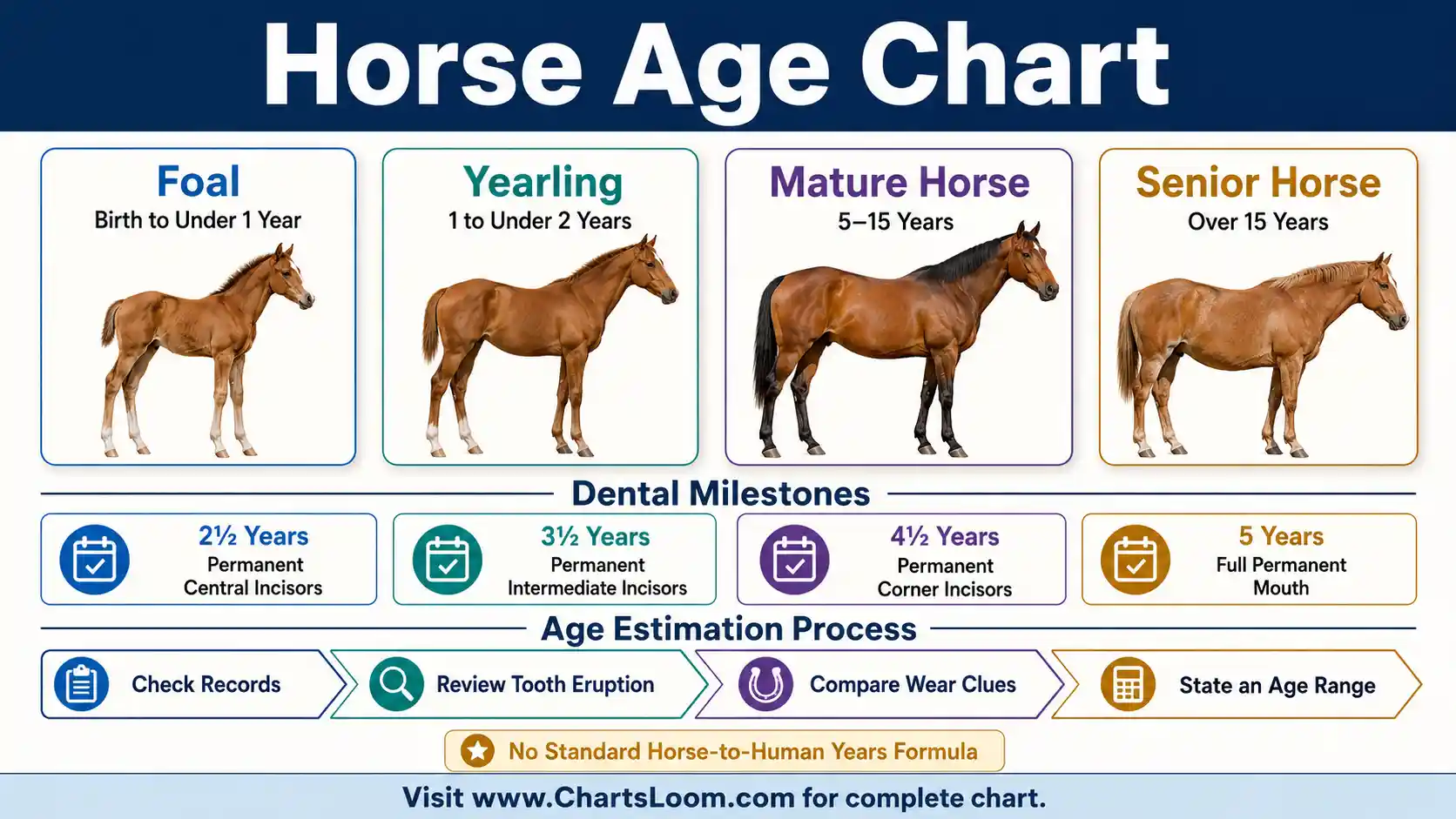
A horse under one year is a foal, one to under two is a yearling, and the AAEP guideline groups horses from five through fifteen as mature and those over fifteen as senior. These bands organize care; they do not prove maturity, fitness or retirement status.
Teeth are most useful before age five, when permanent central, intermediate and corner incisors replace temporary teeth at roughly 2½, 3½ and 4½ years. After the full permanent mouth, cups, dental stars, tooth angle, hooks and Galvayne’s groove become increasingly variable. Report a range rather than an exact birthday.
Young-horse terms
Foal · yearling · youngster
Use exact months through the first two years because development changes quickly.
Best dental window
About 2½–5 years
Permanent-incisor replacement gives stronger anchors than later wear patterns.
AAEP age bands
Mature 5–15 · senior >15
Functional condition can still differ greatly between horses of the same age.
Core limitation
No standard human-years formula
Use calendar age, records, teeth and condition rather than a fictional fixed ratio.
Questions at a glance
How old is a horse in human years?
There is no scientifically standardized horse-to-human-years conversion. Calendar age and life stage are more useful.
When is a horse a senior?
The AAEP guideline uses over 15 years as a senior band, while actual aging varies by health, work and individual condition.
What is a foal?
A foal is a horse under one year old, regardless of sex.
What is a yearling?
A yearling is one year old but has not yet reached its second birthday.
Can teeth show an exact birthday?
No. Eruption narrows young-horse age, while adult wear usually supports only a broad range.
When do permanent incisors appear?
Central, intermediate and corner permanent incisors erupt at roughly 2½, 3½ and 4½ years.
When does a horse have a full mouth?
All permanent teeth are usually present by about five years, subject to individual and dental variation.
What is Galvayne’s groove?
It is a variable groove on the upper corner incisor used as a supporting clue from about 10 to 30 years.
Is the seven-year hook reliable?
No. It may be absent, appear at another age or persist, so it should never be used alone.
Can gray hair estimate age?
No. Coat color and genetics make graying an unreliable age indicator.
Can senior horses still work?
Many can when sound, comfortable and conditioned. Workload should follow function, not age alone.
What is the strongest proof of age?
A verified birth or registry record linked to the correct horse is stronger than any physical estimate.
Horse Age and Life Stage Chart
A year-by-year lookup from birth through age 40. The 5–15 mature and over-15 senior bands follow AAEP wording; younger labels are practical educational terms rather than universal legal definitions.
Swipe horizontally inside the table to view every column.
| Horse age | Practical stage | Age band | How to interpret it |
|---|---|---|---|
| Birth | Foal | Birth to under 1 year | Rapid growth; age terminology and care change quickly within months |
| 1 year | Yearling | 1 to under 2 years | Still growing; use exact months when development or dentition matters |
| 2 years | Young horse | 2 to under 5 years | Growth, training and permanent-tooth replacement continue |
| 3 years | Young horse | 2 to under 5 years | Growth, training and permanent-tooth replacement continue |
| 4 years | Young horse | 2 to under 5 years | Growth, training and permanent-tooth replacement continue |
| 5 years | Mature horse — AAEP mature-horse band begins | 5–15 years | AAEP mature-horse band; workload and care still depend on the individual |
| 6 years | Mature horse | 5–15 years | AAEP mature-horse band; workload and care still depend on the individual |
| 7 years | Mature horse | 5–15 years | AAEP mature-horse band; workload and care still depend on the individual |
| 8 years | Mature horse | 5–15 years | AAEP mature-horse band; workload and care still depend on the individual |
| 9 years | Mature horse | 5–15 years | AAEP mature-horse band; workload and care still depend on the individual |
| 10 years | Mature horse | 5–15 years | AAEP mature-horse band; workload and care still depend on the individual |
| 11 years | Mature horse | 5–15 years | AAEP mature-horse band; workload and care still depend on the individual |
| 12 years | Mature horse | 5–15 years | AAEP mature-horse band; workload and care still depend on the individual |
| 13 years | Mature horse | 5–15 years | AAEP mature-horse band; workload and care still depend on the individual |
| 14 years | Mature horse | 5–15 years | AAEP mature-horse band; workload and care still depend on the individual |
| 15 years | Mature horse | 5–15 years | AAEP mature-horse band; workload and care still depend on the individual |
| 16 years | Senior horse — AAEP senior-horse band | Over 15 years | AAEP senior band; functional age may be younger or older than calendar age |
| 17 years | Senior horse | Over 15 years | AAEP senior band; functional age may be younger or older than calendar age |
| 18 years | Senior horse | Over 15 years | AAEP senior band; functional age may be younger or older than calendar age |
| 19 years | Senior horse | Over 15 years | AAEP senior band; functional age may be younger or older than calendar age |
| 20 years | Senior horse | Over 15 years | AAEP senior band; functional age may be younger or older than calendar age |
| 21 years | Senior horse | Over 15 years | AAEP senior band; functional age may be younger or older than calendar age |
| 22 years | Senior horse | Over 15 years | AAEP senior band; functional age may be younger or older than calendar age |
| 23 years | Senior horse | Over 15 years | AAEP senior band; functional age may be younger or older than calendar age |
| 24 years | Senior horse | Over 15 years | AAEP senior band; functional age may be younger or older than calendar age |
| 25 years | Senior horse | Over 15 years | AAEP senior band; functional age may be younger or older than calendar age |
| 26 years | Senior horse | Over 15 years | AAEP senior band; functional age may be younger or older than calendar age |
| 27 years | Senior horse | Over 15 years | AAEP senior band; functional age may be younger or older than calendar age |
| 28 years | Senior horse | Over 15 years | AAEP senior band; functional age may be younger or older than calendar age |
| 29 years | Senior horse | Over 15 years | AAEP senior band; functional age may be younger or older than calendar age |
| 30 years | Senior horse | Over 15 years | AAEP senior band; functional age may be younger or older than calendar age |
| 31 years | Senior horse | Over 15 years | AAEP senior band; functional age may be younger or older than calendar age |
| 32 years | Senior horse | Over 15 years | AAEP senior band; functional age may be younger or older than calendar age |
| 33 years | Senior horse | Over 15 years | AAEP senior band; functional age may be younger or older than calendar age |
| 34 years | Senior horse | Over 15 years | AAEP senior band; functional age may be younger or older than calendar age |
| 35 years | Senior horse | Over 15 years | AAEP senior band; functional age may be younger or older than calendar age |
| 36 years | Senior horse | Over 15 years | AAEP senior band; functional age may be younger or older than calendar age |
| 37 years | Senior horse | Over 15 years | AAEP senior band; functional age may be younger or older than calendar age |
| 38 years | Senior horse | Over 15 years | AAEP senior band; functional age may be younger or older than calendar age |
| 39 years | Senior horse | Over 15 years | AAEP senior band; functional age may be younger or older than calendar age |
| 40 years | Senior horse | Over 15 years | AAEP senior band; functional age may be younger or older than calendar age |
- • Calendar age is more reliable than appearance or teeth when a birth or registration record exists.
- • A horse can be medically or functionally “old” before or after the senior cutoff, so condition and performance matter.
- • The table does not determine readiness for training, breeding, competition or retirement.
Download or export
Interactive tool
Horse age and life-stage lookup
Enter a known calendar age. The lookup assigns a practical life stage, explains the expected dental context and highlights age-related care questions. It deliberately does not invent a horse-to-human-years number because no scientific standard exists.
For an eight-month-old foal, enter 0 years and 8 months. For a 15-year-old horse, enter 15 years and 0 months.
Lookup result
Life stage
Mature horse
Age term
Mature horse
Dental context: Adult wear, dental stars and a more acute incisor angle provide only a broad range.
Care focus: Maintain baseline records for weight, body condition, soundness, dentition, workload recovery and preventive care.
After the full permanent mouth, dental wear usually supports only a broad age range.
The result is a calendar-age lookup, not a diagnosis or an exact dental-age determination. Verified records outrank appearance-based estimates.
What it does
Converts years and months into a practical equine stage, age term, dental context and age-related care focus.
Why it helps
It keeps foal, yearling, young, mature and senior terminology consistent while showing why teeth become less precise with age.
What it cannot do
It cannot inspect teeth, verify identity, diagnose disease, set a workload, predict lifespan or replace an equine veterinarian.
Foal and Yearling Age by Month
Month-level terminology and practical context from birth through 24 months. Weaning and development vary, so the labels are broad planning guides.
Swipe horizontally inside the table to view every column.
| Calendar age | Common term | Age in years | Main planning focus |
|---|---|---|---|
| Birth | Newborn foal | 0.00 | Colostrum, bonding, standing, nursing and veterinary newborn assessment |
| 1 month | Suckling foal | 0.08 | Rapid growth, mare–foal management, handling and health monitoring |
| 2 months | Suckling foal | 0.17 | Rapid growth, mare–foal management, handling and health monitoring |
| 3 months | Suckling foal | 0.25 | Rapid growth, mare–foal management, handling and health monitoring |
| 4 months | Foal / common weaning window | 0.33 | Weaning timing varies; protect steady growth and minimize abrupt stress |
| 5 months | Foal / common weaning window | 0.42 | Weaning timing varies; protect steady growth and minimize abrupt stress |
| 6 months | Foal / common weaning window | 0.50 | Weaning timing varies; protect steady growth and minimize abrupt stress |
| 7 months | Weanling or older foal | 0.58 | Balanced growth, social development, hoof care and age-appropriate preventive care |
| 8 months | Weanling or older foal | 0.67 | Balanced growth, social development, hoof care and age-appropriate preventive care |
| 9 months | Weanling or older foal | 0.75 | Balanced growth, social development, hoof care and age-appropriate preventive care |
| 10 months | Weanling or older foal | 0.83 | Balanced growth, social development, hoof care and age-appropriate preventive care |
| 11 months | Weanling or older foal | 0.92 | Balanced growth, social development, hoof care and age-appropriate preventive care |
| 12 months | Yearling | 1.00 | Continued skeletal development; avoid using age alone to set workload |
| 13 months | Yearling | 1.08 | Continued skeletal development; avoid using age alone to set workload |
| 14 months | Yearling | 1.17 | Continued skeletal development; avoid using age alone to set workload |
| 15 months | Yearling | 1.25 | Continued skeletal development; avoid using age alone to set workload |
| 16 months | Yearling | 1.33 | Continued skeletal development; avoid using age alone to set workload |
| 17 months | Yearling | 1.42 | Continued skeletal development; avoid using age alone to set workload |
| 18 months | Yearling | 1.50 | Continued skeletal development; avoid using age alone to set workload |
| 19 months | Yearling | 1.58 | Continued skeletal development; avoid using age alone to set workload |
| 20 months | Yearling | 1.67 | Continued skeletal development; avoid using age alone to set workload |
| 21 months | Yearling | 1.75 | Continued skeletal development; avoid using age alone to set workload |
| 22 months | Yearling | 1.83 | Continued skeletal development; avoid using age alone to set workload |
| 23 months | Yearling | 1.92 | Continued skeletal development; avoid using age alone to set workload |
| 24 months | Two-year-old | 2.00 | Young horse; permanent central incisors may be changing around 2½ years |
- • Foal means a horse under one year; yearling means a horse from one year to under two years.
- • Weaning is a management event, not a fixed birthday. The exact timing should fit the mare, foal, nutrition and veterinary plan.
- • Growth should be evaluated with body condition, weight trend, hoof balance and veterinary guidance rather than age alone.
Download or export
Horse Age Terminology Chart
Common equine age, sex, relationship and work-status terms. Several familiar words do not identify a precise calendar age.
Swipe horizontally inside the table to view every column.
| Term | Applies to | Typical age or meaning | Important distinction |
|---|---|---|---|
| Foal | Any sex | Birth to under 1 year | Age term |
| Newborn | Any sex | First days of life | Very early-life term |
| Suckling foal | Any sex | Before weaning | Management term, not a fixed age |
| Weanling | Any sex | After weaning to about 1 year | Management term; timing varies |
| Yearling | Any sex | 1 to under 2 years | Age term |
| Two-year-old | Any sex | 2 to under 3 years | Age term |
| Youngster / young horse | Any sex | Usually under 5 years | Informal broad term |
| Mature horse | Any sex | 5–15 years in AAEP guideline | Guideline age band |
| Senior horse | Any sex | Over 15 years in AAEP guideline | Guideline age band |
| Geriatric horse | Any sex | No universal birthday | Clinical or management description |
| Colt | Male | Usually under 4 years | Sex-and-age term; usage varies |
| Filly | Female | Usually under 4 years | Sex-and-age term; usage varies |
| Stallion | Intact male | Mature male | Sex/reproductive term, not a health stage |
| Mare | Female | Mature female | Sex/reproductive term, not a health stage |
| Gelding | Castrated male | Any post-castration age | Sex status, not an age estimate |
| Dam | Female parent | Any age after producing offspring | Relationship term |
| Sire | Male parent | Any age after producing offspring | Relationship term |
| Broodmare | Breeding mare | Variable | Use and reproductive-status term |
| Pony | Any sex | Defined mainly by height/type | Not a young horse |
| Miniature horse | Any sex | Breed/type term | Not a foal or pony synonym |
| Aged horse | Any sex | Informal, variable | Do not use as an exact age |
| Retired horse | Any sex | Any age | Work-status term, not an age |
| Veteran horse | Any sex | Competition-dependent | Rules differ by organization |
| Unknown-age horse | Any sex | No reliable record | Use a range and confidence statement |
- • Colt and filly cutoffs vary by registry, sport and region; verify the governing rules when the term has legal or competition significance.
- • Pony describes type or height, not youth. A pony can be a senior adult.
- • Geriatric, aged, veteran and retired are contextual descriptions rather than exact birthdays.
Download or export
Dental age estimation
Eruption is stronger evidence than adult wear
Young-horse teeth change in a recognizable sequence. Once all permanent teeth are present, diet, bite alignment, grazing, missing teeth and dental treatment create wider variation. Experienced examiners combine several clues and state uncertainty.
Horse Tooth Eruption and Replacement Chart
A practical sequence for temporary and permanent teeth. Eruption is most useful in young horses and should be interpreted by an experienced examiner.
Swipe horizontally inside the table to view every column.
| Tooth or milestone | Approximate timing | Why it helps | Limitation |
|---|---|---|---|
| Deciduous central incisors (Di1) | 0–1 week | Lower incisors are commonly used for aging | Eruption timing is approximate |
| Deciduous intermediate incisors (Di2) | 4–6 weeks | Adds the middle pair | Individual timing varies |
| Deciduous corner incisors (Di3) | 6–9 months | Completes the temporary incisor set | Late or irregular eruption needs professional interpretation |
| First permanent molars | About 1 year | Grinding teeth behind deciduous premolars | Not safely assessed without proper examination |
| Second permanent molars | About 2 years | Additional grinding teeth | Cheek teeth require a trained oral exam |
| Permanent central incisors (I1) | About 2½ years — Permanent central-incisor anchor | Replace temporary centrals | Strongest young-horse dental anchor |
| Permanent first premolars | About 2½ years | Replace deciduous premolars | Caps may be present during replacement |
| Permanent second premolars | About 3 years | Replace deciduous premolars | Timing can differ by months |
| Permanent intermediate incisors (I2) | About 3½ years — Permanent intermediate-incisor anchor | Replace temporary intermediates | Useful young-horse anchor |
| Permanent third premolars | About 4 years | Complete most cheek-tooth replacement | Professional examination recommended |
| Third permanent molars | About 3½–4 years | Final molar pair | Timing overlaps other dental changes |
| Permanent corner incisors (I3) | About 4½ years — Permanent corner-incisor anchor | Replace temporary corners | Full permanent incisor mouth follows |
| Canine teeth | About 4–5 years | More common and prominent in males | Presence and size vary |
| Wolf teeth | Often about 5–6 months | Small first premolars; may be absent | Presence does not identify exact age |
| Full permanent mouth | Usually by about 5 years | All permanent teeth generally present | Missing or retained teeth can alter the picture |
- • Dental eruption provides the narrowest age ranges before the full permanent mouth is complete.
- • Do not force a horse’s mouth open or place fingers between the teeth. A veterinarian or trained equine dental professional should perform a complete examination.
- • Breed, nutrition, retained caps, missing teeth and individual variation can shift the expected timing.
Download or export
Horse Incisor Replacement and Wear Timeline
Key incisor changes from the temporary mouth through older-horse wear. Confidence falls after the permanent mouth is complete.
Swipe horizontally inside the table to view every column.
| Approximate age | Expected incisor change | Relative usefulness | Interpretation rule |
|---|---|---|---|
| 2 years | Temporary incisors still predominate | Moderate | Use several teeth and clues together; never assign an exact birthday from one feature |
| 2½ years | Permanent central incisors erupt | High | Use several teeth and clues together; never assign an exact birthday from one feature |
| 3 years | Permanent centrals in wear | High | Use several teeth and clues together; never assign an exact birthday from one feature |
| 3½ years | Permanent intermediate incisors erupt | High | Use several teeth and clues together; never assign an exact birthday from one feature |
| 4 years | Permanent intermediates in wear | High | Use several teeth and clues together; never assign an exact birthday from one feature |
| 4½ years | Permanent corner incisors erupt | High | Use several teeth and clues together; never assign an exact birthday from one feature |
| 5 years | Permanent corners in wear; full mouth | High | Use several teeth and clues together; never assign an exact birthday from one feature |
| 5½ years | Full permanent mouth; wear begins to dominate | Moderate | Use several teeth and clues together; never assign an exact birthday from one feature |
| 6 years | Lower central cups commonly disappearing | Moderate | Use several teeth and clues together; never assign an exact birthday from one feature |
| 7 years | Lower intermediate cups commonly disappearing; hook may appear | Moderate | Use several teeth and clues together; never assign an exact birthday from one feature |
| 8 years | Lower corner cups commonly disappearing | Moderate | Use several teeth and clues together; never assign an exact birthday from one feature |
| 9 years | Upper central cups commonly disappearing | Moderate | Use several teeth and clues together; never assign an exact birthday from one feature |
| 10 years | Upper intermediate cups commonly disappearing; Galvayne groove may begin | Low to moderate | Use several teeth and clues together; never assign an exact birthday from one feature |
| 11 years | Upper corner cups commonly disappearing; hook may reappear | Low | Use several teeth and clues together; never assign an exact birthday from one feature |
| 12 years | Dental stars and shape become more important | Low | Use several teeth and clues together; never assign an exact birthday from one feature |
| 15 years | Galvayne groove may reach halfway down corner incisor | Low | Use several teeth and clues together; never assign an exact birthday from one feature |
| 20 years | Galvayne groove may extend the tooth length | Low | Use several teeth and clues together; never assign an exact birthday from one feature |
| 25+ years | Groove and wear clues become increasingly variable | Low | Use several teeth and clues together; never assign an exact birthday from one feature |
- • Permanent central, intermediate and corner incisors erupt at roughly 2½, 3½ and 4½ years.
- • Cup disappearance, hooks and groove timing vary with diet, grazing, tooth alignment and individual wear.
- • After about five years, report a broad range rather than false precision.
Download or export
Dental Wear Clues by Horse Age
Year-by-year dental context from age five through 34. The rows describe expected tendencies, not a guaranteed appearance.
Swipe horizontally inside the table to view every column.
| Calendar age | Typical dental context | Confidence | Main source of uncertainty |
|---|---|---|---|
| 5 years | Lower-incisor cups progressively disappear; dental stars become more visible | Moderate | Diet and dental history can shift the appearance by several years |
| 6 years | Lower-incisor cups progressively disappear; dental stars become more visible | Moderate | Diet and dental history can shift the appearance by several years |
| 7 years | Lower-incisor cups progressively disappear; dental stars become more visible | Moderate | Diet and dental history can shift the appearance by several years |
| 8 years | Lower-incisor cups progressively disappear; dental stars become more visible | Moderate | Diet and dental history can shift the appearance by several years |
| 9 years | Upper-incisor cups progressively disappear; tooth profile begins to lengthen | Low to moderate | Diet and dental history can shift the appearance by several years |
| 10 years | Upper-incisor cups progressively disappear; tooth profile begins to lengthen | Low to moderate | Diet and dental history can shift the appearance by several years |
| 11 years | Upper-incisor cups progressively disappear; tooth profile begins to lengthen | Low to moderate | Diet and dental history can shift the appearance by several years |
| 12 years | Dental stars, changing surface shape and more acute incisor angle contribute | Low to moderate | Diet and dental history can shift the appearance by several years |
| 13 years | Dental stars, changing surface shape and more acute incisor angle contribute | Low | Diet and dental history can shift the appearance by several years |
| 14 years | Dental stars, changing surface shape and more acute incisor angle contribute | Low | Diet and dental history can shift the appearance by several years |
| 15 years | Longer, more angled incisors; Galvayne groove may progress downward | Low | Diet and dental history can shift the appearance by several years |
| 16 years | Longer, more angled incisors; Galvayne groove may progress downward | Low | Diet and dental history can shift the appearance by several years |
| 17 years | Longer, more angled incisors; Galvayne groove may progress downward | Low | Diet and dental history can shift the appearance by several years |
| 18 years | Longer, more angled incisors; Galvayne groove may progress downward | Low | Diet and dental history can shift the appearance by several years |
| 19 years | Longer, more angled incisors; Galvayne groove may progress downward | Low | Diet and dental history can shift the appearance by several years |
| 20 years | Advanced wear, full-length groove around 20, and greater individual variation | Low | Diet and dental history can shift the appearance by several years |
| 21 years | Advanced wear, full-length groove around 20, and greater individual variation | Low | Diet and dental history can shift the appearance by several years |
| 22 years | Advanced wear, full-length groove around 20, and greater individual variation | Low | Diet and dental history can shift the appearance by several years |
| 23 years | Advanced wear, full-length groove around 20, and greater individual variation | Low | Diet and dental history can shift the appearance by several years |
| 24 years | Advanced wear, full-length groove around 20, and greater individual variation | Low | Diet and dental history can shift the appearance by several years |
| 25 years | Groove may disappear from the upper half; tooth loss and abnormal wear become more influential | Low | Diet and dental history can shift the appearance by several years |
| 26 years | Groove may disappear from the upper half; tooth loss and abnormal wear become more influential | Low | Diet and dental history can shift the appearance by several years |
| 27 years | Groove may disappear from the upper half; tooth loss and abnormal wear become more influential | Low | Diet and dental history can shift the appearance by several years |
| 28 years | Groove may disappear from the upper half; tooth loss and abnormal wear become more influential | Low | Diet and dental history can shift the appearance by several years |
| 29 years | Groove may disappear from the upper half; tooth loss and abnormal wear become more influential | Low | Diet and dental history can shift the appearance by several years |
| 30 years | Groove may be absent; worn, missing or diseased teeth make age estimates broad | Low | Diet and dental history can shift the appearance by several years |
| 31 years | Groove may be absent; worn, missing or diseased teeth make age estimates broad | Low | Diet and dental history can shift the appearance by several years |
| 32 years | Groove may be absent; worn, missing or diseased teeth make age estimates broad | Low | Diet and dental history can shift the appearance by several years |
| 33 years | Groove may be absent; worn, missing or diseased teeth make age estimates broad | Low | Diet and dental history can shift the appearance by several years |
| 34 years | Groove may be absent; worn, missing or diseased teeth make age estimates broad | Low | Diet and dental history can shift the appearance by several years |
- • Dental wear is a range-based estimate, not a calendar.
- • Abnormal bite, cribbing, sandy forage, processed feed, missing teeth and dental treatment can change wear patterns.
- • A record-based age should not be replaced by a conflicting tooth estimate without strong evidence.
Download or export
Galvayne’s Groove Age Chart
A year-by-year interpretation of the classic upper-corner-incisor groove from ages 10 to 30, anchored at the commonly taught 10, 15, 20, 25 and 30-year points.
Swipe horizontally inside the table to view every column.
| Approximate age | Expected groove appearance | Where to look | Reliability warning |
|---|---|---|---|
| 10 years | May first appear at the gum line — 10-year anchor | Upper corner incisor | Subtle and variable; never use alone |
| 11 years | Often extends gradually down the upper portion | Upper corner incisor | Subtle and variable; never use alone |
| 12 years | Often extends gradually down the upper portion | Upper corner incisor | Subtle and variable; never use alone |
| 13 years | Often extends gradually down the upper portion | Upper corner incisor | Subtle and variable; never use alone |
| 14 years | Often extends gradually down the upper portion | Upper corner incisor | Subtle and variable; never use alone |
| 15 years | Approximately halfway down the tooth — 15-year anchor | Upper corner incisor | Subtle and variable; never use alone |
| 16 years | May progress from halfway toward the wearing surface | Upper corner incisor | Subtle and variable; never use alone |
| 17 years | May progress from halfway toward the wearing surface | Upper corner incisor | Subtle and variable; never use alone |
| 18 years | May progress from halfway toward the wearing surface | Upper corner incisor | Subtle and variable; never use alone |
| 19 years | May progress from halfway toward the wearing surface | Upper corner incisor | Subtle and variable; never use alone |
| 20 years | May extend the full visible length — 20-year anchor | Upper corner incisor | Subtle and variable; never use alone |
| 21 years | Upper portion may begin to disappear | Upper corner incisor | Subtle and variable; never use alone |
| 22 years | Upper portion may begin to disappear | Upper corner incisor | Subtle and variable; never use alone |
| 23 years | Upper portion may begin to disappear | Upper corner incisor | Subtle and variable; never use alone |
| 24 years | Upper portion may begin to disappear | Upper corner incisor | Subtle and variable; never use alone |
| 25 years | Often absent from upper half and present on lower half — 25-year anchor | Upper corner incisor | Subtle and variable; never use alone |
| 26 years | Remaining lower portion may shorten | Upper corner incisor | Subtle and variable; never use alone |
| 27 years | Remaining lower portion may shorten | Upper corner incisor | Subtle and variable; never use alone |
| 28 years | Remaining lower portion may shorten | Upper corner incisor | Subtle and variable; never use alone |
| 29 years | Remaining lower portion may shorten | Upper corner incisor | Subtle and variable; never use alone |
| 30 years | May be completely absent — 30-year anchor | Upper corner incisor | Subtle and variable; never use alone |
- • At about 10 years the groove may appear at the gum line; around 15 it may be halfway down; around 20 it may span the tooth.
- • Around 25 the upper half may be gone, and around 30 the groove may no longer be visible.
- • The groove is a supporting clue only. Visibility, timing and shape vary markedly.
Download or export
Horse Age Evidence and Reliability Chart
A ranking of records and physical clues. Documentary evidence usually outranks appearance, while dental clues are strongest in young horses.
Swipe horizontally inside the table to view every column.
| Evidence | Best age range | Relative reliability | How to use it |
|---|---|---|---|
| Birth or registry record | All ages | High | Verify identity and continuity of record |
| Microchip matched to record | All ages | High | Chip confirms identity, not the truth of every historical entry |
| Breeder or foaling record | Young horse | High | Strong when contemporaneous and identity is clear |
| Permanent-incisor eruption | 2½–5 years | High to moderate | Best dental window; allow several months of variation |
| Temporary-incisor eruption | Birth–9 months | Moderate | Useful but timing can vary |
| Full permanent mouth | Around 5 years | Moderate | Confirms broad maturity, not an exact birthday |
| Cup disappearance | 6–11 years | Moderate to low | Diet and wear can alter timing |
| Dental stars | About 8+ years | Low to moderate | Combine with shape and angle |
| Incisor surface shape | Adult and senior | Low | Requires experience and comparison of several teeth |
| Incisor angle | Older horse | Low | Conformation and wear alter the profile |
| Tooth length visible | Older horse | Low | Gum recession and eruption vary |
| Galvayne’s groove | About 10–30 years | Low | Subtle, inconsistent and variable |
| 7-year hook | Around 7 years | Low | May be absent or appear at other ages |
| 11-year hook | Around 11 years | Low | May persist or fail to appear |
| Coat graying | Adult and senior | Very low | Strongly affected by color and genetics |
| Muscle loss | Any age | Very low | Can reflect nutrition, pain, work or disease |
| Sunken eyes | Senior | Very low | Not specific and may reflect condition |
| Behavior or calmness | Any age | Very low | Training and temperament dominate |
| Performance history | Adult | Context only | Can narrow minimum age but not exact age |
| Owner recollection | Any age | Variable | Document uncertainty and corroborate where possible |
- • Use the highest-quality evidence available and document the confidence level.
- • When evidence conflicts, verify identity and seek a veterinarian’s examination rather than averaging incompatible estimates.
- • A responsible conclusion may be a broad range such as “approximately 15–20 years.”
Download or export
Age-aware care
Use age to ask better questions, not to make automatic decisions
Growth, training, feeding, work and retirement decisions require the horse’s body condition, teeth, soundness, fitness, history and environment. A healthy senior may remain active, while a younger horse may need major limitations.
Horse Growth and Development by Age
Major age-linked developmental and dental milestones from birth through advanced senior years.
Swipe horizontally inside the table to view every column.
| Age | Developmental context | Expected milestone | Practical focus |
|---|---|---|---|
| Birth–24 hours | Neonatal foal | Standing, nursing and maternal bonding | Immediate veterinary attention for delayed nursing, weakness or abnormal behavior |
| 1–4 weeks | Early foal | Rapid growth and social learning | Monitor mare milk, growth and limb alignment |
| 1–3 months | Suckling foal | Increasing movement and forage exploration | Avoid rapid weight gain and abrupt diet changes |
| 3–6 months | Older foal | High growth demand and common weaning period | Plan nutrition and stress reduction |
| 6–11 months | Weanling | Independent feeding and herd learning | Steady growth, hoof balance and preventive care |
| 12–17 months | Yearling | Continued skeletal and muscular development | Do not equate size with maturity |
| 18–23 months | Yearling | More adult-like body but still developing | Use progressive, low-stress handling |
| 2 years | Young horse | Permanent central incisors changing | Workload suitability is individual |
| 2½ years | Young horse | Permanent central incisors erupt | Dental anchor, not a training license |
| 3 years | Young horse | Central incisors in wear | Continue gradual conditioning |
| 3½ years | Young horse | Permanent intermediate incisors erupt | Growth and balance still developing |
| 4 years | Young horse | Most cheek-tooth replacement nearing completion | Monitor caps and oral comfort |
| 4½ years | Young horse | Permanent corner incisors erupt | Approaching full permanent mouth |
| 5 years | Mature band begins | Full permanent mouth usually present | Establish adult baseline records |
| 6–10 years | Mature horse | Prime adult function for many horses | Match work to soundness, fitness and discipline |
| 11–15 years | Mature horse | Adult wear and individual aging differences grow | Watch recovery, body condition and dental needs |
| Over 15 years | Senior horse | Age-related risk rises but ability varies | Shift toward proactive monitoring |
| 20s | Senior horse | Many remain active with suitable care | Prioritize teeth, weight, comfort and recovery |
| 30s | Advanced senior | Some horses live into their 30s | Use quality of life and function, not age alone |
| Unknown age | Any stage | Build an evidence-based range | Record uncertainty and update with new evidence |
- • Developmental timing varies with breed, mature size, nutrition, health and management.
- • A large body size does not prove skeletal, dental or behavioral maturity.
- • Training, breeding and competition decisions require discipline-specific professional guidance.
Download or export
Horse Care Priorities by Age
Age-guided questions for growth, dentition, workload, preventive care and senior monitoring. The horse’s condition and history remain more important than the label alone.
Swipe horizontally inside the table to view every column.
| Stage | Care domain | Planning priority | Important caution |
|---|---|---|---|
| Foal | Growth trend | Track steady gain and limb development | Rapid or uneven growth deserves review |
| Foal | Nursing and feeding | Confirm adequate intake and normal manure | Weakness or failure to nurse is urgent |
| Foal | Hooves and limbs | Regular skilled assessment | Early imbalances can change quickly |
| Weanling | Stress and social care | Plan gradual, safe weaning | Avoid abrupt isolation where possible |
| Weanling | Nutrition | Balance energy, protein and minerals | More feed is not automatically better growth |
| Yearling | Body condition | Keep a moderate condition | Excess fat can hide growth problems |
| Yearling | Handling | Short, consistent, low-stress sessions | Avoid fatigue and force |
| Young horse | Dentition | Watch tooth replacement and retained caps | Oral discomfort can affect eating or behavior |
| Young horse | Workload | Build gradually | Calendar age alone cannot certify readiness |
| Mature horse | Baseline records | Track weight, condition, soundness and teeth | Trends are more useful than one observation |
| Mature horse | Dental care | Schedule regular oral examination | Frequency depends on findings and history |
| Mature horse | Fitness | Match conditioning to actual work | Allow recovery after changes |
| Mature horse | Preventive care | Individualize vaccines and parasite plan | Use local veterinary guidance |
| Senior horse | Examinations | Consider annual or semiannual review | UMN recommends proactive planning |
| Senior horse | Weight and muscle | Monitor topline and body condition | Loss can be an early health clue |
| Senior horse | Dental function | At least yearly dental checks | Chewing difficulty changes diet options |
| Senior horse | Mobility | Watch stiffness and range of motion | Light work may help selected horses |
| Senior horse | Endocrine signs | Watch coat, laminitis and body-shape change | Discuss testing with a veterinarian |
| Senior horse | Immune risk | Continue preventive care after retirement | Retirement does not end health needs |
| Any age | Sudden change | Investigate appetite, weight, behavior or performance change | Do not label a new problem “just age” |
- • This chart organizes discussion; it is not a treatment or vaccination schedule.
- • Sudden weight loss, pain, colic, difficulty chewing, lameness, neurologic change or breathing trouble requires professional assessment.
- • Retired horses still need dental, hoof, nutrition and preventive care.
Download or export
Senior Horse Monitoring Chart
Common age-related changes and the observations that should trigger a management review or veterinary discussion.
Swipe horizontally inside the table to view every column.
| Body system or domain | What to watch | Next step |
|---|---|---|
| Teeth | Dropping feed, quidding, long fibers in manure | Dental examination and diet review |
| Weight | Unplanned loss | Measure trend and investigate promptly |
| Body condition | Ribs, fat deposits or changing score | Record consistently with the same method |
| Topline | Muscle loss over back and hindquarters | Review pain, nutrition, endocrine and workload factors |
| Appetite | Slower or reduced eating | Check teeth, pain and illness |
| Manure | Loose manure or altered output | Review diet, teeth, hydration and disease |
| Colic risk | Pain, rolling, reduced manure | Emergency veterinary assessment |
| Joints | Stiffness or reduced range | Discuss exercise, footing and pain plan |
| Hooves | Change in growth, shape or comfort | Maintain regular farrier care |
| Laminitis | Heat, pulse, reluctance to move | Urgent veterinary and farrier involvement |
| Coordination | Tripping or reduced agility | Stop unsafe work and seek examination |
| Vision | Bumping, hesitation or eye change | Eye problems can be urgent |
| Hearing | Reduced response | Change handling cues and rule out other causes |
| Respiration | Cough, effort or reduced tolerance | Assess environment and respiratory disease |
| Immune function | More frequent infection | Continue preventive care and investigate |
| Endocrine health | Long coat, abnormal shedding, laminitis | Discuss PPID evaluation |
| Hydration | Reduced intake or impaction risk | Provide accessible clean water and monitor |
| Temperature control | Heat or cold intolerance | Adjust shelter, clipping, blankets and work |
| Saddle fit | Sores or changed back shape | Reassess fit as muscle changes |
| Exercise recovery | Longer recovery after work | Reduce intensity and build gradually |
| Reproduction | Reduced fertility | Age affects mares and stallions differently |
| Social access | Being displaced from feed or shelter | Provide protected access and companionship |
| Skin and tumors | New or changing lumps | Record size and seek veterinary review |
| Quality of life | Persistent pain or loss of normal function | Use objective, repeated welfare assessment |
- • Many horses remain active in their 20s and some into their 30s, but care should adapt to changing function.
- • UMN recommends annual or semiannual physical examinations for senior horses, including dental, body condition and soundness checks.
- • A new symptom should not be assumed to be inevitable aging.
Download or export
Horse Feeding Considerations by Age
How age, teeth, workload and body condition change feeding questions without creating one universal ration.
Swipe horizontally inside the table to view every column.
| Horse or stage | Feeding approach | What to monitor | Key caution |
|---|---|---|---|
| Foal | Milk and gradual forage exploration | Mare and foal plan | Growth rate and nursing adequacy matter |
| Weanling | Balanced growth ration | Moderate, steady growth | Avoid abrupt diet and social changes |
| Yearling | Forage-centered balanced diet | Body condition and development | Do not overfeed for maximum growth |
| Young horse | Forage plus needs-based concentrate | Growth and workload | Weigh feed and adjust gradually |
| Mature easy keeper | Forage-first ration | Prevent excess body condition | Use weight and condition trend |
| Mature hard keeper | Higher-energy plan if needed | Investigate cause first | Dental and disease checks come before simply adding feed |
| Working adult | Energy matched to work | Condition and recovery | Increase changes gradually |
| Retired adult | Maintenance needs may fall | Do not assume retirement means senior feed | Use actual condition |
| Senior with good teeth | Quality forage and balanced ration | Monitor weight and chewing | Age alone does not require a special product |
| Senior with worn teeth | Easy-to-chew complete feed may help | Follow product instructions by weight | Introduce gradually and provide water |
| Senior losing weight | Investigate teeth and health | Use a measured feeding plan | Weight loss is not “normal aging” |
| Senior with poor hay chewing | Soaked or processed forage replacement | Prevent choke and maintain fiber | Veterinary and nutrition guidance needed |
| Senior with PPID risk | Control nonstructural carbohydrate when indicated | Base on diagnosis and individual plan | Do not self-diagnose from age |
| Senior with arthritis | Maintain suitable body condition | Excess and inadequate weight both matter | Coordinate diet and comfort plan |
| Horse with missing teeth | Alternative fiber source | Monitor manure and chewing | Long-stem forage may be unsafe or ineffective |
| Any age changing feed | Transition gradually | Observe manure and appetite | Rapid change raises digestive risk |
| Any age | Clean water | Continuous access | Older horses may need extra monitoring |
| Any age | Salt and mineral balance | Match forage and ration | Avoid unneeded supplement stacking |
| Any age | Feed by weight | Use a scale | Volume measures differ between feeds |
| Any age | Separate feeding if bullied | Ensure actual intake | Group access can hide underfeeding |
- • This chart does not formulate a ration. Forage analysis, body weight, workload and health status can change requirements.
- • Older horses with worn or missing teeth may need a complete feed or alternative fiber source under professional guidance.
- • Measure feed by weight and make changes gradually.
Download or export
Horse Exercise and Workload by Age
Age-aware exercise questions from foalhood through advanced senior years. Suitability depends on maturity, soundness, fitness, discipline and veterinary findings.
Swipe horizontally inside the table to view every column.
| Age or condition | General approach | Monitor | Do not assume |
|---|---|---|---|
| Newborn foal | Natural movement with mare | Normal mobility and fatigue | Do not force exercise |
| Young foal | Safe turnout and play | Limb alignment and injury | Environment must be secure |
| Weanling | Free movement and brief handling | Stress and growth | Avoid repetitive forced work |
| Yearling | Progressive groundwork | Attention and comfort | Short sessions; no age-only guarantees |
| Two-year-old | Discipline-specific preparation | Balance, maturity and soundness | Professional assessment required |
| Three-year-old | Gradual conditioning | Recovery and soreness | Increase one variable at a time |
| Four-year-old | Developing workload | Fitness and dental comfort | Still a young horse |
| Five-year-old | Mature age band begins | Baseline soundness and fitness | Maturity does not equal universal suitability |
| 6–10 years | Adult conditioning | Performance trend and recovery | Match work to discipline |
| 11–15 years | Adult maintenance | Longer warm-up or recovery may help | Individual variation increases |
| 16–19 years | Senior conditioning | Comfort, footing and recovery | Senior does not automatically mean retired |
| 20–24 years | Selected light to moderate work | Soundness and enjoyment | Adapt intensity and duration |
| 25–29 years | Individualized activity | Mobility and fatigue | Prioritize comfort and safety |
| 30+ years | Gentle voluntary movement | Quality of life | Avoid forced exertion |
| Arthritic horse | Low-impact movement if advised | Stiffness before and after | Pain plan must be individualized |
| Horse returning from rest | Reconditioning plan | Heart rate, soreness and legs | Age does not replace fitness assessment |
| Horse with muscle loss | Review health and nutrition first | Topline and gait | Do not train through unexplained loss |
| Horse with neurologic signs | Stop ridden work | Coordination and safety | Urgent veterinary assessment |
| Horse with heat intolerance | Reduce heat load | Respiration and recovery | Older and unfit horses may be vulnerable |
| Any age | Warm up and cool down | Comfort and recovery | Adjust to weather, footing and workload |
- • The table is not a training prescription and does not set a universal backing, racing, jumping or competition age.
- • Build workload gradually and stop for pain, lameness, abnormal breathing, weakness or neurologic signs.
- • A fit senior may outperform a deconditioned younger horse; functional age matters.
Download or export
Horse Age Record and Verification Checklist
A step-by-step evidence checklist for known-age and unknown-age horses.
Swipe horizontally inside the table to view every column.
| Record or clue | What it can establish | Verification step | Limitation |
|---|---|---|---|
| Registered name | Exact identity | Match papers, markings and chip | Do not rely on barn name alone |
| Date of birth | Exact calendar age | Prefer contemporaneous record | Verify identity continuity |
| Microchip | Identity link | Scan and compare with database | Chip does not itself encode age |
| Freeze brand | Identity or registry clue | Decode through issuing body | Brand systems differ |
| Lip tattoo | Racing identity clue | Use official lookup | May fade with age |
| Breeder record | Foaling evidence | Confirm mare, date and foal identity | Later recollection is weaker |
| Veterinary record | Minimum documented age | Trace earliest dated visit | Record may start after birth |
| Dental chart | Age-range evidence | Compare serial examinations | One exam is less useful than a trend |
| Photograph with date | Minimum age/context | Confirm the same horse | Appearance alone is weak |
| Competition record | Minimum age and history | Use official database | Rules and identities vary |
| Sale contract | Historical claim | Corroborate with other evidence | Not automatically accurate |
| Passport | Identity and declared age | Verify issuing organization | Quality differs by jurisdiction |
| Coggins/test record | Dated identity evidence | Use markings and identifiers | Usually not proof of birth date |
| Owner statement | Context | Record source and confidence | Memory can be wrong |
| Stable history | Minimum timeline | Look for dated events | Do not convert anecdotes into exact age |
| Permanent central incisors | Around 2½ years | Support young-horse range | Allow timing variation |
| Permanent intermediate incisors | Around 3½ years | Support young-horse range | Allow timing variation |
| Permanent corner incisors | Around 4½ years | Support young-horse range | Allow timing variation |
| Wear pattern | Adult age range | Use experienced examiner | Report broad range |
| Final report | Combined evidence | State range, method and confidence | Avoid false precision |
- • Start with identity. An accurate date attached to the wrong horse is not useful.
- • Preserve the original source, not only a rewritten age in a new record.
- • For unknown-age horses, document a range and confidence level.
Download or export
Worked Horse Age Examples
Examples showing how calendar age, terminology, dental milestones and confidence should be combined.
Swipe horizontally inside the table to view every column.
| Input or observation | Resulting stage | Dental context | Best interpretation |
|---|---|---|---|
| 0 years, 2 months | Foal | Temporary central and intermediate incisors may be erupting | Use exact months; no human-year conversion |
| 0 years, 8 months | Foal / weanling | Temporary corner incisors may be present | Weaning status is management-dependent |
| 1 year, 0 months | Yearling | First molars already present | Still growing rapidly |
| 1 year, 10 months | Yearling | Young mouth before central replacement | Do not round to two when month precision matters |
| 2 years, 0 months | Young horse | Temporary incisors still expected | Permanent central change approaches |
| 2 years, 6 months | Young horse | Permanent central incisors erupt | Useful dental anchor |
| 3 years, 0 months | Young horse | Permanent centrals in wear | Age estimate can still be relatively narrow |
| 3 years, 6 months | Young horse | Permanent intermediates erupt | Useful dental anchor |
| 4 years, 0 months | Young horse | Most premolar replacement nearing completion | Watch for retained caps |
| 4 years, 6 months | Young horse | Permanent corner incisors erupt | Approaching full mouth |
| 5 years, 0 months | Mature horse | Full permanent mouth usually present | AAEP mature band begins |
| 6 years, 0 months | Mature horse | Lower central cups may disappear | Wear is less exact than eruption |
| 7 years, 0 months | Mature horse | Lower intermediate cups may disappear; hook may occur | Hook is unreliable alone |
| 8 years, 0 months | Mature horse | Lower corner cups may disappear | Combine several clues |
| 10 years, 0 months | Mature horse | Galvayne groove may begin | Broad range only |
| 12 years, 0 months | Mature horse | Dental stars and angle contribute | Records outrank teeth |
| 15 years, 0 months | Mature horse | Groove may be halfway down | AAEP senior band is over 15, not exactly 15 |
| 15 years, 1 month | Senior horse | Same dental context as 15 years | Crosses the guideline’s over-15 boundary |
| 18 years, 0 months | Senior horse | Longer, angled incisors; groove progressing | Functional age varies |
| 20 years, 0 months | Senior horse | Groove may span visible tooth | Monitor teeth and weight |
| 25 years, 0 months | Senior horse | Upper groove may be gone | Dental age estimate is broad |
| 30 years, 0 months | Senior horse | Groove may be absent; advanced wear | Do not infer poor quality of life from age alone |
| Unknown, full permanent mouth | At least broad adult range | Could be about five or older | Wear and records needed |
| Unknown, permanent centrals only | Likely around 2½–3½ years | Young-horse estimate | Confirm other incisors |
| Conflicting passport and teeth | Use verified identity and record | Teeth provide a check, not an automatic override | Seek veterinary assessment |
- • Examples are educational and do not identify an individual horse’s age without examination and records.
- • The calculator uses the same stage boundaries and dental milestone rules shown here.
- • When age is unknown, a range with confidence is more honest than a single number.
Download or export
Practical limitations
What this chart and lookup cannot establish
Exact unknown birthday
Adult dental wear cannot reliably distinguish every adjacent year.
Human-age equivalence
No accepted scientific ratio converts horse years into human years.
Training readiness
Age cannot replace skeletal, soundness, behavior and discipline assessment.
Health diagnosis
Weight loss, pain, dental disease and endocrine changes need examination.
Lifespan prediction
Calendar age does not forecast how long one horse will live.
Quality-of-life verdict
Welfare depends on comfort and function, not a birthday alone.
Frequently asked questions
How old is a horse in human years?
There is no scientifically standardized horse-to-human-year conversion. Use calendar age, life stage, dental findings and functional condition instead.
When is a horse considered a senior?
The AAEP parasite guideline uses over 15 years as a senior band, but individual horses can age faster or slower functionally.
What is a foal?
A foal is a horse under one year of age, regardless of sex.
What is a yearling?
A yearling is a horse from one year to under two years of age.
Is a pony a young horse?
No. Pony describes type or height, not age. A pony can be a foal, adult or senior.
Can teeth reveal a horse’s exact age?
Usually not. Tooth eruption can narrow age in young horses, while adult wear provides only an approximate range.
When do permanent horse incisors erupt?
Central, intermediate and corner permanent incisors erupt at roughly 2½, 3½ and 4½ years.
When does a horse have a full mouth?
All permanent teeth are usually present by about five years, although individual variation and dental problems can alter the pattern.
What is Galvayne’s groove?
It is a groove on the upper corner incisor that may support broad age estimates from about 10 to 30 years, but it is variable and should not be used alone.
What does long in the tooth mean?
Older horses often show more visible, angled incisor crown as teeth continue to erupt and wear, but the phrase is not an exact age test.
Can coat color or gray hairs estimate age?
No. Genetics, color and individual variation make coat graying an unreliable age clue.
Can a senior horse still be ridden?
Many can, when sound, comfortable and appropriately conditioned. Workload should follow functional assessment rather than age alone.
How often should a senior horse have dental checks?
University of Minnesota Extension advises at least yearly dental checks, with the veterinarian setting the interval for the individual horse.
Can a horse live into its 30s?
Yes. University of Minnesota Extension notes that many horses live into their 20s or 30s with good care.
What is the best proof of horse age?
A verified birth or registry record linked to the correct horse is stronger than any appearance-based estimate.
Sources
External URLs are displayed as plain text. Table source labels link only to these entries.
American Association of Equine Practitioners — Internal Parasite Control Guidelines
Provides practical equine age-group language used in the page, including mature horses from 5–15 years, seniors over 15 years, and separate recommendations for foals, weanlings, yearlings and youngsters.
https://aaep.org/wp-content/uploads/2024/05/Internal-Parasite-Guidelines_Updated.pdf
Utah State University Extension — Aging Horses by Their Teeth
Explains permanent-incisor replacement, cups, dental stars, tooth angle, the 7- and 11-year hook, Galvayne’s groove and the important limits of dental age estimation.
https://extension.usu.edu/equine/research/aging-horses-by-their-teeth
University of Minnesota Extension — Caring for Your Senior Horse
Describes age-related changes in digestion, teeth, joints, muscle, immunity, reproduction, coordination and endocrine health, plus examination, feeding, exercise and dental-care priorities.
https://extension.umn.edu/horse-health/caring-your-senior-horse