Science & Chemistry
Pressure Conversion Chart
Convert pressure among Pa, kPa, MPa, bar, atm, psi, Torr, mmHg, inHg, and water-column units, then distinguish unit conversion from absolute, gauge, differential, and vacuum pressure references.
A unit conversion does not change the pressure reference. Keep labels such as absolute, gauge, or differential attached to the value, and use the actual local atmospheric pressure when a gauge-to-absolute conversion requires it.
Pressure conversion basics
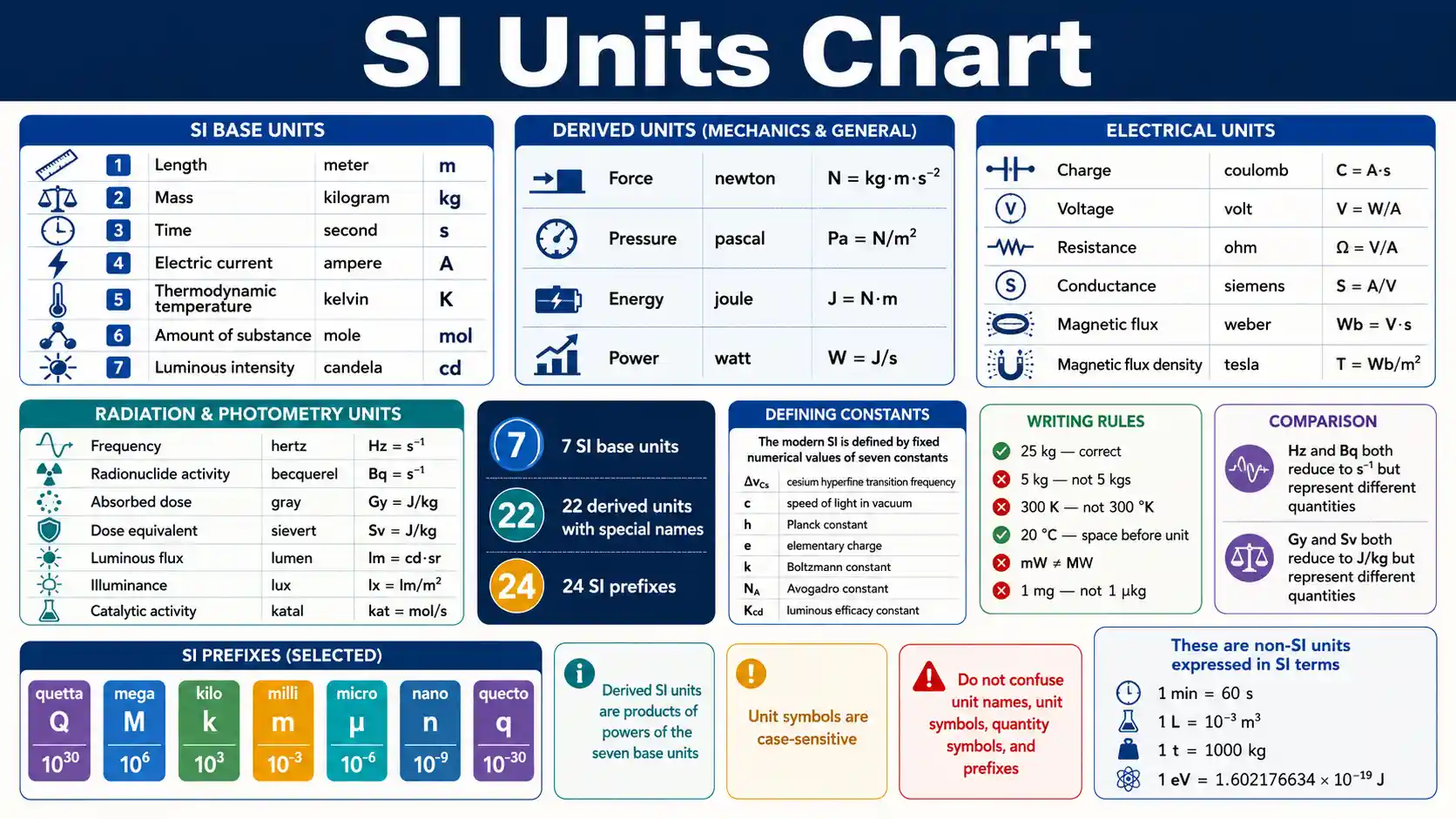
The BIPM SI Brochure defines the pascal as the coherent SI pressure unit. One pascal equals one newton per square metre, so every pressure unit can be compared through an equivalent value in pascals.
One bar equals exactly 100,000 Pa. One standard atmosphere equals exactly 101,325 Pa, so bar and atmosphere are close but not equal.
One psi is approximately 6.894757 kPa. One Torr is exactly 1/760 of a standard atmosphere, or about 133.322368 Pa.
One hectopascal and one millibar both equal 100 Pa, so their numerical values are identical. This is why 1,013.25 hPa and 1,013.25 mbar represent the same pressure.
SI reference
1 Pa = 1 N/m²
The pascal is the coherent SI unit for pressure and stress.
Standard atmosphere
1 atm = 101.325 kPa
The standard atmosphere is exactly 101,325 Pa.
Bar conversion
1 bar = 100 kPa
Bar converts cleanly to 0.1 MPa or 100,000 Pa.
PSI conversion
1 psi ≈ 6.894757 kPa
Convert through pascals to avoid chained rounding.
Pressure Unit Reference Chart
Convert each listed unit to pascals, the coherent SI pressure unit. Exact decimal relationships are marked where the unit definition is exact; column units are shown with conventional conversion factors.
Swipe horizontally inside the table to view every column.
| Unit | Symbol | 1 unit in Pa | Useful relationship | Typical context |
|---|---|---|---|---|
| Pascal | Pa | 1 | 1 Pa = 1 N/m² | SI reference unit |
| Hectopascal | hPa | 100 | 1 hPa = 100 Pa | Weather and atmospheric pressure |
| Kilopascal | kPa | 1,000 | 1 kPa = 10 hPa | Science, engineering, general pressure |
| Megapascal | MPa | 1,000,000 | 1 MPa = 1,000 kPa = 10 bar | Higher pressure and stress |
| Bar | bar | 100,000 | 1 bar = 100 kPa | Engineering and equipment specifications |
| Millibar | mbar | 100 | 1 mbar = 1 hPa | Atmospheric and vacuum contexts |
| Standard atmosphere | atm | 101,325 | 1 atm = 101.325 kPa | Reference atmosphere |
| Pound-force per square inch | psi | ≈6,894.757293 | 1 psi ≈ 6.894757 kPa | U.S. customary engineering and equipment |
| Kip per square inch | ksi | ≈6,894,757.293 | 1 ksi = 1,000 psi | Structural stress |
| Torr | Torr | ≈133.322368 | 1 Torr = 1/760 atm | Vacuum science |
| Millimetre of mercury, conventional | mmHg | ≈133.3224 | 760 mmHg ≈ 1 atm | Column-pressure and clinical conventions |
| Inch of mercury, conventional | inHg | ≈3,386.389 | 1 atm ≈ 29.9213 inHg | Barometric and vacuum contexts |
| Inch of water, conventional | inH₂O | ≈249.0889 | 1 psi ≈ 27.6799 inH₂O | Low differential pressure |
| Centimetre of water, conventional | cmH₂O | 98.0665 | 1 cmH₂O = 10 mmH₂O | Low-pressure column convention |
| Kilogram-force per cm² | kgf/cm² | 98,066.5 | 1 kgf/cm² ≈ 0.980665 bar | Legacy engineering |
Pressure factors are expressed in pascals (Pa).
- • The pascal is the coherent SI pressure unit.
- • Do not infer absolute, gauge, or differential reference from the unit symbol alone.
Download or export
Interactive converter
Pressure Unit Converter
Convert a numerical pressure between SI, atmosphere, imperial, vacuum, and conventional column units. The calculation converts the source value to pascals first, then converts pascals to the target unit.
Converted pressure
14.69594878 psi
Source factor
1 kPa = 1,000 Pa
Target factor
1 psi = 6,894.757293 Pa
Calculation
101.325 kPa × 1,000 Pa/kPa = 101,325 Pa
101,325 Pa ÷ 6,894.757293 Pa/psi = 14.69594878 psi
This tool converts units only. It does not change an absolute pressure into gauge pressure or vice versa; pressure reference and local atmospheric pressure must be handled separately.
1 Standard Atmosphere Conversion Chart
One standard atmosphere is defined exactly as 101,325 Pa. The other values are conversions of that defined reference pressure.
Swipe horizontally inside the table to view every column.
| Unit | Equivalent to 1 atm | Relationship |
|---|---|---|
| Pascal | 101,325 Pa | Exact |
| Kilopascal | 101.325 kPa | Exact decimal conversion |
| Megapascal | 0.101325 MPa | Exact decimal conversion |
| Bar | 1.01325 bar | Exact from 1 bar = 100,000 Pa |
| Millibar | 1,013.25 mbar | Exact from 1 mbar = 100 Pa |
| Hectopascal | 1,013.25 hPa | Exact from 1 hPa = 100 Pa |
| psi | ≈14.69595 psi | Converted from Pa |
| Torr | 760 Torr | Exact by Torr definition |
| Conventional mmHg | ≈760 mmHg | Nearly identical at common displayed precision |
| Conventional inHg | ≈29.9213 inHg | Converted using conventional factor |
| Conventional inH₂O | ≈406.782 inH₂O | Converted using conventional factor |
Reference pressure: 1 atm = 101,325 Pa exactly.
- • Standard atmosphere is a defined reference, not a claim about the local atmospheric pressure at every place and time.
Download or export
Use one reference factor, then round once
The most reliable method is source unit → pascals → target unit. This keeps the conversion transparent and avoids error from repeatedly rounding intermediate values.
Converting 30 psi directly with the NIST factor gives about 206.843 kPa. Converting through a rounded 0.0689 bar-per-psi shortcut would lose unnecessary precision.
PSI Pressure Conversion Chart
Common psi values converted using 1 psi ≈ 6.894757293 kPa.
Swipe horizontally inside the table to view every column.
| psi | kPa | bar | MPa | atm |
|---|---|---|---|---|
| 1 | 6.89476 | 0.0689476 | 0.00689476 | 0.0680460 |
| 5 | 34.4738 | 0.344738 | 0.0344738 | 0.340230 |
| 10 | 68.9476 | 0.689476 | 0.0689476 | 0.680460 |
| 15 | 103.421 | 1.03421 | 0.103421 | 1.02069 |
| 20 | 137.895 | 1.37895 | 0.137895 | 1.36092 |
| 30 | 206.843 | 2.06843 | 0.206843 | 2.04138 |
| 50 | 344.738 | 3.44738 | 0.344738 | 3.40230 |
| 100 | 689.476 | 6.89476 | 0.689476 | 6.80460 |
| 500 | 3,447.38 | 34.4738 | 3.44738 | 34.0230 |
| 1,000 | 6,894.76 | 68.9476 | 6.89476 | 68.0460 |
Values are rounded for chart readability.
- • For calculation chains, convert from the original value using a reference factor rather than repeatedly converting rounded intermediate values.
Download or export
Bar, kPa and MPa Conversion Chart
These units have simple decimal relationships because 1 bar = 100,000 Pa.
Swipe horizontally inside the table to view every column.
| bar | kPa | MPa | Pa |
|---|---|---|---|
| 0.001 | 0.1 | 0.0001 | 100 |
| 0.01 | 1 | 0.001 | 1,000 |
| 0.1 | 10 | 0.01 | 10,000 |
| 0.5 | 50 | 0.05 | 50,000 |
| 1 | 100 | 0.1 | 100,000 |
| 2 | 200 | 0.2 | 200,000 |
| 5 | 500 | 0.5 | 500,000 |
| 10 | 1,000 | 1 | 1,000,000 |
| 50 | 5,000 | 5 | 5,000,000 |
| 100 | 10,000 | 10 | 10,000,000 |
1 bar = 100 kPa = 0.1 MPa = 100,000 Pa.
- • Bar is not an SI unit, although it is a decimal multiple of the pascal and remains widely used.
Download or export
Torr, mmHg and Mercury-Column Conversion Chart
Torr and conventional millimetres of mercury are numerically very close, but the Torr is defined through the standard atmosphere rather than a physical mercury column.
Swipe horizontally inside the table to view every column.
| Quantity | Pa | Torr | Conventional mmHg | Conventional inHg |
|---|---|---|---|---|
| 1 Torr | ≈133.322368 | 1 | ≈1 | ≈0.0393701 |
| 1 conventional mmHg | ≈133.3224 | ≈1.00000024 | 1 | ≈0.0393701 |
| 1 conventional inHg | ≈3,386.389 | ≈25.4000 | ≈25.4000 | 1 |
| 100 Torr | ≈13,332.2 | 100 | ≈100 | ≈3.93701 |
| 500 Torr | ≈66,661.2 | 500 | ≈500 | ≈19.6850 |
| 760 Torr | 101,325 | 760 | ≈760 | ≈29.9213 |
| 1 atm | 101,325 | 760 | ≈760 | ≈29.9213 |
Torr is exactly 1/760 of a standard atmosphere; column-unit rows use NIST conventional factors.
- • Torr and mmHg are often shown as interchangeable at ordinary precision, but they do not arise from the same formal definition.
Download or export
Torr and mmHg are nearly equal, but their definitions differ
The Torr is defined as 101,325/760 Pa. A mercury-column pressure originates from the hydrostatic relationship between density, gravity, and height, so conventional mmHg factors make the unit reproducible without recreating a physical column.
At common displayed precision, 760 Torr and about 760 mmHg both correspond to one standard atmosphere. Use the unit named by the instrument, specification, or source instead of silently swapping symbols.
Water-Column Pressure Conversion Chart
Water-column units are useful for small pressure differences. Conventional factors avoid having to specify a real fluid density and local gravity for every conversion.
Swipe horizontally inside the table to view every column.
| Unit | Pa | kPa | psi | Relation |
|---|---|---|---|---|
| 1 mmH₂O | 9.80665 | 0.00980665 | ≈0.00142233 | Conventional millimetre of water |
| 10 mmH₂O | 98.0665 | 0.0980665 | ≈0.0142233 | Equals 1 cmH₂O |
| 1 cmH₂O | 98.0665 | 0.0980665 | ≈0.0142233 | Conventional centimetre of water |
| 10 cmH₂O | 980.665 | 0.980665 | ≈0.142233 | Equals 100 mmH₂O |
| 1 inH₂O | ≈249.0889 | ≈0.249089 | ≈0.0361273 | Conventional inch of water |
| 10 inH₂O | ≈2,490.889 | ≈2.49089 | ≈0.361273 | Ten conventional inches of water |
| 27.6799 inH₂O | ≈6,894.757 | ≈6.894757 | ≈1 | Approximately 1 psi |
Conventional water-column pressure units.
- • A pressure calculated from an actual liquid column uses ΔP = ρgh and therefore depends on the fluid density and gravitational acceleration.
Download or export
Absolute, Gauge and Differential Pressure Chart
A numerical pressure is incomplete when its reference is ambiguous. The same unit can express absolute, gauge, or differential pressure.
Swipe horizontally inside the table to view every column.
| Pressure type | Reference zero | Relationship | What a zero reading means |
|---|---|---|---|
| Absolute pressure | Perfect vacuum | Pabs ≥ 0 | Ideal zero corresponds to no pressure relative to vacuum. |
| Gauge pressure | Local ambient atmosphere | Pgauge = Pabs − Patm,local | Pressure equals local atmospheric pressure. |
| Positive gauge pressure | Local ambient atmosphere | Pabs > Patm,local | System pressure is above ambient. |
| Negative gauge pressure | Local ambient atmosphere | Pabs < Patm,local | System pressure is below ambient; often called vacuum gauge pressure. |
| Differential pressure | Second measured pressure | ΔP = P1 − P2 | Both ports are at the same pressure. |
| Standard atmosphere | Defined reference value | 1 atm = 101.325 kPa | This is a reference unit, not the current local atmosphere. |
Use explicit labels such as kPa abs, kPa gauge, or kPa differential when the reference matters.
- • To convert gauge pressure to absolute pressure, add the actual local atmospheric pressure—not automatically 101.325 kPa unless that standard-atmosphere assumption is intended.
Download or export
Gauge pressure can be negative; absolute pressure cannot
A negative gauge reading means the measured pressure is below the local atmospheric pressure. It does not mean the absolute pressure is negative.
Convert gauge pressure to absolute pressure with Pabs = Pgauge + Patm,local. The local atmospheric term varies with elevation and weather, so 101.325 kPa is appropriate only when a standard-atmosphere assumption is intended.
Pressure Formula and Relationship Chart
Pressure conversion changes units. Pressure calculation uses a physical relationship, so keep the two tasks separate.
Swipe horizontally inside the table to view every column.
| Relationship | Formula | Use | Important condition |
|---|---|---|---|
| Average normal pressure | P = F/A | Force distributed over an area | Use perpendicular force and consistent SI units for Pa. |
| Pascal definition | 1 Pa = 1 N/m² | Connect pressure with force and area | Pa is an SI derived unit. |
| Hydrostatic difference | ΔP = ρgh | Pressure change through a static fluid column | Density and gravity must match the actual or stated conditions. |
| Gauge to absolute | Pabs = Pgauge + Patm,local | Convert a gauge reading to absolute pressure | Use local atmospheric pressure. |
| Absolute to gauge | Pgauge = Pabs − Patm,local | Convert absolute to gauge pressure | Gauge reference is ambient atmosphere. |
| Unit conversion | Ptarget = Psource × Fsource/Ftarget | Convert between units | Factors must refer to the same pressure quantity and reference. |
| Stress | σ = F/A | Normal stress has the same dimensions as pressure | Stress in solids is not always physically interchangeable with fluid pressure. |
SI pressure and stress dimension: force per area.
- • Use metres squared when deriving pascals directly from newtons; converting cm² or in² requires squaring the length conversion.
Download or export
Pascal Prefix Conversion Chart
SI prefixes make very small and very large pressures easier to write without changing the physical quantity.
Swipe horizontally inside the table to view every column.
| Unit | Symbol | Pa multiplier | Example |
|---|---|---|---|
| Micropascal | µPa | 10⁻⁶ | 1,000,000 µPa = 1 Pa |
| Millipascal | mPa | 10⁻³ | 1,000 mPa = 1 Pa |
| Pascal | Pa | 10⁰ | 1 Pa = 1 N/m² |
| Hectopascal | hPa | 10² | 1 hPa = 100 Pa |
| Kilopascal | kPa | 10³ | 1 kPa = 1,000 Pa |
| Megapascal | MPa | 10⁶ | 1 MPa = 1,000 kPa |
| Gigapascal | GPa | 10⁹ | 1 GPa = 1,000 MPa |
SI prefix symbols are case-sensitive.
- • mPa means millipascal, while MPa means megapascal; the difference is a factor of 10⁹.
Download or export
Worked Pressure Conversion Examples
These examples show the factor method. Multiply by the source-to-pascal factor, then divide by the target-to-pascal factor.
Swipe horizontally inside the table to view every column.
| Convert | Calculation | Result |
|---|---|---|
| 250 kPa → bar | 250 × 1,000 ÷ 100,000 | 2.5 bar |
| 2.5 bar → kPa | 2.5 × 100,000 ÷ 1,000 | 250 kPa |
| 30 psi → kPa | 30 × 6,894.757293 ÷ 1,000 | ≈206.843 kPa |
| 101.325 kPa → atm | 101.325 × 1,000 ÷ 101,325 | 1 atm |
| 760 Torr → atm | 760 × (101,325/760) ÷ 101,325 | 1 atm |
| 1 MPa → bar | 1,000,000 ÷ 100,000 | 10 bar |
| 500 hPa → mbar | 500 × 100 ÷ 100 | 500 mbar |
| 10 inH₂O → Pa | 10 × 249.0889 | ≈2,490.889 Pa |
| 100 mmHg → kPa | 100 × 133.3224 ÷ 1,000 | ≈13.33224 kPa |
Results retain more digits when the reference factor supports them; practical reporting should match the source measurement precision.
- • Do not add or subtract pressures merely to convert units. Addition or subtraction is only needed when changing the pressure reference, such as gauge to absolute.
Download or export
Common Pressure Conversion Mistakes
Most pressure-conversion errors come from reference confusion, unit symbols, column conditions, or premature rounding rather than difficult arithmetic.
Swipe horizontally inside the table to view every column.
| Mistake | Why it fails | Better approach |
|---|---|---|
| Treating gauge and absolute values as interchangeable | Their zero references differ. | Carry the reference label with the number and use local atmospheric pressure when converting reference. |
| Using 100 kPa as exactly 1 atm | 1 atm is exactly 101.325 kPa. | Use 101.325 kPa unless a rounded estimate is explicitly acceptable. |
| Assuming 1 bar equals 1 atm | 1 bar = 100 kPa; 1 atm = 101.325 kPa. | Convert both through pascals or kPa. |
| Writing MPa when mPa is intended | SI symbols are case-sensitive. | Check M = mega and m = milli. |
| Treating Torr and mmHg as formally identical definitions | Torr is defined from atm; mmHg is a column-pressure convention. | Use the specified unit and appropriate factor. |
| Using a water-column height without density conditions | Actual hydrostatic pressure depends on ρ and g. | Use a conventional column unit or calculate ΔP = ρgh with stated conditions. |
| Chaining rounded conversions | Each rounded step can accumulate error. | Convert once from the original value using reference factors. |
| Dropping squared-area conversion in P = F/A | Area units scale by the square of length. | Convert area correctly before computing pressure. |
| Assuming standard atmosphere equals local weather pressure | Local atmospheric pressure varies with weather and elevation. | Use a measured local pressure when an actual gauge/absolute conversion requires it. |
| Reporting more digits than the measurement supports | Conversion does not create measurement precision. | Round the final result to a defensible precision. |
Keep unit symbol, pressure reference, and measurement precision together.
- • A correct numerical factor cannot fix an incorrectly identified pressure reference or measurement condition.
Download or export
How to convert a pressure value correctly
First identify the quantity and reference. A pressure of 200 kPa absolute is not the same physical state as 200 kPa gauge even though both use kPa.
1. Keep the pressure reference
Record absolute, gauge, differential, or vacuum context before changing units.
2. Read the source unit exactly
Pa, kPa, MPa, mbar, bar, psi, Torr, and mmHg have different factors.
3. Convert to pascals
Multiply the source number by the unit factor in Pa per source unit.
4. Convert to the target unit
Divide the pascal value by the target factor in Pa per target unit.
5. Round at the end
Conversion does not create extra measurement precision.
6. Transform the reference only when needed
Gauge-to-absolute conversion requires local atmospheric pressure in addition to the unit conversion.
The NIST pressure conversion table provides practical factors among Pa, mbar, Torr, psi, atm, inH₂O, and inHg. The NIST Guide to the SI conversion appendix provides the broader standards reference and exact standard-atmosphere relationship.
Pressure conversion FAQs
What is the SI unit of pressure?
The pascal (Pa) is the coherent SI unit of pressure. One pascal equals one newton per square metre, or 1 N/m².
How many pascals are in one bar?
One bar equals exactly 100,000 Pa, which is 100 kPa or 0.1 MPa.
How many kilopascals are in one atmosphere?
One standard atmosphere equals exactly 101.325 kPa.
How many kilopascals are in one psi?
One psi is approximately 6.894757 kPa.
How many psi are in one atmosphere?
One standard atmosphere is approximately 14.69595 psi.
Are hPa and mbar the same numerical pressure?
Yes. One hectopascal equals 100 Pa and one millibar also equals 100 Pa, so the numerical values are equal.
Is one bar the same as one atmosphere?
No. One bar is exactly 100 kPa, while one standard atmosphere is exactly 101.325 kPa.
Is Torr the same as mmHg?
They are numerically almost identical at common precision, but the Torr is defined as 1/760 of a standard atmosphere while mmHg is a mercury-column unit or convention.
How do I convert pressure units accurately?
Convert the source value to pascals with its reference factor, then divide by the target unit factor. This avoids compounding rounding errors.
What is gauge pressure?
Gauge pressure is pressure measured relative to local atmospheric pressure. A zero gauge reading means the system pressure matches the local atmosphere.
What is absolute pressure?
Absolute pressure is referenced to perfect vacuum. In ordinary classical pressure measurements, absolute pressure cannot be below zero.
How do I convert gauge pressure to absolute pressure?
Add the local atmospheric pressure to the gauge pressure: Pabs = Pgauge + Patm,local.
Why does pressure in mmHg depend on a convention?
A physical liquid-column pressure depends on fluid density and gravity, so conventional column units use specified reference factors to make conversion reproducible.
What is the difference between kPa and MPa?
One MPa equals 1,000 kPa. A megapascal is 10⁶ Pa, while a kilopascal is 10³ Pa.
Can a gauge pressure be negative?
Yes. Negative gauge pressure means the absolute pressure is below the local atmospheric pressure; it does not mean absolute pressure is negative.
Does converting pressure change its physical reference?
No. Unit conversion changes only the numerical unit representation. Absolute, gauge, and differential references remain separate quantities unless you explicitly transform the reference.
Sources
Pressure-unit definitions, SI relationships, conversion factors, and standard-atmosphere values are grounded in BIPM and NIST references.
Bureau International des Poids et Mesures — SI Brochure, 9th edition
Defines the pascal within the SI and lists the bar as 10⁵ Pa among widely used non-SI units.
https://www.bipm.org/en/publications/si-brochure
National Institute of Standards and Technology — Pressure and Gas Flow Unit Conversions
Provides pressure conversion factors among Pa, mbar, Torr, psi, atm, inches of water, and inches of mercury.
https://www.nist.gov/pml/owm/metric-si/unit-conversion/pressure-and-gas-flow-unit-conversions
National Institute of Standards and Technology — NIST Guide to the SI, Appendix B
Provides SI conversion factors and states that 1 atm equals exactly 101,325 Pa and 1 Torr equals 101,325/760 Pa.
https://www.nist.gov/pml/special-publication-811/nist-guide-si-appendix-b-conversion-factors