Science & Chemistry
Temperature Conversion Chart
Convert Celsius, Fahrenheit, kelvin, and Rankine with exact scale equations, quick-reference tables, absolute-zero checks, and separate rules for temperature differences so offsets are used only when they belong.
A temperature value and a temperature interval are not converted the same way. Absolute values may require offsets such as 32, 273.15, or 459.67; temperature differences use only the interval-size factor.
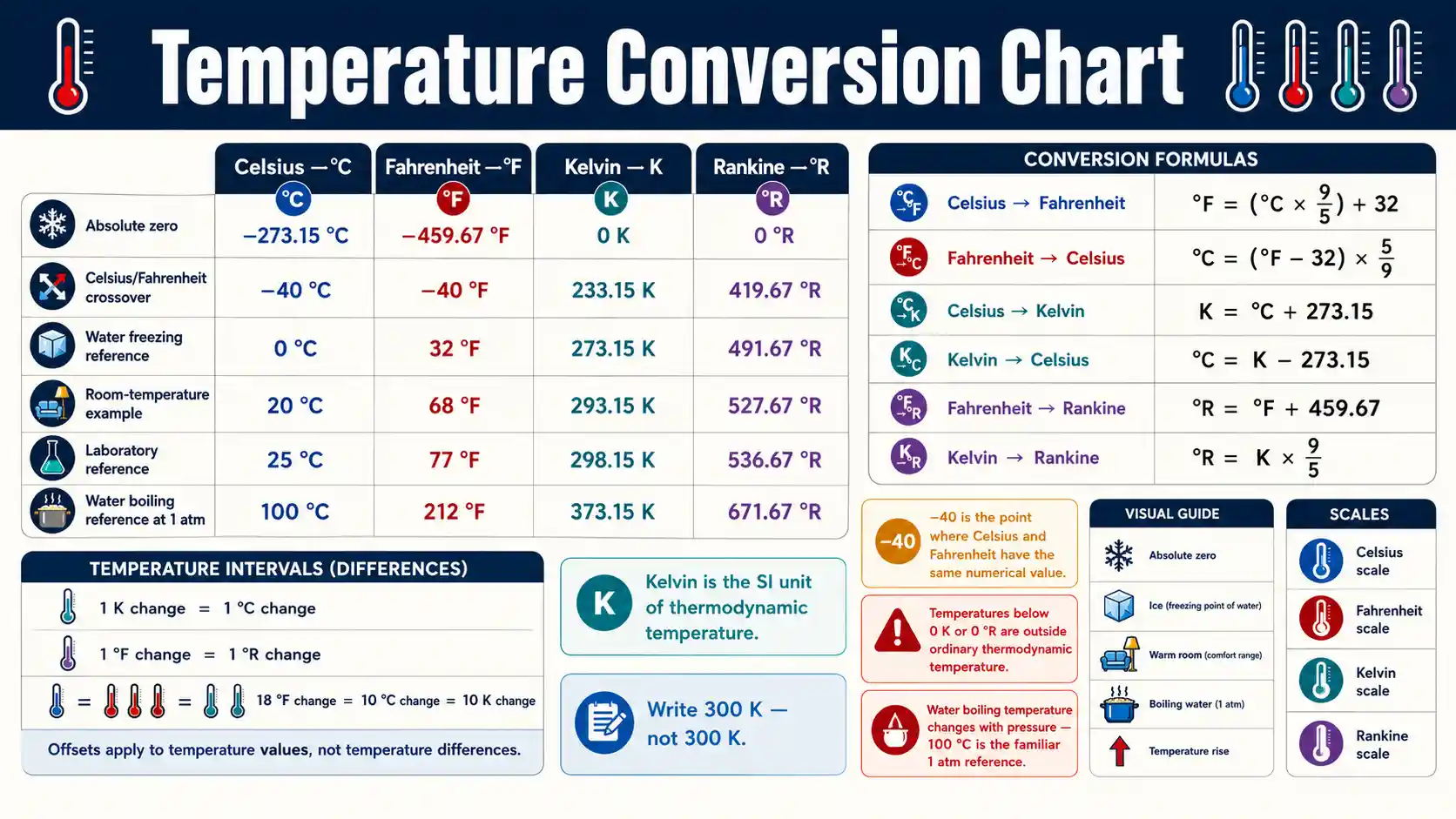
How Celsius, Fahrenheit, kelvin, and Rankine relate
Celsius and kelvin use equal-sized intervals. Their numerical values differ by exactly 273.15, so 0 °C equals 273.15 K and 25 °C equals 298.15 K. NIST lists these exact conversion equations.
Fahrenheit and Rankine also share one interval size. Rankine starts at absolute zero, which makes °R to °F a simple offset conversion, while kelvin to Rankine requires only the 9/5 scale factor.
The NIST Guide to the SI treats temperature and temperature interval as separate conversion categories. That distinction explains why a 10 °C rise is an 18 °F rise, not 50 °F.
Kelvin is the SI unit of thermodynamic temperature. The modern definition fixes the Boltzmann constant, and the BIPM states the exact Celsius relation as T/K = t/°C + 273.15.
Celsius to kelvin
K = °C + 273.15
The Celsius and kelvin scales use the same interval size but different zero points.
Celsius to Fahrenheit
°F = °C × 9/5 + 32
The 9/5 factor changes interval size; the +32 term changes the zero point.
Absolute zero
0 K = −273.15 °C
The same point is −459.67 °F and 0 °R.
Temperature intervals
1 K = 1 °C
A 1 °F or 1 °R interval equals 5/9 K.
Temperature Conversion Formulas
Use these equations for absolute temperature values. Offset terms matter when converting between scales with different zero points.
Swipe horizontally inside the table to view every column.
| Convert from | Convert to | Formula | Example | Key point |
|---|---|---|---|---|
| Celsius (°C) | Fahrenheit (°F) | °F = (°C × 9/5) + 32 | 20 °C = 68 °F | Scale factor plus offset |
| Fahrenheit (°F) | Celsius (°C) | °C = (°F − 32) × 5/9 | 68 °F = 20 °C | Subtract 32 before scaling |
| Celsius (°C) | Kelvin (K) | K = °C + 273.15 | 25 °C = 298.15 K | Exact offset relation |
| Kelvin (K) | Celsius (°C) | °C = K − 273.15 | 298.15 K = 25 °C | Kelvin has no degree sign |
| Fahrenheit (°F) | Kelvin (K) | K = (°F + 459.67) × 5/9 | 32 °F = 273.15 K | Absolute-scale conversion |
| Kelvin (K) | Fahrenheit (°F) | °F = K × 9/5 − 459.67 | 273.15 K = 32 °F | Absolute-scale conversion |
| Fahrenheit (°F) | Rankine (°R) | °R = °F + 459.67 | 32 °F = 491.67 °R | Same interval size |
| Rankine (°R) | Fahrenheit (°F) | °F = °R − 459.67 | 491.67 °R = 32 °F | Same interval size |
| Kelvin (K) | Rankine (°R) | °R = K × 9/5 | 273.15 K = 491.67 °R | Both absolute scales |
| Rankine (°R) | Kelvin (K) | K = °R × 5/9 | 491.67 °R = 273.15 K | Both absolute scales |
| Celsius (°C) | Rankine (°R) | °R = (°C + 273.15) × 9/5 | 0 °C = 491.67 °R | Convert through absolute temperature |
| Rankine (°R) | Celsius (°C) | °C = °R × 5/9 − 273.15 | 491.67 °R = 0 °C | Convert through kelvin-equivalent value |
NIST lists these scale relationships; 273.15 and 459.67 are exact offsets in the conventional scale definitions used here.
- • For temperature differences, use interval factors instead of the absolute-value formulas with offsets.
Download or export
Common Temperature Reference Points
These familiar points make it easier to sanity-check conversions across Celsius, Fahrenheit, kelvin, and Rankine.
Swipe horizontally inside the table to view every column.
| Reference point | Celsius | Fahrenheit | Kelvin | Rankine |
|---|---|---|---|---|
| Absolute zero | −273.15 °C | −459.67 °F | 0 K | 0 °R |
| −40 crossover | −40 °C | −40 °F | 233.15 K | 419.67 °R |
| Water freezing reference | 0 °C | 32 °F | 273.15 K | 491.67 °R |
| Cool day example | 10 °C | 50 °F | 283.15 K | 509.67 °R |
| Room-temperature example | 20 °C | 68 °F | 293.15 K | 527.67 °R |
| Common laboratory reference | 25 °C | 77 °F | 298.15 K | 536.67 °R |
| Warm day example | 30 °C | 86 °F | 303.15 K | 545.67 °R |
| Human-body reference value | 37 °C | 98.6 °F | 310.15 K | 558.27 °R |
| Hot-water reference | 60 °C | 140 °F | 333.15 K | 599.67 °R |
| Water boiling reference at 1 atm | 100 °C | 212 °F | 373.15 K | 671.67 °R |
Physical transition temperatures depend on pressure and material details; the arithmetic conversions shown are exact for the listed numerical values.
- • The NIST temperature page uses common reference values such as 0 °C = 32 °F and 20 °C = 68 °F.
Download or export
Celsius to Fahrenheit, Kelvin and Rankine Quick Chart
Selected Celsius values converted using the exact scale equations.
Swipe horizontally inside the table to view every column.
| Celsius | Fahrenheit | Kelvin | Rankine |
|---|---|---|---|
| -273.15 °C | -459.67 °F | 0 K | 0 °R |
| -100 °C | -148 °F | 173.15 K | 311.67 °R |
| -50 °C | -58 °F | 223.15 K | 401.67 °R |
| -40 °C | -40 °F | 233.15 K | 419.67 °R |
| -20 °C | -4 °F | 253.15 K | 455.67 °R |
| -10 °C | 14 °F | 263.15 K | 473.67 °R |
| 0 °C | 32 °F | 273.15 K | 491.67 °R |
| 10 °C | 50 °F | 283.15 K | 509.67 °R |
| 20 °C | 68 °F | 293.15 K | 527.67 °R |
| 25 °C | 77 °F | 298.15 K | 536.67 °R |
| 30 °C | 86 °F | 303.15 K | 545.67 °R |
| 37 °C | 98.6 °F | 310.15 K | 558.27 °R |
| 40 °C | 104 °F | 313.15 K | 563.67 °R |
| 50 °C | 122 °F | 323.15 K | 581.67 °R |
| 60 °C | 140 °F | 333.15 K | 599.67 °R |
| 75 °C | 167 °F | 348.15 K | 626.67 °R |
| 100 °C | 212 °F | 373.15 K | 671.67 °R |
| 150 °C | 302 °F | 423.15 K | 761.67 °R |
| 200 °C | 392 °F | 473.15 K | 851.67 °R |
| 250 °C | 482 °F | 523.15 K | 941.67 °R |
| 300 °C | 572 °F | 573.15 K | 1031.67 °R |
Kelvin values below 0 K are physically invalid; this list begins at absolute zero.
- • −40 is the unique value where Celsius and Fahrenheit numerical readings are equal.
Download or export
Fahrenheit to Celsius, Kelvin and Rankine Quick Chart
Selected Fahrenheit values converted with the exact affine relationships among the four scales.
Swipe horizontally inside the table to view every column.
| Fahrenheit | Celsius | Kelvin | Rankine |
|---|---|---|---|
| -459.67 °F | -273.15 °C | 0 K | 0 °R |
| -100 °F | -73.33 °C | 199.82 K | 359.67 °R |
| -40 °F | -40 °C | 233.15 K | 419.67 °R |
| 0 °F | -17.78 °C | 255.37 K | 459.67 °R |
| 32 °F | 0 °C | 273.15 K | 491.67 °R |
| 50 °F | 10 °C | 283.15 K | 509.67 °R |
| 68 °F | 20 °C | 293.15 K | 527.67 °R |
| 77 °F | 25 °C | 298.15 K | 536.67 °R |
| 86 °F | 30 °C | 303.15 K | 545.67 °R |
| 98.6 °F | 37 °C | 310.15 K | 558.27 °R |
| 104 °F | 40 °C | 313.15 K | 563.67 °R |
| 122 °F | 50 °C | 323.15 K | 581.67 °R |
| 140 °F | 60 °C | 333.15 K | 599.67 °R |
| 176 °F | 80 °C | 353.15 K | 635.67 °R |
| 212 °F | 100 °C | 373.15 K | 671.67 °R |
| 250 °F | 121.11 °C | 394.26 K | 709.67 °R |
| 300 °F | 148.89 °C | 422.04 K | 759.67 °R |
| 350 °F | 176.67 °C | 449.82 K | 809.67 °R |
| 400 °F | 204.44 °C | 477.59 K | 859.67 °R |
| 450 °F | 232.22 °C | 505.37 K | 909.67 °R |
| 500 °F | 260 °C | 533.15 K | 959.67 °R |
A Fahrenheit interval of 1 °F equals a kelvin or Celsius interval of 5/9.
- • 32 °F corresponds to 0 °C and 273.15 K.
Download or export
Kelvin to Celsius, Fahrenheit and Rankine Quick Chart
Kelvin is the SI unit of thermodynamic temperature and starts at absolute zero.
Swipe horizontally inside the table to view every column.
| Kelvin | Celsius | Fahrenheit | Rankine |
|---|---|---|---|
| 0 K | -273.15 °C | -459.67 °F | 0 °R |
| 100 K | -173.15 °C | -279.67 °F | 180 °R |
| 173.15 K | -100 °C | -148 °F | 311.67 °R |
| 223.15 K | -50 °C | -58 °F | 401.67 °R |
| 233.15 K | -40 °C | -40 °F | 419.67 °R |
| 253.15 K | -20 °C | -4 °F | 455.67 °R |
| 263.15 K | -10 °C | 14 °F | 473.67 °R |
| 273.15 K | 0 °C | 32 °F | 491.67 °R |
| 283.15 K | 10 °C | 50 °F | 509.67 °R |
| 293.15 K | 20 °C | 68 °F | 527.67 °R |
| 298.15 K | 25 °C | 77 °F | 536.67 °R |
| 303.15 K | 30 °C | 86 °F | 545.67 °R |
| 310.15 K | 37 °C | 98.6 °F | 558.27 °R |
| 313.15 K | 40 °C | 104 °F | 563.67 °R |
| 323.15 K | 50 °C | 122 °F | 581.67 °R |
| 373.15 K | 100 °C | 212 °F | 671.67 °R |
| 423.15 K | 150 °C | 302 °F | 761.67 °R |
| 473.15 K | 200 °C | 392 °F | 851.67 °R |
| 573.15 K | 300 °C | 572 °F | 1031.67 °R |
The kelvin symbol is K, not °K.
- • A change of 1 K has the same magnitude as a change of 1 °C.
Download or export
Temperature Converter
Convert Celsius, Fahrenheit, kelvin, and Rankine as absolute temperatures or as temperature differences. The interval mode intentionally removes zero-point offsets.
Converted value
68 °F
20 °C → 68 °F .
Converted through kelvin using the exact scale relationships.
Absolute-temperature conversions use the exact scale relationships. For experimental measurements, preserve significant figures and uncertainty instead of treating a long calculator result as extra measurement precision.
Temperature Difference and Interval Conversions
Temperature intervals use scale factors only. Do not add 32, 273.15, or 459.67 when converting a temperature change.
Swipe horizontally inside the table to view every column.
| Interval | Equivalent interval | Rule | Example | Why no offset |
|---|---|---|---|---|
| 1 K | 1 °C | ΔK = Δ°C | 20 K change = 20 °C change | Kelvin and Celsius interval sizes are equal |
| 1 °C | 1 K | Δ°C = ΔK | 10 °C rise = 10 K rise | Only their zero points differ |
| 1 °F | 5/9 °C | Δ°C = Δ°F × 5/9 | 18 °F change = 10 °C change | Intervals do not use the +32 offset |
| 1 °F | 5/9 K | ΔK = Δ°F × 5/9 | 9 °F change = 5 K change | Same size relation as Celsius |
| 1 °R | 5/9 K | ΔK = Δ°R × 5/9 | 18 °R change = 10 K change | Rankine and Fahrenheit share interval size |
| 1 °R | 1 °F | Δ°R = Δ°F | 25 °R change = 25 °F change | Same interval size |
| 10 °C | 18 °F | Δ°F = Δ°C × 9/5 | 10 °C rise = 18 °F rise | No zero-point offset for differences |
| 100 K | 180 °R | Δ°R = ΔK × 9/5 | 100 K interval = 180 °R | Absolute scales still have different interval sizes |
NIST treats temperature and temperature interval as separate conversion categories.
- • Using the absolute-value formula on an interval is a common source of 32-degree errors.
Download or export
Celsius, Fahrenheit, Kelvin and Rankine Compared
The four scales differ in zero point, interval size, notation, and typical use.
Swipe horizontally inside the table to view every column.
| Scale | Symbol | Absolute zero | Interval size | Common use |
|---|---|---|---|---|
| Celsius | °C | −273.15 °C | 1 °C = 1 K interval | Weather, laboratory, everyday metric use |
| Fahrenheit | °F | −459.67 °F | 1 °F = 5/9 K interval | Everyday temperature in the United States |
| Kelvin | K | 0 K | 1 K = 1 °C interval | SI thermodynamic temperature, science and engineering |
| Rankine | °R | 0 °R | 1 °R = 1 °F interval | Some engineering thermodynamics using Fahrenheit-sized intervals |
Kelvin is written without the degree sign; degree Celsius, degree Fahrenheit, and degree Rankine use degree symbols.
- • Celsius is offset from kelvin by exactly 273.15 in numerical value.
Download or export
Absolute Zero and Physical Scale Limits
Absolute temperature scales start at zero. Values below 0 K or 0 °R are outside ordinary thermodynamic temperature.
Swipe horizontally inside the table to view every column.
| Concept | Celsius | Fahrenheit | Kelvin | Rankine |
|---|---|---|---|---|
| Absolute zero | −273.15 °C | −459.67 °F | 0 K | 0 °R |
| 100 K | −173.15 °C | −279.67 °F | 100 K | 180 °R |
| 200 K | −73.15 °C | −99.67 °F | 200 K | 360 °R |
| 273.15 K reference | 0 °C | 32 °F | 273.15 K | 491.67 °R |
| 300 K reference | 26.85 °C | 80.33 °F | 300 K | 540 °R |
0 K is absolute zero; Kelvin is defined through the fixed numerical value of the Boltzmann constant.
- • Negative Celsius or Fahrenheit values are ordinary because those scales place zero above absolute zero.
Download or export
Temperature Conversion Workflow
A short workflow prevents most unit, offset, and interval mistakes.
Swipe horizontally inside the table to view every column.
| Step | Action | Example | Why it matters |
|---|---|---|---|
| 1 | Identify the source and target scale | °F → °C | The correct formula depends on both scales |
| 2 | Decide whether the quantity is a temperature or a temperature difference | 68 °F versus a 20 °F rise | Absolute values use offsets; intervals do not |
| 3 | Use the exact conversion equation | (68 − 32) × 5/9 | Avoid approximate mental shortcuts for technical work |
| 4 | Keep full precision during the calculation | 20.000… °C | Early rounding can compound errors |
| 5 | Round only to the precision justified by the input | 68 °F → 20 °C | Reported precision should match the data |
| 6 | Check the physical range | K must not be below 0 | Catches sign and offset errors |
| 7 | Sanity-check against a known point | 32 °F ↔ 0 °C | Detects reversed factors or missing offsets |
For interval conversions, replace the affine formulas with the interval factors in the interval table.
- • −40 °C = −40 °F is another useful sanity-check point.
Download or export
Common Temperature Conversion Mistakes
Most conversion errors come from mixing absolute values with intervals, reversing factors, or writing unit symbols incorrectly.
Swipe horizontally inside the table to view every column.
| Mistake | Incorrect approach | Correct approach | Why |
|---|---|---|---|
| Adding 32 to a temperature difference | 10 °C change → 50 °F change | 10 °C change → 18 °F change | Offsets do not apply to intervals |
| Using 9/5 in the wrong direction | °F → °C multiply by 9/5 | °F → °C multiply by 5/9 after subtracting 32 | Fahrenheit intervals are smaller |
| Writing °K | 300 °K | 300 K | Kelvin does not use a degree sign |
| Treating 0 °C as absolute zero | 0 °C = 0 K | 0 °C = 273.15 K | Celsius and kelvin have different zero points |
| Allowing negative kelvin values | −5 K | Check the calculation | Ordinary thermodynamic temperature cannot be below 0 K |
| Assuming 1 °F = 1 °C interval | 20 °F change = 20 °C | 20 °F change = 11.111… °C | Interval sizes differ by 9/5 |
| Rounding 273.15 to 273 in exact work | 25 °C = 298 K exactly | 25 °C = 298.15 K | 273.15 is the exact offset relation |
| Confusing value and interval notation | 20 °C − 10 °C = 10 °C as a formal interval symbol | Temperature difference can be stated as 10 °C or 10 K with context | The numerical interval sizes are equal |
| Using boiling point as universal | Water always boils at 100 °C | 100 °C is the familiar 1-atm reference | Boiling temperature changes with pressure |
| Mixing Rankine and Fahrenheit zeros | 0 °R = 0 °F | 0 °R = −459.67 °F | Rankine is an absolute scale |
Keep value conversions, interval conversions, and physical reference conditions conceptually separate.
- • A calculator can perform arithmetic correctly while still using the wrong physical interpretation.
Download or export
Frequently asked questions
What is the formula from Celsius to Fahrenheit?
Multiply the Celsius value by 9/5 and add 32: °F = (°C × 9/5) + 32.
What is the formula from Fahrenheit to Celsius?
Subtract 32 from the Fahrenheit value, then multiply by 5/9: °C = (°F − 32) × 5/9.
How do you convert Celsius to kelvin?
Add 273.15. The exact scale relation is K = °C + 273.15.
Does kelvin use a degree symbol?
No. Write 300 K, not 300 °K.
At what temperature are Celsius and Fahrenheit equal?
The two scales have the same numerical reading at −40: −40 °C = −40 °F.
What is absolute zero in all four scales?
Absolute zero is 0 K, 0 °R, −273.15 °C, and −459.67 °F.
Can kelvin be negative?
Ordinary thermodynamic temperatures cannot be below 0 K. A negative result usually signals a conversion or interpretation error.
Is a 1 °C change the same as a 1 K change?
Yes. Celsius and kelvin have equal interval sizes, so a 1 °C temperature change equals a 1 K change.
Is a 1 °F change the same as a 1 °R change?
Yes. Fahrenheit and Rankine use the same interval size; their zero points differ.
How do you convert a temperature difference from Fahrenheit to Celsius?
Multiply the Fahrenheit interval by 5/9. Do not subtract 32 when converting a temperature difference.
What is 0 °C in Fahrenheit and kelvin?
0 °C equals 32 °F and 273.15 K.
What is 100 °C in Fahrenheit and kelvin?
100 °C equals 212 °F and 373.15 K.
What is 68 °F in Celsius?
68 °F equals 20 °C exactly under the standard scale conversion equation.
What is Rankine used for?
Rankine is an absolute temperature scale with Fahrenheit-sized intervals and appears in some engineering thermodynamics contexts.
Why is 273.15 used in Celsius–kelvin conversion?
Celsius temperature is offset from thermodynamic temperature so that T/K = t/°C + 273.15 exactly.
Does water always boil at 100 °C?
No. 100 °C is the familiar boiling reference at standard atmospheric pressure; actual boiling temperature changes with pressure and composition.
Sources
Conversion equations and scale definitions are grounded in NIST and BIPM references. URLs are shown as plain text for reference.
National Institute of Standards and Technology — SI Units — Temperature
Provides exact Celsius, Fahrenheit, and kelvin conversion equations and common reference values.
https://www.nist.gov/pml/owm/si-units-temperature
National Institute of Standards and Technology — NIST Guide to the SI — Appendix B.9 Temperature Conversions
Lists temperature and temperature-interval conversions for degree Celsius, degree Fahrenheit, kelvin, and degree Rankine.
https://www.nist.gov/pml/special-publication-811/nist-guide-si-appendix-b-conversion-factors/nist-guide-si-appendix-b9
Bureau International des Poids et Mesures — SI Brochure Appendix 2 — Mise en pratique for the kelvin
Explains the modern kelvin definition and the exact Celsius offset relation T/K = t/°C + 273.15.
https://www.bipm.org/documents/20126/41489682/SI-App2-kelvin.pdf