Family & Parenting · Infant Feeding and Nutrition
Baby Feeding Chart from Birth to 24 Months
Compare breast milk and infant formula patterns, solid-food readiness, complementary meal frequency, first portions, textures, food groups, cup practice, hunger and fullness cues, choking prevention, and warning signs by age.
Feeding charts describe common stages, not a prescription. Premature babies and children with growth, allergy, swallowing, metabolic, gastrointestinal, cardiac, neurological, or developmental concerns need an individualized plan. Use emergency services for severe choking, breathing difficulty, colour change, limpness, or a severe allergic reaction. Read the ChartsLoom Disclaimer.
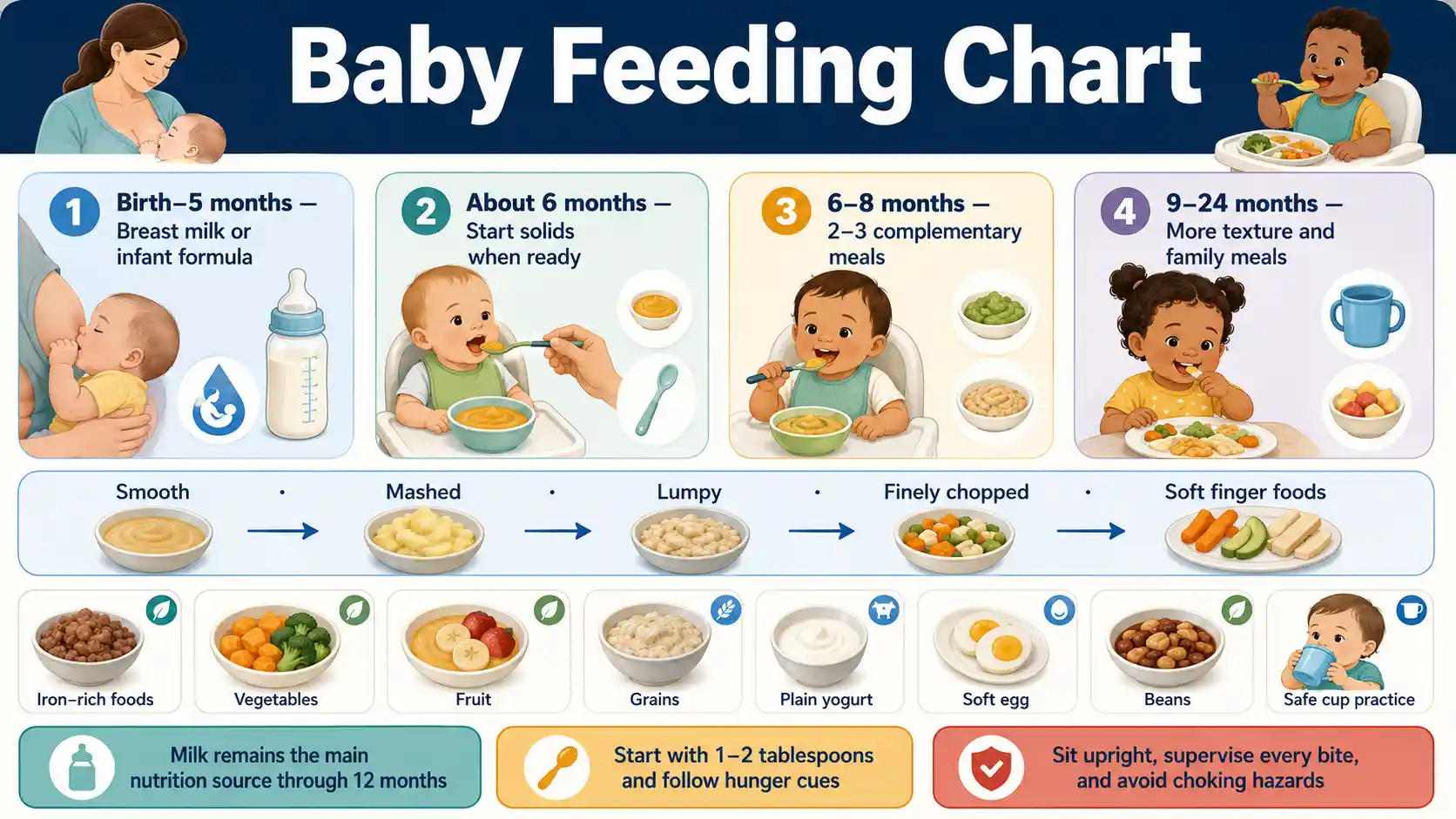
What should a baby eat at each age?
Use breast milk, iron-fortified infant formula, or both before complementary feeding. Start solid foods at about 6 months when the baby shows readiness. Keep milk central through 12 months while gradually increasing nutrient-dense foods, safe textures, meals, self-feeding, and cup skills.
The CDC solid-food introduction guidance places the usual starting point at about 6 months and advises against beginning before 4 months. Readiness includes supported sitting, head and neck control, opening for food, and moving food back to swallow.
Birth to about 6 months
Milk feeds first
Breast milk, iron-fortified infant formula, or both provide routine nutrition before complementary foods begin.
Starting solids
About 6 months
Use age plus head control, supported sitting, mouth opening, and safe swallowing to judge readiness.
Meal progression
Small and gradual
Start with one or two tablespoons, then increase food variety, texture, and meal opportunities with skill.
Safety rule
Upright and supervised
Prepare safe food shapes, hold bottles, respect fullness, and watch every feeding from start to finish.
Quick answers to common baby feeding questions
These short answers cover common age, portion, milk, water, bottle, and safety questions. Individual growth and medical needs can change the plan.
How often should a newborn eat?
Most newborns feed 8–12 times in 24 hours, with timing guided by hunger cues.
When can babies start solids?
Most babies start solid foods at about 6 months when developmental readiness signs are present.
Are solids recommended at 4 months?
Do not introduce solids before 4 months; most babies are ready closer to 6 months.
What is a good first portion?
Start with about 1–2 tablespoons and offer more only when hunger cues continue.
Does a 6-month-old still need milk?
Yes. Breast milk or infant formula remains the main nutrition source through 12 months.
How many solid meals does a 7-month-old need?
A 6–8-month-old commonly receives complementary foods about 2–3 times daily.
How many meals does a 10-month-old need?
A 9–11-month-old commonly receives about 3–4 complementary meals daily while milk feeds continue.
Can babies drink water?
Babies aged 6–12 months can have small amounts of plain water, but water must not replace milk feeds.
Can babies have honey?
No. Keep honey and foods containing honey away from babies younger than 12 months.
Should babies finish every bottle?
No. Stop feeding when the baby turns away, closes the mouth, relaxes, or stops active sucking.
Can cereal go in a bottle?
Do not put cereal in a bottle unless a qualified clinician gives a specific medical plan.
Is gagging the same as choking?
No. Gagging is usually noisy, while choking can be silent and stop breathing, coughing, or crying.
Baby Feeding Chart by Age from Birth to 24 Months
Use this stage chart as an educational starting point. Feed responsively, keep breast milk or infant formula central through the first year, and adapt textures to the baby’s demonstrated skills.
Swipe horizontally inside the table to view every column.
| Age or stage | Milk feeding | Complementary foods | Texture and method | Main safety check |
|---|---|---|---|---|
| Birth to first days | Breastfeed on cues, commonly 8–12 times in 24 hours; formula-only newborns may start with 1–2 fl oz (30–60 mL) every 2–3 hours | No solid foods or routine water | Breast or paced bottle feeding while held | Confirm effective feeding, swallowing, wet diapers, and follow-up after birth — Newborn follow-up matters |
| First weeks to about 5 months | Breast milk or iron-fortified infant formula remains the only routine food; many breastfed babies feed every 2–4 hours and many formula-fed babies every 3–4 hours | Do not introduce solids before 4 months; most babies start at about 6 months | Cue-based breast or bottle feeding | Do not prop bottles, add cereal to bottles, or force finishing |
| About 6 months, when ready | Continue breast milk or infant formula as the main nutrition source | Start small, often 1–2 tablespoons of one soft food; build variety gradually — Start small at about six months | Smooth mashed, pureed, or strained food; upright seated feeding; begin cup practice | Use readiness signs, not age alone, and supervise every bite |
| 6–8 months | Continue milk feeds on cues before or around complementary meals | Offer complementary foods about 2–3 times daily as interest and skill grow | Smooth, mashed, thicker lumpy foods, and soft graspable foods when developmentally ready | Prepare safe shapes and include iron- and zinc-rich foods |
| 9–11 months | Continue breast milk or infant formula; solids take a larger but still complementary role | Offer about 3–4 complementary meals daily, adjusted to appetite | Mashed, minced, finely chopped, soft finger foods, spoon and cup practice | Seat upright, avoid hard round foods, and respond to fullness cues |
| 12–24 months | Breastfeeding may continue; infant formula can usually transition after 12 months to plain pasteurized whole milk or a suitable fortified unsweetened alternative when appropriate — Milk transition begins after twelve months | Build regular family meals and nutritious snacks with varied food groups | Soft family foods cut and cooked for current chewing and swallowing skills | Avoid grazing, added sugars, unsafe textures, and excessive milk that displaces food |
Fluid amounts are shown in U.S. fluid ounces and millilitres. Meal counts are approximate daily opportunities, not fixed requirements.
- • Breast milk and infant formula remain the main nutrition sources from 6 to 12 months while solid foods increase gradually.
- • Premature infants, babies with growth concerns, oral-motor differences, allergies, reflux, or medical conditions need individualized guidance.
- • A baby’s hunger, fullness, development, growth pattern, and clinician advice matter more than a rigid clock schedule.
Download or export
Feed milk by cues instead of forcing a fixed volume
Newborns have small stomachs and feed frequently. Breastfeeding sessions do not have a standard ounce value, and formula amounts vary by baby. Offer feeding when hands move to the mouth, the head turns toward the breast or bottle, or lips begin to smack. Stop when the mouth closes, the head turns away, hands relax, or active sucking ends.
Breast Milk and Formula Feeding Frequency Chart
Milk-feed timing varies. Offer feeds when early hunger cues appear and stop when the baby shows fullness rather than aiming for a mandatory bottle volume or exact interval.
Swipe horizontally inside the table to view every column.
| Feeding pattern | Typical starting rhythm | Useful cues | Stop or reassess when | Important limitation |
|---|---|---|---|---|
| Breastfed newborn | Often 8–12 feeds in 24 hours; some periods may cluster closely — Common newborn breastfeeding frequency | Hands to mouth, rooting, lip movements, increasing alertness | Mouth closes, head turns away, hands relax, swallowing stops | Breastfeeding duration does not directly measure milk intake |
| Breastfed first months | Many exclusively breastfed babies feed every 2–4 hours on average, with normal shorter or longer intervals | Rooting, hand-to-mouth movement, active searching | Baby releases, relaxes, or loses interest | Growth spurts and cluster feeding can temporarily change frequency |
| Formula-only first days | Start by offering 1–2 fl oz (30–60 mL) every 2–3 hours; many feed 8–12 times daily — First-days formula starting amount | Calm early hunger cues | Baby turns away, pauses repeatedly, or relaxes | The correct amount depends on the individual baby and clinician guidance |
| Formula-fed first months | Many feed about every 3–4 hours as stomach capacity increases | Hunger cues before crying | Stop at fullness even when formula remains | Do not stretch intervals or enlarge bottles solely to make a baby sleep longer |
| Mixed feeding | Timing depends on breastfeeds, expressed milk, formula, milk supply, and the family plan | Use the same hunger and fullness cues for breast and bottle | Avoid pressure to finish a supplement | A feeding plan may need lactation or pediatric review when growth or supply is a concern |
| 6–12 months with solids | Milk plus solid-food opportunities commonly total about 5–6 eating or drinking occasions daily | Interest in breast, bottle, spoon, cup, or food | Turning away, pushing food, closing mouth | Solids complement rather than abruptly replace milk feeds — Milk remains important through twelve months |
Frequency is shown as feeds per 24 hours or approximate intervals. One U.S. fluid ounce equals about 30 mL.
- • Crying is often a late hunger cue. Offer feeding while the baby is calm when possible.
- • Never force a baby to finish a bottle. Responsive feeding lets the baby decide how much to take from what is safely offered.
- • A sleepy newborn who cannot wake or stay awake to feed needs prompt professional assessment.
Download or export
Four stages from milk feeding to family meals
The transition is gradual. Milk stays central through the first year while food variety, texture, self-feeding, and meal structure expand.
Birth to about 6 months
Milk feeding
Use breast milk, iron-fortified infant formula, or both. Feed on early hunger cues and stop at fullness.
About 6 months
Readiness first
Start complementary foods when the baby controls the head and neck, sits with support, opens for food, and swallows.
6 to 11 months
Build food and texture
Increase from smooth and mashed foods toward lumps, minced foods, soft finger foods, and cup practice as skills develop.
12 to 24 months
Join family meals
Use regular meals and snacks, child-sized portions, responsive feeding, and safely prepared family foods.
Start solids when age and developmental readiness align
A baby near 6 months should control the head and neck, remain upright with support, open the mouth when food approaches, and move food backward to swallow. Start with small amounts of smooth or mashed food. Increase thickness, lumps, minced food, and soft finger foods as the baby manages each stage safely.
Solid-Food Readiness and Texture Progression Chart
Most babies begin complementary foods at about 6 months when they can manage food safely. Progress texture according to eating skills rather than using teeth or age alone.
Swipe horizontally inside the table to view every column.
| Stage or sign | What to look for | Suitable food texture | Next skill to support | Do not use as proof |
|---|---|---|---|---|
| Head and trunk control | Sits alone or with support and controls head and neck — Upright control is essential | No solids until overall readiness is present; then begin smooth or mashed food | Stable upright eating posture | One isolated milestone does not prove full readiness |
| Oral readiness | Opens for food and moves food from front to back to swallow | Smooth mashed, pureed, or strained food | Manage thicker textures gradually | Pushing food out once does not always mean permanent refusal |
| Hand-to-mouth skill | Brings objects to mouth and reaches or grasps | Soft food on a preloaded spoon or safe graspable pieces when ready | Self-feeding and hand control | Grasping alone does not remove choking risk |
| Early complementary stage | Manages small tastes while seated upright | Smooth, mashed, and gradually thicker foods | Accept varied tastes and textures | A large serving is not required at the first meals |
| Developing chewing skill | Moves jaw, manages soft lumps, and clears food from mouth | Mashed, lumpy, minced, or finely ground foods — Advance texture with skill | Lateral tongue movement and cup use | Teeth are not required for every soft texture |
| Finger-food stage | Picks up food and brings it to mouth accurately | Soft pieces that squash easily and match current grasp | Pinch grasp, chewing, and self-regulation | Finger foods must still be prepared to reduce choking risk |
| Family-food transition | Handles mixed textures and participates in meals | Soft chopped family foods with unsafe pieces removed | Spoon, open cup, and varied meals | Adult preparation is not automatically safe for a young child — Family food still needs preparation |
Readiness is developmental and observational; it is not measured by one numerical score.
- • Introducing solid foods before 4 months is not recommended. Most babies begin at about 6 months.
- • Gagging can occur while learning textures, but silent inability to breathe, cough, or cry is choking and requires emergency action.
- • Developmental delay, poor head control, swallowing difficulty, recurrent coughing, or distress with feeding warrants professional review.
Download or export
Baby feeding stage guide
Enter age, current milk-feeding pattern, and readiness signs to see the matching educational stage. The tool runs only in your browser and does not store or transmit the values.
Stage result
Enter age, review the readiness signs, then select Show feeding stage.
This guide does not calculate calories, prescribe portions, assess growth, diagnose a feeding disorder, or replace an individualized plan for premature or medically complex infants.
Baby Food Group and Nutrient-Dense Choice Chart
Once complementary feeding begins, rotate varied foods instead of relying on one cereal, puree, or fruit. Choose textures and shapes that match the baby’s skills.
Swipe horizontally inside the table to view every column.
| Food group or priority | Baby-appropriate examples | Why it matters | Preparation | Key caution |
|---|---|---|---|---|
| Iron- and zinc-rich foods — Prioritize iron and zinc | Tender meat, poultry, fish, eggs, beans, lentils, tofu, iron-fortified infant cereal | Supports rapidly increasing iron and zinc needs after about 6 months | Puree, mash, mince, shred, or cook until very soft | Avoid hard chunks and choose low-mercury fish |
| Vegetables | Soft cooked broccoli, carrot, squash, peas, beans, leafy vegetables | Adds varied flavours, fibre, vitamins, and minerals | Cook until soft; mash or cut to safe size | Raw hard vegetables are choking hazards |
| Fruit | Banana, avocado, ripe pear, cooked apple, peach, berries prepared safely | Adds variety, energy, fibre, vitamins, and texture practice | Mash, soften, remove pits, and cut round fruit lengthwise into small pieces | Whole grapes and hard raw apple pieces are unsafe |
| Whole grains and cereals | Oat, barley, multigrain cereal, soft rice, quinoa, whole-grain toast prepared safely | Provides energy and varied nutrients | Cook soft; mix cereal to an appropriate texture | Do not rely only on rice cereal |
| Dairy foods before 12 months | Plain unsweetened yogurt and pasteurized cheese in safe forms | Provides protein, calcium, and exposure to dairy foods | Use pasteurized products without added sugar | Cow’s milk is not the main drink before 12 months |
| Healthy fats | Avocado, smooth nut or seed butter thinned into food, olive oil in family foods | Supports energy density and varied food exposure | Thin sticky spreads and mix into a safe texture | Never give whole nuts or thick spoonfuls of nut butter |
| Potential allergens | Cooked egg, smooth peanut product, dairy foods, wheat, soy, fish, shellfish in safe forms | Early introduction alongside other foods can support dietary variety | Introduce one new food at a time in a safe texture | Severe eczema or egg allergy requires clinician advice before peanut introduction — High-risk allergy guidance |
| Water and cup practice | Small amounts of plain water from an open or training cup after solids begin | Supports drinking skill and complements food | Offer with meals while breast milk or formula remains primary through 12 months | Do not replace needed milk feeds with water — Water does not replace milk |
Examples are qualitative food choices; serving size depends on appetite, age, texture skill, and the rest of the day.
- • There is no required order for most first foods. Variety across food groups matters more than a single “best” first food.
- • At first, introduce one single-ingredient food and wait 3–5 days before another new food so reactions are easier to identify.
- • Stop feeding and seek emergency help for breathing difficulty, throat or tongue swelling, widespread hives with other symptoms, collapse, or severe repeated vomiting after a food.
Download or export
Portions describe an offer, not an amount a baby must finish
One or two tablespoons is a practical first serving. Offer more when the baby keeps reaching, opening, or signalling hunger. End the meal when the baby closes the mouth, turns away, pushes food, or disengages. Appetite changes with growth, sleep, illness, milk intake, activity, and the foods offered.
Baby Portions and Complementary Meal Frequency Chart
Portions start small and increase with appetite and skill. Meal counts describe opportunities, while responsive feeding determines how much the child actually eats.
Swipe horizontally inside the table to view every column.
| Age or stage | Starting portion | Complementary meal rhythm | Milk relationship | Responsive-feeding rule |
|---|---|---|---|---|
| About 6 months, first foods | Begin with about 1–2 tablespoons of one food — Start with one or two tablespoons | One small practice meal may grow toward 2–3 complementary feeds daily | Continue usual breast milk or formula feeds | Stop when the baby closes the mouth, turns away, or loses interest |
| 6–8 months | Small servings; offer more if hunger cues continue | About 2–3 complementary meals daily | Milk remains the main nutrition source | The baby does not need to finish a jar, bowl, or prepared amount |
| 9–11 months | Several small food items or spoonfuls across a meal | About 3–4 complementary meals daily | Continue breast milk or infant formula on cues | Let appetite vary from meal to meal |
| 12–24 months | Child-sized portions with seconds available | About 3 meals plus 2–3 snacks, or 3–4 meals with 1–2 snacks — Regular toddler meal rhythm | Breastfeeding may continue; suitable milk and water join family foods | Caregiver chooses what, when, and where; child chooses whether and how much |
| Low appetite day | Offer the normal planned food without pressure | Keep the usual routine | Continue age-appropriate drinks without constant sipping | Judge intake over time, not one meal — Do not pressure feed |
| Growth spurt or high appetite | Offer additional nutrient-dense food after the first serving | Keep structured opportunities | Continue to follow milk and fullness cues | Do not use a rigid chart to cap a hungry child |
One tablespoon is about 15 mL. Meal frequency is shown as approximate opportunities per day.
- • Continuous grazing can reduce appetite at meals and increase tooth exposure to food and drink.
- • A feeding schedule should remain flexible enough to respond to hunger, sleep, illness, and family routine.
- • Persistent poor intake, pain, vomiting, coughing, choking, or growth concern needs professional assessment.
Download or export
Responsive feeding separates the caregiver’s job from the child’s job
The caregiver chooses safe, appropriate foods, timing, and eating location. The baby decides whether to eat and how much. This approach avoids pressure, bottle forcing, distraction feeding, and using food as a reward while maintaining a predictable meal routine.
Baby Hunger and Fullness Cues Chart
Responding to early cues helps feeding stay calm. Crying can be a late hunger sign, and a finished bottle or bowl is not the goal when the baby signals fullness.
Swipe horizontally inside the table to view every column.
| Age band | Hunger cues | Fullness cues | Caregiver response | Common mistake |
|---|---|---|---|---|
| Birth to 5 months | Hands to mouth, rooting toward breast or bottle, lip smacking, clenched hands — Early hunger cues | Closes mouth, turns away, relaxes hands, slows or stops sucking | Offer breast or bottle while calm; pause and stop at fullness | Waiting for crying or repeatedly reoffering after refusal |
| 6 to 23 months | Reaches or points, opens mouth, becomes excited, signals for more | Pushes food away, closes mouth, turns head, signals finished — Respect fullness cues | Offer safe food and let the child decide how much | Distracting, bargaining, or forcing bites |
| During bottle feeding | Actively sucks and stays organized | Needs breaks, turns away, relaxes, leaks milk, stops sucking | Hold close, keep bottle angled, and allow pauses | Propping the bottle or insisting it be empty — Never prop a bottle |
| During spoon feeding | Leans forward, opens mouth, reaches for spoon | Keeps mouth closed, turns away, pushes spoon | Wait, end the meal, or offer again at the next planned time | Scraping food into a closed mouth |
| During self-feeding | Reaches for food and continues purposeful eating | Drops food repeatedly after appetite ends, pushes tray away, disengages | Keep supervision and end calmly | Treating mess or slow eating as refusal |
Cues are behavioral observations and may differ by temperament, illness, fatigue, and development.
- • Responsive feeding means offering appropriate food while respecting hunger and fullness signals.
- • A baby may pause because of fatigue, gas, distraction, flow rate, or swallowing difficulty; repeated problems need evaluation.
- • Food should not be used as a reward or punishment.
Download or export
Introduce new foods clearly and use safe allergen forms
Begin with one single-ingredient food and wait 3–5 days before another new food when first building the diet. Introduce cooked egg, dairy foods, wheat, soy, fish, shellfish, and smooth thinned peanut or nut products in developmentally safe forms. A baby with severe eczema or egg allergy needs clinician guidance before peanut introduction.
Stop the food and seek urgent help for face, tongue, or throat swelling, breathing difficulty, collapse, or widespread hives with other symptoms. A mild isolated rash or repeated vomiting still needs medical advice before the food is offered again.
Foods and Drinks to Avoid or Limit for Babies
Age, preparation, pasteurization, contaminant exposure, and choking risk all affect whether a food or drink is suitable. This chart covers common high-priority restrictions.
Swipe horizontally inside the table to view every column.
| Food or drink | Age or situation | Why | Safer approach | Action |
|---|---|---|---|---|
| Honey or foods containing honey — No honey before twelve months | Under 12 months | Risk of infant botulism | Wait until after the first birthday | Do not add honey to food, water, formula, or a pacifier |
| Cow’s milk as the main drink | Under 12 months | Does not provide the right infant nutrient balance and may increase intestinal bleeding risk | Use breast milk or iron-fortified infant formula | Dairy foods such as plain yogurt may be introduced in suitable forms |
| Juice and sweet drinks | Under 12 months and beyond | Displaces nutrient-dense food and adds concentrated sugar exposure | Offer breast milk, formula, and age-appropriate plain water | Do not use juice for hydration unless a clinician directs it |
| Added sugars | Infants and young children | Adds calories without needed nutrient density | Choose plain yogurt, unsweetened foods, and whole fruit | Check ingredient and Nutrition Facts labels |
| High-sodium processed food | Complementary-feeding period | Can add excessive sodium and crowd out fresh foods | Choose low-sodium or no-salt-added options | Limit processed meats and salty packaged snacks |
| Unpasteurized milk, juice, yogurt, or cheese — Use pasteurized food and drinks | All young children | May contain bacteria that cause serious illness | Use pasteurized products | Do not use raw milk products |
| High-mercury fish | Young children | Excess mercury can harm the developing nervous system | Choose lower-mercury fish and follow local advisories | Avoid shark, swordfish, king mackerel, marlin, orange roughy, Gulf tilefish, and bigeye tuna |
| Whole nuts, popcorn, hard candy, whole grapes, hot-dog rounds | Young children with immature chewing skills | High choking risk from hard, round, sticky, or compressible shapes — Choking hazard | Modify texture, cut lengthwise and smaller, or use smooth thinned forms | Always supervise upright eating |
Age thresholds are shown in months; safety depends on preparation and the child’s current eating skills.
- • Honey is unsafe before 12 months even when mixed into another food.
- • Cow’s milk may be used as an ingredient before 12 months, but it should not replace breast milk or infant formula as the main drink.
- • Food-safety advice can vary by country, water supply, product, and local fish advisory.
Download or export
Choking prevention depends on food preparation and supervision
The CDC choking-prevention guidance advises matching food shape, size, and texture to development, avoiding small hard or sticky foods, seating the child upright, keeping meals calm, and watching continuously. No feeding method removes choking risk.
Choking Prevention and Baby Food Preparation Chart
Change food shape, size, hardness, and stickiness before serving. A child must sit upright and remain directly supervised throughout every meal and snack.
Swipe horizontally inside the table to view every column.
| Food or situation | Higher-risk form | Safer preparation example | Supervision rule | Urgent distinction |
|---|---|---|---|---|
| Round fruit or vegetables | Whole grapes, cherries, cherry tomatoes, firm berries — Whole round food hazard | Soften when needed; cut lengthwise and then into smaller pieces | Child sits upright with an attentive adult | Choking may be silent and prevent coughing or crying |
| Firm raw produce | Raw apple chunks, raw carrot coins | Cook until soft, grate finely, mash, or cut into development-appropriate shapes | No eating while walking, crawling, or riding in a car | Gagging is noisy; choking can block airflow |
| Meat and cheese | Large tough chunks, sausage coins, cheese cubes | Cook tender; shred, mince, or cut cylindrical foods into short thin strips | Check for bones, gristle, skin, and casing | Call emergency services for a severe airway blockage |
| Nuts and nut butter | Whole nuts or thick spoonfuls of sticky nut butter — Whole nuts and thick nut butter are hazards | Use smooth nut butter thinned into puree, cereal, or yogurt | Introduce seated and watch closely | Breathing trouble after eating may also signal allergy |
| Bread and sticky foods | Dense bread balls, sticky candy, large globs | Toast lightly or offer small soft pieces that do not form a plug | Keep mealtime calm and unhurried | Do not perform a blind finger sweep |
| Bottle feeding | Bottle propping, cereal in bottle, feeding while lying flat — Never prop a bottle | Hold the baby close, angle the bottle, and allow pauses | Never leave the baby alone with a bottle | Coughing, colour change, or repeated distress needs assessment |
| Eating environment | Distraction, rushing, car or stroller eating | Use a stable high chair or safe upright seat | Watch every bite and know age-appropriate first aid | Learn choking response from a qualified course |
Food preparation is described by shape, texture, softness, and eating position rather than a fixed size measurement.
- • No food shape is completely risk-free. Preparation, posture, development, and direct supervision work together.
- • A baby who repeatedly coughs, chokes, has a wet voice, changes colour, or struggles to breathe during feeding needs prompt medical evaluation.
- • Emergency choking response differs by age. Use current local emergency and first-aid guidance.
Download or export
Formula safety starts with the exact label and clean preparation
The CDC formula preparation and storage instructions require clean hands and equipment, water measured before powder, the exact label ratio, no microwave warming, and strict time limits. Prepared formula must be used within 2 hours, or within 1 hour once feeding begins, and leftovers from a used bottle must be discarded.
Formula and Bottle-Feeding Safety Chart
Follow the exact product label and use clean equipment. Formula concentration, storage time, warming, and leftover disposal affect safety.
Swipe horizontally inside the table to view every column.
| Step | Correct practice | Avoid | Time or measurement | Why it matters |
|---|---|---|---|---|
| Prepare workspace | Wash hands and clean the preparation surface; use clean feeding supplies | Preparing on a dirty surface or with unwashed hands | Before every preparation | Reduces contamination |
| Mix powdered formula | Measure safe water first, then add the exact labeled powder amount | Extra water, extra powder, or a different scoop — Never change formula concentration | Use the container instructions exactly | Incorrect concentration can cause undernutrition, kidney stress, or dehydration |
| Warm a bottle | Warm under running warm water or in warm water if desired; test before feeding | Microwave heating | Formula does not need warming | Microwaves can create burn-causing hot spots |
| Room-temperature use | Use prepared formula within 2 hours of preparation | Leaving prepared formula out longer | 2 hours if feeding has not begun | Bacteria can multiply |
| After feeding starts | Use within 1 hour and discard leftovers | Saving a partly used bottle — Discard used-bottle leftovers | 1 hour from feeding start | Saliva introduces bacteria |
| Refrigerated preparation | Refrigerate immediately if not used within 2 hours and use within 24 hours | Cooling after prolonged room-temperature storage | Up to 24 hours when promptly refrigerated | Limits bacterial growth |
| Higher-risk infant | Ask the care team about extra preparation precautions | Assuming routine powder preparation is suitable for every infant | Especially under 2 months, premature, or immunocompromised — Higher-risk infant precautions | Powdered formula is not sterile |
| Bottle technique | Hold baby close, angle bottle, allow pauses, and stop at fullness | Propping, forcing, cereal in bottle, or bedtime bottle | Every feeding | Reduces choking, overfeeding, ear infection, and tooth-decay risks |
Storage limits are shown in hours. Mixing ratios come only from the exact infant-formula label.
- • This table does not provide a formula recipe because scoop size and mixing instructions vary by product.
- • Use infant formula made for infants and follow local guidance when water safety is uncertain.
- • A general comparison chart cannot replace the mixing and storage directions on the exact formula container.
Download or export
Common baby feeding mistakes
Starting by age alone
A birthday does not prove head control, stable posture, oral readiness, or safe swallowing. Use age and readiness together.
Replacing milk too quickly
Solid foods increase gradually. Breast milk or infant formula remains the main nutrition source through the first birthday.
Using a chart as a minimum
Portion numbers describe a starting offer. Pressure to finish can override fullness cues and turn meals into conflict.
Advancing texture without skill
Food must match posture, hand control, chewing, and swallowing. Adult food pieces are not automatically safe for a baby.
Changing formula concentration
Extra water or extra powder can harm a baby. Use the exact scoop, water amount, and mixing order printed on the product.
Confusing gagging with safety
Gagging can occur during learning, but repeated coughing, colour change, wet breathing, or distress needs assessment rather than repeated exposure.
Some babies need a feeding plan beyond an age chart
Premature infants: use corrected age, growth, medical stability, oral skills, and the neonatal or pediatric plan rather than starting solids from chronological age alone.
Growth concerns: feeding frequency and portions cannot diagnose slow or rapid growth. Review accurate measurements over time with the child’s clinician.
Reflux, vomiting, or pain: do not thicken bottles, remove food groups, change formula concentration, or start medication without a qualified plan.
Swallowing or oral-motor differences: coughing, choking, wet breathing, prolonged meals, pocketing food, or limited texture progression may require a pediatric feeding and swallowing assessment.
Food allergy risk: severe eczema, egg allergy, a previous immediate reaction, or an existing emergency plan changes how new allergens should be introduced.
Baby Feeding Warning Signs and Next Steps Chart
Some feeding changes need routine advice; others need prompt or emergency care. Use local emergency services for breathing, colour, responsiveness, or severe allergic symptoms.
Swipe horizontally inside the table to view every column.
| Sign | Possible concern | How quickly to act | Immediate step | Do not |
|---|---|---|---|---|
| Cannot breathe, cry, or cough during eating | Severe choking or airway blockage | Emergency now — Emergency choking response | Start age-appropriate choking response and call emergency services | Do not wait for the food to pass |
| Blue, grey, or very pale lips; limpness; severe breathing difficulty | Low oxygen or serious illness | Emergency now | Call emergency services | Do not continue feeding |
| Face, tongue, or throat swelling; breathing trouble; collapse after food | Severe allergic reaction | Emergency now — Emergency allergy response | Use the child’s emergency plan and call emergency services | Do not offer more of the food |
| Repeated choking, coughing, wet breathing, or colour change with feeds | Swallowing or airway problem | Prompt same-day assessment | Stop the feed if unsafe and contact a clinician | Do not keep testing the same texture |
| Newborn feeds fewer than 8 times most days, cannot stay latched, or has reduced diapers | Low intake or ineffective milk transfer | Prompt professional review — Prompt newborn feeding review | Contact the baby’s clinician or lactation professional | Do not rely only on feeding duration |
| Persistent vomiting, blood in vomit or stool, severe pain, swollen abdomen | Illness, obstruction, bleeding, or intolerance | Urgent medical assessment | Contact urgent care or emergency services based on severity | Do not force another feed |
| Very dry mouth, few wet diapers, no tears, unusual sleepiness | Dehydration | Prompt urgent assessment | Contact the child’s clinician or urgent service | Do not dilute formula or give unapproved home remedies |
| Slow growth, prolonged meals, food refusal, distress, or limited texture progression | Feeding, oral-motor, sensory, or medical issue | Arrange clinical review | Track patterns and request pediatric feeding assessment | Do not pressure or shame the child |
Urgency is categorized as emergency, prompt same-day review, urgent assessment, or arranged clinical review.
- • Emergency numbers and first-aid practices vary by country. Follow local emergency guidance.
- • Premature or medically complex infants may have a lower threshold for assessment.
- • This chart supports recognition and escalation; it does not diagnose the cause of a feeding problem.
Download or export
Frequently asked questions
How often should a newborn feed?
Most newborns feed frequently. Breastfed newborns commonly feed 8–12 times in 24 hours, while formula-only newborns may begin with 1–2 ounces every 2–3 hours.
When can a baby start solid foods?
Most babies start complementary foods at about 6 months when they can sit with support, control the head and neck, open for food, and swallow it. Starting before 4 months is not recommended.
Should milk or solids come first at 6 months?
Breast milk or infant formula remains the main nutrition source through 12 months. Solids begin in small amounts and increase gradually around milk feeds.
How much solid food should a 6-month-old eat?
Start with about 1–2 tablespoons and offer more only when hunger cues continue. Early meals are for nutrition, skill practice, and food exposure rather than reaching a fixed volume.
How many meals should a 7-month-old eat?
A 6–8-month-old commonly receives complementary foods about 2–3 times daily while continuing breast milk or infant formula on cues.
How many meals should a 10-month-old eat?
A 9–11-month-old commonly receives about 3–4 complementary meals daily while milk feeding continues. Appetite can vary across days.
Can a baby drink water before 12 months?
After complementary foods begin, a baby aged 6–12 months can have small amounts of plain water, often 4–8 ounces a day. Water must not replace breast milk or infant formula.
Can a baby have cow’s milk before 12 months?
Do not use cow’s milk as the main drink before 12 months. Pasteurized plain yogurt or cheese may be introduced earlier in developmentally safe forms.
Can a baby have honey?
Do not give honey before 12 months because it can cause infant botulism. This restriction includes honey mixed into food, water, formula, or a pacifier.
What are the best first foods for a baby?
There is no required first-food order. Offer varied nutrient-dense foods, including iron- and zinc-rich foods, vegetables, fruit, grains, proteins, and suitable dairy foods.
When should allergenic foods be introduced?
Introduce developmentally safe forms of allergenic foods when other complementary foods begin. Ask a clinician first about peanut introduction when the baby has severe eczema or an egg allergy.
Is baby-led weaning safer than spoon feeding?
Neither method removes choking risk. Use developmentally appropriate textures, upright seating, direct supervision, responsive feeding, and safe preparation whether food is self-fed or spoon-fed.
What is the difference between gagging and choking?
Gagging is usually noisy and may include coughing. Choking can be silent and may prevent breathing, coughing, or crying, so it requires immediate emergency action.
Can cereal go in a baby bottle?
Do not add cereal or solid food to a bottle unless a qualified clinician gives a specific medical plan. It does not reliably improve sleep and can increase choking risk.
How long can prepared formula stay out?
Use prepared formula within 2 hours of preparation and within 1 hour after feeding begins. Refrigerate promptly if unused and discard any formula left in a used bottle.
When should I call a doctor about feeding?
Seek advice for persistent poor intake, reduced wet diapers, painful feeds, repeated vomiting, coughing or choking, poor growth, or delayed texture progression. Breathing difficulty, colour change, limpness, or severe allergy symptoms require emergency care.
Sources
These public-health and pediatric resources support the milk-feeding, complementary food, texture, responsive-feeding, choking, formula-handling, cup, and escalation guidance.
Centers for Disease Control and Prevention — How Much and How Often to Breastfeed
https://www.cdc.gov/infant-toddler-nutrition/breastfeeding/how-much-and-how-often.html
Explains cue-based breastfeeding frequency during the first days, weeks, months, and after complementary foods begin.
Centers for Disease Control and Prevention — Newborn Breastfeeding Basics
https://www.cdc.gov/infant-toddler-nutrition/breastfeeding/newborn-basics.html
Lists newborn feeding frequency, swallowing and latch indicators, diaper patterns, and signs that a baby may not be getting enough milk.
Centers for Disease Control and Prevention — How Much and How Often to Feed Infant Formula
https://www.cdc.gov/infant-toddler-nutrition/formula-feeding/how-much-and-how-often.html
Provides current cue-based formula guidance for the first days, first months, 6 to 12 months, and the transition after 12 months.
Centers for Disease Control and Prevention — Infant Formula Preparation and Storage
https://www.cdc.gov/infant-toddler-nutrition/formula-feeding/preparation-and-storage.html
Explains hand hygiene, water-first mixing, safe warming, time limits, storage, leftover disposal, and extra precautions for higher-risk infants.
Centers for Disease Control and Prevention — About Feeding From a Bottle
https://www.cdc.gov/infant-toddler-nutrition/bottle-feeding/index.html
Covers paced bottle positioning, fullness cues, cleaning, bottle propping, cereal in bottles, and bedtime bottle risks.
Centers for Disease Control and Prevention — When, What, and How to Introduce Solid Foods
https://www.cdc.gov/infant-toddler-nutrition/foods-and-drinks/when-what-and-how-to-introduce-solid-foods.html
Describes the about-six-month starting point, readiness signs, food-group variety, single-ingredient introductions, allergens, and texture preparation.
Centers for Disease Control and Prevention — How Much and How Often To Feed
https://www.cdc.gov/infant-toddler-nutrition/foods-and-drinks/how-much-and-how-often-to-feed.html
Advises starting with one or two tablespoons, increasing solids gradually, and using regular meals and snacks rather than continuous grazing.
Centers for Disease Control and Prevention — Signs Your Child Is Hungry or Full
https://www.cdc.gov/infant-toddler-nutrition/mealtime/signs-your-child-is-hungry-or-full.html
Lists hunger and fullness cues from birth through 23 months and supports responsive feeding without forcing a bottle or plate to be finished.
Centers for Disease Control and Prevention — Foods and Drinks to Encourage
https://www.cdc.gov/infant-toddler-nutrition/foods-and-drinks/foods-and-drinks-to-encourage.html
Recommends varied nutrient-dense foods, breast milk or formula through 12 months, limited water from 6 to 12 months, and suitable milk after 12 months.
Centers for Disease Control and Prevention — Foods and Drinks to Avoid or Limit
https://www.cdc.gov/infant-toddler-nutrition/foods-and-drinks/foods-and-drinks-to-avoid-or-limit.html
Covers honey before 12 months, added sugars, high-sodium foods, high-mercury fish, unpasteurized foods, and unsuitable drinks.
Centers for Disease Control and Prevention — Choking Hazards
https://www.cdc.gov/infant-toddler-nutrition/foods-and-drinks/choking-hazards.html
Explains development-appropriate food shape and texture, seated supervision, calm mealtimes, and common choking hazards.
Centers for Disease Control and Prevention — Tastes and Textures
https://www.cdc.gov/infant-toddler-nutrition/foods-and-drinks/tastes-and-textures.html
Describes progression from smooth foods to mashed, lumpy, finely chopped, ground, and finger foods as eating skills develop.
World Health Organization — Complementary Feeding
https://www.who.int/health-topics/complementary-feeding
Provides age-based complementary meal frequency and texture progression from 6 through 24 months while breastfeeding continues.
American Academy of Pediatrics — From Bottle to Cup: Helping Your Child Make a Healthy Transition
https://www.healthychildren.org/English/ages-stages/baby/feeding-nutrition/Pages/Discontinuing-the-Bottle.aspx
Recommends introducing cup practice around the time solids begin and moving gradually away from bottles as skills develop.