Family & Parenting · Baby Clothing and Fit
Baby Clothing Size Chart for Newborn to 24 Months
Compare preemie, newborn, 3M, 6M, 9M, 12M, 18M, and 24M clothing labels by baby length, weight, age, chest, torso, diaper room, fabric, and garment type. Use the charts to choose a starting size, then confirm the exact product fit.
Baby clothing sizes are not standardized across brands. Stop using clothing that restricts breathing or movement, leaves deep marks, contains loose parts, or places fabric near the face. Follow sleepwear labels and current safe-sleep guidance. Read the ChartsLoom Disclaimer.
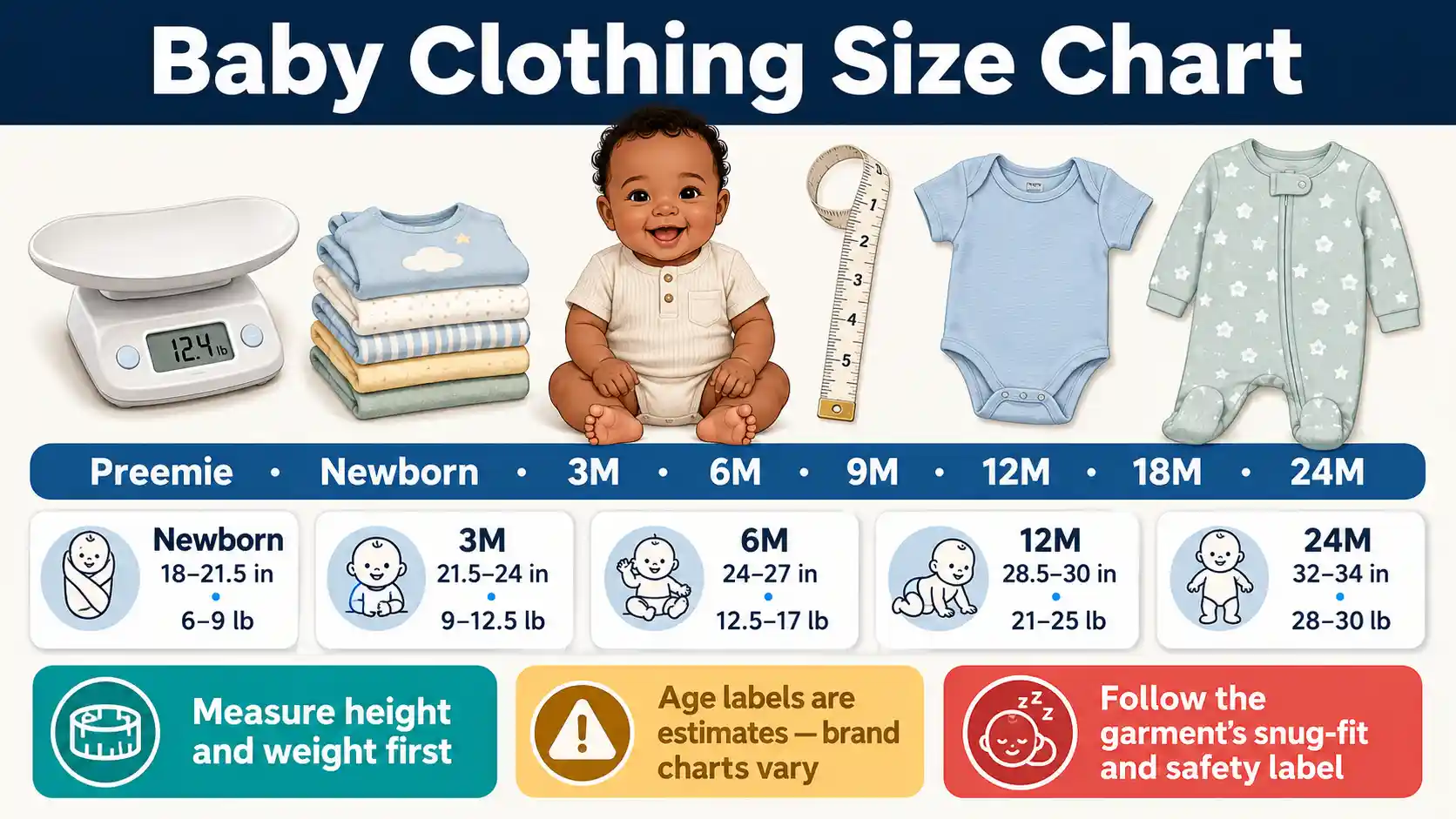
How do you choose the right baby clothing size?
Measure the baby’s current head-to-heel length and weight. Find both measurements on the exact product chart. When they point to different sizes, start with the larger size and check the neckline, torso, diaper room, sleeves, legs, and garment purpose.
The H&M baby measuring guide recommends using height and chest rather than age alone. Age labels remain useful for browsing, but a 6M baby does not automatically need a 6M garment.
Primary measurement
Length or height first
One-piece garments and EU labels depend heavily on head-to-heel length or body height.
Second measurement
Check current weight
Weight helps estimate width, waist, chest, diaper room, and the next likely size band.
Age labels
Useful, not exact
A 6M label usually means up to about six months, but body measurements decide fit.
Fit limit
Purpose changes the fit
Daywear can allow modest growth room; sleepwear must follow its own labeled fit rules.
Quick answers to common baby clothing size questions
These answers explain label meaning and fit decisions. Always compare the exact brand, garment, fabric, and care instructions before buying or continuing to use an item.
What determines baby clothing size?
Current length or height and weight give the best starting size.
Does 3M mean zero to three months?
A 3M label usually means the garment fits up to about three months.
Should I use age or weight?
Use height and weight first; use age only as a secondary estimate.
What if height and weight give different sizes?
Start with the larger size, then check neck, torso, diaper room, and garment purpose.
Is newborn sizing universal?
No. Newborn ranges and cuts differ across brands and product lines.
What does EU size 68 mean?
EU size 68 commonly targets a baby near 68 centimetres tall.
When is a bodysuit too small?
A bodysuit is too small when snaps strain, shoulders pull, or leg openings leave deep marks.
When is a sleeper too short?
A sleeper is too short when toes curl, knees stay bent, or the zipper pulls under tension.
Should I buy 24M or 2T?
Choose 24M for baby proportions and diaper room; compare 2T when a slimmer toddler cut fits better.
Can I size up snug-fit pajamas?
Do not size up snug-fit pajamas solely to create a loose fit.
Do baby clothes shrink?
Some garments shrink or change shape, but fibre, construction, heat, and care instructions control the amount.
Can a clothing label assess growth?
No. Clothing size is a retail fit label, not a child growth assessment.
Baby Clothing Size Chart from Preemie to 24M
These brand-specific body ranges provide a practical starting point for bodysuits and similar garments. Measure the baby and confirm the exact product chart because labels are not standardized across brands.
Swipe horizontally inside the table to view every column.
| Label | Typical label meaning | Length or height | Weight | How to use it |
|---|---|---|---|---|
| Up to 5 lb | Very small preemie range | Up to 17 in (43.2 cm) | Up to 5 lb (2.3 kg) | Use only when the product chart lists this specialized size |
| Preemie | Preemie range | Up to 18 in (45.7 cm) | Up to 6 lb (2.7 kg) | Check NICU or clinician guidance for medically fragile infants |
| Newborn / NB — Common newborn label | Newborn starting size | 18–21.5 in (45.7–54.6 cm) | 6–9 lb (2.7–4.1 kg) | Choose by measurements, not expected birth weight alone |
| 3M or 0–3M | Usually intended through about 3 months | 21.5–24 in (54.6–61.0 cm) | 9–12.5 lb (4.1–5.7 kg) | A label marked 3M often means up to 3 months |
| 6M or 3–6M | Usually intended through about 6 months | 24–27 in (61.0–68.6 cm) | 12.5–17 lb (5.7–7.7 kg) | Move up when length or weight reaches the product limit |
| 9M or 6–9M | Usually intended through about 9 months | 27–28.5 in (68.6–72.4 cm) | 17–21 lb (7.7–9.5 kg) | Check torso length closely in bodysuits and sleepers |
| 12M or 9–12M | Usually intended through about 12 months | 28.5–30 in (72.4–76.2 cm) | 21–25 lb (9.5–11.3 kg) | Allow movement without loose neck or face fabric |
| 18M or 12–18M | Usually intended through about 18 months | 30–32 in (76.2–81.3 cm) | 25–28 lb (11.3–12.7 kg) | Compare diaper room, rise, sleeves, and inseam |
| 24M or 18–24M | Usually intended through about 24 months | 32–34 in (81.3–86.4 cm) | 28–30 lb (12.7–13.6 kg) | Compare with 2T by shape; 24M often allows more diaper room — Compare 24M and 2T shape |
Length and height are shown in inches and centimetres; weight is shown in pounds and kilograms.
- • The numerical ranges above reproduce one current official brand chart; they are not a universal sizing standard.
- • When height and weight point to different sizes, start with the larger size and check the product cut, except where sleepwear instructions require a specific snug fit.
- • Age labels describe an intended band. A baby may wear a younger or older label because growth and garment construction vary.
Download or export
A single-age label usually marks the upper end of a range
A 3M label commonly corresponds to 0–3 months, 6M to 3–6 months, and 12M to 9–12 months. This pattern is common, not universal. EU labels such as 62 or 68 usually reference body height in centimetres, which makes the measurement basis more visible.
Baby Size Label and EU Height Conversion Chart
EU baby sizes commonly reference body height in centimetres, while U.S. labels commonly reference age. Treat this as a label decoder, not an exact cross-brand conversion.
Swipe horizontally inside the table to view every column.
| Approximate age band | Common U.S. label | EU height size | Reference chest | Key caution |
|---|---|---|---|---|
| At birth | Preemie or newborn | 44 | 31.75 cm | Specialized preemie and newborn cuts differ |
| 0–1 month | NB or 0–1M | 50 | 36 cm | Birth weight does not guarantee this size will fit |
| 1–2 months | 0–3M or 1–2M | 56 | 38.5 cm | Compare measured length and chest |
| 2–4 months | 3M or 0–3M | 62 | 43 cm | Age-band endpoints overlap across brands |
| 4–6 months | 6M or 3–6M | 68 — Centimetre-based EU size | 45.5 cm | Sleeper length may become limiting first |
| 6–9 months | 9M or 6–9M | 74 | 47 cm | Diaper room changes the fit of one-piece garments |
| 9–12 months | 12M or 9–12M | 80 | 49.5 cm | Check the product chart before buying ahead |
| 12–18 months | 18M or 12–18M | 86 | 50.75 cm | Toddler cuts may begin to differ by garment |
| 18–24 months | 24M or 18–24M | 92 | 52.5 cm | 24M and 2T are not always interchangeable — 24M differs from 2T |
EU size numbers are centimetre-based body-height labels; chest values are body measurements in centimetres.
- • A garment marked EU 68 is designed around a body height near 68 cm, but ease and cut still vary.
- • Country labels and retailer conversions can differ even when the centimetre size is the same.
- • Use the chart printed by the exact brand and product whenever available.
Download or export
Four-step fit check
The label starts the decision; the body and garment finish it
Measure length
Measure from the top of the head to the bottom of the heel while the baby lies flat.
Check weight
Use a recent weight in the same unit shown by the product chart.
Check the key area
Measure chest, torso, waist, inseam, head, or foot for the garment being bought.
Test the actual fit
Confirm free movement, secure openings, diaper room, and clear fabric around the face.
How to Measure a Baby for Clothing
Use a soft tape and measure over a diaper or thin layer when that matches how the garment will be worn. Keep the tape level and comfortably close to the body.
Swipe horizontally inside the table to view every column.
| Measurement | How to measure | Best used for | Common error |
|---|---|---|---|
| Recumbent length — Primary baby clothing measurement | Lay the baby flat; measure from the top of the head to the bottom of the heel with legs gently straightened | One-piece outfits, sleepers, EU height sizes | Measuring along a bent body or stopping at the ankle |
| Chest | Measure under the arms around the fullest part of the chest | Tops, dresses, jackets, structured outfits | Pulling the tape tight or measuring over bulky clothing |
| Waist | Measure around the natural waist without compressing the abdomen | Pants, leggings, skirts, elastic waistbands | Using the diaper’s widest point as the waist |
| Torso or rise | Measure shoulder to crotch over the diaper area | Bodysuits, rompers, overalls | Ignoring diaper bulk or cloth-diaper volume — Diaper room affects fit |
| Inseam | Measure from crotch seam to ankle or desired hem | Pants and footless sleepers | Using total height when leg proportion is the fit problem |
| Head circumference | Measure above the eyebrows and ears around the widest part of the head | Hats, bonnets, headwear | Choosing by age without checking head size |
| Foot length | Measure heel to longest toe while the foot is relaxed | Booties, socks, soft shoes | Adding excessive growth room or measuring curled toes |
Record measurements in centimetres or inches and keep the same unit throughout one comparison.
- • For infants under age two, body length is normally measured lying down rather than standing.
- • Repeat a surprising measurement before changing sizes.
- • Measure close to purchase time because infants can move through sizes quickly.
Download or export
Baby clothing starting-size finder
Enter current body measurements to find a starting label in the reference chart. The tool runs only in your browser and does not store or transmit the values.
Result
Enter at least one current body measurement, then select Find starting size.
This tool uses one current brand’s bodysuit ranges as a transparent reference. It does not assess growth, diagnose a health concern, or replace the exact garment chart.
Baby Garment Fit Check by Clothing Type
Different garments fail in different places. Check movement, openings, seams, diaper room, and fabric position instead of judging fit from the label alone.
Swipe horizontally inside the table to view every column.
| Garment | Good fit looks like | Too small signs | Too large signs |
|---|---|---|---|
| Bodysuit | Snaps close without pulling; leg openings sit smoothly; baby moves freely | Snaps strain, shoulders pull, deep leg marks appear — Tension shows small fit | Neck gaps, fabric bunches near face, crotch hangs far below diaper |
| Footed sleeper | Toes extend naturally; zipper lies flat; shoulders and crotch are not stretched | Toes curl, knees stay bent, zipper waves under tension | Feet slip out of foot pockets, neckline gaps, fabric twists |
| Top or T-shirt | Shoulder seams sit near shoulders; hem covers torso during movement | Arms bind, hem rides up, neck opening is difficult | Sleeves cover hands, neck opening falls toward shoulders |
| Pants or leggings | Waist stays up without deep marks; diaper and legs move freely | Waist digs in, rise pulls, cuffs restrict ankles | Waist slides down, crotch hangs low, feet catch in hems |
| Jacket or outer layer | Closes over normal layers without compressing chest or neck | Cannot close comfortably, sleeves bind, movement is restricted | Hood or collar obscures face, sleeves cover hands, body twists — Face obstruction risk |
| Hat | Band stays above eyes without leaving deep marks | Band indents skin, ears fold painfully | Hat slips over eyes or rotates easily |
| Socks or booties | Stay on without rings or colour change | Elastic leaves deep grooves, toes compress | Twist, fall off, or create loose fabric around toes |
Fit is assessed by movement, fabric position, seam tension, and pressure marks rather than a numerical unit.
- • Remove or change any garment that restricts breathing, normal movement, circulation, or access to the face.
- • Check fit again after washing and whenever the baby reaches a listed height or weight limit.
- • Loose decorative parts, broken snaps, exposed zipper edges, and detached buttons require immediate removal from use.
Download or export
Size up when the measurement limit or actual fit says so
Move to the next daywear size when the baby reaches a listed height or weight limit, snaps strain, seams pull, toes curl, or elastic leaves deep marks. A larger size must still keep the neckline secure and fabric away from the face. Separate tops and bottoms can solve mismatched torso and leg proportions.
When to Size Up Baby Clothes
Use the larger starting size when the baby crosses a product limit or the garment shows tension. Do not automatically add growth room to snug-fit sleepwear.
Swipe horizontally inside the table to view every column.
| Situation | Recommended action | Why | Exception or check |
|---|---|---|---|
| Height fits one size; weight fits the next | Start with the larger size | The smaller band may pull across torso, waist, or diaper | Check neck and face openings for excess looseness |
| Weight fits one size; length fits the next | Start with the longer size | One-piece garments often become short before they become narrow | Separate tops and bottoms may need different sizes |
| Baby is at the upper limit | Buy the next size for future daywear | The current size may have little remaining ease after washing | Use the current size if it still fits safely and comfortably |
| Baby uses a bulky cloth diaper | Check rise and torso length; consider the next size | Diaper volume changes crotch depth and snap tension | Avoid an overly loose neckline |
| Garment is 100% cotton and not preshrunk | Allow for possible shrinkage | Heat and laundering can reduce dimensions | Follow the care label; do not assume every cotton garment shrinks equally |
| Buying a gift months ahead | Use expected season plus current growth trend | Age label alone may miss body size and weather needs | Keep receipts and avoid removing tags early |
| Snug-fit sleepwear | Follow the exact labeled body range — Do not loosen snug-fit sleepwear | Intentional close fit supports the garment’s safety design | Do not size up solely for a loose fit |
| Loose fabric reaches the face | Do not use the garment yet — Stop using loose face fabric | Excess fabric can obstruct vision or breathing | Choose a smaller size or different cut |
Size decisions use product limits, fit observations, fabric behavior, and garment purpose.
- • A larger number is not always simply longer; brands may change width, rise, sleeves, and proportions.
- • Two-piece outfits can solve mismatched top and bottom measurements.
- • A good fit allows normal movement without tight pressure points or loose fabric near the face.
Download or export
Sleepwear fit must follow the label and room conditions
The U.S. Consumer Product Safety Commission infant garment and sleepwear guidance explains that children’s sleepwear has specific flammability and product-use rules. Follow the sewn-in label. Do not make snug-fit pajamas loose merely to extend wear.
The American Academy of Pediatrics safe-sleep evidence base advises dressing infants for the environment, avoiding overbundling, and checking for sweating, flushed skin, or a hot chest.
Baby Sleepwear Fit and Safety Chart
Sleep clothing must fit the baby, suit the room temperature, and follow the garment label. Size guidance cannot replace safe-sleep practices.
Swipe horizontally inside the table to view every column.
| Check | Safer choice | Avoid | Action |
|---|---|---|---|
| Temperature | Use light, appropriate layers for the room | Overbundling, heavy indoor hats, or excessive layers — Avoid overbundling | Check chest temperature, sweating, and flushed skin |
| Fit | Follow the product’s labeled body range | Sizing up snug-fit pajamas to make them loose | Replace when the baby reaches the listed limit |
| Face and head | Keep clothing and fabric below the face | Loose collars, hoods, bibs, or fabric that can cover the face — Keep face clear | Remove the item before sleep |
| Fasteners | Use intact zippers, snaps, and seams | Broken snaps, loose buttons, sharp zipper edges | Stop use until repaired safely or discarded |
| Cords and ties | Choose garments without hazardous neck or hood cords | Drawstrings, long ties, loops, and loose attachments — Cord hazard | Remove the garment from use |
| Flammability label | Follow the garment’s sleepwear and fit instructions | Treating all daywear as suitable sleepwear | Check local requirements and the sewn-in label |
| Sleep surface | Use sleep clothing with a firm, flat sleep surface | Replacing safe-sleep setup with clothing claims | Follow current infant safe-sleep guidance |
Safety checks use garment labeling, body fit, room conditions, and visible hazards.
- • The American Academy of Pediatrics advises no more than one extra clothing layer compared with what an adult would wear comfortably in the same environment.
- • Sweating, flushed skin, or a hot chest can signal overheating.
- • Breathing difficulty, blue or grey lips, unusual limpness, or severe overheating symptoms require urgent medical help.
Download or export
Fabric and laundry can change the usable size
Cotton knit can relax during wear and shrink with heat. Fleece adds interior bulk. Rib knit may stretch across the chest while remaining short in the torso. Second-hand clothing may no longer match its original label, so measure the garment and inspect every seam, snap, zipper, and elastic opening.
Fabric, Laundry and Baby Clothing Fit Changes
Fabric composition, knit structure, washing, drying, and repeated wear can change fit. The care label controls how a specific garment should be cleaned.
Swipe horizontally inside the table to view every column.
| Factor | Possible fit effect | Practical response | Do not assume |
|---|---|---|---|
| Cotton knit | May relax during wear and shrink with heat or laundering | Wash before final fit decisions when the label permits | Every cotton garment shrinks by the same amount |
| Elastane or spandex blend | Adds stretch and recovery | Check whether seams and openings still sit comfortably | Stretch can compensate for an undersized torso |
| Fleece or quilted fabric | Adds bulk and reduces usable interior space | Check fit over normal layers | The same labeled size fits like a thin bodysuit |
| Rib knit | Can stretch across width while remaining short in torso | Check shoulder-to-crotch length separately | A stretchy chest means the garment is long enough |
| Hot tumble drying | Can increase shrinkage or damage elastic — Heat may change fit | Use the care-label setting | Higher heat always improves hygiene without affecting fit |
| Air drying | May reduce heat-related shrinkage | Reshape gently and dry as directed | Air drying fixes a garment already too small |
| Second-hand clothing | May already be shrunk, stretched, or worn | Measure the garment and inspect all closures | The original size label still predicts current dimensions — Second-hand label may mislead |
| Repeated washing | Can change softness, elastic recovery, and seam shape | Recheck pressure points and loose components | A previously safe fit remains unchanged |
Fabric behavior is qualitative and depends on fibre, knit, construction, care instructions, and prior use.
- • Measure the actual garment when buying second-hand or comparing two brands with the same label.
- • Do not use damaged sleepwear, loose fasteners, or stretched neck openings.
- • Keep laundering products and care choices appropriate for the baby’s skin and the garment label.
Download or export
Common baby clothing sizing mistakes
Buying only by age
Babies of the same age can have different length, weight, chest, torso, and leg proportions. Use age to browse, then use measurements to choose.
Assuming every brand matches
A 6M garment from one brand can match the dimensions of a 3–6M or 6–9M garment elsewhere. Compare body ranges and actual garment measurements.
Ignoring torso and diaper room
Bodysuits and rompers can become short before sleeves or width look small. Check shoulder-to-crotch length and the diaper type.
Adding unlimited growth room
Excess fabric can cover hands, feet, eyes, or the face. Growth room must preserve secure openings, free movement, and the intended sleepwear fit.
Special fit cases need the garment, body, and purpose together
Premature or medically fragile infants: use specialized clothing only when it suits current care needs, access points, monitoring equipment, skin, temperature, and professional guidance.
Cloth diapers: compare rise and torso length because added diaper volume can strain bodysuit snaps and reduce room in pants or sleepers.
Long or short torso: separates can fit better than one-piece garments. Choose tops and bottoms independently when proportions cross size bands.
Mobility changes: crawling and walking increase the importance of secure hems, uncovered hands and feet, flexible knees, and fabric that does not catch.
Frequently asked questions
What size baby clothes should I buy?
Choose the size that fits the baby’s current length or height and weight on the exact brand chart. Use age only as a secondary estimate.
Does 3M mean zero to three months?
Usually, yes. A label marked 3M commonly means the garment is intended to fit up to about three months, but the brand’s body ranges control.
Should I choose baby clothes by weight or height?
Use both. Height often controls one-piece length, while weight and chest affect width, waist, and diaper room.
What should I do when height and weight suggest different sizes?
Start with the larger size and check the neckline, face clearance, sleeves, and garment purpose. Follow exact fit instructions for sleepwear.
Is newborn size the same in every brand?
No. Newborn labels vary by body range, cut, fabric, and product line, so compare the exact size chart before buying.
What is the difference between 24M and 2T?
24M often keeps more diaper room and baby proportions, while 2T may use a slimmer toddler cut. The difference is brand-specific.
When should a baby move to the next clothing size?
Move up when the baby reaches a listed height or weight limit or when seams pull, snaps strain, toes curl, or pressure marks appear.
How much growth room should baby clothes have?
Daywear can have modest room for movement and growth, but neck openings must stay secure and fabric must not reach the face. Snug-fit sleepwear should follow its label.
How do I measure a baby for clothes?
Measure recumbent head-to-heel length, chest under the arms, and the garment-specific area such as torso, waist, inseam, head, or foot.
Do baby clothes shrink after washing?
Some garments can shrink or change shape, especially with heat, but the amount depends on fibre, knit, construction, and care instructions.
Can I size up baby pajamas for longer use?
Do not size up snug-fit sleepwear merely to create a loose fit. Follow the product’s labeled body range and safety instructions.
How many newborn outfits should I buy before birth?
Buy a limited starter set because birth size and growth rate are uncertain. Keep larger sizes available and retain receipts where practical.
Are EU baby sizes based on centimetres?
Yes. EU labels such as 56, 62, or 68 commonly reference body height in centimetres, although garment cut still varies.
What signs show that baby clothes are too tight?
Strained snaps, pulling seams, curled toes, restricted movement, deep elastic marks, or colour change below an opening show that the garment may be too tight.
What signs show that baby clothes are too large?
Fabric over the face, slipping necklines, sleeves covering hands, feet leaving sleeper pockets, or clothing that twists around the body show excessive looseness.
Can clothing size show whether a baby is growing normally?
No. Clothing size is a retail fit label, not a growth assessment. Use measured growth over time and professional guidance for health questions.
Sources
These official size guides, infant measurement resources, consumer-product safety pages, and pediatric safe-sleep recommendations support the sizing, fit, and safety guidance.
Carter's — Kids Clothing Size Chart
https://www.carters.com/size-chart
Provides current brand-specific height and weight ranges for preemie, newborn, 3M through 24M bodysuits, pajamas, outerwear, and accessories.
H&M — Kids Size Guide
https://www.hm.com/bh/customer-service/sizeguide/kids/
Lists baby sizes from EU 44 through 92 with age bands and chest measurements for children from birth through 24 months.
H&M — Baby Size Guide: Find the Right Size
https://www2.hm.com/en_hk/baby/hm-baby/4107a-life-with-baby-landing-page/4107d-baby-size-guide.html
Advises choosing baby clothing by measured height and chest rather than age alone and explains how to measure head-to-heel length and chest.
U.S. Consumer Product Safety Commission — Infant Garments and Tight-fitting Sleepwear Garments
https://www.cpsc.gov/FAQ/Infant-Tightfitting-Garments
Explains current U.S. requirements for infant garments, age-based size labels, tight-fitting sleepwear dimensions, flammability rules, hangtags, and permanent labels.
U.S. Consumer Product Safety Commission — Drawstrings in Children's Upper Outerwear
https://www.cpsc.gov/FAQ/Drawstrings-in-Children%E2%80%99s-Upper-Outerwear
Explains the strangulation and entanglement hazards associated with neck, hood, waist, and bottom drawstrings in children’s outerwear.
American Academy of Pediatrics — 2022 Safe Infant Sleep Evidence Base
https://publications.aap.org/pediatrics/article/150/1/e2022057991/188305/Evidence-Base-for-2022-Updated-Recommendations-for
Advises dressing infants for the ambient temperature, avoiding overbundling, and checking for sweating, flushed skin, or a hot chest.
Centers for Disease Control and Prevention — Using WHO Growth Standard Charts
https://www.cdc.gov/growth-chart-training/hcp/using-growth-charts/who-using.html
Distinguishes recumbent length from standing height and recommends standard measurement protocols for infants and children under age two.