Health & Medical · Oxygen saturation reference
Blood Oxygen Level Chart: SpO₂ Ranges, Symptoms, and Next Steps
Compare normal and low blood oxygen levels, understand pulse-oximeter readings, review COPD and clinical target ranges, identify measurement errors, and know when symptoms need urgent medical care.
A pulse-oximeter number is not a diagnosis. Severe breathing difficulty, chest pain, blue or gray color, confusion, collapse, or inability to wake requires emergency help regardless of the displayed value. Do not change prescribed oxygen without a written care plan. Read the ChartsLoom Disclaimer.
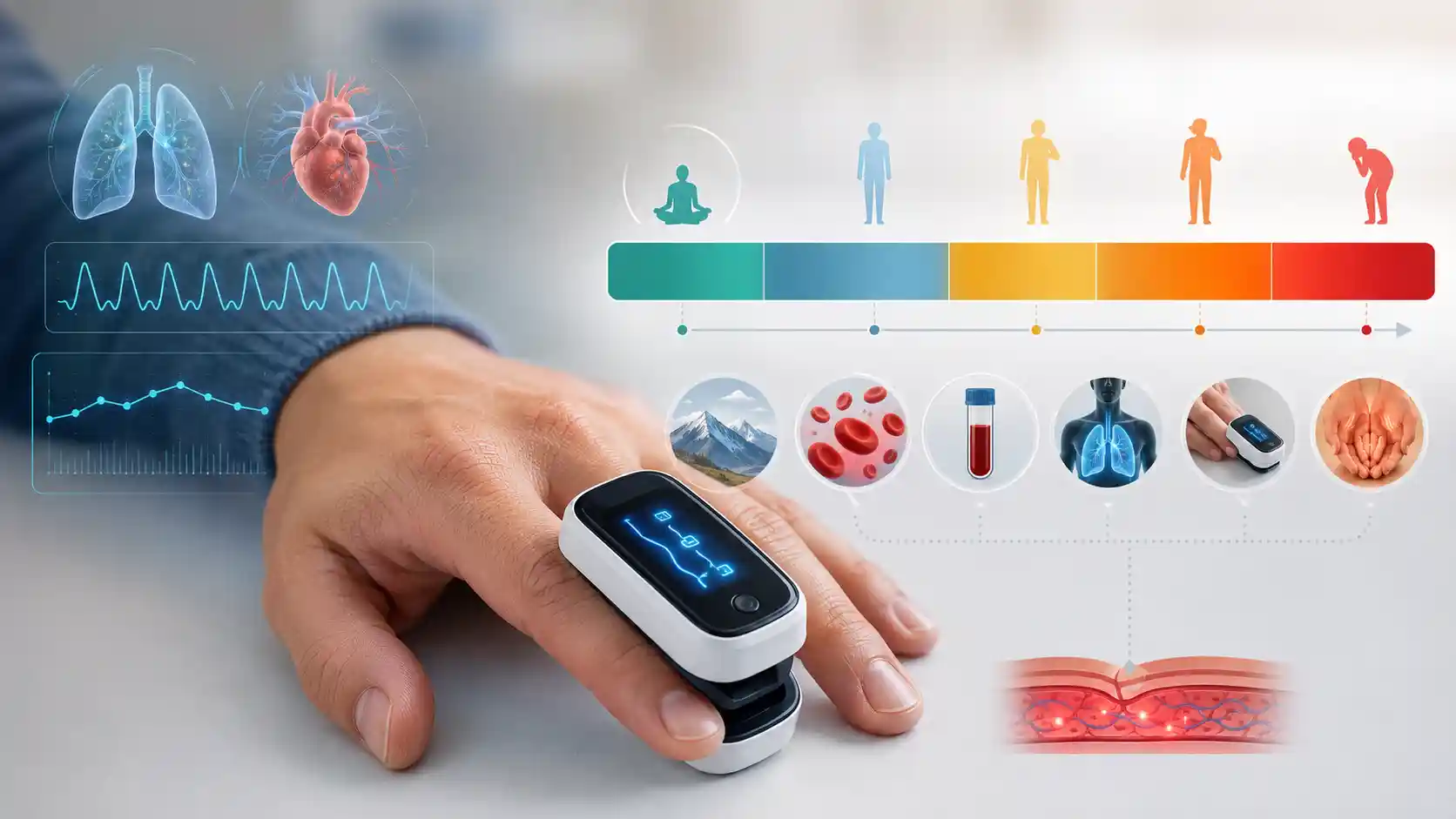
What blood oxygen level is normal?
For many healthy adults near sea level, a resting SpO₂ of 95–100% is usual. General home guidance recommends contacting a healthcare professional at 92% or lower and seeking immediate attention at 88% or lower.
These values are reference points, not universal targets. A person’s normal blood oxygen level can differ because of altitude, chronic lung disease, congenital heart disease, sleep, activity, or a clinician-prescribed oxygen range. Symptoms and a repeated trend matter more than a single unstable reading.
- Usual adult range
- 95–100%
- Contact threshold
- 92% or lower
- Immediate attention
- 88% or lower
- Most useful signal
- Trend + symptoms
Many healthy adults near sea level rest in this range, but altitude, chronic disease, symptoms, and individual targets can change interpretation.
General home guidance recommends contacting a healthcare professional when a confirmed reading is 92% or lower.
A confirmed reading at or below 88% needs immediate medical attention under general home guidance.
A series of stable readings under similar conditions is more meaningful than one isolated value or a fluctuating display.
How to read an SpO₂ result safely
- 1. Confirm the signal. Warm the hand, sit still, remove nail interference, and wait for a stable number.
- 2. Compare with baseline. Note altitude, activity, body position, oxygen setting, and the person’s usual range.
- 3. Check symptoms. Breathing effort, chest pain, color, alertness, and rapid change can matter more than the screen.
- 4. Follow the care plan. Use clinician-set thresholds when available and never self-adjust prescribed oxygen outside that plan.
Blood oxygen level chart for adults at low altitude
This home pulse-oximeter chart organizes resting SpO₂ values for most adults near sea level. Symptoms, trends, altitude, lung disease, prescribed oxygen targets, and device accuracy can change the correct response.
Swipe horizontally inside the table to view every column.
| SpO₂ reading | General interpretation | Practical next step | Important context |
|---|---|---|---|
| 95–100% | Usual resting range for many healthy adults near sea level. | Record the stable reading when monitoring was recommended. Continue watching symptoms and the trend. | A normal display does not rule out every breathing, heart, circulation, or blood problem. |
| 93–94% | Lower than the usual range for many healthy adults. | Repeat the measurement carefully after resting. Contact a clinician if it persists, falls, or occurs with symptoms. | Some people have a different baseline because of altitude or chronic cardiopulmonary disease. |
| 92% or lower — Contact healthcare professional | Low oxygen saturation that needs professional advice under general home guidance. | Contact a healthcare professional promptly. Follow a pre-existing action plan when one has been prescribed. | Do not increase or decrease prescribed oxygen flow unless the care plan specifically tells you to do so. |
| 88% or lower — Immediate medical attention | Severely low under general home guidance. | Seek immediate medical attention, especially when the reading is confirmed or symptoms are present. | Emergency symptoms override the number. Call local emergency services for severe breathing difficulty, blue or gray color, confusion, collapse, or inability to wake. |
| Any value with severe symptoms | A potentially serious emergency even when the screen looks normal. | Call local emergency services for severe shortness of breath, chest pain, blue or gray lips or face, confusion, fainting, or rapidly worsening illness. | Pulse oximeters estimate oxygen saturation and can miss deterioration or produce a falsely reassuring value. |
SpO₂ means peripheral oxygen saturation and is displayed as a percentage.
- • These thresholds summarize general public guidance, not a personalized oxygen prescription or diagnosis.
- • A pulse oximeter may differ from actual arterial saturation by several percentage points. Use the whole clinical picture and repeat an unexpected value correctly.
- • People with clinician-set targets, chronic respiratory failure, congenital heart disease, or high-altitude exposure need individualized interpretation.
Download or export
Visual blood oxygen saturation scale
This scale summarizes general home guidance for resting adults near sea level. A prescribed target, altitude, chronic disease, symptoms, or an inaccurate signal can change the interpretation.
95–100%
Usual range
Common resting range for many healthy adults near sea level
93–94%
Repeat and review
Lower than usual for many healthy adults; confirm technique and trend
≤92%
Contact a clinician
General home guidance recommends prompt professional advice
≤88%
Immediate attention
Seek immediate medical care when confirmed or accompanied by symptoms
For many healthy adults near sea level, 95–100% is usual. Under general home guidance, contact a clinician at 92% or lower and seek immediate attention at 88% or lower.
Call emergency services for severe breathing difficulty, chest pain, blue or gray color, confusion, collapse, or inability to wake—even if the oximeter appears normal.
Chart sources: MedlinePlus pulse-oximetry guidance and FDA pulse-oximeter guidance.
Blood oxygen reading context checker
Organize a measured SpO₂ value using general adult guidance, an existing clinician-set target, or altitude context. The tool does not diagnose illness or prescribe oxygen.
Enter a stable pulse-oximeter reading from 50% to 100%. Correct cold hands, motion, placement, and nail interference before interpreting an unexpected value.
Within the usual adult reference range
A stable 95–100% reading is usual for many healthy adults near sea level, but it does not rule out every heart, lung, blood, or circulation problem.
Safety limit: Do not use this tool to decide whether to start, stop, or change supplemental oxygen. Severe breathing difficulty, chest pain, blue or gray color, confusion, collapse, or inability to wake requires emergency help regardless of the displayed value.
Can oxygen be low without obvious symptoms?
Yes. Hypoxemia can be subtle, and some people do not feel as breathless as the reading suggests. The opposite also occurs: severe breathlessness can happen with a normal SpO₂.
This is why clinicians combine oxygen saturation with respiratory rate, work of breathing, heart rate, blood pressure, temperature, mental status, examination, laboratory tests, and medical history. A fingertip device answers one narrow question and cannot replace a full assessment.
Low oxygen symptoms and action chart
Symptoms can appear before, during, or without a low pulse-oximeter reading. The safest response depends on severity, progression, and the person’s medical plan—not one number alone.
Swipe horizontally inside the table to view every column.
| Sign or symptom | Possible meaning | Action | Why the number may not be enough |
|---|---|---|---|
| Mild breathlessness that resolves with rest | Exertion, illness, airway narrowing, deconditioning, anxiety, anemia, or another cause may be involved. | Rest, measure correctly if advised, and contact a clinician if the symptom is new, recurrent, or worsening. | SpO₂ can remain normal in some causes of breathlessness. |
| Persistent shortness of breath or fast breathing | The lungs or circulation may not be meeting the body’s oxygen needs. | Seek prompt clinical advice, especially with a falling reading, fever, wheeze, or reduced activity. | A single stable-looking value may lag behind a changing condition. |
| Chest pain, pressure, or tightness | A heart, lung, vascular, or other urgent condition may be present. | Use emergency services when pain is severe, persistent, new, or accompanied by sweating, fainting, or breathing difficulty. | A normal oxygen saturation does not exclude a heart attack, pulmonary embolism, or other emergency. |
| Blue or gray lips, face, or nails | Cyanosis can signal inadequate oxygenation or circulation. | Call local emergency services, particularly when the change is new or accompanied by breathing difficulty. | Color changes can be harder to recognize across skin tones and lighting conditions. |
| Confusion, unusual drowsiness, collapse, or inability to wake | The brain may not be receiving enough oxygen, or another critical illness may be present. | Call local emergency services immediately. | Do not wait for a lower reading or repeated measurement. |
| Severe breathing difficulty, gasping, or inability to speak normally | Respiratory failure or another life-threatening problem may be developing. | Call local emergency services immediately and follow dispatcher instructions. | Movement, poor perfusion, and cold skin can make the device inaccurate during an emergency. |
Actions are symptom based and apply regardless of the displayed SpO₂ value.
- • Use local emergency numbers and follow an existing asthma, COPD, oxygen, or cardiac action plan when available.
- • Do not delay care to search for a pulse oximeter or to obtain a “perfect” reading.
Download or export
When should you call emergency services?
Call for severe breathing difficulty, chest pain, blue or gray lips or face, confusion, collapse, inability to wake, gasping, or a rapidly worsening condition.
Do not delay emergency care to warm the hand, compare fingers, change batteries, or repeat the reading multiple times. A normal-looking number can be inaccurate or fail to show the cause of a critical symptom.
Oxygen saturation target ranges by clinical context
Treatment targets differ from general home reference ranges. Clinicians choose a target after considering diagnosis, blood gases, carbon-dioxide retention risk, altitude, and oxygen prescription.
Swipe horizontally inside the table to view every column.
| Context | Common reference or target | How to use it | Safety limitation |
|---|---|---|---|
| Healthy adult resting near sea level | Often 95–100% | Use as a general reference when no different baseline or target has been established. | Symptoms and trends still matter, and an oximeter is not a complete cardiopulmonary assessment. |
| Most acutely ill patients not at risk of hypercapnic respiratory failure | Clinical target often 94–98% | Healthcare teams titrate oxygen toward the prescribed range while evaluating the cause of illness. | This is a monitored clinical target, not instructions for unsupervised home oxygen changes. |
| Known COPD or another risk factor for hypercapnic respiratory failure during acute illness | Clinical target often 88–92% pending blood gas results — Clinician-set controlled oxygen range | A controlled lower target can reduce the risk of excessive oxygen worsening carbon-dioxide retention in susceptible patients. | Only a qualified clinician should set this target. COPD does not automatically mean every home reading of 88–92% is acceptable. |
| Long-term home oxygen therapy | Individual prescription | Follow the prescribed flow rate, duration, activity setting, and target from the treating team. | Do not change flow based only on a consumer oximeter unless the written care plan allows it. |
| High altitude or recent ascent | Lower than the person’s sea-level baseline may occur | Interpret the reading with altitude, symptoms, acclimatization, exertion, and medical history. | Severe headache, confusion, loss of coordination, breathlessness at rest, or cough can indicate altitude illness even without a fixed cutoff. |
| Infant or child | Age, diagnosis, sleep state, altitude, and care setting determine the target | Use pediatric equipment, clinician guidance, and age-appropriate assessment. | Do not apply an adult home threshold to a newborn, premature infant, or child with heart or lung disease. |
Targets are percentages of oxygen saturation. Clinical oxygen prescriptions may also specify flow in liters per minute or device settings.
- • The 94–98% and 88–92% ranges come from acute-care oxygen guidance and require clinical context.
- • People who retain carbon dioxide may need arterial blood gas testing because pulse oximetry does not measure carbon dioxide.
Download or export
Why can an oxygen target be lower with COPD?
Some people with COPD or another cause of chronic respiratory failure can retain carbon dioxide. During acute illness, clinicians may use a controlled target of 88–92% while obtaining arterial blood gases. Excess oxygen can worsen carbon-dioxide retention in susceptible patients.
The range is not a blanket “normal COPD oxygen level.” Many people with COPD do not need that target, and some need a different plan. A healthcare professional must identify the risk, prescribe oxygen, and explain when to call for help.
How to take an accurate pulse oximeter reading
Good technique reduces avoidable error. Repeat an unexpected result after correcting the measurement conditions, but do not delay urgent care when symptoms are severe.
Swipe horizontally inside the table to view every column.
| Step | What to do | Why it matters | Common mistake |
|---|---|---|---|
| 1. Prepare | Rest for several minutes and follow the device instructions. | Recent exertion can temporarily change pulse and oxygen readings. | Measuring immediately after walking, climbing stairs, or coughing. |
| 2. Warm the hand | Use a warm, relaxed hand with adequate circulation. | Cold fingers and poor perfusion can weaken the optical signal. | Using a cold or tightly clenched hand. |
| 3. Remove interference | Remove nail polish or artificial-nail material from the measured finger when possible. | Colored or thick material can interfere with the light path. | Assuming every finger gives the same quality signal. |
| 4. Position correctly | Place the sensor fully on the finger and keep the hand relaxed below heart level. | Consistent placement helps the detector receive a stable signal. | Holding the hand high, pressing the sensor loosely, or using the wrong probe size. |
| 5. Stay still | Avoid talking, shaking, or moving until the display stabilizes. | Motion can create erratic pulse and saturation values. | Recording the first flashing number. |
| 6. Check signal and pulse | Wait for one steady reading and compare the displayed pulse with how the person feels. | A mismatched or implausible pulse can suggest poor signal quality. | Ignoring an unstable waveform, signal icon, or rapidly changing value. |
| 7. Record context | Note the value, pulse, time, symptoms, body position, oxygen setting, and activity. | Trends are more useful when measurements are comparable. | Comparing readings taken under very different conditions without noting them. |
| 8. Repeat or escalate | Repeat an unexpected reading once or twice with corrected technique; act immediately for severe symptoms. | Confirmation can identify device error, while symptoms protect against false reassurance. | Repeating continuously instead of seeking help during deterioration. |
Most fingertip devices display SpO₂ (%) and pulse rate (beats per minute).
- • Use a device suitable for the person and measurement site. Pediatric and neonatal monitoring can require specialized sensors.
- • Follow the manufacturer’s instructions and the monitoring schedule given by the healthcare team.
Download or export
Why does a pulse oximeter jump between numbers?
The sensor looks for a pulsating light signal in arterial blood. Cold fingers, motion, poor circulation, loose placement, bright light, nail products, tremor, and weak pulse amplitude can make the estimate jump. The first number displayed is often less useful than a stable value reached after several seconds.
Compare the displayed pulse with the person’s actual pulse and how they feel. A wildly changing saturation paired with an implausible pulse often signals poor measurement quality. Persistent low readings or concerning symptoms still need professional assessment after technique is corrected.
Pulse oximeter accuracy and false-reading factors
Pulse oximeters estimate arterial oxygen saturation with light. Device design, physiology, environment, and technique can make the displayed number higher or lower than the true value.
Swipe horizontally inside the table to view every column.
| Factor | How it can affect the reading | How to reduce error | When to seek confirmation |
|---|---|---|---|
| Poor circulation or low perfusion | The signal can become weak, unstable, or inaccurate. | Warm the hand, relax, reposition, and use a clinician-approved site or sensor. | Persistent low or inconsistent values, shock, severe illness, or cold extremities. |
| Skin pigmentation and optical bias | Some devices may overestimate saturation more often in people with darker skin pigmentation, especially at lower saturations. — Potential occult hypoxemia risk | Use trends, symptoms, a validated device, and clinical confirmation rather than relying on one number. | Symptoms conflict with the reading, the value is falling, or treatment decisions depend on precision. |
| Skin thickness, temperature, or swelling | Light transmission and blood flow at the sensor site may change. | Use the correct probe and site; warm cold skin and avoid compressed tissue. | The device cannot obtain a stable signal. |
| Movement, tremor, or shivering | Motion can mimic the pulsatile signal and produce fluctuating results. | Keep still, support the hand, and wait for stability. | A reliable reading cannot be obtained during symptoms. |
| Nail polish or artificial nails | Pigment or material can interfere with emitted and detected light. | Remove the material or use another approved site. | Unexpected low or high values persist after correction. |
| Bright ambient light | Strong external light can interfere with some sensors. | Shield the sensor from direct bright light without restricting circulation. | The display remains unstable or implausible. |
| Tobacco use or carbon monoxide exposure | Carboxyhemoglobin can make conventional pulse oximetry look falsely reassuring. — Possible falsely normal value | Treat suspected smoke or carbon monoxide exposure as a medical issue, not a home-oximeter problem. | Headache, dizziness, nausea, confusion, chest pain, or known exposure requires urgent assessment. |
| Abnormal hemoglobin such as methemoglobin | Standard two-wavelength pulse oximetry may not distinguish abnormal hemoglobin species correctly. | Clinical co-oximetry may be required. | Exposure to oxidizing chemicals or medicines, cyanosis, or unexplained symptoms. |
| Consumer wellness device quality | Some products are not reviewed for clinical decision-making and may perform differently from prescription devices. | Check labeling, intended use, validation, and clinician recommendations. | Do not base oxygen treatment or emergency decisions on an unvalidated device alone. |
MedlinePlus notes that pulse-oximeter results may be about 2–4 percentage points higher or lower than the actual blood oxygen level.
- • Accuracy generally becomes more important and more challenging at lower oxygen saturations.
- • Do not use skin color, nail color, or device brand as a substitute for symptoms and professional evaluation.
Download or export
Skin pigmentation can affect pulse-oximeter accuracy
FDA materials warn that pulse oximeters may be less accurate in people with darker skin pigmentation. Some devices can overestimate saturation, creating “occult hypoxemia,” where the arterial oxygen is lower than the screen suggests.
No home correction formula can reliably fix this bias. Use symptoms, trends, a clinically validated device, and professional confirmation when the reading affects treatment or does not match the person’s condition.
SpO₂, SaO₂, PaO₂, and arterial blood gas comparison
Oxygen-related abbreviations describe different measurements. They cannot be converted with one fixed formula because the oxygen–hemoglobin relationship changes with physiology and illness.
Swipe horizontally inside the table to view every column.
| Measure | What it represents | How it is obtained | What it does not show |
|---|---|---|---|
| SpO₂ | Peripheral oxygen saturation estimated by a pulse oximeter | Noninvasive light sensor on a finger, toe, ear, forehead, or another approved site | Does not directly measure oxygen pressure, carbon dioxide, pH, hemoglobin concentration, or oxygen delivery. |
| SaO₂ | Arterial oxygen saturation measured from arterial blood | Laboratory analysis of an arterial sample, often with co-oximetry | Does not by itself describe ventilation, acid–base balance, or total oxygen content. |
| PaO₂ | Partial pressure of dissolved oxygen in arterial blood | Arterial blood gas analysis | Does not equal SpO₂ and does not have a constant one-to-one conversion across the full range. |
| PaCO₂ | Partial pressure of carbon dioxide in arterial blood | Arterial blood gas analysis | Cannot be estimated from a normal pulse-oximeter value. |
| Arterial pH and bicarbonate | Acid–base status and metabolic compensation | Arterial blood gas and chemistry analysis | Not measured by a fingertip oximeter. |
| Oxygen content and delivery | The amount of oxygen carried in blood and delivered to tissues | Calculated from hemoglobin, saturation, dissolved oxygen, and cardiac output | A normal SpO₂ cannot exclude severe anemia or low blood flow. |
SpO₂ and SaO₂ are percentages; PaO₂ and PaCO₂ are commonly reported in mmHg.
- • An arterial blood gas provides more information than pulse oximetry and may be needed when carbon-dioxide retention, acid–base disturbance, severe illness, or measurement bias is suspected.
- • The oxygen dissociation curve is nonlinear; temperature, pH, carbon dioxide, and abnormal hemoglobin can shift the relationship.
Download or export
A normal SpO₂ does not guarantee normal oxygen delivery
Saturation describes what percentage of available hemoglobin binding sites carry oxygen. It does not show how much hemoglobin is present or how much blood the heart delivers. Severe anemia can reduce oxygen content even when SpO₂ remains normal.
Pulse oximetry also cannot measure carbon dioxide or acid–base balance. An arterial blood gas may be necessary when a person is very ill, at risk of carbon-dioxide retention, or showing symptoms that the fingertip reading cannot explain.
Altitude and blood oxygen interpretation chart
Atmospheric oxygen pressure falls as elevation increases. Healthy people can show lower saturations than at sea level, but symptoms and the speed of ascent determine whether the change is expected acclimatization or altitude illness.
Swipe horizontally inside the table to view every column.
| Situation | Expected direction | What to watch | Safer response |
|---|---|---|---|
| Recent arrival at moderate or high altitude | SpO₂ may fall below the person’s sea-level baseline. | Headache, fatigue, poor sleep, nausea, dizziness, and reduced exercise tolerance. | Ascend gradually, limit exertion during acclimatization, and follow travel-health guidance. |
| Reading improves after rest | Exertion-related decline may partially recover. | Whether symptoms also resolve and the value stabilizes. | Continue monitoring only when advised; avoid further ascent if symptoms persist. |
| Worsening headache, vomiting, confusion, or loss of coordination | May indicate severe altitude illness rather than normal acclimatization. | Neurologic changes and rapid deterioration. | Descend and obtain urgent medical help. Do not ascend further. |
| Breathlessness at rest, cough, chest tightness, or marked weakness | May indicate high-altitude pulmonary edema or another cardiopulmonary emergency. | Falling saturation, rapid breathing, inability to walk normally, or blue/gray color. | Descend, use emergency oxygen when available and trained to do so, and seek emergency care. |
| Known heart, lung, blood, or sleep-related condition | The person may tolerate altitude less well. | Symptoms, medication needs, oxygen prescription, and travel plan. | Discuss altitude travel with a clinician before ascent. |
| Comparing devices or people at altitude | Values can differ because of physiology, technique, and device performance. | Trend within the same person and device under similar conditions. | Do not use another person’s reading as a personal target. |
Altitude is commonly expressed in feet or meters above sea level; SpO₂ remains a percentage.
- • There is no single “normal oxygen level by altitude” table that safely applies to every traveler.
- • Pulse oximetry can support assessment but cannot replace symptoms, examination, or descent when altitude illness is suspected.
Download or export
What is a normal oxygen level at high altitude?
There is no single safe SpO₂-by-altitude number for every person. Oxygen saturation usually falls after ascent, but elevation, acclimatization, exertion, sleep, age, health conditions, and device accuracy change the result.
Watch symptoms and the direction of change. Worsening headache, confusion, loss of coordination, breathlessness at rest, cough, chest tightness, or inability to walk normally can indicate severe altitude illness. Do not ascend further; descend and obtain urgent help.
Blood oxygen monitoring by health situation
Pulse oximetry can answer a limited question: what peripheral saturation is estimated at this moment? The meaning changes with the condition, baseline, symptoms, and treatment plan.
Swipe horizontally inside the table to view every column.
| Situation | What SpO₂ can add | What else matters | Key caution |
|---|---|---|---|
| Respiratory infection or pneumonia | Shows whether saturation is low or trending downward. | Breathing effort, respiratory rate, fever, hydration, chest pain, age, and overall condition. | A normal reading does not rule out early or localized disease. |
| Asthma or allergy-related breathing symptoms | May identify significant oxygen compromise during a severe episode. | Wheeze, speech, chest retractions, peak flow, rescue-medicine response, and the action plan. | Do not delay asthma treatment or emergency care because SpO₂ looks normal. |
| COPD | Helps track the prescribed saturation range and response to activity or oxygen. | Baseline, carbon-dioxide retention risk, blood gases, medicines, sputum, and exacerbation plan. | Never assume 88–92% is the correct personal target without clinician confirmation. |
| Heart failure or cardiac disease | Can detect accompanying low saturation. | Chest pain, swelling, weight change, heart rate, blood pressure, rhythm, and exercise tolerance. | Normal SpO₂ does not exclude a cardiac emergency or poor circulation. |
| Sleep-related breathing disorder | Overnight trends may support evaluation when a validated recording device is used. | Sleep study data, airflow, breathing effort, heart rate, sleep stage, and symptoms. | A consumer spot-check cannot diagnose sleep apnea. |
| Anemia | May remain normal because it measures the percentage of available hemoglobin carrying oxygen. | Hemoglobin concentration, symptoms, bleeding, heart rate, and laboratory testing. | Normal saturation does not prove normal oxygen content. |
| Smoke or carbon monoxide exposure | Conventional pulse oximetry may appear normal or high despite dangerous exposure. | Exposure history, symptoms, carboxyhemoglobin, and co-oximetry. | Leave the source and seek urgent medical evaluation; do not rely on the fingertip reading. |
| Home oxygen therapy | Helps follow the prescribed target during rest, sleep, and activity when the plan includes monitoring. | Flow setting, delivery device, tubing, activity, symptoms, and clinician instructions. | Oxygen is a treatment. Do not self-adjust outside the written plan. |
This table describes clinical context, not diagnostic criteria.
- • For allergy-related respiratory symptoms, the seasonal trigger pattern can be reviewed alongside the published Allergy Seasons Chart.
- • For long-term glucose exposure rather than moment-to-moment oxygenation, use the A1C Chart; the two measurements answer different questions.
Download or export
Blood oxygen levels in babies and children need pediatric context
Do not apply an adult home chart to a premature infant, newborn, or child with heart or lung disease. Sensor type, placement, motion, sleep state, age, altitude, diagnosis, and clinician-set targets can all change the result. A child who is struggling to breathe, unusually sleepy, blue or gray, dehydrated, or difficult to wake needs urgent assessment even when a consumer device shows a normal value.
Oxygen saturation is one vital sign. Growth and nutrition provide different information. Parents comparing age-based weight, length, or head circumference can use the Baby Growth Percentile Chart while leaving oxygen interpretation to pediatric guidance.
Frequently asked questions about blood oxygen levels
What is a normal blood oxygen level?
For many healthy adults near sea level, a resting pulse-oximeter reading of 95–100% is usual. A person’s baseline can differ because of altitude, chronic lung disease, congenital conditions, or a clinician-set oxygen target.
Is 94% oxygen saturation normal?
A reading of 94% is slightly below the usual 95–100% range for many healthy adults near sea level. Rest, repeat the measurement correctly, and contact a clinician if it persists, falls, or comes with symptoms.
Is 92% oxygen saturation dangerous?
MedlinePlus advises contacting a healthcare provider at 92% or lower under general home guidance. The response may differ when a clinician has set a personal target, but severe symptoms always require urgent care.
When is blood oxygen an emergency?
A confirmed reading of 88% or lower needs immediate medical attention under general home guidance. Call emergency services at any reading for severe breathing difficulty, blue or gray color, confusion, collapse, chest pain, or inability to wake.
Can a pulse oximeter be wrong?
Yes. Poor circulation, motion, cold skin, nail polish, skin pigmentation, device quality, tobacco use, bright light, and abnormal hemoglobin can affect accuracy. MedlinePlus notes a reading may be about 2–4 points above or below the actual level.
Why does oxygen saturation fluctuate?
Movement, breathing pattern, body position, exertion, sleep, circulation, illness, altitude, and signal quality can change the display. Record stable readings under similar conditions and focus on the trend plus symptoms.
What oxygen level is normal with COPD?
There is no universal home target for every person with COPD. During acute care, clinicians often use 88–92% for people at risk of hypercapnic respiratory failure, but only a healthcare professional should set an individual target.
Should I increase home oxygen when SpO₂ is low?
Only follow the written oxygen prescription or action plan. Increasing flow without guidance can be unsafe for some people, including those at risk of carbon-dioxide retention. Seek professional advice for readings outside the prescribed range.
Does a normal SpO₂ rule out shortness of breath?
No. Asthma, anemia, heart problems, pulmonary embolism, anxiety, deconditioning, and other conditions can cause breathlessness with a normal saturation. New, severe, or worsening symptoms need clinical assessment.
Can carbon monoxide poisoning show a normal oxygen reading?
Yes. Conventional pulse oximeters may misread carboxyhemoglobin as oxygenated hemoglobin, creating a falsely reassuring value. Leave the exposure area and seek urgent medical care for suspected carbon monoxide poisoning.
What is the difference between SpO₂ and PaO₂?
SpO₂ is a noninvasive estimate of the percentage of hemoglobin carrying oxygen. PaO₂ is the pressure of dissolved oxygen measured in arterial blood. They are related but cannot be converted with one fixed formula.
Does altitude lower oxygen saturation?
Yes. Lower atmospheric pressure at altitude can reduce SpO₂, especially before acclimatization and during exertion or sleep. Symptoms, speed of ascent, medical history, and the trend matter more than one universal altitude cutoff.
Which finger is best for a pulse oximeter?
Use the site and finger recommended by the device instructions. A warm, relaxed finger with good circulation and no nail interference is more important than assuming one finger is always best.
How long should I wait for a pulse oximeter reading?
Wait until the number and pulse display stop changing and become steady, usually after several seconds. Repeat an unexpected result after correcting cold hands, movement, placement, or nail interference.
Sources
ChartsLoom uses five authoritative sources for oxygen-saturation ranges, action thresholds, measurement technique, device limitations, clinical oxygen targets, blood gas context, and high-altitude safety.
MedlinePlus, U.S. National Library of Medicine
Pulse OximetryGeneral oxygen-saturation reference range, home-monitoring symptoms, action thresholds, and the expected difference between pulse oximetry and actual blood oxygen.
U.S. Food and Drug Administration
Pulse Oximeter BasicsHow fingertip pulse oximeters work, correct measurement technique, device limitations, and factors that can make a reading inaccurate.
American Thoracic Society
Oxygen TherapyClinical use of pulse oximetry, arterial blood gas testing, oxygen prescriptions, and why oxygen flow should follow a clinician-set plan.
British Thoracic Society
Guideline for Oxygen Use in Healthcare and Emergency SettingsTarget saturation ranges of 94–98% for most acutely ill patients and 88–92% for people at risk of hypercapnic respiratory failure pending blood gas results.
Centers for Disease Control and Prevention
High-Altitude Travel and Altitude IllnessAltitude-related oxygen changes, acclimatization, warning symptoms, and the role and limits of pulse oximetry at elevation.
Use the reading as one part of the clinical picture
A pulse oximeter can reveal a useful trend, but it cannot diagnose the cause, measure carbon dioxide, show total oxygen delivery, or guarantee that a person is safe. Confirm technique, follow personalized targets, and respond to severe symptoms without waiting for the screen to change.