Formula concentration is a safety-critical measurement. Use only commercial infant formula, follow the exact container instructions, and ask the baby’s clinician about prematurity, poor growth, allergy, metabolic disease, renal disease, or prescribed specialty formula.
Birth through the first birthday
Baby Formula Chart
A baby formula chart compares common amounts and feeding frequency by age, but it does not prescribe one fixed bottle size. Use feeding cues, wet diapers, growth, the exact formula label, and the baby’s clinical plan together.
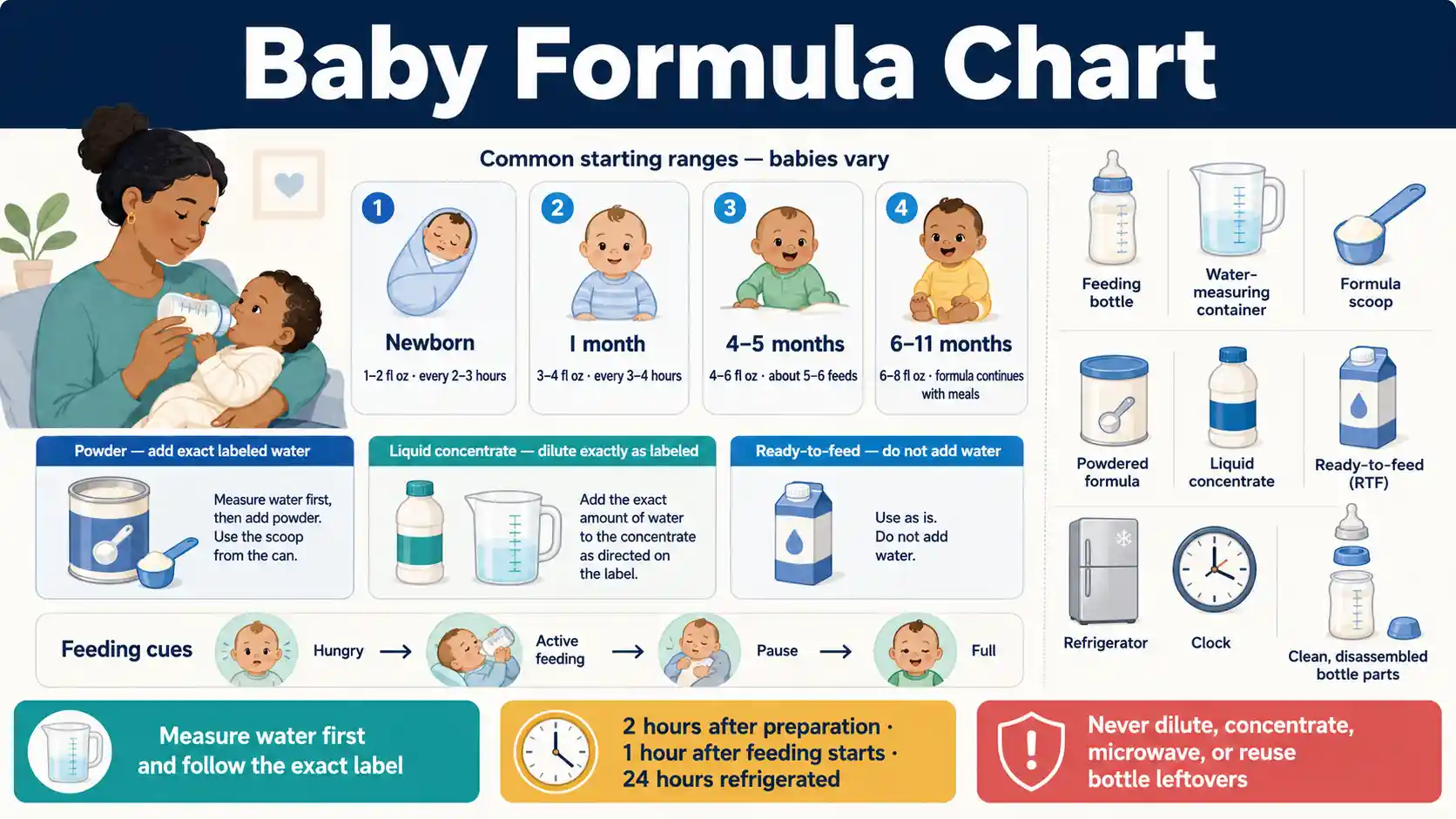
Baby formula quick answer
Formula-fed newborns commonly begin with 1–2 fluid ounces every 2–3 hours. Amounts rise gradually, and many older infants stay near 24–32 fluid ounces across a day. Use the label exactly, stop at fullness, and never change the water-to-formula concentration.
Newborn pattern
1–2 fl oz often
Many formula-fed newborns begin with 30–60 mL every 2–3 hours and feed 8–12 times per day.
Formula choice
Infant and iron-fortified
Choose commercial formula made for infants and fortified with iron unless the care team gives a different plan.
Storage clocks
1 · 2 · 24 hours
Use within one hour after feeding starts, two hours at room temperature, or 24 hours when promptly refrigerated.
Mixing rule
Follow the exact label
Measure water first when required and never add extra water, powder, concentrate, cereal, or another ingredient.
Direct answers to common baby formula questions
How much formula does a newborn drink?
A newborn often starts with 1–2 fluid ounces (30–60 mL) per feed.
How often does a formula-fed newborn eat?
Most formula-fed newborns feed every 2–3 hours, or about 8–12 times in 24 hours.
How much formula does a 1-month-old drink?
A 1-month-old often takes about 3–4 fluid ounces (90–120 mL) per feed.
How much formula does a 6-month-old drink?
A 6-month-old often takes about 6–8 fluid ounces (180–240 mL) at a milk feed.
What formula is recommended for most babies?
Most formula-fed infants can use a commercial iron-fortified formula made specifically for infants.
Is powdered formula sterile?
No. Powdered infant formula is not sterile, even when the container is sealed.
Do you add water to ready-to-feed formula?
No. Ready-to-feed formula must be fed without adding water.
How long can formula sit out?
Prepared formula can remain at room temperature for up to 2 hours when feeding has not started.
How long is a used bottle safe?
Discard formula 1 hour after the baby starts drinking from the bottle.
How long is prepared formula safe in the refrigerator?
Promptly refrigerated prepared formula can be kept for up to 24 hours.
Can formula be diluted?
No. Extra water can cause dangerous electrolyte imbalance and inadequate nutrition.
Can homemade infant formula be used?
No. Homemade formula can cause severe nutrient errors and foodborne illness.
Baby Formula Chart by Age from Birth to 12 Months
These ranges describe common feeding patterns, not a prescription. Follow hunger and fullness cues, monitor growth and hydration, and use the baby’s clinician for individualized needs.
Swipe horizontally inside the table to view every column.
| Age or stage | Typical amount per feed | Common feeding frequency | Approximate daily pattern | Important context |
|---|---|---|---|---|
| First days after birth | Often 1–2 fl oz (30–60 mL) | About every 2–3 hours; commonly 8–12 feeds in 24 hours — Frequent newborn feeding | Highly variable while feeding skills and intake establish | Wake or feed according to the newborn care plan, especially after prematurity, jaundice, low birth weight, or poor intake |
| By the end of first month | Often 3–4 fl oz (90–120 mL) | About every 3–4 hours | Commonly rises toward 24–32 fl oz (710–950 mL) | Use early hunger cues rather than waiting for crying |
| 2–3 months | Often 4–5 fl oz (120–150 mL) | Usually every 3–4 hours | Many babies remain within about 24–32 fl oz (710–950 mL) | Growth spurts can temporarily change frequency |
| 4–5 months | Often 4–6 fl oz (120–180 mL) | Usually 5–6 feeds across 24 hours | Commonly about 24–32 fl oz (710–950 mL) | Do not add cereal to a bottle to increase sleep or fullness |
| 6–8 months | Often 6–8 fl oz (180–240 mL) | Commonly 4–5 milk feeds while solids begin | Formula remains a main nutrition source | Offer formula and complementary foods responsively; solids do not replace formula abruptly — Formula remains central after solids begin |
| 9–11 months | Often 6–8 fl oz (180–240 mL) | Commonly 3–5 milk feeds alongside meals | Daily formula may gradually decline as food skills and meals expand | Continue iron-fortified infant formula through 12 months unless the care team directs otherwise |
| At 12 months | Transition depends on the child’s feeding plan | Meals and snacks become more structured | Infant formula can usually transition after the first birthday | Do not replace infant formula with toddler drink before discussing special nutritional or medical needs — Transition only after first birthday |
Amounts are U.S. fluid ounces with approximate millilitre equivalents. One U.S. fluid ounce is about 30 mL.
- • A baby may take more at one feed and less at another. Daily growth, wet diapers, alertness, and feeding cues matter more than matching every row.
- • Many pediatric references advise discussing intake that is consistently above about 32 fluid ounces per day or markedly below the expected pattern.
- • Premature infants, medically complex infants, and babies using fortified or specialty formula need an individualized plan.
Download or export
Four rules that make a formula chart safer
Amounts matter, but safe concentration, clean preparation, time limits, responsive feeding, and the infant’s medical context matter just as much.
Feed by cues
Age gives a range
Use age-based amounts as a starting reference. Hunger, fullness, growth, hydration, and the care plan determine what a baby actually needs.
Mix exactly
The product label is the recipe
Measure water first when required, use the product’s own scoop or liquid ratio, and never concentrate or dilute the feed.
Track time
One, two, and 24 hours
Discard one hour after feeding begins, use room-temperature prepared formula within two hours, and use promptly refrigerated formula within 24 hours.
Match risk
Powder is not sterile
Ready-to-feed liquid may be safer for infants under two months, born prematurely, or immunocompromised when available and clinically appropriate.
Powder, concentrate, and ready-to-feed are prepared differently
Powder must be mixed with the exact labeled water amount. Liquid concentrate also requires labeled dilution. Ready-to-feed formula requires no water. The FDA infant-formula handling guide explains these three forms and their preparation differences.
Powder, Liquid Concentrate, and Ready-to-Feed Formula
All three commercial forms can provide complete infant nutrition when used as labeled. The preparation process, sterility, convenience, cost, and contamination risk differ.
Swipe horizontally inside the table to view every column.
| Formula form | Water added? | Sterility and handling | Convenience | Key mistake to avoid |
|---|---|---|---|---|
| Powdered infant formula | Yes—measure water first, then add the exact labeled powder amount | Powder is not sterile; prepare with clean hands and equipment — Powder is not sterile | Lightweight, portable, and usually least costly | Do not change the scoop, ratio, water volume, or preparation order |
| Liquid concentrate | Yes—mix with the exact labeled amount of water, often equal parts | Commercial liquid concentrate is made sterile before opening | Fewer measuring steps than powder | Do not feed concentrate undiluted or add extra water |
| Ready-to-feed liquid | No — Never add water to ready-to-feed formula | Commercial ready-to-feed formula is made sterile before opening | Fastest option and useful when safe water or clean preparation is difficult | Do not add water |
Mixing instructions are product-specific. Use only the current directions on the exact container.
- • Ready-to-feed liquid is often preferred when an infant is at higher risk from Cronobacter and the product is available.
- • Opened liquid containers have their own refrigeration and use limits. Follow the package after opening.
- • Never assume two brands or product lines use the same scoop or dilution ratio.
Download or export
Standard formula suits most infants; specialty formula needs a reason
Standard iron-fortified formula is the routine category for most formula-fed babies. Extensively hydrolyzed, amino-acid, preterm, high-calorie, metabolic, renal, and other specialty formulas change ingredients or nutrient density for defined needs. Symptoms should be assessed before repeated switches.
Infant Formula Types and When Clinical Guidance Matters
Formula labels describe ingredients and intended use, but symptoms alone do not reliably identify the right category. Use professional guidance for specialty products and persistent feeding problems.
Swipe horizontally inside the table to view every column.
| Formula category | Typical purpose | What it may contain | When to discuss with a clinician | Important limitation |
|---|---|---|---|---|
| Standard milk-based, iron-fortified — Routine starting category | Routine feeding for most formula-fed infants | Cow’s-milk proteins modified for infants, lactose or another carbohydrate, fats, vitamins, minerals, and iron | Routine questions, growth concerns, or feeding intolerance | Brand differences do not mean one standard formula is universally superior |
| Soy-based infant formula | Specific family preferences or selected clinical situations | Soy protein isolate and non-lactose carbohydrate | Suspected cow’s-milk protein allergy, prematurity, thyroid treatment, or ongoing symptoms | Soy is not appropriate for every allergy or preterm infant |
| Partially hydrolyzed | Easier-to-digest marketing or selected feeding situations | Milk proteins broken into smaller fragments | Persistent symptoms or concern about allergy | Partially hydrolyzed formula does not treat confirmed cow’s-milk protein allergy |
| Extensively hydrolyzed | Often used for diagnosed or strongly suspected cow’s-milk protein allergy | Proteins broken into much smaller fragments | Blood in stool, persistent eczema, vomiting, poor growth, or clinician-directed trial | Use should follow a clear plan and response review |
| Amino-acid based | Severe allergy, multiple food-protein reactions, or failure of extensively hydrolyzed formula | Individual amino acids rather than intact protein chains | Specialist-directed feeding | This is a medical formula, not a routine upgrade |
| Preterm, post-discharge, high-calorie, metabolic, renal, or other specialty formula | Specific growth, nutrient, or disease-related needs | Modified calories, minerals, protein, fat, carbohydrate, or other nutrients | Always — Clinical direction required | Do not concentrate, dilute, substitute, or stop without the prescribing team |
| Toddler drink or follow-up beverage | Marketed for children older than infancy | Varied milk, sweetener, fat, vitamin, and mineral profiles | Before using under 12 months or for a medical need | Toddler products are not substitutes for infant formula during the first year — Not infant formula |
Categories describe intended use rather than a dose or product recommendation.
- • Choose a commercial formula made for infants and fortified with iron unless a qualified clinician gives a different plan.
- • Gas, spit-up, stool colour, or fussiness alone does not prove allergy or require a specialty formula.
- • Never use homemade formula, evaporated-milk recipes, plant beverages, toddler drinks, or ordinary cow’s milk as an infant-formula substitute.
Download or export
Safe formula preparation protects concentration and hygiene
Wash hands, clean the preparation area, use dry feeding equipment, and follow the exact container directions. When water is required, measure it before adding powder or concentrate. Never use a different scoop, estimate a partial scoop, or change the ratio.
Safe Infant Formula Preparation Steps
Use this order for routine commercial formula preparation while following the exact product label and local water-safety advice.
Swipe horizontally inside the table to view every column.
| Step | Action | Why it matters | Powder | Concentrate or ready-to-feed |
|---|---|---|---|---|
| 1. Check product | Confirm infant age range, use-by date, intact seal, undamaged container, and recall status when relevant | Prevents use of expired, damaged, unsuitable, or recalled product | Required | Required |
| 2. Clean preparation area | Wash hands and clean the counter before touching equipment or formula | Reduces contamination | Required | Required |
| 3. Prepare feeding items | Use clean, fully air-dried bottles, nipples, rings, caps, and measuring tools | Moisture and residue can support germ growth | Required | Required |
| 4. Use safe water when water is required | Follow local water guidance and the product instructions | Water quality and preparation guidance vary by location and infant risk | Required | Required for concentrate; not used for ready-to-feed |
| 5. Measure water first | Pour the exact labeled water volume into the bottle or clean container — Measure water first | Water-first preparation protects the final concentration | Required | Required for concentrate |
| 6. Add formula exactly | Use the product’s own scoop or the labeled liquid amount; level powder as directed | Too much or too little formula can cause serious harm — Exact concentration required | Add exact powder amount | Add exact concentrate amount; pour ready-to-feed directly |
| 7. Mix without contaminating | Close the bottle and mix as directed without touching the nipple tip | Reduces contamination and dissolves formula evenly | Required | Required for concentrate |
| 8. Feed or store promptly | Use within the allowed time or refrigerate immediately before the two-hour limit | Limits bacterial growth | Required | Required |
| 9. Warm safely if desired | Use warm water around the bottle and test temperature | Prevents microwave hot spots and burns | Optional | Optional |
| 10. Discard used-bottle leftovers | Throw away formula one hour after feeding begins — Discard leftovers | Saliva introduces bacteria that continue multiplying | Required | Required |
The exact scoop-to-water or concentrate-to-water ratio comes only from the product label.
- • Formula does not need to be warmed. Room-temperature or cool formula is acceptable when the baby accepts it.
- • For infants younger than 2 months, born prematurely, or immunocompromised, ask the care team about ready-to-feed formula or additional powder-preparation precautions.
- • Do not use a microwave, bottle warmer without cleaning, or temperature test that contaminates the nipple.
Download or export
Prepared formula safety checker
Check a prepared bottle against the routine one-hour, two-hour, and 24-hour limits. This tool does not calculate a mixing ratio or decide which formula a baby needs.
Entered information stays in this browser. When timing, temperature, mixing, product, or recall status is uncertain, discard the formula rather than guessing.
Formula storage uses the earliest applicable time limit
The CDC preparation and storage guidance sets a two-hour limit after preparation, a one-hour limit after feeding begins, and a 24-hour limit for formula refrigerated immediately. A used bottle cannot be saved for the next feed.
Prepared Formula Storage and Time-Limit Chart
Time starts at preparation, refrigeration, container opening, or the beginning of a feed. When two limits apply, follow the earlier limit.
Swipe horizontally inside the table to view every column.
| Situation | Maximum routine time | Where to keep it | What to do at the limit | Reason |
|---|---|---|---|---|
| Freshly prepared formula, feeding not started | Use within 2 hours of preparation — Two-hour preparation limit | Room temperature | Feed, refrigerate promptly before the limit, or discard | Bacteria can multiply at room temperature |
| Feeding has started | Use within 1 hour from the start of feeding — One-hour feeding limit | With the baby during the feed | Discard all leftovers | Saliva introduces bacteria into the bottle |
| Prepared formula refrigerated immediately | Use within 24 hours — Twenty-four-hour refrigerated limit | Refrigerator at 40°F (4°C) or colder | Discard after 24 hours | Cold storage slows but does not stop bacterial growth |
| Prepared bottle removed from refrigerator | Use within 2 hours, or within 1 hour after feeding starts—whichever comes first | Room temperature during use | Discard at the earlier limit | Multiple clocks can apply |
| Opened ready-to-feed or concentrate container | Follow the exact package after-opening limit | Covered in the refrigerator | Discard when the label limit is reached | Container sizes and product instructions differ |
| Used bottle returned to refrigerator | Not recommended | Do not store | Discard | Refrigeration does not make saliva-contaminated leftovers safe |
| Formula left in a hot car, direct sun, or unsafe temperature | No reliable safe extension | Do not keep | Discard when safety is uncertain | Heat speeds bacterial growth |
Times are hours. Refrigerator target is 40°F (4°C) or colder.
- • Mark preparation time when making multiple bottles so the oldest bottle is used first.
- • The two-hour rule does not restart after warming or moving a bottle.
- • When the product label is more restrictive, follow the product label.
Download or export
Clean every feeding item and let every part air-dry
Separate all bottle parts, rinse them, wash in a dedicated basin or dishwasher, and let them air-dry completely. Daily sanitizing adds protection for infants younger than 2 months, born prematurely, immunocompromised, or otherwise advised by their care team.
Bottle Cleaning, Sanitizing, and Storage Chart
Cleaning removes milk residue and germs. Sanitizing adds an extra germ-reduction step and is especially important for younger or medically vulnerable infants.
Swipe horizontally inside the table to view every column.
| Task | Safe method | When | Important detail | Common error |
|---|---|---|---|---|
| Separate all parts | Take apart bottle, nipple, cap, ring, valves, and membranes | After every feed | Milk can remain in hidden joints | Washing an assembled bottle |
| Rinse | Rinse parts under running water without placing them in the sink basin | Soon after use | The sink can contain germs | Letting milk dry inside parts |
| Wash by hand | Use a clean basin reserved for feeding items, hot soapy water, and a dedicated brush | After every use unless dishwasher-cleaned | Squeeze water through nipple holes | Using a dirty sponge or sink directly |
| Dishwasher wash | Use hot water and a heated drying or sanitizing setting when items are dishwasher-safe | After use | Place small pieces in a closed basket | Losing or damaging small valves |
| Air-dry fully | Place parts on a clean unused towel or drying rack and let them dry completely — Air-dry completely | After washing or sanitizing | Air-drying avoids towel contamination | Rubbing dry with a used towel |
| Sanitize | Boil, steam, or use a dishwasher sanitizing cycle as item instructions allow | Daily for infants under 2 months, premature infants, immunocompromised infants, or when advised — Higher-risk infant sanitizing | Cleaning must happen before sanitizing | Sanitizing visibly dirty parts |
| Store | Reassemble only when fully dry and keep in a clean protected area | After complete drying | Trapped moisture supports germ growth | Sealing wet parts in a container |
| Clean preparation tools | Wash formula scoops only when the label directs or they become contaminated; dry fully before returning | According to product instructions | Moisture inside powder can introduce germs | Putting a damp scoop into powdered formula — Keep powder scoop dry |
Cleaning frequency is shown per use or daily according to infant risk and equipment instructions.
- • Always follow the bottle, nipple, pump-part, dishwasher, steam-bag, and sanitizer manufacturer instructions.
- • Replace cracked, torn, sticky, cloudy, or damaged feeding parts.
- • Hand hygiene is required before touching clean parts or preparing formula.
Download or export
Feed by hunger and fullness cues, not bottle size alone
The CDC formula amount and frequency guidance emphasizes that feeding patterns change as babies grow. Offer the bottle on early hunger cues, allow pauses, and stop when the baby closes the mouth, turns away, relaxes, or stops active sucking.
Responsive Bottle-Feeding and Baby Cue Chart
The caregiver decides what is offered and keeps feeding safe. The baby decides whether to drink and when to stop.
Swipe horizontally inside the table to view every column.
| Cue or situation | What it may mean | Helpful response | Avoid | Safety note |
|---|---|---|---|---|
| Hands to mouth, rooting, lip smacking, alert movement — Early hunger cues | Early hunger | Offer a feed calmly before crying escalates | Waiting for a strict clock time when cues are clear | Newborns often feed frequently |
| Crying and frantic movement | Late hunger or another need | Calm first, then offer the bottle | Forcing the nipple into the mouth | Crying can make coordination harder |
| Steady sucking and swallowing | Active feeding | Hold baby semi-upright, keep nipple filled, and allow pauses | Bottle propping or leaving baby unattended | Watch breathing and colour |
| Slower sucking, relaxed hands, looking away | Approaching fullness or needing a pause | Lower the bottle, burp if helpful, and wait | Jiggling the bottle to restart sucking | Pauses support self-regulation |
| Closed mouth, turning away, pushing nipple out, falling asleep relaxed | Fullness | End the feed even when formula remains — Respect fullness | Pressure to finish the bottle | Discard leftovers within the one-hour limit |
| Coughing, choking, gulping, leaking milk, widened eyes | Flow may be too fast or coordination may be difficult | Stop, sit upright, assess breathing, and use a slower or paced approach — Stop for coughing or choking | Continuing through distress | Repeated episodes need clinical review |
| Frequent feeds with poor growth or few wet diapers | Possible low intake, mixing issue, illness, or feeding difficulty | Check preparation accuracy and contact the baby’s clinician | Adding extra powder without direction | Concentrating formula can be dangerous |
Cues are behavioural observations rather than fixed feeding-volume targets.
- • Bottle size does not determine what the baby must finish.
- • Use a nipple flow that supports comfortable suck–swallow–breathe coordination.
- • Never prop a bottle, put a baby to bed with a bottle, or leave a feeding baby unattended.
Download or export
Formula changes should solve a defined problem
Minor stool, taste, or gas changes can occur after switching brands. They do not prove allergy. Blood in stool, immediate hives, facial swelling, repeated vomiting, severe eczema, poor intake, or poor growth need assessment rather than a series of unsupervised formula trials.
Formula Switching, Expected Changes, and Warning Symptoms
Minor stool, gas, or taste changes can occur after a switch. Persistent, severe, or multisystem symptoms require clinical assessment rather than repeated unsupervised product changes.
Swipe horizontally inside the table to view every column.
| Observation | Possible explanation | Reasonable first step | When to seek advice | Do not |
|---|---|---|---|---|
| Temporary stool colour or consistency change | Different iron, fat, protein, or carbohydrate composition | Confirm correct mixing and observe hydration and comfort | Blood, white or black stool, severe diarrhea, or ongoing concern | Diagnose allergy from colour alone |
| Mild gas or fussiness | Normal infant behaviour, swallowed air, flow rate, overfeeding, or adjustment | Use paced feeding, burp if helpful, and review cues | Persistent pain, poor intake, vomiting, or poor growth | Switch repeatedly every day |
| Spit-up without distress and with normal growth | Common reflux | Keep baby upright after feeds and avoid pressure to finish | Forceful, green, bloody, painful, or worsening vomiting | Thicken or medicate without a plan |
| Constipation concern | Normal variation, incorrect mixing, illness, or diet after solids begin | Check exact preparation and stool pattern | Hard painful stools, blood, swollen abdomen, or poor feeding | Add extra water to formula — Never dilute for constipation |
| Eczema, hives, facial swelling, wheeze, repeated vomiting | Possible food-protein allergy | Stop the feed when an immediate reaction occurs and follow the emergency plan | Prompt or emergency care depending on symptoms — Possible emergency allergy | Trial multiple formulas during a severe reaction |
| Blood or mucus in stool with distress or poor growth | Possible allergy, infection, or another gastrointestinal problem | Arrange pediatric assessment | Prompt review, especially in young infants | Assume lactose intolerance |
| Specialty formula prescribed | Specific allergy, metabolic, renal, growth, or prematurity need | Follow the written mixing and follow-up plan exactly | Any supply, tolerance, or growth problem | Substitute or alter concentration independently — Do not alter prescribed formula |
Symptoms are grouped by observation and urgency, not by diagnosis.
- • Most infant gas and spit-up is not caused by a dangerous formula reaction.
- • Lactose intolerance is uncommon as a primary cause of routine symptoms in young infants; cow’s-milk protein allergy is a different condition.
- • A structured clinician-guided trial is more informative than rapid switching among several products.
Download or export
Travel and outages require extra formula, safe water, and a backup plan
Keep formula in original labeled packaging, separate powder from water until preparation, carry clean feeding equipment, and protect refrigerated products with adequate cooling. Ready-to-feed liquid can simplify feeding when clean water, refrigeration, or washing is uncertain.
Formula Feeding During Travel, Outages, and Emergencies
Plan around safe water, hand hygiene, cold storage, clean equipment, accurate mixing, and enough product for the full trip or disruption.
Swipe horizontally inside the table to view every column.
| Situation | Preferred option | Preparation plan | Storage plan | Critical warning |
|---|---|---|---|---|
| Short trip or appointment | Premeasured ready-to-feed bottles or sealed ready-to-feed container | Pack clean bottles and nipples | Keep unopened product as labeled; refrigerate opened product when required | Do not prefill powder into a bottle that contains water for long periods |
| Powdered formula away from home | Carry powder and safe water separately | Measure water first only when ready to prepare; use the exact scoop | Use immediately or follow the two-hour and refrigeration limits | Keep the scoop and powder dry |
| Air travel | Pack extra formula in original labeled containers | Allow time for security screening and bring clean feeding items | Use an insulated cooler with frozen packs for products requiring refrigeration | Do not rely on uncertain water or unavailable brands at the destination |
| Power outage | Ready-to-feed formula when safe refrigeration or water is limited | Use clean hands and equipment | Keep refrigerator closed and follow local food-safety guidance | Discard formula when time or temperature safety is uncertain — Discard uncertain formula |
| Boil-water advisory or unsafe water | Ready-to-feed liquid when available | Follow public-health and formula-label instructions for water | Keep prepared formula within normal time limits | Do not assume a home filter removes every hazard |
| Natural disaster or evacuation | Commercial ready-to-feed formula plus single-use feeding supplies when available | Use the safest available clean method | Protect supplies from heat, flood water, pests, and damaged packaging | Never stretch supply by dilution or homemade formula — Never dilute formula |
| Formula shortage or unavailable usual brand | Another suitable commercial infant formula may be possible | Compare infant age range and ask a clinician for specialty-formula substitutions | Keep original packaging and lot information | Do not substitute toddler drink or homemade formula — No toddler-drink substitution |
Storage limits remain the same during travel unless the product label is more restrictive.
- • Pack more formula, bottles, nipples, water, and cooling capacity than the expected minimum.
- • Specialty-formula users should carry the prescription, product details, and an emergency substitution plan.
- • When hygiene is limited, disposable cups may be easier to clean than bottles for an older infant who can drink safely from a cup.
Download or export
Common baby formula mistakes
Using a universal scoop ratio
Scoop size and preparation instructions can differ by product. The current container label is the only safe recipe.
Adding water after powder
When water is required, measure the labeled water volume first. Adding powder first changes how the final concentration is measured.
Saving a used bottle
Saliva enters the bottle during feeding. Refrigeration does not make leftovers safe for a later feed.
Warming in a microwave
Microwave heating can create hot spots that burn the mouth. Formula does not need to be warmed.
Forcing the bottle to be finished
A chart gives a range, not a minimum. Stop at fullness and prepare a smaller bottle when waste is frequent.
Changing specialty formula alone
High-calorie, preterm, allergy, metabolic, renal, and other medical formulas require a defined concentration and follow-up plan.
Some infants need a formula plan beyond an age chart
Infants under 2 months, premature infants, and immunocompromised infants: powdered formula is not sterile. Ask whether ready-to-feed liquid or additional preparation precautions are recommended.
Growth or hydration concerns: bottle volume cannot diagnose intake adequacy. Review accurate growth measurements, wet diapers, feeding ability, and preparation technique.
Allergy or gastrointestinal symptoms: blood in stool, immediate hives, swelling, repeated vomiting, severe eczema, pain, or poor growth needs assessment before changing to a specialty product.
Prescribed high-calorie or disease-specific formula: use the written recipe and exact product. Do not substitute, concentrate, dilute, or stop it without the prescribing team.
Mixed feeding: breast milk and formula amounts vary with milk supply, direct breastfeeding, pumping, and growth. A formula-only chart cannot calculate the total intake from both sources.
Formula Recall Checks and Baby Warning Signs
Check product information before feeding and act promptly when a recall, preparation error, dehydration, severe reaction, or serious illness is possible.
Swipe horizontally inside the table to view every column.
| Situation or sign | Immediate action | Urgency | Information to collect | Do not |
|---|---|---|---|---|
| Product is listed in a recall — Stop recalled formula | Stop using the affected lot and follow the recall instructions | Immediate product action | Brand, product name, lot or batch code, use-by date, purchase location | Feed another bottle from the recalled lot |
| Container is swollen, leaking, rusty, punctured, unsealed, or expired | Do not use it; return or dispose according to local instructions | Before feeding | Photos, lot code, retailer, and product condition | Taste-test or transfer it to another container |
| Formula was mixed with too much or too little water or the wrong scoop | Stop using the mixture and contact the baby’s clinician or poison service for advice | Prompt advice; urgent if symptoms occur — Mixing error requires advice | Product, intended recipe, actual amounts, time, and estimated intake | Correct the bottle by guessing or continue feeding it |
| Fever in an infant younger than 3 months | Seek urgent medical assessment | Urgent now | Temperature, feeding, wet diapers, alertness, and product details | Wait for multiple symptoms |
| Poor feeding, unusual sleepiness, weak cry, temperature change, or irritability in a young infant | Contact urgent medical care, especially after recalled or mishandled formula | Prompt urgent assessment | Onset, formula lot, preparation, intake, diapers, and medical history | Assume the baby only dislikes the formula |
| Few wet diapers, dry mouth, no tears, sunken soft spot, or marked sleepiness | Seek prompt assessment for dehydration | Prompt or urgent depending on severity | Feed amounts, vomiting or diarrhea, wet diapers, and mixing method | Dilute formula or give unapproved home fluids |
| Trouble breathing, blue or grey colour, limpness, seizure, or unresponsiveness | Call emergency services | Emergency now — Emergency symptoms | Time, symptoms, product, and known allergy history | Drive alone while the baby is unstable |
| Hives with facial or tongue swelling, wheeze, repeated vomiting, or collapse | Use the emergency allergy plan and call emergency services | Emergency now | Formula name, amount, timing, and symptoms | Offer more formula to confirm the reaction |
| Persistent vomiting, blood in stool, severe abdominal swelling, or poor growth | Arrange prompt pediatric assessment | Prompt clinical review | Symptom timeline, stool or vomit description, intake, formula, and growth information | Keep changing products without assessment |
Urgency categories are product action, prompt advice, urgent assessment, and emergency response.
- • Recall notices change over time. Check the current FDA recall and infant-formula pages using the exact lot or batch code.
- • Report suspected formula quality or safety problems through the manufacturer and the appropriate food-safety authority.
- • This chart supports recognition and escalation; it does not identify the cause of illness.
Download or export
Frequently asked questions
How much formula does a newborn usually drink?
A formula-fed newborn often starts with 1–2 fluid ounces (30–60 mL) every 2–3 hours. Intake changes rapidly, so follow hunger cues and the newborn care plan.
How often should a formula-fed newborn eat?
Most formula-fed newborns feed 8–12 times in 24 hours. Some need scheduled waking because of prematurity, jaundice, low birth weight, or poor intake.
How much formula should a baby drink in one day?
Many older infants take about 24–32 fluid ounces (710–950 mL) daily, but needs vary with age, weight, growth, solids, and feeding pattern. Discuss intake that is consistently far outside the usual pattern.
What is the difference between powdered and ready-to-feed formula?
Powder requires exact mixing with water and is not sterile. Ready-to-feed formula is made sterile before opening and must not have water added.
Should I measure water or powder first?
Measure the exact water volume first, then add the formula amount printed on the container. Reversing the order can change the final concentration.
Can I add extra water to make formula last longer?
No. Extra water can cause dangerous electrolyte imbalance, poor nutrition, seizures, and growth problems. Never stretch formula by dilution.
Can I add extra powder when my baby seems hungry?
No. Extra powder can overload the kidneys and cause dehydration or excessive nutrient intake. Offer more correctly prepared formula or seek feeding advice.
How long can prepared formula stay at room temperature?
Use prepared formula within 2 hours of preparation. Once feeding begins, use it within 1 hour and discard what remains.
How long can prepared formula stay in the refrigerator?
Prepared formula refrigerated immediately can be stored for up to 24 hours. Label the preparation time and use the oldest bottle first.
Can I refrigerate a bottle after my baby drinks from it?
No. Discard formula one hour after feeding starts because saliva introduces bacteria that refrigeration does not remove.
Does infant formula need to be warmed?
No. Formula can be served cool, at room temperature, or gently warmed. Never microwave a bottle because hot spots can burn the baby.
Which infant formula is best?
Most babies can use a standard commercial iron-fortified infant formula. No single brand is best for every baby, and specialty formulas should address a defined need.
Can I make homemade baby formula?
No. Homemade formula can have unsafe nutrient concentrations and harmful germs. Use regulated commercial infant formula or an emergency plan from qualified health authorities.
Can I switch formula brands?
Many babies can switch between suitable standard iron-fortified formulas, but specialty products require guidance. Seek advice for blood in stool, severe eczema, repeated vomiting, poor growth, or immediate reactions.
When should a baby stop infant formula?
Infant formula usually continues through 12 months. After the first birthday, most children can transition according to their nutrition and medical needs.
When should I get urgent help after formula feeding?
Get urgent help for a fever in a baby under 3 months, severe dehydration, persistent vomiting, blood in stool, or marked sleepiness. Breathing trouble, blue colour, limpness, seizure, or severe allergy symptoms require emergency care.
Sources
These public-health, food-safety, and pediatric resources support the formula amount, selection, preparation, storage, cleaning, responsive-feeding, risk, recall, and escalation guidance.
Centers for Disease Control and Prevention — How Much and How Often to Feed Infant Formula
https://www.cdc.gov/infant-toddler-nutrition/formula-feeding/how-much-and-how-often.html
Provides cue-based guidance for formula amounts and feeding frequency during the first days, first months, 6 to 12 months, and the transition after the first birthday.
Centers for Disease Control and Prevention — Infant Formula Preparation and Storage
https://www.cdc.gov/infant-toddler-nutrition/formula-feeding/preparation-and-storage.html
Explains hand hygiene, water-first mixing, warming, room-temperature limits, refrigeration, leftover disposal, and precautions for higher-risk infants.
Centers for Disease Control and Prevention — Choosing an Infant Formula
https://www.cdc.gov/infant-toddler-nutrition/formula-feeding/choosing-a-formula.html
Recommends iron-fortified formula made for infants and checking the use-by date, seal, container condition, and age labeling.
Centers for Disease Control and Prevention — About Feeding From a Bottle
https://www.cdc.gov/infant-toddler-nutrition/bottle-feeding/index.html
Covers responsive bottle feeding, safe positioning, fullness cues, bottle propping, cereal in bottles, warming, and bedtime-bottle risks.
Centers for Disease Control and Prevention — How to Clean, Sanitize, and Store Infant Feeding Items
https://www.cdc.gov/hygiene/about/clean-sanitize-store-infant-feeding-items.html
Provides step-by-step guidance for separating, rinsing, washing, air-drying, sanitizing when appropriate, and storing bottle parts.
Centers for Disease Control and Prevention — Preventing Cronobacter in Infants
https://www.cdc.gov/cronobacter/prevention/index.html
Explains that powdered infant formula is not sterile and identifies ready-to-feed liquid formula as the safer option for infants at higher risk when available.
Centers for Disease Control and Prevention — Iron and Infant Nutrition
https://www.cdc.gov/infant-toddler-nutrition/vitamins-minerals/iron.html
States that standard iron-fortified infant formula can meet iron needs during the first 12 months and describes iron-rich complementary foods.
Centers for Disease Control and Prevention — Vitamin D and Infant Nutrition
https://www.cdc.gov/infant-toddler-nutrition/vitamins-minerals/vitamin-d.html
Explains vitamin D supplementation context for infants receiving breast milk, mixed feeding, or less than 32 fluid ounces of fortified formula per day.
U.S. Food and Drug Administration — Handling Infant Formula Safely: What You Need to Know
https://www.fda.gov/food/buy-store-serve-safe-food/handling-infant-formula-safely-what-you-need-know
Compares powdered, liquid concentrate, and ready-to-feed forms and summarizes selection, preparation, storage, and feeding safety.
U.S. Food and Drug Administration — Infant Formula: Safety Do’s and Don’ts
https://www.fda.gov/consumers/consumer-updates/infant-formula-safety-dos-and-donts
Warns against homemade formula, dilution, unapproved substitutions, damaged containers, expired products, and unsafe preparation.
U.S. Food and Drug Administration — Infant Formula Information for Parents and Caregivers
https://www.fda.gov/food/infant-formula-homepage/infant-formula-information-parents-caregivers
Explains formula forms, regulation, specialty products, supply questions, preparation, reporting concerns, and caregiver resources.
U.S. Food and Drug Administration — Infant Formula Homepage
https://www.fda.gov/food/resources-you-food/infant-formula-homepage
Provides current FDA infant-formula information, market updates, safety communications, investigations, and recall notices.
U.S. Food and Drug Administration — Recalls, Market Withdrawals, and Safety Alerts
https://www.fda.gov/safety/recalls-market-withdrawals-safety-alerts
Lists current safety notices and recall information for FDA-regulated products, including infant formula when applicable.
American Academy of Pediatrics — Amount and Schedule of Baby Formula Feedings
https://www.healthychildren.org/English/ages-stages/baby/formula-feeding/Pages/amount-and-schedule-of-formula-feedings.aspx
Provides pediatric context for early feed volumes, increasing bottle size, responsive feeding, and the common upper daily intake discussion.