Animals & Pets · Cats
Cat Breeds Chart: Compare Coat, Size, Shape, Activity and Care
Compare 60 widely recognized cat breeds, learn how registries define breeds, separate coat patterns from pedigree, and use practical tables for body type, size, activity, vocality, grooming, distinctive traits and household planning.
Appearance is not pedigree proof. A cat can resemble a recognized breed without documented ancestry, and breed tendencies cannot diagnose health or guarantee temperament. Read the ChartsLoom Disclaimer.
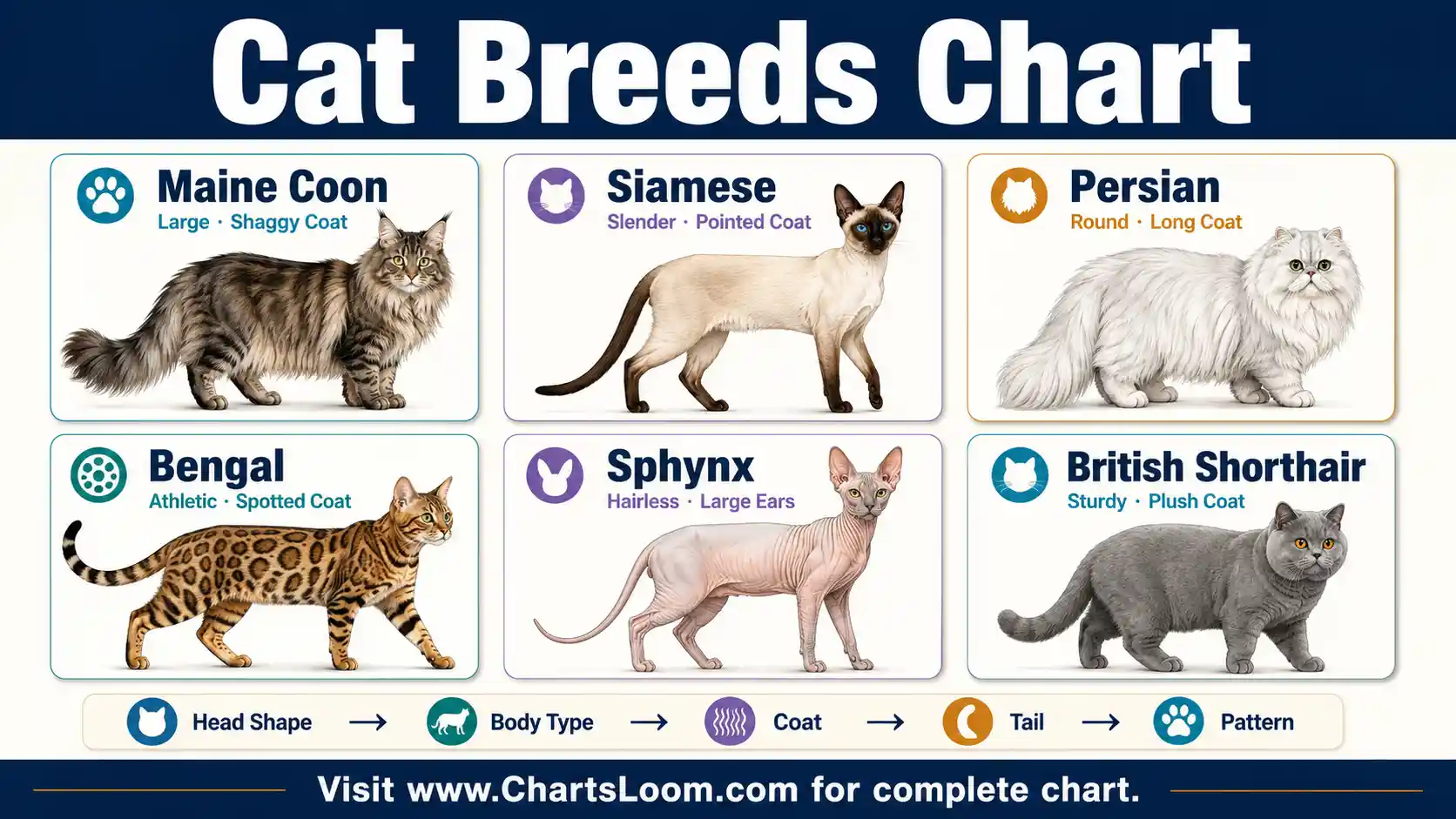
Cat breed comparison: the quick answer
A cat breed is defined by a complete, reproducible standard that covers head, body, coat, color and other distinguishing traits. A single feature—such as tabby stripes, blue fur, points, a bobtail or long hair—cannot establish breed by itself. Registry totals also differ because organizations group and recognize breeds in different ways.
Visual traits can narrow the possibilities, but most pet cats do not have documented pedigrees, and a coat pattern alone does not establish a breed. When you want a quick visual starting point, Click here to upload a clear photo of your cat and receive a breed-profile estimate based on features such as face shape, ears, coat, body proportions and fur texture. Treat the result as an identification aid rather than proof of pedigree, then compare it with the breed standards and trait charts below.
Comparison directory
60 breeds
A practical cross-section of widely recognized shorthaired, longhaired, rex and hairless breeds.
TICA scope
73 recognized breeds
TICA counts some coat-length and structural variants separately under its recognition rules.
CFA scope
46 recognized breeds
CFA uses its own breed recognition and grouping system, so totals differ by registry.
Key limitation
Pattern ≠ breed
Tabby, calico, tortoiseshell and colorpoint describe appearance, not one breed identity.
Questions at a glance
How many cat breeds are recognized?
The total depends on the registry. TICA states 73 recognized breeds, while CFA currently recognizes 46.
Why do registry breed totals differ?
Registries use different recognition stages, standards and rules for grouping variants.
Is tabby a breed?
No. Tabby is a coat pattern found in many breeds and domestic cats.
Is calico a breed?
No. Calico is a color pattern, usually white with red and black patches or dilute equivalents.
Is tortoiseshell a breed?
No. Tortoiseshell describes intermingled red and black color, not pedigree.
Does a pointed coat mean Siamese?
No. Birman, Ragdoll, Himalayan, Balinese and other cats can also be colorpoint.
What is a domestic shorthair?
A short-coated cat without documented ancestry to one recognized breed; it is a descriptive category.
Can a photograph prove a breed?
No. A photo can suggest visual similarity, but registration or pedigree records establish documented breed ancestry.
Which traits are most useful for comparison?
Compare head, muzzle, ears, body, legs, tail, coat texture, color pattern and overall proportions together.
Which breeds are commonly vocal?
Siamese, Oriental, Thai, Balinese, Burmese and Tonkinese are often described as highly communicative.
Do hairless cats need grooming?
Yes. Skin, ears and nails still need routine care, and hairlessness does not guarantee fewer allergens.
Does breed guarantee personality?
No. Breed descriptions are tendencies; socialization, health, age, environment and the individual cat matter greatly.
Cat Breed Recognition and Registry Scope
Breed totals differ because registries use different standards, recognition stages and rules for grouping coat-length or structural variants.
Swipe horizontally inside the table to view every column.
| Term or registry view | Current figure or status | What it means | How to use it |
|---|---|---|---|
| TICA recognized breeds | 73 | TICA counts some coat-length and structural variants as separate breeds. | Use TICA’s current directory for its official scope. |
| CFA recognized breeds | 46 | CFA uses its own recognition and breed-group rules. | Do not assume every TICA breed has identical CFA status. |
| Why totals differ | Registry rules | Recognition stages, variant grouping and standards differ. | Always name the registry when quoting a breed total. |
| Pedigreed breed | Documented ancestry | A cat conforms to a recognized standard and has supporting registration or pedigree records. | Appearance alone cannot prove pedigree. |
| Domestic shorthair | Descriptive category | Short-coated cat without documented ancestry to one recognized breed. | Not a single standardized breed. |
| Domestic longhair | Descriptive category | Long-coated cat without documented ancestry to one recognized breed. | Coat length does not establish breed. |
- • TICA states that it recognizes 73 breeds. CFA states that it currently recognizes 46 breeds.
- • Counts can change when registries recognize, advance, merge or separate breeds and variants.
- • A registry count is not a count of every regional landrace or informal cat type worldwide.
Download or export
Cat Breeds Master Comparison Chart
Compare 60 widely recognized breeds by coat, size, build, activity, vocality, grooming and signature appearance. Traits are typical tendencies, not guarantees for every cat.
Swipe horizontally inside the table to view every column.
| Breed | Coat length | Size | Body build | Activity | Vocality | Grooming | Signature traits |
|---|---|---|---|---|---|---|---|
| Abyssinian | Short | Medium | Lithe | High | Moderate | Low | Ticked coat, large ears and an alert, athletic outline |
| American Bobtail | Short or long | Medium–large | Sturdy | Moderate | Moderate | Moderate | Naturally short tail with a broad, substantial body |
| American Curl | Short or long | Medium | Semi-foreign | Moderate | Quiet–moderate | Moderate | Ears curve backward in a smooth arc |
| American Shorthair | Short | Medium–large | Sturdy | Moderate | Quiet | Low | Broad chest, rounded features and many accepted colors |
| American Wirehair | Short | Medium | Sturdy | Moderate | Quiet | Low–moderate | Distinctive wiry coat, including curled whiskers |
| Australian Mist | Short | Medium | Moderate | Moderate | Quiet–moderate | Low | Misted spotted or marbled pattern with a gentle overall look |
| Balinese | Long | Medium | Slender | High | Vocal | Moderate | Longhaired pointed cat with a long wedge-shaped profile |
| Bengal | Short | Medium–large | Athletic | High | Moderate | Low | High-contrast spots or marbling on a muscular body |
| Birman | Semi-long | Medium | Sturdy | Moderate | Quiet–moderate | Moderate | Pointed coat, blue eyes and white glove markings |
| Bombay | Short | Medium | Muscular | Moderate | Moderate–vocal | Low | Solid black coat with copper or gold eyes |
| British Longhair | Long | Medium–large | Cobby | Low–moderate | Quiet | High | Rounded build with a full, plush long coat |
| British Shorthair | Short | Medium–large | Cobby | Low–moderate | Quiet | Low–moderate | Rounded head, sturdy body and plush coat |
| Burmese | Short | Medium | Muscular | High | Vocal | Low | Compact muscular body with a close, glossy coat |
| Burmilla | Short or long | Medium | Moderate | Moderate | Moderate | Low–moderate | Silver ground color with dark tipping and eye lining |
| Chartreux | Short | Medium–large | Sturdy | Moderate | Quiet | Low–moderate | Blue-gray coat, rounded head and copper-to-gold eyes |
| Chausie | Short | Large | Tall athletic | High | Moderate | Low | Long legs, deep chest and a wild-looking athletic outline |
| Cornish Rex | Very short | Small–medium | Slender | High | Vocal | Low | Tight wavy coat, arched body and large ears |
| Cymric | Long | Medium–large | Rounded | Moderate | Quiet–moderate | High | Longhaired Manx type with no tail or a shortened tail |
| Devon Rex | Short | Small–medium | Slender | High | Moderate–vocal | Low | Large low-set ears, short muzzle and rippled coat |
| Donskoy | Hairless or sparse | Medium | Sturdy | High | Vocal | Moderate | Hairlessness caused by a dominant gene and pronounced skin folds |
| Egyptian Mau | Short | Medium | Athletic | High | Moderate | Low | Naturally spotted coat and distinctive mascara markings |
| Exotic Shorthair | Short | Medium | Cobby | Low | Quiet | Low–moderate | Persian-style round head with a short plush coat |
| Havana Brown | Short | Medium | Moderate | Moderate | Vocal | Low | Warm brown coat, green eyes and a distinctive muzzle |
| Highlander | Short or long | Medium–large | Muscular | High | Moderate | Moderate | Backward-curled ears and a naturally short tail |
| Himalayan | Long | Medium | Cobby | Low | Quiet | High | Persian body and coat combined with point color and blue eyes |
| Japanese Bobtail | Short or long | Medium | Slender | High | Vocal | Low–moderate | Pom-shaped bobtail and long hind legs |
| Khao Manee | Short | Medium | Slender | High | Vocal | Low | Solid white coat with blue, gold or odd-colored eyes |
| Korat | Short | Medium | Muscular | Moderate | Vocal | Low | Silver-tipped blue coat and heart-shaped head |
| Kurilian Bobtail | Short or long | Medium–large | Sturdy | High | Moderate | Moderate–high | Pom-pom tail with a strong, slightly arched body |
| LaPerm | Short or long | Medium | Moderate | Moderate | Moderate | Moderate | Curly coat that may form ringlets and a neck ruff |
| Lykoi | Sparse short | Small–medium | Slender | High | Moderate | Low–moderate | Sparse roan coat and a distinctive mask-like face |
| Maine Coon | Long | Large | Rectangular | Moderate | Moderate | High | Large frame, square muzzle, ear furnishings and long tail |
| Manx | Short | Medium | Rounded | Moderate | Quiet–moderate | Low–moderate | Rounded hindquarters with no tail or a shortened tail |
| Minuet | Short or long | Small–medium | Cobby | Moderate | Quiet–moderate | Moderate–high | Round Persian-influenced features with short legs in standard cats |
| Munchkin | Short or long | Small–medium | Moderate | Moderate | Moderate | Moderate | Short legs with an otherwise proportionate body |
| Nebelung | Semi-long | Medium | Slender | Moderate | Quiet | High | Blue coat with silver tipping and a plumed tail |
| Norwegian Forest Cat | Long | Large | Sturdy | Moderate | Quiet–moderate | High | Triangular head, straight profile and heavy seasonal coat |
| Ocicat | Short | Medium–large | Athletic | High | Moderate | Low | Large thumbprint spots on a fully domestic cat |
| Oriental Longhair | Long | Medium | Slender | High | Very vocal | Moderate | Long wedge head, large ears and a plumed tail |
| Oriental Shorthair | Short | Medium | Slender | High | Very vocal | Low | Extreme wedge profile, large ears and many colors |
| Persian | Long | Medium | Cobby | Low | Quiet | High | Round head, small ears, short nose and long coat |
| Peterbald | Hairless or variable | Medium | Slender | High | Vocal | Moderate | Long Oriental-type body with variable hairlessness |
| Pixiebob | Short or long | Medium–large | Sturdy | Moderate | Quiet–moderate | Moderate | Bobtail, spotted brown tabby coat and substantial build |
| Ragdoll | Semi-long | Large | Sturdy | Low–moderate | Quiet | High | Blue eyes, point pattern and a large, soft-coated body |
| Russian Blue | Short | Medium | Slender | Moderate | Quiet | Low | Even blue coat with silver tipping and vivid green eyes |
| Savannah | Short | Large | Tall athletic | High | Moderate | Low | Long legs, tall ears and bold dark spots |
| Scottish Fold | Short or long | Medium | Rounded | Low–moderate | Quiet | Moderate | Ears fold forward and down; round head and body |
| Scottish Straight | Short or long | Medium | Rounded | Low–moderate | Quiet | Moderate | Scottish breed-group body with upright ears |
| Selkirk Rex | Short or long | Medium–large | Cobby | Moderate | Quiet–moderate | High | Dense curly coat, including curly whiskers |
| Siamese | Short | Medium | Slender | High | Very vocal | Low | Pointed coat, blue eyes, long wedge and large ears |
| Siberian | Long | Large | Sturdy | High | Moderate | High | Powerful body, rounded contours and heavy triple coat |
| Singapura | Short | Small | Compact | High | Moderate | Low | Very small frame, large eyes and warm sepia ticking |
| Snowshoe | Short | Medium | Sturdy | High | Vocal | Low | Point coloration with white feet and facial markings |
| Somali | Long | Medium | Lithe | High | Moderate | High | Longhaired Abyssinian type with a full ruff and plume |
| Sphynx | Hairless | Medium | Muscular | High | Vocal | High | Hairless appearance, large ears and visible skin folds |
| Thai | Short | Medium | Moderate | High | Very vocal | Low | Traditional pointed type with a rounded wedge head |
| Tonkinese | Short | Medium | Muscular | High | Vocal | Low | Mink, point or solid patterns with expressive eyes |
| Toyger | Short | Medium–large | Muscular | High | Moderate | Low | Bold vertical branching stripes designed to resemble a tiger |
| Turkish Angora | Long | Medium | Slender | High | Vocal | High | Fine-boned body, plumed tail and silky coat |
| Turkish Van | Semi-long | Large | Sturdy | High | Moderate | High | Color mainly on head and tail with a powerful body |
- • The directory is a practical comparison of widely recognized breeds, not a substitute for an official registry list or full breed standard.
- • Size, activity, voice and social behavior vary by sex, age, health, socialization and individual temperament.
- • Mixed-breed and non-pedigreed cats may resemble one or several breeds without belonging to them.
Download or export
Interactive tool
Cat breed trait finder
Select practical coat, size, activity, voice, grooming and social-style preferences. The finder compares those choices with the 60-breed reference dataset and returns exact or closest trait matches. It does not inspect a photograph or prove ancestry.
Default example: a medium, short-coated, moderately active, usually quiet cat with low grooming needs and a balanced social style.
Comparison result
Found 3 exact trait matches. Review the individual cat and official breed standards before drawing conclusions.
American Wirehair
6 matched traitsDistinctive wiry coat, including curled whiskers
Matched: Coat: Short or rex · Size: Medium · Activity: Moderate · Vocality: Quiet · Grooming: Low · Social style: Balanced
Manx
6 matched traitsRounded hindquarters with no tail or a shortened tail
Matched: Coat: Short or rex · Size: Medium · Activity: Moderate · Vocality: Quiet · Grooming: Low · Social style: Balanced
Russian Blue
6 matched traitsEven blue coat with silver tipping and vivid green eyes
Matched: Coat: Short or rex · Size: Medium · Activity: Moderate · Vocality: Quiet · Grooming: Low · Social style: Balanced
What it does
Ranks breeds by six broad, deterministic trait categories using the visible comparison dataset.
Why it helps
Turns lifestyle and care preferences into a manageable reading list for deeper research.
What it cannot do
It cannot identify a cat from an image, verify pedigree, predict personality, diagnose health or guarantee household fit.
Structure before color
Compare the whole silhouette, not one eye-catching mark
Head profile, muzzle, ear set, torso length, bone, legs and tail often separate breeds that share the same color. Weight condition and coat volume can disguise structure, so compare several views and avoid relying on one photograph.
Cat Breed Body Type Chart
Body type often separates look-alike breeds more reliably than coat color. Compare torso length, bone, chest, legs, head and overall balance.
Swipe horizontally inside the table to view every column.
| Body type | General outline | Breed examples | Identification focus |
|---|---|---|---|
| Cobby | Compact, broad, deep and rounded | Persian, Exotic Shorthair, British Shorthair | Look at chest width, short back and substantial bone. |
| Semi-cobby | Substantial but less compact than cobby | Birman, Ragdoll | Balanced weight and moderate length. |
| Moderate | Neither extreme nor highly elongated | American Curl, Australian Mist | Proportions are balanced without one dominant extreme. |
| Foreign | Longer and finer-boned than moderate | Abyssinian, Russian Blue | Longer limbs and a lighter athletic outline. |
| Oriental | Very long, tubular and fine-boned | Siamese, Oriental Shorthair, Peterbald | Long wedge head, large ears and extended lines. |
| Rectangular | Long, substantial torso | Maine Coon | Body length and square muzzle are more useful than coat color. |
| Rounded | Rounded rump and compact outline | Manx, Cymric | Hindquarters and tail length are key structural clues. |
| Tall athletic | Long legs, deep chest, strong musculature | Savannah, Chausie | Height and leg length distinguish this from simple large body weight. |
| Lithe | Flexible, lean and athletic | Abyssinian, Somali | Light frame with active posture. |
| Sturdy forest type | Large frame with weather-protective coat | Norwegian Forest Cat, Siberian | Head profile and coat structure separate similar-looking breeds. |
- • Body-condition changes can hide the underlying frame, so do not use weight alone.
- • Registry standards may use more precise or different body-type terminology.
Download or export
Cat Coat Length and Texture Chart
Coat structure includes length, density, undercoat, guard hair, curl and feel. Two cats with the same apparent length may need very different grooming.
Swipe horizontally inside the table to view every column.
| Coat type | Typical structure | Breed examples | What to notice |
|---|---|---|---|
| Hairless | Bare skin or very fine down | Sphynx, Donskoy, Peterbald | Hairlessness can arise from different genetics; skin still needs care. |
| Very short rex | Soft waves with reduced guard hair | Cornish Rex | Coat lies in tight waves. |
| Short rex | Loose curls or ripples | Devon Rex, Selkirk Rex Shorthair | Curl pattern and body type distinguish rex breeds. |
| Wiry | Crimped, springy hairs | American Wirehair | Texture, not just coat length, is the hallmark. |
| Short single coat | Fine coat with little undercoat | Siamese, Oriental Shorthair, Korat | Close coat emphasizes body structure. |
| Short double coat | Dense undercoat and protective outer hair | Russian Blue, Chartreux | Feels plush or resilient. |
| Plush shorthair | Very dense, standing coat | British Shorthair, Exotic Shorthair | Round body types can look larger because of coat density. |
| Semi-long silky | Flowing coat with modest undercoat | Birman, Ragdoll, Turkish Van | Often less cottony than Persian coat. |
| Long single coat | Fine, silky and flowing | Balinese, Turkish Angora | Usually lies closer to the body. |
| Long double coat | Dense insulating undercoat | Maine Coon, Norwegian Forest Cat, Nebelung | Seasonal shedding can be substantial. |
| Triple coat | Multiple dense layers | Siberian | Heavy seasonal coat with strong insulation. |
| Curly longhair | Long curls or ringlets | LaPerm, Selkirk Rex Longhair | Curl amount can vary across the body. |
| Sparse roan | Partially hairless with mixed colored and white hairs | Lykoi | Not the same coat type as Sphynx. |
| Shaggy weather coat | Uneven length with protective texture | Maine Coon, American Bobtail | Functional texture is more informative than simple “longhair.” |
- • Season, age, nutrition and health can change coat density and appearance.
- • Hairless and sparse-coated cats still require routine skin, ear and nail care.
Download or export
Cat Colors and Patterns That Are Not Breeds
A color or pattern can occur in many pedigreed breeds and in domestic cats. Use it as one clue within the complete head, body, coat and pedigree picture.
Swipe horizontally inside the table to view every column.
| Color or pattern | Description | Where it may occur | Breed-identification limit |
|---|---|---|---|
| Tabby | Mackerel, classic, spotted or ticked markings | Many breeds and domestic cats | Pattern, not a breed. |
| Calico | White with red and black patches, or dilute equivalents | Many breeds and domestic cats | Pattern, not a breed; strongly associated with female cats genetically. |
| Tortoiseshell | Intermingled black and red, or dilute equivalents | Many breeds and domestic cats | Pattern, not a breed. |
| Colorpoint | Paler body with darker face, ears, legs and tail | Siamese, Birman, Ragdoll, Himalayan and others | Point pattern alone does not make a cat Siamese. |
| Mitted | Pointed pattern with white paws and other white areas | Ragdoll, Birman-like presentations | Compare the exact white-marking standard. |
| Bicolor | White combined with another color | Many breeds | Amount and placement of white vary. |
| Van pattern | Color mainly on head and tail with mostly white body | Turkish Van and domestic cats | Pattern can occur outside the named breed. |
| Solid | One visually uniform color | Bombay, Russian Blue, Korat and many others | Body and head type remain essential. |
| Smoke | Pale hair roots with darker tips | Many longhair and shorthair breeds | Best seen when the coat moves or parts. |
| Shaded | Dark tipping over a pale undercoat | Burmilla, Persian and others | Tipping amount affects the overall appearance. |
| Chinchilla | Very light tipping over a pale coat | Persian and related lines | A color division, not a separate universal breed. |
| Spotted | Distinct spots across the body | Bengal, Egyptian Mau, Ocicat, Savannah | Spot shape and body structure help separate breeds. |
| Marbled | Flowing swirls or horizontal pattern | Bengal and domestic tabbies | A dramatic pattern still does not prove ancestry. |
| Ticked | Each hair banded with color | Abyssinian, Somali, Singapura | Body may appear nearly patternless from a distance. |
| Roan | Mix of colored and white hairs | Lykoi | Different from silver tipping or smoke. |
| Blue | Dilute black producing gray-blue appearance | Russian Blue, Chartreux, Korat and many others | Blue coat alone cannot distinguish these breeds. |
| Odd-eyed | Eyes of two different colors | Khao Manee and many white cats | Eye color is one clue, not proof of breed. |
| White spotting | Any amount of white caused by spotting genes | Many breeds and domestic cats | White placement is usually less diagnostic than structure. |
- • Tabby, calico, tortoiseshell and colorpoint are not single breeds.
- • The same visible pattern can arise in cats with very different ancestry and body type.
Download or export
Lifestyle comparison
Translate breed descriptions into daily responsibilities
Size affects equipment, activity affects enrichment, vocality affects household noise, and coat type affects grooming. These are planning prompts, not promises: the individual cat’s observed behavior and health remain more important than a generalized label.
Cat Breed Size and Build Comparison
Size categories describe typical adult frames, not target body weights. Sex, lineage, age and body condition produce substantial overlap.
Swipe horizontally inside the table to view every column.
| Breed | Typical size category | Build | Useful visual clue |
|---|---|---|---|
| Chausie | Large | Tall athletic | Long legs, deep chest and a wild-looking athletic outline |
| Maine Coon | Large | Rectangular | Large frame, square muzzle, ear furnishings and long tail |
| Norwegian Forest Cat | Large | Sturdy | Triangular head, straight profile and heavy seasonal coat |
| Ragdoll | Large | Sturdy | Blue eyes, point pattern and a large, soft-coated body |
| Savannah | Large | Tall athletic | Long legs, tall ears and bold dark spots |
| Siberian | Large | Sturdy | Powerful body, rounded contours and heavy triple coat |
| Turkish Van | Large | Sturdy | Color mainly on head and tail with a powerful body |
| Abyssinian | Medium | Lithe | Ticked coat, large ears and an alert, athletic outline |
| American Curl | Medium | Semi-foreign | Ears curve backward in a smooth arc |
| American Wirehair | Medium | Sturdy | Distinctive wiry coat, including curled whiskers |
| Australian Mist | Medium | Moderate | Misted spotted or marbled pattern with a gentle overall look |
| Balinese | Medium | Slender | Longhaired pointed cat with a long wedge-shaped profile |
| Birman | Medium | Sturdy | Pointed coat, blue eyes and white glove markings |
| Bombay | Medium | Muscular | Solid black coat with copper or gold eyes |
| Burmese | Medium | Muscular | Compact muscular body with a close, glossy coat |
| Burmilla | Medium | Moderate | Silver ground color with dark tipping and eye lining |
| Donskoy | Medium | Sturdy | Hairlessness caused by a dominant gene and pronounced skin folds |
| Egyptian Mau | Medium | Athletic | Naturally spotted coat and distinctive mascara markings |
| Exotic Shorthair | Medium | Cobby | Persian-style round head with a short plush coat |
| Havana Brown | Medium | Moderate | Warm brown coat, green eyes and a distinctive muzzle |
| Himalayan | Medium | Cobby | Persian body and coat combined with point color and blue eyes |
| Japanese Bobtail | Medium | Slender | Pom-shaped bobtail and long hind legs |
| Khao Manee | Medium | Slender | Solid white coat with blue, gold or odd-colored eyes |
| Korat | Medium | Muscular | Silver-tipped blue coat and heart-shaped head |
| LaPerm | Medium | Moderate | Curly coat that may form ringlets and a neck ruff |
| Manx | Medium | Rounded | Rounded hindquarters with no tail or a shortened tail |
| Nebelung | Medium | Slender | Blue coat with silver tipping and a plumed tail |
| Oriental Longhair | Medium | Slender | Long wedge head, large ears and a plumed tail |
| Oriental Shorthair | Medium | Slender | Extreme wedge profile, large ears and many colors |
| Persian | Medium | Cobby | Round head, small ears, short nose and long coat |
| Peterbald | Medium | Slender | Long Oriental-type body with variable hairlessness |
| Russian Blue | Medium | Slender | Even blue coat with silver tipping and vivid green eyes |
- • Do not use body weight alone to identify breed or judge healthy condition.
- • Large breeds also need appropriately sized carriers, litter boxes, beds and climbing furniture.
Download or export
Cat Breed Activity and Enrichment Chart
Typical activity level helps plan play and environment, but every cat still needs daily opportunities to stalk, chase, climb, scratch and rest safely.
Swipe horizontally inside the table to view every column.
| Breed | Typical activity | Social style | Practical enrichment plan |
|---|---|---|---|
| American Bobtail | Moderate | Balanced | Provide daily interactive play with varied toys and vertical options. |
| American Curl | Moderate | People-oriented | Provide daily interactive play with varied toys and vertical options. |
| American Shorthair | Moderate | Balanced | Provide daily interactive play with varied toys and vertical options. |
| American Wirehair | Moderate | Balanced | Provide daily interactive play with varied toys and vertical options. |
| Australian Mist | Moderate | People-oriented | Provide daily interactive play with varied toys and vertical options. |
| Birman | Moderate | People-oriented | Provide daily interactive play with varied toys and vertical options. |
| Bombay | Moderate | People-oriented | Provide daily interactive play with varied toys and vertical options. |
| Burmilla | Moderate | People-oriented | Provide daily interactive play with varied toys and vertical options. |
| Chartreux | Moderate | Balanced | Provide daily interactive play with varied toys and vertical options. |
| Cymric | Moderate | Balanced | Provide daily interactive play with varied toys and vertical options. |
| Havana Brown | Moderate | People-oriented | Provide daily interactive play with varied toys and vertical options. |
| Korat | Moderate | People-oriented | Provide daily interactive play with varied toys and vertical options. |
| LaPerm | Moderate | People-oriented | Provide daily interactive play with varied toys and vertical options. |
| Maine Coon | Moderate | People-oriented | Provide daily interactive play with varied toys and vertical options. |
| Manx | Moderate | Balanced | Provide daily interactive play with varied toys and vertical options. |
| Minuet | Moderate | People-oriented | Provide daily interactive play with varied toys and vertical options. |
| Munchkin | Moderate | People-oriented | Provide daily interactive play with varied toys and vertical options. |
| Nebelung | Moderate | Balanced | Provide daily interactive play with varied toys and vertical options. |
| Norwegian Forest Cat | Moderate | Balanced | Provide daily interactive play with varied toys and vertical options. |
| Pixiebob | Moderate | Balanced | Provide daily interactive play with varied toys and vertical options. |
| Russian Blue | Moderate | Balanced | Provide daily interactive play with varied toys and vertical options. |
| Selkirk Rex | Moderate | People-oriented | Provide daily interactive play with varied toys and vertical options. |
| British Longhair | Low–moderate | Balanced | Provide gentle daily play and avoid assuming a calm cat needs no enrichment. |
| British Shorthair | Low–moderate | Balanced | Provide gentle daily play and avoid assuming a calm cat needs no enrichment. |
| Ragdoll | Low–moderate | People-oriented | Provide gentle daily play and avoid assuming a calm cat needs no enrichment. |
| Scottish Fold | Low–moderate | Balanced | Provide gentle daily play and avoid assuming a calm cat needs no enrichment. |
| Scottish Straight | Low–moderate | Balanced | Provide gentle daily play and avoid assuming a calm cat needs no enrichment. |
| Exotic Shorthair | Low | People-oriented | Provide gentle daily play and avoid assuming a calm cat needs no enrichment. |
| Himalayan | Low | People-oriented | Provide gentle daily play and avoid assuming a calm cat needs no enrichment. |
| Persian | Low | People-oriented | Provide gentle daily play and avoid assuming a calm cat needs no enrichment. |
| Abyssinian | High | People-oriented | Plan several active play sessions, climbing and puzzle-based enrichment. |
| Balinese | High | People-oriented | Plan several active play sessions, climbing and puzzle-based enrichment. |
- • A calm breed label does not justify inactivity, obesity or a barren environment.
- • Sudden activity loss can reflect pain, illness, fear or environmental stress rather than personality.
Download or export
Cat Breed Grooming Needs Chart
Grooming depends on coat density and texture as well as length. This chart highlights broad maintenance levels rather than fixed schedules.
Swipe horizontally inside the table to view every column.
| Breed | Coat length | Coat texture | Typical grooming | Practical care note |
|---|---|---|---|---|
| Kurilian Bobtail | Short or long | Dense, weather-resistant | Moderate–high | Inspect regularly and adjust brushing to shedding, tangles and coat condition. |
| Minuet | Short or long | Plush | Moderate–high | Inspect regularly and adjust brushing to shedding, tangles and coat condition. |
| American Bobtail | Short or long | Shaggy double coat | Moderate | Inspect regularly and adjust brushing to shedding, tangles and coat condition. |
| American Curl | Short or long | Silky, light undercoat | Moderate | Inspect regularly and adjust brushing to shedding, tangles and coat condition. |
| Balinese | Long | Fine, silky single coat | Moderate | Inspect regularly and adjust brushing to shedding, tangles and coat condition. |
| Birman | Semi-long | Silky with little undercoat | Moderate | Inspect regularly and adjust brushing to shedding, tangles and coat condition. |
| Donskoy | Hairless or sparse | Rubbery skin; variable coat types | Moderate | Inspect regularly and adjust brushing to shedding, tangles and coat condition. |
| Highlander | Short or long | Dense, soft | Moderate | Inspect regularly and adjust brushing to shedding, tangles and coat condition. |
| LaPerm | Short or long | Loose curls and waves | Moderate | Inspect regularly and adjust brushing to shedding, tangles and coat condition. |
| Munchkin | Short or long | Varies by coat length | Moderate | Inspect regularly and adjust brushing to shedding, tangles and coat condition. |
| Oriental Longhair | Long | Fine, silky | Moderate | Inspect regularly and adjust brushing to shedding, tangles and coat condition. |
| Peterbald | Hairless or variable | Hairless, flock, brush or straight | Moderate | Inspect regularly and adjust brushing to shedding, tangles and coat condition. |
| Pixiebob | Short or long | Woolly double coat | Moderate | Inspect regularly and adjust brushing to shedding, tangles and coat condition. |
| Scottish Fold | Short or long | Dense and plush | Moderate | Inspect regularly and adjust brushing to shedding, tangles and coat condition. |
| Scottish Straight | Short or long | Dense and plush | Moderate | Inspect regularly and adjust brushing to shedding, tangles and coat condition. |
| American Wirehair | Short | Crimped and springy | Low–moderate | Inspect regularly and adjust brushing to shedding, tangles and coat condition. |
| British Shorthair | Short | Very dense and plush | Low–moderate | Inspect regularly and adjust brushing to shedding, tangles and coat condition. |
| Burmilla | Short or long | Silky, silver shaded | Low–moderate | Inspect regularly and adjust brushing to shedding, tangles and coat condition. |
| Chartreux | Short | Dense, woolly double coat | Low–moderate | Inspect regularly and adjust brushing to shedding, tangles and coat condition. |
| Exotic Shorthair | Short | Dense and plush | Low–moderate | Inspect regularly and adjust brushing to shedding, tangles and coat condition. |
| Japanese Bobtail | Short or long | Silky, low undercoat | Low–moderate | Inspect regularly and adjust brushing to shedding, tangles and coat condition. |
| Lykoi | Sparse short | Roan, partially hairless | Low–moderate | Inspect regularly and adjust brushing to shedding, tangles and coat condition. |
| Manx | Short | Dense double coat | Low–moderate | Inspect regularly and adjust brushing to shedding, tangles and coat condition. |
| Abyssinian | Short | Fine, ticked | Low | Inspect regularly and adjust brushing to shedding, tangles and coat condition. |
| American Shorthair | Short | Dense and resilient | Low | Inspect regularly and adjust brushing to shedding, tangles and coat condition. |
| Australian Mist | Short | Soft, close coat | Low | Inspect regularly and adjust brushing to shedding, tangles and coat condition. |
| Bengal | Short | Dense, sleek | Low | Inspect regularly and adjust brushing to shedding, tangles and coat condition. |
| Bombay | Short | Close, glossy | Low | Inspect regularly and adjust brushing to shedding, tangles and coat condition. |
| Burmese | Short | Fine, satin-like | Low | Inspect regularly and adjust brushing to shedding, tangles and coat condition. |
| Chausie | Short | Coarse outer coat | Low | Inspect regularly and adjust brushing to shedding, tangles and coat condition. |
| Cornish Rex | Very short | Soft waves, minimal guard hair | Low | Inspect regularly and adjust brushing to shedding, tangles and coat condition. |
| Devon Rex | Short | Soft, loose curls | Low | Inspect regularly and adjust brushing to shedding, tangles and coat condition. |
- • Introduce brushing, combing, nail handling and carrier practice gradually and positively.
- • Mats, skin changes, excessive oil, bald areas or sudden grooming difficulty deserve professional assessment.
Download or export
Cat Breed Household Interaction Chart
Breed tendencies can guide questions, but compatibility depends on the individual cat, handling, supervision, introductions and available retreat space.
Swipe horizontally inside the table to view every column.
| Breed | Typical social style | Activity | Interaction consideration | Decision rule |
|---|---|---|---|---|
| Abyssinian | People-oriented | High | Often seeks interaction; provide choice, retreat space and respectful handling. | Assess the individual cat, household routines and introduction plan rather than relying on breed alone. |
| American Bobtail | Balanced | Moderate | Allow the individual to choose contact and maintain predictable quiet areas. | Assess the individual cat, household routines and introduction plan rather than relying on breed alone. |
| American Curl | People-oriented | Moderate | Often seeks interaction; provide choice, retreat space and respectful handling. | Assess the individual cat, household routines and introduction plan rather than relying on breed alone. |
| American Shorthair | Balanced | Moderate | Allow the individual to choose contact and maintain predictable quiet areas. | Assess the individual cat, household routines and introduction plan rather than relying on breed alone. |
| American Wirehair | Balanced | Moderate | Allow the individual to choose contact and maintain predictable quiet areas. | Assess the individual cat, household routines and introduction plan rather than relying on breed alone. |
| Australian Mist | People-oriented | Moderate | Often seeks interaction; provide choice, retreat space and respectful handling. | Assess the individual cat, household routines and introduction plan rather than relying on breed alone. |
| Balinese | People-oriented | High | Often seeks interaction; provide choice, retreat space and respectful handling. | Assess the individual cat, household routines and introduction plan rather than relying on breed alone. |
| Bengal | People-oriented | High | Often seeks interaction; provide choice, retreat space and respectful handling. | Assess the individual cat, household routines and introduction plan rather than relying on breed alone. |
| Birman | People-oriented | Moderate | Often seeks interaction; provide choice, retreat space and respectful handling. | Assess the individual cat, household routines and introduction plan rather than relying on breed alone. |
| Bombay | People-oriented | Moderate | Often seeks interaction; provide choice, retreat space and respectful handling. | Assess the individual cat, household routines and introduction plan rather than relying on breed alone. |
| British Longhair | Balanced | Low–moderate | Allow the individual to choose contact and maintain predictable quiet areas. | Assess the individual cat, household routines and introduction plan rather than relying on breed alone. |
| British Shorthair | Balanced | Low–moderate | Allow the individual to choose contact and maintain predictable quiet areas. | Assess the individual cat, household routines and introduction plan rather than relying on breed alone. |
| Burmese | People-oriented | High | Often seeks interaction; provide choice, retreat space and respectful handling. | Assess the individual cat, household routines and introduction plan rather than relying on breed alone. |
| Burmilla | People-oriented | Moderate | Often seeks interaction; provide choice, retreat space and respectful handling. | Assess the individual cat, household routines and introduction plan rather than relying on breed alone. |
| Chartreux | Balanced | Moderate | Allow the individual to choose contact and maintain predictable quiet areas. | Assess the individual cat, household routines and introduction plan rather than relying on breed alone. |
| Chausie | People-oriented | High | Often seeks interaction; provide choice, retreat space and respectful handling. | Assess the individual cat, household routines and introduction plan rather than relying on breed alone. |
| Cornish Rex | People-oriented | High | Often seeks interaction; provide choice, retreat space and respectful handling. | Assess the individual cat, household routines and introduction plan rather than relying on breed alone. |
| Cymric | Balanced | Moderate | Allow the individual to choose contact and maintain predictable quiet areas. | Assess the individual cat, household routines and introduction plan rather than relying on breed alone. |
| Devon Rex | People-oriented | High | Often seeks interaction; provide choice, retreat space and respectful handling. | Assess the individual cat, household routines and introduction plan rather than relying on breed alone. |
| Donskoy | People-oriented | High | Often seeks interaction; provide choice, retreat space and respectful handling. | Assess the individual cat, household routines and introduction plan rather than relying on breed alone. |
| Egyptian Mau | Balanced | High | Allow the individual to choose contact and maintain predictable quiet areas. | Assess the individual cat, household routines and introduction plan rather than relying on breed alone. |
| Exotic Shorthair | People-oriented | Low | Often seeks interaction; provide choice, retreat space and respectful handling. | Assess the individual cat, household routines and introduction plan rather than relying on breed alone. |
| Havana Brown | People-oriented | Moderate | Often seeks interaction; provide choice, retreat space and respectful handling. | Assess the individual cat, household routines and introduction plan rather than relying on breed alone. |
| Highlander | People-oriented | High | Often seeks interaction; provide choice, retreat space and respectful handling. | Assess the individual cat, household routines and introduction plan rather than relying on breed alone. |
| Himalayan | People-oriented | Low | Often seeks interaction; provide choice, retreat space and respectful handling. | Assess the individual cat, household routines and introduction plan rather than relying on breed alone. |
| Japanese Bobtail | People-oriented | High | Often seeks interaction; provide choice, retreat space and respectful handling. | Assess the individual cat, household routines and introduction plan rather than relying on breed alone. |
- • No breed is automatically safe or unsafe for every child, adult, cat or dog.
- • Choose the individual whose observed behavior fits the household and use gradual introductions.
Download or export
Cat Breed Apartment and Space Considerations
Floor area is only one part of indoor suitability. Vertical territory, resource placement, activity, vocality and equipment size can matter more.
Swipe horizontally inside the table to view every column.
| Breed | Size | Activity | Vocality | Space-planning note |
|---|---|---|---|---|
| Devon Rex | Small–medium | High | Moderate–vocal | Compensate for limited floor area with vertical space and active daily play. |
| Donskoy | Medium | High | Vocal | Compensate for limited floor area with vertical space and active daily play. |
| Egyptian Mau | Medium | High | Moderate | Compensate for limited floor area with vertical space and active daily play. |
| Exotic Shorthair | Medium | Low | Quiet | A compact home can work when resources, play and retreat areas are adequate. |
| Havana Brown | Medium | Moderate | Vocal | A compact home can work when resources, play and retreat areas are adequate. |
| Highlander | Medium–large | High | Moderate | Compensate for limited floor area with vertical space and active daily play. |
| Himalayan | Medium | Low | Quiet | A compact home can work when resources, play and retreat areas are adequate. |
| Japanese Bobtail | Medium | High | Vocal | Compensate for limited floor area with vertical space and active daily play. |
| Khao Manee | Medium | High | Vocal | Compensate for limited floor area with vertical space and active daily play. |
| Korat | Medium | Moderate | Vocal | A compact home can work when resources, play and retreat areas are adequate. |
| Kurilian Bobtail | Medium–large | High | Moderate | Compensate for limited floor area with vertical space and active daily play. |
| LaPerm | Medium | Moderate | Moderate | A compact home can work when resources, play and retreat areas are adequate. |
| Lykoi | Small–medium | High | Moderate | Compensate for limited floor area with vertical space and active daily play. |
| Maine Coon | Large | Moderate | Moderate | Use sturdy tall furniture, a large carrier and an appropriately large litter box. |
| Manx | Medium | Moderate | Quiet–moderate | A compact home can work when resources, play and retreat areas are adequate. |
| Minuet | Small–medium | Moderate | Quiet–moderate | A compact home can work when resources, play and retreat areas are adequate. |
| Munchkin | Small–medium | Moderate | Moderate | A compact home can work when resources, play and retreat areas are adequate. |
| Nebelung | Medium | Moderate | Quiet | A compact home can work when resources, play and retreat areas are adequate. |
| Norwegian Forest Cat | Large | Moderate | Quiet–moderate | Use sturdy tall furniture, a large carrier and an appropriately large litter box. |
| Ocicat | Medium–large | High | Moderate | Compensate for limited floor area with vertical space and active daily play. |
| Oriental Longhair | Medium | High | Very vocal | Compensate for limited floor area with vertical space and active daily play. |
| Oriental Shorthair | Medium | High | Very vocal | Compensate for limited floor area with vertical space and active daily play. |
| Persian | Medium | Low | Quiet | A compact home can work when resources, play and retreat areas are adequate. |
| Peterbald | Medium | High | Vocal | Compensate for limited floor area with vertical space and active daily play. |
| Pixiebob | Medium–large | Moderate | Quiet–moderate | A compact home can work when resources, play and retreat areas are adequate. |
| Ragdoll | Large | Low–moderate | Quiet | Use sturdy tall furniture, a large carrier and an appropriately large litter box. |
- • A high-energy cat can live in a compact home when enrichment and vertical space are excellent.
- • Consider neighbor noise, secure windows, litter-box placement and separation of key resources.
Download or export
Evidence and interpretation
Distinctive does not always mean diagnostic
Curled ears, short legs, rex coats, bobtails, spots and hairlessness can narrow a visual comparison. The strongest conclusion still comes from documented ancestry plus a complete match to the relevant standard, not from novelty alone.
Distinctive Cat Breed Traits Chart
These memorable traits can narrow a comparison, but each must be evaluated with the complete breed standard and documented ancestry.
Swipe horizontally inside the table to view every column.
| Breed | Distinctive trait | Body build | Coat length | Important limit |
|---|---|---|---|---|
| American Bobtail | Naturally short tail with a broad, substantial body | Sturdy | Short or long | Use the complete breed standard; one standout feature is not proof of ancestry. |
| American Curl | Ears curve backward in a smooth arc | Semi-foreign | Short or long | Use the complete breed standard; one standout feature is not proof of ancestry. |
| American Wirehair | Distinctive wiry coat, including curled whiskers | Sturdy | Short | Use the complete breed standard; one standout feature is not proof of ancestry. |
| Bengal | High-contrast spots or marbling on a muscular body | Athletic | Short | Use the complete breed standard; one standout feature is not proof of ancestry. |
| Birman | Pointed coat, blue eyes and white glove markings | Sturdy | Semi-long | Use the complete breed standard; one standout feature is not proof of ancestry. |
| Bombay | Solid black coat with copper or gold eyes | Muscular | Short | Use the complete breed standard; one standout feature is not proof of ancestry. |
| Cornish Rex | Tight wavy coat, arched body and large ears | Slender | Very short | Use the complete breed standard; one standout feature is not proof of ancestry. |
| Devon Rex | Large low-set ears, short muzzle and rippled coat | Slender | Short | Use the complete breed standard; one standout feature is not proof of ancestry. |
| Donskoy | Hairlessness caused by a dominant gene and pronounced skin folds | Sturdy | Hairless or sparse | Use the complete breed standard; one standout feature is not proof of ancestry. |
| Egyptian Mau | Naturally spotted coat and distinctive mascara markings | Athletic | Short | Use the complete breed standard; one standout feature is not proof of ancestry. |
| Highlander | Backward-curled ears and a naturally short tail | Muscular | Short or long | Use the complete breed standard; one standout feature is not proof of ancestry. |
| Japanese Bobtail | Pom-shaped bobtail and long hind legs | Slender | Short or long | Use the complete breed standard; one standout feature is not proof of ancestry. |
| Khao Manee | Solid white coat with blue, gold or odd-colored eyes | Slender | Short | Use the complete breed standard; one standout feature is not proof of ancestry. |
| Kurilian Bobtail | Pom-pom tail with a strong, slightly arched body | Sturdy | Short or long | Use the complete breed standard; one standout feature is not proof of ancestry. |
| LaPerm | Curly coat that may form ringlets and a neck ruff | Moderate | Short or long | Use the complete breed standard; one standout feature is not proof of ancestry. |
| Lykoi | Sparse roan coat and a distinctive mask-like face | Slender | Sparse short | Use the complete breed standard; one standout feature is not proof of ancestry. |
| Maine Coon | Large frame, square muzzle, ear furnishings and long tail | Rectangular | Long | Use the complete breed standard; one standout feature is not proof of ancestry. |
| Manx | Rounded hindquarters with no tail or a shortened tail | Rounded | Short | Use the complete breed standard; one standout feature is not proof of ancestry. |
| Munchkin | Short legs with an otherwise proportionate body | Moderate | Short or long | Use the complete breed standard; one standout feature is not proof of ancestry. |
| Norwegian Forest Cat | Triangular head, straight profile and heavy seasonal coat | Sturdy | Long | Use the complete breed standard; one standout feature is not proof of ancestry. |
| Peterbald | Long Oriental-type body with variable hairlessness | Slender | Hairless or variable | Use the complete breed standard; one standout feature is not proof of ancestry. |
| Ragdoll | Blue eyes, point pattern and a large, soft-coated body | Sturdy | Semi-long | Use the complete breed standard; one standout feature is not proof of ancestry. |
| Savannah | Long legs, tall ears and bold dark spots | Tall athletic | Short | Use the complete breed standard; one standout feature is not proof of ancestry. |
| Scottish Fold | Ears fold forward and down; round head and body | Rounded | Short or long | Use the complete breed standard; one standout feature is not proof of ancestry. |
| Selkirk Rex | Dense curly coat, including curly whiskers | Cobby | Short or long | Use the complete breed standard; one standout feature is not proof of ancestry. |
| Sphynx | Hairless appearance, large ears and visible skin folds | Muscular | Hairless | Use the complete breed standard; one standout feature is not proof of ancestry. |
| Toyger | Bold vertical branching stripes designed to resemble a tiger | Muscular | Short | Use the complete breed standard; one standout feature is not proof of ancestry. |
| Turkish Van | Color mainly on head and tail with a powerful body | Sturdy | Semi-long | Use the complete breed standard; one standout feature is not proof of ancestry. |
- • A natural mutation or unusual feature can also appear outside an established breed.
- • Do not select a cat solely for an extreme physical trait without considering welfare and care needs.
Download or export
Cat Breed Identification Evidence Chart
Evidence ranges from documented ancestry to low-confidence visual clues. Strong identification combines several independent sources rather than one feature.
Swipe horizontally inside the table to view every column.
| Evidence | Relative strength | What it can support | Limitation |
|---|---|---|---|
| Pedigree or registration record | High | Documents ancestry under a named registry. | Verify the issuing organization and identity of the cat. |
| Known breeder and parentage | High | Connects the cat to a planned breeding program. | Records matter more than resemblance. |
| Whole-body breed standard match | Moderate | Uses head, body, coat, tail and proportions together. | Still cannot prove ancestry without records. |
| Distinctive structural trait | Moderate | Curled ears, bobtail or rex coat can narrow possibilities. | The same trait may occur in several breeds or domestic cats. |
| Coat texture | Moderate | Rex, wire, sparse and dense coat types can be informative. | Texture varies with age, season and health. |
| Head and muzzle shape | Moderate | Useful when assessed with body and ear set. | Camera angle can distort the face. |
| Body proportions | Moderate | Long, cobby, rectangular and tall builds narrow groups. | Weight condition can disguise structure. |
| Tail length and shape | Moderate | Useful for bobtail and tailless breed groups. | Injury and natural domestic variation can mimic breed traits. |
| One coat color | Low | Many breeds share colors. | Never use color alone. |
| One pattern | Low | Tabby, calico, tortoiseshell and point occur widely. | Pattern is not breed identity. |
| Eye color alone | Low | Some standards specify eye colors. | Age, lighting and mixed ancestry reduce reliability. |
| Personality alone | Low | Some breeds have broad behavioral tendencies. | Individual variation is large. |
| Body weight alone | Low | Size can exclude some extremes. | Sex, age and body condition strongly affect weight. |
| Shelter label without records | Low–moderate | May summarize visible resemblance. | Treat it as a working description, not pedigree proof. |
| Photo-based estimate | Low–moderate | Can organize visible possibilities quickly. | Image quality and mixed ancestry limit certainty. |
| DNA comparison | Variable | May estimate genetic similarity using a company database. | Coverage and interpretation differ by provider. |
- • “Relative strength” is a practical comparison, not a laboratory accuracy percentage.
- • Photo tools and visual charts are starting points; they do not create pedigree documentation.
Download or export
Cat Breed Myths and Corrections
Common shortcuts confuse coat pattern, color, body size or one unusual feature with a complete breed identity.
Swipe horizontally inside the table to view every column.
| Myth | Correction | Better approach |
|---|---|---|
| Every tabby is the same breed | Tabby is a pattern found across many breeds and domestic cats. | Compare structure, coat texture and records. |
| Every pointed cat is Siamese | Many breeds and domestic cats can be colorpoint. | Check body type, head, coat length and pedigree. |
| Every blue cat is a Russian Blue | Chartreux, Korat, British Shorthair and domestic cats can also be blue. | Eye color and body type help, but records prove breed. |
| Every large longhair is a Maine Coon | Norwegian Forest Cats, Siberians, Ragdolls and domestic longhairs may look similar. | Use muzzle, profile, body and coat texture together. |
| Hairless means no grooming | Hairless cats still need skin, ear and nail care. | Match care to the individual cat. |
| Hairless means allergen-free | Allergenic proteins are not limited to fur. | No breed is guaranteed hypoallergenic. |
| Breed predicts exact personality | Breed descriptions are tendencies, not promises. | Meet the individual cat and assess its history. |
| A photo proves purebred status | A photo shows appearance, not documented ancestry. | Use pedigree or registration records. |
| Domestic shorthair is one breed | It is a descriptive category for cats without a specific documented breed. | Use it as a coat-and-pedigree description. |
| Calico is a breed | Calico is a color pattern. | Record the pattern separately from breed. |
| Tortoiseshell is a breed | Tortoiseshell is a color pattern. | Record the pattern separately from breed. |
| All longhaired cats need identical grooming | Coat density, texture and undercoat differ. | Base grooming on the coat in front of you. |
| Large ears identify an Oriental breed | Several unrelated breeds and domestic cats can have large ears. | Evaluate head shape and body proportions too. |
| A bobtail always means one bobtail breed | Several recognized breeds have short tails, and domestic variation occurs. | Examine tail structure and the complete standard. |
| Folded ears are only a cosmetic trait | Ear folding is a structural trait and should not be used as the sole basis for a care decision. | Seek veterinary guidance for mobility or pain concerns. |
| All cats from one litter share one father | Cats can have litters with more than one sire. | Appearance among littermates may vary greatly. |
| Registry totals should match | Registries group and recognize breeds differently. | Name the registry and current source. |
| Rare appearance means rare breed | Unusual colors or features can occur in non-pedigreed cats. | Require evidence beyond novelty. |
- • Breed language should describe evidence honestly, especially for rescue and shelter cats without pedigree records.
- • Domestic cats do not need a named breed to be distinctive, healthy or suitable companions.
Download or export
Questions to Ask Before Choosing a Cat Breed
Use these questions to translate breed descriptions into daily responsibilities, household constraints and long-term care decisions.
Swipe horizontally inside the table to view every column.
| Decision area | Question to ask | Why it matters |
|---|---|---|
| Daily activity | How much interactive play can the household provide? | High-energy breeds need climbing, chasing and problem-solving outlets. |
| Time alone | How many hours is the cat usually without company? | People-oriented cats may need more social contact and enrichment. |
| Vocal tolerance | Is frequent calling acceptable? | Siamese-family and Oriental-type cats can be highly communicative. |
| Grooming time | Can the household brush, comb and check the coat regularly? | Dense long coats and curly coats have different maintenance needs. |
| Skin-care time | Can the household manage skin, ear and nail care? | Hairless does not mean maintenance-free. |
| Home size | Is there room for large litter boxes and sturdy furniture? | Large breeds need equipment sized for their bodies. |
| Vertical space | Can shelves, trees or climbing routes be provided? | Athletic cats benefit from safe height and movement. |
| Children | Can children follow gentle handling and retreat-space rules? | Individual temperament and supervision matter more than labels. |
| Other pets | How will introductions be managed? | Breed tendencies do not replace gradual introductions. |
| Noise sensitivity | Would a vocal cat disturb household members or neighbors? | Consider both breed tendency and the individual cat. |
| Shedding tolerance | How much loose hair is manageable? | Short hair can still shed heavily; coat density matters. |
| Climate | Can the indoor environment remain comfortable year-round? | Coat type does not eliminate the need for safe indoor temperatures. |
| Budget | Can routine care, grooming and unexpected veterinary costs be covered? | Purchase price is only one part of lifetime cost. |
| Breeder records | Are pedigree, health information and contracts available? | Responsible documentation is more useful than marketing claims. |
| Adoption goals | Is a particular look essential, or would an individual match be better? | Many domestic cats suit homes without belonging to a named breed. |
| Long-term fit | Can the household support the cat through aging and change? | Choose for the full lifespan, not only kitten appearance. |
- • Observed individual temperament is often more useful than a generalized breed label.
- • Adoption counselors, reputable breeders and veterinary professionals can help assess fit and care needs.
Download or export
Worked breed-comparison examples
Blue shorthaired cat
Blue fur alone does not distinguish Russian Blue, Chartreux, Korat, British Shorthair or a domestic shorthair. Compare eye color, head, body, coat density and records.
Large shaggy tabby
Maine Coon, Norwegian Forest Cat, Siberian and domestic longhair can overlap. Check muzzle shape, profile, body proportions, coat texture and documented ancestry.
Pointed blue-eyed cat
The point pattern occurs in Siamese, Balinese, Birman, Ragdoll, Himalayan and other cats. Coat length and body type narrow the list; the pattern does not prove Siamese ancestry.
Practical limitations
- • The 60-breed directory is a comparison set, not every breed or variant recognized worldwide.
- • Registry status and totals can change; consult the named registry for current official recognition.
- • Visual resemblance, a photo result or a shelter label cannot create pedigree documentation.
- • Trait levels describe broad tendencies and cannot predict one cat’s behavior, health or household fit.
- • The finder uses exact deterministic categories and does not analyze images, genetics, medical history or local regulations.
Frequently asked questions
How many cat breeds are there?
The number depends on the registry. TICA states that it recognizes 73 breeds, while CFA currently recognizes 46; other registries use different rules and group variants differently.
Is tabby a cat breed?
No. Tabby is a coat pattern found in many pedigreed breeds and in domestic cats without a documented breed.
Is calico a breed?
No. Calico describes a color pattern, usually white with red and black patches or their dilute equivalents.
Is tortoiseshell a breed?
No. Tortoiseshell is a color pattern, not a breed.
Can coat color identify a cat breed?
Coat color can narrow possibilities, but it cannot establish breed by itself because many breeds and domestic cats share the same colors and patterns.
What is a domestic shorthair?
Domestic shorthair is a descriptive category for a short-coated cat without documented pedigree to a recognized breed; it is not one standardized breed.
What is the largest common cat breed?
Maine Coons, Savannahs, Norwegian Forest Cats and Siberians are among the larger recognized breeds, but individual size varies.
Which cat breeds are especially vocal?
Siamese, Oriental Shorthair, Oriental Longhair, Thai, Balinese, Burmese and Tonkinese are commonly described as vocal or highly communicative.
Which breeds need the most grooming?
Persians, Himalayans and many dense longhaired breeds need frequent coat care. Hairless cats also need regular skin, ear and nail care.
Are hairless cats hypoallergenic?
No cat is guaranteed hypoallergenic. Hairless cats still produce allergenic proteins in saliva and skin secretions.
Can a photo prove a cat is purebred?
No. A photo can suggest visual similarity, but pedigree records or verified ancestry are needed to establish a registered breed.
Do all cats of one breed have the same personality?
No. Breed tendencies are averages. Socialization, health, age, environment and individual temperament strongly affect behavior.
Are mixed-breed cats less healthy?
Not necessarily. Health depends on genetics, breeding practices, preventive care, environment and the individual cat, not simply whether it has a pedigree.
What traits matter most for visual breed comparison?
Compare the whole cat: head and muzzle, ears, eyes, body proportions, legs, tail, coat length and texture, color pattern and overall balance.
How should I use the breed finder?
Choose the traits that matter most to you, review exact or near matches, and then read official breed standards. It is a comparison aid, not proof of identity or suitability.
Authoritative sources
The Cat Fanciers’ Association — CFA Recognized Breeds
Provides official CFA breed profiles with coat length, distinguishing characteristics and typical personality descriptions.
https://cfa.org/breeds/
The International Cat Association — Browse All Breeds
States that TICA recognizes 73 cat breeds and provides filters and profiles by temperament, size, activity level and grooming.
https://tica.org/ticas-breeds/browse-all-breeds/
The Cat Fanciers’ Association — A Pattern Does Not a Breed Make
Explains that a breed is defined by a complete, reproducible standard rather than one color or pattern, notes CFA’s current 46 recognized breeds, and distinguishes patterns such as tabby, calico, tortoiseshell and point from breed identity.
https://cfa.org/cat-talk/a-pattern-does-not-a-breed-make/