Animals & Pets · Cat nutrition
Cat Feeding Chart by Weight, Calories, Life Stage and Meal Schedule
Estimate calories, translate wet or dry food labels into measured portions, plan kitten and adult meals and monitor whether the starting amount suits your cat.
This page is educational, not a veterinary prescription. Illness, pregnancy, lactation, underweight, recovery and therapeutic weight change need individualized guidance. A cat that stops eating or eats markedly less needs prompt advice. Read the ChartsLoom Disclaimer.
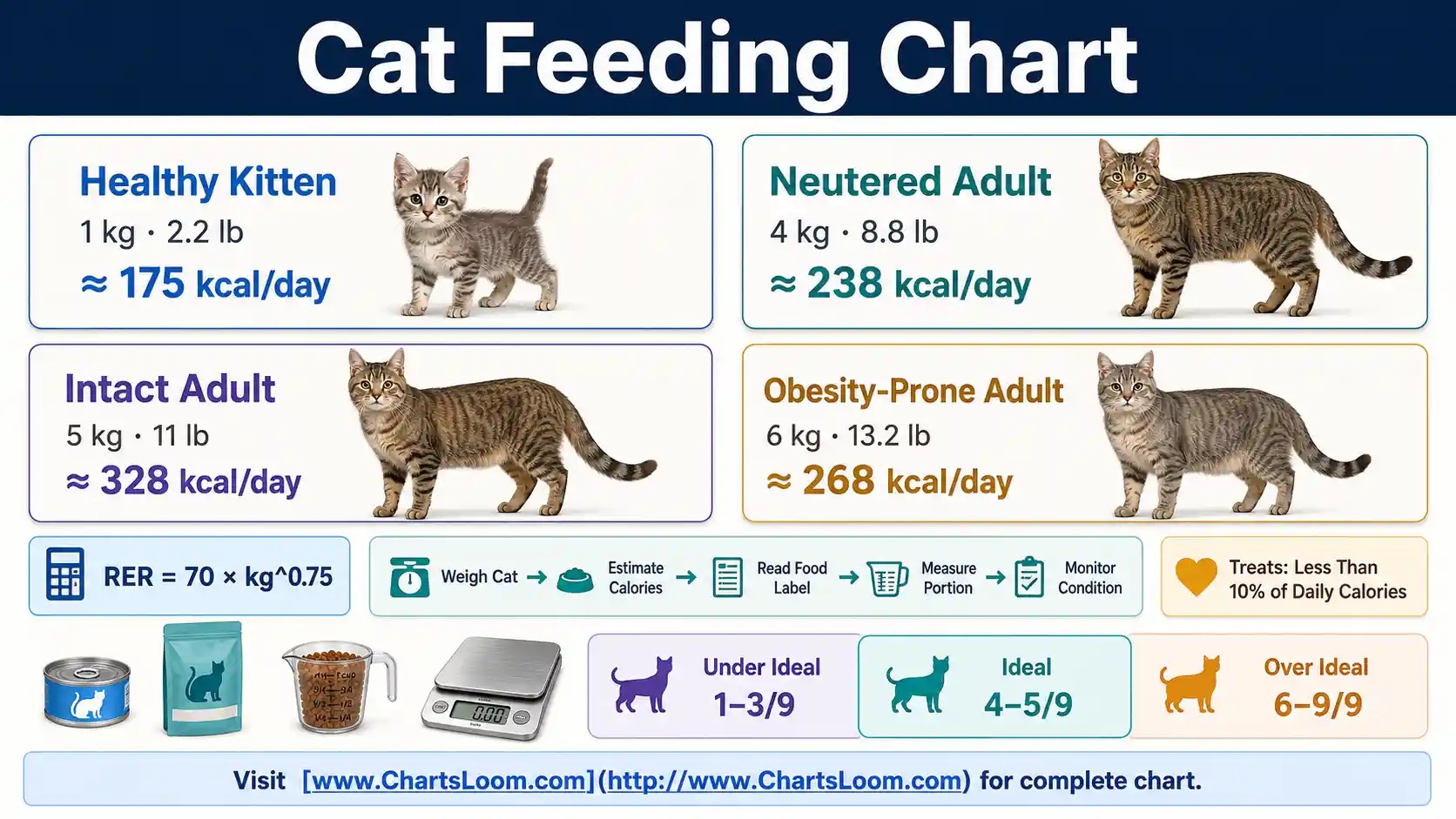
Quick answer: calculate calories, measure every format, then monitor
A useful cat feeding plan connects body weight, a starting calorie estimate, calories per cup, can, pouch or gram, and the cat’s actual trend. Count wet food, dry food, treats and toppers together. If weight, body condition, muscle condition or appetite changes, recheck the amount and seek veterinary guidance when appropriate.
Core formula
70 × kg^0.75
This calculates resting energy requirement, a baseline rather than the final ration.
Adult example
1.2 × RER
A common starting multiplier for a healthy neutered adult cat.
Treat allowance
<10%
Treats, toppers and food used for medication count toward the daily total.
Essential follow-up
Weigh and assess
Body weight, body condition, muscle condition and appetite determine whether the amount fits.
Questions at a glance
How much should I feed my cat?
Use the food label or a calorie estimate as a starting point, measure every food source and adjust according to weight and body condition.
What is RER?
Resting energy requirement is the calculated calorie baseline for a healthy animal at rest.
How is feline RER calculated?
A common formula is 70 multiplied by body weight in kilograms raised to the 0.75 power.
What does MER mean?
Maintenance energy requirement is a daily estimate created by multiplying RER by a life-stage or adult-status factor.
What multiplier applies to a neutered adult?
Merck lists 1.2 × RER as a common healthy starting estimate.
What multiplier applies to a healthy kitten?
Merck lists 2.5 × RER as a general starting estimate for healthy kittens.
Do cats of equal weight need equal calories?
No. Activity, body composition, age, environment, neuter status and health can change actual need.
How many meals should a cat eat?
Many cats can eat two to four measured meals, while some benefit from smaller portions divided more often.
Do treats count as food?
Yes. Lickable treats, toppers, dental products, table food and medication treats all add calories.
Is one cup equal across cat foods?
No. Products vary widely in calories per cup and grams per cup.
Where are food calories listed?
Find the Calorie Content statement, which gives kcal/kg and kcal per familiar unit such as a cup, can or pouch.
Can this chart plan a medical diet?
No. Disease, pregnancy, lactation, underweight and therapeutic weight loss require individualized veterinary guidance.
Cat resting energy requirement chart
Resting energy requirement by body weight using the exponential formula across common domestic-cat weights.
Swipe horizontally inside the table to view every column.
| Weight (kg) | Weight (lb) | RER (kcal/day) | Formula | Interpretation |
|---|---|---|---|---|
| 0.5 | 1.1 | 42 | 70 × kg^0.75 | Calculated resting baseline |
| 0.75 | 1.7 | 56 | 70 × kg^0.75 | Calculated resting baseline |
| 1 | 2.2 | 70 | 70 × kg^0.75 | Calculated resting baseline |
| 1.25 | 2.8 | 83 | 70 × kg^0.75 | Calculated resting baseline |
| 1.5 | 3.3 | 95 | 70 × kg^0.75 | Calculated resting baseline |
| 1.75 | 3.9 | 107 | 70 × kg^0.75 | Calculated resting baseline |
| 2 | 4.4 | 118 | 70 × kg^0.75 | Calculated resting baseline |
| 2.25 | 5.0 | 129 | 70 × kg^0.75 | Calculated resting baseline |
| 2.5 | 5.5 | 139 | 70 × kg^0.75 | Calculated resting baseline |
| 2.75 | 6.1 | 149 | 70 × kg^0.75 | Calculated resting baseline |
| 3 | 6.6 | 160 | 70 × kg^0.75 | Calculated resting baseline |
| 3.25 | 7.2 | 169 | 70 × kg^0.75 | Calculated resting baseline |
| 3.5 | 7.7 | 179 | 70 × kg^0.75 | Calculated resting baseline |
| 3.75 | 8.3 | 189 | 70 × kg^0.75 | Calculated resting baseline |
| 4 | 8.8 | 198 | 70 × kg^0.75 | Calculated resting baseline |
| 4.25 | 9.4 | 207 | 70 × kg^0.75 | Calculated resting baseline |
| 4.5 | 9.9 | 216 | 70 × kg^0.75 | Calculated resting baseline |
| 4.75 | 10.5 | 225 | 70 × kg^0.75 | Calculated resting baseline |
| 5 | 11.0 | 234 | 70 × kg^0.75 | Calculated resting baseline |
| 5.25 | 11.6 | 243 | 70 × kg^0.75 | Calculated resting baseline |
| 5.5 | 12.1 | 251 | 70 × kg^0.75 | Calculated resting baseline |
| 5.75 | 12.7 | 260 | 70 × kg^0.75 | Calculated resting baseline |
| 6 | 13.2 | 268 | 70 × kg^0.75 | Calculated resting baseline |
| 6.25 | 13.8 | 277 | 70 × kg^0.75 | Calculated resting baseline |
| 6.5 | 14.3 | 285 | 70 × kg^0.75 | Calculated resting baseline |
| 6.75 | 14.9 | 293 | 70 × kg^0.75 | Calculated resting baseline |
| 7 | 15.4 | 301 | 70 × kg^0.75 | Calculated resting baseline |
| 7.25 | 16.0 | 309 | 70 × kg^0.75 | Calculated resting baseline |
| 7.5 | 16.5 | 317 | 70 × kg^0.75 | Calculated resting baseline |
| 7.75 | 17.1 | 325 | 70 × kg^0.75 | Calculated resting baseline |
| 8 | 17.6 | 333 | 70 × kg^0.75 | Calculated resting baseline |
| 8.25 | 18.2 | 341 | 70 × kg^0.75 | Calculated resting baseline |
| 8.5 | 18.7 | 348 | 70 × kg^0.75 | Calculated resting baseline |
| 8.75 | 19.3 | 356 | 70 × kg^0.75 | Calculated resting baseline |
| 9 | 19.8 | 364 | 70 × kg^0.75 | Calculated resting baseline |
| 9.25 | 20.4 | 371 | 70 × kg^0.75 | Calculated resting baseline |
| 9.5 | 20.9 | 379 | 70 × kg^0.75 | Calculated resting baseline |
| 9.75 | 21.5 | 386 | 70 × kg^0.75 | Calculated resting baseline |
| 10 | 22.0 | 394 | 70 × kg^0.75 | Calculated resting baseline |
| 10.25 | 22.6 | 401 | 70 × kg^0.75 | Calculated resting baseline |
| 10.5 | 23.1 | 408 | 70 × kg^0.75 | Calculated resting baseline |
| 10.75 | 23.7 | 416 | 70 × kg^0.75 | Calculated resting baseline |
| 11 | 24.3 | 423 | 70 × kg^0.75 | Calculated resting baseline |
| 11.25 | 24.8 | 430 | 70 × kg^0.75 | Calculated resting baseline |
| 11.5 | 25.4 | 437 | 70 × kg^0.75 | Calculated resting baseline |
| 11.75 | 25.9 | 444 | 70 × kg^0.75 | Calculated resting baseline |
| 12 | 26.5 | 451 | 70 × kg^0.75 | Calculated resting baseline |
| 12.25 | 27.0 | 458 | 70 × kg^0.75 | Calculated resting baseline |
| 12.5 | 27.6 | 465 | 70 × kg^0.75 | Calculated resting baseline |
| 12.75 | 28.1 | 472 | 70 × kg^0.75 | Calculated resting baseline |
| 13 | 28.7 | 479 | 70 × kg^0.75 | Calculated resting baseline |
| 13.25 | 29.2 | 486 | 70 × kg^0.75 | Calculated resting baseline |
| 13.5 | 29.8 | 493 | 70 × kg^0.75 | Calculated resting baseline |
| 13.75 | 30.3 | 500 | 70 × kg^0.75 | Calculated resting baseline |
| 14 | 30.9 | 507 | 70 × kg^0.75 | Calculated resting baseline |
| 14.25 | 31.4 | 513 | 70 × kg^0.75 | Calculated resting baseline |
| 14.5 | 32.0 | 520 | 70 × kg^0.75 | Calculated resting baseline |
| 14.75 | 32.5 | 527 | 70 × kg^0.75 | Calculated resting baseline |
| 15 | 33.1 | 534 | 70 × kg^0.75 | Calculated resting baseline |
Energy values are rounded kilocalories per day.
- • RER is a mathematical baseline, not the final ration.
- • Use an appropriate body weight and monitor the individual cat rather than treating the result as a fixed prescription.
Download or export
Cat daily calorie chart by weight and profile
Starting daily energy estimates for common healthy-cat profiles.
Swipe horizontally inside the table to view every column.
| Weight (kg) | RER | Obesity-prone adult 1.0× | Neutered adult 1.2× | Intact adult 1.4× | Healthy kitten 2.5× |
|---|---|---|---|---|---|
| 0.5 | 42 | 42 | 50 | 59 | 105 |
| 0.75 | 56 | 56 | 67 | 78 | 140 |
| 1 | 70 | 70 | 84 | 98 | 175 |
| 1.25 | 83 | 83 | 100 | 116 | 208 |
| 1.5 | 95 | 95 | 114 | 133 | 238 |
| 1.75 | 107 | 107 | 128 | 150 | 268 |
| 2 | 118 | 118 | 142 | 165 | 295 |
| 2.25 | 129 | 129 | 155 | 181 | 322 |
| 2.5 | 139 | 139 | 167 | 195 | 348 |
| 2.75 | 149 | 149 | 179 | 209 | 372 |
| 3 | 160 | 160 | 192 | 224 | 400 |
| 3.25 | 169 | 169 | 203 | 237 | 422 |
| 3.5 | 179 | 179 | 215 | 251 | 448 |
| 3.75 | 189 | 189 | 227 | 265 | 472 |
| 4 | 198 | 198 | 238 | 277 | 495 |
| 4.25 | 207 | 207 | 248 | 290 | 518 |
| 4.5 | 216 | 216 | 259 | 302 | 540 |
| 4.75 | 225 | 225 | 270 | 315 | 562 |
| 5 | 234 | 234 | 281 | 328 | 585 |
| 5.25 | 243 | 243 | 292 | 340 | 608 |
| 5.5 | 251 | 251 | 301 | 351 | 628 |
| 5.75 | 260 | 260 | 312 | 364 | 650 |
| 6 | 268 | 268 | 322 | 375 | 670 |
| 6.25 | 277 | 277 | 332 | 388 | 692 |
| 6.5 | 285 | 285 | 342 | 399 | 712 |
| 6.75 | 293 | 293 | 352 | 410 | 732 |
| 7 | 301 | 301 | 361 | 421 | 752 |
| 7.25 | 309 | 309 | 371 | 433 | 772 |
| 7.5 | 317 | 317 | 380 | 444 | 792 |
| 7.75 | 325 | 325 | 390 | 455 | 812 |
| 8 | 333 | 333 | 400 | 466 | 832 |
| 8.25 | 341 | 341 | 409 | 477 | 852 |
| 8.5 | 348 | 348 | 418 | 487 | 870 |
| 8.75 | 356 | 356 | 427 | 498 | 890 |
| 9 | 364 | 364 | 437 | 510 | 910 |
| 9.25 | 371 | 371 | 445 | 519 | 928 |
| 9.5 | 379 | 379 | 455 | 531 | 948 |
| 9.75 | 386 | 386 | 463 | 540 | 965 |
| 10 | 394 | 394 | 473 | 552 | 985 |
| 10.25 | 401 | 401 | 481 | 561 | 1002 |
| 10.5 | 408 | 408 | 490 | 571 | 1020 |
| 10.75 | 416 | 416 | 499 | 582 | 1040 |
| 11 | 423 | 423 | 508 | 592 | 1058 |
| 11.25 | 430 | 430 | 516 | 602 | 1075 |
| 11.5 | 437 | 437 | 524 | 612 | 1092 |
| 11.75 | 444 | 444 | 533 | 622 | 1110 |
| 12 | 451 | 451 | 541 | 631 | 1128 |
Rounded kcal/day starting estimates.
- • These multipliers are starting estimates for healthy cats; individual needs can differ.
- • Pregnancy, lactation, illness, recovery and therapeutic weight change require individualized veterinary planning.
Download or export
Interactive tool
Daily calorie and portion calculator
Enter body weight, a supported healthy-cat profile, the food’s calories per cup, can, pouch, tray or other measured unit, and the planned number of meals. The calculator applies the Merck RER formula and profile multiplier, then reserves up to 10% for treats.
Default example: a 4 kg neutered adult eating food with 90 kcal per measured unit, divided into three meals.
Calculated starting point
Starting estimate calculated. Monitor body weight, body condition, muscle condition and appetite, then adjust with veterinary guidance.
- RER
- 198 kcal
- Daily estimate
- 238 kcal
- Main food
- 2.38 units/day
- Per meal
- 0.79 units
Treat allowance: up to 24 kcal/day. Main-food budget after that allowance: 214 kcal/day.
What it does
Calculates RER, applies one supported healthy-cat multiplier and converts calories into measured food units.
Why it helps
It connects body weight with the calorie statement instead of relying on cup, can or pouch size alone.
What it cannot do
It cannot prescribe diets for disease, pregnancy, lactation, recovery, underweight or therapeutic weight loss.
Cat food portions by calorie density
Example portions for healthy neutered adults after reserving up to 10% of daily calories for treats.
Swipe horizontally inside the table to view every column.
| Weight (kg) | Daily estimate (kcal) | Food energy (kcal/unit) | Units/day | Units/meal (3 meals) | Treat ceiling (kcal) |
|---|---|---|---|---|---|
| 1.5 | 114 | 70 | 1.47 | 0.49 | 11 |
| 1.5 | 114 | 90 | 1.14 | 0.38 | 11 |
| 1.5 | 114 | 120 | 0.86 | 0.29 | 11 |
| 1.5 | 114 | 180 | 0.57 | 0.19 | 11 |
| 1.5 | 114 | 300 | 0.34 | 0.11 | 11 |
| 1.5 | 114 | 420 | 0.25 | 0.08 | 11 |
| 2 | 142 | 70 | 1.83 | 0.61 | 14 |
| 2 | 142 | 90 | 1.42 | 0.47 | 14 |
| 2 | 142 | 120 | 1.07 | 0.36 | 14 |
| 2 | 142 | 180 | 0.71 | 0.24 | 14 |
| 2 | 142 | 300 | 0.43 | 0.14 | 14 |
| 2 | 142 | 420 | 0.30 | 0.10 | 14 |
| 2.5 | 167 | 70 | 2.14 | 0.71 | 17 |
| 2.5 | 167 | 90 | 1.67 | 0.56 | 17 |
| 2.5 | 167 | 120 | 1.25 | 0.42 | 17 |
| 2.5 | 167 | 180 | 0.83 | 0.28 | 17 |
| 2.5 | 167 | 300 | 0.50 | 0.17 | 17 |
| 2.5 | 167 | 420 | 0.36 | 0.12 | 17 |
| 3 | 192 | 70 | 2.47 | 0.82 | 19 |
| 3 | 192 | 90 | 1.92 | 0.64 | 19 |
| 3 | 192 | 120 | 1.44 | 0.48 | 19 |
| 3 | 192 | 180 | 0.96 | 0.32 | 19 |
| 3 | 192 | 300 | 0.58 | 0.19 | 19 |
| 3 | 192 | 420 | 0.41 | 0.14 | 19 |
| 3.5 | 215 | 70 | 2.77 | 0.92 | 22 |
| 3.5 | 215 | 90 | 2.16 | 0.72 | 22 |
| 3.5 | 215 | 120 | 1.62 | 0.54 | 22 |
| 3.5 | 215 | 180 | 1.08 | 0.36 | 22 |
| 3.5 | 215 | 300 | 0.65 | 0.22 | 22 |
| 3.5 | 215 | 420 | 0.46 | 0.15 | 22 |
| 4 | 238 | 70 | 3.06 | 1.02 | 24 |
| 4 | 238 | 90 | 2.38 | 0.79 | 24 |
| 4 | 238 | 120 | 1.78 | 0.59 | 24 |
| 4 | 238 | 180 | 1.19 | 0.40 | 24 |
| 4 | 238 | 300 | 0.71 | 0.24 | 24 |
| 4 | 238 | 420 | 0.51 | 0.17 | 24 |
| 4.5 | 259 | 70 | 3.33 | 1.11 | 26 |
| 4.5 | 259 | 90 | 2.59 | 0.86 | 26 |
| 4.5 | 259 | 120 | 1.94 | 0.65 | 26 |
| 4.5 | 259 | 180 | 1.29 | 0.43 | 26 |
| 4.5 | 259 | 300 | 0.78 | 0.26 | 26 |
| 4.5 | 259 | 420 | 0.55 | 0.18 | 26 |
| 5 | 281 | 70 | 3.61 | 1.20 | 28 |
| 5 | 281 | 90 | 2.81 | 0.94 | 28 |
| 5 | 281 | 120 | 2.11 | 0.70 | 28 |
| 5 | 281 | 180 | 1.41 | 0.47 | 28 |
| 5 | 281 | 300 | 0.84 | 0.28 | 28 |
| 5 | 281 | 420 | 0.60 | 0.20 | 28 |
| 6 | 322 | 70 | 4.14 | 1.38 | 32 |
| 6 | 322 | 90 | 3.22 | 1.07 | 32 |
| 6 | 322 | 120 | 2.42 | 0.81 | 32 |
| 6 | 322 | 180 | 1.61 | 0.54 | 32 |
| 6 | 322 | 300 | 0.97 | 0.32 | 32 |
| 6 | 322 | 420 | 0.69 | 0.23 | 32 |
| 7 | 361 | 70 | 4.64 | 1.55 | 36 |
| 7 | 361 | 90 | 3.61 | 1.20 | 36 |
| 7 | 361 | 120 | 2.71 | 0.90 | 36 |
| 7 | 361 | 180 | 1.81 | 0.60 | 36 |
| 7 | 361 | 300 | 1.08 | 0.36 | 36 |
| 7 | 361 | 420 | 0.77 | 0.26 | 36 |
| 8 | 400 | 70 | 5.14 | 1.71 | 40 |
| 8 | 400 | 90 | 4.00 | 1.33 | 40 |
| 8 | 400 | 120 | 3.00 | 1.00 | 40 |
| 8 | 400 | 180 | 2.00 | 0.67 | 40 |
| 8 | 400 | 300 | 1.20 | 0.40 | 40 |
| 8 | 400 | 420 | 0.86 | 0.29 | 40 |
| 9 | 437 | 70 | 5.61 | 1.87 | 44 |
| 9 | 437 | 90 | 4.37 | 1.46 | 44 |
| 9 | 437 | 120 | 3.27 | 1.09 | 44 |
| 9 | 437 | 180 | 2.18 | 0.73 | 44 |
| 9 | 437 | 300 | 1.31 | 0.44 | 44 |
| 9 | 437 | 420 | 0.94 | 0.31 | 44 |
| 10 | 473 | 70 | 6.09 | 2.03 | 47 |
| 10 | 473 | 90 | 4.73 | 1.58 | 47 |
| 10 | 473 | 120 | 3.55 | 1.18 | 47 |
| 10 | 473 | 180 | 2.37 | 0.79 | 47 |
| 10 | 473 | 300 | 1.42 | 0.47 | 47 |
| 10 | 473 | 420 | 1.01 | 0.34 | 47 |
| 12 | 541 | 70 | 6.96 | 2.32 | 54 |
| 12 | 541 | 90 | 5.41 | 1.80 | 54 |
| 12 | 541 | 120 | 4.06 | 1.35 | 54 |
| 12 | 541 | 180 | 2.71 | 0.90 | 54 |
| 12 | 541 | 300 | 1.62 | 0.54 | 54 |
| 12 | 541 | 420 | 1.16 | 0.39 | 54 |
- • A measured unit can be a cup, can, pouch, tray or weighed serving; use the exact unit printed on the label.
- • These are worked mathematical examples, not universal feeding directions.
Download or export
Cat treat calorie budget chart
Maximum treat calories when treats remain at or below 10% of the daily total.
Swipe horizontally inside the table to view every column.
| Daily total (kcal) | 10% treat ceiling | Main diet budget | If 2 kcal/treat | If 5 kcal/treat |
|---|---|---|---|---|
| 80 | 8 | 72 | 4 | 2 |
| 90 | 9 | 81 | 4 | 2 |
| 100 | 10 | 90 | 5 | 2 |
| 110 | 11 | 99 | 6 | 2 |
| 120 | 12 | 108 | 6 | 2 |
| 130 | 13 | 117 | 6 | 3 |
| 140 | 14 | 126 | 7 | 3 |
| 150 | 15 | 135 | 8 | 3 |
| 160 | 16 | 144 | 8 | 3 |
| 170 | 17 | 153 | 8 | 3 |
| 180 | 18 | 162 | 9 | 4 |
| 190 | 19 | 171 | 10 | 4 |
| 200 | 20 | 180 | 10 | 4 |
| 210 | 21 | 189 | 10 | 4 |
| 220 | 22 | 198 | 11 | 4 |
| 230 | 23 | 207 | 12 | 5 |
| 240 | 24 | 216 | 12 | 5 |
| 250 | 25 | 225 | 12 | 5 |
| 260 | 26 | 234 | 13 | 5 |
| 270 | 27 | 243 | 14 | 5 |
| 280 | 28 | 252 | 14 | 6 |
| 290 | 29 | 261 | 14 | 6 |
| 300 | 30 | 270 | 15 | 6 |
| 310 | 31 | 279 | 16 | 6 |
| 320 | 32 | 288 | 16 | 6 |
| 330 | 33 | 297 | 16 | 7 |
| 340 | 34 | 306 | 17 | 7 |
| 350 | 35 | 315 | 18 | 7 |
| 360 | 36 | 324 | 18 | 7 |
| 370 | 37 | 333 | 18 | 7 |
| 380 | 38 | 342 | 19 | 8 |
| 390 | 39 | 351 | 20 | 8 |
| 400 | 40 | 360 | 20 | 8 |
| 410 | 41 | 369 | 20 | 8 |
| 420 | 42 | 378 | 21 | 8 |
| 430 | 43 | 387 | 22 | 9 |
| 440 | 44 | 396 | 22 | 9 |
| 450 | 45 | 405 | 22 | 9 |
| 460 | 46 | 414 | 23 | 9 |
| 470 | 47 | 423 | 24 | 9 |
| 480 | 48 | 432 | 24 | 10 |
| 490 | 49 | 441 | 24 | 10 |
| 500 | 50 | 450 | 25 | 10 |
| 510 | 51 | 459 | 26 | 10 |
| 520 | 52 | 468 | 26 | 10 |
| 530 | 53 | 477 | 26 | 11 |
| 540 | 54 | 486 | 27 | 11 |
| 550 | 55 | 495 | 28 | 11 |
| 560 | 56 | 504 | 28 | 11 |
| 570 | 57 | 513 | 28 | 11 |
| 580 | 58 | 522 | 29 | 12 |
| 590 | 59 | 531 | 30 | 12 |
| 600 | 60 | 540 | 30 | 12 |
| 610 | 61 | 549 | 30 | 12 |
| 620 | 62 | 558 | 31 | 12 |
| 630 | 63 | 567 | 32 | 13 |
| 640 | 64 | 576 | 32 | 13 |
| 650 | 65 | 585 | 32 | 13 |
| 660 | 66 | 594 | 33 | 13 |
| 670 | 67 | 603 | 34 | 13 |
| 680 | 68 | 612 | 34 | 14 |
- • Treats include lickable treats, dental products, table food, toppers and food used for training or medication.
- • The complete and balanced diet should remain the nutritional foundation.
Download or export
Kitten feeding schedule by growth stage
Meal frequency and diet-purpose checkpoints from weaning through adult transition.
Swipe horizontally inside the table to view every column.
| Stage | Typical age | Meal pattern | Diet purpose | Practical note |
|---|---|---|---|---|
| Early weaning | About 3–5 weeks | Several small meals plus nursing as appropriate | Complete and balanced kitten food | Use a texture and transition plan suited to the kitten. |
| Young kitten | 6–8 weeks | 4 small measured meals | Kitten growth diet | Track weight frequently and confirm steady gain. |
| Growing kitten | 2–4 months | 3–4 measured meals | Kitten growth diet | Energy need is high relative to body size. |
| Mid-growth | 4–6 months | 3 measured meals | Kitten growth diet | Recalculate as weight changes. |
| Adolescent kitten | 6–9 months | 2–3 measured meals | Kitten growth diet | Watch for excess fat gain after neutering. |
| Late growth | 9–12 months | Usually 2–3 meals | Kitten diet until growth is complete | Transition timing varies by individual and breed. |
| Adult transition | Around 12 months for many cats | Measured adult schedule | Adult maintenance diet | Change gradually and match calories, not cup volume. |
| Large, slow-maturing breed | May mature later than 12 months | Individualized measured schedule | Growth diet until veterinary-confirmed maturity | Avoid switching solely because the calendar reaches one year. |
- • Healthy kittens have higher energy needs than adults and need a food appropriate for growth.
- • Failure to gain, persistent diarrhea, vomiting or poor appetite requires veterinary assessment.
Download or export
Adult cat meal-pattern chart
Practical ways to divide and deliver a measured daily ration.
Swipe horizontally inside the table to view every column.
| Situation | Possible pattern | Why it may help | Important limit |
|---|---|---|---|
| Healthy indoor adult | 2–4 measured meals | Makes intake visible and supports portion control | Keep the daily calorie total fixed. |
| Cat that eats too quickly | Several smaller measured meals | Reduces the size of each feeding | Use a safe slow-feeding or puzzle method if appropriate. |
| Multi-cat household | Separate measured stations | Shows which cat ate and reduces food competition | Prevent access to another cat’s ration. |
| Wet-food schedule | Measured meals with prompt storage of leftovers | Supports portion tracking and food safety | Follow label storage instructions. |
| Dry-food schedule | Premeasure the entire daily ration | Prevents repeated uncounted refills | Do not free-pour from the bag. |
| Mixed wet and dry feeding | Calculate calories from both products | Prevents double feeding | Subtract one food before adding the other. |
| Automatic feeder | Several timed measured portions | Can divide calories across the day | Verify dispensing accuracy. |
| Puzzle or forage feeding | Use part of the measured daily ration | Adds activity without adding calories | Match the device to mobility and confidence. |
| Senior cat | Individualized small measured meals | Makes appetite and weight changes easier to notice | Unplanned weight loss is not normal aging. |
| Cat receiving medication with food | Use the schedule directed by the veterinary team | Supports correct drug administration | Do not alter medication timing independently. |
- • Meal pattern does not change the total calorie budget by itself.
- • Persistent appetite change, food avoidance or difficulty eating can indicate illness or pain.
Download or export
Cat body-condition score and feeding response
A nine-point body-condition interpretation for deciding whether a feeding estimate needs review.
Swipe horizontally inside the table to view every column.
| Score | Category | Typical appearance or feel | Feeding response |
|---|---|---|---|
| 1 | Emaciated | Ribs, spine and pelvis very prominent; no palpable fat | Prompt veterinary assessment |
| 2 | Very thin | Ribs readily visible; minimal muscle and fat cover | Veterinary assessment and careful feeding plan |
| 3 | Thin | Ribs easy to feel with little fat; marked waist | Review intake, health and trend |
| 4 | Lean / ideal | Ribs easily felt with slight fat cover; clear waist | Often within ideal range |
| 5 | Ideal | Well-proportioned; ribs palpable with slight cover | Maintain and monitor |
| 6 | Slightly over ideal | Ribs palpable with excess cover; waist less obvious | Measure calories and reassess |
| 7 | Overweight | Ribs difficult to feel; abdominal fat pad more obvious | Veterinary weight-management discussion |
| 8 | Obese | Ribs not easily felt; marked fat deposits | Veterinary weight-management plan |
| 9 | Severely obese | Heavy fat deposits; waist absent | Veterinary assessment and controlled plan |
- • Scores 4/9 and 5/9 are generally considered ideal in the WSAVA framework.
- • Body condition should be assessed by sight and touch; coat length can hide changes.
Download or export
How to read a cat food label
The label fields that matter when choosing a food and calculating an actual portion.
Swipe horizontally inside the table to view every column.
| Label field | What to find | Why it matters |
|---|---|---|
| Intended species | Look for “cat food” | Dog food may not supply feline-specific nutrients |
| Nutritional adequacy | Complete and balanced for the correct life stage | Distinguishes a staple diet from a treat or supplement |
| Life stage | Growth, adult maintenance, gestation/lactation or all life stages | Choose a statement that matches the cat |
| Calorie content | kcal/kg and kcal per cup, can, pouch or unit | Required for portion calculations |
| Feeding directions | Amount by body weight and frequency | Use as a starting point, not an automatic prescription |
| Net weight | Total product amount | Helps calculate servings and cost |
| Guaranteed analysis | Minimum protein/fat and maximum moisture/fiber | Not the same as actual average nutrient content |
| Moisture | As-fed water percentage | Important when comparing wet and dry products |
| Ingredient list | Ingredients in descending as-fed weight | Does not by itself prove nutrient quality or balance |
| Product name wording | “With,” “dinner” and “flavor” have different meanings | Marketing wording does not equal nutrient suitability |
| Manufacturer details | Responsible company and contact information | Useful for questions about average nutrient data |
| Storage directions | Refrigeration or dry-storage instructions | Protects quality and reduces contamination risk |
- • Compare calories per familiar unit before changing foods or mixing formats.
- • For long-term feeding, confirm that the adequacy statement matches the cat’s life stage.
Download or export
Wet versus dry cat food comparison
Practical differences that affect calorie calculation, storage and measuring.
Swipe horizontally inside the table to view every column.
| Feature | Wet food | Dry food | Feeding implication |
|---|---|---|---|
| Water content | Usually about 68–78% water | Usually about 10% water | Compare products on a calorie or dry-matter basis |
| Calories per gram | Often lower because of water | Often higher and more compact | Read kcal per can, pouch, cup and gram |
| Portion appearance | Larger visible volume for equal calories | Smaller visible volume for equal calories | Volume can mislead |
| Storage before opening | Shelf-stable when sealed | Cool, dry storage | Follow package directions |
| Storage after opening | Usually refrigerate and use promptly | Keep sealed and dry | Discard spoiled or contaminated food |
| Measuring | Weigh or divide cans and pouches | Weigh grams or use a standardized cup | A kitchen scale is more repeatable |
| Hydration contribution | Provides more water with the food | Provides less water with the food | Fresh drinking water remains necessary |
| Palatability | Often highly palatable | Varies by product and cat | Preference is individual |
| Dental claim | Ordinary wet food is not a dental treatment | Ordinary kibble is not automatically a dental treatment | Use products with supported dental claims when needed |
| Mixing formats | Count all wet-food calories | Count all dry-food calories | The combined total must match the daily budget |
- • Neither format is automatically appropriate for every cat; suitability depends on the complete diet and the individual.
- • Guaranteed-analysis percentages should not be compared directly across foods with very different moisture levels.
Download or export
Cat food calorie-density conversion chart
Conversions between kcal/kg, kcal/g, weighed portions and familiar wet-food units.
Swipe horizontally inside the table to view every column.
| Label energy | kcal/g | Measured amount | Calories in amount | Amount for 100 kcal |
|---|---|---|---|---|
| 2500 | 2.50 | 25 | 62 | 40.0 |
| 2500 | 2.50 | 50 | 125 | 40.0 |
| 2750 | 2.75 | 25 | 69 | 36.4 |
| 2750 | 2.75 | 50 | 138 | 36.4 |
| 3000 | 3.00 | 25 | 75 | 33.3 |
| 3000 | 3.00 | 50 | 150 | 33.3 |
| 3250 | 3.25 | 25 | 81 | 30.8 |
| 3250 | 3.25 | 50 | 162 | 30.8 |
| 3500 | 3.50 | 25 | 88 | 28.6 |
| 3500 | 3.50 | 50 | 175 | 28.6 |
| 3750 | 3.75 | 25 | 94 | 26.7 |
| 3750 | 3.75 | 50 | 188 | 26.7 |
| 4000 | 4.00 | 25 | 100 | 25.0 |
| 4000 | 4.00 | 50 | 200 | 25.0 |
| 4250 | 4.25 | 25 | 106 | 23.5 |
| 4250 | 4.25 | 50 | 212 | 23.5 |
| 4500 | 4.50 | 25 | 112 | 22.2 |
| 4500 | 4.50 | 50 | 225 | 22.2 |
| 4750 | 4.75 | 25 | 119 | 21.1 |
| 4750 | 4.75 | 50 | 238 | 21.1 |
| 5000 | 5.00 | 25 | 125 | 20.0 |
| 5000 | 5.00 | 50 | 250 | 20.0 |
| 5250 | 5.25 | 25 | 131 | 19.0 |
| 5250 | 5.25 | 50 | 262 | 19.0 |
| 5500 | 5.50 | 25 | 138 | 18.2 |
| 5500 | 5.50 | 50 | 275 | 18.2 |
| 5750 | 5.75 | 25 | 144 | 17.4 |
| 5750 | 5.75 | 50 | 288 | 17.4 |
| 6000 | 6.00 | 25 | 150 | 16.7 |
| 6000 | 6.00 | 50 | 300 | 16.7 |
| Label unit | — | 1 can or pouch | 60 | 1.67 units |
| Label unit | — | 1 can or pouch | 70 | 1.43 units |
| Label unit | — | 1 can or pouch | 80 | 1.25 units |
| Label unit | — | 1 can or pouch | 90 | 1.11 units |
| Label unit | — | 1 can or pouch | 100 | 1.00 units |
| Label unit | — | 1 can or pouch | 110 | 0.91 units |
| Label unit | — | 1 can or pouch | 120 | 0.83 units |
| Label unit | — | 1 can or pouch | 140 | 0.71 units |
| Label unit | — | 1 can or pouch | 160 | 0.62 units |
| Label unit | — | 1 can or pouch | 180 | 0.56 units |
- • Use the product’s stated calorie content whenever available.
- • For a wet-food unit row, the final column shows the number of whole labeled units that supply 100 kcal.
Download or export
Cat food measuring methods
How common portioning methods differ in repeatability and usefulness.
Swipe horizontally inside the table to view every column.
| Method | Measures | Repeatability | Best practice |
|---|---|---|---|
| Digital kitchen scale | Grams | High repeatability | Tare the empty bowl first |
| Standard 8 fl oz measuring cup | Cup volume | Moderate | Level the food consistently |
| Manufacturer scoop | Unknown unless labeled | Variable | Verify its volume or weight |
| Can or pouch fractions | Half, third or quarter unit | Moderate | Use label calories for the whole unit |
| Preportioned daily container | Whole-day ration | High when weighed first | Family members feed only from that container |
| Automatic feeder | Programmed portions | Variable by machine | Test several dispenses on a scale |
| Tablespoon | Small volume | Low to moderate | Useful only when the food and method stay constant |
| Handful or visual estimate | Unstandardized | Poor | Avoid for routine calorie control |
| Shared household log | Meals and treats | Improves accountability | Record every person and product |
| Body-weight check | Kilograms or pounds | Outcome measure | Use the same scale and conditions when possible |
- • Weighing food in grams is usually more repeatable than estimating by eye.
- • The most precise method still requires the correct daily calorie target.
Download or export
Seven-day cat food transition chart
One gradual example for moving between tolerated foods while keeping calories visible.
Swipe horizontally inside the table to view every column.
| Day | Current food | New food | Monitoring note |
|---|---|---|---|
| Day 1 | 75% current food | 25% new food | Watch acceptance and stool |
| Day 2 | 70% current food | 30% new food | Keep total calories similar |
| Day 3 | 60% current food | 40% new food | Continue only if tolerated |
| Day 4 | 50% current food | 50% new food | Measure both foods |
| Day 5 | 40% current food | 60% new food | Avoid adding uncounted toppers |
| Day 6 | 25% current food | 75% new food | Recheck appetite and digestion |
| Day 7 | 0% current food | 100% new food | Use the new food’s calorie statement |
- • Some cats need a slower transition; a veterinarian may direct a different plan.
- • Do not persist with a food that causes vomiting, diarrhea, refusal to eat or another concerning reaction.
Download or export
Cat food nutritional-adequacy statements
What common adequacy wording means for feline life-stage feeding.
Swipe horizontally inside the table to view every column.
| Statement category | Intended cat | What it means | Limit |
|---|---|---|---|
| Growth | Kittens | Complete and balanced for growth | Use through appropriate growth period |
| Adult maintenance | Healthy adult cats | Complete and balanced for maintenance | Not intended to meet kitten growth needs |
| Gestation/lactation | Pregnant or nursing queens | Complete and balanced for reproduction | Requires individualized monitoring |
| All life stages | Growth, reproduction and maintenance | Generally meets the most demanding listed stage | May be more calorie-dense than some adults need |
| Intermittent or supplemental only | Treat, topper or special product | Not a complete long-term diet | Must not displace the complete diet |
- • Use the exact adequacy statement rather than front-of-package marketing terms.
- • Dog food is not an appropriate complete diet for cats because feline nutrient requirements differ.
Download or export
Cat feeding adjustments and common mistakes
Observations and errors that should change how a feeding plan is reviewed.
Swipe horizontally inside the table to view every column.
| Observation or mistake | Why it matters | Better response |
|---|---|---|
| Stable weight and ideal condition | Maintain the measured amount | Recheck regularly |
| Weight rising above goal | Confirm all foods and measuring accuracy | Discuss a controlled reduction |
| Weight falling unintentionally | Check appetite, intake and health | Arrange veterinary assessment |
| After neutering | Monitor closely for reduced energy need | Recalculate and measure |
| Kitten growth slowing unexpectedly | Check weight trend and food suitability | Veterinary assessment |
| Senior cat losing muscle or weight | Do not assume normal aging | Veterinary assessment |
| Several people feeding | Daily calories may be duplicated | Use one measured daily container |
| Multi-cat food stealing | Individual intake becomes unknown | Feed separately |
| Switching foods cup-for-cup | Calorie density may change | Match calories, not volume |
| Ignoring lickable treats | Small packets can add meaningful calories | Count every treat |
| Free-pouring dry food | Daily intake is unknown | Premeasure the full ration |
| Using a random scoop | Portion size is inconsistent | Use grams or a standard measure |
| Choosing by ingredient list alone | It does not show complete nutrient balance | Check adequacy and calorie statements |
| Comparing wet and dry as-fed percentages | Moisture distorts comparison | Use dry-matter or calorie basis |
| Assuming senior food is always lower calorie | Older cats can lose condition | Match food to the individual |
| Adding supplements without need | Can unbalance a complete diet | Use only with veterinary justification |
| Using adult food for a kitten | May not meet growth needs | Choose a growth-appropriate complete diet |
| Abrupt diet change | May reduce acceptance or upset digestion | Transition gradually when appropriate |
| Treating appetite loss as pickiness | Cats can become seriously ill when not eating | Seek prompt veterinary advice |
| Using the calculator for disease | Medical energy and nutrient needs differ | Use an individualized veterinary plan |
- • Make measured changes and follow trends instead of reacting to one isolated observation.
- • A cat that stops eating or eats markedly less needs prompt veterinary attention.
Download or export
Cat feeding worked examples
Worked calculations connecting weight, profile, food energy and divided portions.
Swipe horizontally inside the table to view every column.
| Weight (kg) | Profile | RER | Daily kcal | Food kcal/unit | Units/day after treats | Units/meal |
|---|---|---|---|---|---|---|
| 1.5 | Healthy kitten | 95 | 238 | 90 | 2.38 | 0.59 |
| 2 | Healthy kitten | 118 | 295 | 100 | 2.66 | 0.67 |
| 2.5 | Neutered adult | 139 | 167 | 80 | 1.88 | 0.62 |
| 3 | Neutered adult | 160 | 192 | 90 | 1.92 | 0.64 |
| 3.5 | Intact adult | 179 | 251 | 100 | 2.26 | 0.75 |
| 4 | Neutered adult | 198 | 238 | 120 | 1.78 | 0.59 |
| 4.5 | Obesity-prone adult | 216 | 216 | 70 | 2.77 | 0.92 |
| 5 | Neutered adult | 234 | 281 | 300 | 0.84 | 0.28 |
| 5.5 | Intact adult | 251 | 351 | 320 | 0.99 | 0.33 |
| 6 | Obesity-prone adult | 268 | 268 | 350 | 0.69 | 0.23 |
| 6.5 | Neutered adult | 285 | 342 | 380 | 0.81 | 0.27 |
| 7 | Intact adult | 301 | 421 | 420 | 0.90 | 0.30 |
| 8 | Neutered adult | 333 | 400 | 400 | 0.90 | 0.30 |
| 9 | Obesity-prone adult | 364 | 364 | 420 | 0.78 | 0.26 |
| 10 | Intact adult | 394 | 552 | 450 | 1.10 | 0.37 |
| 3.2 | Neutered adult | 167 | 200 | 85 | 2.12 | 0.53 |
| 4.2 | Neutered adult | 205 | 246 | 95 | 2.33 | 0.58 |
| 5.2 | Obesity-prone adult | 241 | 241 | 110 | 1.97 | 0.66 |
| 7.5 | Neutered adult | 317 | 380 | 150 | 2.28 | 0.76 |
| 12 | Intact adult | 451 | 631 | 500 | 1.14 | 0.38 |
- • Each example reserves 10% of the daily estimate for treats; use the full calorie total when no treats are fed.
- • Portions are rounded and must be checked against actual weight and body-condition trends.
Download or export
Practical limitations
A feeding chart cannot see the whole cat
Calculated calories can be wrong for an individual even when the arithmetic is correct. Lean mass, activity, environment, neuter status, age, digestion, medication and health all affect energy use. The result must be checked against repeated weight, body-condition, muscle-condition and appetite observations.
Do not use this calculator to treat obesity, underweight, diabetes, kidney disease, hyperthyroidism, gastrointestinal disease, food reactions or another medical condition. Seek prompt veterinary help when a cat stops eating, eats markedly less, vomits repeatedly, loses weight or seems unwell.
Cat feeding FAQs
How much should I feed my cat each day?
Start with the food label or a calorie estimate, measure the food, count treats and adjust according to repeated weight and body-condition observations.
What is the RER formula for cats?
A common formula is RER = 70 × body weight in kilograms raised to the 0.75 power.
How many calories does a neutered adult cat need?
A common starting estimate is 1.2 × RER, but the individual requirement can be higher or lower.
How many calories does an intact adult cat need?
A common healthy starting estimate is 1.4 × RER, followed by monitoring and adjustment.
How many calories does a kitten need?
Merck lists 2.5 × RER as a general starting multiplier for healthy kittens, with growth and body condition monitored.
How often should I feed my cat?
Many cats can eat two to four measured meals, while kittens and some individual cats benefit from smaller, more frequent portions.
Should treats count toward daily calories?
Yes. Lickable treats, toppers, table food, dental products and medication treats all add calories.
How many calories may come from treats?
Keep treats below 10% of total daily calories so the complete diet remains the nutritional foundation.
Is one cup equal across cat foods?
No. Dry foods vary in calorie density and grams per cup, while wet foods vary by can, pouch and tray size.
Where are calories shown on cat food?
Look for the Calorie Content statement expressed as kcal/kg and kcal per familiar unit such as a cup, can or pouch.
Can I compare wet and dry food percentages directly?
Not reliably, because their moisture contents differ. Compare nutrients on a dry-matter or calorie basis.
Can I mix wet and dry cat food?
Yes, when both foods are appropriate, but count the calories from both and keep the combined total within the plan.
Should I use current weight or ideal weight?
Healthy maintenance estimates use an appropriate current weight; therapeutic weight change needs a veterinarian-selected method.
Can this calculator plan a medical diet?
No. Disease, pregnancy, lactation, recovery, underweight and therapeutic weight loss require individualized veterinary guidance.
When should appetite change be urgent?
A cat that stops eating, eats markedly less, vomits repeatedly, loses weight or seems unwell needs prompt veterinary advice.
Sources
External source addresses are displayed as plain text. Table references above link only to these source entries.
Merck Veterinary Manual — Daily Maintenance Energy Requirements for Dogs and Cats
Provides the resting energy requirement framework and common starting multipliers for intact adult, neutered adult, obesity-prone adult and healthy kitten profiles.
https://www.merckvetmanual.com/multimedia/table/daily-maintenance-energy-requirements-for-dogs-and-cats
Merck Veterinary Manual — Dog and Cat Foods
Explains calorie statements, nutritional adequacy, feeding directions, wet-versus-dry comparison and why body weight and condition must be monitored.
https://www.merckvetmanual.com/management-and-nutrition/nutrition-small-animals/dog-and-cat-foods
World Small Animal Veterinary Association — Body Condition Score — Cat
Provides the nine-point feline body-condition framework used to describe under-ideal, ideal and over-ideal condition.
https://wsava.org/wp-content/uploads/2020/08/Body-Condition-Score-cat-updated-August-2020.pdf