Animals & Pets · Dog nutrition
Dog Feeding Chart by Weight, Calories, Life Stage and Meal Schedule
Estimate calories, translate a food label into measured portions, plan meal frequency and monitor whether the starting amount suits your dog.
This page is educational, not a veterinary prescription. Illness, pregnancy, lactation, rapid growth, extreme exercise, recovery and therapeutic weight change need individualized guidance. Read the ChartsLoom Disclaimer.
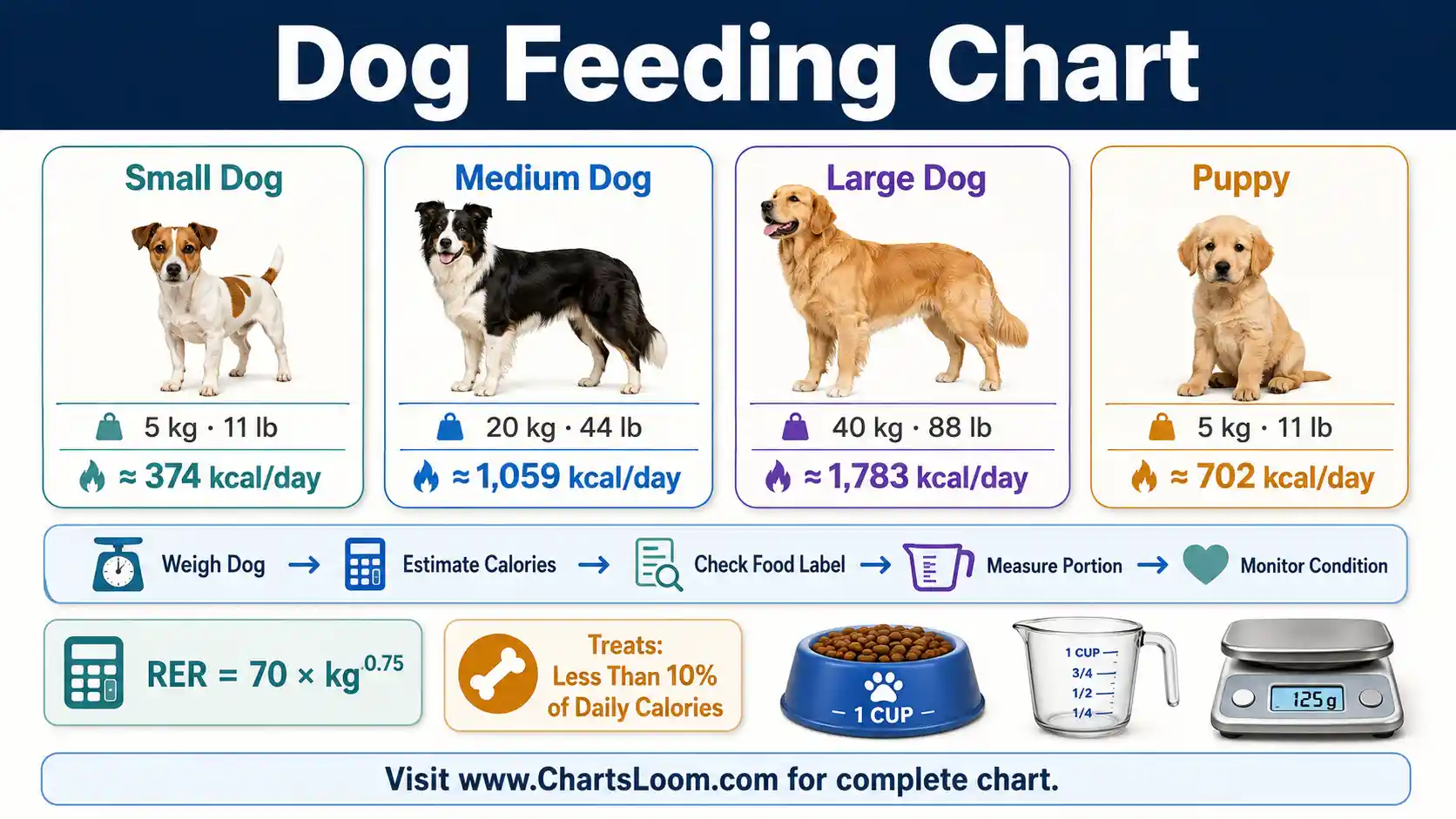
Quick answer: calculate calories, measure food, then monitor
A useful feeding plan connects four pieces of information: the dog’s appropriate body weight, a starting daily calorie estimate, the food’s calories per measured unit and the dog’s actual weight and body-condition trend. The formula does not replace observation. If weight rises or falls away from the goal, confirm every calorie source and adjust with veterinary guidance.
Core formula
70 × kg^0.75
This calculates resting energy requirement, a starting baseline rather than the final ration.
Adult example
1.6 × RER
A common starting multiplier for a healthy neutered adult dog.
Treat allowance
<10%
Treats, chews and training rewards should remain below 10% of total calories.
Essential follow-up
Weigh and assess
Body weight and body condition show whether the calculated amount fits the individual dog.
Questions at a glance
How much should I feed my dog?
Use the food label or a calorie estimate as a starting point, measure the food and adjust according to weight and body condition.
What is RER?
Resting energy requirement is the calorie baseline for a healthy animal at rest in a thermoneutral environment.
How is RER calculated?
A common formula is 70 multiplied by body weight in kilograms raised to the 0.75 power.
What is MER?
Maintenance energy requirement is RER multiplied by a factor for life stage and adult status.
Do all dogs of the same weight need equal calories?
No. Merck notes that individual needs can vary roughly 30% above or below a formula estimate.
How many meals should an adult dog eat?
Many healthy adults do well with two measured meals, but the daily calorie total matters more than the split alone.
How often should a puppy eat?
Young puppies commonly eat three or four small meals before moving toward two meals as they mature.
Do treats count as food?
Yes. Treats, chews, table food and training rewards all add calories.
Is one cup equal across dog foods?
No. A cup can contain very different calories and grams depending on the product.
Where do I find food calories?
Find the Calorie Content statement, which gives kcal/kg and kcal per familiar unit such as a cup, can or treat.
Should I follow the package amount exactly?
Treat package directions as a starting point and adjust by measured trends.
Can this chart plan a medical diet?
No. Disease, pregnancy, lactation, recovery, weight-loss treatment and extreme work need individualized veterinary guidance.
Dog resting energy requirement chart
Resting energy requirement (RER) by body weight using the exponential formula that can be applied across body sizes.
Swipe horizontally inside the table to view every column.
| Weight (kg) | Weight (lb) | RER (kcal/day) | Linear estimate (kcal/day) | Formula used |
|---|---|---|---|---|
| 1 | 2.2 | 70 | Not used | 70 × kg^0.75 |
| 2 | 4.4 | 118 | Not used | 70 × kg^0.75 |
| 3 | 6.6 | 160 | 160 | 70 × kg^0.75 |
| 4 | 8.8 | 198 | 190 | 70 × kg^0.75 |
| 5 | 11.0 | 234 | 220 | 70 × kg^0.75 |
| 6 | 13.2 | 268 | 250 | 70 × kg^0.75 |
| 7 | 15.4 | 301 | 280 | 70 × kg^0.75 |
| 8 | 17.6 | 333 | 310 | 70 × kg^0.75 |
| 9 | 19.8 | 364 | 340 | 70 × kg^0.75 |
| 10 | 22.0 | 394 | 370 | 70 × kg^0.75 |
| 11 | 24.3 | 423 | 400 | 70 × kg^0.75 |
| 12 | 26.5 | 451 | 430 | 70 × kg^0.75 |
| 13 | 28.7 | 479 | 460 | 70 × kg^0.75 |
| 14 | 30.9 | 507 | 490 | 70 × kg^0.75 |
| 15 | 33.1 | 534 | 520 | 70 × kg^0.75 |
| 16 | 35.3 | 560 | 550 | 70 × kg^0.75 |
| 17 | 37.5 | 586 | 580 | 70 × kg^0.75 |
| 18 | 39.7 | 612 | 610 | 70 × kg^0.75 |
| 19 | 41.9 | 637 | 640 | 70 × kg^0.75 |
| 20 | 44.1 | 662 | 670 | 70 × kg^0.75 |
| 21 | 46.3 | 687 | 700 | 70 × kg^0.75 |
| 22 | 48.5 | 711 | 730 | 70 × kg^0.75 |
| 23 | 50.7 | 735 | 760 | 70 × kg^0.75 |
| 24 | 52.9 | 759 | 790 | 70 × kg^0.75 |
| 25 | 55.1 | 783 | 820 | 70 × kg^0.75 |
| 26 | 57.3 | 806 | 850 | 70 × kg^0.75 |
| 27 | 59.5 | 829 | 880 | 70 × kg^0.75 |
| 28 | 61.7 | 852 | 910 | 70 × kg^0.75 |
| 29 | 63.9 | 875 | 940 | 70 × kg^0.75 |
| 30 | 66.1 | 897 | 970 | 70 × kg^0.75 |
| 31 | 68.3 | 920 | 1000 | 70 × kg^0.75 |
| 32 | 70.5 | 942 | 1030 | 70 × kg^0.75 |
| 33 | 72.8 | 964 | 1060 | 70 × kg^0.75 |
| 34 | 75.0 | 986 | 1090 | 70 × kg^0.75 |
| 35 | 77.2 | 1007 | 1120 | 70 × kg^0.75 |
| 36 | 79.4 | 1029 | 1150 | 70 × kg^0.75 |
| 37 | 81.6 | 1050 | 1180 | 70 × kg^0.75 |
| 38 | 83.8 | 1071 | 1210 | 70 × kg^0.75 |
| 39 | 86.0 | 1092 | 1240 | 70 × kg^0.75 |
| 40 | 88.2 | 1113 | 1270 | 70 × kg^0.75 |
| 41 | 90.4 | 1134 | 1300 | 70 × kg^0.75 |
| 42 | 92.6 | 1155 | 1330 | 70 × kg^0.75 |
| 43 | 94.8 | 1175 | 1360 | 70 × kg^0.75 |
| 44 | 97.0 | 1196 | 1390 | 70 × kg^0.75 |
| 45 | 99.2 | 1216 | Not used | 70 × kg^0.75 |
| 46 | 101.4 | 1236 | Not used | 70 × kg^0.75 |
| 47 | 103.6 | 1257 | Not used | 70 × kg^0.75 |
| 48 | 105.8 | 1277 | Not used | 70 × kg^0.75 |
| 49 | 108.0 | 1296 | Not used | 70 × kg^0.75 |
| 50 | 110.2 | 1316 | Not used | 70 × kg^0.75 |
| 51 | 112.4 | 1336 | Not used | 70 × kg^0.75 |
| 52 | 114.6 | 1356 | Not used | 70 × kg^0.75 |
| 53 | 116.8 | 1375 | Not used | 70 × kg^0.75 |
| 54 | 119.0 | 1394 | Not used | 70 × kg^0.75 |
| 55 | 121.3 | 1414 | Not used | 70 × kg^0.75 |
| 56 | 123.5 | 1433 | Not used | 70 × kg^0.75 |
| 57 | 125.7 | 1452 | Not used | 70 × kg^0.75 |
| 58 | 127.9 | 1471 | Not used | 70 × kg^0.75 |
| 59 | 130.1 | 1490 | Not used | 70 × kg^0.75 |
| 60 | 132.3 | 1509 | Not used | 70 × kg^0.75 |
| 61 | 134.5 | 1528 | Not used | 70 × kg^0.75 |
| 62 | 136.7 | 1547 | Not used | 70 × kg^0.75 |
| 63 | 138.9 | 1565 | Not used | 70 × kg^0.75 |
| 64 | 141.1 | 1584 | Not used | 70 × kg^0.75 |
| 65 | 143.3 | 1602 | Not used | 70 × kg^0.75 |
| 66 | 145.5 | 1621 | Not used | 70 × kg^0.75 |
| 67 | 147.7 | 1639 | Not used | 70 × kg^0.75 |
| 68 | 149.9 | 1658 | Not used | 70 × kg^0.75 |
| 69 | 152.1 | 1676 | Not used | 70 × kg^0.75 |
| 70 | 154.3 | 1694 | Not used | 70 × kg^0.75 |
Energy values are kilocalories per day.
- • RER is a calculated baseline, not the final feeding prescription.
- • The linear formula 30 × kg + 70 is shown only for weights greater than 2 kg and less than 45 kg, as described by Merck.
Download or export
Dog daily calorie chart by weight and profile
Starting maintenance-energy estimates for common healthy-dog profiles.
Swipe horizontally inside the table to view every column.
| Weight (kg) | RER | Obesity-prone adult 1.4× | Neutered adult 1.6× | Intact adult 1.8× | Puppy ≥4 months 2× | Puppy <4 months 3× |
|---|---|---|---|---|---|---|
| 1 | 70 | 98 | 112 | 126 | 140 | 210 |
| 2 | 118 | 165 | 189 | 212 | 236 | 354 |
| 3 | 160 | 224 | 256 | 288 | 320 | 480 |
| 4 | 198 | 277 | 317 | 356 | 396 | 594 |
| 5 | 234 | 328 | 374 | 421 | 468 | 702 |
| 6 | 268 | 375 | 429 | 482 | 536 | 804 |
| 7 | 301 | 421 | 482 | 542 | 602 | 903 |
| 8 | 333 | 466 | 533 | 599 | 666 | 999 |
| 9 | 364 | 510 | 582 | 655 | 728 | 1092 |
| 10 | 394 | 552 | 630 | 709 | 788 | 1182 |
| 11 | 423 | 592 | 677 | 761 | 846 | 1269 |
| 12 | 451 | 631 | 722 | 812 | 902 | 1353 |
| 13 | 479 | 671 | 766 | 862 | 958 | 1437 |
| 14 | 507 | 710 | 811 | 913 | 1014 | 1521 |
| 15 | 534 | 748 | 854 | 961 | 1068 | 1602 |
| 16 | 560 | 784 | 896 | 1008 | 1120 | 1680 |
| 17 | 586 | 820 | 938 | 1055 | 1172 | 1758 |
| 18 | 612 | 857 | 979 | 1102 | 1224 | 1836 |
| 19 | 637 | 892 | 1019 | 1147 | 1274 | 1911 |
| 20 | 662 | 927 | 1059 | 1192 | 1324 | 1986 |
| 21 | 687 | 962 | 1099 | 1237 | 1374 | 2061 |
| 22 | 711 | 995 | 1138 | 1280 | 1422 | 2133 |
| 23 | 735 | 1029 | 1176 | 1323 | 1470 | 2205 |
| 24 | 759 | 1063 | 1214 | 1366 | 1518 | 2277 |
| 25 | 783 | 1096 | 1253 | 1409 | 1566 | 2349 |
| 26 | 806 | 1128 | 1290 | 1451 | 1612 | 2418 |
| 27 | 829 | 1161 | 1326 | 1492 | 1658 | 2487 |
| 28 | 852 | 1193 | 1363 | 1534 | 1704 | 2556 |
| 29 | 875 | 1225 | 1400 | 1575 | 1750 | 2625 |
| 30 | 897 | 1256 | 1435 | 1615 | 1794 | 2691 |
| 31 | 920 | 1288 | 1472 | 1656 | 1840 | 2760 |
| 32 | 942 | 1319 | 1507 | 1696 | 1884 | 2826 |
| 33 | 964 | 1350 | 1542 | 1735 | 1928 | 2892 |
| 34 | 986 | 1380 | 1578 | 1775 | 1972 | 2958 |
| 35 | 1007 | 1410 | 1611 | 1813 | 2014 | 3021 |
| 36 | 1029 | 1441 | 1646 | 1852 | 2058 | 3087 |
| 37 | 1050 | 1470 | 1680 | 1890 | 2100 | 3150 |
| 38 | 1071 | 1499 | 1714 | 1928 | 2142 | 3213 |
| 39 | 1092 | 1529 | 1747 | 1966 | 2184 | 3276 |
| 40 | 1113 | 1558 | 1781 | 2003 | 2226 | 3339 |
| 41 | 1134 | 1588 | 1814 | 2041 | 2268 | 3402 |
| 42 | 1155 | 1617 | 1848 | 2079 | 2310 | 3465 |
| 43 | 1175 | 1645 | 1880 | 2115 | 2350 | 3525 |
| 44 | 1196 | 1674 | 1914 | 2153 | 2392 | 3588 |
| 45 | 1216 | 1702 | 1946 | 2189 | 2432 | 3648 |
| 46 | 1236 | 1730 | 1978 | 2225 | 2472 | 3708 |
| 47 | 1257 | 1760 | 2011 | 2263 | 2514 | 3771 |
| 48 | 1277 | 1788 | 2043 | 2299 | 2554 | 3831 |
| 49 | 1296 | 1814 | 2074 | 2333 | 2592 | 3888 |
| 50 | 1316 | 1842 | 2106 | 2369 | 2632 | 3948 |
Rounded kcal/day starting estimates.
- • Use current body weight only when that weight is appropriate; weight-loss plans may use a veterinary target-weight method.
- • Merck notes that two animals of the same weight can differ by roughly 30% above or below a formula estimate.
Download or export
Interactive tool
Daily calorie and portion calculator
Enter body weight, a supported healthy-dog profile, the food’s calories per cup, can, pouch or other measured unit, and the planned number of meals. The calculator applies the Merck RER formula and profile multiplier, then reserves up to 10% for treats.
Default example: a 20 kg neutered adult eating food with 350 kcal per measured unit, divided into two meals.
Calculated starting point
Starting estimate calculated. Monitor body weight and body condition, then adjust with veterinary guidance.
- RER
- 662 kcal
- Daily estimate
- 1059 kcal
- Main food
- 2.72 units/day
- Per meal
- 1.36 units
Treat allowance: up to 106 kcal/day. Main-food budget after that allowance: 953 kcal/day.
What it does
Calculates RER, applies one supported healthy-dog multiplier and converts calories into measured food units.
Why it helps
It connects body weight with the calorie statement on a food label instead of relying on cup volume alone.
What it cannot do
It cannot prescribe diets for disease, pregnancy, lactation, extreme work, recovery, weight-loss treatment or abnormal growth.
Dog food portions by calorie density
Example measured portions for neutered adults after reserving up to 10% of calories for treats.
Swipe horizontally inside the table to view every column.
| Weight (kg) | Daily estimate (kcal) | Food energy (kcal/unit) | Food units/day | Units per meal (2 meals) | Treat ceiling (kcal) |
|---|---|---|---|---|---|
| 2 | 189 | 250 | 0.68 | 0.34 | 19 |
| 2 | 189 | 300 | 0.57 | 0.28 | 19 |
| 2 | 189 | 350 | 0.49 | 0.24 | 19 |
| 2 | 189 | 400 | 0.42 | 0.21 | 19 |
| 2 | 189 | 450 | 0.38 | 0.19 | 19 |
| 2 | 189 | 500 | 0.34 | 0.17 | 19 |
| 3 | 256 | 250 | 0.92 | 0.46 | 26 |
| 3 | 256 | 300 | 0.77 | 0.38 | 26 |
| 3 | 256 | 350 | 0.66 | 0.33 | 26 |
| 3 | 256 | 400 | 0.57 | 0.29 | 26 |
| 3 | 256 | 450 | 0.51 | 0.26 | 26 |
| 3 | 256 | 500 | 0.46 | 0.23 | 26 |
| 4 | 317 | 250 | 1.14 | 0.57 | 32 |
| 4 | 317 | 300 | 0.95 | 0.47 | 32 |
| 4 | 317 | 350 | 0.81 | 0.41 | 32 |
| 4 | 317 | 400 | 0.71 | 0.36 | 32 |
| 4 | 317 | 450 | 0.63 | 0.32 | 32 |
| 4 | 317 | 500 | 0.57 | 0.28 | 32 |
| 5 | 374 | 250 | 1.35 | 0.67 | 37 |
| 5 | 374 | 300 | 1.12 | 0.56 | 37 |
| 5 | 374 | 350 | 0.96 | 0.48 | 37 |
| 5 | 374 | 400 | 0.84 | 0.42 | 37 |
| 5 | 374 | 450 | 0.75 | 0.37 | 37 |
| 5 | 374 | 500 | 0.67 | 0.34 | 37 |
| 7 | 482 | 250 | 1.74 | 0.87 | 48 |
| 7 | 482 | 300 | 1.45 | 0.72 | 48 |
| 7 | 482 | 350 | 1.24 | 0.62 | 48 |
| 7 | 482 | 400 | 1.08 | 0.54 | 48 |
| 7 | 482 | 450 | 0.96 | 0.48 | 48 |
| 7 | 482 | 500 | 0.87 | 0.43 | 48 |
| 10 | 630 | 250 | 2.27 | 1.13 | 63 |
| 10 | 630 | 300 | 1.89 | 0.94 | 63 |
| 10 | 630 | 350 | 1.62 | 0.81 | 63 |
| 10 | 630 | 400 | 1.42 | 0.71 | 63 |
| 10 | 630 | 450 | 1.26 | 0.63 | 63 |
| 10 | 630 | 500 | 1.13 | 0.57 | 63 |
| 12 | 722 | 250 | 2.60 | 1.30 | 72 |
| 12 | 722 | 300 | 2.17 | 1.08 | 72 |
| 12 | 722 | 350 | 1.86 | 0.93 | 72 |
| 12 | 722 | 400 | 1.62 | 0.81 | 72 |
| 12 | 722 | 450 | 1.44 | 0.72 | 72 |
| 12 | 722 | 500 | 1.30 | 0.65 | 72 |
| 15 | 854 | 250 | 3.08 | 1.54 | 85 |
| 15 | 854 | 300 | 2.56 | 1.28 | 85 |
| 15 | 854 | 350 | 2.20 | 1.10 | 85 |
| 15 | 854 | 400 | 1.92 | 0.96 | 85 |
| 15 | 854 | 450 | 1.71 | 0.85 | 85 |
| 15 | 854 | 500 | 1.54 | 0.77 | 85 |
| 20 | 1059 | 250 | 3.81 | 1.91 | 106 |
| 20 | 1059 | 300 | 3.18 | 1.59 | 106 |
| 20 | 1059 | 350 | 2.72 | 1.36 | 106 |
| 20 | 1059 | 400 | 2.38 | 1.19 | 106 |
| 20 | 1059 | 450 | 2.12 | 1.06 | 106 |
| 20 | 1059 | 500 | 1.91 | 0.95 | 106 |
| 25 | 1253 | 250 | 4.51 | 2.26 | 125 |
| 25 | 1253 | 300 | 3.76 | 1.88 | 125 |
| 25 | 1253 | 350 | 3.22 | 1.61 | 125 |
| 25 | 1253 | 400 | 2.82 | 1.41 | 125 |
| 25 | 1253 | 450 | 2.51 | 1.25 | 125 |
| 25 | 1253 | 500 | 2.26 | 1.13 | 125 |
| 30 | 1435 | 250 | 5.17 | 2.58 | 144 |
| 30 | 1435 | 300 | 4.31 | 2.15 | 144 |
| 30 | 1435 | 350 | 3.69 | 1.85 | 144 |
| 30 | 1435 | 400 | 3.23 | 1.61 | 144 |
| 30 | 1435 | 450 | 2.87 | 1.44 | 144 |
| 30 | 1435 | 500 | 2.58 | 1.29 | 144 |
| 35 | 1611 | 250 | 5.80 | 2.90 | 161 |
| 35 | 1611 | 300 | 4.83 | 2.42 | 161 |
| 35 | 1611 | 350 | 4.14 | 2.07 | 161 |
| 35 | 1611 | 400 | 3.62 | 1.81 | 161 |
| 35 | 1611 | 450 | 3.22 | 1.61 | 161 |
| 35 | 1611 | 500 | 2.90 | 1.45 | 161 |
| 40 | 1781 | 250 | 6.41 | 3.21 | 178 |
| 40 | 1781 | 300 | 5.34 | 2.67 | 178 |
| 40 | 1781 | 350 | 4.58 | 2.29 | 178 |
| 40 | 1781 | 400 | 4.01 | 2.00 | 178 |
| 40 | 1781 | 450 | 3.56 | 1.78 | 178 |
| 40 | 1781 | 500 | 3.21 | 1.60 | 178 |
| 50 | 2106 | 250 | 7.58 | 3.79 | 211 |
| 50 | 2106 | 300 | 6.32 | 3.16 | 211 |
| 50 | 2106 | 350 | 5.41 | 2.71 | 211 |
| 50 | 2106 | 400 | 4.74 | 2.37 | 211 |
| 50 | 2106 | 450 | 4.21 | 2.11 | 211 |
| 50 | 2106 | 500 | 3.79 | 1.90 | 211 |
| 60 | 2414 | 250 | 8.69 | 4.35 | 241 |
| 60 | 2414 | 300 | 7.24 | 3.62 | 241 |
| 60 | 2414 | 350 | 6.21 | 3.10 | 241 |
| 60 | 2414 | 400 | 5.43 | 2.72 | 241 |
| 60 | 2414 | 450 | 4.83 | 2.41 | 241 |
| 60 | 2414 | 500 | 4.35 | 2.17 | 241 |
| 70 | 2710 | 250 | 9.76 | 4.88 | 271 |
| 70 | 2710 | 300 | 8.13 | 4.07 | 271 |
| 70 | 2710 | 350 | 6.97 | 3.48 | 271 |
| 70 | 2710 | 400 | 6.10 | 3.05 | 271 |
| 70 | 2710 | 450 | 5.42 | 2.71 | 271 |
| 70 | 2710 | 500 | 4.88 | 2.44 | 271 |
- • A measured unit may be a cup, can, pouch or weighed serving; use the same unit printed in the calorie statement.
- • These are mathematical examples, not universal package feeding directions.
Download or export
Dog treat calorie budget chart
Maximum treat calories when treats remain at or below 10% of the daily total.
Swipe horizontally inside the table to view every column.
| Daily total (kcal) | 10% treat ceiling | Main diet budget | If 5 kcal/treat | If 10 kcal/treat |
|---|---|---|---|---|
| 100 | 10 | 90 | 2 | 1 |
| 150 | 15 | 135 | 3 | 2 |
| 200 | 20 | 180 | 4 | 2 |
| 250 | 25 | 225 | 5 | 2 |
| 300 | 30 | 270 | 6 | 3 |
| 350 | 35 | 315 | 7 | 4 |
| 400 | 40 | 360 | 8 | 4 |
| 450 | 45 | 405 | 9 | 4 |
| 500 | 50 | 450 | 10 | 5 |
| 550 | 55 | 495 | 11 | 6 |
| 600 | 60 | 540 | 12 | 6 |
| 650 | 65 | 585 | 13 | 6 |
| 700 | 70 | 630 | 14 | 7 |
| 750 | 75 | 675 | 15 | 8 |
| 800 | 80 | 720 | 16 | 8 |
| 850 | 85 | 765 | 17 | 8 |
| 900 | 90 | 810 | 18 | 9 |
| 950 | 95 | 855 | 19 | 10 |
| 1000 | 100 | 900 | 20 | 10 |
| 1050 | 105 | 945 | 21 | 10 |
| 1100 | 110 | 990 | 22 | 11 |
| 1150 | 115 | 1035 | 23 | 12 |
| 1200 | 120 | 1080 | 24 | 12 |
| 1250 | 125 | 1125 | 25 | 12 |
| 1300 | 130 | 1170 | 26 | 13 |
| 1350 | 135 | 1215 | 27 | 14 |
| 1400 | 140 | 1260 | 28 | 14 |
| 1450 | 145 | 1305 | 29 | 14 |
| 1500 | 150 | 1350 | 30 | 15 |
| 1550 | 155 | 1395 | 31 | 16 |
| 1600 | 160 | 1440 | 32 | 16 |
| 1650 | 165 | 1485 | 33 | 16 |
| 1700 | 170 | 1530 | 34 | 17 |
| 1750 | 175 | 1575 | 35 | 18 |
| 1800 | 180 | 1620 | 36 | 18 |
| 1850 | 185 | 1665 | 37 | 18 |
| 1900 | 190 | 1710 | 38 | 19 |
| 1950 | 195 | 1755 | 39 | 20 |
| 2000 | 200 | 1800 | 40 | 20 |
- • Treats include chews, dental products, table food and calories used during training.
- • The main diet should remain nutritionally complete and balanced for the dog’s life stage.
Download or export
Puppy feeding schedule by growth stage
Meal frequency and diet-selection checkpoints from weaning through adult transition.
Swipe horizontally inside the table to view every column.
| Stage | Typical age | Meals/day | Diet purpose | Practical note |
|---|---|---|---|---|
| Weaning transition | About 3–4 weeks | 4 small meals | Growth/reproduction or appropriate growth diet | Use softened food if advised; keep changes gradual. |
| Young puppy | 8–12 weeks | 3–4 meals | Growth diet | Small stomach capacity favors divided meals. |
| Early growth | 3–4 months | 3 meals | Growth diet | Merck multiplier commonly starts near 3 × RER before 4 months. |
| Later growth | 4–6 months | 3 meals | Growth diet | Common starting multiplier falls near 2 × RER after 4 months. |
| Adolescent small/medium breed | 6–12 months | 2 meals | Growth diet until mature | Monitor body condition as growth rate slows. |
| Adolescent large/giant breed | 6–18+ months | 2–3 meals | Food appropriate for large-size growth | Avoid unplanned mineral supplementation. |
| Near adult size | Around 90% expected adult weight | 2 meals | Transition toward adult maintenance when appropriate | Merck notes a less energy-dense diet is generally used near this point. |
| Adult transition | Breed-dependent maturity | Usually 2 meals | Adult maintenance once growth is complete | Use veterinary and manufacturer guidance for timing. |
- • A puppy’s expected adult size affects growth duration and mineral needs.
- • Do not use adult-maintenance food for a growing puppy unless a veterinarian has specifically directed it.
Download or export
Adult dog meal-frequency chart
Common meal patterns and the reason each may be chosen.
Swipe horizontally inside the table to view every column.
| Situation | Typical pattern | Why it may help | Important limit |
|---|---|---|---|
| Healthy adult | 2 measured meals | Predictable intake and easier monitoring | Keep daily calories fixed across meals. |
| Food-motivated adult | 2–3 measured meals | May reduce long gaps without increasing total intake | Divide the same daily ration. |
| Toy or very small dog | 2–3 meals | May suit small stomach capacity | Ask a veterinarian about dogs prone to low blood sugar. |
| Large or deep-chested dog | 2 or more measured meals | Avoid one very large meal | Discuss exercise timing and bloat risk with a veterinarian. |
| Working day | Split around work as professionally planned | Energy timing may matter | Extreme work is outside the standard calculator. |
| Senior dog | Usually 2 measured meals | Supports routine and monitoring | Age alone does not determine calorie needs. |
| Weight-management plan | Multiple measured portions if helpful | Can support satiety and tracking | Use the prescribed daily total. |
| Medication with food | As directed | Matches drug instructions | Do not alter medication timing without advice. |
| Free-choice feeding | Usually not preferred for calorie control | Intake is difficult to measure | Merck notes most dogs can become overweight when fed freely. |
| Multi-dog household | Separate measured meals | Prevents food stealing and tracks appetite | Remove bowls after the planned meal window. |
- • Meal frequency does not change the daily calorie budget by itself.
- • Sudden appetite change can be a medical sign and should not be solved only by changing the schedule.
Download or export
Dog body-condition score and feeding response
A practical nine-point body-condition interpretation linked to feeding follow-up.
Swipe horizontally inside the table to view every column.
| Score | Category | Typical observation | Feeding response |
|---|---|---|---|
| 1 | Emaciated | Ribs, spine and pelvis very prominent; no obvious fat | Prompt veterinary assessment |
| 2 | Very thin | Ribs easily visible; marked waist and tuck | Veterinary assessment and careful plan |
| 3 | Thin | Ribs easy to feel with minimal cover; pronounced waist | Review intake and health |
| 4 | Lean | Ribs easy to feel; clear waist and abdominal tuck | Often acceptable for some dogs |
| 5 | Ideal | Ribs palpable without excess fat; visible waist and tuck | Maintain and monitor |
| 6 | Slightly over ideal | Ribs palpable with slight excess cover; waist less marked | Measure food and reassess |
| 7 | Overweight | Ribs difficult to feel; fat deposits; reduced waist | Veterinary weight plan |
| 8 | Obese | Ribs hard to feel; obvious fat deposits; little waist | Veterinary weight plan |
| 9 | Severely obese | Heavy fat deposits; absent waist; abdominal distension | Veterinary assessment |
- • Body condition is assessed by touch and shape, not body weight alone.
- • Long or dense coats can hide ribs and waist, so hands-on assessment matters.
Download or export
Dog food label reading chart
The label fields that affect feeding calculations and diet suitability.
Swipe horizontally inside the table to view every column.
| Label item | What it tells you | How to use it |
|---|---|---|
| Product identity | Confirms the food and intended species | Do not assume similar-looking packages have equal calories |
| Net quantity | Shows package weight or volume | Useful for cost and supply planning, not portion size alone |
| Ingredient list | Lists ingredients by as-fed weight | Does not directly rank nutrient quality |
| Guaranteed analysis | Minimum protein/fat; maximum fiber/moisture | Compare unlike food formats on dry-matter or caloric basis |
| Nutritional adequacy statement | States life stage and complete/balanced status | Match growth, adult maintenance or other intended use |
| Feeding directions | Gives a starting amount by animal weight and time | Adjust using body condition and actual calorie intake |
| Calorie Content heading | Shows metabolizable energy | Find kcal/kg and kcal per familiar unit |
| kcal/kg | Standard comparison expression | Useful for comparing similar foods |
| kcal/cup | Energy per measuring cup | Use a level standardized cup, not a random scoop |
| kcal/can or pouch | Energy in the entire package unit | Account for partial packages precisely |
| kcal/treat or piece | Energy in each item | Add all treats to the daily total |
| Intermittent or supplemental statement | Food is not complete for long-term sole feeding | Do not use as the only diet unless directed |
| Large-size growth qualification | Clarifies suitability for dogs expected to reach at least 70 lb/32 kg | Important for growing large-breed puppies |
| Manufacturer contact | Allows detailed nutrient questions | Ask for typical analysis when needed |
- • The ingredient list alone cannot determine whether a diet is appropriate.
- • Calorie content and nutritional adequacy are essential for turning a label into a feeding plan.
Download or export
Dog food calorie-density conversion chart
Convert kcal/kg into calories per gram and example serving weights.
Swipe horizontally inside the table to view every column.
| kcal/kg | kcal/gram | kcal per 100 g | kcal per 120 g | kcal per 150 g |
|---|---|---|---|---|
| 2500 | 2.50 | 250 | 300 | 375 |
| 2600 | 2.60 | 260 | 312 | 390 |
| 2700 | 2.70 | 270 | 324 | 405 |
| 2800 | 2.80 | 280 | 336 | 420 |
| 2900 | 2.90 | 290 | 348 | 435 |
| 3000 | 3.00 | 300 | 360 | 450 |
| 3100 | 3.10 | 310 | 372 | 465 |
| 3200 | 3.20 | 320 | 384 | 480 |
| 3300 | 3.30 | 330 | 396 | 495 |
| 3400 | 3.40 | 340 | 408 | 510 |
| 3500 | 3.50 | 350 | 420 | 525 |
| 3600 | 3.60 | 360 | 432 | 540 |
| 3700 | 3.70 | 370 | 444 | 555 |
| 3800 | 3.80 | 380 | 456 | 570 |
| 3900 | 3.90 | 390 | 468 | 585 |
| 4000 | 4.00 | 400 | 480 | 600 |
| 4100 | 4.10 | 410 | 492 | 615 |
| 4200 | 4.20 | 420 | 504 | 630 |
| 4300 | 4.30 | 430 | 516 | 645 |
| 4400 | 4.40 | 440 | 528 | 660 |
| 4500 | 4.50 | 450 | 540 | 675 |
| 4600 | 4.60 | 460 | 552 | 690 |
| 4700 | 4.70 | 470 | 564 | 705 |
| 4800 | 4.80 | 480 | 576 | 720 |
| 4900 | 4.90 | 490 | 588 | 735 |
| 5000 | 5.00 | 500 | 600 | 750 |
| 5100 | 5.10 | 510 | 612 | 765 |
| 5200 | 5.20 | 520 | 624 | 780 |
| 5300 | 5.30 | 530 | 636 | 795 |
| 5400 | 5.40 | 540 | 648 | 810 |
| 5500 | 5.50 | 550 | 660 | 825 |
- • Use the actual grams in the serving rather than assuming every cup has the same mass.
- • The calorie statement on the package is the preferred value.
Download or export
Dog food measuring-method accuracy chart
Compare common portioning methods and their likely consistency.
Swipe horizontally inside the table to view every column.
| Method | Relative accuracy | Best practice | Main caution |
|---|---|---|---|
| Kitchen gram scale | High | Weigh the empty bowl, tare, then add food | Best for small portions and calorie-dense foods |
| Standard 8 fl oz measuring cup | Moderate | Level the top consistently | Cup volume is not food weight |
| Manufacturer scoop | Variable | Confirm its stated volume or grams | Unmarked scoops can mislead |
| Can fraction by weight | High | Weigh the full contents, then portion grams | More precise than visual fractions |
| Pouch fraction by weight | High | Use package net weight and a scale | Account for leftovers |
| Treat count | Moderate | Use kcal per piece and count every item | Piece sizes may vary |
| Training kibble | High | Remove it from the meal ration first | Prevents double counting |
| Household spoon | Low | Avoid for main portions | Spoon sizes and heaping vary |
| Handful | Very low | Do not use for calorie control | Hand size and food shape vary |
| Automatic feeder | Variable | Calibrate each compartment or release | Verify actual grams dispensed |
| Food puzzle | High if premeasured | Load part of the daily ration | Puzzle use does not add calories |
| Shared family feeding log | High | Record meals, treats and chews | Prevents duplicate feeding |
- • For weight management, a gram scale is generally more repeatable than visual cup estimates.
- • Always measure the full daily amount, including food placed in toys or used for training.
Download or export
Seven-day dog food transition chart
A common gradual transition pattern for otherwise healthy dogs.
Swipe horizontally inside the table to view every column.
| Day or situation | Current food | New food | Action |
|---|---|---|---|
| Day 1 | 75% current | 25% new | Observe stool and appetite |
| Day 2 | 75% current | 25% new | Continue if tolerated |
| Day 3 | 50% current | 50% new | Keep total calories measured |
| Day 4 | 50% current | 50% new | Pause progression if signs develop |
| Day 5 | 25% current | 75% new | Check stool quality |
| Day 6 | 25% current | 75% new | Maintain consistent meal times |
| Day 7 | 0% current | 100% new | Continue monitoring |
| Sensitive dog | Slower transition | Veterinary guidance | Use a longer schedule when advised |
| Therapeutic diet change | As prescribed | As prescribed | Follow the veterinary plan |
| Acute vomiting/diarrhea | Do not improvise | Seek veterinary advice | A transition chart is not treatment |
- • This schedule is a general example; some dogs need a slower veterinary-directed transition.
- • Match calories during the change because equal cup volumes can have different energy values.
Download or export
Dog food nutritional-adequacy statements
What common adequacy wording means for life-stage feeding.
Swipe horizontally inside the table to view every column.
| Statement category | Intended dog | What to look for | Limit |
|---|---|---|---|
| Growth | Puppies | Growth of dogs | Check large-size growth qualification when relevant |
| Growth including large-size dogs | Puppies expected to be ≥70 lb/32 kg adult | Growth including large-size dogs | Appropriate calcium control matters |
| Growth except large-size dogs | Small/medium puppies only | Growth except large-size dogs | Not intended for large-size puppy growth |
| Adult maintenance | Healthy adult dogs | Adult maintenance | Not automatically appropriate for puppies |
| Gestation/lactation | Pregnant or nursing dogs | Gestation/lactation | Energy needs can be highly individual |
| All life stages | Growth, reproduction and adult maintenance | All life stages | Usually formulated to growth/reproduction standards |
| Intermittent or supplemental only | Treats, toppers or special products | Not complete and balanced | Must not displace the core complete diet |
| Veterinary therapeutic diet | Specific diagnosed condition | Use under veterinary supervision | Do not choose only from a chart |
- • Use the exact adequacy statement, not front-of-package marketing language.
- • Supplements can unbalance a complete diet and should have a clear justification.
Download or export
Dog feeding adjustment and monitoring chart
How weight, body condition and changing circumstances should affect follow-up.
Swipe horizontally inside the table to view every column.
| Observation | Immediate check | Next step |
|---|---|---|
| Stable weight; BCS 4–5 | Maintain current measured total | Recheck monthly |
| Weight rising; BCS moving above 5 | Confirm all calories and measuring accuracy | Discuss a controlled reduction |
| Weight falling unintentionally | Check intake, appetite and health | Veterinary assessment |
| Hungry but ideal condition | Split ration or add approved low-calorie enrichment | Do not automatically add calories |
| Leaves food repeatedly | Confirm freshness, amount and health | Persistent appetite change needs assessment |
| Activity increased temporarily | Track duration and body condition | Do not overcorrect after one active day |
| Activity decreased | Prevent unnoticed calorie excess | Reassess after routine change |
| After neutering | Monitor weight and condition closely | Many dogs need fewer calories |
| Senior with muscle loss | Do not assume simple calorie restriction | Veterinary assessment of muscle and disease |
| New medication | Watch appetite and weight | Ask about feeding interactions |
| Post-surgery or illness | Use discharge instructions | Standard calculator may be inappropriate |
| Pregnant or lactating | Use veterinary plan | Needs can exceed standard adult formulas |
| Extreme athletic work | Use performance nutrition plan | Outside ordinary maintenance multipliers |
| Large puppy growing too quickly | Review body condition and diet suitability | Avoid extra calcium without advice |
| Multi-dog competition | Feed separately and record intake | Prevent stealing and unequal portions |
- • Make small, measured changes and allow time to assess the trend unless a veterinarian directs otherwise.
- • Unexplained appetite or weight change can signal illness.
Download or export
Common dog feeding mistakes and corrections
Frequent errors that make otherwise sound calculations inaccurate.
Swipe horizontally inside the table to view every column.
| Mistake | Why it matters | Better approach |
|---|---|---|
| Using cups without checking kcal/cup | Equal cup volumes can differ greatly in calories | Read the calorie statement |
| Feeding the package maximum automatically | Directions are only a starting point | Monitor body condition |
| Ignoring treats and chews | They can exceed the calorie budget | Count every calorie source |
| Using current weight during obesity treatment | It may overestimate a weight-loss ration | Use a veterinary target plan |
| Switching foods cup-for-cup | Energy density may change | Match calories, not volume |
| Free-pouring food | Daily intake becomes unknown | Premeasure the full ration |
| Several family members feeding | Meals may be duplicated | Use a shared log |
| Adding supplements casually | Can unbalance a complete food | Use only with justification |
| Choosing by ingredient list alone | Ingredients do not reveal total nutrient balance | Check adequacy and nutrient profile |
| Assuming grain-free means lower calorie | Marketing category does not define energy | Compare kcal/unit |
| Assuming senior means automatic restriction | Some seniors lose muscle or weight | Assess the individual dog |
| Reducing food after one weigh-in | Normal measurement variation exists | Use repeated trends |
| Ignoring body condition under a thick coat | Visual assessment can miss fat change | Feel ribs and waist |
| Using a random scoop | Scoop volume is unknown | Use grams or a standard cup |
| Treating appetite change as behavior only | It can indicate disease | Seek assessment when persistent |
| Feeding adult food to a puppy | May not meet growth needs | Use the correct life-stage diet |
| Using a calculator for disease | Clinical needs can differ markedly | Use veterinary nutrition guidance |
| Changing diet abruptly | Can cause gastrointestinal upset | Transition gradually when appropriate |
- • Accuracy depends on measuring the actual food and counting all calorie sources.
- • A calculator cannot correct an inappropriate food choice or unrecognized medical condition.
Download or export
Dog feeding worked examples
Worked calculations that connect weight, profile, calorie density and meal portions.
Swipe horizontally inside the table to view every column.
| Weight (kg) | Profile | RER | Daily kcal | Food kcal/unit | Units/day after treats | Units/meal |
|---|---|---|---|---|---|---|
| 3 | Neutered adult | 160 | 256 | 380 | 0.61 | 0.30 |
| 5 | Intact adult | 234 | 421 | 420 | 0.90 | 0.45 |
| 8 | Obesity-prone adult | 333 | 466 | 300 | 1.40 | 0.70 |
| 10 | Puppy ≥4 months | 394 | 788 | 400 | 1.77 | 0.59 |
| 12 | Neutered adult | 451 | 722 | 350 | 1.86 | 0.93 |
| 15 | Intact adult | 534 | 961 | 450 | 1.92 | 0.96 |
| 20 | Neutered adult | 662 | 1059 | 350 | 2.72 | 1.36 |
| 25 | Obesity-prone adult | 783 | 1096 | 320 | 3.08 | 1.54 |
| 30 | Intact adult | 897 | 1615 | 400 | 3.63 | 1.82 |
| 35 | Neutered adult | 1007 | 1611 | 380 | 3.82 | 1.91 |
| 40 | Puppy ≥4 months | 1113 | 2226 | 420 | 4.77 | 1.59 |
| 45 | Neutered adult | 1216 | 1946 | 450 | 3.89 | 1.95 |
| 50 | Obesity-prone adult | 1316 | 1842 | 360 | 4.61 | 2.30 |
| 55 | Intact adult | 1414 | 2545 | 400 | 5.72 | 2.86 |
| 60 | Neutered adult | 1509 | 2414 | 420 | 5.17 | 2.59 |
| 7 | Puppy <4 months | 301 | 903 | 380 | 2.14 | 0.53 |
| 18 | Puppy <4 months | 612 | 1836 | 420 | 3.93 | 0.98 |
| 22 | Puppy ≥4 months | 711 | 1422 | 380 | 3.37 | 1.12 |
| 6 | Neutered adult | 268 | 429 | 250 | 1.54 | 0.77 |
| 70 | Neutered adult | 1694 | 2710 | 500 | 4.88 | 2.44 |
- • Each example reserves 10% of the daily estimate for treats; use the full calorie total when no treats are fed.
- • Rounded portions should be checked against actual body-weight and body-condition trends.
Download or export
Practical limitations
A feeding chart cannot see the whole dog
Calculated calories can be wrong for an individual even when the arithmetic is correct. Breed, lean mass, activity, environment, neuter status, age, medication and health all change energy use. Merck notes that requirements among animals of the same weight can vary markedly.
Do not use this calculator to treat obesity, underweight, diabetes, kidney disease, gastrointestinal disease, pancreatitis, food reactions or other medical conditions. Seek prompt veterinary help for persistent refusal to eat, vomiting, diarrhea, rapid weight change, weakness or difficulty swallowing.
Dog feeding FAQs
How much should I feed my dog each day?
Start with the food label or a calorie estimate, measure the actual food, count treats, and adjust according to body weight and body condition.
What is the RER formula for dogs?
A common formula is RER = 70 × body weight in kilograms raised to the 0.75 power.
What is MER?
Maintenance energy requirement is a daily calorie estimate created by multiplying RER by a factor for life stage and adult status.
How many calories does a neutered adult dog need?
A common starting estimate is 1.6 × RER, but the individual requirement may be substantially higher or lower.
How many calories does a puppy need?
Common starting multipliers are about 3 × RER before four months and 2 × RER after four months, with growth and body condition monitored.
How many meals should an adult dog eat?
Many healthy adults eat two measured meals daily, although the best schedule depends on the dog and veterinary needs.
How many meals should a puppy eat?
Young puppies commonly need three or four small meals, moving toward two meals as growth and stomach capacity progress.
Should treats be included in daily calories?
Yes. Treats, chews, table food and training rewards all count toward the daily total.
How many calories may come from treats?
Merck advises keeping treats below 10% of total caloric intake so the complete diet remains the nutritional foundation.
Is one cup of every dog food equal?
No. Foods vary widely in calorie density and the grams contained in a cup.
Where are calories shown on a dog food label?
Look for the Calorie Content statement, normally expressed as kcal/kg and kcal per familiar unit such as a cup, can or treat.
Can I use package feeding directions exactly?
Use them as a starting point, then monitor weight and body condition because individual needs vary.
Should I feed by current weight or ideal weight?
Healthy maintenance estimates often use current appropriate weight; weight-loss or gain plans may require a veterinarian-selected target weight.
Can this calculator plan a medical diet?
No. Disease, pregnancy, lactation, recovery, extreme work and therapeutic weight loss require individualized veterinary guidance.
How often should I recheck the feeding amount?
Recheck after food, activity, life-stage, neuter-status or health changes and whenever weight or body condition trends away from the goal.
Sources
External source addresses are displayed as plain text. Table references above link only to these source entries.
Merck Veterinary Manual — Nutritional Requirements of Small Animals and Daily Maintenance Energy Requirements
Provides the RER formulas, explains maintenance energy estimates, lists common healthy-dog multipliers and notes that individual requirements may vary substantially from a calculated starting point.
https://www.merckvetmanual.com/management-and-nutrition/nutrition-small-animals/nutritional-requirements-of-small-animals
Merck Veterinary Manual — Dog and Cat Foods
Explains pet-food label elements, nutritional adequacy statements, feeding directions, calorie declarations, dry-matter comparisons and the recommendation that treats remain below 10% of total caloric intake.
https://www.merckvetmanual.com/management-and-nutrition/nutrition-small-animals/dog-and-cat-foods
World Small Animal Veterinary Association — Body Condition Score — Dog
Provides the nine-point canine body-condition scoring framework, including hands-on and visual descriptions for under-ideal, ideal and over-ideal condition.
https://wsava.org/wp-content/uploads/2020/01/Body-Condition-Score-Dog.pdf