Animals & Pets · Preventive care
Cat Vaccination Chart for Kittens, Adults, FVRCP, FeLV and Rabies
Compare kitten timing, adult revaccination, FeLV exposure, rabies rules, routes, records, reactions, catch-up examples and high-risk settings.
This chart is educational and cannot prescribe vaccination. A veterinarian must assess health, records, FeLV status, local disease, licensed products and legal rabies requirements. Suspected rabies exposure or a severe reaction needs prompt professional help. Read the ChartsLoom Disclaimer.
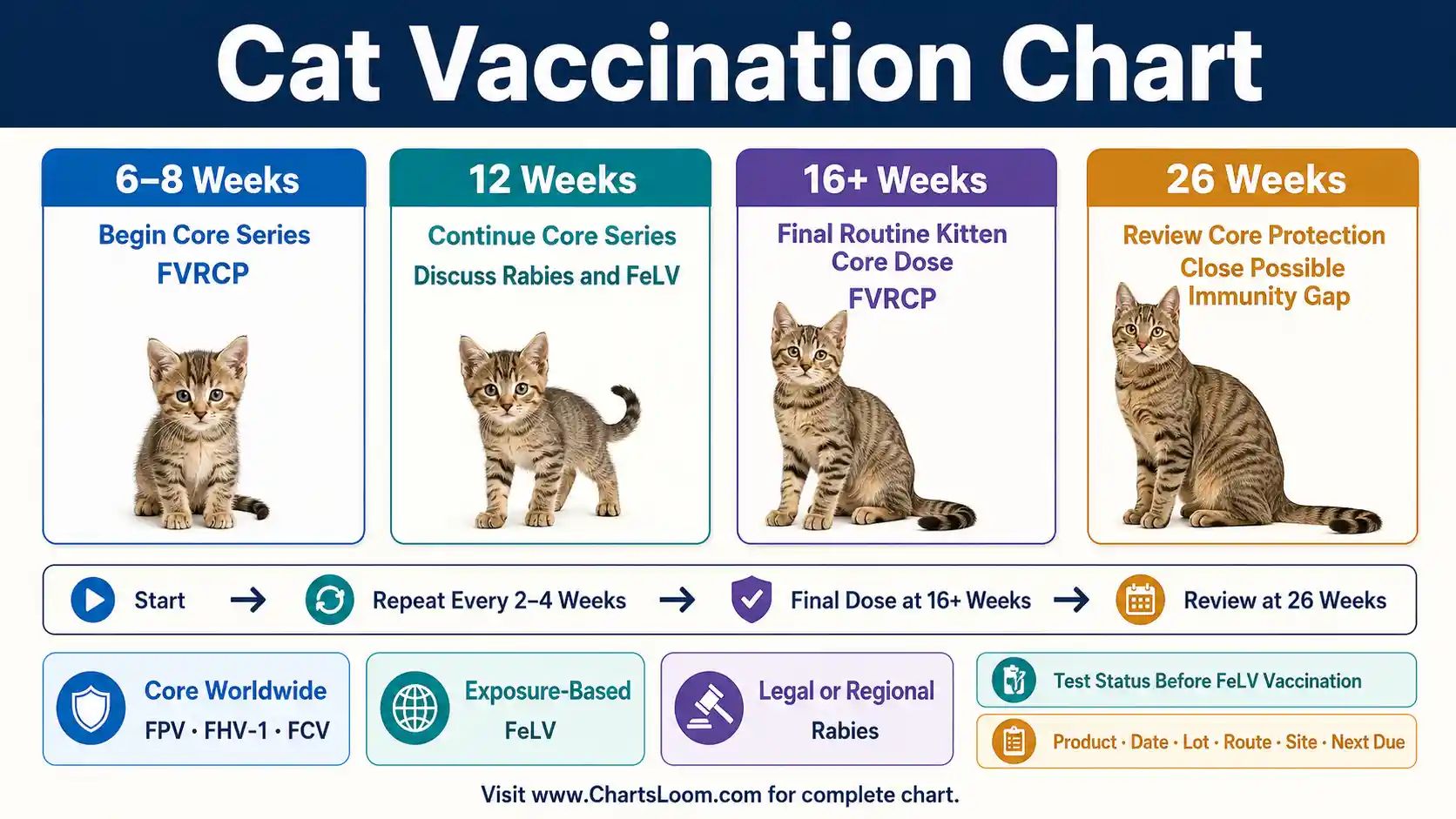
Cat vaccination schedule at a glance
A routine pet kitten usually begins FVRCP at 6–8 weeks and repeats it every 2–4 weeks until a dose at 16 weeks or older. A revaccination near 26 weeks may close a remaining maternal-antibody gap. FeLV requires testing and a lifestyle assessment, while rabies follows local law and product labeling. An annual health visit does not mean every vaccine is due annually.
Kitten core series
6–8 to ≥16 weeks
Repeat FVRCP every 2–4 weeks so a routine dose is given at 16 weeks or older.
Follow-up option
Around 26 weeks
A core revaccination near 6 months can narrow the remaining maternal-antibody susceptibility window.
FeLV planning
Test, then assess risk
FeLV is core through one year in AAHA/AAFP guidance and risk-based for older cats.
Rabies rule
Law and product control
Eligibility, certificate validity and booster timing vary by jurisdiction and licensed product.
Questions at a glance
What vaccines are core for cats?
Panleukopenia, herpesvirus-1 and calicivirus are core worldwide. Rabies is core where endemic or legally required.
When should kitten FVRCP start?
Routine pet kittens commonly start at 6 to 8 weeks, while selected shelter protocols may begin earlier.
How often is FVRCP repeated?
Repeat kitten core doses every 2 to 4 weeks until a dose is given at 16 weeks or older.
Why do kittens need several doses?
Maternally derived antibodies can block early responses and decline at different times.
What happens around 26 weeks?
A core revaccination at about 26 weeks can reduce the chance that a kitten remains unprotected after the early series.
Is FeLV vaccine core for kittens?
AAHA/AAFP treats FeLV as core through one year, while older cats need an exposure-based assessment.
Should a cat be tested before FeLV vaccine?
Yes. FeLV status should be assessed, and only FeLV-negative cats should be vaccinated.
When can a cat receive rabies vaccine?
Most cats should not receive the first dose before 12 weeks, but local law and the product label determine the valid schedule.
How often do low-risk adults need FVRCP?
After an effective primary series, parenteral core revaccination is generally no more frequent than every three years.
Do indoor cats need vaccines?
Indoor cats still need a core-risk review, and local rabies law can apply regardless of lifestyle.
Can vaccine reactions occur?
Mild short-lived effects can occur, while facial swelling, collapse, breathing difficulty or repeated vomiting need urgent care.
Can this page create a legal schedule?
No. A veterinarian, licensed product and local law determine the actual schedule and certificate.
Cat vaccine overview chart
Compare common feline vaccines by guideline category, primary series, revaccination pattern and the risk each decision addresses.
Swipe horizontally inside the table to view every column.
| Vaccine | Category | Typical route | Primary series | Revaccination | Key interpretation |
|---|---|---|---|---|---|
| FPV (panleukopenia) | Core worldwide | Usually combined parenteral FVRCP | Begin about 6–8 weeks; repeat every 2–4 weeks through ≥16 weeks | Consider at 26 weeks; then low-risk cats no more often than every 3 years | Strong, long-lived protection from appropriate core products |
| FHV-1 (herpesvirus) | Core worldwide | FVRCP injection or intranasal product | Same kitten-series framework as FPV when in combined vaccine | Risk- and route-dependent; parenteral core intervals are often longer than intranasal | Vaccination reduces disease severity but does not prevent all infection or latency |
| FCV (calicivirus) | Core worldwide | FVRCP injection or intranasal product | Same kitten-series framework as FPV when in combined vaccine | Risk- and route-dependent | Protection is not absolute because circulating strains vary |
| Rabies | Core where endemic or legally required | Injection under veterinary supervision | Follow local law and product; usually not before 12 weeks | Follow local law and licensed duration of immunity | Nearly always fatal and a public-health concern |
| FeLV | Core for kittens through 1 year in AAHA/AAFP; risk-based for adults | Injection after negative-status assessment | Two doses commonly 3–4 weeks apart, starting as early as 8 weeks | One year after series, then interval based on exposure risk and product | Test before vaccination; vaccination does not replace exposure prevention |
| Chlamydia felis | Non-core | Injection | Two doses 2–4 weeks apart when indicated | Annual while sustained confirmed risk continues | Best reserved for multi-cat settings with confirmed clinical disease |
| Bordetella bronchiseptica | Non-core | Intranasal | Single dose product may be used from about 4 weeks in selected settings | Annual while sustained risk continues | Not routinely used in typical pet cats |
| FIV | Regional non-core where product is available | Injection | Three doses 2–3 weeks apart | Annual for sustained risk where used | Availability and efficacy vary; vaccination can complicate antibody testing |
| FIP vaccine | Not recommended for routine pet cats | Intranasal product in some markets | Not recommended by WSAVA | Not recommended | Insufficient evidence for routine recommendation |
| Giardia vaccine | Not recommended | Product availability varies | Not recommended | Not recommended | Insufficient evidence for routine recommendation |
| Microsporum canis vaccine | Not recommended | Product availability varies | Not recommended | Not recommended | Insufficient evidence for routine recommendation |
| Shelter-entry core MLV | Core shelter protocol | Parenteral core MLV where appropriate | At or before entry; protocols may start at 4 weeks and repeat every 2–3 weeks | Shelter-specific | High-exposure populations use different protocols from stable pet homes |
- • Core status varies with geography and lifestyle. Rabies law and product labeling override a general chart.
- • FeLV vaccination should follow testing and an individualized exposure assessment.
Download or export
Kitten vaccination schedule by age
A week-by-week planning reference for routine pet kittens from four through twenty weeks.
Swipe horizontally inside the table to view every column.
| Age | FVRCP status | Core action | Rabies | FeLV |
|---|---|---|---|---|
| 4 weeks | Routine pet-home FVRCP usually not started | Veterinary assessment; shelter protocols may differ | Usually too young | Usually too young |
| 5 weeks | Routine pet-home FVRCP usually not started | Veterinary assessment; shelter protocols may differ | Usually too young | Usually too young |
| 6 weeks | Start or continue FVRCP series | Repeat every 2–4 weeks so a dose is given at ≥16 weeks | Usually too young | Usually too young |
| 7 weeks | Start or continue FVRCP series | Repeat every 2–4 weeks so a dose is given at ≥16 weeks | Usually too young | Usually too young |
| 8 weeks | Start or continue FVRCP series | Repeat every 2–4 weeks so a dose is given at ≥16 weeks | Usually too young | Start or continue two-dose FeLV series 3–4 weeks apart |
| 9 weeks | Start or continue FVRCP series | Repeat every 2–4 weeks so a dose is given at ≥16 weeks | Usually too young | Start or continue two-dose FeLV series 3–4 weeks apart |
| 10 weeks | Start or continue FVRCP series | Repeat every 2–4 weeks so a dose is given at ≥16 weeks | Usually too young | Start or continue two-dose FeLV series 3–4 weeks apart |
| 11 weeks | Start or continue FVRCP series | Repeat every 2–4 weeks so a dose is given at ≥16 weeks | Usually too young | Start or continue two-dose FeLV series 3–4 weeks apart |
| 12 weeks | Start or continue FVRCP series | Repeat every 2–4 weeks so a dose is given at ≥16 weeks | Follow local law and product label | Start or continue two-dose FeLV series 3–4 weeks apart |
| 13 weeks | Start or continue FVRCP series | Repeat every 2–4 weeks so a dose is given at ≥16 weeks | Follow local law and product label | Start or continue two-dose FeLV series 3–4 weeks apart |
| 14 weeks | Start or continue FVRCP series | Repeat every 2–4 weeks so a dose is given at ≥16 weeks | Follow local law and product label | Start or continue two-dose FeLV series 3–4 weeks apart |
| 15 weeks | Start or continue FVRCP series | Repeat every 2–4 weeks so a dose is given at ≥16 weeks | Follow local law and product label | Start or continue two-dose FeLV series 3–4 weeks apart |
| 16 weeks | Final routine kitten-series window | Give/confirm a core dose at 16 weeks or older; high-risk series may continue to 20 weeks | Follow local law and product label | Start or continue two-dose FeLV series 3–4 weeks apart |
| 17 weeks | Final routine kitten-series window | Give/confirm a core dose at 16 weeks or older; high-risk series may continue to 20 weeks | Follow local law and product label | Confirm two-dose FeLV series and testing status |
| 18 weeks | Final routine kitten-series window | Give/confirm a core dose at 16 weeks or older; high-risk series may continue to 20 weeks | Follow local law and product label | Confirm two-dose FeLV series and testing status |
| 19 weeks | Final routine kitten-series window | Give/confirm a core dose at 16 weeks or older; high-risk series may continue to 20 weeks | Follow local law and product label | Confirm two-dose FeLV series and testing status |
| 20 weeks | Final routine kitten-series window | Give/confirm a core dose at 16 weeks or older; high-risk series may continue to 20 weeks | Follow local law and product label | Confirm two-dose FeLV series and testing status |
- • A routine pet-home kitten series commonly starts at 6–8 weeks and repeats every 2–4 weeks through 16–18 weeks.
- • Shelter, outbreak and unusually high-risk protocols can start earlier or use shorter intervals.
Download or export
Kitten FVRCP series interval examples
Worked timing examples show why the start age and interval determine how many visits are needed before a dose at 16 weeks or older.
Swipe horizontally inside the table to view every column.
| Starting point | Interval pattern | Example ages | Last shown dose | Interpretation |
|---|---|---|---|---|
| Start 6 weeks | Every 2 weeks | 6 → 8 → 10 → 12 → 14 → 16 weeks | 16 weeks | Meets ≥16-week endpoint |
| Start 6 weeks | Every 3 weeks | 6 → 9 → 12 → 15 → 18 weeks | 18 weeks | Meets ≥16-week endpoint |
| Start 6 weeks | Every 4 weeks | 6 → 10 → 14 → 18 weeks | 18 weeks | Meets ≥16-week endpoint |
| Start 7 weeks | Every 2 weeks | 7 → 9 → 11 → 13 → 15 → 17 weeks | 17 weeks | Meets ≥16-week endpoint |
| Start 7 weeks | Every 3 weeks | 7 → 10 → 13 → 16 weeks | 16 weeks | Meets ≥16-week endpoint |
| Start 7 weeks | Every 4 weeks | 7 → 11 → 15 → 19 weeks | 19 weeks | Meets ≥16-week endpoint |
| Start 8 weeks | Every 2 weeks | 8 → 10 → 12 → 14 → 16 weeks | 16 weeks | Meets ≥16-week endpoint |
| Start 8 weeks | Every 3 weeks | 8 → 11 → 14 → 17 weeks | 17 weeks | Meets ≥16-week endpoint |
| Start 8 weeks | Every 4 weeks | 8 → 12 → 16 weeks | 16 weeks | Meets ≥16-week endpoint |
| Start 9 weeks | Every 2 weeks | 9 → 11 → 13 → 15 → 17 weeks | 17 weeks | Meets ≥16-week endpoint |
| Start 9 weeks | Every 3 weeks | 9 → 12 → 15 → 18 weeks | 18 weeks | Meets ≥16-week endpoint |
| Start 9 weeks | Every 4 weeks | 9 → 13 → 17 weeks | 17 weeks | Meets ≥16-week endpoint |
| Start 10 weeks | Every 2 weeks | 10 → 12 → 14 → 16 weeks | 16 weeks | Meets ≥16-week endpoint |
| Start 10 weeks | Every 3 weeks | 10 → 13 → 16 weeks | 16 weeks | Meets ≥16-week endpoint |
| Start 10 weeks | Every 4 weeks | 10 → 14 → 18 weeks | 18 weeks | Meets ≥16-week endpoint |
| Start 11 weeks | Every 2 weeks | 11 → 13 → 15 → 17 weeks | 17 weeks | Meets ≥16-week endpoint |
| Start 11 weeks | Every 3 weeks | 11 → 14 → 17 weeks | 17 weeks | Meets ≥16-week endpoint |
| Start 11 weeks | Every 4 weeks | 11 → 15 → 19 weeks | 19 weeks | Meets ≥16-week endpoint |
| Start 12 weeks | Every 2 weeks | 12 → 14 → 16 weeks | 16 weeks | Meets ≥16-week endpoint |
| Start 12 weeks | Every 3 weeks | 12 → 15 → 18 weeks | 18 weeks | Meets ≥16-week endpoint |
| Start 12 weeks | Every 4 weeks | 12 → 16 weeks | 16 weeks | Meets ≥16-week endpoint |
| Start 6 weeks | Gap of 5 weeks | Previous dose at 6; next presentation at 11 | 11 weeks | Veterinarian commonly restarts with at least two doses 3–4 weeks apart when the gap is ≥6 weeks |
| Start 6 weeks | Gap of 6 weeks | Previous dose at 6; next presentation at 12 | 12 weeks | Veterinarian commonly restarts with at least two doses 3–4 weeks apart when the gap is ≥6 weeks |
| Start 6 weeks | Gap of 7 weeks | Previous dose at 6; next presentation at 13 | 13 weeks | Veterinarian commonly restarts with at least two doses 3–4 weeks apart when the gap is ≥6 weeks |
| Start 6 weeks | Gap of 8 weeks | Previous dose at 6; next presentation at 14 | 14 weeks | Veterinarian commonly restarts with at least two doses 3–4 weeks apart when the gap is ≥6 weeks |
| Start 8 weeks | Gap of 5 weeks | Previous dose at 8; next presentation at 13 | 13 weeks | Veterinarian commonly restarts with at least two doses 3–4 weeks apart when the gap is ≥6 weeks |
| Start 8 weeks | Gap of 6 weeks | Previous dose at 8; next presentation at 14 | 14 weeks | Veterinarian commonly restarts with at least two doses 3–4 weeks apart when the gap is ≥6 weeks |
| Start 8 weeks | Gap of 7 weeks | Previous dose at 8; next presentation at 15 | 15 weeks | Veterinarian commonly restarts with at least two doses 3–4 weeks apart when the gap is ≥6 weeks |
| Start 8 weeks | Gap of 8 weeks | Previous dose at 8; next presentation at 16 | 16 weeks | Veterinarian commonly restarts with at least two doses 3–4 weeks apart when the gap is ≥6 weeks |
| Start 10 weeks | Gap of 5 weeks | Previous dose at 10; next presentation at 15 | 15 weeks | Veterinarian commonly restarts with at least two doses 3–4 weeks apart when the gap is ≥6 weeks |
| Start 10 weeks | Gap of 6 weeks | Previous dose at 10; next presentation at 16 | 16 weeks | Veterinarian commonly restarts with at least two doses 3–4 weeks apart when the gap is ≥6 weeks |
| Start 10 weeks | Gap of 7 weeks | Previous dose at 10; next presentation at 17 | 17 weeks | Veterinarian commonly restarts with at least two doses 3–4 weeks apart when the gap is ≥6 weeks |
| Start 10 weeks | Gap of 8 weeks | Previous dose at 10; next presentation at 18 | 18 weeks | Veterinarian commonly restarts with at least two doses 3–4 weeks apart when the gap is ≥6 weeks |
| Start 12 weeks | Gap of 5 weeks | Previous dose at 12; next presentation at 17 | 17 weeks | Veterinarian commonly restarts with at least two doses 3–4 weeks apart when the gap is ≥6 weeks |
| Start 12 weeks | Gap of 6 weeks | Previous dose at 12; next presentation at 18 | 18 weeks | Veterinarian commonly restarts with at least two doses 3–4 weeks apart when the gap is ≥6 weeks |
| Start 12 weeks | Gap of 7 weeks | Previous dose at 12; next presentation at 19 | 19 weeks | Veterinarian commonly restarts with at least two doses 3–4 weeks apart when the gap is ≥6 weeks |
| Start 12 weeks | Gap of 8 weeks | Previous dose at 12; next presentation at 20 | 20 weeks | Veterinarian commonly restarts with at least two doses 3–4 weeks apart when the gap is ≥6 weeks |
- • These examples illustrate timing only and do not select a product or replace the veterinarian’s schedule.
- • AAHA/AAFP states a 2-week minimum and 4-week maximum recommended interval during the primary series.
Download or export
Interactive tool
Cat vaccination discussion planner
Enter age, record status, environment and exposure factors. The planner organizes guideline-based topics to discuss with a veterinarian. It does not tell you to administer a vaccine or create a legally valid schedule.
Default example: a 12-week-old kitten with an in-progress series and possible contact with unknown cats.
Discussion plan
Discussion plan generated. Use it to prepare for a veterinary appointment, not to administer vaccines yourself.
- Stage
- Kitten core-series window
- Approximate age
- 12 weeks
Priority checks
- • Start or continue FVRCP every 2–4 weeks.
- • Plan a final routine kitten core dose at 16 weeks of age or older.
- • Check rabies legal status, certificate dates and licensed product with the veterinarian or local authority.
Questions to discuss
- • Confirm FeLV testing status and discuss a two-dose FeLV primary series, generally 3–4 weeks apart, when indicated.
- • Ongoing adult FeLV revaccination depends on regular exposure risk and the licensed product.
Limits
- • A veterinarian must confirm health, prior records, FeLV status, product labels and local disease risk.
- • Rabies timing and legal validity are controlled by local law and the licensed product.
- • This planner does not create an appointment schedule, vaccination certificate or diagnosis.
What it does
Maps age, records and exposure selections to guideline-based discussion points.
Why it helps
It highlights kitten timing, FeLV testing, legal rabies checks and lifestyle questions before a visit.
What it cannot do
It cannot assess health, select a licensed product, replace local law or certify vaccination.
Adult cat core vaccination framework
Compare low- and higher-exposure adult planning after the kitten primary series.
Swipe horizontally inside the table to view every column.
| Age | Exposure context | Life stage | FVRCP discussion | FeLV discussion | Rabies |
|---|---|---|---|---|---|
| 0.5 years | Low exposure | Young cat | Confirm kitten series and 26-week/6-month revaccination | Core through 1 year in AAHA/AAFP; confirm two-dose series | Rabies always follows local law and product |
| 0.5 years | Higher exposure | Young cat | Confirm kitten series and 26-week/6-month revaccination | Core through 1 year in AAHA/AAFP; confirm two-dose series | Rabies always follows local law and product |
| 1 years | Low exposure | Young adult | Review primary series and recorded due date | Continue only according to exposure risk and product | Rabies always follows local law and product |
| 1 years | Higher exposure | Young adult | Review primary series and recorded due date | Continue only according to exposure risk and product | Rabies always follows local law and product |
| 2 years | Low exposure | Young adult | Review primary series and recorded due date | Continue only according to exposure risk and product | Rabies always follows local law and product |
| 2 years | Higher exposure | Young adult | Review primary series and recorded due date | Continue only according to exposure risk and product | Rabies always follows local law and product |
| 3 years | Low exposure | Adult or senior | No more often than every 3 years for low-risk cats | Usually not indicated without ongoing exposure | Rabies always follows local law and product |
| 3 years | Higher exposure | Adult or senior | Consider more frequent revaccination, potentially annual, after veterinary risk review | Discuss ongoing FeLV revaccination after negative-status assessment | Rabies always follows local law and product |
| 4 years | Low exposure | Adult or senior | No more often than every 3 years for low-risk cats | Usually not indicated without ongoing exposure | Rabies always follows local law and product |
| 4 years | Higher exposure | Adult or senior | Consider more frequent revaccination, potentially annual, after veterinary risk review | Discuss ongoing FeLV revaccination after negative-status assessment | Rabies always follows local law and product |
| 5 years | Low exposure | Adult or senior | No more often than every 3 years for low-risk cats | Usually not indicated without ongoing exposure | Rabies always follows local law and product |
| 5 years | Higher exposure | Adult or senior | Consider more frequent revaccination, potentially annual, after veterinary risk review | Discuss ongoing FeLV revaccination after negative-status assessment | Rabies always follows local law and product |
| 6 years | Low exposure | Adult or senior | No more often than every 3 years for low-risk cats | Usually not indicated without ongoing exposure | Rabies always follows local law and product |
| 6 years | Higher exposure | Adult or senior | Consider more frequent revaccination, potentially annual, after veterinary risk review | Discuss ongoing FeLV revaccination after negative-status assessment | Rabies always follows local law and product |
| 7 years | Low exposure | Adult or senior | No more often than every 3 years for low-risk cats | Usually not indicated without ongoing exposure | Rabies always follows local law and product |
| 7 years | Higher exposure | Adult or senior | Consider more frequent revaccination, potentially annual, after veterinary risk review | Discuss ongoing FeLV revaccination after negative-status assessment | Rabies always follows local law and product |
| 8 years | Low exposure | Adult or senior | No more often than every 3 years for low-risk cats | Usually not indicated without ongoing exposure | Rabies always follows local law and product |
| 8 years | Higher exposure | Adult or senior | Consider more frequent revaccination, potentially annual, after veterinary risk review | Discuss ongoing FeLV revaccination after negative-status assessment | Rabies always follows local law and product |
| 9 years | Low exposure | Adult or senior | No more often than every 3 years for low-risk cats | Usually not indicated without ongoing exposure | Rabies always follows local law and product |
| 9 years | Higher exposure | Adult or senior | Consider more frequent revaccination, potentially annual, after veterinary risk review | Discuss ongoing FeLV revaccination after negative-status assessment | Rabies always follows local law and product |
| 10 years | Low exposure | Adult or senior | No more often than every 3 years for low-risk cats | Usually not indicated without ongoing exposure | Rabies always follows local law and product |
| 10 years | Higher exposure | Adult or senior | Consider more frequent revaccination, potentially annual, after veterinary risk review | Discuss ongoing FeLV revaccination after negative-status assessment | Rabies always follows local law and product |
| 12 years | Low exposure | Adult or senior | No more often than every 3 years for low-risk cats | Usually not indicated without ongoing exposure | Rabies always follows local law and product |
| 12 years | Higher exposure | Adult or senior | Consider more frequent revaccination, potentially annual, after veterinary risk review | Discuss ongoing FeLV revaccination after negative-status assessment | Rabies always follows local law and product |
| 15 years | Low exposure | Adult or senior | No more often than every 3 years for low-risk cats | Usually not indicated without ongoing exposure | Rabies always follows local law and product |
| 15 years | Higher exposure | Adult or senior | Consider more frequent revaccination, potentially annual, after veterinary risk review | Discuss ongoing FeLV revaccination after negative-status assessment | Rabies always follows local law and product |
| 18 years | Low exposure | Adult or senior | No more often than every 3 years for low-risk cats | Usually not indicated without ongoing exposure | Rabies always follows local law and product |
| 18 years | Higher exposure | Adult or senior | Consider more frequent revaccination, potentially annual, after veterinary risk review | Discuss ongoing FeLV revaccination after negative-status assessment | Rabies always follows local law and product |
| 20 years | Low exposure | Adult or senior | No more often than every 3 years for low-risk cats | Usually not indicated without ongoing exposure | Rabies always follows local law and product |
| 20 years | Higher exposure | Adult or senior | Consider more frequent revaccination, potentially annual, after veterinary risk review | Discuss ongoing FeLV revaccination after negative-status assessment | Rabies always follows local law and product |
| 22 years | Low exposure | Adult or senior | No more often than every 3 years for low-risk cats | Usually not indicated without ongoing exposure | Rabies always follows local law and product |
| 22 years | Higher exposure | Adult or senior | Consider more frequent revaccination, potentially annual, after veterinary risk review | Discuss ongoing FeLV revaccination after negative-status assessment | Rabies always follows local law and product |
| 24 years | Low exposure | Adult or senior | No more often than every 3 years for low-risk cats | Usually not indicated without ongoing exposure | Rabies always follows local law and product |
| 24 years | Higher exposure | Adult or senior | Consider more frequent revaccination, potentially annual, after veterinary risk review | Discuss ongoing FeLV revaccination after negative-status assessment | Rabies always follows local law and product |
| 26 years | Low exposure | Adult or senior | No more often than every 3 years for low-risk cats | Usually not indicated without ongoing exposure | Rabies always follows local law and product |
| 26 years | Higher exposure | Adult or senior | Consider more frequent revaccination, potentially annual, after veterinary risk review | Discuss ongoing FeLV revaccination after negative-status assessment | Rabies always follows local law and product |
- • Age alone does not determine the schedule; records, product, route, geography and exposure matter.
- • Regular health examinations remain important even when no vaccine is due.
Download or export
Feline leukemia vaccine risk chart
Use lifestyle and household context to prepare an FeLV discussion; testing and exposure prevention remain central.
Swipe horizontally inside the table to view every column.
| Lifestyle or household | Age group | Risk level | Testing | Vaccine discussion | Non-vaccine control |
|---|---|---|---|---|---|
| Strictly indoor single cat; all cats tested negative | Kitten ≤1 year | Low | Test before vaccination | Discuss two-dose FeLV series after testing; AAHA/AAFP treats it as core through 1 year | Prevent contact with infected or unknown-status cats whenever possible |
| Strictly indoor single cat; all cats tested negative | Adult >1 year | Low | Test before vaccination | Routine adult FeLV revaccination may not be needed | Prevent contact with infected or unknown-status cats whenever possible |
| Strictly indoor single cat; all cats tested negative | Senior cat | Low | Test before vaccination | Routine adult FeLV revaccination may not be needed | Prevent contact with infected or unknown-status cats whenever possible |
| Indoor multi-cat household; all cats tested negative | Kitten ≤1 year | Low | Test before vaccination | Discuss two-dose FeLV series after testing; AAHA/AAFP treats it as core through 1 year | Prevent contact with infected or unknown-status cats whenever possible |
| Indoor multi-cat household; all cats tested negative | Adult >1 year | Low | Test before vaccination | Routine adult FeLV revaccination may not be needed | Prevent contact with infected or unknown-status cats whenever possible |
| Indoor multi-cat household; all cats tested negative | Senior cat | Low | Test before vaccination | Routine adult FeLV revaccination may not be needed | Prevent contact with infected or unknown-status cats whenever possible |
| Supervised patio or harness access only | Kitten ≤1 year | Usually low | Test before vaccination | Discuss two-dose FeLV series after testing; AAHA/AAFP treats it as core through 1 year | Prevent contact with infected or unknown-status cats whenever possible |
| Supervised patio or harness access only | Adult >1 year | Usually low | Test before vaccination | Clarify direct-contact and unknown-status exposure before deciding | Prevent contact with infected or unknown-status cats whenever possible |
| Supervised patio or harness access only | Senior cat | Usually low | Test before vaccination | Clarify direct-contact and unknown-status exposure before deciding | Prevent contact with infected or unknown-status cats whenever possible |
| Unsupervised outdoor access | Kitten ≤1 year | High | Test before vaccination | Discuss two-dose FeLV series after testing; AAHA/AAFP treats it as core through 1 year | Prevent contact with infected or unknown-status cats whenever possible |
| Unsupervised outdoor access | Adult >1 year | High | Test before vaccination | Discuss revaccination because regular exposure remains possible | Prevent contact with infected or unknown-status cats whenever possible |
| Unsupervised outdoor access | Senior cat | High | Test before vaccination | Discuss revaccination because regular exposure remains possible | Prevent contact with infected or unknown-status cats whenever possible |
| Lives with FeLV-positive cat | Kitten ≤1 year | High | Test before vaccination | Discuss two-dose FeLV series after testing; AAHA/AAFP treats it as core through 1 year | Prevent contact with infected or unknown-status cats whenever possible |
| Lives with FeLV-positive cat | Adult >1 year | High | Test before vaccination | Discuss revaccination because regular exposure remains possible | Prevent contact with infected or unknown-status cats whenever possible |
| Lives with FeLV-positive cat | Senior cat | High | Test before vaccination | Discuss revaccination because regular exposure remains possible | Prevent contact with infected or unknown-status cats whenever possible |
| Lives with cat of unknown status | Kitten ≤1 year | High | Test before vaccination | Discuss two-dose FeLV series after testing; AAHA/AAFP treats it as core through 1 year | Prevent contact with infected or unknown-status cats whenever possible |
| Lives with cat of unknown status | Adult >1 year | High | Test before vaccination | Discuss revaccination because regular exposure remains possible | Prevent contact with infected or unknown-status cats whenever possible |
| Lives with cat of unknown status | Senior cat | High | Test before vaccination | Discuss revaccination because regular exposure remains possible | Prevent contact with infected or unknown-status cats whenever possible |
| Frequent foster-cat intake without consistent testing | Kitten ≤1 year | High | Test before vaccination | Discuss two-dose FeLV series after testing; AAHA/AAFP treats it as core through 1 year | Prevent contact with infected or unknown-status cats whenever possible |
| Frequent foster-cat intake without consistent testing | Adult >1 year | High | Test before vaccination | Discuss revaccination because regular exposure remains possible | Prevent contact with infected or unknown-status cats whenever possible |
| Frequent foster-cat intake without consistent testing | Senior cat | High | Test before vaccination | Discuss revaccination because regular exposure remains possible | Prevent contact with infected or unknown-status cats whenever possible |
| New kitten with future lifestyle uncertain | Kitten ≤1 year | Core through 1 year | Test before vaccination | Discuss two-dose FeLV series after testing; AAHA/AAFP treats it as core through 1 year | Prevent contact with infected or unknown-status cats whenever possible |
| New kitten with future lifestyle uncertain | Adult >1 year | Core through 1 year | Test before vaccination | Clarify direct-contact and unknown-status exposure before deciding | Prevent contact with infected or unknown-status cats whenever possible |
| New kitten with future lifestyle uncertain | Senior cat | Core through 1 year | Test before vaccination | Clarify direct-contact and unknown-status exposure before deciding | Prevent contact with infected or unknown-status cats whenever possible |
| Boarding with no direct contact and verified policies | Kitten ≤1 year | Context-dependent | Test before vaccination | Discuss two-dose FeLV series after testing; AAHA/AAFP treats it as core through 1 year | Prevent contact with infected or unknown-status cats whenever possible |
| Boarding with no direct contact and verified policies | Adult >1 year | Context-dependent | Test before vaccination | Clarify direct-contact and unknown-status exposure before deciding | Prevent contact with infected or unknown-status cats whenever possible |
| Boarding with no direct contact and verified policies | Senior cat | Context-dependent | Test before vaccination | Clarify direct-contact and unknown-status exposure before deciding | Prevent contact with infected or unknown-status cats whenever possible |
- • Only FeLV-negative cats should be vaccinated against FeLV.
- • A vaccine reduces risk but does not make ongoing exposure safe.
Download or export
Cat rabies vaccination rules and timing
Rabies decisions are legal and public-health matters as well as medical decisions.
Swipe horizontally inside the table to view every column.
| Age or situation | General status | Legal check | Product check | Important rule | Record action |
|---|---|---|---|---|---|
| 4 weeks | Generally below routine minimum | Check local law | Check licensed product | Initial vaccination considered immunizing after 28 days in CDC guidance | Keep certificate and next-due date |
| 6 weeks | Generally below routine minimum | Check local law | Check licensed product | Initial vaccination considered immunizing after 28 days in CDC guidance | Keep certificate and next-due date |
| 8 weeks | Generally below routine minimum | Check local law | Check licensed product | Initial vaccination considered immunizing after 28 days in CDC guidance | Keep certificate and next-due date |
| 10 weeks | Generally below routine minimum | Check local law | Check licensed product | Initial vaccination considered immunizing after 28 days in CDC guidance | Keep certificate and next-due date |
| 12 weeks | Age may be eligible; law and product control | Check local law | Check licensed product | Initial vaccination considered immunizing after 28 days in CDC guidance | Keep certificate and next-due date |
| 14 weeks | Age may be eligible; law and product control | Check local law | Check licensed product | Initial vaccination considered immunizing after 28 days in CDC guidance | Keep certificate and next-due date |
| 16 weeks | Age may be eligible; law and product control | Check local law | Check licensed product | Initial vaccination considered immunizing after 28 days in CDC guidance | Keep certificate and next-due date |
| 20 weeks | Age may be eligible; law and product control | Check local law | Check licensed product | Initial vaccination considered immunizing after 28 days in CDC guidance | Keep certificate and next-due date |
| 26 weeks | Age may be eligible; law and product control | Check local law | Check licensed product | Initial vaccination considered immunizing after 28 days in CDC guidance | Keep certificate and next-due date |
| 52 weeks | Age may be eligible; law and product control | Check local law | Check licensed product | Initial vaccination considered immunizing after 28 days in CDC guidance | Keep certificate and next-due date |
| Current certificate | Legal/public-health decision | Contact veterinarian or authority | Do not improvise timing | Exposure management can differ sharply by vaccination status | Preserve records |
| Overdue booster with prior record | Legal/public-health decision | Contact veterinarian or authority | Do not improvise timing | Exposure management can differ sharply by vaccination status | Preserve records |
| No record | Legal/public-health decision | Contact veterinarian or authority | Do not improvise timing | Exposure management can differ sharply by vaccination status | Preserve records |
| Cat exposed to suspected rabid animal | Legal/public-health decision | Contact veterinarian or authority | Do not improvise timing | Exposure management can differ sharply by vaccination status | Preserve records |
| Cat bit or scratched a person | Legal/public-health decision | Contact veterinarian or authority | Do not improvise timing | Exposure management can differ sharply by vaccination status | Preserve records |
| International or interstate travel | Legal/public-health decision | Contact veterinarian or authority | Do not improvise timing | Exposure management can differ sharply by vaccination status | Preserve records |
| Indoor-only cat | Legal/public-health decision | Contact veterinarian or authority | Do not improvise timing | Exposure management can differ sharply by vaccination status | Preserve records |
| Community or free-roaming cat | Legal/public-health decision | Contact veterinarian or authority | Do not improvise timing | Exposure management can differ sharply by vaccination status | Preserve records |
| Vaccine adverse-event history | Legal/public-health decision | Contact veterinarian or authority | Do not improvise timing | Exposure management can differ sharply by vaccination status | Preserve records |
| Local outbreak | Legal/public-health decision | Contact veterinarian or authority | Do not improvise timing | Exposure management can differ sharply by vaccination status | Preserve records |
- • Most cats should not receive their first rabies vaccine before 12 weeks, but local law and product labeling govern.
- • After a possible rabies exposure or a bite to a person, contact public-health and veterinary authorities promptly.
Download or export
Feline vaccine route and product-type chart
Compare common routes and product categories without treating products as interchangeable.
Swipe horizontally inside the table to view every column.
| Vaccine or product type | Route | Context | Potential advantage | Caution | Record requirement |
|---|---|---|---|---|---|
| FVRCP modified-live | Subcutaneous | Routine pet home | Rapid, strong FPV response | Avoid in pregnant queens and very young kittens unless specifically directed | Record product, lot, route and site |
| FVRCP modified-live | Subcutaneous | Higher-risk environment | Rapid, strong FPV response | Avoid in pregnant queens and very young kittens unless specifically directed | Record product, lot, route and site |
| FVRCP inactivated | Subcutaneous | Routine pet home | Alternative when modified-live is unsuitable | Often requires two-dose primary series | Record product, lot, route and site |
| FVRCP inactivated | Subcutaneous | Higher-risk environment | Alternative when modified-live is unsuitable | Often requires two-dose primary series | Record product, lot, route and site |
| FHV/FCV intranasal | Intranasal | Routine pet home | Rapid respiratory protection | May cause mild transient respiratory signs | Record product, lot, route and site |
| FHV/FCV intranasal | Intranasal | Higher-risk environment | Rapid respiratory protection | May cause mild transient respiratory signs | Record product, lot, route and site |
| FeLV recombinant | Subcutaneous | Routine pet home | Non-adjuvanted options exist | Two-dose primary series | Record product, lot, route and site |
| FeLV recombinant | Subcutaneous | Higher-risk environment | Non-adjuvanted options exist | Two-dose primary series | Record product, lot, route and site |
| FeLV inactivated | Subcutaneous | Routine pet home | Product-specific interval options | Two-dose primary series | Record product, lot, route and site |
| FeLV inactivated | Subcutaneous | Higher-risk environment | Product-specific interval options | Two-dose primary series | Record product, lot, route and site |
| Rabies recombinant | Subcutaneous | Routine pet home | Non-adjuvanted option in some markets | Law and product control | Record product, lot, route and site |
| Rabies recombinant | Subcutaneous | Higher-risk environment | Non-adjuvanted option in some markets | Law and product control | Record product, lot, route and site |
| Rabies inactivated | Subcutaneous | Routine pet home | One- or three-year DOI products exist | Law and product control | Record product, lot, route and site |
| Rabies inactivated | Subcutaneous | Higher-risk environment | One- or three-year DOI products exist | Law and product control | Record product, lot, route and site |
| Chlamydia felis | Subcutaneous | Routine pet home | Selected multi-cat settings | Not routine for typical pet cats | Record product, lot, route and site |
| Chlamydia felis | Subcutaneous | Higher-risk environment | Selected multi-cat settings | Not routine for typical pet cats | Record product, lot, route and site |
| Bordetella | Intranasal | Routine pet home | Selected colony settings | Not routine for typical pet cats | Record product, lot, route and site |
| Bordetella | Intranasal | Higher-risk environment | Selected colony settings | Not routine for typical pet cats | Record product, lot, route and site |
| FIV | Subcutaneous | Routine pet home | Limited regional availability | Can affect antibody-test interpretation | Record product, lot, route and site |
| FIV | Subcutaneous | Higher-risk environment | Limited regional availability | Can affect antibody-test interpretation | Record product, lot, route and site |
| Shelter FVRCP MLV | Subcutaneous | Routine pet home | Rapid population protection | Use shelter protocol | Record product, lot, route and site |
| Shelter FVRCP MLV | Subcutaneous | Higher-risk environment | Rapid population protection | Use shelter protocol | Record product, lot, route and site |
| Oral feline vaccine | Not a common routine route | Routine pet home | No standard routine role in this chart | Confirm exact product | Record product, lot, route and site |
| Oral feline vaccine | Not a common routine route | Higher-risk environment | No standard routine role in this chart | Confirm exact product | Record product, lot, route and site |
- • Always follow the licensed product leaflet and veterinarian instructions.
- • Intranasal respiratory products do not replace a reliable parenteral FPV component when panleukopenia protection is needed.
Download or export
Cat vaccination record checklist
A complete record is more useful than a vague note that the cat received “shots.”
Swipe horizontally inside the table to view every column.
| Record field | Priority | Where kept | How used | Why it matters |
|---|---|---|---|---|
| Cat identity | Required | Permanent medical record | Verify before the next dose | Helps resolve product, legal, exposure or adverse-event questions |
| Date administered | Required | Permanent medical record | Verify before the next dose | Helps resolve product, legal, exposure or adverse-event questions |
| Vaccine antigen | Required | Permanent medical record | Verify before the next dose | Helps resolve product, legal, exposure or adverse-event questions |
| Brand and product | Required | Permanent medical record | Verify before the next dose | Helps resolve product, legal, exposure or adverse-event questions |
| Manufacturer | Required | Permanent medical record | Verify before the next dose | Helps resolve product, legal, exposure or adverse-event questions |
| Lot or serial number | Required | Permanent medical record | Verify before the next dose | Helps resolve product, legal, exposure or adverse-event questions |
| Expiration date | Required | Permanent medical record | Verify before the next dose | Helps resolve product, legal, exposure or adverse-event questions |
| Route | Required | Permanent medical record | Verify before the next dose | Helps resolve product, legal, exposure or adverse-event questions |
| Anatomical site | Required | Permanent medical record | Verify before the next dose | Helps resolve product, legal, exposure or adverse-event questions |
| Dose | Required | Permanent medical record | Verify before the next dose | Helps resolve product, legal, exposure or adverse-event questions |
| Veterinarian or administrator | Required | Permanent medical record | Verify before the next dose | Helps resolve product, legal, exposure or adverse-event questions |
| Clinic | Required | Permanent medical record | Verify before the next dose | Helps resolve product, legal, exposure or adverse-event questions |
| Rabies certificate number | Required | Permanent medical record | Verify before the next dose | Helps resolve product, legal, exposure or adverse-event questions |
| Rabies tag number | Required | Permanent medical record | Verify before the next dose | Helps resolve product, legal, exposure or adverse-event questions |
| Licensed duration | Required | Permanent medical record | Verify before the next dose | Helps resolve product, legal, exposure or adverse-event questions |
| Next due date | Required | Permanent medical record | Verify before the next dose | Helps resolve product, legal, exposure or adverse-event questions |
| FeLV test date | When applicable | Permanent medical record | Verify before the next dose | Helps resolve product, legal, exposure or adverse-event questions |
| FeLV test result | When applicable | Permanent medical record | Verify before the next dose | Helps resolve product, legal, exposure or adverse-event questions |
| Previous reaction | When applicable | Permanent medical record | Verify before the next dose | Helps resolve product, legal, exposure or adverse-event questions |
| Concurrent vaccines | When applicable | Permanent medical record | Verify before the next dose | Helps resolve product, legal, exposure or adverse-event questions |
| Health assessment | When applicable | Permanent medical record | Verify before the next dose | Helps resolve product, legal, exposure or adverse-event questions |
| Owner consent | When applicable | Permanent medical record | Verify before the next dose | Helps resolve product, legal, exposure or adverse-event questions |
| Travel purpose | When applicable | Permanent medical record | Verify before the next dose | Helps resolve product, legal, exposure or adverse-event questions |
| Public-health instruction | When applicable | Permanent medical record | Verify before the next dose | Helps resolve product, legal, exposure or adverse-event questions |
- • AAHA/AAFP recommends recording route and anatomical site and avoiding the interscapular region when possible.
- • Rabies documentation must satisfy local legal requirements.
Download or export
Pre-vaccination checklist for cats
Prepare records, health information, lifestyle details and practical questions before the appointment.
Swipe horizontally inside the table to view every column.
| Check | Action | Timing | Who reviews | Common mistake |
|---|---|---|---|---|
| Identity and age | Confirm microchip, name and age | Before visit | Veterinarian review | Do not conceal relevant history |
| Previous records | Obtain dates, products and certificates | Before visit | Veterinarian review | Do not conceal relevant history |
| Current illness | Report fever, vomiting, diarrhea, respiratory signs or poor appetite | Before visit | Veterinarian review | Do not conceal relevant history |
| Pregnancy | Tell the veterinarian before modified-live products are considered | Before visit | Veterinarian review | Do not conceal relevant history |
| Retrovirus status | Review FeLV/FIV testing and exposure | Before visit | Veterinarian review | Do not conceal relevant history |
| Medication | List immunosuppressive and other current drugs | Before visit | Veterinarian review | Do not conceal relevant history |
| Previous reaction | Describe timing, signs and treatment | Before visit | Veterinarian review | Do not conceal relevant history |
| Travel | Bring destination and deadline requirements | Before visit | Veterinarian review | Do not conceal relevant history |
| Rabies law | Confirm jurisdiction requirements | Before visit | Veterinarian review | Do not conceal relevant history |
| Indoor/outdoor access | Describe unsupervised exposure | Before visit | Veterinarian review | Do not conceal relevant history |
| Household cats | Know FeLV status where possible | Before visit | Veterinarian review | Do not conceal relevant history |
| Boarding plans | Identify dates and facility requirements | Before visit | Veterinarian review | Do not conceal relevant history |
| Shelter origin | Share intake and outbreak history | Before visit | Veterinarian review | Do not conceal relevant history |
| Vaccine spacing | Review recent vaccine events | Before visit | Veterinarian review | Do not conceal relevant history |
| Product availability | Ask which licensed products are used | Before visit | Veterinarian review | Do not conceal relevant history |
| Fear and handling | Plan low-stress transport and restraint | Before visit | Veterinarian review | Do not conceal relevant history |
| Carrier | Use a secure familiar carrier | Before visit | Veterinarian review | Do not conceal relevant history |
| Observation time | Allow time to monitor after vaccination | Before visit | Veterinarian review | Do not conceal relevant history |
| Emergency contact | Know whom to call after hours | Before visit | Veterinarian review | Do not conceal relevant history |
| Injection site | Ask where each product will be administered | Before visit | Veterinarian review | Do not conceal relevant history |
| Baseline lump check | Report existing masses | Before visit | Veterinarian review | Do not conceal relevant history |
| Consent questions | Discuss benefits and risks | Before visit | Veterinarian review | Do not conceal relevant history |
| Titer question | Ask whether FPV serology is useful in a specific case | Before visit | Veterinarian review | Do not conceal relevant history |
| Written plan | Leave with dates and next steps | Before visit | Veterinarian review | Do not conceal relevant history |
- • Vaccination is one part of a complete preventive-health visit.
- • A veterinarian may postpone, modify or avoid a vaccine after examining the cat.
Download or export
Cat vaccine reaction monitoring chart
Separate mild expected effects from urgent reactions and persistent injection-site concerns.
Swipe horizontally inside the table to view every column.
| Sign | Timing | Concern level | Action | Escalation threshold |
|---|---|---|---|---|
| Mild sleepiness | First hours | Often mild | Monitor closely | Call if severe, prolonged or worsening |
| Mild sleepiness | Following days | Often mild | Monitor closely | Call if severe, prolonged or worsening |
| Mild soreness | First hours | Often mild | Limit pressure on site | Call if severe or persistent |
| Mild soreness | Following days | Often mild | Limit pressure on site | Call if severe or persistent |
| Small temporary appetite decrease | First hours | Can occur | Offer normal food and water | Call promptly if the cat stops eating or seems unwell |
| Small temporary appetite decrease | Following days | Can occur | Offer normal food and water | Call promptly if the cat stops eating or seems unwell |
| Brief low-grade fever | First hours | Can occur | Monitor behavior and hydration | Call if marked or persistent |
| Brief low-grade fever | Following days | Can occur | Monitor behavior and hydration | Call if marked or persistent |
| Mild sneezing after intranasal vaccine | First hours | Can occur | Monitor | Call if breathing is difficult or signs are severe |
| Mild sneezing after intranasal vaccine | Following days | Can occur | Monitor | Call if breathing is difficult or signs are severe |
| Facial swelling | First hours | Urgent | Contact veterinarian immediately | Emergency care may be needed |
| Facial swelling | Following days | Urgent | Contact veterinarian immediately | Emergency care may be needed |
| Hives | First hours | Urgent | Contact veterinarian immediately | Emergency care may be needed |
| Hives | Following days | Urgent | Contact veterinarian immediately | Emergency care may be needed |
| Repeated vomiting | First hours | Urgent | Contact veterinarian immediately | Emergency care may be needed |
| Repeated vomiting | Following days | Urgent | Contact veterinarian immediately | Emergency care may be needed |
| Collapse | First hours | Emergency | Seek emergency veterinary care | Do not wait |
| Collapse | Following days | Emergency | Seek emergency veterinary care | Do not wait |
| Breathing difficulty | First hours | Emergency | Seek emergency veterinary care | Do not wait |
| Breathing difficulty | Following days | Emergency | Seek emergency veterinary care | Do not wait |
| Pale gums | First hours | Emergency | Seek emergency veterinary care | Do not wait |
| Pale gums | Following days | Emergency | Seek emergency veterinary care | Do not wait |
| Persistent injection-site mass | First hours | Needs examination | Measure and record | Arrange veterinary assessment |
| Persistent injection-site mass | Following days | Needs examination | Measure and record | Arrange veterinary assessment |
- • Severe allergic reactions can progress quickly and require immediate veterinary care.
- • Any persistent or enlarging injection-site lump should be examined; record its size and duration.
Download or export
Injection-site mass monitoring chart
A practical record for monitoring a post-injection lump and knowing when veterinary assessment should not be delayed.
Swipe horizontally inside the table to view every column.
| Finding | Duration | Trend question | Action | Important limit |
|---|---|---|---|---|
| Not measurable | <1 month | Stable or changing? | Monitor as directed and record changes | Use the 3-2-1 concept as a prompt, not a self-diagnosis |
| Not measurable | 1–3 months | Stable or changing? | Measure, photograph and schedule veterinary review | Use the 3-2-1 concept as a prompt, not a self-diagnosis |
| Not measurable | >3 months | Stable or changing? | Prompt veterinary examination; biopsy or removal may be discussed | Use the 3-2-1 concept as a prompt, not a self-diagnosis |
| <1 cm | <1 month | Stable or changing? | Monitor as directed and record changes | Use the 3-2-1 concept as a prompt, not a self-diagnosis |
| <1 cm | 1–3 months | Stable or changing? | Measure, photograph and schedule veterinary review | Use the 3-2-1 concept as a prompt, not a self-diagnosis |
| <1 cm | >3 months | Stable or changing? | Prompt veterinary examination; biopsy or removal may be discussed | Use the 3-2-1 concept as a prompt, not a self-diagnosis |
| 1–2 cm | <1 month | Stable or changing? | Monitor as directed and record changes | Use the 3-2-1 concept as a prompt, not a self-diagnosis |
| 1–2 cm | 1–3 months | Stable or changing? | Measure, photograph and schedule veterinary review | Use the 3-2-1 concept as a prompt, not a self-diagnosis |
| 1–2 cm | >3 months | Stable or changing? | Prompt veterinary examination; biopsy or removal may be discussed | Use the 3-2-1 concept as a prompt, not a self-diagnosis |
| >2 cm | <1 month | Stable or changing? | Prompt veterinary examination; biopsy or removal may be discussed | Use the 3-2-1 concept as a prompt, not a self-diagnosis |
| >2 cm | 1–3 months | Stable or changing? | Prompt veterinary examination; biopsy or removal may be discussed | Use the 3-2-1 concept as a prompt, not a self-diagnosis |
| >2 cm | >3 months | Stable or changing? | Prompt veterinary examination; biopsy or removal may be discussed | Use the 3-2-1 concept as a prompt, not a self-diagnosis |
| Weekly check 1 | Week 1 | Measure in the same direction | Record diameter and texture | Escalate sooner if painful, ulcerated or rapidly growing |
| Weekly check 2 | Week 2 | Measure in the same direction | Record diameter and texture | Escalate sooner if painful, ulcerated or rapidly growing |
| Weekly check 3 | Week 3 | Measure in the same direction | Record diameter and texture | Escalate sooner if painful, ulcerated or rapidly growing |
| Weekly check 4 | Week 4 | Measure in the same direction | Record diameter and texture | Escalate sooner if painful, ulcerated or rapidly growing |
| Weekly check 5 | Week 5 | Measure in the same direction | Record diameter and texture | Escalate sooner if painful, ulcerated or rapidly growing |
| Weekly check 6 | Week 6 | Measure in the same direction | Record diameter and texture | Escalate sooner if painful, ulcerated or rapidly growing |
| Weekly check 7 | Week 7 | Measure in the same direction | Record diameter and texture | Escalate sooner if painful, ulcerated or rapidly growing |
| Weekly check 8 | Week 8 | Measure in the same direction | Record diameter and texture | Escalate sooner if painful, ulcerated or rapidly growing |
| Weekly check 9 | Week 9 | Measure in the same direction | Record diameter and texture | Escalate sooner if painful, ulcerated or rapidly growing |
| Weekly check 10 | Week 10 | Measure in the same direction | Record diameter and texture | Escalate sooner if painful, ulcerated or rapidly growing |
| Weekly check 11 | Week 11 | Measure in the same direction | Record diameter and texture | Escalate sooner if painful, ulcerated or rapidly growing |
| Weekly check 12 | Week 12 | Measure in the same direction | Record diameter and texture | Escalate sooner if painful, ulcerated or rapidly growing |
- • The commonly cited 3-2-1 rule prompts investigation when a mass persists for 3 months, exceeds 2 cm, or is still growing 1 month after vaccination.
- • Do not wait for a rule threshold if a mass is painful, ulcerated, rapidly growing or otherwise concerning.
Download or export
Cat vaccination catch-up examples
Illustrative catch-up situations show why age and documentation must be considered together.
Swipe horizontally inside the table to view every column.
| Current age | Known history | Core discussion | Rabies | FeLV | Record action |
|---|---|---|---|---|---|
| 8 weeks | No records | Build or continue kitten series to a dose at ≥16 weeks | Check rabies law | Test before FeLV vaccine | Document a new next-due plan |
| 12 weeks | No records | Build or continue kitten series to a dose at ≥16 weeks | Check rabies law | Test before FeLV vaccine | Document a new next-due plan |
| 18 weeks | No records | If history is uncertain, veterinarian may use two core doses 2–4 weeks apart | Check rabies law | Test before FeLV vaccine | Document a new next-due plan |
| 7 months | No records | Review need for the 26-week core revaccination and complete FeLV kitten plan | Check rabies law | Test before FeLV vaccine | Document a new next-due plan |
| 2 years | No records | Use adult catch-up based on records, product and risk; avoid needless repeated core doses | Check rabies law | Test before FeLV vaccine | Document a new next-due plan |
| 8 years | No records | Use adult catch-up based on records, product and risk; avoid needless repeated core doses | Check rabies law | Test before FeLV vaccine | Document a new next-due plan |
| 8 weeks | One FVRCP dose before 16 weeks | Build or continue kitten series to a dose at ≥16 weeks | Check rabies law | Test before FeLV vaccine | Document a new next-due plan |
| 12 weeks | One FVRCP dose before 16 weeks | Build or continue kitten series to a dose at ≥16 weeks | Check rabies law | Test before FeLV vaccine | Document a new next-due plan |
| 18 weeks | One FVRCP dose before 16 weeks | If history is uncertain, veterinarian may use two core doses 2–4 weeks apart | Check rabies law | Test before FeLV vaccine | Document a new next-due plan |
| 7 months | One FVRCP dose before 16 weeks | Review need for the 26-week core revaccination and complete FeLV kitten plan | Check rabies law | Test before FeLV vaccine | Document a new next-due plan |
| 2 years | One FVRCP dose before 16 weeks | Use adult catch-up based on records, product and risk; avoid needless repeated core doses | Check rabies law | Test before FeLV vaccine | Document a new next-due plan |
| 8 years | One FVRCP dose before 16 weeks | Use adult catch-up based on records, product and risk; avoid needless repeated core doses | Check rabies law | Test before FeLV vaccine | Document a new next-due plan |
| 8 weeks | FVRCP documented at ≥16 weeks | Build or continue kitten series to a dose at ≥16 weeks | Check rabies law | Test before FeLV vaccine | Document a new next-due plan |
| 12 weeks | FVRCP documented at ≥16 weeks | Build or continue kitten series to a dose at ≥16 weeks | Check rabies law | Test before FeLV vaccine | Document a new next-due plan |
| 18 weeks | FVRCP documented at ≥16 weeks | If history is uncertain, veterinarian may use two core doses 2–4 weeks apart | Check rabies law | Test before FeLV vaccine | Document a new next-due plan |
| 7 months | FVRCP documented at ≥16 weeks | Review need for the 26-week core revaccination and complete FeLV kitten plan | Check rabies law | Test before FeLV vaccine | Document a new next-due plan |
| 2 years | FVRCP documented at ≥16 weeks | Use adult catch-up based on records, product and risk; avoid needless repeated core doses | Check rabies law | Test before FeLV vaccine | Document a new next-due plan |
| 8 years | FVRCP documented at ≥16 weeks | Use adult catch-up based on records, product and risk; avoid needless repeated core doses | Check rabies law | Test before FeLV vaccine | Document a new next-due plan |
| 8 weeks | Kitten series complete; no 26-week dose | Build or continue kitten series to a dose at ≥16 weeks | Check rabies law | Test before FeLV vaccine | Document a new next-due plan |
| 12 weeks | Kitten series complete; no 26-week dose | Build or continue kitten series to a dose at ≥16 weeks | Check rabies law | Test before FeLV vaccine | Document a new next-due plan |
| 18 weeks | Kitten series complete; no 26-week dose | If history is uncertain, veterinarian may use two core doses 2–4 weeks apart | Check rabies law | Test before FeLV vaccine | Document a new next-due plan |
| 7 months | Kitten series complete; no 26-week dose | Review need for the 26-week core revaccination and complete FeLV kitten plan | Check rabies law | Test before FeLV vaccine | Document a new next-due plan |
| 2 years | Kitten series complete; no 26-week dose | Use adult catch-up based on records, product and risk; avoid needless repeated core doses | Check rabies law | Test before FeLV vaccine | Document a new next-due plan |
| 8 years | Kitten series complete; no 26-week dose | Use adult catch-up based on records, product and risk; avoid needless repeated core doses | Check rabies law | Test before FeLV vaccine | Document a new next-due plan |
| 8 weeks | Adult series current | Build or continue kitten series to a dose at ≥16 weeks | Check rabies law | Test before FeLV vaccine | Document a new next-due plan |
| 12 weeks | Adult series current | Build or continue kitten series to a dose at ≥16 weeks | Check rabies law | Test before FeLV vaccine | Document a new next-due plan |
| 18 weeks | Adult series current | If history is uncertain, veterinarian may use two core doses 2–4 weeks apart | Check rabies law | Test before FeLV vaccine | Document a new next-due plan |
| 7 months | Adult series current | Review need for the 26-week core revaccination and complete FeLV kitten plan | Check rabies law | Test before FeLV vaccine | Document a new next-due plan |
| 2 years | Adult series current | Use adult catch-up based on records, product and risk; avoid needless repeated core doses | Check rabies law | Test before FeLV vaccine | Document a new next-due plan |
| 8 years | Adult series current | Use adult catch-up based on records, product and risk; avoid needless repeated core doses | Check rabies law | Test before FeLV vaccine | Document a new next-due plan |
| 8 weeks | Adult series overdue | Build or continue kitten series to a dose at ≥16 weeks | Check rabies law | Test before FeLV vaccine | Document a new next-due plan |
| 12 weeks | Adult series overdue | Build or continue kitten series to a dose at ≥16 weeks | Check rabies law | Test before FeLV vaccine | Document a new next-due plan |
| 18 weeks | Adult series overdue | If history is uncertain, veterinarian may use two core doses 2–4 weeks apart | Check rabies law | Test before FeLV vaccine | Document a new next-due plan |
| 7 months | Adult series overdue | Review need for the 26-week core revaccination and complete FeLV kitten plan | Check rabies law | Test before FeLV vaccine | Document a new next-due plan |
| 2 years | Adult series overdue | Use adult catch-up based on records, product and risk; avoid needless repeated core doses | Check rabies law | Test before FeLV vaccine | Document a new next-due plan |
| 8 years | Adult series overdue | Use adult catch-up based on records, product and risk; avoid needless repeated core doses | Check rabies law | Test before FeLV vaccine | Document a new next-due plan |
- • These are discussion examples, not prescriptions.
- • A veterinarian must choose the product, number of doses and intervals.
Download or export
Feline vaccine titer testing chart
Understand where serology can help and where it cannot substitute for vaccination or legal documentation.
Swipe horizontally inside the table to view every column.
| Purpose | Test | Possible result | Interpretation | Respiratory-virus limit | Rabies limit |
|---|---|---|---|---|---|
| Confirm FPV response after kitten series | FPV serology | Positive antibody result | Supports prior exposure/response for FPV | FHV-1 and FCV titers are less useful for routine protection decisions | Rabies titers do not automatically replace legal vaccination |
| Confirm FPV response after kitten series | FPV serology | Negative antibody result | Does not always prove susceptibility; discuss vaccination | FHV-1 and FCV titers are less useful for routine protection decisions | Rabies titers do not automatically replace legal vaccination |
| Confirm FPV response after kitten series | FPV serology | No validated result available | Do not infer protection | FHV-1 and FCV titers are less useful for routine protection decisions | Rabies titers do not automatically replace legal vaccination |
| Confirm FPV response after kitten series | FPV serology | Result pending | Do not infer protection | FHV-1 and FCV titers are less useful for routine protection decisions | Rabies titers do not automatically replace legal vaccination |
| Assess mature adult FPV immunity | FPV serology | Positive antibody result | Supports prior exposure/response for FPV | FHV-1 and FCV titers are less useful for routine protection decisions | Rabies titers do not automatically replace legal vaccination |
| Assess mature adult FPV immunity | FPV serology | Negative antibody result | Does not always prove susceptibility; discuss vaccination | FHV-1 and FCV titers are less useful for routine protection decisions | Rabies titers do not automatically replace legal vaccination |
| Assess mature adult FPV immunity | FPV serology | No validated result available | Do not infer protection | FHV-1 and FCV titers are less useful for routine protection decisions | Rabies titers do not automatically replace legal vaccination |
| Assess mature adult FPV immunity | FPV serology | Result pending | Do not infer protection | FHV-1 and FCV titers are less useful for routine protection decisions | Rabies titers do not automatically replace legal vaccination |
| Avoid needless FPV revaccination | FPV serology | Positive antibody result | Supports prior exposure/response for FPV | FHV-1 and FCV titers are less useful for routine protection decisions | Rabies titers do not automatically replace legal vaccination |
| Avoid needless FPV revaccination | FPV serology | Negative antibody result | Does not always prove susceptibility; discuss vaccination | FHV-1 and FCV titers are less useful for routine protection decisions | Rabies titers do not automatically replace legal vaccination |
| Avoid needless FPV revaccination | FPV serology | No validated result available | Do not infer protection | FHV-1 and FCV titers are less useful for routine protection decisions | Rabies titers do not automatically replace legal vaccination |
| Avoid needless FPV revaccination | FPV serology | Result pending | Do not infer protection | FHV-1 and FCV titers are less useful for routine protection decisions | Rabies titers do not automatically replace legal vaccination |
| Outbreak management | FPV serology | Positive antibody result | Supports prior exposure/response for FPV | FHV-1 and FCV titers are less useful for routine protection decisions | Rabies titers do not automatically replace legal vaccination |
| Outbreak management | FPV serology | Negative antibody result | Does not always prove susceptibility; discuss vaccination | FHV-1 and FCV titers are less useful for routine protection decisions | Rabies titers do not automatically replace legal vaccination |
| Outbreak management | FPV serology | No validated result available | Do not infer protection | FHV-1 and FCV titers are less useful for routine protection decisions | Rabies titers do not automatically replace legal vaccination |
| Outbreak management | FPV serology | Result pending | Do not infer protection | FHV-1 and FCV titers are less useful for routine protection decisions | Rabies titers do not automatically replace legal vaccination |
| Imported cat with uncertain records | FPV serology | Positive antibody result | Supports prior exposure/response for FPV | FHV-1 and FCV titers are less useful for routine protection decisions | Rabies titers do not automatically replace legal vaccination |
| Imported cat with uncertain records | FPV serology | Negative antibody result | Does not always prove susceptibility; discuss vaccination | FHV-1 and FCV titers are less useful for routine protection decisions | Rabies titers do not automatically replace legal vaccination |
| Imported cat with uncertain records | FPV serology | No validated result available | Do not infer protection | FHV-1 and FCV titers are less useful for routine protection decisions | Rabies titers do not automatically replace legal vaccination |
| Imported cat with uncertain records | FPV serology | Result pending | Do not infer protection | FHV-1 and FCV titers are less useful for routine protection decisions | Rabies titers do not automatically replace legal vaccination |
| Previous serious adverse event | FPV serology | Positive antibody result | Supports prior exposure/response for FPV | FHV-1 and FCV titers are less useful for routine protection decisions | Rabies titers do not automatically replace legal vaccination |
| Previous serious adverse event | FPV serology | Negative antibody result | Does not always prove susceptibility; discuss vaccination | FHV-1 and FCV titers are less useful for routine protection decisions | Rabies titers do not automatically replace legal vaccination |
| Previous serious adverse event | FPV serology | No validated result available | Do not infer protection | FHV-1 and FCV titers are less useful for routine protection decisions | Rabies titers do not automatically replace legal vaccination |
| Previous serious adverse event | FPV serology | Result pending | Do not infer protection | FHV-1 and FCV titers are less useful for routine protection decisions | Rabies titers do not automatically replace legal vaccination |
- • WSAVA supports FPV serology from about 20 weeks to assess seroconversion in selected cases.
- • A laboratory result must be interpreted by a veterinarian in context.
Download or export
Shelter and high-risk feline vaccination chart
Compare stable pet-home planning with population settings where exposure pressure and record uncertainty are greater.
Swipe horizontally inside the table to view every column.
| Setting | Records | Core action | Interval concept | Non-vaccine control | Governance |
|---|---|---|---|---|---|
| Routine indoor pet home | Known records | Review records and exposure before selecting vaccines | Use pet-cat schedule unless risk justifies change | Separate sick cats and reduce exposure | Use a written population-health protocol |
| Routine indoor pet home | Unknown records | Review records and exposure before selecting vaccines | Use pet-cat schedule unless risk justifies change | Separate sick cats and reduce exposure | Use a written population-health protocol |
| Indoor/outdoor pet home | Known records | Review records and exposure before selecting vaccines | Use pet-cat schedule unless risk justifies change | Separate sick cats and reduce exposure | Use a written population-health protocol |
| Indoor/outdoor pet home | Unknown records | Review records and exposure before selecting vaccines | Use pet-cat schedule unless risk justifies change | Separate sick cats and reduce exposure | Use a written population-health protocol |
| Boarding cattery | Known records | Review records and exposure before selecting vaccines | Use pet-cat schedule unless risk justifies change | Separate sick cats and reduce exposure | Use a written population-health protocol |
| Boarding cattery | Unknown records | Review records and exposure before selecting vaccines | Use pet-cat schedule unless risk justifies change | Separate sick cats and reduce exposure | Use a written population-health protocol |
| Breeding cattery | Known records | Review records and exposure before selecting vaccines | Use pet-cat schedule unless risk justifies change | Separate sick cats and reduce exposure | Use a written population-health protocol |
| Breeding cattery | Unknown records | Review records and exposure before selecting vaccines | Use pet-cat schedule unless risk justifies change | Separate sick cats and reduce exposure | Use a written population-health protocol |
| Foster network | Known records | Review records and exposure before selecting vaccines | Use pet-cat schedule unless risk justifies change | Separate sick cats and reduce exposure | Use a written population-health protocol |
| Foster network | Unknown records | Review records and exposure before selecting vaccines | Use pet-cat schedule unless risk justifies change | Separate sick cats and reduce exposure | Use a written population-health protocol |
| Municipal shelter | Known records | Vaccinate core MLV at or before entry when medically appropriate | High-risk protocols may repeat every 2–3 weeks | Separate sick cats and reduce exposure | Use a written population-health protocol |
| Municipal shelter | Unknown records | Vaccinate core MLV at or before entry when medically appropriate | High-risk protocols may repeat every 2–3 weeks | Separate sick cats and reduce exposure | Use a written population-health protocol |
| Private rescue | Known records | Vaccinate core MLV at or before entry when medically appropriate | High-risk protocols may repeat every 2–3 weeks | Separate sick cats and reduce exposure | Use a written population-health protocol |
| Private rescue | Unknown records | Vaccinate core MLV at or before entry when medically appropriate | High-risk protocols may repeat every 2–3 weeks | Separate sick cats and reduce exposure | Use a written population-health protocol |
| Sanctuary | Known records | Review records and exposure before selecting vaccines | Use pet-cat schedule unless risk justifies change | Separate sick cats and reduce exposure | Use a written population-health protocol |
| Sanctuary | Unknown records | Review records and exposure before selecting vaccines | Use pet-cat schedule unless risk justifies change | Separate sick cats and reduce exposure | Use a written population-health protocol |
| Outbreak response | Known records | Vaccinate core MLV at or before entry when medically appropriate | High-risk protocols may repeat every 2–3 weeks | Separate sick cats and reduce exposure | Use a written population-health protocol |
| Outbreak response | Unknown records | Vaccinate core MLV at or before entry when medically appropriate | High-risk protocols may repeat every 2–3 weeks | Separate sick cats and reduce exposure | Use a written population-health protocol |
| Community-cat program | Known records | Vaccinate core MLV at or before entry when medically appropriate | High-risk protocols may repeat every 2–3 weeks | Separate sick cats and reduce exposure | Use a written population-health protocol |
| Community-cat program | Unknown records | Vaccinate core MLV at or before entry when medically appropriate | High-risk protocols may repeat every 2–3 weeks | Separate sick cats and reduce exposure | Use a written population-health protocol |
| Pet shop | Known records | Review records and exposure before selecting vaccines | Use pet-cat schedule unless risk justifies change | Separate sick cats and reduce exposure | Use a written population-health protocol |
| Pet shop | Unknown records | Review records and exposure before selecting vaccines | Use pet-cat schedule unless risk justifies change | Separate sick cats and reduce exposure | Use a written population-health protocol |
| Multi-cat home with respiratory disease | Known records | Review records and exposure before selecting vaccines | Use pet-cat schedule unless risk justifies change | Separate sick cats and reduce exposure | Use a written population-health protocol |
| Multi-cat home with respiratory disease | Unknown records | Review records and exposure before selecting vaccines | Use pet-cat schedule unless risk justifies change | Separate sick cats and reduce exposure | Use a written population-health protocol |
- • Shelter protocols are not automatically appropriate for a stable household cat.
- • Population management, isolation, sanitation, ventilation and intake flow matter alongside vaccination.
Download or export
Worked cat vaccination scenarios
Forty-eight examples combine age, records and exposure to demonstrate how the questions change.
Swipe horizontally inside the table to view every column.
| Cat | Context | FVRCP discussion | FeLV discussion | Rabies | Next step | Limit |
|---|---|---|---|---|---|---|
| 6-week kitten | Indoor, known-negative household | Start/continue FVRCP | Test and discuss FeLV | Usually too young | Veterinary exam and record review | No schedule is final until product, health and local rules are confirmed |
| 6-week kitten | Outdoor access | Start/continue FVRCP | Test and discuss FeLV | Usually too young | Veterinary exam and record review | No schedule is final until product, health and local rules are confirmed |
| 6-week kitten | Unknown records | Start/continue FVRCP | Test and discuss FeLV | Usually too young | Veterinary exam and record review | No schedule is final until product, health and local rules are confirmed |
| 6-week kitten | Boarding soon | Start/continue FVRCP | Test and discuss FeLV | Usually too young | Veterinary exam and record review | No schedule is final until product, health and local rules are confirmed |
| 6-week kitten | FeLV-positive housemate | Start/continue FVRCP | Test and discuss FeLV | Usually too young | Veterinary exam and record review | No schedule is final until product, health and local rules are confirmed |
| 6-week kitten | Shelter intake | Start/continue FVRCP | Test and discuss FeLV | Usually too young | Veterinary exam and record review | No schedule is final until product, health and local rules are confirmed |
| 9-week kitten | Indoor, known-negative household | Start/continue FVRCP | Test and discuss FeLV | Usually too young | Veterinary exam and record review | No schedule is final until product, health and local rules are confirmed |
| 9-week kitten | Outdoor access | Start/continue FVRCP | Test and discuss FeLV | Usually too young | Veterinary exam and record review | No schedule is final until product, health and local rules are confirmed |
| 9-week kitten | Unknown records | Start/continue FVRCP | Test and discuss FeLV | Usually too young | Veterinary exam and record review | No schedule is final until product, health and local rules are confirmed |
| 9-week kitten | Boarding soon | Start/continue FVRCP | Test and discuss FeLV | Usually too young | Veterinary exam and record review | No schedule is final until product, health and local rules are confirmed |
| 9-week kitten | FeLV-positive housemate | Start/continue FVRCP | Test and discuss FeLV | Usually too young | Veterinary exam and record review | No schedule is final until product, health and local rules are confirmed |
| 9-week kitten | Shelter intake | Start/continue FVRCP | Test and discuss FeLV | Usually too young | Veterinary exam and record review | No schedule is final until product, health and local rules are confirmed |
| 12-week kitten | Indoor, known-negative household | Start/continue FVRCP | Test and discuss FeLV | Check law/product eligibility | Veterinary exam and record review | No schedule is final until product, health and local rules are confirmed |
| 12-week kitten | Outdoor access | Start/continue FVRCP | Test and discuss FeLV | Check law/product eligibility | Veterinary exam and record review | No schedule is final until product, health and local rules are confirmed |
| 12-week kitten | Unknown records | Start/continue FVRCP | Test and discuss FeLV | Check law/product eligibility | Veterinary exam and record review | No schedule is final until product, health and local rules are confirmed |
| 12-week kitten | Boarding soon | Start/continue FVRCP | Test and discuss FeLV | Check law/product eligibility | Veterinary exam and record review | No schedule is final until product, health and local rules are confirmed |
| 12-week kitten | FeLV-positive housemate | Start/continue FVRCP | Test and discuss FeLV | Check law/product eligibility | Veterinary exam and record review | No schedule is final until product, health and local rules are confirmed |
| 12-week kitten | Shelter intake | Start/continue FVRCP | Test and discuss FeLV | Check law/product eligibility | Veterinary exam and record review | No schedule is final until product, health and local rules are confirmed |
| 16-week kitten | Indoor, known-negative household | Start/continue FVRCP | Test and discuss FeLV | Check law/product eligibility | Veterinary exam and record review | No schedule is final until product, health and local rules are confirmed |
| 16-week kitten | Outdoor access | Start/continue FVRCP | Test and discuss FeLV | Check law/product eligibility | Veterinary exam and record review | No schedule is final until product, health and local rules are confirmed |
| 16-week kitten | Unknown records | Start/continue FVRCP | Test and discuss FeLV | Check law/product eligibility | Veterinary exam and record review | No schedule is final until product, health and local rules are confirmed |
| 16-week kitten | Boarding soon | Start/continue FVRCP | Test and discuss FeLV | Check law/product eligibility | Veterinary exam and record review | No schedule is final until product, health and local rules are confirmed |
| 16-week kitten | FeLV-positive housemate | Start/continue FVRCP | Test and discuss FeLV | Check law/product eligibility | Veterinary exam and record review | No schedule is final until product, health and local rules are confirmed |
| 16-week kitten | Shelter intake | Start/continue FVRCP | Test and discuss FeLV | Check law/product eligibility | Veterinary exam and record review | No schedule is final until product, health and local rules are confirmed |
| 26-week kitten | Indoor, known-negative household | Discuss 26-week core revaccination | Test and discuss FeLV | Check law/product eligibility | Veterinary exam and record review | No schedule is final until product, health and local rules are confirmed |
| 26-week kitten | Outdoor access | Discuss 26-week core revaccination | Test and discuss FeLV | Check law/product eligibility | Veterinary exam and record review | No schedule is final until product, health and local rules are confirmed |
| 26-week kitten | Unknown records | Discuss 26-week core revaccination | Test and discuss FeLV | Check law/product eligibility | Veterinary exam and record review | No schedule is final until product, health and local rules are confirmed |
| 26-week kitten | Boarding soon | Discuss 26-week core revaccination | Test and discuss FeLV | Check law/product eligibility | Veterinary exam and record review | No schedule is final until product, health and local rules are confirmed |
| 26-week kitten | FeLV-positive housemate | Discuss 26-week core revaccination | Test and discuss FeLV | Check law/product eligibility | Veterinary exam and record review | No schedule is final until product, health and local rules are confirmed |
| 26-week kitten | Shelter intake | Discuss 26-week core revaccination | Test and discuss FeLV | Check law/product eligibility | Veterinary exam and record review | No schedule is final until product, health and local rules are confirmed |
| 10-month cat | Indoor, known-negative household | Review record and due date | Test and discuss FeLV | Check law/product eligibility | Veterinary exam and record review | No schedule is final until product, health and local rules are confirmed |
| 10-month cat | Outdoor access | Review record and due date | Test and discuss FeLV | Check law/product eligibility | Veterinary exam and record review | No schedule is final until product, health and local rules are confirmed |
| 10-month cat | Unknown records | Review record and due date | Test and discuss FeLV | Check law/product eligibility | Veterinary exam and record review | No schedule is final until product, health and local rules are confirmed |
| 10-month cat | Boarding soon | Review record and due date | Test and discuss FeLV | Check law/product eligibility | Veterinary exam and record review | No schedule is final until product, health and local rules are confirmed |
| 10-month cat | FeLV-positive housemate | Review record and due date | Test and discuss FeLV | Check law/product eligibility | Veterinary exam and record review | No schedule is final until product, health and local rules are confirmed |
| 10-month cat | Shelter intake | Review record and due date | Test and discuss FeLV | Check law/product eligibility | Veterinary exam and record review | No schedule is final until product, health and local rules are confirmed |
| 2-year adult | Indoor, known-negative household | Review record and due date | Usually low priority if exposure remains low | Check law/product eligibility | Veterinary exam and record review | No schedule is final until product, health and local rules are confirmed |
| 2-year adult | Outdoor access | Review record and due date | Test and discuss FeLV | Check law/product eligibility | Veterinary exam and record review | No schedule is final until product, health and local rules are confirmed |
| 2-year adult | Unknown records | Review record and due date | Test and discuss FeLV | Check law/product eligibility | Veterinary exam and record review | No schedule is final until product, health and local rules are confirmed |
| 2-year adult | Boarding soon | Review record and due date | Usually low priority if exposure remains low | Check law/product eligibility | Veterinary exam and record review | No schedule is final until product, health and local rules are confirmed |
| 2-year adult | FeLV-positive housemate | Review record and due date | Test and discuss FeLV | Check law/product eligibility | Veterinary exam and record review | No schedule is final until product, health and local rules are confirmed |
| 2-year adult | Shelter intake | Review record and due date | Test and discuss FeLV | Check law/product eligibility | Veterinary exam and record review | No schedule is final until product, health and local rules are confirmed |
| 8-year adult | Indoor, known-negative household | Review record and due date | Usually low priority if exposure remains low | Check law/product eligibility | Veterinary exam and record review | No schedule is final until product, health and local rules are confirmed |
| 8-year adult | Outdoor access | Review record and due date | Test and discuss FeLV | Check law/product eligibility | Veterinary exam and record review | No schedule is final until product, health and local rules are confirmed |
| 8-year adult | Unknown records | Review record and due date | Test and discuss FeLV | Check law/product eligibility | Veterinary exam and record review | No schedule is final until product, health and local rules are confirmed |
| 8-year adult | Boarding soon | Review record and due date | Usually low priority if exposure remains low | Check law/product eligibility | Veterinary exam and record review | No schedule is final until product, health and local rules are confirmed |
| 8-year adult | FeLV-positive housemate | Review record and due date | Test and discuss FeLV | Check law/product eligibility | Veterinary exam and record review | No schedule is final until product, health and local rules are confirmed |
| 8-year adult | Shelter intake | Review record and due date | Test and discuss FeLV | Check law/product eligibility | Veterinary exam and record review | No schedule is final until product, health and local rules are confirmed |
- • Examples are intentionally conservative and educational.
- • They do not authorize vaccine administration or establish legal rabies status.
Download or export
Important limitations
Guidelines are not product labels
Minimum ages, routes, dose counts and licensed intervals differ. The veterinarian must follow the product and jurisdiction.
Lifestyle changes risk
Outdoor access, unknown-status cats, boarding and shelter exposure can change FeLV and respiratory-vaccine decisions.
Health changes the decision
Illness, pregnancy, immune suppression, previous reactions and outbreak exposure require patient-specific assessment.
Records matter
A vague note that a cat received “shots” may not establish product, timing, route, site or legal rabies status.
Cat vaccination FAQs
What vaccines are core for cats worldwide?
WSAVA identifies feline panleukopenia virus, feline herpesvirus-1 and feline calicivirus vaccines as worldwide core vaccines.
When should kitten FVRCP vaccination start?
Routine pet-kitten schedules commonly start around 6–8 weeks, although high-risk shelter protocols may begin earlier.
How often are kitten core doses repeated?
They are generally repeated every 2–4 weeks until a dose is given at 16 weeks of age or older.
Why does a kitten need several doses?
Maternally derived antibodies decline at different times and can block early vaccine responses, so a series improves the chance of immunization.
What is the 26-week vaccine visit?
WSAVA and AAHA/AAFP support considering a core revaccination at about 26 weeks or 6 months to narrow the window of susceptibility.
Is FeLV vaccine core for kittens?
AAHA/AAFP treats FeLV vaccination as core for kittens through one year, while adult use depends on exposure risk and regional context.
Should a cat be tested before FeLV vaccination?
Yes. FeLV status should be assessed before vaccination, and only FeLV-negative cats should be vaccinated.
Does an indoor cat need rabies vaccination?
Local law and public-health policy determine rabies requirements; indoor status does not automatically remove a legal requirement.
Can rabies vaccine be given before 12 weeks?
CDC says most cats should not be vaccinated before 12 weeks, but the licensed product and local law control the schedule.
How often do adult cats need FVRCP?
After an effective primary series, low-risk cats are generally revaccinated no more often than every three years; higher-risk cats may need more frequent review.
Are vaccination and immunity the same thing?
No. A vaccine is administered to stimulate immunity, but response can vary and protection is not absolute.
Can a vaccine cause mild tiredness or soreness?
Mild short-lived effects can occur, but severe, worsening or persistent signs require veterinary advice.
What reactions need emergency care?
Breathing difficulty, collapse, facial swelling, repeated vomiting or other rapidly progressing signs need immediate veterinary attention.
Can titers replace every cat vaccine?
No. FPV serology can help in selected decisions, but FHV-1 and FCV titers are less useful and rabies law may still require vaccination.
Can this planner create a legal vaccine schedule?
No. It only organizes discussion points; a veterinarian, licensed product and local law determine the actual schedule.
Sources
External URLs are shown as plain text. Product labels, local law and a veterinarian’s assessment remain controlling.
World Small Animal Veterinary Association — 2024 Guidelines for the Vaccination of Dogs and Cats
Provides global feline core-vaccine principles, kitten-series timing, the 26-week revaccination option, adult intervals, FeLV risk guidance, shelter considerations and vaccines that are not recommended.
https://wsava.org/wp-content/uploads/2024/04/WSAVA-Vaccination-guidelines-2024.pdf
American Animal Hospital Association and American Association of Feline Practitioners — 2020 AAHA/AAFP Feline Vaccination Guidelines
Provides North American feline vaccine categories, kitten schedules, FeLV recommendations, lifestyle risk assessment, administration-site guidance and post-vaccination considerations.
https://www.aaha.org/resources/2020-aahaaafp-feline-vaccination-guidelines/
Centers for Disease Control and Prevention — Information for Veterinarians — Rabies
Explains that feline rabies vaccination must follow local law, initial vaccination is generally not given before 12 weeks, legal schedules vary, and exposure management requires public-health involvement.
https://www.cdc.gov/rabies/hcp/veterinarians/index.html