Animals & Pets · Preventive care
Dog Vaccination Chart for Puppies, Adults, Core Vaccines and Lifestyle Risk
Compare puppy timing, adult revaccination, rabies rules, leptospirosis, respiratory and tick-related vaccine discussions, records, reactions and catch-up examples.
This chart is educational and cannot prescribe vaccination. A veterinarian must assess health, records, local disease, licensed products and legal rabies requirements. Suspected rabies exposure or a severe reaction needs prompt professional help. Read the ChartsLoom Disclaimer.
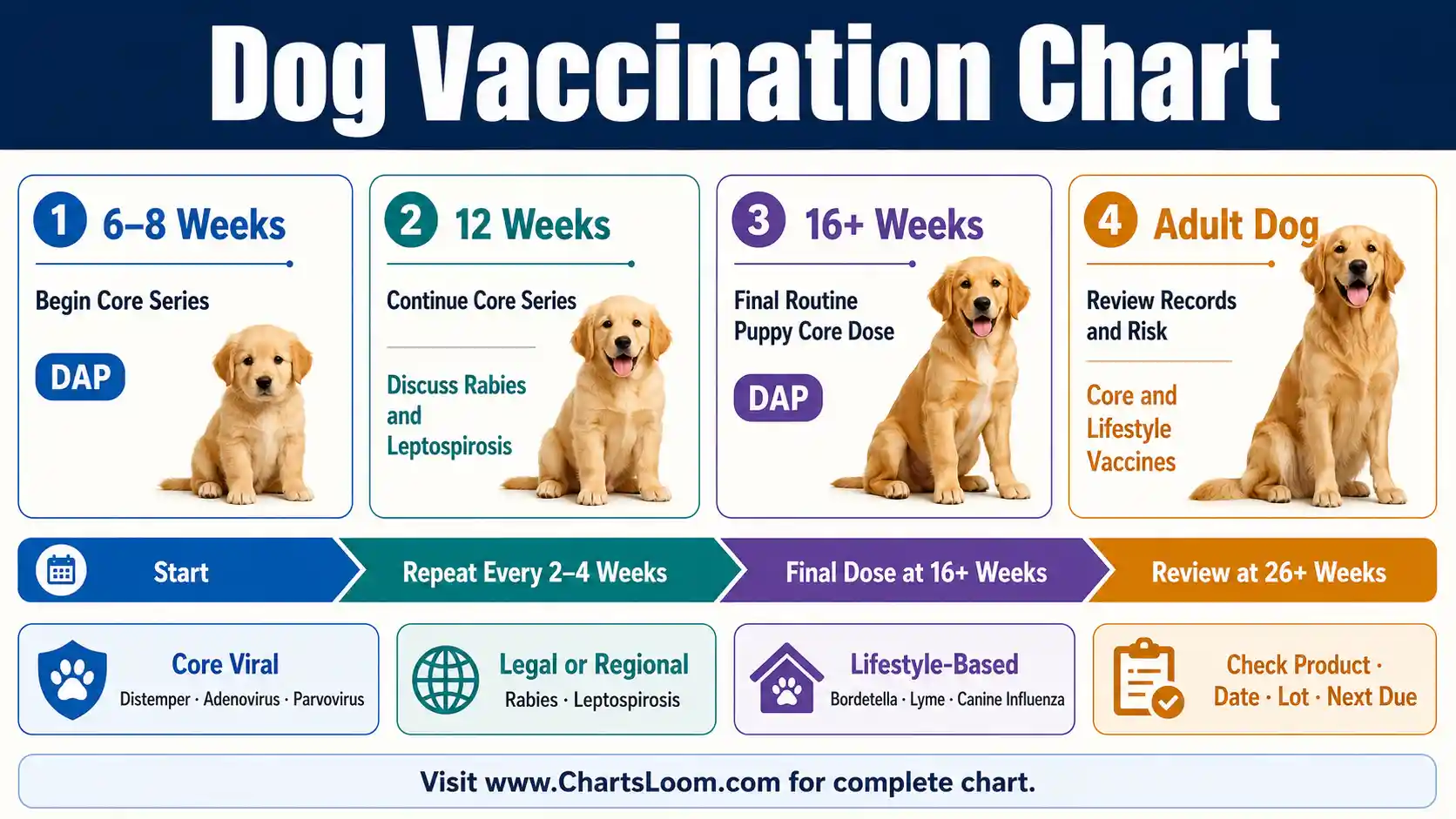
Dog vaccination schedule at a glance
A routine pet puppy usually starts the distemper–adenovirus–parvovirus series at 6–8 weeks and repeats it every 2–4 weeks until a final dose at 16 weeks or older. High-risk puppies may continue to 18–20 weeks. Rabies follows local law, while leptospirosis and other vaccines depend on region, product and exposure. An annual health visit does not mean every vaccine is due annually.
Puppy core series
6–8 to ≥16 weeks
Start at 6–8 weeks and repeat every 2–4 weeks so the final routine dose is given at 16 weeks or older.
High-risk puppies
Up to 18–20 weeks
WSAVA advises considering an extended series where exposure risk is especially high.
Adult core interval
Usually ≤ every 3 years
After an effective primary series, core viral vaccines should not be repeated more often than needed.
Rabies rule
Law and product control
The legal minimum age, certificate validity and booster timing vary by jurisdiction and licensed product.
Questions at a glance
What vaccines are core for dogs?
Distemper, adenovirus and parvovirus are core worldwide. Rabies is core where endemic or required, and leptospirosis is core where regional disease and suitable vaccines justify it.
When should puppy shots start?
Routine pet puppies commonly begin the core viral series at 6 to 8 weeks.
How often are puppy shots repeated?
Repeat core puppy doses every 2 to 4 weeks until the final dose is given at 16 weeks or older.
Why are several puppy doses needed?
Maternal antibodies can block an early response, so repeated doses reduce the window of susceptibility.
Do high-risk puppies need a later dose?
They may. WSAVA advises considering continuation to 18 to 20 weeks in especially high-risk situations.
What happens around 26 weeks?
WSAVA advises considering another core viral dose at or shortly after 26 weeks to close a possible immunity gap.
How often do adult dogs need DAP boosters?
After a successful primary series, core viral revaccination is generally no more frequent than every three years.
When can a dog receive rabies vaccine?
Most dogs should not receive the first rabies dose before 12 weeks, but local law and the product label decide the valid schedule.
When is the first rabies dose considered effective?
CDC guidance treats a dog as initially immunized 28 days after the first rabies vaccination.
Does every dog need leptospirosis vaccination?
Regional guidance differs. It is strongly recommended where leptospirosis occurs, and current AAHA resources recommend it broadly for North American dogs.
Who may need Bordetella vaccination?
Dogs that board, attend daycare, enter shelters, visit shows or have frequent close dog contact commonly need a risk assessment.
Who may need Lyme vaccination?
Dogs with meaningful tick exposure in or traveling to endemic areas may be candidates, together with reliable tick prevention.
Dog vaccine overview chart
Compare common canine vaccines by category, route, primary series, revaccination pattern and the risk each decision addresses.
Swipe horizontally inside the table to view every column.
| Vaccine | Guideline category | Typical route | Initial series | Revaccination | Why it matters |
|---|---|---|---|---|---|
| Distemper (CDV) | Core worldwide | Combination injection | Puppy series from 6–8 weeks; repeat to ≥16 weeks | Core revaccination generally no more often than every 3 years after primary series | Severe contagious viral disease |
| Adenovirus (CAV-2) | Core worldwide | Combination injection | Given with distemper and parvovirus | Same core interval framework | CAV-2 vaccine protects against infectious canine hepatitis caused by CAV-1 |
| Parvovirus (CPV-2) | Core worldwide | Combination injection | Repeat every 2–4 weeks; final puppy dose at ≥16 weeks | Same core interval framework | Maternal antibody can block early doses |
| Rabies | Core where endemic or legally required | Injection by veterinarian or under veterinary supervision | Usually not before 12 weeks; follow product and law | Timing set by product label and local law | Nearly always fatal and a public-health concern |
| Leptospira | Core where disease occurs and suitable vaccine exists; AAHA now recommends broadly in North America | Injection | Usually two initial doses 2–4 weeks apart; age depends on product and guidance | Usually annual | Zoonotic bacterial disease; regional serovars matter |
| Bordetella bronchiseptica | Lifestyle-based / non-core for typical pet homes | Intranasal, oral or injectable products | Mucosal products may use one dose; injectable products commonly use two | Often annual or product-specific | Consider for boarding, daycare, shelters, shows and close dog contact |
| Canine parainfluenza (CPiV) | Lifestyle-based; often included in combinations | Injection or mucosal combination | Schedule depends on route and product | Often annual when risk continues | Respiratory vaccine reduces severity rather than guaranteeing no infection |
| Canine influenza H3N2/H3N8 | Lifestyle-based / non-core | Injection | Two initial doses generally 2–4 weeks apart | Usually annual while risk continues | Consider for outbreak areas and frequent close-contact settings |
| Borrelia burgdorferi (Lyme) | Lifestyle- and geography-based / non-core | Injection | Two initial doses generally 2–4 weeks apart | Usually annual before tick season when risk continues | Tick control remains essential |
| Leishmania | Regional non-core | Product-specific injection | Product-specific multi-dose series | Usually annual where licensed and indicated | Not a substitute for vector control |
| Canine herpesvirus-1 | Special-use reproductive vaccine | Injection to pregnant bitches where licensed | Product-specific pregnancy timing | Repeated with later pregnancies per product | Not a routine pet-dog vaccine |
| Canine coronavirus enteric vaccine | Not recommended by WSAVA for routine pet dogs | Injection | Not recommended | Not recommended | Evidence does not support routine use where current guidelines apply |
- • Core status can differ by geography. WSAVA treats leptospirosis as core where the disease occurs and suitable vaccines exist; AAHA currently recommends it broadly for North American dogs.
- • Product labels and local law override a general chart.
Download or export
Puppy vaccination schedule by age
A week-by-week planning reference for routine pet puppies from four through twenty weeks.
Swipe horizontally inside the table to view every column.
| Age | Core viral status | Core viral action | Rabies | Leptospirosis |
|---|---|---|---|---|
| 4 weeks | Routine pet-home DAP generally not started yet | Veterinary assessment; shelter protocols differ | Generally too young | Usually too young |
| 5 weeks | Routine pet-home DAP generally not started yet | Veterinary assessment; shelter protocols differ | Generally too young | Usually too young |
| 6 weeks | Start or continue DAP series | Repeat every 2–4 weeks so final dose is at ≥16 weeks | Generally too young | Usually too young |
| 7 weeks | Start or continue DAP series | Repeat every 2–4 weeks so final dose is at ≥16 weeks | Generally too young | Usually too young |
| 8 weeks | Start or continue DAP series | Repeat every 2–4 weeks so final dose is at ≥16 weeks | Generally too young | Discuss timing; many North American plans begin at ≥12 weeks |
| 9 weeks | Start or continue DAP series | Repeat every 2–4 weeks so final dose is at ≥16 weeks | Generally too young | Discuss timing; many North American plans begin at ≥12 weeks |
| 10 weeks | Start or continue DAP series | Repeat every 2–4 weeks so final dose is at ≥16 weeks | Generally too young | Discuss timing; many North American plans begin at ≥12 weeks |
| 11 weeks | Start or continue DAP series | Repeat every 2–4 weeks so final dose is at ≥16 weeks | Generally too young | Discuss timing; many North American plans begin at ≥12 weeks |
| 12 weeks | Start or continue DAP series | Repeat every 2–4 weeks so final dose is at ≥16 weeks | Follow local law and product label | Two-dose initial series may begin if indicated |
| 13 weeks | Start or continue DAP series | Repeat every 2–4 weeks so final dose is at ≥16 weeks | Follow local law and product label | Two-dose initial series may begin if indicated |
| 14 weeks | Start or continue DAP series | Repeat every 2–4 weeks so final dose is at ≥16 weeks | Follow local law and product label | Two-dose initial series may begin if indicated |
| 15 weeks | Start or continue DAP series | Repeat every 2–4 weeks so final dose is at ≥16 weeks | Follow local law and product label | Two-dose initial series may begin if indicated |
| 16 weeks | Minimum final puppy DAP age reached | Give final core puppy dose if schedule and health allow | Follow local law and product label | Two-dose initial series may begin if indicated |
| 17 weeks | High-risk extension window | High-risk puppies may continue to 18–20 weeks | Follow local law and product label | Two-dose initial series may begin if indicated |
| 18 weeks | High-risk extension window | High-risk puppies may continue to 18–20 weeks | Follow local law and product label | Two-dose initial series may begin if indicated |
| 19 weeks | High-risk extension window | High-risk puppies may continue to 18–20 weeks | Follow local law and product label | Two-dose initial series may begin if indicated |
| 20 weeks | High-risk extension window | High-risk puppies may continue to 18–20 weeks | Follow local law and product label | Two-dose initial series may begin if indicated |
- • The final routine puppy core viral dose should be given at 16 weeks of age or older.
- • High-risk puppies may continue core viral vaccination to 18–20 weeks.
Download or export
Puppy DAP series examples
Examples showing how different start ages and 2-, 3- or 4-week intervals can still reach a final core dose at 16 weeks or older.
Swipe horizontally inside the table to view every column.
| Starting age | Interval | Example dose ages (weeks) | Final dose age | Interpretation |
|---|---|---|---|---|
| 6 weeks | 2 weeks | 6 → 8 → 10 → 12 → 14 → 16 | 16 weeks | Meets ≥16-week final-dose principle |
| 6 weeks | 3 weeks | 6 → 9 → 12 → 15 → 18 | 18 weeks | Meets ≥16-week final-dose principle |
| 6 weeks | 4 weeks | 6 → 10 → 14 → 18 | 18 weeks | Meets ≥16-week final-dose principle |
| 7 weeks | 2 weeks | 7 → 9 → 11 → 13 → 15 → 17 | 17 weeks | Meets ≥16-week final-dose principle |
| 7 weeks | 3 weeks | 7 → 10 → 13 → 16 | 16 weeks | Meets ≥16-week final-dose principle |
| 7 weeks | 4 weeks | 7 → 11 → 15 → 19 | 19 weeks | Meets ≥16-week final-dose principle |
| 8 weeks | 2 weeks | 8 → 10 → 12 → 14 → 16 | 16 weeks | Meets ≥16-week final-dose principle |
| 8 weeks | 3 weeks | 8 → 11 → 14 → 17 | 17 weeks | Meets ≥16-week final-dose principle |
| 8 weeks | 4 weeks | 8 → 12 → 16 | 16 weeks | Meets ≥16-week final-dose principle |
| 9 weeks | 2 weeks | 9 → 11 → 13 → 15 → 17 | 17 weeks | Meets ≥16-week final-dose principle |
| 9 weeks | 3 weeks | 9 → 12 → 15 → 18 | 18 weeks | Meets ≥16-week final-dose principle |
| 9 weeks | 4 weeks | 9 → 13 → 17 | 17 weeks | Meets ≥16-week final-dose principle |
| 10 weeks | 2 weeks | 10 → 12 → 14 → 16 | 16 weeks | Meets ≥16-week final-dose principle |
| 10 weeks | 3 weeks | 10 → 13 → 16 | 16 weeks | Meets ≥16-week final-dose principle |
| 10 weeks | 4 weeks | 10 → 14 → 18 | 18 weeks | Meets ≥16-week final-dose principle |
| 11 weeks | 2 weeks | 11 → 13 → 15 → 17 | 17 weeks | Meets ≥16-week final-dose principle |
| 11 weeks | 3 weeks | 11 → 14 → 17 | 17 weeks | Meets ≥16-week final-dose principle |
| 11 weeks | 4 weeks | 11 → 15 → 19 | 19 weeks | Meets ≥16-week final-dose principle |
| 12 weeks | 2 weeks | 12 → 14 → 16 | 16 weeks | Meets ≥16-week final-dose principle |
| 12 weeks | 3 weeks | 12 → 15 → 18 | 18 weeks | Meets ≥16-week final-dose principle |
| 12 weeks | 4 weeks | 12 → 16 | 16 weeks | Meets ≥16-week final-dose principle |
| 13 weeks | 2 weeks | 13 → 15 → 17 | 17 weeks | Meets ≥16-week final-dose principle |
| 13 weeks | 3 weeks | 13 → 16 | 16 weeks | Meets ≥16-week final-dose principle |
| 13 weeks | 4 weeks | 13 → 17 | 17 weeks | Meets ≥16-week final-dose principle |
- • These are arithmetic examples, not appointments or prescriptions.
- • A veterinarian chooses the actual interval according to health, exposure risk and product label.
Download or export
Interactive tool
Dog vaccination discussion planner
Enter age, record status, environment and exposure factors. The planner summarizes guideline-based topics to discuss with a veterinarian. It does not tell you to administer a vaccine or create a legally valid schedule.
Default example: a 12-week-old North American puppy with an in-progress series and routine outdoor exposure.
Discussion plan
Discussion plan generated. Use it to prepare for a veterinary appointment, not to administer vaccines yourself.
- Stage
- Puppy core-series window
- Approximate age
- 12 weeks
Priority checks
- • Start or continue distemper–adenovirus–parvovirus vaccination every 2–4 weeks.
- • Plan the final routine puppy core dose for 16 weeks of age or older.
- • Check rabies legal status and certificate dates with the veterinarian or local authority.
Questions to discuss
- • Discuss leptospirosis vaccination; an initial series generally requires two doses 2–4 weeks apart, followed by annual revaccination.
Limits
- • A veterinarian must confirm health, prior records, product labels and local disease risk.
- • Rabies timing and legal validity are controlled by local law and the licensed product.
- • This planner does not create an appointment schedule, vaccine certificate or diagnosis.
What it does
Maps age, records and exposure selections to guideline-based discussion points.
Why it helps
It highlights missing records, puppy timing, legal rabies checks and lifestyle questions before a visit.
What it cannot do
It cannot assess health, select a licensed product, replace local law or certify vaccination.
Adult dog core vaccination framework
How age and documentation change the discussion for distemper, adenovirus and parvovirus catch-up or revaccination.
Swipe horizontally inside the table to view every column.
| Age band | Documented history | What the record means | Discussion point | Always check |
|---|---|---|---|---|
| 17–25 weeks | Documented puppy series through ≥16 weeks | Records support primary core series | Discuss a core dose at about 26+ weeks, then longer interval framework | Rabies still follows law; risk-based vaccines assessed separately |
| 17–25 weeks | Documented puppy series plus 26+ week dose | WSAVA follow-up dose documented | Core revaccination commonly at 3 years of age, then no more often than every 3 years | Rabies still follows law; risk-based vaccines assessed separately |
| 17–25 weeks | One old DAP dose only | Incomplete or uncertain primary history | Veterinarian reviews whether catch-up needs one or two doses 2–4 weeks apart | Rabies still follows law; risk-based vaccines assessed separately |
| 17–25 weeks | Two old DAP doses, final before 16 weeks | Maternal-antibody interference may have affected response | Veterinarian reviews whether catch-up needs one or two doses 2–4 weeks apart | Rabies still follows law; risk-based vaccines assessed separately |
| 17–25 weeks | Unknown vaccination history | Treat as uncertain; veterinarian selects catch-up | Veterinarian may use one potent MLV/recombinant dose or a two-dose product/guideline schedule | Rabies still follows law; risk-based vaccines assessed separately |
| 17–25 weeks | Documented adult core vaccine within 3 years | Likely within common core revaccination interval | Do not repeat core vaccine needlessly; confirm due date and product record | Rabies still follows law; risk-based vaccines assessed separately |
| 17–25 weeks | Documented adult core vaccine over 3 years ago | Review product, health and catch-up plan | Veterinarian reviews whether catch-up needs one or two doses 2–4 weeks apart | Rabies still follows law; risk-based vaccines assessed separately |
| 26–51 weeks | Documented puppy series through ≥16 weeks | Records support primary core series | Discuss a core dose at about 26+ weeks, then longer interval framework | Rabies still follows law; risk-based vaccines assessed separately |
| 26–51 weeks | Documented puppy series plus 26+ week dose | WSAVA follow-up dose documented | Core revaccination commonly at 3 years of age, then no more often than every 3 years | Rabies still follows law; risk-based vaccines assessed separately |
| 26–51 weeks | One old DAP dose only | Incomplete or uncertain primary history | Veterinarian reviews whether catch-up needs one or two doses 2–4 weeks apart | Rabies still follows law; risk-based vaccines assessed separately |
| 26–51 weeks | Two old DAP doses, final before 16 weeks | Maternal-antibody interference may have affected response | Veterinarian reviews whether catch-up needs one or two doses 2–4 weeks apart | Rabies still follows law; risk-based vaccines assessed separately |
| 26–51 weeks | Unknown vaccination history | Treat as uncertain; veterinarian selects catch-up | Veterinarian may use one potent MLV/recombinant dose or a two-dose product/guideline schedule | Rabies still follows law; risk-based vaccines assessed separately |
| 26–51 weeks | Documented adult core vaccine within 3 years | Likely within common core revaccination interval | Do not repeat core vaccine needlessly; confirm due date and product record | Rabies still follows law; risk-based vaccines assessed separately |
| 26–51 weeks | Documented adult core vaccine over 3 years ago | Review product, health and catch-up plan | Veterinarian reviews whether catch-up needs one or two doses 2–4 weeks apart | Rabies still follows law; risk-based vaccines assessed separately |
| 1–3 years | Documented puppy series through ≥16 weeks | Records support primary core series | Discuss a core dose at about 26+ weeks, then longer interval framework | Rabies still follows law; risk-based vaccines assessed separately |
| 1–3 years | Documented puppy series plus 26+ week dose | WSAVA follow-up dose documented | Core revaccination commonly at 3 years of age, then no more often than every 3 years | Rabies still follows law; risk-based vaccines assessed separately |
| 1–3 years | One old DAP dose only | Incomplete or uncertain primary history | Veterinarian reviews whether catch-up needs one or two doses 2–4 weeks apart | Rabies still follows law; risk-based vaccines assessed separately |
| 1–3 years | Two old DAP doses, final before 16 weeks | Maternal-antibody interference may have affected response | Veterinarian reviews whether catch-up needs one or two doses 2–4 weeks apart | Rabies still follows law; risk-based vaccines assessed separately |
| 1–3 years | Unknown vaccination history | Treat as uncertain; veterinarian selects catch-up | Veterinarian may use one potent MLV/recombinant dose or a two-dose product/guideline schedule | Rabies still follows law; risk-based vaccines assessed separately |
| 1–3 years | Documented adult core vaccine within 3 years | Likely within common core revaccination interval | Do not repeat core vaccine needlessly; confirm due date and product record | Rabies still follows law; risk-based vaccines assessed separately |
| 1–3 years | Documented adult core vaccine over 3 years ago | Review product, health and catch-up plan | Veterinarian reviews whether catch-up needs one or two doses 2–4 weeks apart | Rabies still follows law; risk-based vaccines assessed separately |
| 4–7 years | Documented puppy series through ≥16 weeks | Records support primary core series | Discuss a core dose at about 26+ weeks, then longer interval framework | Rabies still follows law; risk-based vaccines assessed separately |
| 4–7 years | Documented puppy series plus 26+ week dose | WSAVA follow-up dose documented | Core revaccination commonly at 3 years of age, then no more often than every 3 years | Rabies still follows law; risk-based vaccines assessed separately |
| 4–7 years | One old DAP dose only | Incomplete or uncertain primary history | Veterinarian reviews whether catch-up needs one or two doses 2–4 weeks apart | Rabies still follows law; risk-based vaccines assessed separately |
| 4–7 years | Two old DAP doses, final before 16 weeks | Maternal-antibody interference may have affected response | Veterinarian reviews whether catch-up needs one or two doses 2–4 weeks apart | Rabies still follows law; risk-based vaccines assessed separately |
| 4–7 years | Unknown vaccination history | Treat as uncertain; veterinarian selects catch-up | Veterinarian may use one potent MLV/recombinant dose or a two-dose product/guideline schedule | Rabies still follows law; risk-based vaccines assessed separately |
| 4–7 years | Documented adult core vaccine within 3 years | Likely within common core revaccination interval | Do not repeat core vaccine needlessly; confirm due date and product record | Rabies still follows law; risk-based vaccines assessed separately |
| 4–7 years | Documented adult core vaccine over 3 years ago | Review product, health and catch-up plan | Veterinarian reviews whether catch-up needs one or two doses 2–4 weeks apart | Rabies still follows law; risk-based vaccines assessed separately |
- • A potent modified-live or recombinant core dose may protect most previously unvaccinated adults, but some manufacturers and regional guidelines recommend a two-dose series.
- • Do not give core vaccines more often than needed.
Download or export
Dog rabies vaccination rules and timing
Common rabies situations, with the legal and public-health limits that a generic schedule cannot replace.
Swipe horizontally inside the table to view every column.
| Context | Situation | General action | Key rule |
|---|---|---|---|
| Rabies-endemic area | First rabies vaccine, dog under 12 weeks | Usually wait until at least 12 weeks unless local product/law says older | Local law and licensed product |
| Rabies-endemic area | First rabies vaccine at ≥12 weeks | Veterinarian administers under local rules | Initial immunization recognized after 28 days by CDC framework |
| Rabies-endemic area | Booster given while current | Dog is considered vaccinated immediately after booster | Keep certificate and due date |
| Rabies-endemic area | Booster given after lapse | Often considered vaccinated immediately after booster, but exposure management may vary | Public-health officials decide after exposure |
| Rabies-endemic area | No certificate available | Do not assume legal currency | Contact veterinarian or local authority |
| Rabies-endemic area | Travel across borders | Check destination entry rules well before travel | Microchip, waiting period, certificate or titer may be required |
| Rabies-endemic area | Dog bites a person | Report and follow local public-health instructions | Do not rely on vaccination history alone |
| Rabies-endemic area | Healthy dog observed after bite | Local authorities may require a 10-day observation | Do not vaccinate during observation unless directed |
| Rabies-endemic area | Vaccinated dog exposed to rabies | Immediate booster and 45-day owner observation are common CDC guidance | Public-health oversight required |
| Rabies-endemic area | Never-vaccinated dog exposed | Euthanasia or strict quarantine may be required | Emergency public-health case |
| Area with legal rabies mandate | First rabies vaccine, dog under 12 weeks | Usually wait until at least 12 weeks unless local product/law says older | Local law and licensed product |
| Area with legal rabies mandate | First rabies vaccine at ≥12 weeks | Veterinarian administers under local rules | Initial immunization recognized after 28 days by CDC framework |
| Area with legal rabies mandate | Booster given while current | Dog is considered vaccinated immediately after booster | Keep certificate and due date |
| Area with legal rabies mandate | Booster given after lapse | Often considered vaccinated immediately after booster, but exposure management may vary | Public-health officials decide after exposure |
| Area with legal rabies mandate | No certificate available | Do not assume legal currency | Contact veterinarian or local authority |
| Area with legal rabies mandate | Travel across borders | Check destination entry rules well before travel | Microchip, waiting period, certificate or titer may be required |
| Area with legal rabies mandate | Dog bites a person | Report and follow local public-health instructions | Do not rely on vaccination history alone |
| Area with legal rabies mandate | Healthy dog observed after bite | Local authorities may require a 10-day observation | Do not vaccinate during observation unless directed |
| Area with legal rabies mandate | Vaccinated dog exposed to rabies | Immediate booster and 45-day owner observation are common CDC guidance | Public-health oversight required |
| Area with legal rabies mandate | Never-vaccinated dog exposed | Euthanasia or strict quarantine may be required | Emergency public-health case |
- • Rabies vaccination must comply with local law and licensed product directions.
- • After a possible rabies exposure or bite, contact public-health and veterinary authorities promptly.
Download or export
Dog leptospirosis vaccination chart
Age, geography and exposure examples for discussing the two-dose primary series and annual revaccination.
Swipe horizontally inside the table to view every column.
| Age band | Scenario | Why it matters | Primary series | Revaccination | Age note |
|---|---|---|---|---|---|
| 8–11 weeks | North American pet dog that goes outdoors | AAHA resources now treat leptospirosis as core | Discuss starting at ≥12 weeks; two initial doses 2–4 weeks apart | Annual | Product minimum age controls |
| 8–11 weeks | Region where canine leptospirosis occurs | WSAVA considers vaccination core when implicated serogroups and suitable vaccines are available | Two-dose initial series | Annual | Product minimum age controls |
| 8–11 weeks | Urban dog with rodent exposure | Exposure can occur in cities | Strong discussion point | Annual if vaccinated | Product minimum age controls |
| 8–11 weeks | Suburban dog using parks | Wildlife urine and wet environments may create risk | Discuss based on local disease | Annual if vaccinated | Product minimum age controls |
| 8–11 weeks | Rural dog near livestock or standing water | Potential exposure may be higher | Strong discussion point | Annual if vaccinated | Product minimum age controls |
| 8–11 weeks | Dog that swims in lakes or ponds | Water exposure can matter | Discuss local risk | Annual if vaccinated | Product minimum age controls |
| 8–11 weeks | Indoor-only dog in endemic region | Risk may not be zero if dog goes outside briefly or rodents enter | Veterinarian assesses local guidance | Annual if vaccinated | Product minimum age controls |
| 8–11 weeks | Previous leptospirosis infection | Past illness does not create a universal vaccine exemption | Specialist/veterinary plan | Individualized | Product minimum age controls |
| 12–15 weeks | North American pet dog that goes outdoors | AAHA resources now treat leptospirosis as core | Discuss starting at ≥12 weeks; two initial doses 2–4 weeks apart | Annual | Common North American start window |
| 12–15 weeks | Region where canine leptospirosis occurs | WSAVA considers vaccination core when implicated serogroups and suitable vaccines are available | Two-dose initial series | Annual | Common North American start window |
| 12–15 weeks | Urban dog with rodent exposure | Exposure can occur in cities | Strong discussion point | Annual if vaccinated | Common North American start window |
| 12–15 weeks | Suburban dog using parks | Wildlife urine and wet environments may create risk | Discuss based on local disease | Annual if vaccinated | Common North American start window |
| 12–15 weeks | Rural dog near livestock or standing water | Potential exposure may be higher | Strong discussion point | Annual if vaccinated | Common North American start window |
| 12–15 weeks | Dog that swims in lakes or ponds | Water exposure can matter | Discuss local risk | Annual if vaccinated | Common North American start window |
| 12–15 weeks | Indoor-only dog in endemic region | Risk may not be zero if dog goes outside briefly or rodents enter | Veterinarian assesses local guidance | Annual if vaccinated | Common North American start window |
| 12–15 weeks | Previous leptospirosis infection | Past illness does not create a universal vaccine exemption | Specialist/veterinary plan | Individualized | Common North American start window |
| ≥16 weeks | North American pet dog that goes outdoors | AAHA resources now treat leptospirosis as core | Discuss starting at ≥12 weeks; two initial doses 2–4 weeks apart | Annual | Adult or older puppy schedule |
| ≥16 weeks | Region where canine leptospirosis occurs | WSAVA considers vaccination core when implicated serogroups and suitable vaccines are available | Two-dose initial series | Annual | Adult or older puppy schedule |
| ≥16 weeks | Urban dog with rodent exposure | Exposure can occur in cities | Strong discussion point | Annual if vaccinated | Adult or older puppy schedule |
| ≥16 weeks | Suburban dog using parks | Wildlife urine and wet environments may create risk | Discuss based on local disease | Annual if vaccinated | Adult or older puppy schedule |
| ≥16 weeks | Rural dog near livestock or standing water | Potential exposure may be higher | Strong discussion point | Annual if vaccinated | Adult or older puppy schedule |
| ≥16 weeks | Dog that swims in lakes or ponds | Water exposure can matter | Discuss local risk | Annual if vaccinated | Adult or older puppy schedule |
| ≥16 weeks | Indoor-only dog in endemic region | Risk may not be zero if dog goes outside briefly or rodents enter | Veterinarian assesses local guidance | Annual if vaccinated | Adult or older puppy schedule |
| ≥16 weeks | Previous leptospirosis infection | Past illness does not create a universal vaccine exemption | Specialist/veterinary plan | Individualized | Adult or older puppy schedule |
- • Leptospirosis vaccine selection should match locally important serogroups when possible.
- • An initial series generally requires two doses; one isolated dose does not establish the usual primary series.
Download or export
Dog respiratory vaccine risk chart
Group-contact settings compared with Bordetella and parainfluenza product routes and primary-series patterns.
Swipe horizontally inside the table to view every column.
| Setting | Contact pattern | Exposure level | Vaccine type | Initial pattern | Repeat pattern |
|---|---|---|---|---|---|
| Occasional grooming visit | Brief dog contact | Low to moderate | Bordetella intranasal/oral | Mucosal product may protect after one dose | Product-specific, often annual |
| Occasional grooming visit | Brief dog contact | Low to moderate | Bordetella injectable | Often needs two initial doses 2–4 weeks apart | Product-specific, often annual |
| Occasional grooming visit | Brief dog contact | Low to moderate | CPiV-containing respiratory vaccine | May be injectable or mucosal combination | Often annual when risk continues |
| Weekly daycare | Frequent close contact | High | Bordetella intranasal/oral | Mucosal product may protect after one dose | Product-specific, often annual |
| Weekly daycare | Frequent close contact | High | Bordetella injectable | Often needs two initial doses 2–4 weeks apart | Product-specific, often annual |
| Weekly daycare | Frequent close contact | High | CPiV-containing respiratory vaccine | May be injectable or mucosal combination | Often annual when risk continues |
| Boarding kennel | Dense temporary housing | High | Bordetella intranasal/oral | Mucosal product may protect after one dose | Product-specific, often annual |
| Boarding kennel | Dense temporary housing | High | Bordetella injectable | Often needs two initial doses 2–4 weeks apart | Product-specific, often annual |
| Boarding kennel | Dense temporary housing | High | CPiV-containing respiratory vaccine | May be injectable or mucosal combination | Often annual when risk continues |
| Dog show or sport event | Many unfamiliar dogs | Moderate to high | Bordetella intranasal/oral | Mucosal product may protect after one dose | Product-specific, often annual |
| Dog show or sport event | Many unfamiliar dogs | Moderate to high | Bordetella injectable | Often needs two initial doses 2–4 weeks apart | Product-specific, often annual |
| Dog show or sport event | Many unfamiliar dogs | Moderate to high | CPiV-containing respiratory vaccine | May be injectable or mucosal combination | Often annual when risk continues |
| Training class | Repeated group contact | Moderate | Bordetella intranasal/oral | Mucosal product may protect after one dose | Product-specific, often annual |
| Training class | Repeated group contact | Moderate | Bordetella injectable | Often needs two initial doses 2–4 weeks apart | Product-specific, often annual |
| Training class | Repeated group contact | Moderate | CPiV-containing respiratory vaccine | May be injectable or mucosal combination | Often annual when risk continues |
| Shelter intake | High-density, uncertain history | Very high | Bordetella intranasal/oral | Mucosal product may protect after one dose | Product-specific, often annual |
| Shelter intake | High-density, uncertain history | Very high | Bordetella injectable | Often needs two initial doses 2–4 weeks apart | Product-specific, often annual |
| Shelter intake | High-density, uncertain history | Very high | CPiV-containing respiratory vaccine | May be injectable or mucosal combination | Often annual when risk continues |
| Dog park several times weekly | Close outdoor contact | Moderate | Bordetella intranasal/oral | Mucosal product may protect after one dose | Product-specific, often annual |
| Dog park several times weekly | Close outdoor contact | Moderate | Bordetella injectable | Often needs two initial doses 2–4 weeks apart | Product-specific, often annual |
| Dog park several times weekly | Close outdoor contact | Moderate | CPiV-containing respiratory vaccine | May be injectable or mucosal combination | Often annual when risk continues |
| Household with no outside dog contact | Limited exposure | Low | Bordetella intranasal/oral | Mucosal product may protect after one dose | Product-specific, often annual |
| Household with no outside dog contact | Limited exposure | Low | Bordetella injectable | Often needs two initial doses 2–4 weeks apart | Product-specific, often annual |
| Household with no outside dog contact | Limited exposure | Low | CPiV-containing respiratory vaccine | May be injectable or mucosal combination | Often annual when risk continues |
- • Respiratory vaccines may reduce illness severity but cannot guarantee that infection or coughing will not occur.
- • Intranasal or oral products must never be injected.
Download or export
Dog Lyme vaccine risk chart
Geography, tick exposure and prevention factors that shape a Lyme vaccine discussion.
Swipe horizontally inside the table to view every column.
| Region | Exposure | Discussion | Primary series | Revaccination | Season | Essential companion measure |
|---|---|---|---|---|---|---|
| Known endemic area | Frequent woodland or brush exposure | Discuss two-dose primary series and annual revaccination if risk is meaningful | Two doses generally 2–4 weeks apart when used | Annual while risk continues | Before local tick season | Vaccination does not replace tick control |
| Known endemic area | Frequent woodland or brush exposure | Discuss two-dose primary series and annual revaccination if risk is meaningful | Two doses generally 2–4 weeks apart when used | Annual while risk continues | Year-round tick activity | Vaccination does not replace tick control |
| Known endemic area | Backyard tick exposure | Discuss two-dose primary series and annual revaccination if risk is meaningful | Two doses generally 2–4 weeks apart when used | Annual while risk continues | Before local tick season | Vaccination does not replace tick control |
| Known endemic area | Backyard tick exposure | Discuss two-dose primary series and annual revaccination if risk is meaningful | Two doses generally 2–4 weeks apart when used | Annual while risk continues | Year-round tick activity | Vaccination does not replace tick control |
| Known endemic area | Consistent veterinarian-recommended tick prevention | Discuss two-dose primary series and annual revaccination if risk is meaningful | Two doses generally 2–4 weeks apart when used | Annual while risk continues | Before local tick season | Vaccination does not replace tick control |
| Known endemic area | Consistent veterinarian-recommended tick prevention | Discuss two-dose primary series and annual revaccination if risk is meaningful | Two doses generally 2–4 weeks apart when used | Annual while risk continues | Year-round tick activity | Vaccination does not replace tick control |
| Known endemic area | No tick prevention | Address tick prevention first and discuss vaccine urgently if endemic/travel risk exists | Two doses generally 2–4 weeks apart when used | Annual while risk continues | Before local tick season | Vaccination does not replace tick control |
| Known endemic area | No tick prevention | Address tick prevention first and discuss vaccine urgently if endemic/travel risk exists | Two doses generally 2–4 weeks apart when used | Annual while risk continues | Year-round tick activity | Vaccination does not replace tick control |
| Travel to endemic area | Frequent woodland or brush exposure | Discuss two-dose primary series and annual revaccination if risk is meaningful | Two doses generally 2–4 weeks apart when used | Annual while risk continues | Before local tick season | Vaccination does not replace tick control |
| Travel to endemic area | Frequent woodland or brush exposure | Discuss two-dose primary series and annual revaccination if risk is meaningful | Two doses generally 2–4 weeks apart when used | Annual while risk continues | Year-round tick activity | Vaccination does not replace tick control |
| Travel to endemic area | Backyard tick exposure | Discuss two-dose primary series and annual revaccination if risk is meaningful | Two doses generally 2–4 weeks apart when used | Annual while risk continues | Before local tick season | Vaccination does not replace tick control |
| Travel to endemic area | Backyard tick exposure | Discuss two-dose primary series and annual revaccination if risk is meaningful | Two doses generally 2–4 weeks apart when used | Annual while risk continues | Year-round tick activity | Vaccination does not replace tick control |
| Travel to endemic area | Consistent veterinarian-recommended tick prevention | Discuss two-dose primary series and annual revaccination if risk is meaningful | Two doses generally 2–4 weeks apart when used | Annual while risk continues | Before local tick season | Vaccination does not replace tick control |
| Travel to endemic area | Consistent veterinarian-recommended tick prevention | Discuss two-dose primary series and annual revaccination if risk is meaningful | Two doses generally 2–4 weeks apart when used | Annual while risk continues | Year-round tick activity | Vaccination does not replace tick control |
| Travel to endemic area | No tick prevention | Address tick prevention first and discuss vaccine urgently if endemic/travel risk exists | Two doses generally 2–4 weeks apart when used | Annual while risk continues | Before local tick season | Vaccination does not replace tick control |
| Travel to endemic area | No tick prevention | Address tick prevention first and discuss vaccine urgently if endemic/travel risk exists | Two doses generally 2–4 weeks apart when used | Annual while risk continues | Year-round tick activity | Vaccination does not replace tick control |
| No known local transmission | Frequent woodland or brush exposure | Vaccine often lower priority; reassess travel and changing local risk | Two doses generally 2–4 weeks apart when used | Annual while risk continues | Before local tick season | Vaccination does not replace tick control |
| No known local transmission | Frequent woodland or brush exposure | Vaccine often lower priority; reassess travel and changing local risk | Two doses generally 2–4 weeks apart when used | Annual while risk continues | Year-round tick activity | Vaccination does not replace tick control |
| No known local transmission | Backyard tick exposure | Vaccine often lower priority; reassess travel and changing local risk | Two doses generally 2–4 weeks apart when used | Annual while risk continues | Before local tick season | Vaccination does not replace tick control |
| No known local transmission | Backyard tick exposure | Vaccine often lower priority; reassess travel and changing local risk | Two doses generally 2–4 weeks apart when used | Annual while risk continues | Year-round tick activity | Vaccination does not replace tick control |
| No known local transmission | Consistent veterinarian-recommended tick prevention | Vaccine often lower priority; reassess travel and changing local risk | Two doses generally 2–4 weeks apart when used | Annual while risk continues | Before local tick season | Vaccination does not replace tick control |
| No known local transmission | Consistent veterinarian-recommended tick prevention | Vaccine often lower priority; reassess travel and changing local risk | Two doses generally 2–4 weeks apart when used | Annual while risk continues | Year-round tick activity | Vaccination does not replace tick control |
| No known local transmission | No tick prevention | Address tick prevention first and discuss vaccine urgently if endemic/travel risk exists | Two doses generally 2–4 weeks apart when used | Annual while risk continues | Before local tick season | Vaccination does not replace tick control |
| No known local transmission | No tick prevention | Address tick prevention first and discuss vaccine urgently if endemic/travel risk exists | Two doses generally 2–4 weeks apart when used | Annual while risk continues | Year-round tick activity | Vaccination does not replace tick control |
- • Lyme vaccination is lifestyle- and geography-based.
- • Year-round veterinarian-recommended tick control remains important whether or not vaccination is used.
Download or export
Dog vaccine route and series chart
Why route, product type, age and prior history determine whether a vaccine uses one dose, repeated puppy doses or a two-dose primary series.
Swipe horizontally inside the table to view every column.
| Vaccine | Product route/type | Patient context | Initial pattern | Repeat pattern | Use context | Safety rule |
|---|---|---|---|---|---|---|
| DAP core combination | Parenteral MLV/recombinant | Puppy | Multiple doses to ≥16 weeks | Long-duration core immunity after effective response | Typical pet-home use | Veterinarian must use the licensed product by the correct route |
| DAP core combination | Parenteral MLV/recombinant | Puppy | Multiple doses to ≥16 weeks | Long-duration core immunity after effective response | High-exposure setting | Veterinarian must use the licensed product by the correct route |
| DAP core combination | Parenteral MLV/recombinant | Puppy | Multiple doses to ≥16 weeks | Long-duration core immunity after effective response | Catch-up discussion | Veterinarian must use the licensed product by the correct route |
| DAP core combination | Parenteral MLV/recombinant | Adult unknown history | One dose likely protects most; some products/guidelines use two | Follow veterinarian/product | Typical pet-home use | Veterinarian must use the licensed product by the correct route |
| DAP core combination | Parenteral MLV/recombinant | Adult unknown history | One dose likely protects most; some products/guidelines use two | Follow veterinarian/product | High-exposure setting | Veterinarian must use the licensed product by the correct route |
| DAP core combination | Parenteral MLV/recombinant | Adult unknown history | One dose likely protects most; some products/guidelines use two | Follow veterinarian/product | Catch-up discussion | Veterinarian must use the licensed product by the correct route |
| Rabies | Parenteral inactivated/recombinant | Puppy or adult | One dose under law and product | Legal interval controls | Typical pet-home use | Veterinarian must use the licensed product by the correct route |
| Rabies | Parenteral inactivated/recombinant | Puppy or adult | One dose under law and product | Legal interval controls | High-exposure setting | Veterinarian must use the licensed product by the correct route |
| Rabies | Parenteral inactivated/recombinant | Puppy or adult | One dose under law and product | Legal interval controls | Catch-up discussion | Veterinarian must use the licensed product by the correct route |
| Leptospira | Parenteral inactivated | Puppy or adult | Two doses 2–4 weeks apart | Annual | Typical pet-home use | Veterinarian must use the licensed product by the correct route |
| Leptospira | Parenteral inactivated | Puppy or adult | Two doses 2–4 weeks apart | Annual | High-exposure setting | Veterinarian must use the licensed product by the correct route |
| Leptospira | Parenteral inactivated | Puppy or adult | Two doses 2–4 weeks apart | Annual | Catch-up discussion | Veterinarian must use the licensed product by the correct route |
| Bordetella | Intranasal live | At-risk puppy/adult | Often one dose | Often annual | Typical pet-home use | Veterinarian must use the licensed product by the correct route |
| Bordetella | Intranasal live | At-risk puppy/adult | Often one dose | Often annual | High-exposure setting | Veterinarian must use the licensed product by the correct route |
| Bordetella | Intranasal live | At-risk puppy/adult | Often one dose | Often annual | Catch-up discussion | Veterinarian must use the licensed product by the correct route |
| Bordetella | Oral live | At-risk puppy/adult | Often one dose | Often annual | Typical pet-home use | Veterinarian must use the licensed product by the correct route |
| Bordetella | Oral live | At-risk puppy/adult | Often one dose | Often annual | High-exposure setting | Veterinarian must use the licensed product by the correct route |
| Bordetella | Oral live | At-risk puppy/adult | Often one dose | Often annual | Catch-up discussion | Veterinarian must use the licensed product by the correct route |
| Bordetella | Parenteral inactivated/subunit | At-risk puppy/adult | Often two doses 2–4 weeks apart | Often annual | Typical pet-home use | Veterinarian must use the licensed product by the correct route |
| Bordetella | Parenteral inactivated/subunit | At-risk puppy/adult | Often two doses 2–4 weeks apart | Often annual | High-exposure setting | Veterinarian must use the licensed product by the correct route |
| Bordetella | Parenteral inactivated/subunit | At-risk puppy/adult | Often two doses 2–4 weeks apart | Often annual | Catch-up discussion | Veterinarian must use the licensed product by the correct route |
| Canine influenza | Parenteral inactivated | At-risk puppy/adult | Two doses 2–4 weeks apart | Annual | Typical pet-home use | Veterinarian must use the licensed product by the correct route |
| Canine influenza | Parenteral inactivated | At-risk puppy/adult | Two doses 2–4 weeks apart | Annual | High-exposure setting | Veterinarian must use the licensed product by the correct route |
| Canine influenza | Parenteral inactivated | At-risk puppy/adult | Two doses 2–4 weeks apart | Annual | Catch-up discussion | Veterinarian must use the licensed product by the correct route |
| Lyme | Parenteral bacterin/subunit | At-risk puppy/adult | Two doses 2–4 weeks apart | Annual | Typical pet-home use | Veterinarian must use the licensed product by the correct route |
| Lyme | Parenteral bacterin/subunit | At-risk puppy/adult | Two doses 2–4 weeks apart | Annual | High-exposure setting | Veterinarian must use the licensed product by the correct route |
| Lyme | Parenteral bacterin/subunit | At-risk puppy/adult | Two doses 2–4 weeks apart | Annual | Catch-up discussion | Veterinarian must use the licensed product by the correct route |
| Leishmania | Parenteral regional product | Eligible dog where licensed | Product-specific multi-dose series | Annual | Typical pet-home use | Veterinarian must use the licensed product by the correct route |
| Leishmania | Parenteral regional product | Eligible dog where licensed | Product-specific multi-dose series | Annual | High-exposure setting | Veterinarian must use the licensed product by the correct route |
| Leishmania | Parenteral regional product | Eligible dog where licensed | Product-specific multi-dose series | Annual | Catch-up discussion | Veterinarian must use the licensed product by the correct route |
- • Only veterinary professionals should administer vaccines by the licensed route.
- • Exact minimum ages and intervals differ among products and jurisdictions.
Download or export
Dog vaccination record checklist
The fields that make a vaccine record useful for routine care, adverse-event investigation, boarding and travel.
Swipe horizontally inside the table to view every column.
| Record section | Field | Why it matters | Where to keep it | When to carry it |
|---|---|---|---|---|
| Dog identity | Name | Match certificate to patient | Keep in the permanent medical record | Carry copies for travel, boarding or emergencies |
| Dog identity | Microchip number | Important for travel and legal records | Keep in the permanent medical record | Carry copies for travel, boarding or emergencies |
| Dog identity | Date of birth or estimated age | Checks minimum-age rules | Keep in the permanent medical record | Carry copies for travel, boarding or emergencies |
| Vaccine | Disease antigens | Clarifies what was actually given | Keep in the permanent medical record | Carry copies for travel, boarding or emergencies |
| Vaccine | Product trade name | Allows product-label review | Keep in the permanent medical record | Carry copies for travel, boarding or emergencies |
| Vaccine | Manufacturer | Supports traceability | Keep in the permanent medical record | Carry copies for travel, boarding or emergencies |
| Vaccine | Lot or serial number | Supports adverse-event reporting | Keep in the permanent medical record | Carry copies for travel, boarding or emergencies |
| Vaccine | Expiration date | Confirms product validity | Keep in the permanent medical record | Carry copies for travel, boarding or emergencies |
| Vaccine | Dose volume | Clinical record | Keep in the permanent medical record | Carry copies for travel, boarding or emergencies |
| Vaccine | Route | Distinguishes oral, intranasal and injectable products | Keep in the permanent medical record | Carry copies for travel, boarding or emergencies |
| Vaccine | Injection site | Supports reaction follow-up | Keep in the permanent medical record | Carry copies for travel, boarding or emergencies |
| Timing | Administration date | Establishes series interval | Keep in the permanent medical record | Carry copies for travel, boarding or emergencies |
| Timing | Next due date | Reduces missed boosters | Keep in the permanent medical record | Carry copies for travel, boarding or emergencies |
| Timing | Age at dose | Confirms final puppy dose timing | Keep in the permanent medical record | Carry copies for travel, boarding or emergencies |
| Timing | Previous dose date | Checks minimum interval | Keep in the permanent medical record | Carry copies for travel, boarding or emergencies |
| Provider | Veterinarian name | Clinical accountability | Keep in the permanent medical record | Carry copies for travel, boarding or emergencies |
| Provider | Clinic name and address | Record verification | Keep in the permanent medical record | Carry copies for travel, boarding or emergencies |
| Provider | Signature or official certification | May be legally required | Keep in the permanent medical record | Carry copies for travel, boarding or emergencies |
| Provider | License details where required | Jurisdiction-specific | Keep in the permanent medical record | Carry copies for travel, boarding or emergencies |
| Rabies | Rabies certificate number | Legal documentation | Keep in the permanent medical record | Carry copies for travel, boarding or emergencies |
| Rabies | One-year or three-year product | Determines labeled duration | Keep in the permanent medical record | Carry copies for travel, boarding or emergencies |
| Rabies | Jurisdiction due date | Law may differ from label | Keep in the permanent medical record | Carry copies for travel, boarding or emergencies |
| Patient safety | Previous reaction | Changes future planning | Keep in the permanent medical record | Carry copies for travel, boarding or emergencies |
| Patient safety | Current medications | May affect assessment | Keep in the permanent medical record | Carry copies for travel, boarding or emergencies |
| Patient safety | Health status at vaccination | Documents suitability | Keep in the permanent medical record | Carry copies for travel, boarding or emergencies |
| Patient safety | Pregnancy/reproductive status | May affect product choice | Keep in the permanent medical record | Carry copies for travel, boarding or emergencies |
| Risk plan | Lifestyle exposures | Supports non-core decisions | Keep in the permanent medical record | Carry copies for travel, boarding or emergencies |
| Risk plan | Travel destinations | May add regional requirements | Keep in the permanent medical record | Carry copies for travel, boarding or emergencies |
| Risk plan | Boarding/daycare rules | Facility requirements can differ | Keep in the permanent medical record | Carry copies for travel, boarding or emergencies |
| Risk plan | Veterinarian notes | Captures individualized plan | Keep in the permanent medical record | Carry copies for travel, boarding or emergencies |
- • A sticker or product label in the medical record improves traceability.
- • Rabies certificates may require specific legal fields beyond a general clinic receipt.
Download or export
Dog pre-vaccination checklist
What to review with the veterinary team before a vaccine visit.
Swipe horizontally inside the table to view every column.
| Checklist group | Item | Action | Boundary |
|---|---|---|---|
| Identity and records | Confirm dog and owner details | Discuss with veterinary team | Do not self-administer or alter a schedule without veterinary direction |
| Identity and records | Bring all prior vaccine certificates | Discuss with veterinary team | Do not self-administer or alter a schedule without veterinary direction |
| Identity and records | Check microchip if travel is planned | Discuss with veterinary team | Do not self-administer or alter a schedule without veterinary direction |
| Age and schedule | Verify age at every previous puppy dose | Discuss with veterinary team | Do not self-administer or alter a schedule without veterinary direction |
| Age and schedule | Confirm interval since the last dose | Discuss with veterinary team | Do not self-administer or alter a schedule without veterinary direction |
| Age and schedule | Identify overdue or unknown records | Discuss with veterinary team | Do not self-administer or alter a schedule without veterinary direction |
| Health today | Report fever, vomiting, diarrhea or marked lethargy | Discuss with veterinary team | Do not self-administer or alter a schedule without veterinary direction |
| Health today | Report coughing, nasal discharge or breathing changes | Discuss with veterinary team | Do not self-administer or alter a schedule without veterinary direction |
| Health today | Report appetite and drinking changes | Discuss with veterinary team | Do not self-administer or alter a schedule without veterinary direction |
| Health today | Report recent surgery or hospitalization | Discuss with veterinary team | Do not self-administer or alter a schedule without veterinary direction |
| Medication | List prescription medicines | Discuss with veterinary team | Do not self-administer or alter a schedule without veterinary direction |
| Medication | List steroids or immune-modifying drugs | Discuss with veterinary team | Do not self-administer or alter a schedule without veterinary direction |
| Medication | List supplements and preventives | Discuss with veterinary team | Do not self-administer or alter a schedule without veterinary direction |
| History | Describe any prior vaccine reaction | Discuss with veterinary team | Do not self-administer or alter a schedule without veterinary direction |
| History | Describe chronic disease or immune disorder | Discuss with veterinary team | Do not self-administer or alter a schedule without veterinary direction |
| History | Discuss pregnancy or breeding plans | Discuss with veterinary team | Do not self-administer or alter a schedule without veterinary direction |
| Exposure | Describe boarding, daycare and grooming | Discuss with veterinary team | Do not self-administer or alter a schedule without veterinary direction |
| Exposure | Describe dog parks, shows and classes | Discuss with veterinary team | Do not self-administer or alter a schedule without veterinary direction |
| Exposure | Describe tick habitat and travel | Discuss with veterinary team | Do not self-administer or alter a schedule without veterinary direction |
| Exposure | Describe wildlife, rodents and standing water | Discuss with veterinary team | Do not self-administer or alter a schedule without veterinary direction |
| Legal and travel | Check local rabies law | Discuss with veterinary team | Do not self-administer or alter a schedule without veterinary direction |
| Legal and travel | Check destination entry rules | Discuss with veterinary team | Do not self-administer or alter a schedule without veterinary direction |
| Planning | Ask which vaccines are core for this dog | Discuss with veterinary team | Do not self-administer or alter a schedule without veterinary direction |
| Planning | Ask which non-core risks are meaningful | Discuss with veterinary team | Do not self-administer or alter a schedule without veterinary direction |
| Planning | Confirm next due date before leaving | Discuss with veterinary team | Do not self-administer or alter a schedule without veterinary direction |
- • Vaccination is a clinical decision made after assessing the dog, records, product and exposure risk.
- • Do not delay urgent veterinary care simply to keep a routine vaccine appointment.
Download or export
Dog vaccine reaction monitoring chart
Common mild observations and emergency warning signs after vaccination.
Swipe horizontally inside the table to view every column.
| Timing | Sign | Possible meaning | Action | Urgency | Documentation |
|---|---|---|---|---|---|
| Within minutes to hours | Mild soreness at injection site | Often short-lived | Monitor comfort and activity | Call if severe, worsening or persistent | Record and report suspected adverse events through the veterinary team |
| Within minutes to hours | Mild sleepiness | Can occur briefly | Allow rest and water | Call if profound or prolonged | Record and report suspected adverse events through the veterinary team |
| Within minutes to hours | Mild reduced appetite | Can occur briefly | Monitor intake | Call if persistent or accompanied by vomiting | Record and report suspected adverse events through the veterinary team |
| Within minutes to hours | Small firm swelling | May occur locally | Do not massage aggressively | Call if enlarging, painful or persistent | Record and report suspected adverse events through the veterinary team |
| Within minutes to hours | Facial swelling or hives | Possible allergic reaction | Seek veterinary care promptly | Urgent | Record and report suspected adverse events through the veterinary team |
| Within minutes to hours | Repeated vomiting or diarrhea | Possible systemic reaction | Contact veterinarian promptly | Urgent | Record and report suspected adverse events through the veterinary team |
| Within minutes to hours | Trouble breathing | Severe emergency sign | Seek emergency care immediately | Emergency | Record and report suspected adverse events through the veterinary team |
| Within minutes to hours | Collapse or marked weakness | Severe emergency sign | Seek emergency care immediately | Emergency | Record and report suspected adverse events through the veterinary team |
| Within minutes to hours | Pale gums | Possible emergency | Seek emergency care immediately | Emergency | Record and report suspected adverse events through the veterinary team |
| Within minutes to hours | Seizure | Neurologic emergency | Seek emergency care immediately | Emergency | Record and report suspected adverse events through the veterinary team |
| Later the same day | Mild soreness at injection site | Often short-lived | Monitor comfort and activity | Call if severe, worsening or persistent | Record and report suspected adverse events through the veterinary team |
| Later the same day | Mild sleepiness | Can occur briefly | Allow rest and water | Call if profound or prolonged | Record and report suspected adverse events through the veterinary team |
| Later the same day | Mild reduced appetite | Can occur briefly | Monitor intake | Call if persistent or accompanied by vomiting | Record and report suspected adverse events through the veterinary team |
| Later the same day | Small firm swelling | May occur locally | Do not massage aggressively | Call if enlarging, painful or persistent | Record and report suspected adverse events through the veterinary team |
| Later the same day | Facial swelling or hives | Possible allergic reaction | Seek veterinary care promptly | Urgent | Record and report suspected adverse events through the veterinary team |
| Later the same day | Repeated vomiting or diarrhea | Possible systemic reaction | Contact veterinarian promptly | Urgent | Record and report suspected adverse events through the veterinary team |
| Later the same day | Trouble breathing | Severe emergency sign | Seek emergency care immediately | Emergency | Record and report suspected adverse events through the veterinary team |
| Later the same day | Collapse or marked weakness | Severe emergency sign | Seek emergency care immediately | Emergency | Record and report suspected adverse events through the veterinary team |
| Later the same day | Pale gums | Possible emergency | Seek emergency care immediately | Emergency | Record and report suspected adverse events through the veterinary team |
| Later the same day | Seizure | Neurologic emergency | Seek emergency care immediately | Emergency | Record and report suspected adverse events through the veterinary team |
| Following days | Mild soreness at injection site | Often short-lived | Monitor comfort and activity | Call if severe, worsening or persistent | Record and report suspected adverse events through the veterinary team |
| Following days | Mild sleepiness | Can occur briefly | Allow rest and water | Call if profound or prolonged | Record and report suspected adverse events through the veterinary team |
| Following days | Mild reduced appetite | Can occur briefly | Monitor intake | Call if persistent or accompanied by vomiting | Record and report suspected adverse events through the veterinary team |
| Following days | Small firm swelling | May occur locally | Do not massage aggressively | Call if enlarging, painful or persistent | Record and report suspected adverse events through the veterinary team |
| Following days | Facial swelling or hives | Possible allergic reaction | Seek veterinary care promptly | Urgent | Record and report suspected adverse events through the veterinary team |
| Following days | Repeated vomiting or diarrhea | Possible systemic reaction | Contact veterinarian promptly | Urgent | Record and report suspected adverse events through the veterinary team |
| Following days | Trouble breathing | Severe emergency sign | Seek emergency care immediately | Emergency | Record and report suspected adverse events through the veterinary team |
| Following days | Collapse or marked weakness | Severe emergency sign | Seek emergency care immediately | Emergency | Record and report suspected adverse events through the veterinary team |
| Following days | Pale gums | Possible emergency | Seek emergency care immediately | Emergency | Record and report suspected adverse events through the veterinary team |
| Following days | Seizure | Neurologic emergency | Seek emergency care immediately | Emergency | Record and report suspected adverse events through the veterinary team |
- • Emergency signs include breathing difficulty, collapse, seizures, pale gums or rapidly progressing facial swelling.
- • This table cannot determine whether a sign was caused by a vaccine.
Download or export
Dog vaccination catch-up examples
How age, records and current health affect catch-up conversations.
Swipe horizontally inside the table to view every column.
| Presentation status | Scenario | Core plan discussion | Series note | Other priority | Health rule |
|---|---|---|---|---|---|
| Healthy at presentation | 8-week puppy, no records | Begin age-appropriate core series | Repeat every 2–4 weeks to ≥16 weeks | Discuss rabies when legally age-eligible | Veterinarian confirms suitability |
| Healthy at presentation | 14-week puppy, one DAP at 8 weeks | Continue core series | Need a dose at ≥16 weeks | High-risk extension may be considered | Veterinarian confirms suitability |
| Healthy at presentation | 18-week puppy, no records | Start catch-up now | Product/guideline may use one or two doses | Review rabies and leptospirosis | Veterinarian confirms suitability |
| Healthy at presentation | 7-month dog, puppy series complete at 16 weeks | Discuss WSAVA 26+ week core dose | Then long-duration core interval | Check rabies certificate | Veterinarian confirms suitability |
| Healthy at presentation | 2-year adult, no records | Treat history as unknown | Veterinarian selects one-dose or two-dose core approach | Rabies follows local law | Veterinarian confirms suitability |
| Healthy at presentation | 5-year adult, DAP 4 years ago | Review whether core revaccination is due | Avoid unnecessary repeat dosing | Assess lifestyle vaccines separately | Veterinarian confirms suitability |
| Healthy at presentation | Adult with rabies certificate expired | Arrange legal booster promptly | Exposure management can differ while overdue | Contact local authority after exposure | Veterinarian confirms suitability |
| Healthy at presentation | Adult with unknown lepto history | Two-dose initial series is generally required when used | Do not assume one old dose completes the series | Annual thereafter | Veterinarian confirms suitability |
| Healthy at presentation | Adult entering boarding in 3 days | Facility requirements may not allow enough lead time | Mucosal respiratory product timing is product-specific | Call veterinarian and facility now | Veterinarian confirms suitability |
| Healthy at presentation | Imported dog with foreign records | Verify product, dates, microchip and legal acceptance | Translation or official certification may be needed | Do not assume all records meet destination rules | Veterinarian confirms suitability |
| Mild illness reported | 8-week puppy, no records | Begin age-appropriate core series | Repeat every 2–4 weeks to ≥16 weeks | Discuss rabies when legally age-eligible | Proceed only after veterinary health assessment |
| Mild illness reported | 14-week puppy, one DAP at 8 weeks | Continue core series | Need a dose at ≥16 weeks | High-risk extension may be considered | Proceed only after veterinary health assessment |
| Mild illness reported | 18-week puppy, no records | Start catch-up now | Product/guideline may use one or two doses | Review rabies and leptospirosis | Proceed only after veterinary health assessment |
| Mild illness reported | 7-month dog, puppy series complete at 16 weeks | Discuss WSAVA 26+ week core dose | Then long-duration core interval | Check rabies certificate | Proceed only after veterinary health assessment |
| Mild illness reported | 2-year adult, no records | Treat history as unknown | Veterinarian selects one-dose or two-dose core approach | Rabies follows local law | Proceed only after veterinary health assessment |
| Mild illness reported | 5-year adult, DAP 4 years ago | Review whether core revaccination is due | Avoid unnecessary repeat dosing | Assess lifestyle vaccines separately | Proceed only after veterinary health assessment |
| Mild illness reported | Adult with rabies certificate expired | Arrange legal booster promptly | Exposure management can differ while overdue | Contact local authority after exposure | Proceed only after veterinary health assessment |
| Mild illness reported | Adult with unknown lepto history | Two-dose initial series is generally required when used | Do not assume one old dose completes the series | Annual thereafter | Proceed only after veterinary health assessment |
| Mild illness reported | Adult entering boarding in 3 days | Facility requirements may not allow enough lead time | Mucosal respiratory product timing is product-specific | Call veterinarian and facility now | Proceed only after veterinary health assessment |
| Mild illness reported | Imported dog with foreign records | Verify product, dates, microchip and legal acceptance | Translation or official certification may be needed | Do not assume all records meet destination rules | Proceed only after veterinary health assessment |
| Previous vaccine reaction | 8-week puppy, no records | Begin age-appropriate core series | Repeat every 2–4 weeks to ≥16 weeks | Discuss rabies when legally age-eligible | Proceed only after veterinary health assessment |
| Previous vaccine reaction | 14-week puppy, one DAP at 8 weeks | Continue core series | Need a dose at ≥16 weeks | High-risk extension may be considered | Proceed only after veterinary health assessment |
| Previous vaccine reaction | 18-week puppy, no records | Start catch-up now | Product/guideline may use one or two doses | Review rabies and leptospirosis | Proceed only after veterinary health assessment |
| Previous vaccine reaction | 7-month dog, puppy series complete at 16 weeks | Discuss WSAVA 26+ week core dose | Then long-duration core interval | Check rabies certificate | Proceed only after veterinary health assessment |
| Previous vaccine reaction | 2-year adult, no records | Treat history as unknown | Veterinarian selects one-dose or two-dose core approach | Rabies follows local law | Proceed only after veterinary health assessment |
| Previous vaccine reaction | 5-year adult, DAP 4 years ago | Review whether core revaccination is due | Avoid unnecessary repeat dosing | Assess lifestyle vaccines separately | Proceed only after veterinary health assessment |
| Previous vaccine reaction | Adult with rabies certificate expired | Arrange legal booster promptly | Exposure management can differ while overdue | Contact local authority after exposure | Proceed only after veterinary health assessment |
| Previous vaccine reaction | Adult with unknown lepto history | Two-dose initial series is generally required when used | Do not assume one old dose completes the series | Annual thereafter | Proceed only after veterinary health assessment |
| Previous vaccine reaction | Adult entering boarding in 3 days | Facility requirements may not allow enough lead time | Mucosal respiratory product timing is product-specific | Call veterinarian and facility now | Proceed only after veterinary health assessment |
| Previous vaccine reaction | Imported dog with foreign records | Verify product, dates, microchip and legal acceptance | Translation or official certification may be needed | Do not assume all records meet destination rules | Proceed only after veterinary health assessment |
- • Unknown records do not automatically mean a dog should receive every vaccine on the same day.
- • Rabies catch-up and exposure management remain subject to law and public-health direction.
Download or export
Dog vaccine titer testing chart
Where antibody testing can and cannot help with canine vaccination decisions.
Swipe horizontally inside the table to view every column.
| Timing | Test or antigen | What it may show | Potential use | Important limit | Interpretation |
|---|---|---|---|---|---|
| Before a planned core booster | CDV antibody | May support evidence of protection | Useful in selected core-vaccine decisions | Not a legal substitute for rabies vaccination | Veterinary interpretation required |
| Before a planned core booster | CAV antibody | May support evidence of protection | Selected cases and research-quality testing | Interpret with veterinarian | Veterinary interpretation required |
| Before a planned core booster | CPV antibody | May support evidence of protection | Can check puppy response after final series | Test at least 4 weeks after vaccination when used | Veterinary interpretation required |
| Before a planned core booster | Rabies antibody | Used for some travel/import rules | Only approved laboratories and timing count | Does not replace legally required vaccination unless law explicitly allows | Veterinary interpretation required |
| Before a planned core booster | Leptospira antibody | Poor routine substitute for vaccination status | Titers do not reliably define protection | Use clinical and product guidance | Veterinary interpretation required |
| Before a planned core booster | Bordetella antibody | Not a routine decision tool | Mucosal immunity is not captured well by serum titer | Risk assessment is more useful | Veterinary interpretation required |
| Before a planned core booster | Canine influenza antibody | Not routine for pet scheduling | Specialized outbreak or research contexts | Follow veterinarian/public-health advice | Veterinary interpretation required |
| Before a planned core booster | Lyme antibody | Diagnostic and exposure tests differ from vaccine decisions | Interpret vaccination and infection markers carefully | Tick prevention remains essential | Veterinary interpretation required |
| Before a planned core booster | Post-vaccine titer in immunocompromised dog | May help specialist assessment | Case-specific | Does not guarantee complete immunity | Veterinary interpretation required |
| Before a planned core booster | Annual health check without vaccination due | Titer may be discussed for selected core viruses | Health exam remains important | Do not equate annual exam with annual core vaccination | Veterinary interpretation required |
| After a completed primary series | CDV antibody | May support evidence of protection | Useful in selected core-vaccine decisions | Not a legal substitute for rabies vaccination | Veterinary interpretation required |
| After a completed primary series | CAV antibody | May support evidence of protection | Selected cases and research-quality testing | Interpret with veterinarian | Veterinary interpretation required |
| After a completed primary series | CPV antibody | May support evidence of protection | Can check puppy response after final series | Test at least 4 weeks after vaccination when used | Veterinary interpretation required |
| After a completed primary series | Rabies antibody | Used for some travel/import rules | Only approved laboratories and timing count | Does not replace legally required vaccination unless law explicitly allows | Veterinary interpretation required |
| After a completed primary series | Leptospira antibody | Poor routine substitute for vaccination status | Titers do not reliably define protection | Use clinical and product guidance | Veterinary interpretation required |
| After a completed primary series | Bordetella antibody | Not a routine decision tool | Mucosal immunity is not captured well by serum titer | Risk assessment is more useful | Veterinary interpretation required |
| After a completed primary series | Canine influenza antibody | Not routine for pet scheduling | Specialized outbreak or research contexts | Follow veterinarian/public-health advice | Veterinary interpretation required |
| After a completed primary series | Lyme antibody | Diagnostic and exposure tests differ from vaccine decisions | Interpret vaccination and infection markers carefully | Tick prevention remains essential | Veterinary interpretation required |
| After a completed primary series | Post-vaccine titer in immunocompromised dog | May help specialist assessment | Case-specific | Does not guarantee complete immunity | Veterinary interpretation required |
| After a completed primary series | Annual health check without vaccination due | Titer may be discussed for selected core viruses | Health exam remains important | Do not equate annual exam with annual core vaccination | Veterinary interpretation required |
- • Serology is most useful for selected core viral antigens and specific travel rules.
- • A rabies titer normally does not replace legally required vaccination unless the relevant authority explicitly accepts it.
Download or export
Dog vaccination worked examples
Thirty scenarios showing how age, records, setting and regional disease priorities change the discussion.
Swipe horizontally inside the table to view every column.
| Regional context | Dog | Age | Records | Lifestyle | Core discussion | Other discussion |
|---|---|---|---|---|---|---|
| Rabies-endemic / legally regulated | Puppy A | 8 weeks | No doses | Typical home | DAP now; repeat to ≥16 weeks | Rabies at legal age; discuss lepto |
| Rabies-endemic / legally regulated | Puppy B | 12 weeks | DAP at 8 weeks | Typical home | Continue DAP; final at ≥16 weeks | Rabies and first lepto discussion |
| Rabies-endemic / legally regulated | Puppy C | 16 weeks | DAP at 8 and 12 weeks | Typical home | Final puppy DAP now if healthy | Plan 26+ week review |
| Rabies-endemic / legally regulated | Puppy D | 18 weeks | DAP at 6, 10 and 14 weeks | High-risk environment | High-risk final dose may be appropriate | Veterinarian sets exact interval |
| Rabies-endemic / legally regulated | Young Dog E | 7 months | Puppy series through 16 weeks | Typical home | Discuss 26+ week WSAVA dose | Check rabies and lepto records |
| Rabies-endemic / legally regulated | Adult F | 2 years | Unknown | Typical home | Adult catch-up core discussion | Rabies law controls |
| Rabies-endemic / legally regulated | Adult G | 4 years | Core dose at 1 year | Typical home | Review 3-year core due date | Do not repeat needlessly |
| Rabies-endemic / legally regulated | Adult H | 3 years | Core current | Weekly daycare | Core may not be due | Discuss respiratory vaccines |
| Rabies-endemic / legally regulated | Adult I | 5 years | Core current | Frequent woodland hiking | Core may not be due | Discuss Lyme and lepto plus tick control |
| Rabies-endemic / legally regulated | Adult J | 6 years | Rabies overdue | Typical home | Arrange legal booster | Public-health rules matter after exposure |
| Leptospirosis region with suitable vaccine | Puppy A | 8 weeks | No doses | Typical home | DAP now; repeat to ≥16 weeks | Rabies at legal age; discuss lepto |
| Leptospirosis region with suitable vaccine | Puppy B | 12 weeks | DAP at 8 weeks | Typical home | Continue DAP; final at ≥16 weeks | Rabies and first lepto discussion |
| Leptospirosis region with suitable vaccine | Puppy C | 16 weeks | DAP at 8 and 12 weeks | Typical home | Final puppy DAP now if healthy | Plan 26+ week review |
| Leptospirosis region with suitable vaccine | Puppy D | 18 weeks | DAP at 6, 10 and 14 weeks | High-risk environment | High-risk final dose may be appropriate | Veterinarian sets exact interval |
| Leptospirosis region with suitable vaccine | Young Dog E | 7 months | Puppy series through 16 weeks | Typical home | Discuss 26+ week WSAVA dose | Check rabies and lepto records |
| Leptospirosis region with suitable vaccine | Adult F | 2 years | Unknown | Typical home | Adult catch-up core discussion | Rabies law controls |
| Leptospirosis region with suitable vaccine | Adult G | 4 years | Core dose at 1 year | Typical home | Review 3-year core due date | Do not repeat needlessly |
| Leptospirosis region with suitable vaccine | Adult H | 3 years | Core current | Weekly daycare | Core may not be due | Discuss respiratory vaccines |
| Leptospirosis region with suitable vaccine | Adult I | 5 years | Core current | Frequent woodland hiking | Core may not be due | Discuss Lyme and lepto plus tick control |
| Leptospirosis region with suitable vaccine | Adult J | 6 years | Rabies overdue | Typical home | Arrange legal booster | Public-health rules matter after exposure |
| Lower documented exposure region | Puppy A | 8 weeks | No doses | Typical home | DAP now; repeat to ≥16 weeks | Rabies at legal age; discuss lepto |
| Lower documented exposure region | Puppy B | 12 weeks | DAP at 8 weeks | Typical home | Continue DAP; final at ≥16 weeks | Rabies and first lepto discussion |
| Lower documented exposure region | Puppy C | 16 weeks | DAP at 8 and 12 weeks | Typical home | Final puppy DAP now if healthy | Plan 26+ week review |
| Lower documented exposure region | Puppy D | 18 weeks | DAP at 6, 10 and 14 weeks | High-risk environment | High-risk final dose may be appropriate | Veterinarian sets exact interval |
| Lower documented exposure region | Young Dog E | 7 months | Puppy series through 16 weeks | Typical home | Discuss 26+ week WSAVA dose | Check rabies and lepto records |
| Lower documented exposure region | Adult F | 2 years | Unknown | Typical home | Adult catch-up core discussion | Rabies law controls |
| Lower documented exposure region | Adult G | 4 years | Core dose at 1 year | Typical home | Review 3-year core due date | Do not repeat needlessly |
| Lower documented exposure region | Adult H | 3 years | Core current | Weekly daycare | Core may not be due | Discuss respiratory vaccines |
| Lower documented exposure region | Adult I | 5 years | Core current | Frequent woodland hiking | Core may not be due | Discuss Lyme and lepto plus tick control |
| Lower documented exposure region | Adult J | 6 years | Rabies overdue | Typical home | Arrange legal booster | Public-health rules matter after exposure |
- • Examples are educational and do not create a valid vaccination certificate or appointment schedule.
- • A veterinarian must review health, product labels, local disease and law.
Download or export
Important limitations
Guidelines are not product labels
Minimum ages, routes, number of doses and licensed intervals can differ. The veterinarian must follow the actual product and jurisdiction.
Core status can be regional
Leptospirosis and rabies priorities depend on local disease, law and vaccine availability. A chart cannot know the current situation in every location.
Health changes the decision
Illness, pregnancy, immune suppression, prior reactions and outbreak exposure require a patient-specific assessment.
Records matter
A vaccine name without date, product, route, lot, provider and legal certificate details may not prove that a dog is current.
Dog vaccination FAQs
What vaccines are core for dogs?
Distemper, adenovirus and parvovirus are core worldwide. Rabies is core where endemic or legally required, and leptospirosis is treated as core in regions where it occurs and suitable vaccines are available; AAHA currently recommends it broadly in North America.
When should puppy vaccinations start?
Routine pet puppies commonly begin the distemper-adenovirus-parvovirus series at 6 to 8 weeks of age.
How often are puppy core vaccines repeated?
WSAVA recommends repeating core puppy doses every 2 to 4 weeks, with the final dose at 16 weeks of age or older.
Why does a puppy need several doses?
Maternally derived antibodies can block early vaccine responses, so repeated doses narrow the window when a puppy may remain susceptible.
Should high-risk puppies be vaccinated past 16 weeks?
In especially high-risk settings, WSAVA advises considering continuation to 18 to 20 weeks.
What is the 26-week puppy vaccine?
WSAVA advises considering an additional core viral dose at or shortly after 26 weeks to close the immunity gap for puppies that did not respond earlier.
How often do adult dogs need DAP core boosters?
After an effective primary series and follow-up, core viral vaccines generally should not be repeated more often than every three years.
When can a dog receive its first rabies vaccine?
Most dogs should not receive rabies vaccine before 12 weeks, but the licensed product and local law determine the valid timing.
When is a dog considered immunized after its first rabies vaccine?
CDC guidance recognizes initial immunization 28 days after the first rabies vaccination.
Does every dog need a leptospirosis vaccine?
The answer depends on region and guideline. WSAVA treats it as core where leptospirosis occurs and suitable vaccines exist, while current AAHA resources recommend it broadly for North American dogs.
Which dogs may need Bordetella vaccination?
Dogs that board, attend daycare, visit shows, enter shelters or have frequent close contact with unfamiliar dogs commonly need a respiratory-vaccine risk assessment.
Which dogs may need Lyme vaccination?
Dogs living in or traveling to Lyme-endemic areas with meaningful tick exposure may be candidates, alongside effective tick prevention.
Can a vaccine titer replace every booster?
No. Titers can help for selected core viral antigens and certain travel rules, but they are not equally useful for all vaccines and usually do not replace legal rabies requirements.
What should I do if my dog has an unknown vaccine history?
Bring any available records to a veterinarian. Catch-up may use one or two core doses depending on product, guideline, age and risk; rabies follows local law.
What signs after vaccination need emergency care?
Trouble breathing, collapse, seizures, pale gums, severe weakness or rapidly progressing facial swelling require immediate veterinary attention.
Sources
External URLs are shown as plain text so the page remains a focused reference. Product labels, local law and a veterinarian’s assessment remain controlling.
World Small Animal Veterinary Association — 2024 Guidelines for the Vaccination of Dogs and Cats
Provides global core and non-core principles, puppy-series timing, revaccination guidance, lifestyle risk assessment, catch-up concepts and cautions about product and regional differences.
https://wsava.org/wp-content/uploads/2024/04/WSAVA-Vaccination-guidelines-2024.pdf
American Animal Hospital Association — 2022 AAHA Canine Vaccination Guidelines
Provides North American canine vaccine categories, initial-series schedules, lifestyle-based recommendations and current AAHA resource updates, including leptospirosis guidance.
https://www.aaha.org/resources/2022-aaha-canine-vaccination-guidelines/
Centers for Disease Control and Prevention — Information for Veterinarians — Rabies
Explains that rabies vaccination must follow local law, most dogs should not receive it before 12 weeks, initial immunization is recognized after 28 days, and exposure management requires public-health involvement.
https://www.cdc.gov/rabies/hcp/veterinarians/index.html