Family & Parenting
Chore Chart
Age-appropriate household tasks, daily and weekly routines, teaching steps, motivation ideas, inclusive adaptations, and essential safety limits.
Age bands are starting points, not guarantees of readiness. Adults must control access to medicines, cleaning chemicals, concentrated detergent, sharp tools, hot surfaces, standing water, heights, heavy objects, animals, and powered equipment until the child can complete the exact task safely.
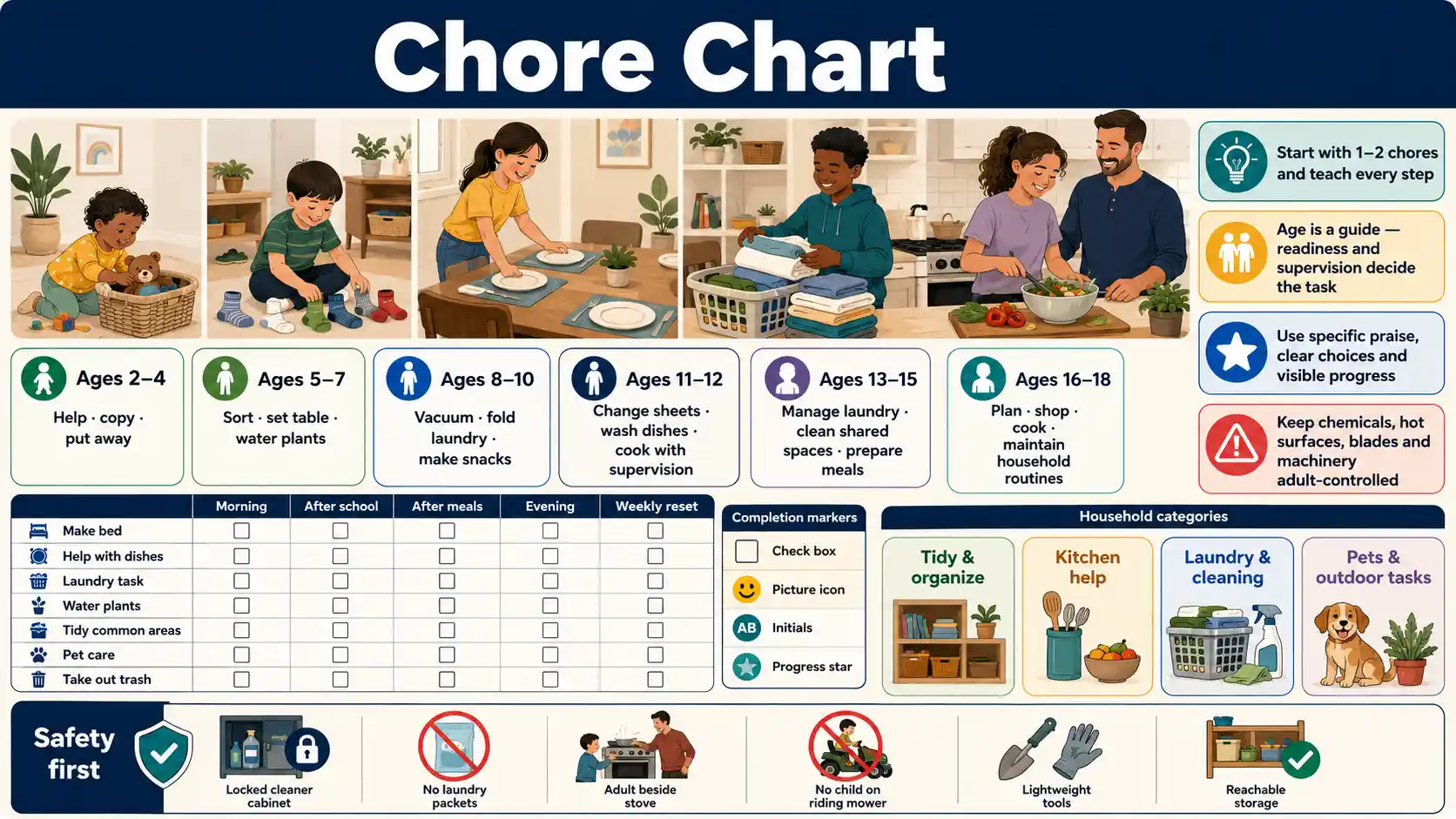
What chores are appropriate for children by age?
Young children can start with simple helper tasks, school-age children can take ownership of regular home routines, and teenagers can practise broader life skills. The best chore is safe, useful, clearly taught, and matched to the child’s current judgment and coordination. The AAP age-appropriate chore guide recommends starting early, introducing tasks gradually, using a visible chart, and praising effort rather than expecting perfection.
Start small
1–2 chores
Teach a short dependable list before adding more tasks or a complicated point system.
Make timing visible
Cue · task · done
Attach each chore to a predictable event and define the finished result in observable terms.
Build belonging
Shared contribution
Children learn responsibility when chores are framed as meaningful help for the household rather than punishment.
Safety first
Readiness beats age
Chemicals, heat, blades, water, heights, animals, and powered equipment require task-specific limits.
Direct answers to common chore-chart questions
When should children start chores?
Toddlers can begin by copying simple one-step tasks such as placing toys in a basket or carrying clothes to a hamper while an adult works beside them.
What chores can a preschooler do?
Preschoolers can put toys away, wipe a low table with water, carry unbreakable items, feed a pet with a premeasured scoop, and help sort laundry.
What chores can a 5-year-old do?
Many 5-year-olds can match socks, clear safe dishes, make a simple bed, water plants, dust reachable surfaces, and reset toys or books.
What chores can an 8-year-old do?
An 8-year-old may be ready to vacuum, fold laundry, prepare a cold snack, load safe dishwasher items, and put groceries on reachable shelves.
What chores can a teenager do?
Teenagers can manage laundry, prepare meals, clean shared spaces, help shop, care for pets, complete trained yard tasks, and assist younger siblings while an adult remains responsible.
How many chores should a child have?
Start with one or two chores and add tasks only after the child can complete the current responsibilities safely and consistently.
How do I make a chore chart?
Give each task an owner, timing cue, clear completion standard, frequency, and simple check box or picture marker.
Should children earn allowance for chores?
Families can treat basic chores as household contribution and reserve payment for optional extra jobs, using one clear and consistent rule.
How should I respond when chores are refused?
Check the task, instruction, timing, fairness, and support level, then simplify the first step and use calm follow-through instead of shame.
Can children use cleaning products?
Only children who can follow the exact label should use an adult-approved product, and cleaners must never be mixed.
Can children handle laundry packets?
No. Children should not handle liquid laundry packets because their concentrated contents can cause serious poisoning and injury.
At what age can a child mow the lawn?
AAP guidance recommends at least age 12 for a walk-behind power mower and age 16 for a ride-on mower, plus maturity, training, protective equipment, and supervision.
Age-Appropriate Chore Chart for Children and Teens
Use age as a starting point, then match each task to the child’s judgment, coordination, reading ability, sensory needs, and supervision level.
Swipe horizontally inside the table to view every column.
| Age or stage | Good starting chores | Skills being practiced | Adult support |
|---|---|---|---|
| 18 months–2 years | Carry a diaper to the bin, place toys in a basket, bring a cup to the counter, copy simple wiping with a dry cloth | Imitation, one-step directions, sorting, participation | Work beside the child and finish the task together |
| 3–4 years | Put toys away, place clothes in a hamper, wipe a low table with water, feed a pet with a premeasured scoop, carry unbreakable items | Following a short sequence, matching, care for shared spaces | Give one instruction at a time and supervise closely |
| 5–7 years | Make the bed, set or clear the table, sort laundry, water plants, dust, sweep small areas, put away groceries on low shelves — Common elementary-age starting chores | Routine, classification, fine-motor control, responsibility | Demonstrate first, use a picture checklist, and inspect together |
| 8–10 years | Vacuum, prepare a simple cold snack, fold and put away laundry, load safe dishwasher items, take out a light trash bag, walk a calm pet with an adult nearby | Planning, organization, tool use, time awareness | Teach safety rules and remain available for help |
| 11–12 years | Change sheets, clean a bathroom with approved products, unload the dishwasher, do laundry, prepare a simple meal with supervision, wash the car | Multi-step work, hygiene, sequencing, problem-solving | Supervise heat, knives, chemicals, machines, and younger siblings — High-risk steps still require supervision |
| 13–15 years | Plan and cook simple meals, clean shared rooms, manage personal laundry, complete yard tasks without powered equipment, help with shopping lists, assist younger siblings while an adult is home | Independent living, prioritization, teamwork, budgeting awareness | Set clear boundaries and check high-risk steps |
| 16–18 years | Manage a full laundry cycle, prepare family meals, grocery shop when legally able, clean kitchen and bathrooms, maintain a vehicle interior, perform trained yard work | Household management, reliability, scheduling, life preparation | Use equipment-specific rules; do not assume age alone proves readiness |
Age bands are examples, not pass-or-fail developmental standards.
- • Introduce one or two reliable chores before adding more. A short list is easier to learn than a crowded chart.
- • Remove any task involving chemicals, blades, heat, electricity, water, heights, heavy lifting, animals, or machinery when the child cannot complete it safely.
Download or export
Build a balanced daily and weekly chore routine
Use a few short daily responsibilities for personal and shared-space resets. Add one or two weekly tasks for deeper cleaning, laundry, meal help, pet care, or outdoor work. Protect sleep, school, meals, play, physical activity, and unstructured time.
Use a visible definition of done
“Clean your room” is vague. “Put clothes in the hamper, books on the shelf, and toys in labeled bins” gives the child a finish line that can be checked without an argument.
Daily and Weekly Chore Schedule Template
A balanced chart combines a few short daily responsibilities with one or two weekly tasks. Assign ownership, timing, and a clear finish standard.
Swipe horizontally inside the table to view every column.
| Frequency | Example task | When it happens | Definition of done | Chart marker |
|---|---|---|---|---|
| Every morning | Make bed or straighten sleep space | After dressing | Pillow and bedding are arranged to the family standard — Make completion standards observable | Check box |
| After meals | Carry dishes and wipe place | Immediately after eating | Dishes reach the agreed location and crumbs are removed | Check box |
| After play | Reset toys, books, or craft supplies | Before the next activity | Items return to labeled homes and the floor is clear | Picture icon |
| Every evening | Place dirty clothes in hamper and prepare school items | Before the bedtime routine | Floor is clear and needed items are ready | Two-step checklist |
| Twice weekly | Water assigned plants or complete pet-care step | Named days | Correct amount is given and spills are cleaned | Day boxes |
| Weekly | Vacuum, dust, change sheets, or clean one zone | Consistent weekend block | The named zone meets the visible checklist | Initials or check |
| As needed | Help unload groceries or reset entryway | After a family event | Items are sorted into safe storage areas | Helper star |
| Monthly | Declutter one drawer, shelf, or clothing category | Scheduled family reset | Keep, donate, and discard groups are resolved | Progress bar |
Choose a chart marker the child can understand and complete independently.
- • A definition of done reduces arguments because the child can see the expected result before starting.
- • Keep school, sleep, meals, physical activity, and downtime protected when assigning chores.
Download or export
Organize chores by room or household zone
Zone-based charts reduce clutter and make ownership visible. Rotate undesirable tasks, compare time and effort rather than task names alone, and keep adult-only hazards out of the child’s assignment.
Room-by-Room Household Chore Chart
Organizing chores by zone makes the chart easier to scan and prevents one child from receiving only undesirable tasks.
Swipe horizontally inside the table to view every column.
| Home zone | Lower-risk tasks | Tasks that need more skill | Keep adults responsible for |
|---|---|---|---|
| Bedroom | Put toys away, place laundry in hamper, arrange books, make bed | Change sheets, organize drawers, vacuum | Moving heavy furniture, high shelves, damaged electrical items |
| Kitchen | Set napkins, carry unbreakable dishes, wipe with water, sort utensils | Load dishwasher, prepare food, clean counters | Raw meat sanitation, hot ovens, sharp knives, strong cleaners, grease — Kitchen heat, blades, and chemicals are high-risk |
| Bathroom | Hang towel, place clothes in hamper, restock toilet paper | Wipe mirror, sweep, clean fixtures with approved product | Medicines, bleach, toilet chemicals, mold treatment, blocked drains |
| Living area | Return books, fold blankets, dust reachable surfaces | Vacuum, clean glass with an approved method, organize media | Heavy electronics, unstable furniture, high windows, electrical repair |
| Laundry | Sort colors, match socks, fold towels, put away clothes | Load machine, measure an approved product, select settings | Laundry packets for children, bleach, machine repair, lifting heavy wet loads — Laundry packets should not be handled by children |
| Entryway | Line up shoes, hang reachable coats, sort mail | Sweep, wipe a low door panel, organize bags | Snow blowers, icy steps, high storage, unknown packages |
| Yard | Collect toys, water plants, pull identified weeds, sweep patio | Rake, garden, wash outdoor furniture | Power tools, pesticides, ladders, fuel, mower use below safety thresholds |
| Pet area | Refill water, measure food, place toys in basket | Brush a calm pet, clean an enclosure with instruction | Aggressive animals, medication, waste from high-risk animals, veterinary care |
Task safety depends on the home, product, animal, equipment, and child.
- • Cleaning products should remain in original labeled containers and locked away unless an adult selects and supervises an age-appropriate product.
- • Do not assign a task solely because another child of the same age can do it.
Download or export
Teach a new chore before expecting independence
A chore is a learned sequence. Show the finished result, divide it into short steps, demonstrate slowly, practise together, and reduce prompts only after the child can complete the task safely.
How to Teach a New Chore Step by Step
Children learn chores as skills. Break the task into observable steps, model it, practise together, and fade support gradually.
Swipe horizontally inside the table to view every column.
| Teaching stage | Adult action | Child action | Move on when |
|---|---|---|---|
| 1. Define | State one task and show the finished result | Looks at the model or picture | The child can point to or describe the goal |
| 2. Break down | Divide the task into 3–6 short steps | Repeats or follows the sequence | The order is understandable |
| 3. Demonstrate | Complete the task slowly while naming each step | Watches and asks questions | The child knows which tools and areas are used |
| 4. Do together | Share the task and prompt only as needed — Shared practice supports learning | Completes selected steps | Most steps are safe with close support |
| 5. Guided practice | Observe and use brief reminders | Completes the full sequence | The task is safe and mostly accurate |
| 6. Independent try | Stay available but do not take over early | Completes the task and checks the result | The child can meet the agreed standard |
| 7. Feedback | Praise effort, name one success, and correct one priority — Feedback should be specific | Adjusts or repeats a step | Feedback leads to improvement rather than shutdown |
| 8. Maintain | Schedule the task and review occasionally | Completes it as part of routine | The task remains safe and reliable over time |
The number of steps should match the child’s language, attention, and working-memory needs.
- • Use pictures, labels, color coding, timers, or written checklists when verbal directions are not enough.
- • Avoid correcting every small detail during early practice; focus first on safety and the main completion standard.
Download or export
Age-based chore chart builder
Create a small starting list from age, household priority, and current support level. The result is a planning aid, not proof that a child can complete a task safely.
Match supervision to the fastest possible hazard
Supervision must be close enough for an adult to intervene before injury. The CPSC childproofing guidance says medicines, detergent, household cleaners, matches, lighters, knives, and other hazards should remain locked and out of reach. Child-resistant packaging is not childproof.
Never mix cleaning products
Do not assign a chore that could lead a child to combine bleach, ammonia, acids, toilet products, or another cleaner. Use one labeled product at a time and follow the exact instructions.
Chore Safety and Supervision Chart
A child can complete a task independently only when the hazards, equipment, environment, and emergency response are within that child’s capability.
Swipe horizontally inside the table to view every column.
| Hazard type | Lower-risk alternative | Supervision level | Do not assign when |
|---|---|---|---|
| Cleaning chemicals | Dry dusting, water-only wiping, or an adult-dispensed mild product | Adult selects product and checks ventilation and label | The child may mix products, taste, spray toward the face, or ignore label directions — Never allow chemical mixing |
| Laundry products | Sort, fold, load clothes, and carry empty baskets | Adult controls concentrated detergent and bleach | The task includes liquid laundry packets or unsecured chemicals |
| Heat and cooking | Wash produce, stir cold ingredients, set the table | Direct adult supervision near ovens, stoves, hot liquids, and sharp tools | The child cannot follow stop, carry, and emergency rules |
| Water | Wipe a small spill or water plants with a light container | Close supervision around buckets, bathtubs, pools, and slippery floors | A young child could be left alone near standing water |
| Electricity | Use manual tools or unplugged appliances for teaching | Adult confirms dry hands, intact cords, and correct operation | Equipment is damaged, wet, hot, powerful, or unfamiliar |
| Heights | Use reachable shelves and floor-level tasks | Adult controls ladders and unstable step stools | The child must climb furniture, lean from a window, or carry items on stairs |
| Heavy or sharp objects | Use lightweight unbreakable items and child-appropriate tools | Adult assesses weight, grip, route, and protective equipment | Dropping or slipping could cause injury |
| Outdoor machinery | Rake, water, sweep, or hand-pull identified weeds | Age, maturity, training, protective gear, and active supervision | The child is under 12 for a walk-behind power mower or under 16 for a ride-on mower — Power mower age minimums |
| Pets and siblings | Feed a calm pet with premeasured food or play beside a younger child | Adult remains responsible and available | The animal is unpredictable or the child is expected to replace adult childcare |
Supervision means an adult can see, hear, and intervene at the speed the hazard requires.
- • Age does not override product labels, local laws, appliance instructions, or the child’s demonstrated readiness.
- • Call local emergency services for serious injury, breathing difficulty, loss of consciousness, major burns, or severe poisoning symptoms.
Download or export
Progress kitchen chores from cold tasks to supervised cooking
Begin with table setting, produce washing, measuring, and cold assembly. Add heat, knives, and appliances only after the child demonstrates handwashing, tool control, food-safety knowledge, and emergency response.
Kitchen Chore Chart by Skill and Risk
Kitchen chores progress from sorting and cold preparation to supervised heat and knife work. Skill and judgment matter more than a birthday alone.
Swipe horizontally inside the table to view every column.
| Task level | Examples | Skills required | Safety boundary |
|---|---|---|---|
| Beginner | Set napkins, carry plastic cups, wipe with water, sort spoons, place fruit in a bowl | One-step directions and safe carrying | Keep away from active cooking and hot liquids |
| Early helper | Rinse produce, tear lettuce, measure dry ingredients, assemble a cold snack | Handwashing, measuring, following 2–3 steps | Adult handles choking hazards, allergens, and sharp packaging |
| Developing | Load safe dishwasher items, make a sandwich, mix batter, use a toaster with permission | Sequence, appliance rules, cleanup | Adult checks knives, heat, cords, and food safety |
| Supervised cook | Use a stovetop or oven, cut soft foods, cook eggs or pasta, reheat food | Heat control, knife technique, timer use, emergency response | Adult remains directly available and approves each tool |
| Independent teen task | Prepare a familiar meal, clean the kitchen, store leftovers, use a food thermometer | Planning, safe temperatures, cross-contamination prevention | Independence follows demonstrated competence, not age alone |
| Never routine child chores | Deep-fry, clean hot grease, handle broken glass, use damaged appliances, mix cleaners | High-risk specialist response | Adult-only task — Adult-only kitchen hazards |
Use the appliance manual and food-safety rules for the exact task.
- • Teach clean, separate, cook, and chill practices whenever a child handles food.
- • Keep pot handles turned inward, hot drinks away from edges, and young children outside the cooking zone.
Download or export
Separate organizing skills from chemical handling
Children can sort, fold, dust, sweep, and put items away long before they are ready to measure detergent or use bathroom cleaners. Liquid laundry packets should not be handled by children.
Cleaning and Laundry Chore Chart
Separate low-risk organizing and fabric tasks from chemical handling, heavy lifting, and machine hazards.
Swipe horizontally inside the table to view every column.
| Task | Good beginner version | Progression | Safety note |
|---|---|---|---|
| Sorting laundry | Match socks or separate lights and darks | Read care labels and create loads | Check pockets for batteries, medication, sharp items, and electronics |
| Folding | Fold washcloths and towels | Fold shirts, pants, and fitted items | Use a stable surface and manageable basket |
| Loading washer | Place dry clothing into an open machine | Select cycle with adult approval | Adult controls detergent until the child can use the exact product safely |
| Detergent | No handling for young children | Older child uses measured conventional detergent under instruction | Children should not handle liquid laundry packets; keep all products locked away — Keep laundry packets away from children |
| Dryer | Remove cool dry items after an adult opens the machine | Clean accessible lint screen and select cycle | No climbing, repair, or handling overheated loads |
| Dusting | Use a dry microfiber cloth on reachable surfaces | Use an adult-approved damp method | Avoid vents, electronics, broken surfaces, and high shelves |
| Floor cleaning | Sweep or use a lightweight vacuum | Mop a small dry-safe area and place a warning marker | Standing water, buckets, cords, and slippery floors require supervision |
| Bathroom cleaning | Restock paper and hang towels | Use one labeled adult-approved product on one fixture | Never mix products; keep medicines and toilet chemicals locked — Never mix cleaning products |
| Trash | Empty a light dry bin | Tie and move an inspected bag | Adults handle glass, sharp metal, chemicals, medical waste, and heavy bags |
The product label determines handling, protective equipment, ventilation, and storage.
- • Do not transfer cleaning products into drink bottles or unlabeled containers.
- • A child who cannot read or reliably follow the product label should not independently use that product.
Download or export
Use extra limits for outdoor work, pets, and sibling help
Weather, traffic, animal behavior, water, machinery, and childcare responsibility can turn a routine chore into a high-risk task. The AAP lawn mower safety guide sets age 12 as the general minimum for a walk-behind power mower and age 16 for a ride-on mower, with readiness, training, and supervision still required.
Outdoor, Pet-Care and Family-Help Chore Chart
These tasks can build confidence, but weather, animals, machinery, traffic, water, and childcare responsibility can increase risk quickly.
Swipe horizontally inside the table to view every column.
| Task area | Age-flexible starting task | Advanced version | Adult remains responsible for |
|---|---|---|---|
| Plants | Water a marked plant with a small container | Plan a watering schedule and prune with approved tools | Chemicals, toxic plants, ladders, and sharp tools |
| Yard | Collect toys, sweep patio, pull identified weeds | Rake, mulch, edge by hand, maintain a garden | Powered equipment, pesticides, fuel, heavy loads, and traffic exposure |
| Lawn mowing | No mower operation | Walk-behind at 12+ or ride-on at 16+ after readiness, training, and supervision — Power mower age thresholds | Younger children must stay far from the mowing area |
| Pet food and water | Use premeasured food and refill a stable water bowl | Track supplies and clean feeding equipment | Diet changes, medication, choking risks, aggressive behavior |
| Pet exercise | Play with a calm pet in a secure area | Walk a trained pet on a safe route | Traffic, large or reactive animals, heat, and bite risk |
| Pet waste | Point out waste or carry sealed supplies | Clean low-risk waste with hygiene instruction | Pregnancy-related risks, exotic animals, sick animals, and contaminated areas |
| Younger siblings | Fetch supplies or play while an adult is present | Help with a routine under direct adult responsibility | Bathing, medication, feeding hazards, transport, and being the sole caregiver — Adults retain childcare responsibility |
| Community help | Sort donations or carry light items | Volunteer in an age-approved setting | Background checks, transportation, tools, and safeguarding rules |
Weather, animal behavior, local laws, and the physical environment can change a task’s risk level.
- • A chore should never place a child in charge of another child’s safety without an appropriate adult plan.
- • Mower thresholds are minimum guidance; maturity, judgment, coordination, protective equipment, and supervision still matter.
Download or export
Use praise, choices, rewards, and allowance carefully
Specific praise tells a child what worked. A check mark makes progress visible. Allowance can teach money skills when the family clearly distinguishes expected contribution from optional paid jobs.
Chore Motivation, Praise and Reward Chart
A chore system works best when expectations are clear, effort is noticed, and rewards support—not replace—family contribution.
Swipe horizontally inside the table to view every column.
| Approach | How to use it | Useful for | Avoid |
|---|---|---|---|
| Specific praise | Name the effort or behavior: “You started without a reminder and put every book away.” — Specific praise is actionable | Building confidence and repetition | Generic praise that gives no information |
| Visual completion mark | Use checks, magnets, pictures, or initials immediately after completion | Children who benefit from concrete progress | Changing the rule after the task is done |
| Natural privilege | Link completed routines to available free time after essential responsibilities | Teaching order and time management | Removing sleep, meals, affection, school needs, or physical activity |
| Allowance | Define which tasks are family contributions and which optional extra jobs can earn money | Money skills and optional work | Paying for every act of basic self-care or kindness |
| Sticker or point system | Set a short goal and a visible exchange rule | Starting a new routine | Large delayed goals that feel unreachable |
| Choice | Let the child choose between two acceptable chores or choose the order | Reducing power struggles | Offering a choice when only one option is actually acceptable |
| Team reset | Complete a timed family cleanup together with assigned zones | Busy households and shared spaces | Turning speed into unsafe rushing |
| Repair after missed chore | Return to the task, simplify it, and solve the barrier | Teaching accountability | Shame, humiliation, excessive work, or unpredictable punishment — Avoid shame and excessive punishment |
Rewards should be affordable, predictable, and proportionate to the family’s values and resources.
- • A child should receive food, shelter, care, affection, education, sleep, and safety regardless of chore performance.
- • Praise effort and skill development rather than perfection.
Download or export
Common chore-chart mistakes
Assigning too many tasks
A crowded chart creates avoidance and makes success hard to see.
Using vague instructions
Replace “clean up” with a short sequence and visible completion standard.
Expecting adult quality
Set a safe age-appropriate standard and teach one correction at a time.
Using chores only as punishment
Regular contribution works better when it is part of family routine.
Ignoring school and sleep
Chores should not displace essential rest, learning, meals, activity, or relationships.
Assuming siblings are identical
Age, strength, attention, sensory needs, language, and experience change readiness.
Rewarding unsafe speed
Do not use races when chemicals, tools, stairs, pets, hot items, or heavy loads are involved.
Making older children substitute parents
Sibling help can be useful, but adults remain responsible for safety and care.
Adapt chores for disability, fatigue, attention, and sensory needs
Equal contribution does not require identical tasks. Use picture steps, seated work, lighter containers, reachable storage, timers, sensory protection, adapted handles, or a different chore of similar value.
Common Chore Problems and Inclusive Adaptations
When a child repeatedly struggles, adjust the task, instruction, timing, environment, or support before concluding that the child is unwilling.
Swipe horizontally inside the table to view every column.
| Problem | Likely barrier | Practical adaptation | When to reconsider the task |
|---|---|---|---|
| Needs constant reminders | The cue is not visible or the routine is not established | Attach the chore to an existing event and use one visual prompt | The child still cannot start after repeated teaching |
| Forgets steps | Working-memory or language load is too high | Use pictures, a numbered card, or one step at a time | Missing a step creates a safety risk |
| Takes too long | Task is too broad, tools are hard to use, or perfection is expected | Set a small zone, provide adapted tools, and define a reasonable finish | The task consistently disrupts sleep, school, meals, or necessary rest |
| Avoids sensory tasks | Texture, smell, noise, temperature, or wetness is distressing | Offer gloves, headphones, a dry alternative, or another chore of equal value — Offer a safe sensory adaptation | Exposure causes pain, panic, breathing symptoms, or shutdown |
| Cannot lift or reach | Task exceeds strength, balance, mobility, or range of motion | Use lighter containers, reachable storage, seated work, or a grab tool | The adaptation still creates fall, strain, or dropping risk |
| Argues about fairness | Workload or desirability is unequal | Rotate disliked tasks, compare time and effort, and keep expectations visible | One child carries adult-level family responsibility |
| Rushes and skips quality | The reward favors speed or the finish standard is unclear | Use a short quality checklist and remove speed competition | Rushing creates chemical, heat, tool, or fall risk — Stop unsafe rushing |
| Refuses after prior success | Fatigue, stress, illness, schedule overload, conflict, or changing needs | Ask what changed, reduce the load temporarily, and restore the routine gradually | There is persistent distress, pain, major functional decline, or a safety concern |
| Different homes use different rules | Expectations and tools change between caregivers | Use a portable checklist with home-specific steps | The child is being asked to mediate adult conflict |
Equal contribution does not require identical tasks.
- • Children with disabilities, chronic illness, pain, fatigue, attention differences, or sensory needs may need adapted tools, timing, or task alternatives.
- • Seek professional support when a new loss of daily-living skills, severe distress, pain, or major functional change appears.
Download or export
Frequently asked questions
What chores can a 3-year-old do?
A 3-year-old can usually help put toys away, place clothes in a hamper, wipe a low table with water, carry unbreakable items, or feed a pet with a premeasured scoop while an adult supervises.
What chores can a 5-year-old do?
Many 5-year-olds can make a simple bed, match socks, clear unbreakable dishes, water plants, dust reachable surfaces, and put toys or books away after instruction and practice.
What chores can an 8-year-old do?
An 8-year-old may be ready to vacuum, fold and put away laundry, prepare a cold snack, load safe dishwasher items, and help put groceries away with clear safety rules.
What chores should a teenager do?
Teenagers can contribute through laundry, meal preparation, kitchen and bathroom cleaning, shopping help, pet care, shared-space maintenance, yard work, and sibling help that does not replace adult childcare.
How many chores should a child have?
Start with one or two dependable chores and add responsibilities only after the child can complete the current tasks safely and consistently.
Should chores be daily or weekly?
Use a few short daily chores for personal and shared-space routines, then add one or two weekly tasks that require more time.
Should children be paid for chores?
Families can separate basic household contributions from optional extra jobs that earn money. The rule should be clear, affordable, and consistent.
How do I make a chore chart work?
Give each chore an owner, timing cue, visible completion standard, and simple marker. Review the chart regularly and teach new tasks before expecting independence.
What should I do when my child refuses chores?
Check whether the task is understood, safe, manageable, fairly assigned, and scheduled at a realistic time. Simplify the first step and use calm follow-through instead of shame.
Can children use cleaning products?
Only an adult-approved product should be used, and the child must be able to follow the exact label and avoid mixing. Medicines, strong cleaners, bleach, and concentrated laundry products should remain locked away.
Can children handle laundry detergent packets?
No. The CPSC advises that children should not handle liquid laundry packets because their concentrated contents can cause serious poisoning and injury.
At what age can a child mow the lawn?
AAP guidance recommends at least age 12 for a walk-behind power mower and at least age 16 for a ride-on mower, plus maturity, coordination, training, protective gear, and supervision.
Can an older child babysit as a chore?
Helping a younger sibling while an adult remains responsible can be a family task. Sole childcare requires a separate readiness assessment, emergency plan, and compliance with local rules.
How can I adapt chores for ADHD or autism?
Use visual steps, short work periods, predictable timing, limited choices, sensory adaptations, and immediate feedback. Match the task to the child rather than assigning by age alone.
How often should chores rotate?
Rotate chores when children have mastered the current tasks or when fairness requires it, but keep enough consistency for each child to build competence.
Are chores supposed to be done perfectly?
No. The standard should be safe, age-appropriate, and clearly defined. Praise effort and improvement while teaching one correction at a time.
Sources
These pediatric, developmental, consumer-safety, and food-safety references support the age examples, teaching methods, routines, safety limits, mower thresholds, chemical-storage rules, and kitchen guidance used on this page.
American Academy of Pediatrics — Age-Appropriate Chores for Children
https://www.healthychildren.org/English/family-life/family-dynamics/communication-discipline/Pages/Chores-and-Responsibility.aspx
Provides age-based household chore examples and recommends clear expectations, visual lists, one new task at a time, and praise for effort.
American Academy of Pediatrics — Household Chores for Teens
https://www.healthychildren.org/English/family-life/family-dynamics/Pages/Household-Chores-for-Adolescents.aspx
Describes teen responsibilities including shared-space cleaning, laundry, meal preparation, pet care, yard work, errands, and sibling help.
Centers for Disease Control and Prevention — Milestones by 4 Years
https://www.cdc.gov/act-early/milestones/4-years.html
Encourages simple chores such as bringing in mail, feeding a pet, or wiping tables to build independence.
Centers for Disease Control and Prevention — Milestones by 5 Years
https://www.cdc.gov/act-early/milestones/5-years.html
Lists simple home chores such as matching socks or clearing the table as a common social and emotional milestone by age 5.
American Academy of Pediatrics — What Is the Best Way to Discipline My Child?
https://www.healthychildren.org/English/family-life/family-dynamics/communication-discipline/Pages/Disciplining-Your-Child.aspx
Supports simple step-by-step directions, age-appropriate chores, praise, choices, and sensible limits.
American Academy of Pediatrics — The Importance of Family Routines
https://www.healthychildren.org/English/family-life/family-dynamics/Pages/The-Importance-of-Family-Routines.aspx
Explains how predictable routines help children know what to expect and make household responsibilities easier to complete consistently.
U.S. Consumer Product Safety Commission — Childproofing Your Home
https://www.cpsc.gov/safety-education/safety-guides/kids-and-babies/Childproofing-Your-Home
Recommends locked storage for medicines, cleaners, detergent, matches, lighters, knives, and other hazards, plus supervision around water and hot surfaces.
U.S. Consumer Product Safety Commission — Poison Prevention Information Center
https://www.cpsc.gov/Safety-Education/Safety-Education-Centers/Poison-Prevention-Information-Center
Advises keeping chemicals and cleaning supplies locked away and not allowing children to handle liquid laundry packets.
American Academy of Pediatrics — Kitchen Safety: 10 Tips for Families With Young Children
https://www.healthychildren.org/English/safety-prevention/at-home/Pages/Kitchen-Safety.aspx
Covers supervision, burn prevention, appliance controls, sharp tools, hot liquids, and safer ways for children to help in the kitchen.
American Academy of Pediatrics — Lawn Mower Safety: Information for Families
https://www.healthychildren.org/English/safety-prevention/at-home/Pages/Lawnmower-Safety.aspx
Recommends age 12 or older for walk-behind power mowers and age 16 or older for ride-on mowers, with maturity, training, and supervision.
U.S. Department of Agriculture — Food Safety Basics
https://www.fsis.usda.gov/food-safety/safe-food-handling-and-preparation/food-safety-basics
Supports clean, separate, cook, and chill practices when children help prepare food or clean kitchen work areas.