Family & Parenting
Child Sleep by Age Chart
Recommended daily sleep from birth through age 18, including naps, bedtime planning, infant safety, common sleep problems, and warning signs.
Sleep ranges describe total opportunity for generally healthy children. They do not diagnose insomnia, sleep apnea, excessive sleepiness, or another disorder. Severe breathing difficulty, blue or gray colour, seizure, confusion, or difficulty waking requires urgent action.
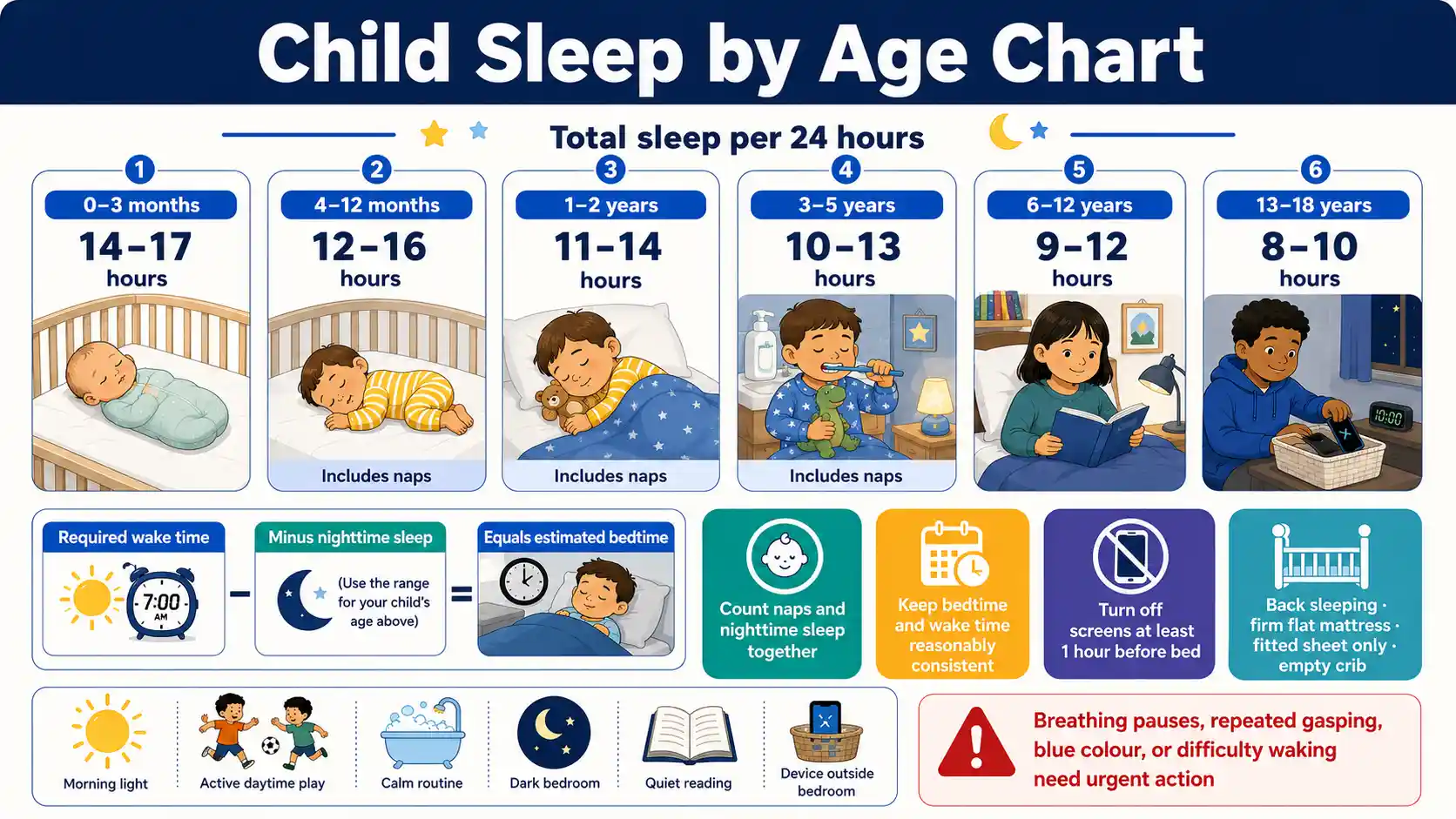
How much sleep does a child need by age?
Sleep need decreases gradually from infancy through adolescence. Newborns generally need 14–17 hours per day. Infants ages 4–12 months need 12–16 hours, toddlers need 11–14 hours, preschoolers need 10–13 hours, school-age children need 9–12 hours, and teenagers need 8–10 hours. The daily total includes naps. The CDC sleep-duration table provides the age ranges used in the primary chart.
Daily total
Count all sleep
Add nighttime sleep and naps across the full 24-hour day before comparing the result with an age range.
Infant safety
Back · firm · flat
Every infant sleep should begin on the back in an empty approved sleep space with a firm, flat surface.
Body-clock anchor
Stable wake time
A reasonably consistent wake time, morning light, and bedtime routine help the sleep schedule remain predictable.
Medical warning
Breathing matters
Frequent snoring, gasping, breathing pauses, unusual sleepiness, or difficulty waking needs medical attention.
Direct answers to common child sleep questions
How much sleep does a newborn need?
Newborns ages 0–3 months generally need 14–17 hours of sleep per 24 hours, divided across day and night.
How much sleep does a 4- to 12-month-old need?
Infants ages 4–12 months should regularly get 12–16 hours of sleep per 24 hours, including naps.
How much sleep does a toddler need?
Children ages 1–2 years should regularly get 11–14 hours per 24 hours, including naps.
How much sleep does a preschooler need?
Children ages 3–5 years should regularly get 10–13 hours per 24 hours, including any nap.
How much sleep does a school-age child need?
Children ages 6–12 years should regularly get 9–12 hours of sleep per 24 hours.
How much sleep does a teenager need?
Teenagers ages 13–18 years should regularly get 8–10 hours of sleep per 24 hours.
Do naps count toward daily sleep?
Yes. Add naps to nighttime sleep when calculating the total amount in 24 hours.
How do I estimate bedtime?
Start with the required wake time, subtract the planned nighttime sleep, and allow additional wind-down time before sleep onset.
When should screens stop before bed?
Turn off screens at least one hour before bedtime and keep devices outside the bedroom when possible.
Is night waking normal for babies?
Yes. Night waking is common in infancy, especially while sleep cycles, feeding patterns, and self-settling skills are developing.
Is loud snoring normal in children?
No. Frequent loud snoring can indicate sleep-disordered breathing and warrants pediatric discussion.
What is the safest infant sleep setup?
Place the baby on the back in an empty crib, bassinet, portable crib, or play yard with a firm, flat mattress and fitted sheet.
Child Sleep Duration Chart by Age
Recommended sleep is the total amount across a 24-hour day. Infant, toddler, and preschool totals include naps.
Swipe horizontally inside the table to view every column.
| Age group | Recommended sleep per 24 hours | Do naps count? | How to interpret the range |
|---|---|---|---|
| Newborn: 0–3 months | 14–17 hours | Yes | Sleep is usually divided into many short periods across day and night. Feeding needs and medical guidance take priority. |
| Infant: 4–12 months | 12–16 hours — AASM infant sleep range | Yes | Total all nighttime sleep and naps. Regular sleep cycles develop gradually. |
| Toddler: 1–2 years | 11–14 hours | Yes | Many toddlers take one or two naps before moving toward one nap. |
| Preschool: 3–5 years | 10–13 hours | Yes | Some children still nap; others meet the total with nighttime sleep alone. |
| School age: 6–12 years | 9–12 hours — AASM school-age sleep range | Usually no planned nap | The schedule should allow enough sleep before the required wake time. |
| Teen: 13–18 years | 8–10 hours — AASM teen sleep range | Usually no planned nap | Puberty often shifts sleep timing later, while school schedules may still require early waking. |
Hours are total sleep in each 24-hour period.
- • These ranges apply to generally healthy children. Individual needs can differ within the range and sometimes outside it under clinical guidance.
- • A newborn who is difficult to wake for feeds, has poor intake, breathing problems, or unusual lethargy needs prompt medical assessment rather than a schedule adjustment.
Download or export
Total sleep means all actual sleep in 24 hours
Add nighttime sleep and naps. Do not count the full time spent in bed when a child lies awake for a long period. One short night does not define a chronic problem, but a repeated pattern below the range can affect alertness, mood, learning, behaviour, and safety. A repeated total above the range may also need review when the child remains sleepy, is difficult to wake, or has a sudden change.
Child Sleep by Age Chart
0–3 months
14–17 hours
Total sleep per 24 hours
4–12 months
12–16 hours
Total sleep per 24 hours
1–2 years
11–14 hours
Total sleep per 24 hours
3–5 years
10–13 hours
Total sleep per 24 hours
6–12 years
9–12 hours
Total sleep per 24 hours
13–18 years
8–10 hours
Total sleep per 24 hours
Daily sleep needs decrease gradually with age.
A regular schedule helps, but individual sleep patterns vary.
Breathing pauses, blue colour, or difficulty waking need urgent action.
Common Nap Patterns by Age
Nap number and timing vary more than total sleep recommendations. Use these patterns as planning context, not fixed developmental deadlines.
Swipe horizontally inside the table to view every column.
| Age | Common daytime pattern | Typical transition | What matters most |
|---|---|---|---|
| 0–3 months | Many short sleep periods | No stable nap schedule is expected | Feed responsively and use safe sleep for every sleep period |
| 4–6 months | Often 3–4 naps | Daytime sleep begins to organize | Watch total sleep and tired cues rather than forcing exact clock times |
| 6–9 months | Often 2–3 naps | The late third nap may shorten | Protect bedtime when a nap is skipped |
| 9–12 months | Often 2 naps | Morning and afternoon naps become more predictable | Avoid dropping to one nap solely because of a few difficult days |
| 12–18 months | Usually 1–2 naps | Many children move toward one midday nap | Use mood, night sleep, and sustained readiness to guide the change |
| 18 months–3 years | Often 1 nap | The nap may gradually shorten | Keep enough total sleep across day and night |
| 3–5 years | Nap varies by child | Many stop regular naps during preschool | An earlier bedtime may replace lost daytime sleep |
| 6 years and older | Routine naps are uncommon | Occasional short nap may follow illness or sleep loss | Frequent daytime sleepiness deserves attention to night sleep and health — Persistent daytime sleepiness needs review |
Nap counts are common patterns, not clinical recommendations.
- • A child can move between patterns during growth spurts, illness, travel, childcare changes, or schedule transitions.
- • Late or long naps can delay bedtime in some children, while removing a needed nap can cause overtiredness and more bedtime difficulty.
Download or export
Plan bedtime backward from the required wake time
Choose a realistic total within the age range. Subtract naps to estimate nighttime sleep, then count backward from the required wake time. Add the usual wind-down and sleep-onset time. The result is a starting window, not a guarantee that sleep begins at one exact minute.
Bedtime Planning Examples by Wake Time
A bedtime window can be estimated by subtracting expected nighttime sleep from the required wake time. These are examples, not prescribed schedules.
Swipe horizontally inside the table to view every column.
| Age example | Required wake time | Example nap total | Example total-sleep target | Estimated bedtime |
|---|---|---|---|---|
| 8-month infant | 7:00 a.m. | 3 hours | 14 hours | About 8:00 p.m. for roughly 11 nighttime hours |
| 18-month toddler | 7:00 a.m. | 2 hours | 13 hours | About 8:00 p.m. for roughly 11 nighttime hours |
| 3-year-old | 7:00 a.m. | 1 hour | 11.5 hours | About 8:30 p.m. for roughly 10.5 nighttime hours |
| 5-year-old without a nap | 7:00 a.m. | 0 hours | 11 hours | About 8:00 p.m. |
| 8-year-old | 6:30 a.m. | 0 hours | 10 hours | About 8:30 p.m. — Example school-age bedtime calculation |
| 12-year-old | 6:30 a.m. | 0 hours | 9.5 hours | About 9:00 p.m. |
| 16-year-old | 6:30 a.m. | 0 hours | 9 hours | About 9:30 p.m. |
Times assume the child falls asleep near the estimated bedtime; time in bed is not always time asleep.
- • Start from the required wake time, choose a total within the age range, subtract naps, and count backward for nighttime sleep.
- • Allow extra wind-down time when a child usually takes longer to fall asleep.
Download or export
Child sleep range and bedtime guide
Compare total sleep with the age range and estimate a bedtime window from wake time and naps. The result is educational and cannot diagnose a sleep disorder.
The bedtime window assumes the entered nap time is actual sleep. Medical conditions, medicines, shift-work households, anxiety, neurodevelopmental differences, and puberty can change the plan.
Safe infant sleep takes priority over longer sleep
Place every infant on the back on a firm, flat, non-inclined surface in an approved crib, bassinet, portable crib, or play yard. Use only a fitted sheet. Keep pillows, blankets, bumpers, positioners, and toys out. Room share without bed sharing, ideally for at least the first 6 months. Review the full AAP safe-sleep guidance.
Safe Infant Sleep Checklist
Safe-sleep practices apply to every nap and nighttime sleep during infancy, even when a baby sleeps poorly or is congested.
Swipe horizontally inside the table to view every column.
| Sleep element | Safer practice | Avoid | Why it matters |
|---|---|---|---|
| Position | Place the baby on the back for every sleep — Back sleeping is recommended | Starting sleep on the side or stomach | Back sleeping lowers the risk of sleep-related infant death |
| Surface | Use a firm, flat, non-inclined mattress in an approved sleep space | Sofas, armchairs, cushions, nests, loungers, or inclined products — Unsafe sleep surfaces | Soft and angled surfaces can obstruct breathing or cause entrapment |
| Sleep space | Use the baby’s own crib, bassinet, portable crib, or play yard | Bed sharing or sleeping with another person | Room sharing is safer than surface sharing |
| Room location | Keep the infant sleep area in the caregiver’s room, ideally for at least 6 months | Moving the baby to an unsafe adult surface for convenience | Room sharing supports supervision without bed-sharing hazards |
| Bedding | Use only a fitted sheet | Pillows, blankets, bumpers, quilts, positioners, and soft toys — Keep infant sleep area empty | An empty sleep area reduces suffocation and entrapment hazards |
| Temperature | Dress the baby appropriately and keep the head uncovered | Overheating, hats indoors during sleep, or heavy layers | Sweating or a hot chest can signal overheating |
| Swaddling | Place a swaddled baby on the back and stop when rolling attempts begin | Weighted swaddles or swaddling after rolling attempts | Rolling while swaddled can make repositioning difficult |
| Sitting devices | Move a sleeping baby from a car seat, swing, stroller, or carrier to a firm flat surface as soon as practical | Using sitting devices as routine sleep spaces outside travel | The head can fall forward or sideways and compromise the airway |
Infant safe-sleep guidance applies through the first year unless the child’s medical team provides specific instructions.
- • Once a baby can roll both ways independently, continue placing the baby on the back but do not repeatedly reposition a baby who rolls during sleep.
- • Do not use wedges or incline the mattress for reflux unless a specialist directs a medically supervised alternative.
Download or export
A short predictable bedtime routine works better than a complicated ritual
Repeat the same calm sequence most nights. Dim lights, finish hygiene, read or talk quietly, and use one clear final goodnight step. Turn off screens at least one hour before bedtime. A routine should reduce stimulation and conflict, not become an hour of repeated negotiations.
Bedtime Routine Chart by Age
A short, predictable sequence helps children shift from daytime activity to sleep. Keep the order consistent while adjusting the steps for age.
Swipe horizontally inside the table to view every column.
| Age | Routine length | Useful sequence | Keep consistent |
|---|---|---|---|
| Infant | About 15–30 minutes | Feed, quiet interaction, diaper, sleep clothing, short song or book, safe sleep space | Calm cues and safe sleep; feeding may still occur overnight |
| Toddler | About 20–30 minutes | Wash, pajamas, brush teeth, two books, cuddle, lights out | Clear limit on extra requests and the same final step |
| Preschool | About 20–40 minutes | Toilet, wash, pajamas, brush teeth, choose books, brief talk, goodnight | Visual routine and predictable return for reassurance |
| School age | About 30–45 minutes | Prepare for morning, hygiene, read, quiet conversation, lights out | Devices outside the bedroom and a stable wake time — Keep devices outside the bedroom |
| Teen | About 30–60 minutes | Finish tasks, dim lights, hygiene, low-stimulation activity, devices away | Enough protected sleep opportunity before school wake time |
Routine length excludes time spent repeatedly delaying bedtime.
- • Turn off screens at least 60 minutes before bedtime when possible.
- • A routine should be calm and repeatable; it does not need special products or a long checklist.
Download or export
Light, activity, screens, caffeine, and wake time shape sleep
Use morning light and daytime activity to strengthen the body clock. Keep the bedroom dark, quiet, and comfortably cool. Charge devices outside the bedroom. Avoid late caffeine. Maintain a reasonably stable wake time, because repeatedly sleeping far later on weekends can shift bedtime later again.
Healthy Sleep Environment and Daytime Habits
Sleep timing is shaped by light, activity, food and drink, the bedroom, and the consistency of the daily schedule.
Swipe horizontally inside the table to view every column.
| Factor | Helpful approach | Common disruptor | Practical adjustment |
|---|---|---|---|
| Morning light | Get outdoor or bright morning light | Dim mornings and bright late-night light | Open curtains and spend time outside after waking |
| Daily activity | Use active play and exercise during the day | Heavy exercise immediately before bed | Finish vigorous activity earlier and use gentle wind-down movement |
| Bedroom light | Keep the room dark or use a dim night-light if needed | Bright ceiling lights or glowing devices | Dim lights during the routine and cover unnecessary indicators |
| Noise | Use a quiet, steady environment | Television, alerts, or changing household noise | Silence notifications and use consistent low background sound if helpful |
| Temperature | Use a comfortably cool room and suitable sleep clothing | Overheating or large temperature swings | Adjust layers rather than adding unsafe infant bedding |
| Screens | Keep devices out of the bedroom and stop use before bed | Autoplay, social alerts, gaming, or videos at lights-out — Screens can delay sleep | Charge devices outside the bedroom and set a family cutoff |
| Caffeine | Avoid caffeine in young children and limit it in older children | Coffee, tea, cola, energy drinks, chocolate, or some medicines late in the day | Check labels and avoid caffeine for at least several hours before bed |
| Wake time | Keep wake time reasonably consistent, including weekends — Consistent wake time supports timing | Large weekend sleep-ins that shift the body clock | Use modest weekend differences and morning light |
The safest infant environment remains a firm, flat, empty sleep space even when other room adjustments are used.
- • Sleep hygiene supports sleep but does not rule out pain, breathing disorders, anxiety, medication effects, restless legs, or another medical cause.
Download or export
Sleep problems are defined by patterns and daytime impact
Bedtime resistance, night waking, early waking, nightmares, night terrors, sleepwalking, bedwetting, snoring, and daytime sleepiness have different causes and first steps. Record frequency, timing, breathing, unusual movements, pain, medicines, naps, and daytime effects instead of relying on one difficult night.
Common Child Sleep Problems and First Steps
The pattern, frequency, duration, daytime effect, and breathing symptoms determine whether a sleep problem needs routine changes or medical review.
Swipe horizontally inside the table to view every column.
| Sleep concern | Common pattern | First step | When to seek help |
|---|---|---|---|
| Bedtime resistance | Stalling, repeated requests, leaving bed | Use a short predictable routine and calm consistent limits | Persistent severe conflict, anxiety, or major family impairment |
| Difficulty falling asleep | Long sleep onset despite adequate opportunity | Review naps, wake time, screens, caffeine, light, and stress | Problem lasts for weeks or causes daytime impairment |
| Night waking | Child wakes and needs help returning to sleep | Respond calmly and consistently; check schedule and sleep associations | Pain, breathing difficulty, unusual movements, or frequent prolonged waking |
| Early waking | Wakes much earlier than desired | Check bedtime, light exposure, room noise, and total sleep | Persistent short sleep or marked daytime sleepiness |
| Nightmares | Child wakes frightened and remembers a dream | Offer reassurance and reduce frightening content | Frequent distress, trauma symptoms, or major sleep avoidance |
| Night terrors | Sudden screaming or distress early in the night with little recall | Keep the environment safe and avoid forceful waking | Events are frequent, dangerous, unusual, or occur with seizure concern |
| Sleepwalking | Child walks while not fully awake | Lock hazards, clear stairs, and guide back gently | Injury risk, leaving the home, frequent events, or unusual movements |
| Frequent snoring | Loud breathing on many nights | Record frequency and associated gasping or pauses | Discuss promptly because sleep-disordered breathing may be present — Frequent snoring needs medical discussion |
| Daytime sleepiness | Falling asleep in class, car rides, or activities | Review actual sleep opportunity and schedule | Persistent sleepiness, attention change, or safety risk — Persistent daytime sleepiness needs review |
| Bedwetting after age 5 | Nighttime wetting after expected toilet-learning age | Use neutral support and protect sleep and dignity | New onset, pain, thirst, constipation, snoring, or daytime symptoms |
A sleep diary can record bedtime, estimated sleep onset, waking, naps, symptoms, and daytime effects for 1–2 weeks.
- • Do not punish a child for insomnia, nightmares, sleepwalking, night terrors, snoring, or bedwetting.
- • Frequent snoring is not simply a harmless habit when it occurs with gasping, breathing pauses, restless sleep, daytime sleepiness, or behaviour change.
Download or export
Shift the whole schedule in small steps
Move wake time, meals, naps, light, routine, and bedtime together. Ten- to fifteen-minute changes every few days are easier to sustain than a sudden one-hour shift. Morning light and a stable wake time usually matter more than repeatedly forcing an earlier bedtime when the child is not sleepy.
How to Shift a Child’s Sleep Schedule
Small, repeated shifts usually work better than a sudden large bedtime change. Protect the wake time and morning light while adjusting the evening.
Swipe horizontally inside the table to view every column.
| Situation | Suggested pace | What to shift | What to avoid |
|---|---|---|---|
| Starting school or childcare | Move 10–15 minutes every 1–3 days — Use small schedule shifts | Wake time, meals, nap, routine, and bedtime together | Changing only bedtime while wake time stays late |
| Daylight-saving change | Begin several days before when possible | Light exposure and the whole routine in small steps | Expecting the body clock to reset in one night |
| Travel across time zones | Use destination morning light and local meals | Wake, meals, naps, activity, and bedtime | Long late naps that lock in the previous time zone |
| After illness | Return gradually as energy improves | Wake time first, then naps and bedtime | Removing needed recovery sleep too quickly |
| Dropping a nap | Test over 1–2 weeks | Shorten or move the nap before removing it | Dropping after only one or two difficult nap days |
| Teen schedule delay | Advance gradually and stabilize wake time | Morning light, evening device cutoff, and bedtime | Large weekend sleep-ins that repeatedly reset the clock |
Shift size is a practical starting point, not a medical rule.
- • A child who cannot adapt despite adequate opportunity may need assessment for insomnia, circadian delay, anxiety, medication effects, or another condition.
Download or export
Common child sleep chart mistakes
Counting time in bed as sleep
Record estimated sleep onset and waking. A child can spend 10 hours in bed but sleep much less.
Ignoring naps
Naps are part of the 24-hour total and can change the amount of nighttime sleep needed.
Using age as an exact bedtime
Age gives a duration range. Required wake time, naps, and sleep onset determine the bedtime window.
Dropping a nap after a few refusals
Temporary nap resistance does not always mean the child is ready to stop napping.
Letting weekends reset the schedule
Large sleep-ins can delay the body clock and make the next school night harder.
Treating frequent snoring as harmless
Frequent loud snoring can signal obstructed breathing and should be discussed with a clinician.
Using melatonin before finding the cause
Address sleep opportunity, routines, screens, breathing, pain, anxiety, and medicines first with pediatric guidance.
Using unsafe products to extend infant sleep
Weighted sleep products, inclines, loungers, pillows, and loose bedding do not make infant sleep safer.
Health, development, medicines, and family routines can change the sleep plan
Children with sensory differences, ADHD, anxiety, trauma, pain, reflux, eczema, asthma, seizures, medication effects, or complex medical needs may require individualized assessment. Preserve adequate sleep opportunity and safe infant sleep while adapting routines to communication, culture, shared-care homes, and family work schedules.
Special Sleep Contexts and Useful Questions
Sleep recommendations remain useful, but the cause and solution may differ when health, development, medication, culture, or family schedules affect sleep.
Swipe horizontally inside the table to view every column.
| Context | Possible sleep effect | Useful questions | Possible support |
|---|---|---|---|
| Prematurity or medical complexity | Different feeding, breathing, comfort, or monitoring needs | Has the medical team given a specific sleep or feeding plan? | Follow individualized safe-sleep and medical instructions |
| Autism or sensory differences | Sensitivity to light, sound, texture, transitions, or routine change | Which sensory and communication supports reduce arousal? | Visual routine, gradual changes, and clinician review of persistent insomnia |
| ADHD | Delayed sleep onset, inconsistent timing, restless sleep, medication effects | Is sleep loss worsening attention, or is medication timing relevant? | Review schedule, breathing, restless legs, and medicines with the prescriber |
| Anxiety or trauma | Fear, checking, nightmares, or difficulty separating | What thought, event, or trigger appears before sleep? | Predictable reassurance and mental-health support when persistent |
| Chronic pain, reflux, eczema, asthma, or seizures | Waking, discomfort, cough, itch, or unusual events | Are symptoms controlled and are events documented? | Medical treatment of the underlying condition — Treat underlying medical symptoms |
| Medication or supplement use | Sedation, alertness, nightmares, or schedule change | Did sleep change after a dose or timing change? | Ask the prescriber or pharmacist before changing treatment — Do not change medicine without advice |
| Shift-work or shared-care households | Different bedtime cues and inconsistent wake times | Which anchors can remain the same in every home? | Keep the same sequence, comfort object when age-safe, and core wake window |
| Cultural or religious routines | Later meals, shared rooms, seasonal schedule changes | Can the total sleep opportunity and safety needs still be met? | Adapt timing while preserving age-appropriate duration and infant safety |
Personalized plans should preserve safe infant sleep and adequate total sleep while respecting family context.
- • Do not stop or alter a prescribed medicine solely because sleep changed. Contact the prescriber.
- • Melatonin should not replace evaluation of a breathing disorder, restless legs, pain, anxiety, medication effect, or inadequate sleep opportunity.
Download or export
Child Sleep Warning Signs and Next Actions
Breathing, alertness, safety, and sudden change determine urgency. A sleep-duration chart cannot rule out a sleep or medical disorder.
Swipe horizontally inside the table to view every column.
| Warning sign | Why it matters | Next action |
|---|---|---|
| Blue, gray, or very pale colour; severe breathing struggle; or child is difficult to wake | May signal inadequate oxygen or another emergency | Use emergency services now — Emergency action |
| Breathing pauses, repeated gasping, choking, or marked chest pulling during sleep | May indicate obstructed breathing or another respiratory problem | Seek urgent medical assessment; use emergency care if severe or ongoing — Urgent breathing assessment |
| Frequent loud snoring | Can be a sign of sleep-disordered breathing | Arrange pediatric review, especially with pauses, restless sleep, headaches, or daytime problems |
| New extreme sleepiness, confusion, weakness, seizure, or unusual unresponsiveness | May reflect an acute neurologic, metabolic, toxic, or infectious problem | Seek urgent or emergency care based on severity |
| Infant sleeping on a sofa, armchair, soft surface, incline, or with loose bedding | Raises suffocation, entrapment, and sleep-related death risk | Move the infant to a firm, flat, empty approved sleep space on the back — Move infant to safe sleep space |
| Falling asleep at school, during meals, or in unsafe situations | Suggests inadequate or poor-quality sleep and creates injury risk | Promptly review sleep opportunity and arrange medical assessment |
| Insomnia or night waking lasting weeks with daytime impairment | Persistent problems may need structured behavioural or medical evaluation | Discuss with the child’s clinician and bring a sleep diary |
| Pain, persistent cough, itch, reflux, frequent urination, or thirst disrupting sleep | An underlying condition may be driving the waking | Arrange medical assessment rather than treating only the schedule |
| Dangerous sleepwalking or leaving the home | Creates immediate injury risk | Secure hazards now and seek clinical guidance |
| Caregiver exhaustion creates a risk of falling asleep with an infant on a sofa or chair | Sofa and armchair sleep with an infant is especially hazardous | Place the infant in the safe sleep space and seek another alert adult or support |
Local emergency numbers and care pathways vary by country.
- • Trust a caregiver’s observation of breathing or alertness changes, even when the child appears better by the time of an appointment.
- • Record videos only when it is safe to do so; never delay emergency action to record an event.
Download or export
Frequently asked questions
How much sleep does a newborn need?
Newborns ages 0–3 months generally need 14–17 hours of sleep per 24 hours, usually divided into many short periods.
How much sleep does a 4- to 12-month-old need?
Infants ages 4–12 months should regularly get 12–16 hours of sleep per 24 hours, including naps.
How much sleep does a 1- to 2-year-old need?
Toddlers ages 1–2 years should regularly get 11–14 hours of sleep per 24 hours, including naps.
How much sleep does a 3- to 5-year-old need?
Preschool children ages 3–5 years should regularly get 10–13 hours per 24 hours, including any nap.
How much sleep does a school-age child need?
Children ages 6–12 years should regularly get 9–12 hours of sleep per 24 hours.
How much sleep does a teenager need?
Teenagers ages 13–18 years should regularly get 8–10 hours of sleep per 24 hours.
Do naps count toward a child’s daily sleep?
Yes. Naps count toward the 24-hour total, especially for infants, toddlers, and preschool children.
How do I calculate a child’s bedtime?
Start with the required wake time, subtract the needed nighttime sleep, and account for daytime naps and usual time to fall asleep.
Should a child have the same bedtime every night?
A reasonably consistent bedtime and wake time support the body clock, although small adjustments for family life are normal.
When should screens stop before bedtime?
The AAP recommends turning off screens at least one hour before bedtime and keeping devices out of the bedroom.
Is it normal for babies to wake during the night?
Yes. Night waking is common in infancy; the pattern, feeding needs, ability to settle, growth, and breathing determine whether it needs review.
Is frequent snoring normal in children?
No. Frequent loud snoring can signal sleep-disordered breathing and should be discussed with a pediatric clinician.
When can a baby sleep on the stomach?
Place every infant on the back to start sleep. A baby who independently rolls both ways may remain in the position they reach on a firm, flat, empty sleep surface.
When should swaddling stop?
Stop swaddling as soon as a baby shows signs of trying to roll, and never use weighted swaddles.
Can I give my child melatonin for sleep?
Discuss melatonin with the child’s pediatrician first and address schedule, screens, breathing, pain, anxiety, and other causes rather than using it as a routine shortcut.
What sleep symptoms need urgent help?
Blue or gray colour, severe breathing struggle, repeated gasping, prolonged breathing pauses, seizure, confusion, or difficulty waking require urgent or emergency assessment.
Sources
These primary and professional references support the sleep-duration ranges, nap context, bedtime habits, infant safe-sleep practices, melatonin cautions, and warning signs used on this page. Frequent snoring, breathing problems during sleep, daytime sleepiness, attention difficulty, and behaviour change are among the signs described in the AAP childhood sleep-apnea guide.
Centers for Disease Control and Prevention — About Sleep
https://www.cdc.gov/sleep/about/index.html
Lists recommended daily sleep by age, including newborn, infant, toddler, preschool, school-age, and teen ranges.
American Academy of Sleep Medicine — Recommended Amount of Sleep for Pediatric Populations
https://jcsm.aasm.org/doi/10.5664/jcsm.5866
Provides consensus recommendations for healthy children from 4 months through 18 years, with naps included for younger age groups.
American Academy of Pediatrics — Sleep: How Many Hours Does Your Child Need?
https://www.healthychildren.org/English/healthy-living/sleep/Pages/healthy-sleep-habits-how-many-hours-does-your-child-need.aspx
Explains age-based sleep needs, regular routines, screen-free time before bed, and common childhood sleep problems.
American Academy of Pediatrics — Sleep in Babies
https://www.healthychildren.org/English/ages-stages/baby/sleep/Pages/default.aspx
Describes fragmented newborn sleep, developing sleep cycles, normal night waking, and variation among infants.
American Academy of Pediatrics — How to Keep Your Sleeping Baby Safe
https://www.healthychildren.org/English/ages-stages/baby/sleep/Pages/a-parents-guide-to-safe-sleep.aspx
Supports back sleeping, a firm flat surface, an empty infant sleep area, room sharing without bed sharing, and avoidance of unsafe sleep products.
Centers for Disease Control and Prevention — Providing Care for Babies to Sleep Safely
https://www.cdc.gov/sudden-infant-death/sleep-safely/index.html
Summarizes safe infant sleep position, surface, room-sharing, bedding, and overheating guidance.
American Academy of Pediatrics — Sleep Apnea in Children: Detection and Treatment
https://www.healthychildren.org/English/ages-stages/baby/sleep/Pages/Sleep-Apnea-Detection.aspx
Lists frequent snoring, breathing problems, daytime sleepiness, attention difficulty, and behaviour concerns as possible sleep-apnea signs.
American Academy of Pediatrics — Melatonin for Kids: What Parents Should Know
https://www.healthychildren.org/English/healthy-living/sleep/Pages/melatonin-and-childrens-sleep.aspx
Advises discussing melatonin with a pediatrician and addressing sleep habits before treating it as a routine bedtime aid.
Centers for Disease Control and Prevention — Short Sleep Duration Among Infants, Children, and Adolescents
https://www.cdc.gov/mmwr/volumes/70/wr/mm7038a1.htm
Reports that short sleep was less common among children with a regular bedtime than among those without one.
American Academy of Pediatrics — The Importance of Family Routines
https://www.healthychildren.org/English/family-life/family-dynamics/Pages/The-Importance-of-Family-Routines.aspx
Supports calm and predictable nighttime rituals such as reading, conversation, songs, and avoiding exciting activity before bed.