Family & Parenting
Child Development Milestone Chart
Selected social, language, cognitive, movement, self-care, and preschool milestones from 2 months through 5 years, with screening and act-early guidance.
This chart supports developmental monitoring. It does not diagnose delay, autism, language disorder, learning disability, or motor disorder. Act promptly when a child loses a skill or when a parent, caregiver, teacher, or clinician remains concerned.
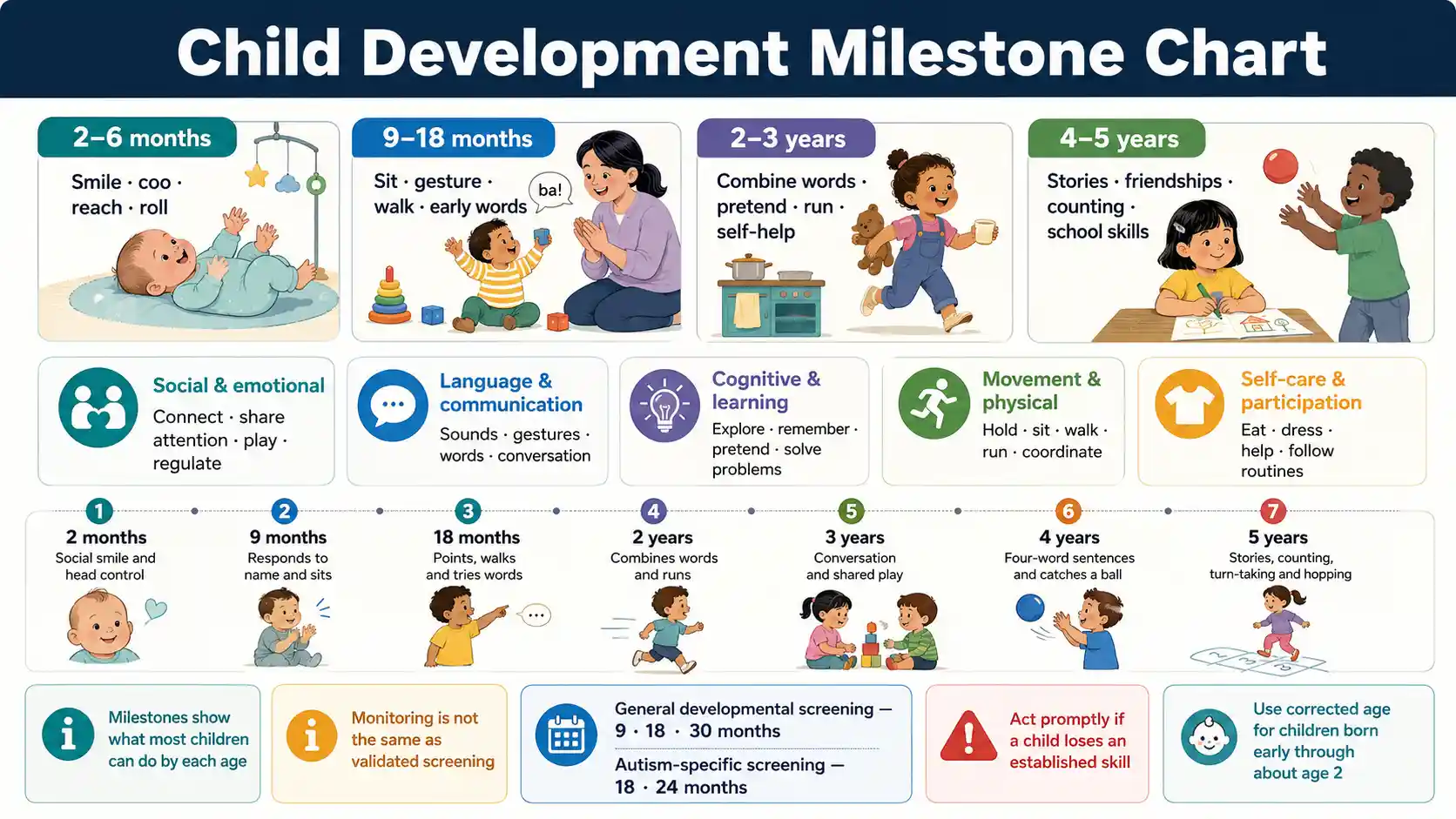
What does a child development milestone chart show?
A child development milestone chart shows selected skills that most children can do by specific ages. Children reach milestones in how they play, learn, speak, act, move, and participate in daily routines. CDC checklists cover 2 months through 5 years and define “most children” as at least 75%. The chart is a monitoring reference, not a pass-or-fail test. The complete current CDC checklist is available through the CDC developmental milestones resource.
Chart meaning
75% or more
CDC milestones describe skills most children can do by the listed age; they are not the earliest possible ages.
Development areas
Connected domains
Social, language, cognitive, movement, physical, and self-care development should be interpreted together.
Routine screening
9 · 18 · 30 months
General developmental screening is recommended at these ages, with autism-specific screening at 18 and 24 months.
Act-early rule
Do not wait
Loss of an established skill, persistent concern, or lack of progress warrants prompt discussion and possible screening.
Direct answers to common child development questions
What is a child development milestone?
A child development milestone is a social, communication, thinking, movement, or self-care skill that most children can do by a certain age.
What percentage of children meet a CDC milestone by the listed age?
CDC milestone checklists use skills that at least 75% of children can do by that age.
When should a baby respond to their name?
Responding to their name is a CDC milestone by 9 months.
When do toddlers combine two words?
Saying at least two words together, such as “more milk,” is a CDC milestone by 2 years.
How many words are expected around 30 months?
CDC lists saying about 50 words as a milestone by 30 months, while total communication across all languages should be counted.
When should speech be understandable most of the time?
Talking well enough for other people to understand most of the time is a CDC milestone by 3 years.
When do children use four-word sentences?
Saying sentences with four or more words is a CDC milestone by 4 years.
How long should a 5-year-old attend to an activity?
Paying attention for 5 to 10 minutes during story time, crafts, or another non-screen activity is a CDC milestone by 5 years.
Is a milestone checklist a developmental test?
No. A milestone checklist supports monitoring, while formal screening uses a standardized, validated tool.
When is general developmental screening recommended?
General developmental screening is recommended at 9, 18, and 30 months and whenever a concern arises.
Does multilingual exposure cause language delay?
No. Multilingual exposure does not cause language disorder; count communication across all languages and communication systems.
What is the most important developmental warning sign?
Loss of a previously acquired skill needs prompt medical discussion, even when other development appears typical.
Child Development Milestone Chart from 2 Months to 5 Years
Selected CDC milestone examples show broad progression across connected developmental domains. Use the complete checklist for the child’s age.
Swipe horizontally inside the table to view every column.
| Age | Social and emotional | Language and communication | Cognitive and learning | Movement, physical, and self-care |
|---|---|---|---|---|
| 2 months | Calms with voice or touch; looks at faces; smiles responsively | Makes sounds besides crying; reacts to loud sounds | Watches a caregiver move; looks at a toy briefly | Holds head up on tummy; moves both arms and legs; briefly opens hands |
| 4 months | Smiles to gain attention; chuckles; seeks interaction | Coos; answers sounds; turns toward a familiar voice | Opens mouth for feeding when hungry; studies hands | Holds head steady; holds and swings at toys; pushes onto forearms |
| 6 months | Recognizes familiar people; laughs; enjoys mirrors | Takes turns making sounds; squeals; blows raspberries | Mouths objects; reaches for wanted toys; signals fullness | Rolls tummy to back; pushes up on straight arms; supports sitting with hands |
| 9 months | Responds to name; shows varied expressions; enjoys peek-a-boo — Name response is an important observation | Babbles repeated sounds; lifts arms to be picked up | Looks for dropped objects; bangs objects together | Gets into sitting; transfers objects; rakes food; sits without support |
| 12 months | Plays simple social games | Waves; uses a parent name; briefly understands “no” | Puts objects in containers; searches for hidden objects | Pulls to stand; cruises; uses pincer grasp; drinks from an open cup with help |
| 15 months | Copies other children; shows affection; points for help | Tries one or two words besides parent names; follows a direction with gesture and words | Uses familiar objects appropriately; stacks two small objects | Takes a few independent steps; finger-feeds |
| 18 months | Checks caregiver proximity; points to share interest; helps with dressing | Tries at least three words besides parent names; follows one-step directions without gestures | Copies simple chores; uses toys purposefully | Walks independently; scribbles; uses fingers and tries spoon and open cup |
| 24 months | Notices when others are hurt; checks a caregiver’s reaction | Combines at least two words; points to body parts and book pictures; uses varied gestures — Two-word combinations by 2 years | Uses one hand while the other manipulates; operates toy controls; combines toys in play | Runs; kicks a ball; walks up a few steps; eats with a spoon |
| 30 months | Plays beside and sometimes with children; follows simple routines | Says about 50 words; combines words with an action; uses I, me, or we | Pretends; solves simple problems; follows two-step directions; knows at least one colour | Twists lids or knobs; removes some clothes; jumps with both feet; turns pages singly |
| 3 years | Calms after separation; notices and joins other children | Uses at least two back-and-forth exchanges; asks questions; says first name; is understood most of the time | Draws a circle after demonstration; avoids a warned hot object | Strings large items; puts on some clothes; uses a fork |
| 4 years | Pretends roles; seeks peer play; comforts others; adjusts behaviour to setting | Uses sentences with four or more words; tells about the day; answers simple function questions — Four-word sentences by 4 years | Names colours; predicts a familiar story; draws a person with three or more body parts | Catches a large ball; pours with supervision; unbuttons; holds pencil with fingers and thumb |
| 5 years | Follows rules or takes turns; performs for others; does simple chores | Tells a story with at least two events; answers story questions; sustains conversation; recognizes rhymes | Counts to 10; names some numerals and letters; uses time words; attends 5–10 minutes; writes some name letters — Attention during non-screen activities | Buttons some buttons; hops on one foot |
Age is chronological age unless corrected age is appropriate before 24 months.
- • CDC milestones describe skills most children, defined as at least 75%, can do by the listed age.
- • A milestone chart supports monitoring and does not replace a standardized, validated developmental screen.
- • Skill loss, persistent caregiver concern, or lack of progress across domains warrants prompt discussion regardless of age.
Download or export
Developmental domains overlap in everyday activities
A child uses several developmental systems at once. Pointing at a picture combines social attention, communication, visual access, memory, and hand control. Dressing combines motor planning, balance, problem-solving, sensory tolerance, and understanding. Review patterns across domains rather than using one motor or language item as the whole picture.
Child Development Milestone Chart
2–6 months
Smile · coo · reach · roll
9–18 months
Sit · gesture · walk · early words
2–3 years
Combine words · pretend · run · self-help
4–5 years
Stories · friendships · counting · school skills
Milestones describe skills most children can do by an age.
Monitoring is not the same as validated screening.
Act promptly after skill loss or persistent concern.
Communication includes understanding, gestures, speech, signs, AAC, and every language
Count meaningful communication across all languages and systems. Multilingual exposure does not cause language disorder. Hearing access, interaction opportunity, motor speech, understanding, and functional participation all shape interpretation.
Language and Communication Milestones
Communication includes looking, listening, gestures, sounds, understanding, speech, conversation, storytelling, and communication across all languages or systems.
Swipe horizontally inside the table to view every column.
| Age | Expressive example | Understanding or interaction | Count across languages | Discuss sooner when |
|---|---|---|---|---|
| 2 months | Makes sounds besides crying | Reacts to loud sound and caregiver voice | All vocal communication counts | There is no sound response or voice reaction |
| 6 months | Takes turns making sounds | Listens and responds during vocal play | Count communication in every home language | Vocalization or response is absent or declining |
| 9 months | Babbles repeated sounds | Responds to name and lifts arms to be picked up | Gestures and signs are meaningful communication | Name response, babbling, or gestures are consistently absent |
| 18 months | Tries at least three words besides parent names | Follows a one-step direction without a gesture | Combine meaningful words across languages | Words, gestures, or understanding are not progressing |
| 2 years | Says at least two words together — Two-word combination milestone | Points to named body parts or pictures | A word in either language counts once | No two-word combinations or limited understanding needs discussion |
| 30 months | Uses about 50 words and action-word combinations — About 50 words by 30 months | Names book pictures and follows two-step directions | Total vocabulary across languages matters more than one-language count | Vocabulary, combinations, or comprehension remain limited |
| 3 years | Uses back-and-forth conversation and asks questions | Speech is understood most of the time | Multilingual speech clarity can vary by listener and language | Conversation, understanding, or intelligibility causes daily difficulty |
| 4 years | Uses four-word sentences and tells about the day | Answers what common objects are for | Observe narrative skills in the strongest language | The child cannot communicate needs or is losing language |
| 5 years | Tells a two-event story and sustains conversation | Answers story questions and uses or recognizes rhymes | Speech, signs, AAC, and all languages support communication | The child cannot sustain age-expected communication or participation |
- • Multilingual exposure does not cause language disorder. Assess total communication across languages and contexts.
- • Hearing access should be reviewed when speech, language, or response-to-sound concerns arise.
Download or export
Cognitive development appears through attention, exploration, memory, pretend play, and early concepts
Learning is visible in how a child searches, imitates, solves problems, remembers sequences, uses symbols, counts, and talks about stories. Opportunity and familiarity affect what a child demonstrates on a particular day.
Cognitive, Learning, and Problem-Solving Milestones
Cognitive development grows through attention, memory, exploration, cause and effect, pretend play, concepts, stories, counting, and early literacy.
Swipe horizontally inside the table to view every column.
| Age | Selected milestone | Skill process | Everyday example | Supportive activity |
|---|---|---|---|---|
| 2 months | Watches a caregiver move | Attention and visual tracking | Follows a face moving slowly nearby | Talk face to face and pause for attention |
| 6 months | Reaches for a wanted toy | Goal-directed action | Adjusts the hand toward an object | Offer one safe object just within reach |
| 9 months | Looks for a dropped object | Early object permanence and search | Leans or looks toward where the toy fell | Play simple hide-and-find games |
| 12 months | Puts objects in containers | Cause, effect, and spatial learning | Drops a block into a cup and removes it | Use large safe containers and objects |
| 18 months | Copies a simple chore | Imitation and functional learning | Pretends to sweep or wipe | Invite safe participation in routines |
| 2 years | Operates switches, knobs, or buttons | Problem-solving and cause and effect | Tries controls on a toy | Use simple mechanical toys without small parts |
| 30 months | Pretends, follows two-step directions, and knows one colour | Symbolic thought, working memory, concepts | Feeds a doll and completes two linked actions | Use pretend objects and simple two-step routines |
| 3 years | Draws a circle after demonstration | Visual-motor imitation and representation | Copies a round shape | Draw together without demanding perfection |
| 4 years | Predicts a familiar story and names colours | Sequence, recall, and concepts | Says what comes next in a known book | Ask open questions during shared reading |
| 5 years | Counts to 10 and attends for 5–10 minutes | Early numeracy, sustained attention, and literacy | Counts objects and writes some name letters | Count daily objects and provide short hands-on tasks |
- • Performance depends on opportunity, familiarity, language access, sensory access, interest, and fatigue.
- • Screen-based performance does not replace observation during real play, conversation, and daily routines.
Download or export
Movement development includes posture, mobility, hand use, coordination, and self-care
Observe comfort, symmetry, quality, endurance, participation, and progress—not only whether a child performs a standard action. Adaptive equipment and alternative movement can support meaningful development.
Movement, Fine-Motor, and Self-Care Milestones
Physical development includes posture, mobility, hand use, coordination, eating, dressing, drawing, and participation in daily routines.
Swipe horizontally inside the table to view every column.
| Age | Gross-motor example | Hand or visual-motor example | Self-care example | Important context |
|---|---|---|---|---|
| 2 months | Holds head up briefly on tummy | Opens hands briefly | Coordinates sucking or feeding when healthy | Observe symmetry and comfortable breathing |
| 6 months | Rolls tummy to back and supports sitting | Reaches and grasps toys | Closes lips to signal fullness | Floor time supports movement opportunities |
| 9 months | Gets into sitting and sits without support | Transfers objects and rakes food | Brings food toward the mouth | Some children use different mobility patterns |
| 12 months | Pulls to stand and cruises | Uses pincer grasp | Drinks from an open cup with help | Independent walking is not required at 12 months |
| 18 months | Walks and climbs on or off furniture | Scribbles | Tries a spoon and open cup; helps with dressing | Watch for persistent asymmetry or loss of control |
| 2 years | Runs, kicks a ball, and walks up steps | Uses both hands together for simple tasks | Eats with a spoon | Practice in safe, accessible spaces |
| 30 months | Jumps with both feet | Twists lids and turns pages singly | Removes some loose clothing | Toilet readiness varies and is not a pass-or-fail milestone |
| 3 years | Moves confidently in play | Strings large items and draws a circle | Uses a fork and puts on some clothes | Adaptive equipment can support participation |
| 4 years | Catches a large ball | Holds a pencil with fingers and thumb | Pours with supervision and unbuttons | Quality, pain, fatigue, and safety matter |
| 5 years | Hops on one foot | Writes some letters in the name | Buttons some buttons and completes simple chores | Independence grows gradually and still needs supervision |
- • A child with a motor disability may show developmental progress through adapted movement, communication, access, and participation.
- • Sudden weakness, loss of coordination, or one-sided change requires urgent medical assessment.
Download or export
Child development age and screening guide
Find the nearest CDC checklist from 2 months through 5 years, estimate corrected age before 24 months, and review screening timing. The result is educational, not diagnostic.
Corrected age is an estimate and is generally used through about age 2. Follow the child’s neonatal, primary-care, therapy, or educational plan when it specifies another approach.
Developmental monitoring and screening answer different questions
Monitoring asks what a child is doing over time. Screening uses a validated questionnaire or observation tool to estimate risk. A screen does not diagnose a condition, and a reassuring checklist does not cancel a persistent concern. The CDC monitoring and screening guidance explains the distinction.
Developmental Monitoring and Screening Schedule
Monitoring happens continuously. Screening uses a standardized, validated tool at recommended ages and whenever a concern appears.
Swipe horizontally inside the table to view every column.
| Process | When | Who participates | What it does | What a result means |
|---|---|---|---|---|
| Developmental monitoring | From birth through childhood | Families, caregivers, teachers, and clinicians | Tracks play, learning, speech, behaviour, movement, and progress | An observation guides discussion; it is not a score |
| Developmental surveillance | At every well-child visit | Clinician with family input | Reviews concerns, history, observation, strengths, and risk factors | Concern may trigger screening or referral |
| General developmental screening | 9 months — Routine general screening | Clinician uses a validated tool | Screens broad early-development risk | A concerning result needs follow-up; it is not a diagnosis |
| General developmental screening | 18 months — Routine general screening | Clinician uses a validated tool | Screens broad development during rapid toddler change | Follow-up may include evaluation and early intervention |
| Autism-specific screening | 18 months | Clinician uses a validated autism-specific tool | Identifies social-communication and behaviour risk | A positive screen does not diagnose autism |
| Autism-specific screening | 24 months | Clinician uses a validated autism-specific tool | Repeats autism screening at the next recommended age | Further assessment depends on the result and concerns |
| General developmental screening | 30 months — Routine general screening | Clinician uses a validated tool | Reviews language, learning, motor, social, and adaptive development | A concerning result needs a documented plan |
| Additional screening | Whenever concern arises — Do not wait when concerned | Family, teacher, therapist, or clinician can raise concern | Addresses concerns without waiting for the next routine age | Concern alone can justify screening or referral |
| Hearing and vision assessment | When communication, response, motor, or learning concerns suggest it | Qualified hearing or vision professional | Checks sensory access that affects development | A sensory finding can change support and interpretation |
| Comprehensive evaluation | After concerning surveillance, screening, regression, or persistent concern | Appropriate developmental, medical, therapy, and educational professionals | Determines strengths, needs, diagnosis when applicable, and services | Evaluation is broader than a milestone checklist |
- • CDC milestone checklists are not substitutes for standardized screening tools.
- • Early intervention eligibility, school evaluation, and referral routes vary by location.
Download or export
School readiness is broader than letters, numbers, or worksheets
Readiness includes communication, play, regulation, health, movement, self-care, curiosity, following routines, and asking for help. A child does not need to read independently before kindergarten.
Preschool and Early School Readiness Skills
School readiness is a broad pattern of communication, regulation, participation, health, motor, and learning skills—not an entrance test.
Swipe horizontally inside the table to view every column.
| Area | Around 3 years | Around 4 years | Around 5 years | How adults can support |
|---|---|---|---|---|
| Communication | Back-and-forth conversation; asks who, what, where, or why | Uses four-word sentences and tells about the day | Tells a two-event story and sustains longer conversation | Read, talk, listen, expand the child’s words, and allow every communication mode |
| Social participation | Joins other children and recovers after separation | Seeks peers, comforts others, and adapts to settings | Takes turns, follows game rules, and completes simple chores | Model language for joining play, waiting, solving conflict, and asking for help |
| Early learning | Draws a circle and follows simple safety warnings | Names colours and predicts familiar stories | Counts to 10, recognizes some letters and numerals, and uses time words | Use books, songs, counting, sorting, pretend play, and daily problem-solving |
| Attention and regulation | Participates in short shared tasks with support | Follows routines and changes behaviour by setting | Attends 5–10 minutes to a hands-on activity | Use predictable routines, movement breaks, calm coaching, and realistic task length |
| Motor and self-care | Uses a fork and puts on some clothes | Catches a ball, pours, unbuttons, and uses a mature crayon grasp | Hops, buttons, and writes some name letters | Offer safe practice and adaptations without requiring perfect independence |
| Health and participation | Communicates basic needs and participates in routines | Manages longer group routines with adult help | Participates in learning, play, meals, toileting, and transitions with support | Address sleep, hearing, vision, nutrition, pain, access, and attendance barriers |
- • A child does not need to read, write full words, or perform formal arithmetic before kindergarten.
- • Readiness expectations differ by education system; developmental participation matters more than worksheets.
Download or export
Specific observations make developmental concerns easier to assess
Record the exact behaviour, date, frequency, setting, support used, communication modes, and change over time. Ask childcare or preschool staff what they observe. A short private video can show movement, speech, or play that is difficult to reproduce during an appointment.
How to Observe and Record Developmental Skills
Specific examples across settings are more useful than labels such as “behind,” “lazy,” “advanced,” or “not listening.”
Swipe horizontally inside the table to view every column.
| Record | Useful detail | Example | Why it helps | Avoid |
|---|---|---|---|---|
| Exact behaviour | Describe what the child did or did not do | Looked toward the door after name was called twice | Creates an observable starting point | Interpreting motive |
| Date and age | Record the date and age in months or years | Observed at 32 months on 10 July | Shows trajectory and timing | Relying only on memory |
| Frequency | Note how often the behaviour occurs | Used two-word phrases several times daily | Separates emerging from consistent skill | Calling a one-time event a mastered skill |
| Setting | Include home, childcare, preschool, clinic, or community | Talks at home but not in group care | Reveals context and participation differences | Assuming one setting represents all settings |
| Support used | Note prompts, modelling, equipment, language, or communication support | Followed the direction after a gesture | Clarifies independent and supported performance | Ignoring access needs |
| Languages and communication modes | Record words, signs, gestures, AAC, and every language | Uses 35 words across two languages plus signs | Prevents undercounting communication | Counting only English speech |
| Short private video | Capture natural behaviour when safe and respectful | Twenty-second clip of gait or play | Shows movement or interaction difficult to recreate | Posting identifiable health information publicly |
| Change over time | Compare weeks or months | Stopped using five familiar words after illness — Regression example | Identifies plateau or regression | Waiting after skill loss |
- • Share observations with the child’s clinician and, when relevant, teachers, therapists, early intervention, or school evaluation staff.
- • Do not delay an appointment solely to collect more examples when regression or acute symptoms are present.
Download or export
Responsive routines support development without turning play into a test
Talk, listen, read, sing, move, pretend, create, count real objects, and include children in safe daily routines. Follow interest and fatigue cues. Expensive toys and milestone-drilling apps are not required.
Everyday Activities That Support Child Development
Responsive relationships, play, conversation, movement, reading, and daily participation support development without turning childhood into a test.
Swipe horizontally inside the table to view every column.
| Activity | Skills supported | Infant or toddler adaptation | Preschool adaptation | Safety or limitation |
|---|---|---|---|---|
| Face-to-face conversation | Social connection, language, attention | Copy sounds, name actions, and pause for a response | Ask open questions and expand answers | Follow cues for a break and use accessible communication |
| Shared reading | Language, joint attention, memory, early literacy | Name pictures and let the child touch or turn pages | Ask what happened and what may happen next | Do not require completion of the whole book |
| Floor and outdoor play | Gross motor, planning, exploration | Offer safe floor space, reaching, rolling, and crawling opportunities | Run, climb, throw, catch, dance, and explore | Use supervision and adapt for mobility, traffic, water, sun, and falls |
| Songs, rhythm, and gestures | Language, imitation, memory, coordination | Repeat simple sounds and hand motions | Add rhymes, sequence, dance, and turn-taking | Keep sound comfortable for hearing sensitivity |
| Pretend play | Symbolic thought, social problem-solving, language | Model feeding a doll or using an object appropriately | Use dress-up, stories, shops, school, or household roles | Avoid small choking hazards and stereotypes |
| Art and construction | Fine motor, creativity, planning | Large crayons, stacking, containers, and safe sensory play | Drawing, blocks, child scissors, puzzles, and simple crafts | Match materials to developmental and sensory needs |
| Daily chores and self-care | Motor planning, independence, sequencing | Put toys in a box or carry a napkin | Dress, pour, sort laundry, clear dishes, or help prepare food | Participation matters more than speed or perfection |
| Peer play | Social communication, regulation, flexibility | Side-by-side play with adult support | Games, turn-taking, cooperative pretend play, and conflict coaching | Adult support should match the child’s regulation and safety needs |
| Counting and concept talk | Early numeracy, categories, time, comparison | Use in, out, big, small, more, and all done | Count real objects; discuss colours, shapes, sequence, and time words | Avoid drilling or using worksheets as the main learning method |
| Predictable routines | Regulation, memory, self-care, participation | Use consistent sleep, feeding, and transition cues | Use visual or verbal steps for morning, preschool, meals, and bedtime | Adapt routines for disability, illness, culture, and family circumstances |
- • Children learn through responsive real-world interaction; expensive toys and milestone-drilling apps are unnecessary.
- • Adapt activities for hearing, vision, mobility, communication, sensory, medical, and cultural needs.
Download or export
Common child development chart mistakes
Treating the chart as a deadline
A milestone age describes when most children can do a skill. It does not define one exact day for every child.
Looking at only speech or walking
Review social attention, understanding, play, hand skills, movement, self-care, regulation, and participation together.
Waiting after skill loss
Regression changes urgency. Contact the child’s clinician promptly instead of waiting for the next checklist age.
Ignoring hearing, vision, pain, or access
Sensory access, health, movement, communication support, and opportunity affect what a child can demonstrate.
Counting only one language
Count meaningful words and communication across every language, gesture system, sign system, and AAC method.
Using reassurance without a plan
Ask what will be screened, whether hearing or vision needs assessment, what referrals are appropriate, and when progress will be reviewed.
Comparing siblings as the standard
Siblings can follow different trajectories. Use age-specific checklists and the individual child’s progress.
Turning play into repeated testing
Observe natural behaviour across settings. Repeated demands can increase stress and hide typical performance.
Milestone interpretation changes with access, health, culture, and developmental context
Prematurity: use corrected age during roughly the first 2 years when recommended by the care team.
Hearing or vision differences: use accessible cues and specialist assessment rather than a literal comparison with a task that depends on unavailable sensory information.
Motor disability or medical complexity: assess communication, cognition, participation, progress, comfort, and adaptive equipment—not only the standard motor action.
Multilingual and multicultural development: count communication across languages and interpret routines within the family’s culture and opportunities.
Neurodivergence: strengths and support needs can coexist. Milestone monitoring should guide access and evaluation, not reduce a child to a deficit list.
Illness, sleep, stress, trauma, and environment: temporary state affects performance. Persistent pattern, functional impact, and trajectory matter more than one demonstration.
Developmental Warning Signs and Next Actions
A concerning observation does not establish a diagnosis. It identifies a reason to share specifics, screen, evaluate, or seek urgent medical care.
Swipe horizontally inside the table to view every column.
| Observation | Why it matters | Recommended timing | Next step | Emergency exception |
|---|---|---|---|---|
| Loss of any previously acquired skill — Skill loss requires prompt action | Regression can signal a developmental, neurologic, sensory, or medical problem | Contact the child’s clinician promptly | Describe the exact lost skill and request evaluation | Emergency care for sudden weakness, seizure, altered consciousness, or breathing difficulty |
| No response to sound, voice, or name | Hearing access affects communication and safety | Discuss promptly when consistent or new | Request hearing assessment and developmental review | Urgent care for sudden hearing change with severe illness or neurologic symptoms |
| Persistent lack of gestures, shared attention, interaction, or communication | These patterns can affect participation and may require developmental assessment | Raise the concern as soon as a pattern is noticed | Ask for validated screening and appropriate referral | Emergency care is usually unnecessary without acute symptoms |
| Marked stiffness, floppiness, one-sided movement, pain, or loss of motor control | Tone, asymmetry, pain, and coordination can require medical and therapy evaluation | Discuss promptly | Request physical, neurologic, and functional assessment | Emergency care for sudden one-sided weakness or inability to move |
| Feeding decline, repeated choking, or poor swallowing coordination | Feeding involves airway, motor, sensory, and medical skills | Prompt clinical review | Ask about feeding and swallowing assessment | Emergency care for choking, blue colour, or breathing difficulty |
| No progress across several months or domains | Trajectory can reveal need even when no single item defines concern | Do not wait for the next routine screening age | Request standardized screening and a follow-up plan | Emergency care is generally not needed without acute symptoms |
| Major difficulty participating at home, childcare, preschool, or community | Functional impact helps define support needs | Discuss when the pattern persists | Gather examples and request developmental, educational, or therapy review | Urgent care for immediate danger to the child or others |
| Caregiver or teacher concern despite a reassuring checklist | People who know the child observe more settings and time | Raise it now — Caregiver concern warrants action | Ask what will be screened, referred, or rechecked and when | Use urgent care for acute medical danger |
| Positive or incomplete screening result | A screen identifies risk, not a diagnosis | Follow the stated referral timeline | Complete evaluation and contact relevant early services | Emergency care only for an acute safety or medical problem |
| Sudden change with fever, head injury, toxin exposure, severe headache, or illness | An acute medical problem can affect behaviour, movement, speech, or consciousness | Seek same-day urgent assessment or emergency care as appropriate — Acute change may be an emergency | Describe onset, exposure, injury, and associated symptoms | Call emergency services for severe or rapidly worsening symptoms |
Referral, early intervention, and school-evaluation pathways vary by country and region.
- • In the United States, families can contact early intervention for children under 3 and the local public school system for children 3 and older without waiting for a diagnosis.
- • A clinician may also assess hearing, vision, growth, sleep, nutrition, feeding, pain, neurologic status, and environmental access.
Download or export
Frequently asked questions
What is a child development milestone?
A developmental milestone is a skill or behaviour that most children can do by a certain age in social, communication, cognitive, movement, or self-care development.
What does “most children” mean on CDC milestone charts?
CDC milestone checklists use skills that at least 75% of children are expected to show by the listed age.
Does missing one milestone diagnose a developmental delay?
No. One missed item does not diagnose a delay, but it is a reason to share the observation and ask whether screening or follow-up is needed.
What ages does this child development chart cover?
This chart covers selected milestones from 2 months through 5 years, including infant, toddler, and preschool development.
When is general developmental screening recommended?
General developmental screening is recommended at 9, 18, and 30 months and whenever a parent, teacher, or clinician has a concern.
When is autism-specific screening recommended?
Autism-specific screening is recommended at 18 and 24 months and whenever concern about social communication or behaviour arises.
Is milestone monitoring the same as developmental screening?
No. Monitoring tracks skills over time, while screening uses a standardized, validated tool to estimate developmental risk.
Should children born early use corrected age?
Children born prematurely are generally compared using corrected age through about 2 years, unless their clinical follow-up plan recommends another approach.
Do words in multiple languages count together?
Yes. Count meaningful communication across every language, sign system, gesture set, or augmentative communication method the child uses.
Does multilingual exposure cause language delay?
No. Multilingual exposure does not cause a language disorder, although vocabulary may be distributed across languages.
Is crawling required before walking?
No. Some children use different mobility patterns or skip classic hands-and-knees crawling, but overall progress, symmetry, comfort, and participation still matter.
Does a child need to read before kindergarten?
No. Early school readiness includes communication, social participation, attention, motor skills, self-care, curiosity, and early concepts; independent reading is not required.
When should a child be understood by other people?
By 3 years, CDC lists talking well enough for others to understand most of the time; persistent intelligibility concerns should be discussed.
How long should a 5-year-old pay attention?
CDC lists paying attention for 5 to 10 minutes during activities such as story time or crafts as a milestone by 5 years; screen time does not count.
Is losing a skill a warning sign?
Yes. Loss of a previously acquired social, language, learning, feeding, self-care, or movement skill needs prompt medical discussion.
What should I bring to a developmental appointment?
Bring dated observations, completed checklists or screens, information from caregivers or teachers, and short private videos when they help show natural communication, play, or movement.
Sources
These primary references support the age examples, milestone definitions, screening schedule, corrected-age context, school-readiness discussion, and act-early guidance used on this page. AAP parent guidance also emphasizes tracking milestones through age 5 and sharing concerns promptly. See Milestones Matter.
Centers for Disease Control and Prevention — CDC Developmental Milestones
https://www.cdc.gov/act-early/milestones/index.html
Provides milestone checklists from 2 months through 5 years and explains that milestones describe skills most children, defined as 75% or more, can do by an age.
Centers for Disease Control and Prevention — Milestones by 2 Months
https://www.cdc.gov/act-early/milestones/2-months.html
Supports the earliest social, communication, cognitive, and movement examples in the age chart.
Centers for Disease Control and Prevention — Milestones by 6 Months
https://www.cdc.gov/act-early/milestones/6-months.html
Supports selected 6-month interaction, sound, exploration, rolling, and supported-sitting milestones.
Centers for Disease Control and Prevention — Milestones by 9 Months
https://www.cdc.gov/act-early/milestones/9-months.html
Supports selected name-response, babbling, object-search, transfer, and independent-sitting milestones.
Centers for Disease Control and Prevention — Milestones by 1 Year
https://www.cdc.gov/act-early/milestones/1-year.html
Supports selected gesture, early-language, object-permanence, standing, cruising, and pincer-grasp milestones.
Centers for Disease Control and Prevention — Milestones by 18 Months
https://www.cdc.gov/act-early/milestones/18-months.html
Supports selected shared-attention, early-word, direction-following, walking, scribbling, and self-feeding milestones.
Centers for Disease Control and Prevention — Milestones by 2 Years
https://www.cdc.gov/act-early/milestones/2-years.html
Supports selected two-word, gesture, pretend-play, problem-solving, running, stair, ball, and spoon milestones.
Centers for Disease Control and Prevention — Milestones by 30 Months
https://www.cdc.gov/act-early/milestones/30-months.html
Supports selected peer play, vocabulary, two-step direction, pretend-play, colour, jumping, page-turning, and dressing milestones.
Centers for Disease Control and Prevention — Milestones by 3 Years
https://www.cdc.gov/act-early/milestones/3-years.html
Supports selected conversation, question, speech, circle-drawing, peer-play, fork, stringing, and dressing milestones.
Centers for Disease Control and Prevention — Milestones by 4 Years
https://www.cdc.gov/act-early/milestones/4-years.html
Supports selected pretend play, friendship, empathy, four-word sentence, story, colour, drawing, catching, pouring, and pencil-grasp milestones.
Centers for Disease Control and Prevention — Milestones by 5 Years
https://www.cdc.gov/act-early/milestones/5-years.html
Supports selected turn-taking, chores, storytelling, conversation, rhyme, counting, attention, early writing, buttoning, and hopping milestones.
Centers for Disease Control and Prevention — Developmental Monitoring and Screening
https://www.cdc.gov/act-early/about/developmental-monitoring-and-screening.html
Distinguishes ongoing monitoring from standardized screening and supports acting whenever a concern arises.
American Academy of Pediatrics — Early Childhood Screening Practices and Barriers
https://publications.aap.org/pediatrics/article/154/2/e2023065552/197801/Early-Childhood-Screening-Practices-and-Barriers-A
Reiterates general developmental screening at 9, 18, and 30 months; autism-specific screening is recommended at 18 and 24 months.
American Academy of Pediatrics — Milestones Matter: Your Child's Growth and Development by Age 5
https://www.healthychildren.org/English/family-life/health-management/Pages/Milestones-Matter.aspx
Provides parent-facing milestone context through age 5 and emphasizes tracking, sharing concerns, and acting early.
American Academy of Pediatrics — Your Preemie's Growth and Developmental Milestones
https://www.healthychildren.org/English/ages-stages/baby/preemie/Pages/Preemie-Milestones.aspx
Explains corrected age for children born early and its use for developmental comparison through about 2 years.
Social and emotional development grows from connection to participation
Early smiling and shared attention develop into gestures, empathy, peer play, turn-taking, regulation, and independence. Temperament affects style, but persistent loss, isolation, or inability to participate deserves attention.