A milestone chart supports observation; it does not diagnose development. Share concerns promptly, ask for validated screening, and seek urgent care for sudden weakness, seizure, altered consciousness, blue colour, choking, or breathing difficulty.
Social · communication · learning · movement
Baby Milestones Chart
A baby milestones chart shows selected skills that most children can do by specific ages. Use it to notice progress from 2 to 24 months, not to grade a child or replace developmental screening, hearing assessment, vision assessment, or professional evaluation.
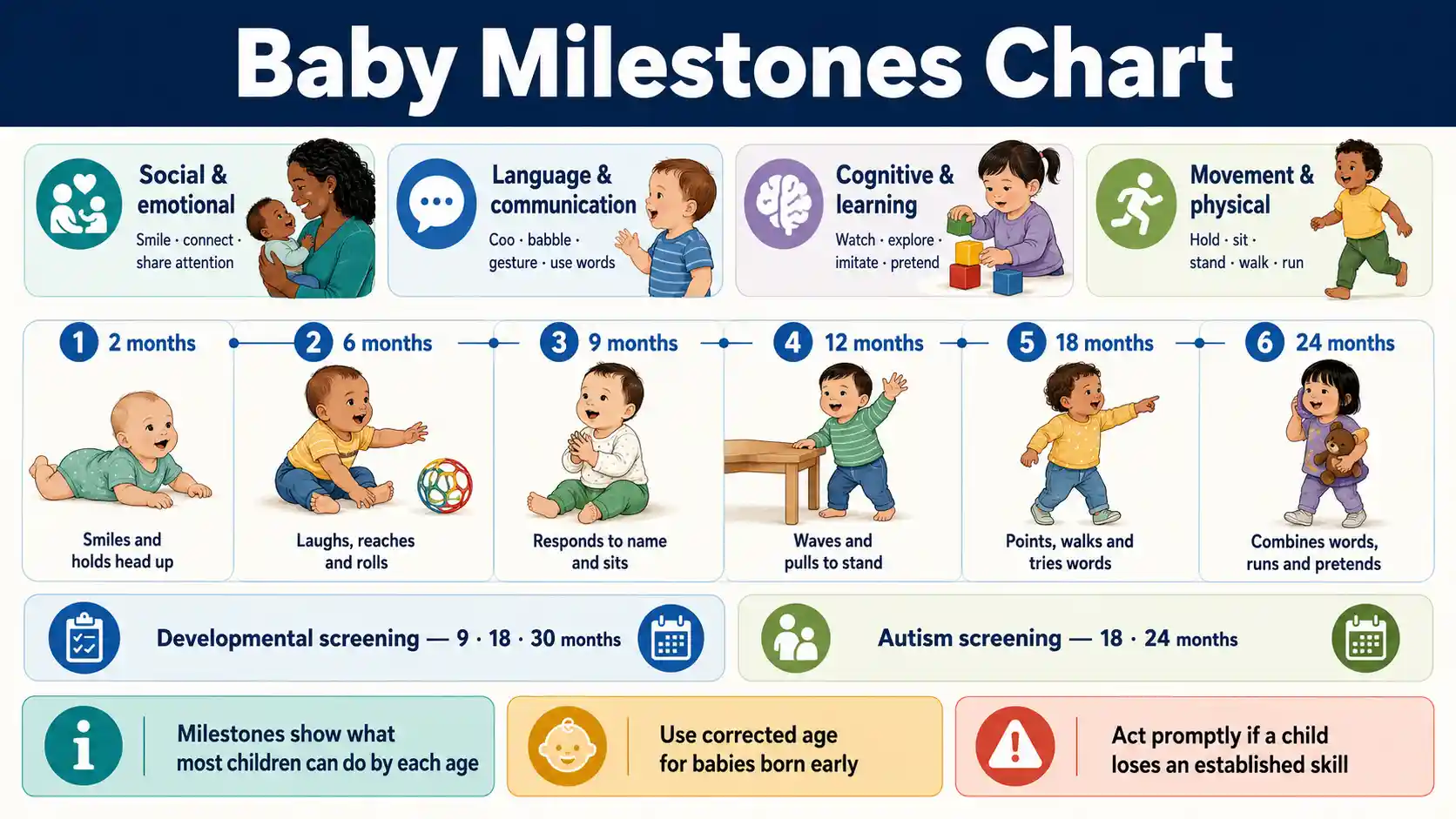
Baby milestones quick answer
CDC checklists use skills that at least 75% of children can do by the listed age. Look at progress across four domains, use corrected age for prematurity when appropriate, complete recommended screening, and act promptly when a skill is lost or concern persists.
Chart meaning
75% or more
CDC milestones describe skills most children can do by the listed age, not the earliest possible age for a skill.
Developmental areas
Four connected domains
Social-emotional, communication, cognitive, and movement skills should be considered together.
Routine screening
9 · 18 · 30 months
General developmental screening is recommended at these ages, with autism screening at 18 and 24 months.
Act-early rule
Do not wait on regression
Loss of any established skill or a persistent caregiver concern needs prompt discussion and possible screening.
Direct answers to common baby milestone questions
What is a baby milestone?
A baby milestone is a social, communication, thinking, or movement skill that most children can do by a certain age.
What percentage of children meet a CDC milestone by the listed age?
CDC milestone checklists use skills that at least 75% of children can do by that age.
When do babies usually smile socially?
Smiling when a caregiver talks or smiles is a CDC milestone by 2 months.
When should a baby respond to their name?
Looking or reacting when called by name is a CDC milestone by 9 months.
When do babies usually sit without support?
Sitting without support is a CDC milestone by 9 months.
When do babies usually pull to stand?
Pulling up to stand is a CDC milestone by 12 months.
When do babies usually start saying words?
By 12 months, many babies use a special name for a parent; other meaningful words often expand from 15 to 18 months.
When do toddlers combine two words?
Saying at least two words together, such as “more milk,” is a CDC milestone by 24 months.
Is a milestone checklist a developmental test?
No. A milestone checklist supports monitoring, while formal screening uses a standardized, validated tool.
When is general developmental screening recommended?
General developmental screening is recommended at 9, 18, and 30 months and whenever a concern arises.
How long should corrected age be used for a premature baby?
Corrected age is generally used for developmental tracking through about 2 years.
What is the most important milestone warning sign?
Loss of a previously acquired skill needs prompt medical discussion, even if other milestones appear typical.
Baby Milestones Chart by Age from 2 to 24 Months
This overview shows selected CDC milestone examples across four domains. It is a monitoring reference, not a pass-or-fail test or diagnosis.
Swipe horizontally inside the table to view every column.
| Age | Social and emotional | Language and communication | Cognitive and learning | Movement and physical |
|---|---|---|---|---|
| 2 months | Calms when spoken to or picked up; looks at faces; smiles responsively | Makes sounds besides crying; reacts to loud sounds | Watches a caregiver move; looks at a toy for several seconds | Holds head up on tummy; moves both arms and legs; briefly opens hands |
| 4 months | Smiles to gain attention; chuckles; seeks interaction | Coos; answers sounds; turns toward a familiar voice | Opens mouth for breast or bottle when hungry; studies hands | Holds head steady; holds and swings at toys; pushes onto forearms |
| 6 months | Knows familiar people; laughs; enjoys mirrors | Takes turns making sounds; squeals; blows raspberries | Mouths objects; reaches for wanted toys; closes lips when full | Rolls tummy to back; pushes up on straight arms; supports sitting with hands |
| 9 months | Responds to name; shows several expressions; enjoys peek-a-boo — Name response is an important social-communication observation | Babbles repeated sounds; lifts arms to be picked up | Looks for dropped objects; bangs objects together | Gets into sitting; transfers objects; rakes food; sits without support |
| 12 months | Plays simple social games such as pat-a-cake | Waves; uses a special parent name; understands “no” briefly | Puts objects in containers; searches for a hidden object | Pulls to stand; cruises; uses pincer grasp; drinks from an open cup with help |
| 15 months | Copies other children in play; shows affection; points to request help | Tries one or two words besides parent names; looks at familiar named objects; follows a direction with gesture and words | Uses objects appropriately; stacks two small objects | Takes a few independent steps; finger-feeds |
| 18 months | Checks that caregiver is nearby; points to share interest; helps with dressing | Tries at least three words besides parent names; follows one-step directions without gestures — Three or more words besides parent names | Copies simple chores; uses toys in simple purposeful ways | Walks independently; scribbles; tries spoon and open cup; climbs on and off furniture |
| 24 months | Notices when others are hurt; checks a caregiver’s reaction in new situations | Combines at least two words; points to body parts and book pictures; uses varied gestures — Two-word combinations by 2 years | Uses one hand while the other manipulates; operates simple toy controls; combines toys in play | Runs; kicks a ball; walks up a few stairs; eats with a spoon |
Age is chronological age unless corrected age is appropriate for a child born prematurely.
- • Milestones describe skills most children—75% or more—can do by the listed age.
- • A child may develop skills in a different order, but loss of any established skill needs prompt medical discussion.
- • Use the complete age-specific checklist rather than relying on one selected example.
Download or export
Four developmental domains belong on one milestone chart
Development is integrated. A movement change can affect play and communication, while hearing, vision, feeding, health, and access to interaction can influence several domains at once.
Connection
Social and emotional
Watch how the child looks, smiles, responds, shares attention, imitates, and participates in relationships and play.
Exchange
Language and communication
Count sounds, gestures, understanding, meaningful words, and back-and-forth interaction—not only clear speech.
Learning
Cognitive and problem-solving
Notice attention, exploration, memory, imitation, cause and effect, object use, and emerging pretend play.
Action
Movement and physical
Observe head and trunk control, mobility, hand skills, feeding skills, coordination, and increasing independence.
Communication starts before clear words
Early communication includes reacting to sound, cooing, babbling, taking turns, looking, lifting arms, waving, pointing, understanding, and purposeful words. Count communication across every language and consider hearing whenever sound response or speech progression is unclear.
Language and Communication Milestones by Age
Communication starts with sound, gaze, gestures, and turn-taking before clear words emerge.
Swipe horizontally inside the table to view every column.
| Age | Selected milestone | Communication form | How caregivers can support it | Important context |
|---|---|---|---|---|
| 2 months | Makes sounds besides crying | Early vowel-like or comfort sounds | Copy the sound and pause for a response | A startle or reaction to loud sound also matters |
| 4 months | Coos and answers sounds | Back-and-forth vocal play | Talk face-to-face and imitate sounds | Observe whether the baby turns toward voices |
| 6 months | Takes turns making sounds | Squeals, raspberries, and varied vocal play | Respond as though having a conversation | Babbling quality matters more than a specific syllable |
| 9 months | Uses repeated babble | Strings such as “mamama” or “bababa” | Name objects and wait for a sound or gesture | Also observe response to name and everyday sounds |
| 12 months | Waves and uses a special parent name | Gesture plus an early meaningful word | Label people and routines repeatedly | Understanding often develops ahead of spoken words |
| 15 months | Tries one or two other words | Approximate words count when used consistently for meaning | Repeat and expand the child’s attempt | Speech does not need to sound perfectly clear |
| 18 months | Tries three or more other words | Growing functional vocabulary | Offer simple choices and name the selected item | One-step directions without gestures test understanding |
| 24 months | Combines at least two words — Two-word combinations | Short combinations such as “more milk” | Expand to a slightly longer phrase | Use of gestures and understanding remain important |
Words may be approximations, signs, or consistent sounds used with clear meaning; multilingual children should be considered across all languages.
- • A bilingual or multilingual environment does not cause a language disorder.
- • Persistent lack of sound response, babbling, gestures, words, or skill progression should be discussed rather than explained by screen exposure or personality alone.
Download or export
Cognitive milestones grow through attention and exploration
Babies learn by watching, mouthing, reaching, dropping, hiding, opening, closing, copying, combining, and pretending. Everyday play gives richer information than repeatedly asking a child to perform one task on command.
Cognitive and Learning Milestones by Age
Cognitive milestones reflect attention, exploration, memory, cause and effect, imitation, and early problem-solving.
Swipe horizontally inside the table to view every column.
| Age | Selected milestone | Underlying skill | Simple activity | Avoid over-testing |
|---|---|---|---|---|
| 2 months | Looks at a toy for several seconds | Visual attention | Move one simple object slowly within view | Stop when the baby looks tired or turns away |
| 4 months | Studies hands | Body awareness and visual exploration | Allow safe free movement and hand play | Do not force grasping or positioning |
| 6 months | Reaches for a wanted toy | Goal-directed movement | Place a safe toy just within reach | Mouthing is a normal exploration method |
| 9 months | Looks for a dropped object | Early object permanence | Drop or partly hide a safe toy during play | One missed attempt does not show a delay |
| 12 months | Puts an object in a container | Cause, effect, and spatial learning | Use a large block and open cup | Avoid small objects that can be choking hazards |
| 15 months | Uses familiar objects appropriately | Functional understanding and imitation | Offer a cup, brush, or toy phone in play | Allow multiple ways to explore safely |
| 18 months | Copies simple chores | Imitation and sequence learning | Invite the child to wipe or put toys away | Keep expectations playful and brief |
| 24 months | Uses controls and combines toys | Problem-solving and representational play | Offer simple pretend sets or cause-and-effect toys | A worksheet is not required to build cognition |
Activities should use age-appropriate, non-toxic objects without small detachable parts.
- • Everyday play and interaction provide better developmental information than drilling a child to perform on demand.
- • Development may look different in children with motor, vision, or hearing disabilities; assess access and adaptation, not only the final action.
Download or export
Movement milestones include hands, feeding, and self-care
Gross motor development receives attention, but hand use, symmetry, grasp, cup and spoon skills, scribbling, and participation in dressing also matter. A child does not need to crawl in one exact style, but progress, coordination, and equal use of both sides should be observed.
Movement and Physical Milestones by Age
Movement milestones include gross motor control, hand skills, feeding skills, and increasing independence.
Swipe horizontally inside the table to view every column.
| Age | Gross motor example | Hand or self-care example | Safe practice | Variation to remember |
|---|---|---|---|---|
| 2 months | Holds head up briefly during tummy time | Briefly opens hands | Supervised awake tummy time on a firm surface | Head control develops gradually |
| 4 months | Pushes onto elbows or forearms | Holds a placed toy and brings hands to mouth | Provide floor play and reachable toys | Rolling direction and timing vary |
| 6 months | Rolls tummy to back and supports sitting with hands | Reaches and closes lips when full | Use floor-level play and upright supported feeding | Independent sitting may still be emerging |
| 9 months | Gets into sitting and sits without support | Transfers objects and rakes food | Childproof before mobility expands | Some babies crawl differently or skip classic crawling |
| 12 months | Pulls to stand and cruises | Pincer grasp; cup with help | Anchor furniture and use stair gates | Independent walking is not required at exactly 12 months — Walking varies around the first birthday |
| 15 months | Takes a few independent steps | Finger-feeds | Use stable surfaces and barefoot indoor practice when safe | Confidence and opportunity affect walking |
| 18 months | Walks alone and climbs onto low furniture | Scribbles; attempts spoon and open cup | Supervise climbing and use washable art materials | Spills and uneven steps remain common |
| 24 months | Runs, kicks, and walks up a few stairs | Eats with a spoon | Use gates, helmets, and close outdoor supervision | Coordination continues to mature |
Movement observations should account for the child’s medical history, opportunities, and any adaptive equipment.
- • Skipping crawling alone does not establish a developmental disorder.
- • Persistent one-sided use, unusual stiffness or floppiness, loss of movement, or inability to bear weight deserves clinical review.
Download or export
Baby milestone age and screening guide
Estimate the nearest CDC checklist age, calculate corrected age for prematurity through 24 months, and see the next routine screening checkpoint. This tool does not score or diagnose development.
Corrected age is an estimate. Use the child’s neonatal follow-up or primary care plan when it specifies a different gestational-age calculation or longer correction period.
Developmental monitoring and screening answer different questions
Monitoring follows development continuously through observations and conversations. Screening uses a validated tool at defined ages or whenever concern arises. Current CDC developmental screening guidance lists general screening at 9, 18, and 30 months and autism screening at 18 and 24 months.
Developmental Monitoring and Screening Schedule
Monitoring happens continuously. Screening uses a standardized, validated tool at recommended visits or whenever concern arises.
Swipe horizontally inside the table to view every column.
| Process or visit | Typical timing | Who participates | What it does | What it does not do |
|---|---|---|---|---|
| Developmental monitoring | At home and at every health visit from infancy onward | Family, caregivers, early educators, and clinicians | Tracks skills, progress, strengths, and concerns over time | Does not provide a standardized score or diagnosis |
| General developmental screening | 9 months | Trained health or early-childhood professional using a validated tool | Checks risk across developmental domains | Does not diagnose a specific condition |
| General developmental screening | 18 months | Trained professional | Checks whether further evaluation or support may be needed | Does not replace ongoing monitoring |
| Autism-specific screening | 18 months | Qualified clinician using an age-appropriate validated tool | Assesses autism-related risk signs | A positive screen is not an autism diagnosis |
| Autism-specific screening | 24 months | Qualified clinician | Repeats autism-specific risk screening | A negative result does not override a strong concern |
| General developmental screening | 30 months | Trained professional | Reassesses broad development before age 3 | Does not limit screening to only these ages |
| Additional screening | Any time a family or professional has a concern — Screen whenever concern arises | Qualified professional | Responds to new concerns, risk factors, or regression | Families do not need to wait for a scheduled age |
Screening recommendations refer to routine well-child care and may vary with medical history, local practice, and available programs.
- • Milestone checklists support monitoring but are not standardized, validated screening instruments.
- • Screening can lead to surveillance, hearing or vision assessment, specialist evaluation, or early intervention referral.
Download or export
Corrected age gives premature babies a fairer early comparison
Corrected age subtracts the weeks a baby was born before 40 weeks from chronological age. The American Academy of Pediatrics premature-baby guide recommends using adjusted age for developmental tracking through about 2 years.
Corrected Age Chart for Babies Born Prematurely
Corrected age accounts for how many weeks early a baby was born when interpreting early development.
Swipe horizontally inside the table to view every column.
| Chronological age | Weeks born early | Corrected age | Calculation | How to use it |
|---|---|---|---|---|
| 8 weeks | 3 weeks early | 5 weeks | 8 − 3 = 5 weeks | Compare early milestones with about 5 weeks while also tracking forward progress |
| 16 weeks | 4 weeks early | 12 weeks | 16 − 4 = 12 weeks | Use approximately 3 months as the developmental reference |
| 24 weeks | 5 weeks early | 19 weeks | 24 − 5 = 19 weeks | Use approximately 4 months and 3 weeks as the reference |
| 9 months | 8 weeks early | About 7 months | 39 − 8 ≈ 31 weeks | Review the nearest corrected-age checklist and the child’s trajectory |
| 18 months | 6 weeks early | About 16½ months | 78 − 6 ≈ 72 weeks | Continue using corrected age during the first 2 years |
| 24 months | Any degree of prematurity | Discuss transition from correction | Many children have caught up by about age 2 | Use the clinician’s advice if support needs continue — Individualize after age 2 |
Corrected age = chronological age in weeks minus the number of weeks born before 40 weeks’ gestation.
- • Use corrected age for developmental tracking through about 2 years unless the child’s clinician recommends otherwise.
- • Corrected age does not replace follow-up for prematurity-related hearing, vision, feeding, growth, or neurologic risks.
Download or export
Specific observations make milestone concerns easier to assess
Record what the child did, when it occurred, how often it happens, the setting, and any help used. A short private video can show babbling, gaze, movement, or feeding that is hard to reproduce during an appointment.
How to Observe and Record a Baby Milestone
Specific observations help clinicians distinguish a one-time situation from a consistent developmental pattern.
Swipe horizontally inside the table to view every column.
| Record | Useful detail | Example | Why it helps | Avoid |
|---|---|---|---|---|
| Skill observed | Describe the exact action | “Transfers a block from right hand to left” | Keeps the observation objective | “Seems advanced” without an example |
| Age and date | Write the date and child’s age | “9 months, 6 days” | Shows progression over time | Relying on memory months later |
| Frequency | Note whether it happened once, sometimes, or consistently | “Responded to name 4 of 5 times in a quiet room” | Separates emerging from established skill | Testing repeatedly until the child becomes tired |
| Setting | Record noise, people, illness, fatigue, and distractions | “At home after nap, no television” | Explains performance differences | Assuming one setting represents all settings |
| Support used | State prompts, gestures, positioning, or assistance | “Pulled to stand using sofa edge” | Clarifies independence level | Counting a fully assisted action as independent |
| Video or photo | Capture a brief natural example when safe | Short clip of babbling or walking pattern | Can show a hard-to-reproduce behavior | Delaying urgent care to obtain a recording |
| Regression — Regression needs prompt action | Name the skill and when it stopped | “No longer waves or says ‘mama’ for two weeks” | Skill loss changes urgency | Waiting for the next routine visit |
| Questions for visit | Write the concern and desired next step | “Should hearing and development be screened?” | Makes the appointment actionable | Leaving with no follow-up plan |
Use neutral descriptions and share records with the child’s health professional when concerned.
- • A short video can support discussion but cannot diagnose development.
- • Do not post identifiable health videos publicly when a private clinical review is available.
Download or export
Responsive routines support development without turning play into a test
Talk, imitate, pause, read, sing, provide supervised floor play, and include children in safe daily routines. Follow interest and fatigue cues. Expensive toys, flash cards, and milestone-drilling apps are not required.
Everyday Activities That Support Development
Responsive interaction, safe movement, shared reading, and ordinary routines support multiple domains without turning play into a test.
Swipe horizontally inside the table to view every column.
| Activity | Domains supported | How to do it | Age adaptation | Safety or limitation |
|---|---|---|---|---|
| Face-to-face talking | Social, language, attention | Copy sounds, describe actions, and pause for a response | Use shorter turns with young babies and simple choices with toddlers | Follow the child’s cues for a break |
| Shared reading | Language, cognition, joint attention | Name pictures, point, and let the child turn pages | Use cloth books early and simple picture books later | Do not require the child to sit through a whole book |
| Supervised floor play | Gross motor, reaching, problem-solving | Offer safe open space and reachable toys | Tummy time for young infants; climbing and ball play for toddlers | Use a firm surface away from hazards |
| Songs with gestures | Language, imitation, memory, motor | Repeat familiar songs and pause before a favorite action | Start with simple facial expressions and add hand motions | Keep volume comfortable |
| Container play | Fine motor, cause and effect | Place large safe objects in and out of a container | Use larger items for infants and sorting play for toddlers | No small choking hazards |
| Mealtime participation | Self-care, fine motor, communication | Offer safe finger foods, spoon practice, and cue-based choices | Match texture and seating to feeding readiness | Direct supervision is required |
| Simple chores | Imitation, motor planning, social participation | Invite wiping, carrying a napkin, or putting toys away | Use one-step directions first | The goal is participation, not performance |
| Outdoor exploration | Movement, language, sensory learning | Name sights and allow safe movement | Stroller talk for infants; walking and ball play for toddlers | Use sun, traffic, water, and fall protection |
Choose activities that fit the child’s abilities, interests, culture, environment, and accessibility needs.
- • Development grows through repeated responsive interaction, not expensive toys or apps.
- • Stop or adapt an activity that causes distress, pain, breathing difficulty, or unsafe fatigue.
Download or export
Common baby milestone mistakes
Treating a chart as a deadline
A milestone age identifies when most children can do a skill. It does not define an exact day for every child.
Looking at only motor skills
Sitting and walking matter, but social attention, gestures, understanding, play, hand skills, and communication also require monitoring.
Waiting after skill loss
Regression changes urgency. Contact the child’s clinician promptly instead of waiting for the next milestone age.
Ignoring corrected age
A baby born early may need corrected age through about 2 years to avoid an unfair comparison with chronological age alone.
Testing a tired child repeatedly
Observe natural behavior across settings and days. Repeated performance demands can hide what the child usually does.
Using reassurance without a follow-up plan
Ask what will be screened, whether hearing or vision needs review, and exactly when progress will be reassessed.
Milestone interpretation changes with access, health, and developmental context
Prematurity: use corrected age during the first 2 years and follow neonatal recommendations for hearing, vision, feeding, growth, and neurologic follow-up.
Hearing or vision differences: a child may need accessible cues, adapted activities, and specialist assessment rather than a literal comparison with a visually or auditorily defined task.
Motor disability or medical complexity: assess communication, cognition, participation, progress, and use of adaptive equipment—not only whether the child performs the standard motor action.
Multilingual families: count communication across all languages. A child may distribute words across languages while still showing healthy total language growth.
Illness, sleep, stress, and opportunity: temporary state affects performance. Persistent patterns and trajectory matter more than one missed demonstration.
Developmental Warning Signs and Next Actions
A milestone concern does not establish a diagnosis. The action is to share specific observations and request the appropriate evaluation.
Swipe horizontally inside the table to view every column.
| Observation | Why it matters | Recommended timing | Next step | Emergency exception |
|---|---|---|---|---|
| Loss of any previously acquired skill — Skill loss is urgent to discuss | Regression can signal a developmental, neurologic, hearing, vision, or medical problem | Contact the child’s clinician promptly; do not wait for the next routine visit | Describe the exact lost skill and request evaluation | Call emergency services for sudden weakness, seizure, altered consciousness, or breathing difficulty |
| No response to sound or voice | Hearing access affects communication and safety | Discuss promptly, especially if consistent or new | Request hearing assessment and developmental review | Urgent care for sudden hearing change with severe illness or neurologic symptoms |
| Persistent lack of eye contact, gestures, shared attention, or name response | These are important social-communication observations | Raise the concern as soon as a pattern is noticed | Ask for validated developmental and autism screening when age-appropriate | Emergency care is not usually required unless accompanied by acute illness or regression |
| Marked stiffness, floppiness, one-sided movement, or loss of motor control | Motor asymmetry or abnormal tone can need neurologic or therapy assessment | Discuss promptly | Request physical and neurologic examination | Emergency care for sudden one-sided weakness or inability to move |
| Feeding skill decline, repeated choking, or poor coordination | Feeding requires coordinated motor, airway, and sensory skills | Prompt clinical review | Discuss feeding and swallowing evaluation | Emergency care for choking, blue colour, or breathing difficulty |
| No progress across several months or domains | Trajectory matters even when no single milestone defines the concern | Do not wait for a missed screening age | Request standardized screening and follow-up plan | Emergency care is generally not required without acute symptoms |
| Caregiver concern despite a reassuring checklist | Families observe the child across more settings and time | Raise it now — Caregiver concern warrants action | Ask what will be screened, referred, or rechecked and when | Use urgent care for acute medical danger |
| Positive or incomplete screening result | A screen identifies risk, not a diagnosis | Follow the stated referral timeline | Complete evaluation and contact early intervention when appropriate | Seek emergency care only for an acute safety or medical problem |
Early intervention access and referral pathways vary by country and region.
- • Families in the United States can contact their state or territory early intervention program without waiting for a diagnosis.
- • A clinician may also assess hearing, vision, growth, sleep, feeding, neurologic status, and environmental access.
Download or export
Frequently asked questions
What is a developmental milestone?
A developmental milestone is a skill or behavior that most children can do by a certain age in social, communication, cognitive, or movement development.
What does “most children” mean on the CDC milestone chart?
CDC milestone checklists use skills that at least 75% of children are expected to show by the listed age.
Does missing one milestone mean a baby has a developmental delay?
No. One missed item does not diagnose a delay, but it is a reason to share the observation and ask whether screening or follow-up is needed.
When should a baby have developmental screening?
Routine general developmental screening is recommended at 9, 18, and 30 months, with additional screening whenever a concern arises.
When is autism screening recommended?
Autism-specific screening is recommended at 18 and 24 months and whenever a clinician or family has a concern.
Are milestone checklists the same as developmental screening?
No. Checklists support ongoing monitoring, while screening uses a standardized, validated tool and produces a structured risk result.
Should premature babies use corrected age for milestones?
Yes. Babies born early are generally tracked using corrected age through about 2 years, unless their clinician recommends a different approach.
How do I calculate corrected age?
Subtract the number of weeks the baby was born before 40 weeks’ gestation from chronological age in weeks.
Is crawling required before walking?
No. Some children use different mobility patterns or skip classic hands-and-knees crawling, but overall movement progress and symmetry still matter.
Do words in two languages count together?
Yes. Consider meaningful words and communication across every language a child uses; multilingual exposure does not cause language disorder.
When should a baby respond to their name?
Responding to their name is a CDC milestone by 9 months; a consistent lack of response should be discussed and hearing should also be considered.
When do babies usually start using words?
By 12 months, many babies use a special name for a parent; by 15 to 18 months, early functional words should be expanding.
When do toddlers combine two words?
Saying at least two words together, such as “more milk,” is a CDC milestone by 2 years.
Is losing a skill a warning sign?
Yes. Loss of a previously acquired social, language, thinking, feeding, or movement skill needs prompt medical discussion.
Can screen time teach milestones?
Screens do not replace responsive talking, play, movement, reading, and real-world interaction, which provide richer developmental learning.
What should I bring to a milestone appointment?
Bring specific dated observations, completed screening or checklist results, short private videos when helpful, and questions about evaluation and follow-up.
Sources
These primary references support the age examples, screening schedule, corrected-age method, monitoring guidance, and act-early recommendations used on this page.
Centers for Disease Control and Prevention — CDC Developmental Milestones
https://www.cdc.gov/act-early/milestones/index.html
Provides milestone checklists by age and explains that CDC milestones describe what most children, defined as 75% or more, can do by a given age.
Centers for Disease Control and Prevention — Milestones by 2 Months
https://www.cdc.gov/act-early/milestones/2-months.html
Lists social, communication, cognitive, and movement milestones most babies show by 2 months.
Centers for Disease Control and Prevention — Milestones by 4 Months
https://www.cdc.gov/act-early/milestones/4-months.html
Lists milestone examples most babies show by 4 months, including attention, cooing, head control, and reaching.
Centers for Disease Control and Prevention — Milestones by 6 Months
https://www.cdc.gov/act-early/milestones/6-months.html
Lists milestone examples most babies show by 6 months across four developmental domains.
Centers for Disease Control and Prevention — Milestones by 9 Months
https://www.cdc.gov/act-early/milestones/9-months.html
Lists milestone examples most babies show by 9 months, including name response, varied babbling, sitting, and object exploration.
Centers for Disease Control and Prevention — Milestones by 1 Year
https://www.cdc.gov/act-early/milestones/1-year.html
Lists milestone examples most babies show by 12 months, including gestures, simple words, object permanence, and pulling to stand.
Centers for Disease Control and Prevention — Milestones by 15 Months
https://www.cdc.gov/act-early/milestones/15-months.html
Lists milestone examples most children show by 15 months, including pointing, early words, object use, steps, and finger feeding.
Centers for Disease Control and Prevention — Milestones by 18 Months
https://www.cdc.gov/act-early/milestones/18-months.html
Lists milestone examples most children show by 18 months, including shared attention, words, one-step directions, walking, and spoon practice.
Centers for Disease Control and Prevention — Milestones by 2 Years
https://www.cdc.gov/act-early/milestones/2-years.html
Lists milestone examples most children show by 24 months, including two-word combinations, pretend play, running, and spoon use.
Centers for Disease Control and Prevention — Developmental Monitoring and Screening
https://www.cdc.gov/act-early/about/developmental-monitoring-and-screening.html
Distinguishes routine milestone monitoring from formal validated developmental screening and lists recommended screening ages.
Centers for Disease Control and Prevention — Concerned About Your Child's Development?
https://www.cdc.gov/act-early/families/concerned.html
Explains how families can share concerns, request screening, seek evaluation, and contact early intervention services.
American Academy of Pediatrics — Milestones Matter: Your Child's Growth and Development
https://www.healthychildren.org/English/family-life/health-management/Pages/Milestones-Matter.aspx
Provides parent-facing milestone context and reiterates developmental screening at 9, 18, and 30 months and autism screening at 18 and 24 months.
American Academy of Pediatrics — Your Preemie's Growth and Developmental Milestones
https://www.healthychildren.org/English/ages-stages/baby/preemie/Pages/Preemie-Milestones.aspx
Explains corrected age for babies born early and recommends using adjusted age for developmental tracking through about 2 years.
Social milestones develop through responsive relationships
Social development begins with calming, looking, and smiling. It expands into shared games, name response, gestures, pointing, imitation, and checking a caregiver’s reaction. The CDC milestone checklists organize these observations by age and show photos and videos of many skills.