Mathematics & Education · Measurement
Conversion Chart for Length, Weight, Volume and More
Compare common SI and U.S. customary units for length, mass, volume, area, speed, temperature, and elapsed time. Each table shows the factor, formula, conditions, and a worked example.
Confirm the quantity and unit definition before converting. U.S. and Imperial gallons differ, mass and volume need density to relate, and temperature readings require an offset formula.
Quick answer
Preserve the quantity while changing its unit
Most conversions multiply by a factor that represents the same quantity in two units. Arrange the factor so the starting unit cancels and the target unit remains. Temperature readings are the major exception because Celsius and Fahrenheit also use different zero points.
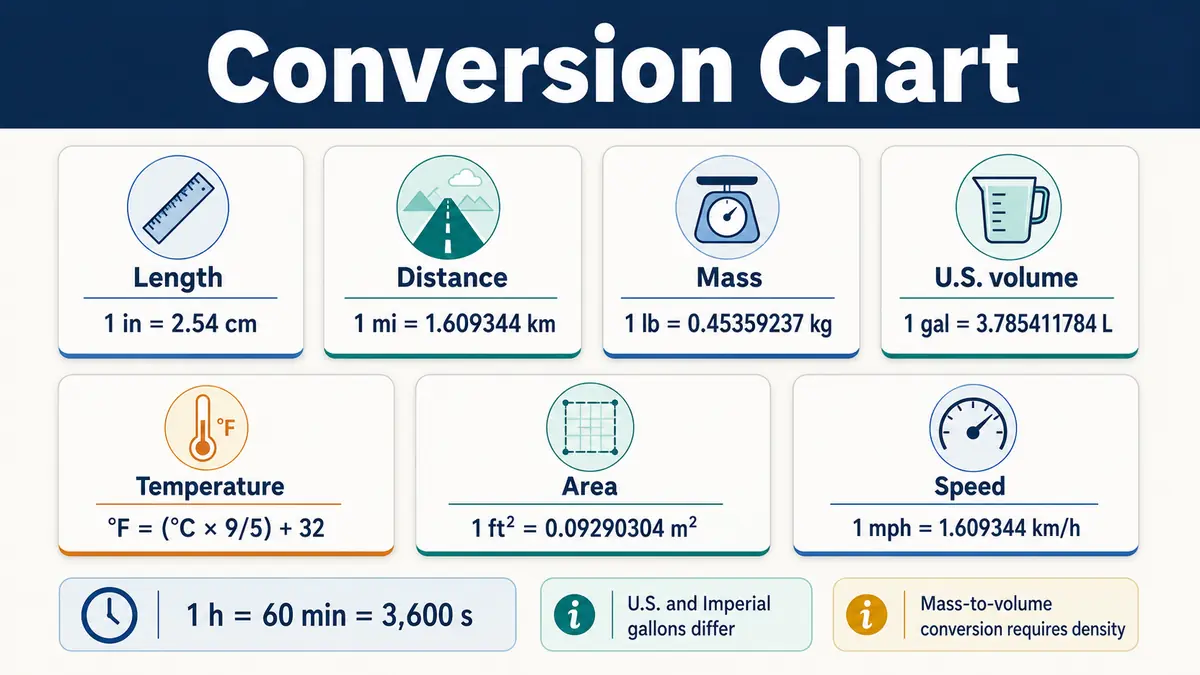
The exact and approximate factors below follow the official NIST SI conversion reference.
Length anchor
1 in = 2.54 cm
The international inch-to-centimeter relationship is exact.
Mass anchor
1 lb = 0.45359237 kg
The avoirdupois pound-to-kilogram relationship is exact.
U.S. liquid volume
1 gal = 3.785411784 L
This value applies to the U.S. liquid gallon, not the Imperial gallon.
Temperature rule
Scale + offset
Celsius and Fahrenheit readings require formulas rather than a single factor.
Common conversion questions at a glance
These concise answers cover the factors, formulas, and distinctions that prevent the most common errors.
What is a conversion factor?
A conversion factor is a ratio equal to 1 that changes the unit expression without changing the physical quantity.
How many centimeters are in one inch?
One international inch equals exactly 2.54 centimeters.
How many feet are in one meter?
One meter equals approximately 3.28084 feet.
How many kilometers are in one mile?
One international mile equals exactly 1.609344 kilometers.
How many kilograms are in one pound?
One avoirdupois pound equals exactly 0.45359237 kilogram.
How many liters are in a U.S. gallon?
One U.S. liquid gallon equals exactly 3.785411784 liters.
Can cups be converted directly to grams?
No. Cups measure volume and grams measure mass, so the ingredient density is required.
How do you convert Celsius to Fahrenheit?
Multiply Celsius by 9/5 and add 32.
How do you convert area units?
Square the corresponding linear conversion factor because area has two dimensions.
How do you convert volume units?
Cube a linear conversion factor for cubic units, or use the defined capacity-unit factor.
When should a converted value be rounded?
Keep guard digits during calculation and round only the final result to appropriate precision.
Why should units be written in every step?
Written units cancel algebraically and make an inverted or incompatible factor easier to detect.
Reliable workflow
Convert units without losing the quantity
Identify quantity
Confirm that both units measure the same kind of quantity.
Confirm definition
Check SI, U.S. customary, Imperial, or another named system.
Arrange factor
Place units so the starting unit cancels.
Calculate
Carry guard digits and avoid early rounding.
Check scale
Estimate whether the result should be larger or smaller.
Report clearly
Round once and attach the correct target unit.
Length Conversion Chart
Convert common metric and U.S. customary length units by multiplying the starting value by the listed factor.
Swipe horizontally inside the table to view every column.
| From | To | Multiply by | Example |
|---|---|---|---|
| inch (in) | millimeter (mm) | 25.4 exactly — Exact inch definition | 8 in = 203.2 mm |
| inch (in) | centimeter (cm) | 2.54 exactly | 12 in = 30.48 cm |
| foot (ft) | meter (m) | 0.3048 exactly | 10 ft = 3.048 m |
| yard (yd) | meter (m) | 0.9144 exactly | 5 yd = 4.572 m |
| mile (mi) | kilometer (km) | 1.609344 exactly — Exact mile-to-kilometer factor | 3 mi = 4.828032 km |
| millimeter (mm) | inch (in) | 0.03937007874 | 100 mm ≈ 3.937 in |
| centimeter (cm) | inch (in) | 0.3937007874 | 30 cm ≈ 11.811 in |
| meter (m) | foot (ft) | 3.280839895 | 2 m ≈ 6.562 ft |
| meter (m) | yard (yd) | 1.093613298 | 10 m ≈ 10.936 yd |
| kilometer (km) | mile (mi) | 0.6213711922 | 5 km ≈ 3.107 mi |
The international yard is exactly 0.9144 meter, so the inch, foot, and mile factors derived from it are exact.
- • Reverse a conversion by dividing by the original factor or multiplying by its reciprocal.
- • Keep extra digits during calculation and round only the final result.
- • A linear factor cannot be reused unchanged for area or volume.
Download or export
Mass and Weight Conversion Chart
These factors convert numerical mass values. Everyday language often says weight, but kilogram and pound values in this table represent mass units.
Swipe horizontally inside the table to view every column.
| From | To | Multiply by | Example |
|---|---|---|---|
| ounce (oz) | gram (g) | 28.349523125 exactly | 4 oz = 113.3980925 g |
| pound (lb) | kilogram (kg) | 0.45359237 exactly — Exact pound definition | 10 lb = 4.5359237 kg |
| U.S. short ton — U.S. short ton only | kilogram (kg) | 907.18474 exactly | 2 short tons = 1,814.36948 kg |
| metric tonne (t) | kilogram (kg) | 1,000 exactly | 1.5 t = 1,500 kg |
| gram (g) | ounce (oz) | 0.03527396195 | 500 g ≈ 17.637 oz |
| kilogram (kg) | pound (lb) | 2.204622622 | 70 kg ≈ 154.324 lb |
| kilogram (kg) | U.S. short ton | 0.00110231131 | 1,000 kg ≈ 1.10231 short tons |
| milligram (mg) | gram (g) | 0.001 exactly | 750 mg = 0.75 g |
The avoirdupois pound is exactly 0.45359237 kilogram; one avoirdupois ounce is one-sixteenth of a pound.
- • Do not confuse a U.S. short ton with a metric tonne or a British long ton.
- • Mass does not change with gravity; physical weight is a force and uses units such as newtons.
- • Ingredient mass and ingredient volume are not interchangeable without density information.
Download or export
Volume and Capacity Conversion Chart
The U.S. liquid units below differ from Imperial units. Confirm the measurement system before converting gallons, quarts, pints, cups, or fluid ounces.
Swipe horizontally inside the table to view every column.
| From | To | Multiply by | Example |
|---|---|---|---|
| liter (L) | milliliter (mL) | 1,000 exactly | 1.25 L = 1,250 mL |
| cubic meter (m³) | liter (L) | 1,000 exactly | 0.5 m³ = 500 L |
| U.S. gallon (gal) — U.S. liquid gallon | liter (L) | 3.785411784 exactly | 2 gal = 7.570823568 L |
| U.S. quart (qt) | liter (L) | 0.946352946 exactly | 4 qt = 3.785411784 L |
| U.S. pint (pt) | milliliter (mL) | 473.176473 exactly | 2 pt = 946.352946 mL |
| U.S. cup | milliliter (mL) | 236.5882365 exactly | 2 cups = 473.176473 mL |
| U.S. fluid ounce (fl oz) — Volume unit, not mass ounce | milliliter (mL) | 29.5735295625 exactly | 8 fl oz = 236.5882365 mL |
| liter (L) | U.S. gallon (gal) | 0.2641720524 | 10 L ≈ 2.64172 gal |
| milliliter (mL) | U.S. fluid ounce (fl oz) | 0.0338140227 | 500 mL ≈ 16.907 fl oz |
This table uses U.S. liquid measure, not U.S. dry measure or Imperial measure.
- • One U.S. gallon contains 4 quarts, 8 pints, 16 cups, or 128 U.S. fluid ounces.
- • A fluid ounce measures volume; an avoirdupois ounce measures mass.
- • Cooking cup sizes can vary by country and recipe source.
Download or export
Browser-only educational tool
Multi-category unit converter
Convert compatible length, mass, U.S. liquid volume, temperature, area, speed, and elapsed-time units. The calculation stays in your browser.
Converted value
10 mi = 16.09344 km
- Quantity type
- Length
- Calculation basis
- 10 × 1,609.344 ÷ 1,000
The result uses defined factors where available. Round the displayed value to the precision appropriate for your original measurement and purpose.
Temperature Conversion Formulas
Temperature conversions require an offset as well as a scale factor. Do not use a simple multiplier for Celsius and Fahrenheit readings.
Swipe horizontally inside the table to view every column.
| Conversion | Formula | Example | Important condition |
|---|---|---|---|
| Celsius to Fahrenheit | °F = (°C × 9/5) + 32 | 20 °C = 68 °F | Use for temperature readings. |
| Fahrenheit to Celsius | °C = (°F − 32) × 5/9 | 77 °F = 25 °C | Subtract 32 before multiplying. |
| Celsius to kelvin | K = °C + 273.15 — Exact Celsius-to-kelvin offset | 0 °C = 273.15 K | Kelvin uses no degree symbol. |
| Kelvin to Celsius | °C = K − 273.15 | 300 K = 26.85 °C | Kelvin values cannot be below 0 K. |
| Fahrenheit to kelvin | K = (°F − 32) × 5/9 + 273.15 | 32 °F = 273.15 K | Apply both offset and scale. |
| Kelvin to Fahrenheit | °F = (K − 273.15) × 9/5 + 32 | 273.15 K = 32 °F | Apply both offset and scale. |
| Temperature interval | 1 °C difference = 1 K difference | A rise of 10 °C = a rise of 10 K | Intervals differ from absolute readings. — Interval conversion rule |
| Temperature interval | 1 °F difference = 5/9 K difference | A rise of 18 °F = a rise of 10 K | Do not add 32 to interval changes. |
Use °C and °F for Celsius and Fahrenheit; use K for kelvin.
- • Absolute zero is 0 K, −273.15 °C, or −459.67 °F.
- • Celsius and Fahrenheit have the same numerical reading at −40.
- • A temperature difference uses scale conversion only; an absolute temperature reading also needs the offset.
Download or export
Area Conversion Chart
Area factors square the corresponding length factor. For example, one square foot equals (0.3048 m)², not 0.3048 m².
Swipe horizontally inside the table to view every column.
| From | To | Multiply by | Example |
|---|---|---|---|
| square inch (in²) | square centimeter (cm²) | 6.4516 exactly | 20 in² = 129.032 cm² |
| square foot (ft²) | square meter (m²) | 0.09290304 exactly — Squared foot-to-meter factor | 100 ft² = 9.290304 m² |
| square yard (yd²) | square meter (m²) | 0.83612736 exactly | 50 yd² = 41.806368 m² |
| acre — Area unit, not length | square meter (m²) | 4,046.8564224 exactly | 2 acres = 8,093.7128448 m² |
| hectare (ha) | square meter (m²) | 10,000 exactly | 3 ha = 30,000 m² |
| square mile (mi²) | square kilometer (km²) | 2.589988110336 exactly | 5 mi² = 12.94994055168 km² |
| square meter (m²) | square foot (ft²) | 10.76391042 | 25 m² ≈ 269.098 ft² |
| square kilometer (km²) | square mile (mi²) | 0.3861021585 | 10 km² ≈ 3.86102 mi² |
Square units describe two-dimensional area; they are not interchangeable with linear units.
- • When each length dimension is multiplied by k, the area is multiplied by k².
- • An acre is an area unit and has no single fixed length or width.
- • State the final unit with a superscript 2 or the word square.
Download or export
Speed Conversion Chart
Speed conversions combine a distance conversion with a time conversion. These factors assume constant average speed over the measured interval.
Swipe horizontally inside the table to view every column.
| From | To | Multiply by | Example |
|---|---|---|---|
| mile per hour (mph) | kilometer per hour (km/h) | 1.609344 exactly | 60 mph = 96.56064 km/h |
| kilometer per hour (km/h) | mile per hour (mph) | 0.6213711922 | 100 km/h ≈ 62.1371 mph |
| meter per second (m/s) | kilometer per hour (km/h) | 3.6 exactly — Exact m/s-to-km/h factor | 10 m/s = 36 km/h |
| kilometer per hour (km/h) | meter per second (m/s) | 0.2777777778 | 90 km/h = 25 m/s |
| mile per hour (mph) | meter per second (m/s) | 0.44704 exactly | 55 mph = 24.5872 m/s |
| knot (kn) — Nautical speed unit | kilometer per hour (km/h) | 1.852 exactly | 20 kn = 37.04 km/h |
| knot (kn) | mile per hour (mph) | 1.150779448 | 15 kn ≈ 17.2617 mph |
One knot equals one nautical mile per hour; the international nautical mile is exactly 1,852 meters.
- • Average speed equals distance divided by elapsed time.
- • Speed has magnitude only; velocity also includes direction.
- • Pace is time per distance and therefore changes inversely with speed.
Download or export
Time Conversion Chart
These fixed relationships work for elapsed-time calculations. Calendar months and years require date-aware rules because their lengths vary.
Swipe horizontally inside the table to view every column.
| Unit | Equivalent | Seconds | Example |
|---|---|---|---|
| 1 minute | 60 seconds | 60 | 3 min = 180 s |
| 1 hour | 60 minutes | 3,600 | 2.5 h = 9,000 s |
| 1 day | 24 hours | 86,400 — Exact SI day length | 3 d = 259,200 s |
| 1 week | 7 days | 604,800 | 2 weeks = 1,209,600 s |
| 1 millisecond | 0.001 second | 0.001 | 250 ms = 0.25 s |
| 1 microsecond | 0.000001 second | 0.000001 | 500,000 μs = 0.5 s |
| Common year — Calendar-dependent value | 365 days | 31,536,000 | Use only when a 365-day year is specified. |
| Leap year | 366 days | 31,622,400 | Use only when a 366-day year is specified. |
The SI unit of time is the second (s).
- • A month is not a fixed number of seconds; use actual dates when calendar accuracy matters.
- • Civil days can be affected by time zones and daylight-saving changes, while an SI day is exactly 86,400 seconds.
- • Do not treat decimal hours as hours-and-minutes notation: 1.5 hours is 1 hour 30 minutes.
Download or export
Conversion Method and Rounding Guide
A reliable conversion preserves the physical quantity, cancels units, carries enough precision, and reports a sensible final result.
Swipe horizontally inside the table to view every column.
| Step | Action | Example | Why it matters |
|---|---|---|---|
| 1. Identify quantity | Confirm length, area, mass, volume, temperature, speed, or time. | A gallon is volume; a pound is mass. | Only compatible quantities can be converted directly. |
| 2. Confirm system | Distinguish U.S., Imperial, SI, and other definitions. | U.S. gallon ≠ Imperial gallon. — Ambiguous unit systems | A familiar unit name may have multiple definitions. |
| 3. Write factor | Place the unwanted unit opposite itself. | 10 in × 2.54 cm / 1 in | Unit cancellation exposes setup errors. |
| 4. Calculate | Multiply or divide without early rounding. | 10 × 2.54 = 25.4 | Guard digits reduce accumulated error. |
| 5. Check direction | Estimate whether the number should grow or shrink. — Reasonableness check | Meters to centimeters produces a larger number. | A reasonableness check catches inverted factors. |
| 6. Round once | Round the final answer to appropriate precision. | 3.107 mi rather than every intermediate value | Final precision should match the input and purpose. |
| 7. Label result | Write the value and unit together. | 25.4 cm | An unlabeled number is incomplete. |
A conversion factor is a ratio equal to 1, so it changes the unit expression without changing the physical quantity.
- • Exact defined factors do not limit significant figures; measured inputs usually do.
- • For area, square the linear factor. For volume, cube the linear factor.
- • Temperature readings use affine formulas with offsets, not ordinary unit-factor cancellation alone.
Download or export
Special cases and practical limitations
Mass versus volume
A direct conversion requires density. One cup of water and one cup of flour occupy similar volume but do not have the same mass.
U.S. versus Imperial capacity
The U.S. liquid gallon, Imperial gallon, and U.S. dry gallon are different units. Name the system before using a factor.
Calendar duration
Months and years do not have one universal duration in seconds. Use actual start and end dates for date-sensitive work.
Temperature intervals
A change of 1 °C equals a change of 1 K, but converting absolute readings between Celsius and kelvin requires adding or subtracting 273.15.
Measured precision
An exact factor can produce many digits, but the result should not imply more measurement precision than the input supports.
Compound units
Convert every component. For example, miles per hour to meters per second changes both distance and time units.
Common conversion mistakes to avoid
Inverting the factor
Estimate the expected direction and arrange units so the starting unit cancels.
Mixing incompatible quantities
Length cannot convert directly to area, and volume cannot convert directly to mass without more information.
Using the wrong gallon
Specify U.S. liquid, U.S. dry, or Imperial before converting capacity.
Treating temperature as ordinary scaling
Celsius and Fahrenheit readings need both multiplication and an offset.
Forgetting powers
Square a linear factor for area and cube it for volume.
Rounding every step
Keep extra digits through intermediate calculations and round once at the end.
Dropping the unit
Attach the target unit to every reported result and preserve squared or cubed notation.
Confusing decimal time
A value of 1.5 hours means 1 hour 30 minutes, not 1 hour 50 minutes.
Frequently asked questions
What is a unit conversion?
A unit conversion expresses the same physical quantity in a different compatible unit by using a valid factor or formula.
How do I choose the correct conversion factor?
Choose a factor that places the starting unit in the denominator and the target unit in the numerator so the starting unit cancels.
Are conversion factors always exact?
No. Defined relationships such as 1 inch = 2.54 centimeters are exact, while some published decimal reciprocals are rounded.
How many centimeters are in one inch?
One international inch equals exactly 2.54 centimeters.
How many kilometers are in one mile?
One international mile equals exactly 1.609344 kilometers.
How many kilograms are in one pound?
One avoirdupois pound equals exactly 0.45359237 kilogram.
How many liters are in one U.S. gallon?
One U.S. liquid gallon equals exactly 3.785411784 liters.
Is an Imperial gallon the same as a U.S. gallon?
No. Imperial and U.S. gallons are different sizes, so the measurement system must be stated.
How do I convert Celsius to Fahrenheit?
Multiply the Celsius value by 9/5 and add 32.
How do I convert Fahrenheit to Celsius?
Subtract 32 from the Fahrenheit value and multiply the result by 5/9.
Why can I not use a length factor directly for area?
Area is two-dimensional, so the corresponding length factor must be squared.
Why can I not convert cups directly to grams?
Cups measure volume and grams measure mass, so the conversion requires the ingredient density or a substance-specific reference.
What is the difference between mass and weight?
Mass measures the amount of matter, while physical weight is the gravitational force acting on that mass.
When should I round a converted value?
Carry extra digits through the calculation and round the final value according to the input precision and practical purpose.
What does dimensional analysis do?
Dimensional analysis arranges conversion factors so unwanted units cancel and the desired unit remains.
Can the converter handle months and calendar years exactly?
No single fixed factor converts every calendar month or year because their lengths vary; date-aware calculations are required.
Sources
National Institute of Standards and Technology — NIST Guide to the SI, Appendix B: Conversion Factors
Authoritative conversion factors for expressing non-SI quantities in SI units and accepted units.
https://www.nist.gov/pml/special-publication-811/nist-guide-si-appendix-b-conversion-factors
National Institute of Standards and Technology — Unit Conversion Resources
Official resources for length, area, volume, mass, temperature, and U.S. customary conversion factors.
https://www.nist.gov/pml/owm/metric-si/unit-conversion
Bureau International des Poids et Mesures — The International System of Units (SI), 9th Edition
The authoritative SI reference for unit names, symbols, prefixes, and accepted non-SI units.
https://www.bipm.org/en/publications/si-brochure