Family & Parenting
Cousin Chart
Calculate first, second, and distant cousin relationships from a common ancestor, understand removals, compare special family terms, and verify the result.
This chart uses common English-language genealogical naming. Family, cultural, legal, adoption, and DNA contexts may use different terms. Verify the most recent common ancestor and every parent-child link before treating a calculated relationship as established.
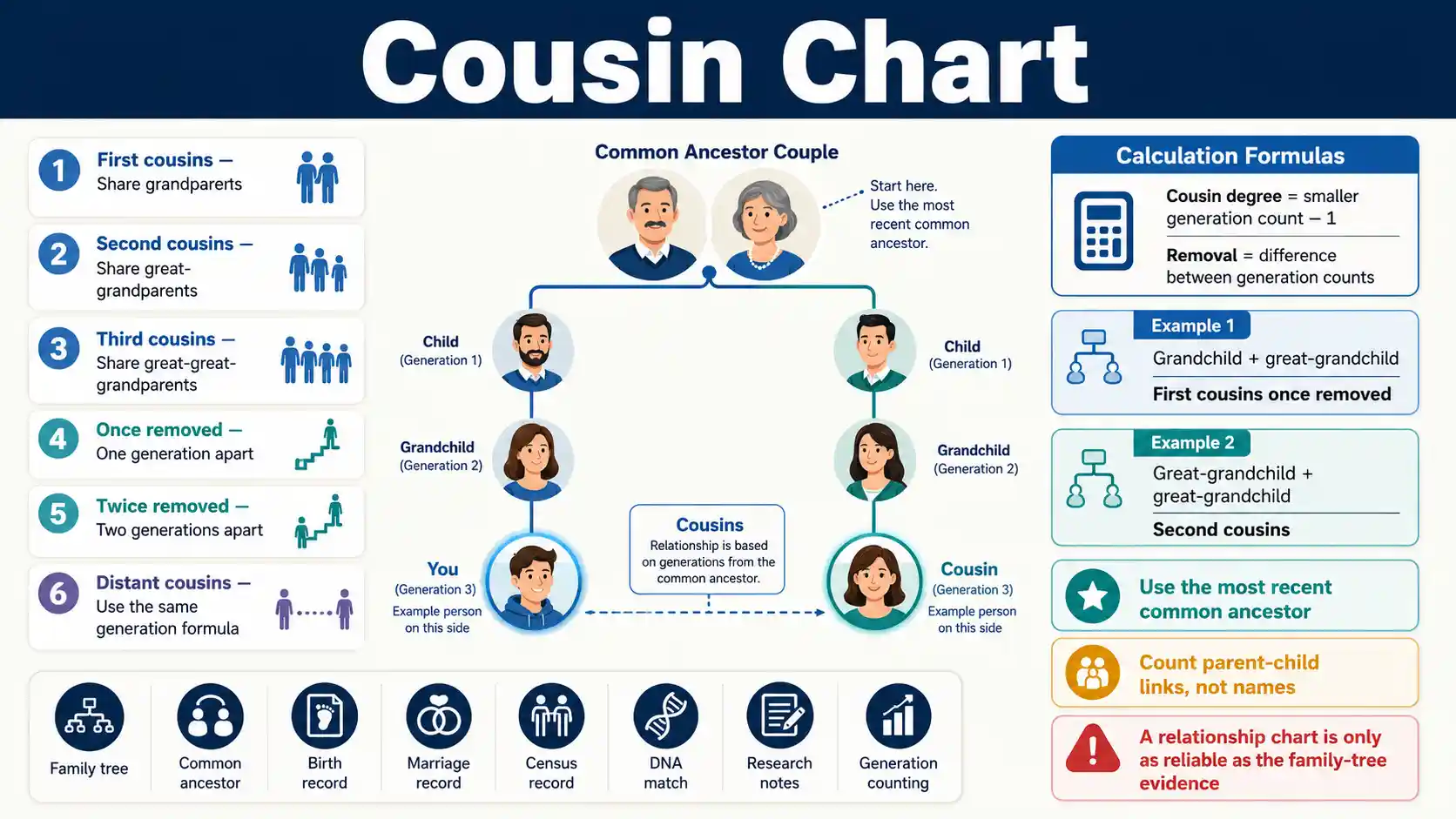
How does a cousin chart work?
Find the most recent ancestor shared by both people, count the generations from each person to that ancestor, and compare the two counts. The smaller count minus one gives the cousin degree. The difference between counts gives the removal. The FamilySearch cousin-chart guide uses this same generation-based method.
Find the anchor
Most recent common ancestor
Use the nearest ancestor shared by both people, not an older ancestor they also share.
Find cousin degree
Smaller count − 1
Count generations from each person to the common ancestor and subtract one from the smaller count.
Find removal
Difference between counts
A one-generation difference is once removed; a two-generation difference is twice removed.
Prove the path
Record every generation
A calculated label remains a hypothesis until each parent-child link is supported by evidence.
Direct answers to common cousin questions
What is a first cousin?
First cousins share a grandparent and are both two generations from that most recent common ancestor.
What is a second cousin?
Second cousins share a great-grandparent and are both three generations from that shared ancestor.
What does once removed mean?
Once removed means the relatives are one generation apart.
What does twice removed mean?
Twice removed means the relatives are two generations apart.
How do I find cousin degree?
Subtract one from the smaller number of generations to the most recent common ancestor.
How do I find removal?
Take the absolute difference between the two generation counts.
What is my parent’s first cousin to me?
Your parent’s first cousin is your first cousin once removed.
What is my first cousin’s child to me?
Your first cousin’s child is your first cousin once removed.
What is a half first cousin?
Half first cousins descend from parents who are half siblings and usually share one grandparent.
What is a double first cousin?
Double first cousins share both sets of grandparents because two sibling pairs formed families with each other.
Can DNA identify one exact cousin relationship?
DNA can support a relationship, but overlapping shared-DNA ranges mean records and family-tree evidence are still needed.
Do cousin labels work the same everywhere?
No. Degree-and-removal terms are common in English-language genealogy, while cultures and legal systems may classify kin differently.
Cousin Degree Chart by Shared Ancestor
When both people are in the same generation, the cousin degree is one less than the number of generations from either person to the most recent common ancestor.
Swipe horizontally inside the table to view every column.
| Relationship | Shared ancestor | Generations from each person | Plain-language example |
|---|---|---|---|
| Siblings | Parent | 1 and 1 | Two people share at least one parent |
| First cousins | Grandparent — First cousins share grandparents | 2 and 2 | Their parents are siblings |
| Second cousins | Great-grandparent — Second cousins share great-grandparents | 3 and 3 | Their grandparents are siblings |
| Third cousins | Great-great-grandparent | 4 and 4 | Their great-grandparents are siblings |
| Fourth cousins | 3rd-great-grandparent | 5 and 5 | Their 2nd-great-grandparents are siblings |
| Fifth cousins | 4th-great-grandparent | 6 and 6 | Their 3rd-great-grandparents are siblings |
| Sixth cousins | 5th-great-grandparent | 7 and 7 | Their 4th-great-grandparents are siblings |
| Seventh cousins | 6th-great-grandparent | 8 and 8 | Their 5th-great-grandparents are siblings |
Degree applies to collateral relatives who descend through different child lines of the shared ancestor.
- • Use the most recent common ancestor, not a more distant ancestor the two people also share.
- • If the people are in different generations, add the appropriate removal after finding the cousin degree.
Download or export
Removal describes a generation difference
“Removed” does not create a new cousin degree. First cousins once removed are still in a first-cousin line, but one person is one generation farther from the shared ancestor. The relationship works in both directions.
Cousin Removal Chart with Examples
Removal measures the difference in generation levels. Once removed means a one-generation difference; twice removed means a two-generation difference.
Swipe horizontally inside the table to view every column.
| Relationship | Generation distances | Common ancestor | Example |
|---|---|---|---|
| First cousin | 2 and 2 | Grandparent for both | You and your parent’s sibling’s child |
| First cousin once removed — Common once-removed example | 2 and 3 | Grandparent for one; great-grandparent for the other | You and your first cousin’s child |
| First cousin twice removed | 2 and 4 | Grandparent for one; great-great-grandparent for the other | You and your first cousin’s grandchild |
| Second cousin | 3 and 3 | Great-grandparent for both | You and the grandchild of your grandparent’s sibling |
| Second cousin once removed | 3 and 4 | Great-grandparent for one; great-great-grandparent for the other | You and your second cousin’s child |
| Second cousin twice removed | 3 and 5 | Great-grandparent for one; 3rd-great-grandparent for the other | You and your second cousin’s grandchild |
| Third cousin once removed | 4 and 5 | Great-great-grandparent for one; 3rd-great-grandparent for the other | You and your third cousin’s child |
| Fourth cousin three times removed | 5 and 8 | 3rd-great-grandparent for one; 6th-great-grandparent for the other | A fourth-cousin line separated by three generations |
Removal = absolute difference between the two generation counts.
- • Removal does not mean emotional distance, geography, or a broken family connection.
- • The relationship is reciprocal: each person is the same cousin degree and removal from the other.
Download or export
Match generation counts before naming the relationship
A grandchild and great-grandchild of the same ancestor are first cousins once removed. Two great-grandchildren are second cousins. These examples make the formula visible.
Common Cousin Relationship Matrix
Find each person’s number of generations from the same most recent common ancestor, then read the resulting relationship.
Swipe horizontally inside the table to view every column.
| Person A generations | Person B generations | Relationship | How to read it |
|---|---|---|---|
| 1 | 1 | Siblings | Both are children of the common ancestor |
| 1 | 2 | Aunt/uncle and niece/nephew | One is a child; the other is a grandchild |
| 1 | 3 | Great-aunt/uncle and grandniece/nephew | One is a child; the other is a great-grandchild |
| 2 | 2 | First cousins | Both are grandchildren |
| 2 | 3 | First cousins once removed — First cousins once removed | Grandchild and great-grandchild |
| 2 | 4 | First cousins twice removed | Grandchild and great-great-grandchild |
| 3 | 3 | Second cousins | Both are great-grandchildren |
| 3 | 4 | Second cousins once removed | Great-grandchild and great-great-grandchild |
| 4 | 4 | Third cousins | Both are great-great-grandchildren |
| 4 | 6 | Third cousins twice removed | The nearer line determines third cousin; the two-level gap determines removal |
Generation 1 = child, 2 = grandchild, 3 = great-grandchild, and so on.
- • This matrix assumes the two people descend through different children of the common ancestor.
- • If one person is the common ancestor, the relationship is direct ancestor and descendant rather than cousin.
Download or export
Rule out direct-line and aunt-or-uncle relationships first
Parents, grandparents, siblings, aunts, uncles, nieces, and nephews are not assigned cousin degrees. Cousin labels begin when both people are at least grandchildren of the shared ancestor and descend through different child lines.
Direct and Collateral Family Relationship Chart
A cousin chart works best when direct-line and aunt-or-uncle relationships are identified before applying cousin degree and removal.
Swipe horizontally inside the table to view every column.
| People compared | Relationship | Shared ancestor pattern | Cousin label? |
|---|---|---|---|
| Parent and child | Direct ancestor and descendant | One person is the other’s parent | No |
| Grandparent and grandchild | Direct ancestor and descendant | One person is two generations above the other | No |
| Siblings | Brother, sister, or sibling | Share at least one parent | No |
| Aunt/uncle and niece/nephew | Collateral relationship | One is sibling of the other’s parent | No |
| Great-aunt/uncle and grandniece/nephew | Collateral relationship | One is sibling of the other’s grandparent | No |
| Children of siblings | First cousins — First cousin pattern | Share grandparents | Yes |
| Grandchildren of siblings | Second cousins | Share great-grandparents | Yes |
| A first cousin and that cousin’s child | First cousins once removed | Share the same ancestral couple at different generation levels | Yes |
“Collateral” means neither person is a direct ancestor or descendant of the other.
- • Do not call a parent’s cousin an aunt or uncle in a formal genealogy chart unless that is a family or cultural usage.
- • Everyday kinship terms can differ from genealogical labels.
Download or export
Calculate the relationship in a repeatable sequence
Write both paths from the people to the common ancestor. Count parent-child links, not names on the page. Then calculate degree and removal separately.
How to Calculate a Cousin Relationship
Use this sequence whenever a family tree contains distant cousins or relatives from different generations.
Swipe horizontally inside the table to view every column.
| Step | Action | Question to answer | Result |
|---|---|---|---|
| 1 | Identify both people | Which two people are being compared? | Fixes the endpoints |
| 2 | Trace each ancestral line upward | Which parents and grandparents belong to each line? | Creates two paths |
| 3 | Find the most recent common ancestor | Who is the nearest ancestor shared by both people? | Sets the relationship anchor |
| 4 | Confirm different child lines | Do the two paths descend through different children? | Separates cousins from direct-line relationships |
| 5 | Count generations for Person A | How many parent-child steps connect A to the ancestor? | First generation count |
| 6 | Count generations for Person B | How many parent-child steps connect B to the ancestor? | Second generation count |
| 7 | Find cousin degree | What is the smaller count minus one? | First, second, third cousin, and so on — Cousin degree formula |
| 8 | Find removal | What is the absolute difference between counts? | Once, twice, or more removed — Removal formula |
| 9 | Check documents | Do records support each parent-child link? | Evidence-based relationship |
| 10 | State both lines | Can the path be written from each person to the ancestor? | A relationship others can verify |
For cousin relationships, both generation counts must be at least 2.
- • A relationship calculator is only as reliable as the family-tree links entered into it.
- • Conflicting records, adoptions, unknown parentage, and pedigree collapse may require more than one relationship path.
Download or export
Cousin relationship calculator
Select how each person descends from the same most recent common ancestor. The tool calculates cousin degree, removal, sibling, aunt-or-uncle, or direct-line relationships.
Add detail for half, double, step, adoptive, and marital connections
Standard cousin degree describes the generation structure. Extra words explain whether the connection runs through half siblings, two ancestral couples, adoption, stepfamily, marriage, or several shared ancestral paths.
Half, Double, Step, Adoptive and In-Law Cousin Terms
Family structures can create valid social, legal, and genealogical relationships that need more detail than a standard cousin degree.
Swipe horizontally inside the table to view every column.
| Term | Meaning | Genealogical effect | Clear wording |
|---|---|---|---|
| Half first cousins | Their parents are half siblings | Share one grandparent rather than an ancestral couple | Half first cousins |
| Half second cousins | Their grandparents are half siblings | Share one great-grandparent | Half second cousins |
| Double first cousins — Double-cousin relationship | Two siblings from one family have children with two siblings from another family | Share both sets of grandparents | Double first cousins |
| Parallel cousins | Children of two brothers or children of two sisters | Still first cousins in standard English genealogy | First cousins; parallel cousin in some kinship systems |
| Cross cousins | Children of a brother and a sister | Still first cousins in standard English genealogy | First cousins; cross cousin in some kinship systems |
| Step-cousins | Connected through a stepfamily rather than a shared ancestor | No biological common ancestor is implied | Step-cousins |
| Cousins by adoption | Connected through a legal or family adoption relationship | Family relationship is real; genetic relationship may differ | Cousins through adoption |
| Cousin-in-law | Common informal term for a cousin’s spouse or spouse’s cousin | Not a single precise genealogical category | State the exact connection when precision matters |
| Multiple relationship paths | The same people descend from more than one shared ancestral line | They may be cousins in more than one way | List each supported relationship |
Terminology varies across families, cultures, legal systems, and genealogy platforms.
- • Adoptive, step, foster, chosen, and marital family relationships should be described respectfully and according to the purpose of the chart.
- • A biological relationship label does not determine the closeness or importance of a family bond.
Download or export
Use DNA to support the tree, not replace it
Shared centimorgans can fit several relationships. The FamilySearch centimorgan guide recommends comparing DNA evidence with genealogical information because one DNA amount cannot identify a unique cousin label.
Cousin Relationships and Theoretical Shared DNA
These percentages are inheritance-model averages for a single full relationship path. Actual autosomal DNA sharing varies and can overlap with other relationships.
Swipe horizontally inside the table to view every column.
| Relationship | Theoretical average shared DNA | What DNA can show | Important limitation |
|---|---|---|---|
| First cousins | 12.5% — Theoretical first-cousin average | Usually share detectable autosomal DNA | Observed amounts vary |
| First cousins once removed | 6.25% | Usually share detectable autosomal DNA | Can resemble other close relationships |
| Second cousins | 3.125% | Usually share detectable autosomal DNA | Range overlaps several relationship categories |
| Second cousins once removed | 1.5625% | Often share detectable autosomal DNA | Documentary trees remain necessary |
| Third cousins | 0.78125% | Many share detectable DNA | Some may share little or no detectable DNA |
| Fourth cousins | 0.1953125% | A match may support a documented line | Many true fourth cousins share no detectable segment |
| Half first cousins | 6.25% | Average is similar to first cousin once removed | Relationship alternatives can overlap |
| Double first cousins | 25% | Average can resemble a half-sibling or grandparent category | Family-tree structure is essential |
| Any distant match | Variable | Can suggest a common ancestral network | Centimorgans alone do not prove one exact cousin label — DNA alone is not a precise label |
Theoretical percentages assume full relationships, one relationship path, and simple Mendelian averages.
- • Autosomal DNA is inherited randomly, so a genealogical cousin relationship does not guarantee a specific shared amount.
- • Endogamy, pedigree collapse, multiple relationships, and population history can increase or complicate shared DNA.
Download or export
Verify every link to the common ancestor
Birth, marriage, death, census, probate, land, court, family, and DNA evidence can support a relationship. The National Archives genealogy resources provide record-research starting points and family-history forms.
Records Used to Verify a Cousin Relationship
A reliable cousin relationship requires evidence for every parent-child link from both people back to the same ancestor.
Swipe horizontally inside the table to view every column.
| Record or evidence | What it may show | Common weakness | Best use |
|---|---|---|---|
| Birth or baptism record | Parents, child, date, and place | Names may vary or a parent may be omitted | Link a child to parents |
| Marriage record | Spouses, ages, residences, and sometimes parents | Later marriages and aliases can confuse identity | Connect family groups and surnames |
| Death record or obituary | Parents, spouse, children, siblings, and residence | Informant may be mistaken | Corroborate a family network |
| Census or household record | People living together at a date and place | Relationship labels or ages may be wrong | Track households across time |
| Probate, will, or estate file | Heirs and family relationships | May omit deceased or estranged relatives | Identify children and collateral kin |
| Land, tax, or court record | Residence, associates, transactions, and kinship clues | May not state relationships directly | Separate people with similar names |
| Family Bible, letter, photo, or oral history | Names, events, and family memory | Can contain copied errors or missing context | Generate leads and preserve family knowledge |
| DNA matches | Genetic connection to a relative network | One amount can fit several relationships | Support a documented hypothesis |
| Pedigree and family-group sheet | Organized names, dates, places, and links | A chart is a conclusion, not source evidence — Charts summarize rather than prove | Summarize and identify research gaps |
Prefer independent records created near the event and explain conflicts rather than hiding them.
- • Do not copy an online tree as proof unless it cites records that can be evaluated.
- • Protect living people’s privacy when publishing names, dates, DNA results, adoption details, or sensitive family information.
Download or export
State which cousin terminology the chart uses
Everyday speech may call many relatives “cousin,” “auntie,” or “uncle.” Formal genealogy, legal documents, cultural kinship systems, DNA services, and family preferences may describe the same connection differently.
Cousin Terminology Across Contexts
The same people may be described differently in everyday speech, formal genealogy, cultural kinship systems, legal documents, and DNA platforms.
Swipe horizontally inside the table to view every column.
| Context | Typical wording | What it communicates | What to verify |
|---|---|---|---|
| Formal English-language genealogy | Second cousin once removed — Formal genealogy label | Degree plus generation difference | Most recent common ancestor and generation counts |
| Everyday family speech | Cousin, auntie, uncle, niece, nephew | Social role and family closeness | Whether precision is needed |
| Cultural kinship system | Culture-specific relationship term | Lineage, generation, clan, marriage rules, or social duties | Meaning within that culture |
| Legal document | Relative, descendant, issue, heir, degree of kinship | A definition tied to a law or document | The controlling jurisdiction and exact text |
| Adoption or stepfamily | Cousin through adoption or step-cousin | Family connection without assuming genetics | The family’s preferred wording |
| DNA testing service | Estimated second–third cousin range | Probability based on shared DNA | Tree evidence and alternative relationships |
| Historical record | Cousin, kinsman, relation | May have been used broadly | Local language and historical usage |
| Genealogy database | Calculated relationship path | Result from the entered tree | Whether every tree link is correct and unique |
Relationship words are context-dependent; a genealogy chart should state the convention it uses.
- • This reference uses common English-language genealogical degree-and-removal terminology.
- • Legal inheritance and marriage rules can define kinship differently and require jurisdiction-specific advice.
Download or export
Common cousin-chart mistakes
Use the nearest common ancestor, count generational links, separate degree from removal, document half relationships, consider multiple ancestral paths, and protect living people’s information.
Common Cousin Chart Mistakes and Corrections
Most relationship errors come from using the wrong ancestor, counting people instead of generational steps, or confusing cousin degree with removal.
Swipe horizontally inside the table to view every column.
| Mistake | Why it fails | Correction | Quick check |
|---|---|---|---|
| Using the oldest shared ancestor | Produces a relationship that is more distant than necessary | Use the most recent common ancestor | Can a nearer shared ancestor be found? |
| Counting names instead of links | People and parent-child steps are not the same count | Count each parent-child connection | Child = 1; grandchild = 2 |
| Calling removal a cousin degree | “Once removed” does not mean second cousin | Calculate degree and removal separately — Separate degree from removal | Smaller count minus 1; difference for removal |
| Assuming every parent’s cousin is an aunt or uncle | Everyday usage may differ from formal genealogy | Use first cousin once removed when that is the calculated relationship | Write both paths to the ancestor |
| Treating marriage as shared ancestry | A spouse does not create a biological common ancestor | State cousin-in-law or the exact marital link | Which ancestor is shared? |
| Ignoring half relationships | The cousins may share one ancestor rather than an ancestral couple | Add “half” when supported | Were the connecting siblings half siblings? |
| Using DNA cM as a unique answer | Many relationships share overlapping DNA ranges | Combine DNA with records and age evidence | What other relationships fit? |
| Trusting an unsourced online tree | Copied errors can repeat across many trees | Verify every generation with records | Can each parent-child link be cited? |
| Ignoring pedigree collapse | Two people may share several ancestral paths | Calculate and document each path | Do the same ancestors appear more than once? |
| Publishing living-person details | Can expose private or sensitive information | Minimize, obtain consent, and follow platform rules | Is every detail necessary? — Privacy warning |
A correct label depends on a correct family tree.
- • When records conflict, report the uncertainty rather than forcing one relationship.
- • Use neutral wording for unknown parentage, adoption, donor conception, and other sensitive family histories.
Download or export
Frequently asked questions
What is a first cousin?
A first cousin is the child of your parent’s sibling. You and a first cousin share at least one grandparent and are both two generations from that shared ancestor.
What is a second cousin?
A second cousin is a person who shares a great-grandparent with you and is in the same generation level. Your grandparents are siblings.
What does once removed mean?
Once removed means the two relatives are one generation apart. Your first cousin’s child is your first cousin once removed.
What does twice removed mean?
Twice removed means the relatives are two generations apart. Your first cousin’s grandchild is your first cousin twice removed.
How do I calculate cousin degree?
Count each person’s generations to the most recent common ancestor. Subtract one from the smaller count to get the cousin degree.
How do I calculate removal?
Subtract the smaller generation count from the larger count. The difference is the number of times removed.
What ancestor do first cousins share?
First cousins share a grandparent or grandparent couple. Their parents descend through different children of that shared ancestor.
What ancestor do second cousins share?
Second cousins share a great-grandparent or great-grandparent couple. Their grandparents descend through different children of that ancestor.
Is my parent’s cousin my second cousin?
No. Your parent’s first cousin is your first cousin once removed because the cousin degree stays first and the generation gap is one.
Is my cousin’s child my niece or nephew?
Not in formal genealogy. Your first cousin’s child is your first cousin once removed, although families may use aunt, uncle, niece, or nephew socially.
Are step-cousins blood relatives?
Not necessarily. Step-cousins are connected through a stepfamily relationship, and the term does not by itself imply a shared biological ancestor.
What is a half cousin?
A half cousin descends from half siblings in the connecting generation. Half first cousins share one grandparent instead of a grandparent couple.
What is a double first cousin?
Double first cousins result when two siblings from one family have children with two siblings from another family. The cousins share both sets of grandparents.
Can DNA prove an exact cousin relationship?
DNA can support a relationship hypothesis, but shared DNA ranges overlap. Records, ages, family trees, and other matches are needed to identify one exact relationship.
Why does a family-tree website show a different cousin label?
The entered tree may use a different common ancestor, contain an incorrect link, include multiple relationship paths, or calculate a social relationship instead of a genetic one.
Do cousin terms work the same in every culture?
No. Degree-and-removal terminology is common in English-language genealogy, while other cultures may use different terms based on lineage, generation, gender, clan, or social role.
Sources
These genealogy, family-tree, DNA, and archival research references support the degree-and-removal method, relationship matrix, DNA limitations, and evidence guidance used on this page.
FamilySearch — Cousin Chart—How to Calculate Family Relationships
https://www.familysearch.org/en/blog/cousin-chart
Explains how cousin degree comes from the nearer generation to a shared ancestor and how removal records the difference between generations.
FamilySearch — Family Relationship Chart
https://cms-z-assets.familysearch.org/b1/77/ecce06334751b2d78320191150c5/family-relationship-chart.pdf
Provides a relationship matrix for siblings, cousins, direct-line relatives, and cousins removed by one or more generations.
FamilySearch — What Is a Second Cousin? Cousin Relationships Explained
https://www.familysearch.org/en/blog/what-is-a-second-cousin
Defines second cousins and gives practical examples of first cousins once removed and other cross-generation cousin relationships.
Ancestry — Cousin Chart: Cousins, Second Cousins, and More
https://www.ancestry.com/c/dna-learning-hub/cousins-dna-match
Describes cousin degrees, removals, common ancestors, and why DNA relationship estimates can overlap across genealogical relationships.
Ancestry — Relatives and Cousin Relationship Names
https://www.ancestry.com/c/family-history-learning-hub/relatives
Explains that cousin labels combine the distance to a common ancestor with the generation difference between two relatives.
FamilySearch — Untangling the Centimorgans on Your DNA Test
https://www.familysearch.org/en/blog/centimorgan-chart-understanding-dna
Explains that shared centimorgans can fit multiple possible relationships and should be interpreted with documentary genealogy.
U.S. National Archives — Resources for Genealogists and Family Historians
https://www.archives.gov/research/genealogy
Provides record-research guidance and genealogy charts for documenting ancestors, households, and family relationships.
FamilySearch — Genealogy Research Forms
https://www.familysearch.org/en/wiki/Genealogy_Research_Forms
Lists pedigree, family-group, research-log, and relationship forms used to organize evidence for family connections.