Finance & Money · Credit reports and scores
Credit Score Chart
A credit score chart maps a model-generated score to a broad rating or risk tier. Base FICO and VantageScore models commonly use a 300–850 scale, but their category boundaries differ and lenders can use other versions.
Use the chart to identify a published score band, not to predict approval or a rate. Review the model, version, credit bureau, product type, and date shown with the score.
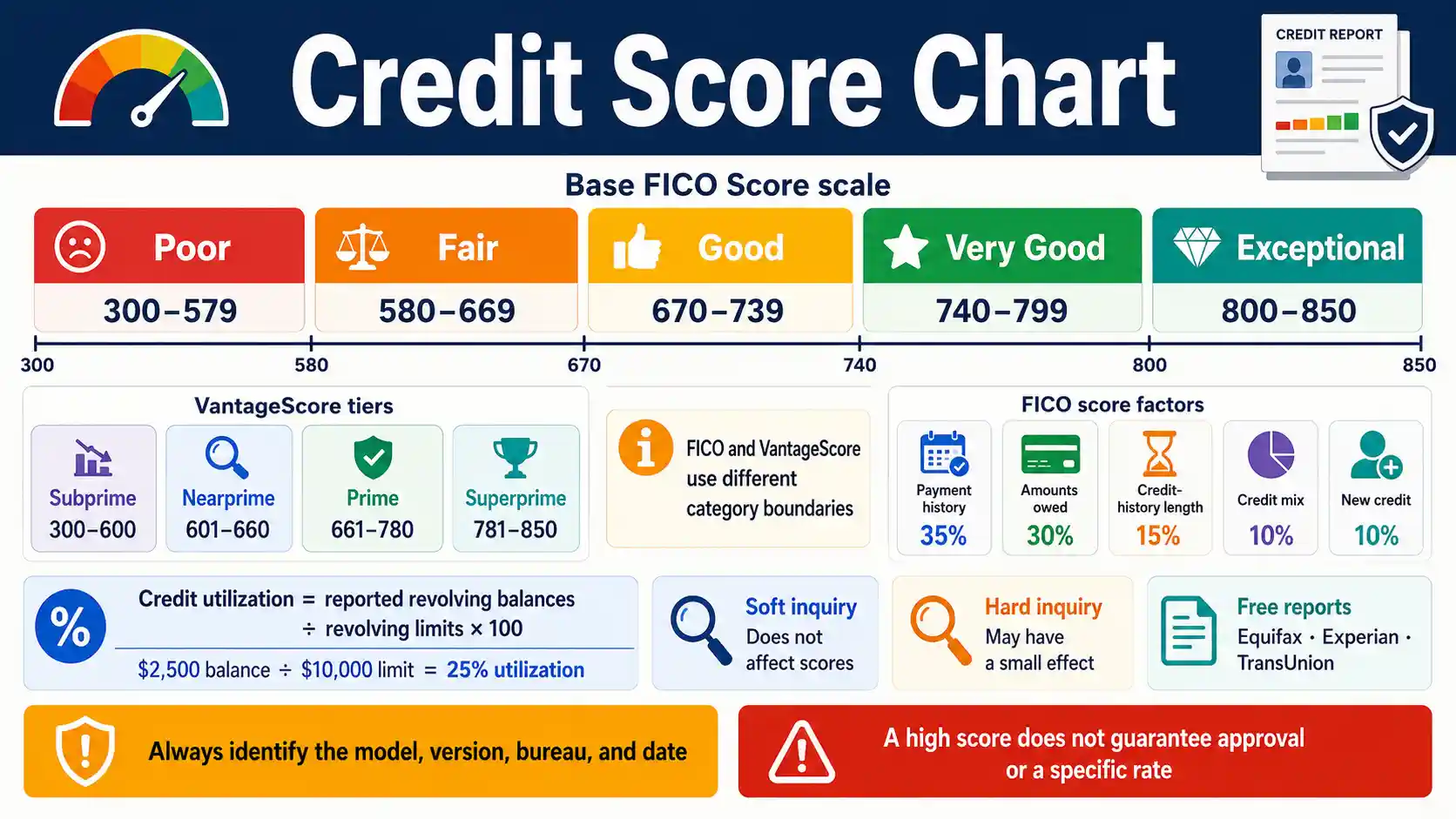
How to read a credit score chart
Start by identifying the scoring model. Match the number to that model only, then review the underlying credit reports for late payments, balances, limits, inquiries, account ownership, and errors. A score summarizes report data; it does not replace the report.
Common base scale
300–850
Base FICO Scores and current VantageScore models commonly use 300 as the low end and 850 as the high end.
Model difference
Labels are not interchangeable
A 700 score is Good under the common FICO chart and Prime under the VantageScore chart.
Report access
Free weekly reports
AnnualCreditReport.com provides free weekly online reports from Equifax, Experian, and TransUnion.
Critical limit
No score guarantees approval
Lenders can use another model and also consider income, debt, collateral, product rules, and the full application.
Direct answers to common credit score questions
What is a good FICO Score?
FICO labels base scores from 670 through 739 as Good.
What is a good VantageScore?
VantageScore places scores from 661 through 780 in its Prime tier.
Is 700 a good credit score?
A 700 score is Good under the common FICO chart and Prime under VantageScore.
What is the highest base credit score?
The highest base FICO Score and VantageScore is generally 850.
Why do credit scores differ?
The model, version, bureau data, product type, and calculation date can change the score.
Does checking your own credit hurt?
No. Checking your own report is a soft inquiry and does not lower your score.
Can a hard inquiry affect a score?
Yes. A hard inquiry may have a small effect, depending on the model and credit profile.
How is utilization calculated?
Divide reported revolving balances by revolving credit limits and multiply by 100.
Is 30% utilization an official cutoff?
No. Thirty percent is a common reference point, not a universal scoring cliff.
Must you carry debt to build credit?
No. Carrying an interest-bearing balance is not required to build credit.
How long can most negative information remain?
Most negative information can generally be reported for up to seven years.
Can a high score guarantee approval?
No. A high score does not guarantee approval, pricing, or a particular credit limit.
FICO Credit Score Range Chart
Base FICO Scores commonly use a 300–850 scale. These labels summarize broad risk bands, but each lender sets its own approval, pricing, and underwriting rules.
Swipe horizontally inside the table to view every column.
| Base FICO score | FICO rating | Broad interpretation | Important limitation |
|---|---|---|---|
| 300–579 | Poor | Substantially below the range FICO labels good | Approval and pricing still depend on the lender, product, income, debt, and full application — No universal approval rule |
| 580–669 | Fair | Below the range FICO labels good | Some lenders may approve credit, but terms can differ widely |
| 670–739 — FICO good score range | Good | Near or above the range many lenders view favorably | A good-band score does not guarantee approval or a particular rate |
| 740–799 | Very good | Above the good range and generally associated with lower modeled risk | The lender may use another bureau, model, or industry-specific score |
| 800–850 | Exceptional | Highest base FICO rating band | A perfect 850 is not required to qualify for favorable terms |
Base FICO Score range: 300–850. Industry-specific FICO Scores can use a 250–900 scale.
- • The label describes the score model band, not a universal lending decision.
- • A score can differ across Equifax, Experian, and TransUnion because the underlying report data may differ.
- • The score a consumer sees may differ from the score a lender uses for a mortgage, auto loan, or credit card.
Download or export
FICO labels are model bands, not lending promises
The official myFICO credit-score guide publishes the familiar Poor, Fair, Good, Very Good, and Exceptional bands. A lender still decides which score version, report source, cutoff, and other underwriting rules apply.
VantageScore Credit Tier Chart
VantageScore 4.0 uses a 300–850 scale but groups scores differently from the common FICO rating chart.
Swipe horizontally inside the table to view every column.
| VantageScore | Credit tier | Broad model label | Comparison caution |
|---|---|---|---|
| 300–600 | Subprime | Lowest VantageScore tier | Do not translate this label directly into a FICO label |
| 601–660 | Nearprime | Below the Prime tier | A score of 650 receives a different label under the FICO chart |
| 661–780 — VantageScore Prime tier | Prime | Broad middle-to-upper tier | The 120-point tier spans several FICO rating bands |
| 781–850 | Superprime | Highest VantageScore tier | The boundary differs from FICO Exceptional, which begins at 800 — Different boundary from FICO |
VantageScore 4.0 range: 300–850.
- • Always identify the score brand and version before interpreting a number.
- • A lender can use a different model from the one displayed by a bank, card issuer, or consumer app.
- • Higher scores generally indicate lower modeled credit risk, but they do not guarantee approval.
Download or export
VantageScore uses different tier boundaries
The VantageScore consumer guide groups current 300–850 scores into Subprime, Nearprime, Prime, and Superprime tiers. Do not convert one brand label into another without checking the actual chart.
FICO Score Factor Weight Chart
FICO groups report data into five broad categories. The published percentages describe importance for the general population and can vary by credit profile.
Swipe horizontally inside the table to view every column.
| FICO data category | General weight | Examples of report data | Practical focus |
|---|---|---|---|
| Payment history | 35% — Largest general FICO category | On-time payments, late payments, collections, and serious delinquencies | Pay every required bill by its due date |
| Amounts owed | 30% — Second-largest general FICO category | Revolving balances, credit limits, utilization, installment balances, and accounts with balances | Keep reported revolving balances manageable relative to limits |
| Length of credit history | 15% | Age of oldest account, average account age, and time since account activity | Avoid closing or opening accounts only to chase a short-term score change |
| Credit mix | 10% | Revolving accounts, installment loans, mortgages, and other account types | Do not borrow solely to create a mix |
| New credit | 10% | Recent hard inquiries and recently opened accounts | Apply for credit deliberately and compare same-type loans within a focused window |
Published FICO category weights total 100% for the general population.
- • The formula uses many variables inside each category; the percentages are not a point-by-point calculator.
- • One action can affect more than one category, and the effect depends on the full report.
- • FICO does not publish a guaranteed point increase for paying a balance, opening an account, or removing an error.
Download or export
Credit score range and utilization checker
Classify a 300–850 score under the selected model and calculate aggregate revolving utilization. The tool does not predict approval, pricing, or a future score change.
Example scenarios
Selected score band
Good
Base FICO Score range 670–739
Aggregate utilization
25.0%
The reported ratio is between 10% and 29.9%.
Calculation
$2,500 ÷ $10,000 × 100 = 25.0%
This result labels the selected model range and performs arithmetic only. It cannot estimate a point change because scoring formulas use the full credit file.
Credit Utilization Calculation Chart
Credit utilization equals reported revolving balance divided by revolving credit limit. These examples are calculation bands, not official score cutoffs.
Swipe horizontally inside the table to view every column.
| Reported balance | Credit limit | Utilization | What the number means |
|---|---|---|---|
| $0 | $10,000 | 0% | No revolving balance is reported in this example |
| $500 | $10,000 | 5% | Five cents is reported for each dollar of available revolving credit |
| $2,500 | $10,000 | 25% | One quarter of the combined revolving limit is reported as used |
| $3,000 | $10,000 | 30% | A common educational reference point, not a scoring cliff or guarantee — Thirty percent is not an official cutoff |
| $5,000 | $10,000 | 50% | Half of the combined revolving limit is reported as used |
| $9,000 | $10,000 | 90% | Most of the combined revolving limit is reported as used |
| $11,000 | $10,000 | 110% — Balance exceeds limit | The reported balance exceeds the stated limit |
Utilization percentage = reported revolving balances ÷ total revolving limits × 100.
- • Scoring models can evaluate both total utilization and utilization on individual revolving accounts.
- • The balance shown on a credit report can differ from the current app balance because issuers report on their own schedules.
- • Paying in full by the due date can avoid interest under card terms, but the reported balance can still be above zero if it was reported before payment.
Download or export
Credit Report, Score, and Inquiry Comparison Chart
A credit report is the underlying record. A credit score is a model-generated number based on report data. An inquiry records access to a credit file.
Swipe horizontally inside the table to view every column.
| Item | What it is | What it contains or does | Score effect |
|---|---|---|---|
| Credit report | A record maintained by a consumer reporting company | Accounts, payment history, balances, inquiries, identifying data, and public-record information when reportable | Report information supplies inputs to scoring models |
| Credit score | A number generated by a scoring model | Summarizes modeled credit risk using selected report data | The score itself is the output, not a report entry |
| Soft inquiry | A review that does not result from a new-credit application | Examples include checking your own report, account review, and some prescreening | Does not affect credit scores — Soft inquiry does not affect scores |
| Hard inquiry | A file review connected with an application for credit | Appears on the report and indicates a request for new credit | May have a small score effect, depending on the model and profile — Hard inquiry may affect score |
| Rate-shopping inquiries | Several same-type loan inquiries made in a focused period | Mortgage, auto, or student-loan shopping may be grouped by common models | Common models generally treat qualifying inquiries within about 14–45 days as one |
Inquiry treatment depends on the scoring model, loan type, and timing.
- • Checking your own credit report does not lower your score.
- • A credit report does not necessarily include a free credit score.
- • Review the score brand, version, bureau source, and calculation date before comparing two scores.
Download or export
Review all three credit reports before fixing a score problem
The Consumer Financial Protection Bureau credit-report hub explains report review, score differences, disputes, and consumer rights. Free weekly online reports are available through AnnualCreditReport.com.
Credit Report Information Time Limit Chart
Federal law generally limits how long many negative items may be reported. The exact date and exceptions can depend on the item and applicable law.
Swipe horizontally inside the table to view every column.
| Information type | General reporting period | Starting point or context | Action to take |
|---|---|---|---|
| Most negative information | Generally up to 7 years — General seven-year period | Often tied to the event or delinquency date under applicable reporting rules | Check dates and dispute inaccurate or obsolete information |
| Bankruptcy | Up to 10 years — Bankruptcy can remain up to ten years | Measured under the applicable bankruptcy reporting rule | Confirm chapter, filing details, and dates on each report |
| Positive open accounts | Can remain while active | Accurate current accounts may continue to be reported | Review payment status, balance, limit, and ownership |
| Closed positive accounts | May remain after closure | Retention practices can vary while information remains reportable | Keep records and confirm the account is marked closed correctly |
| Hard inquiries | Visible for a limited period | The report records who requested access and when | Investigate inquiries you do not recognize |
| Identity-theft information | Special blocking and alert rights may apply | Use the identity-theft process rather than waiting for ordinary aging | Report identity theft and contact reporting companies promptly |
General federal reporting periods are educational summaries, not a case-specific legal determination.
- • Accurate negative information generally cannot be removed merely because it lowers a score.
- • An error should be disputed with both the reporting company and the company that furnished the information.
- • A credit reporting company generally must investigate a properly submitted dispute, commonly within 30 days.
Download or export
Common Credit Score Mistakes and Better Actions
Credit-building claims often oversimplify how scoring works. Use actions that improve report accuracy and payment behavior without promising a specific point gain.
Swipe horizontally inside the table to view every column.
| Mistake | Why it can mislead or hurt | Better action | What to verify |
|---|---|---|---|
| Treating every score as the same model | FICO, VantageScore, industry versions, bureaus, and dates can produce different numbers | Record the model, version, bureau, and date | Compare like with like |
| Missing a payment to preserve cash | Payment history is a major scoring category and late fees or default consequences may follow | Contact the lender before the due date if payment is at risk | Due date, minimum payment, hardship options, and reporting terms |
| Opening several accounts for a quick boost | New accounts and inquiries can affect the profile and create more debt capacity | Apply only for useful credit you can manage | Fees, terms, approval need, and repayment plan |
| Closing an old card only to improve the score | Closure can reduce available revolving credit and change utilization | Evaluate fees, fraud risk, age, and utilization before closing | Balance, limit, annual fee, and account terms |
| Carrying interest-bearing debt to build credit | Interest is a cost and a balance is not required to show responsible payment | Pay according to the statement and avoid unnecessary interest — Interest is not required to build credit | Statement balance, due date, grace period, and reported balance |
| Assuming 30% utilization is a pass-fail line | Scoring does not use one public universal cliff for every profile | Calculate actual utilization and keep balances manageable | Total and per-card reported balances and limits |
| Paying a credit-repair company to remove accurate data | Accurate, timely information generally cannot be lawfully erased on demand — Accurate information cannot be erased on demand | Dispute genuine errors directly and keep documentation | Contract, fees, promises, and cancellation rights |
| Ignoring a score drop caused by an error | Incorrect late payments, balances, accounts, or identity data can affect decisions | Review all three reports and dispute inaccurate items | Account ownership, dates, balances, limits, and payment status |
| Expecting a guaranteed point increase | Scoring formulas and full-file interactions prevent exact public predictions | Track report changes and compare the same score model over time | Model, version, bureau, and date — Compare the same model over time |
| Using a score as a complete approval test | Lenders also evaluate income, debt, collateral, product rules, and other criteria | Review the full application and lender requirements | APR, fees, payment, total cost, and approval conditions |
No legitimate educational chart can guarantee a specific score increase or approval decision.
- • Avoid companies that promise a new credit identity or guaranteed removal of accurate negative information.
- • Do not share Social Security numbers, report-access credentials, or account passwords with an unverified service.
- • For identity theft, use IdentityTheft.gov and place appropriate fraud alerts or freezes promptly.
Download or export
Limits and special cases
Thin or new credit files
A person may not have enough eligible report history to generate a score under a particular model. Another model may score the same file differently.
Mortgage and industry scores
Mortgage, auto, and bankcard decisions can use specialized or older model versions. Industry-specific FICO Scores can use a 250–900 range.
Identity theft and mixed files
Unknown accounts, addresses, inquiries, or personal data require prompt report review. Use identity-theft blocking, alerts, and freezes when the situation warrants them.
Approval uses more than a score
Income, debt-to-income ratio, down payment, collateral, account history, fraud checks, and product rules can affect a decision even when the score is high.
Frequently asked questions
What is a good FICO Score?
FICO labels base scores from 670 through 739 as Good. Lenders set their own approval and pricing rules, so the label does not guarantee a loan or rate.
What is a good VantageScore?
VantageScore places scores from 661 through 780 in its Prime tier. Its tier boundaries differ from the common FICO rating bands.
Is 700 a good credit score?
A 700 base FICO Score falls in the Good range, while a 700 VantageScore falls in the Prime tier. The lender may use a different score version or bureau.
What is the highest credit score?
The highest base FICO Score and VantageScore is generally 850. Some industry-specific FICO Scores use a 250–900 scale.
Why are my credit scores different?
Scores can differ because the model, version, credit bureau data, loan type, and calculation date differ. Compare the same score type before judging a change.
Does checking my own credit lower my score?
No. Checking your own credit report is a soft inquiry and does not lower your credit score.
Does a hard inquiry lower a credit score?
A hard inquiry may have a small effect, depending on the scoring model and profile. Same-type mortgage, auto, or student-loan inquiries may be grouped during a focused shopping period.
Is 30% credit utilization a strict cutoff?
No. Thirty percent is a common educational reference, not a universal scoring cliff. Lower reported revolving utilization is generally preferable, but the exact effect depends on the full profile.
How do I calculate credit utilization?
Divide reported revolving balances by total revolving credit limits and multiply by 100. Also review utilization on each individual card.
Do I need to carry a balance to build credit?
No. Carrying an interest-bearing balance is not required to build credit. Paying as agreed and keeping reported balances manageable are more useful goals.
How often can I check my credit reports for free?
Free weekly online credit reports are available from Equifax, Experian, and TransUnion through AnnualCreditReport.com.
How long does negative information stay on a credit report?
Most negative information can generally be reported for up to seven years. Bankruptcies can remain for up to ten years, subject to applicable rules and exceptions.
How do I dispute a credit report error?
Dispute the error with the credit reporting company and the company that supplied the information. Explain the problem and include copies of supporting documents.
Can a credit repair company guarantee a score increase?
No legitimate service can guarantee a specific point increase. Accurate, timely negative information generally cannot be removed simply because it lowers a score.
Does a high score guarantee approval?
No. Lenders can consider the score, income, debt, collateral, loan-to-value ratio, product rules, and other application information.
Sources
These scoring-company and U.S. consumer-protection resources support the range labels, factor categories, report guidance, inquiry treatment, dispute information, and reporting periods.
FICO — myFICO — Credit Scores and What Is in a FICO Score
https://www.myfico.com/credit-education/credit-scores
Publishes the 300–850 base FICO score range, common rating bands, and the five broad data categories used in FICO scoring.
VantageScore — The Complete Guide to Your VantageScore Credit Score
https://vantagescore.com/consumers/blog/the-complete-guide-to-your-vantagescore
Publishes the 300–850 VantageScore scale and the Subprime, Nearprime, Prime, and Superprime credit tiers.
Consumer Financial Protection Bureau — Understand Your Credit Score
https://www.consumerfinance.gov/consumer-tools/credit-reports-and-scores/understand-your-credit-score/
Explains that consumers have multiple credit scores and that model, bureau data, product type, and calculation date can change the result.
AnnualCreditReport.com — Official Free Credit Reports
https://www.annualcreditreport.com/index.action
Provides free weekly online credit reports from Equifax, Experian, and TransUnion through the federally authorized website.
Consumer Financial Protection Bureau — Credit Report Errors, Inquiries, and Reporting Time Limits
https://www.consumerfinance.gov/consumer-tools/credit-reports-and-scores/
Provides consumer guidance on disputes, inquiries, report review, and the general seven-year limit for most negative information and ten-year limit for bankruptcies.