Animals & Pets · Dogs
Dog Breeds Chart: Compare Size, Groups, Coat, Activity and Care
Compare 60 widely known dog breeds, understand AKC and FCI group systems, and plan for adult size, coat, shedding, exercise, trainability, noise, space and original working purpose.
Breed is not destiny. These tables describe broad tendencies and cannot predict one dog’s health, behavior or household fit. Read the ChartsLoom Disclaimer.
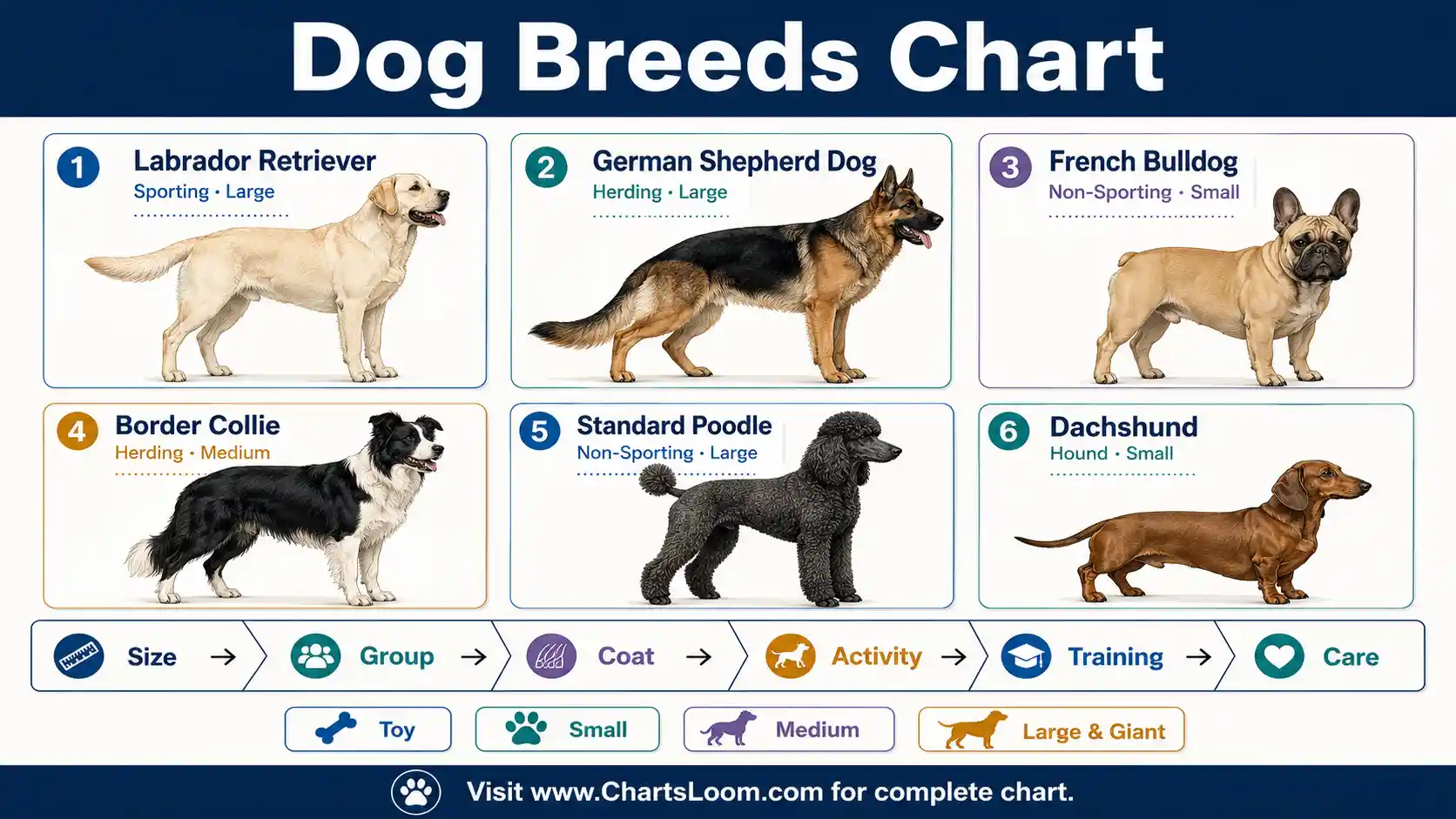
Dog breed comparison: the quick answer
A dog breed is a population maintained to a written standard describing structure, movement, coat and defining characteristics. Registries recognize and group breeds differently, so always name the organization when quoting a total or group. For household planning, compare the adult dog’s likely size, exercise, grooming, shedding, noise and training needs rather than choosing by appearance alone.
Comparison directory
60 breeds
A practical cross-section of toy, hound, sporting, working, terrier, herding and companion breeds.
AKC recognition
205 breeds
The AKC states that it recognizes 205 breeds and organizes fully recognized breeds into seven groups.
FCI recognition
364 breeds
The FCI states that it recognizes 364 breeds across ten international groups.
Key limitation
Traits ≠ guarantees
Breed patterns help planning, but the individual dog’s health, history, training and behavior remain decisive.
Questions at a glance
How many dog breeds are recognized?
The answer depends on the registry. The AKC states 205, while the FCI states 364.
Why do registry totals differ?
Registries apply different naming, recognition and variety rules.
What are the seven AKC groups?
Sporting, Hound, Working, Terrier, Toy, Non-Sporting and Herding.
What are the ten FCI groups?
The FCI separates sheepdogs, molossoid types, terriers, dachshunds, spitz, scent hounds, pointing dogs, retrievers and flushing dogs, companion dogs and sighthounds.
Does dog size predict exercise needs?
No. Some small terriers need more activity than much larger, calmer breeds.
Does short hair mean low shedding?
No. Coat density and growth cycle matter more than length alone.
Are low-shedding breeds allergy-free?
No breed is guaranteed allergen-free.
Can a photo identify a breed?
A photo can suggest visual similarities but cannot prove ancestry.
What makes a breed easy to train?
Responsiveness, motivation, reinforcement history and handler skill all matter.
Is a small dog automatically apartment-friendly?
No. Noise, energy, housetraining and access needs can outweigh size.
Does breed guarantee temperament?
No. Breed describes tendencies, not a fixed personality.
Which traits should households compare?
Compare adult size, activity, grooming, shedding, noise, trainability, health screening and individual behavior.
Dog Breed Recognition and Registry Scope
Registry totals differ because organizations use different recognition stages, standards, naming systems and group structures.
Swipe horizontally inside the table to view every column.
| Registry or term | Current figure or status | Meaning | How to use it |
|---|---|---|---|
| AKC fully recognized breeds | 205 | American Kennel Club registry total stated for 2026 | Use the live AKC list for United States recognition status. |
| AKC breed groups | 7 | Sporting, Hound, Working, Terrier, Toy, Non-Sporting and Herding | Groups reflect historical purpose and show organization, not exact lifestyle fit. |
| AKC varieties | Some breeds have recognized varieties | Varieties may differ by size, coat or color while remaining one breed framework | Check the specific breed standard and registry wording. |
| AKC Foundation Stock Service | Separate from full recognition | Records developing breeds that are not yet eligible for full AKC registration | Do not count FSS entries as fully recognized breeds. |
| FCI recognized breeds | 364 | International federation total stated by FCI | Use the FCI nomenclature for international group and standard references. |
| FCI breed groups | 10 | Functional and historical grouping system | The FCI and AKC systems do not map one-to-one. |
| Royal Kennel Club directory | Registry-specific list | United Kingdom breed names, groups and standards can differ from AKC usage | Name the registry whenever quoting a group or recognition total. |
| Worldwide dog types | More than any single registry total | Regional breeds, landraces and developing populations may sit outside one registry | Avoid presenting one registry count as every dog breed worldwide. |
- • Counts and recognition status can change; use the named registry’s current directory.
- • One registry total is not a count of every regional breed, landrace or developing population worldwide.
Download or export
Dog Breeds Master Comparison Chart
Compare 60 widely known breeds by registry group, adult size, weight, coat, shedding, activity, trainability and defining appearance.
Swipe horizontally inside the table to view every column.
| Breed | AKC group | Size | Typical adult weight | Coat | Shedding | Activity | Trainability | Signature traits |
|---|---|---|---|---|---|---|---|---|
| Affenpinscher | Toy | Toy | 7–10 lb | Wiry, dense | Low | Moderate | Moderate | Small square dog with a wiry coat and monkey-like expression |
| Afghan Hound | Hound | Large | 50–60 lb | Long, silky | Low | Moderate | Moderate | Tall, elegant outline with long flowing coat and ringed tail |
| Airedale Terrier | Terrier | Large | 50–70 lb | Hard, wiry | Low | High | High | Largest terrier with a long head and black-and-tan jacket |
| Akita | Working | Large | 70–130 lb | Double coat | High | Moderate | High | Powerful spitz with a broad head and curled tail |
| Alaskan Malamute | Working | Large | 75–85 lb | Heavy double coat | High | High | Moderate | Substantial northern dog with plume tail and strong bone |
| Australian Cattle Dog | Herding | Medium | 35–50 lb | Short double coat | Moderate | High | High | Compact, muscular herder with blue or red speckling |
| Australian Shepherd | Herding | Medium | 40–65 lb | Medium double coat | High | High | High | Athletic herder with varied coat colors and natural or docked tail |
| Basenji | Hound | Medium | 22–24 lb | Short, fine | Low | High | Moderate | Fine-boned hound with curled tail, wrinkled forehead and yodel-like vocalization |
| Basset Hound | Hound | Medium | 40–65 lb | Short, smooth | Moderate | Moderate | Moderate | Long, low body with heavy bone, long ears and loose skin |
| Beagle | Hound | Small | Under 30 lb | Short, dense | Moderate | High | Moderate | Compact scent hound with long ears and white-tipped tail |
| Belgian Malinois | Herding | Large | 40–80 lb | Short double coat | Moderate | High | High | Square, alert shepherd with black mask and high drive |
| Bernese Mountain Dog | Working | Giant | 70–115 lb | Long double coat | High | Moderate | High | Large tricolor mountain dog with broad chest and gentle expression |
| Bichon Frise | Non-Sporting | Small | 12–18 lb | Curly double coat | Low | Moderate | High | Small white companion with rounded outline and plush curls |
| Border Collie | Herding | Medium | 30–55 lb | Smooth or rough double coat | Moderate | High | High | Agile herder with intense eye and exceptional responsiveness |
| Boston Terrier | Non-Sporting | Small | 12–25 lb | Short, smooth | Low | Moderate | High | Compact tuxedo-marked dog with square muzzle and upright ears |
| Boxer | Working | Large | 50–80 lb | Short, smooth | Moderate | High | High | Muscular square dog with short muzzle and expressive face |
| Brittany | Sporting | Medium | 30–40 lb | Dense, flat or wavy | Moderate | High | High | Compact orange-and-white or liver-and-white pointing dog |
| Bulldog | Non-Sporting | Medium | 40–50 lb | Short, smooth | Moderate | Calm | Moderate | Low, broad dog with loose skin, undershot jaw and rolling gait |
| Bull Terrier | Terrier | Medium | 50–70 lb | Short, flat | Moderate | High | High | Muscular dog with distinctive egg-shaped head and triangular eyes |
| Cavalier King Charles Spaniel | Toy | Small | 13–18 lb | Silky, feathered | Moderate | Moderate | High | Small spaniel with large dark eyes and long feathered ears |
| Chihuahua | Toy | Toy | Up to 6 lb | Smooth or long | Low | Moderate | Moderate | Tiny alert dog with apple-shaped head or deer-like outline |
| Chinese Crested | Toy | Small | 8–12 lb | Hairless or powderpuff | Low | Moderate | High | Fine-boned dog in hairless and fully coated varieties |
| Cocker Spaniel | Sporting | Small | 20–30 lb | Silky, feathered | Moderate | Moderate | High | Compact sporting spaniel with long ears and abundant feathering |
| Collie | Herding | Large | 50–75 lb | Rough or smooth | High | Moderate | High | Long wedge-shaped head with rough or smooth coat variety |
| Dachshund | Hound | Small | 11–32 lb | Smooth, long or wire | Moderate | Moderate | Moderate | Long low body with short legs and three coat varieties |
| Dalmatian | Non-Sporting | Large | 45–70 lb | Short, dense | High | High | High | Athletic white dog with distinct black or liver spots |
| Doberman Pinscher | Working | Large | 60–100 lb | Short, smooth | Moderate | High | High | Sleek square dog with wedge head and powerful athletic build |
| English Springer Spaniel | Sporting | Medium | 40–50 lb | Medium, feathered | Moderate | High | High | Balanced spaniel with long ears, feathering and active gait |
| French Bulldog | Non-Sporting | Small | Under 28 lb | Short, smooth | Moderate | Moderate | Moderate | Compact dog with bat ears, short muzzle and heavy bone |
| German Shepherd Dog | Herding | Large | 50–90 lb | Medium double coat | High | High | High | Strong, agile shepherd with sloping outline and erect ears |
| Golden Retriever | Sporting | Large | 55–75 lb | Dense, water-repellent | High | High | High | Balanced golden sporting dog with feathering and friendly expression |
| Great Dane | Working | Giant | 110–175 lb | Short, smooth | Moderate | Moderate | Moderate | Very tall, powerful dog with a clean rectangular outline |
| Great Pyrenees | Working | Giant | 85–160 lb | Long double coat | High | Moderate | Moderate | Large white mountain guardian with heavy coat and calm bearing |
| Havanese | Toy | Small | 7–13 lb | Long, silky or wavy | Low | Moderate | High | Small sturdy companion with long silky coat and plumed tail |
| Irish Setter | Sporting | Large | 60–70 lb | Long, silky | Moderate | High | High | Tall red sporting dog with flowing feathering and racy outline |
| Russell Terrier | Terrier | Small | 9–15 lb | Smooth, broken or rough | Moderate | High | High | Compact white terrier with flexible body and lively expression |
| Labrador Retriever | Sporting | Large | 55–80 lb | Short, dense double coat | High | High | High | Strong sporting dog with broad head, otter tail and dense coat |
| Maltese | Toy | Toy | Under 7 lb | Long, silky | Low | Moderate | High | Tiny white dog with floor-length silky coat and dark eyes |
| Mastiff | Working | Giant | 120–230 lb | Short, dense | Moderate | Calm | Moderate | Massive, heavy-boned dog with broad head and black mask |
| Miniature Pinscher | Toy | Toy | 8–10 lb | Short, smooth | Low | High | High | Compact square dog with high-stepping gait and alert expression |
| Miniature Schnauzer | Terrier | Small | 11–20 lb | Wiry double coat | Low | High | High | Sturdy small schnauzer with beard, eyebrows and rectangular head |
| Newfoundland | Working | Giant | 100–150 lb | Heavy water-resistant double coat | High | Moderate | High | Massive water dog with broad head, webbed feet and thick coat |
| Papillon | Toy | Toy | 5–10 lb | Long, silky | Moderate | High | High | Fine-boned toy spaniel with large butterfly-like ears |
| Pekingese | Toy | Small | Up to 14 lb | Long double coat | High | Calm | Moderate | Low, compact dog with broad head, heavy mane and rolling gait |
| Pembroke Welsh Corgi | Herding | Small | Up to 30 lb | Medium double coat | High | High | High | Long low herder with upright ears and fox-like expression |
| Pomeranian | Toy | Toy | 3–7 lb | Abundant double coat | High | High | High | Tiny spitz with profuse stand-off coat and plumed tail |
| Poodle (Standard) | Non-Sporting | Large | 40–70 lb | Curly, dense | Low | High | High | Square, athletic dog with dense curls and refined head |
| Pug | Toy | Small | 14–18 lb | Short double coat | High | Moderate | Moderate | Compact dog with wrinkled face, curled tail and square body |
| Rhodesian Ridgeback | Hound | Large | 70–85 lb | Short, sleek | Low | High | High | Athletic hound with a ridge of reversed hair along the back |
| Rottweiler | Working | Large | 80–135 lb | Short double coat | Moderate | Moderate | High | Powerful black-and-tan dog with broad head and substantial body |
| Samoyed | Working | Large | 35–65 lb | Heavy white double coat | High | High | High | White northern spitz with upturned mouth and plume tail |
| Shetland Sheepdog | Herding | Small | 15–25 lb | Long double coat | High | High | High | Small agile herder with long wedge head and abundant mane |
| Shiba Inu | Non-Sporting | Small | 17–23 lb | Short double coat | High | High | Moderate | Compact Japanese spitz with curled tail and fox-like face |
| Shih Tzu | Toy | Small | 9–16 lb | Long, dense | Low | Moderate | Moderate | Sturdy small dog with broad round head and flowing coat |
| Siberian Husky | Working | Large | 35–60 lb | Medium double coat | High | High | Moderate | Medium northern sled dog with erect ears and brush tail |
| Staffordshire Bull Terrier | Terrier | Medium | 24–38 lb | Short, smooth | Low | High | High | Compact muscular terrier with broad head and strong jaw |
| Vizsla | Sporting | Large | 44–60 lb | Short, smooth | Low | High | High | Lean rust-colored sporting dog with close coat and long ears |
| Weimaraner | Sporting | Large | 55–90 lb | Short, smooth | Low | High | High | Sleek gray sporting dog with amber or blue-gray eyes |
| Whippet | Hound | Medium | 25–40 lb | Short, smooth | Low | Moderate | Moderate | Slender deep-chested sighthound with arched loin |
| Yorkshire Terrier | Toy | Toy | About 7 lb | Long, silky | Low | High | High | Tiny terrier with straight blue-and-tan silky coat |
- • Values are practical adult comparison ranges, not guarantees for every dog.
- • Sex, age, body condition, breeding line, health and registry standard can affect measurements and behavior.
Download or export
Interactive tool
Dog breed trait finder
Select adult size, activity, grooming, shedding, trainability and home-space preferences. The finder compares those choices with the visible 60-breed dataset and returns exact or closest category matches.
Default example: a medium, highly active, highly trainable dog with low grooming, moderate shedding and adaptable space needs.
Comparison result
Found 2 exact trait matches. Use these as research leads, then assess the individual dog.
Australian Cattle Dog
6 matched traitsCompact, muscular herder with blue or red speckling
Matched: Size: Medium · Activity: High · Grooming: Low · Shedding: Moderate · Trainability: High · Home space: Adaptable
Bull Terrier
6 matched traitsMuscular dog with distinctive egg-shaped head and triangular eyes
Matched: Size: Medium · Activity: High · Grooming: Low · Shedding: Moderate · Trainability: High · Home space: Adaptable
What it does
Ranks breeds by six broad, deterministic lifestyle and care categories from the visible dataset.
Why it helps
Turns household constraints into a smaller breed-research list without pretending to choose a dog for you.
What it cannot do
It cannot identify a dog from an image, prove ancestry, predict behavior, diagnose health or guarantee suitability.
Registry structure
Group names describe history, not a complete lifestyle forecast
AKC and FCI groups reflect historical purpose and registry organization. Dogs within one group can still differ greatly in size, energy, coat, sociability and training needs.
AKC Dog Breed Groups Chart
The seven AKC groups organize fully recognized breeds largely by historical purpose and type.
Swipe horizontally inside the table to view every column.
| AKC group | Typical members | Historical function | Examples |
|---|---|---|---|
| Sporting | Pointers, setters, spaniels and retrievers | Field work involving birds and game | Brittany; Golden Retriever; Labrador Retriever |
| Hound | Sighthounds and scent hounds | Pursuit or tracking by sight or scent | Afghan Hound; Beagle; Whippet |
| Working | Guardians, draft dogs, sled dogs and service types | Strength, protection, hauling or specialized work | Boxer; Great Dane; Siberian Husky |
| Terrier | Earth dogs and vermin-control breeds | Persistence, digging and prey-oriented work | Airedale Terrier; Bull Terrier; Russell Terrier |
| Toy | Small companion breeds | Companionship, often with alert-dog heritage | Chihuahua; Papillon; Yorkshire Terrier |
| Non-Sporting | Diverse breeds not placed in the other six groups | Varied historical purposes | Bulldog; Dalmatian; Poodle |
| Herding | Livestock-moving and controlling breeds | Gathering, driving or guarding stock | Border Collie; German Shepherd Dog; Pembroke Welsh Corgi |
- • Group membership is a registry classification, not a complete temperament or care forecast.
Download or export
FCI Dog Breed Groups Chart
The FCI uses ten groups, which do not map directly to the seven AKC groups.
Swipe horizontally inside the table to view every column.
| FCI group | Official group name | Broad purpose | Examples |
|---|---|---|---|
| 1 | Sheepdogs and Cattledogs except Swiss Cattledogs | Livestock management | Border Collie; German Shepherd Dog |
| 2 | Pinscher and Schnauzer, Molossoid, Swiss Mountain and Cattledogs | Guarding, farm, mountain and utility work | Bernese Mountain Dog; Dobermann; Rottweiler |
| 3 | Terriers | Vermin and earth work | Airedale Terrier; Russell Terrier |
| 4 | Dachshunds | Underground scent work | Dachshund |
| 5 | Spitz and Primitive Types | Northern work, hunting and ancient-type dogs | Akita; Samoyed; Shiba Inu |
| 6 | Scenthounds and Related Breeds | Tracking game by scent | Basset Hound; Beagle; Dalmatian |
| 7 | Pointing Dogs | Locating and indicating game | Brittany; Irish Setter; Vizsla |
| 8 | Retrievers, Flushing Dogs and Water Dogs | Finding, flushing and retrieving game | Cocker Spaniel; Golden Retriever; Labrador Retriever |
| 9 | Companion and Toy Dogs | Primarily companion breeds | Bichon Frise; Chihuahua; Pug |
| 10 | Sighthounds | Pursuit by sight and speed | Afghan Hound; Rhodesian Ridgeback; Whippet |
- • Official breed names and sections should be checked in the live FCI nomenclature.
Download or export
Dog Breed Size, Height and Weight Chart
Representative adult height and weight ranges help plan equipment, transport, housing and handling.
Swipe horizontally inside the table to view every column.
| Breed | Size class | Typical height | Typical weight | AKC group |
|---|---|---|---|---|
| Affenpinscher | Toy | 9–11.5 in | 7–10 lb | Toy |
| Afghan Hound | Large | 25–27 in | 50–60 lb | Hound |
| Airedale Terrier | Large | 23 in | 50–70 lb | Terrier |
| Akita | Large | 24–28 in | 70–130 lb | Working |
| Alaskan Malamute | Large | 23–25 in | 75–85 lb | Working |
| Australian Cattle Dog | Medium | 17–20 in | 35–50 lb | Herding |
| Australian Shepherd | Medium | 18–23 in | 40–65 lb | Herding |
| Basenji | Medium | 16–17 in | 22–24 lb | Hound |
| Basset Hound | Medium | Up to 15 in | 40–65 lb | Hound |
| Beagle | Small | Up to 15 in | Under 30 lb | Hound |
| Belgian Malinois | Large | 22–26 in | 40–80 lb | Herding |
| Bernese Mountain Dog | Giant | 23–27.5 in | 70–115 lb | Working |
| Bichon Frise | Small | 9.5–11.5 in | 12–18 lb | Non-Sporting |
| Border Collie | Medium | 18–22 in | 30–55 lb | Herding |
| Boston Terrier | Small | 15–17 in | 12–25 lb | Non-Sporting |
| Boxer | Large | 21.5–25 in | 50–80 lb | Working |
| Brittany | Medium | 17.5–20.5 in | 30–40 lb | Sporting |
| Bulldog | Medium | 14–15 in | 40–50 lb | Non-Sporting |
| Bull Terrier | Medium | 21–22 in | 50–70 lb | Terrier |
| Cavalier King Charles Spaniel | Small | 12–13 in | 13–18 lb | Toy |
| Chihuahua | Toy | 5–8 in | Up to 6 lb | Toy |
| Chinese Crested | Small | 11–13 in | 8–12 lb | Toy |
| Cocker Spaniel | Small | 13.5–15.5 in | 20–30 lb | Sporting |
| Collie | Large | 22–26 in | 50–75 lb | Herding |
| Dachshund | Small | 5–9 in | 11–32 lb | Hound |
| Dalmatian | Large | 19–24 in | 45–70 lb | Non-Sporting |
| Doberman Pinscher | Large | 24–28 in | 60–100 lb | Working |
| English Springer Spaniel | Medium | 19–20 in | 40–50 lb | Sporting |
| French Bulldog | Small | 11–13 in | Under 28 lb | Non-Sporting |
| German Shepherd Dog | Large | 22–26 in | 50–90 lb | Herding |
| Golden Retriever | Large | 21.5–24 in | 55–75 lb | Sporting |
| Great Dane | Giant | 28–32 in | 110–175 lb | Working |
| Great Pyrenees | Giant | 25–32 in | 85–160 lb | Working |
| Havanese | Small | 8.5–11.5 in | 7–13 lb | Toy |
| Irish Setter | Large | 25–27 in | 60–70 lb | Sporting |
| Russell Terrier | Small | 10–12 in | 9–15 lb | Terrier |
| Labrador Retriever | Large | 21.5–24.5 in | 55–80 lb | Sporting |
| Maltese | Toy | 7–9 in | Under 7 lb | Toy |
| Mastiff | Giant | 27.5 in and up | 120–230 lb | Working |
| Miniature Pinscher | Toy | 10–12.5 in | 8–10 lb | Toy |
- • Height is generally measured at the withers.
- • Use the individual dog’s healthy body condition rather than targeting a chart number alone.
Download or export
Daily care
Translate breed descriptions into time, space and routine
A dense coat changes grooming and shedding. Working heritage can increase exercise and mental-work needs. Vocality and adult size affect neighbors, travel, equipment and emergency planning.
Dog Coat Types and Grooming Chart
Coat length, texture, density and growth pattern affect brushing, bathing, trimming and professional grooming needs.
Swipe horizontally inside the table to view every column.
| Breed | Coat type | Grooming level | Shedding | Practical care note |
|---|---|---|---|---|
| Affenpinscher | Wiry, dense | Moderate | Low | Routine home care is usually manageable with consistency. |
| Afghan Hound | Long, silky | High | Low | Professional trimming may be useful. |
| Airedale Terrier | Hard, wiry | High | Low | Professional trimming may be useful. |
| Akita | Double coat | Moderate | High | Routine home care is usually manageable with consistency. |
| Alaskan Malamute | Heavy double coat | High | High | Professional trimming may be useful. |
| Australian Cattle Dog | Short double coat | Low | Moderate | Routine home care is usually manageable with consistency. |
| Australian Shepherd | Medium double coat | Moderate | High | Routine home care is usually manageable with consistency. |
| Basenji | Short, fine | Low | Low | Routine home care is usually manageable with consistency. |
| Basset Hound | Short, smooth | Low | Moderate | Routine home care is usually manageable with consistency. |
| Beagle | Short, dense | Low | Moderate | Routine home care is usually manageable with consistency. |
| Belgian Malinois | Short double coat | Low | Moderate | Routine home care is usually manageable with consistency. |
| Bernese Mountain Dog | Long double coat | High | High | Professional trimming may be useful. |
| Bichon Frise | Curly double coat | High | Low | Professional trimming may be useful. |
| Border Collie | Smooth or rough double coat | Moderate | Moderate | Routine home care is usually manageable with consistency. |
| Boston Terrier | Short, smooth | Low | Low | Routine home care is usually manageable with consistency. |
| Boxer | Short, smooth | Low | Moderate | Routine home care is usually manageable with consistency. |
| Brittany | Dense, flat or wavy | Low | Moderate | Routine home care is usually manageable with consistency. |
| Bulldog | Short, smooth | Low | Moderate | Routine home care is usually manageable with consistency. |
| Bull Terrier | Short, flat | Low | Moderate | Routine home care is usually manageable with consistency. |
| Cavalier King Charles Spaniel | Silky, feathered | Moderate | Moderate | Routine home care is usually manageable with consistency. |
| Chihuahua | Smooth or long | Low | Low | Routine home care is usually manageable with consistency. |
| Chinese Crested | Hairless or powderpuff | Moderate | Low | Routine home care is usually manageable with consistency. |
| Cocker Spaniel | Silky, feathered | High | Moderate | Professional trimming may be useful. |
| Collie | Rough or smooth | Moderate | High | Routine home care is usually manageable with consistency. |
| Dachshund | Smooth, long or wire | Moderate | Moderate | Routine home care is usually manageable with consistency. |
| Dalmatian | Short, dense | Low | High | Routine home care is usually manageable with consistency. |
| Doberman Pinscher | Short, smooth | Low | Moderate | Routine home care is usually manageable with consistency. |
| English Springer Spaniel | Medium, feathered | Moderate | Moderate | Routine home care is usually manageable with consistency. |
| French Bulldog | Short, smooth | Low | Moderate | Routine home care is usually manageable with consistency. |
| German Shepherd Dog | Medium double coat | Moderate | High | Routine home care is usually manageable with consistency. |
| Golden Retriever | Dense, water-repellent | Moderate | High | Routine home care is usually manageable with consistency. |
| Great Dane | Short, smooth | Low | Moderate | Routine home care is usually manageable with consistency. |
| Great Pyrenees | Long double coat | High | High | Professional trimming may be useful. |
| Havanese | Long, silky or wavy | High | Low | Professional trimming may be useful. |
| Irish Setter | Long, silky | High | Moderate | Professional trimming may be useful. |
| Russell Terrier | Smooth, broken or rough | Low | Moderate | Routine home care is usually manageable with consistency. |
- • Low shedding can still require intensive clipping or combing.
- • Introduce grooming gradually and inspect skin, ears, nails and teeth as part of routine care.
Download or export
Dog Shedding and Allergy Interpretation Chart
Shedding level describes loose hair, while allergy exposure depends on proteins carried in dander, saliva and urine.
Swipe horizontally inside the table to view every column.
| Breed | Typical shedding | Coat | Interpretation |
|---|---|---|---|
| Bichon Frise | Low | Curly double coat | Lower-shedding does not mean allergen-free. |
| Border Collie | Moderate | Smooth or rough double coat | Expect loose hair and plan regular coat care. |
| Boston Terrier | Low | Short, smooth | Lower-shedding does not mean allergen-free. |
| Boxer | Moderate | Short, smooth | Expect loose hair and plan regular coat care. |
| Brittany | Moderate | Dense, flat or wavy | Expect loose hair and plan regular coat care. |
| Bulldog | Moderate | Short, smooth | Expect loose hair and plan regular coat care. |
| Bull Terrier | Moderate | Short, flat | Expect loose hair and plan regular coat care. |
| Cavalier King Charles Spaniel | Moderate | Silky, feathered | Expect loose hair and plan regular coat care. |
| Chihuahua | Low | Smooth or long | Lower-shedding does not mean allergen-free. |
| Chinese Crested | Low | Hairless or powderpuff | Lower-shedding does not mean allergen-free. |
| Cocker Spaniel | Moderate | Silky, feathered | Expect loose hair and plan regular coat care. |
| Collie | High | Rough or smooth | Expect loose hair and plan regular coat care. |
| Dachshund | Moderate | Smooth, long or wire | Expect loose hair and plan regular coat care. |
| Dalmatian | High | Short, dense | Expect loose hair and plan regular coat care. |
| Doberman Pinscher | Moderate | Short, smooth | Expect loose hair and plan regular coat care. |
| English Springer Spaniel | Moderate | Medium, feathered | Expect loose hair and plan regular coat care. |
| French Bulldog | Moderate | Short, smooth | Expect loose hair and plan regular coat care. |
| German Shepherd Dog | High | Medium double coat | Expect loose hair and plan regular coat care. |
| Golden Retriever | High | Dense, water-repellent | Expect loose hair and plan regular coat care. |
| Great Dane | Moderate | Short, smooth | Expect loose hair and plan regular coat care. |
| Great Pyrenees | High | Long double coat | Expect loose hair and plan regular coat care. |
| Havanese | Low | Long, silky or wavy | Lower-shedding does not mean allergen-free. |
| Irish Setter | Moderate | Long, silky | Expect loose hair and plan regular coat care. |
| Russell Terrier | Moderate | Smooth, broken or rough | Expect loose hair and plan regular coat care. |
- • No breed is guaranteed hypoallergenic.
- • Individual reactions vary; spend time with the dog and seek medical advice for significant allergies.
Download or export
Dog Breed Exercise and Activity Chart
Historical work and typical energy help estimate exercise and enrichment needs, but age and health must guide intensity.
Swipe horizontally inside the table to view every column.
| Breed | Activity level | Original function | Daily planning focus |
|---|---|---|---|
| Affenpinscher | Moderate | Companion and vermin control | Steady daily activity with age-appropriate pacing. |
| Afghan Hound | Moderate | Sighthound | Steady daily activity with age-appropriate pacing. |
| Airedale Terrier | High | Vermin and versatile working | Frequent active exercise plus mental work. |
| Akita | Moderate | Guarding and hunting | Steady daily activity with age-appropriate pacing. |
| Alaskan Malamute | High | Freight sled dog | Frequent active exercise plus mental work. |
| Australian Cattle Dog | High | Cattle herding | Frequent active exercise plus mental work. |
| Australian Shepherd | High | Livestock herding | Frequent active exercise plus mental work. |
| Basenji | High | Hunting | Frequent active exercise plus mental work. |
| Basset Hound | Moderate | Scent tracking | Steady daily activity with age-appropriate pacing. |
| Beagle | High | Scent hunting | Frequent active exercise plus mental work. |
| Belgian Malinois | High | Herding and protection work | Frequent active exercise plus mental work. |
| Bernese Mountain Dog | Moderate | Draft and farm work | Steady daily activity with age-appropriate pacing. |
| Bichon Frise | Moderate | Companion | Steady daily activity with age-appropriate pacing. |
| Border Collie | High | Sheep herding | Frequent active exercise plus mental work. |
| Boston Terrier | Moderate | Companion | Steady daily activity with age-appropriate pacing. |
| Boxer | High | Guarding and working | Frequent active exercise plus mental work. |
| Brittany | High | Pointing and retrieving | Frequent active exercise plus mental work. |
| Bulldog | Calm | Companion, formerly bull baiting | Regular gentle activity; calm does not mean inactive. |
| Bull Terrier | High | Terrier and companion | Frequent active exercise plus mental work. |
| Cavalier King Charles Spaniel | Moderate | Companion spaniel | Steady daily activity with age-appropriate pacing. |
| Chihuahua | Moderate | Companion | Steady daily activity with age-appropriate pacing. |
| Chinese Crested | Moderate | Companion | Steady daily activity with age-appropriate pacing. |
| Cocker Spaniel | Moderate | Flushing and retrieving | Steady daily activity with age-appropriate pacing. |
| Collie | Moderate | Sheep herding | Steady daily activity with age-appropriate pacing. |
| Dachshund | Moderate | Badger hunting | Steady daily activity with age-appropriate pacing. |
| Dalmatian | High | Coach dog | Frequent active exercise plus mental work. |
| Doberman Pinscher | High | Protection and working | Frequent active exercise plus mental work. |
| English Springer Spaniel | High | Flushing and retrieving | Frequent active exercise plus mental work. |
| French Bulldog | Moderate | Companion | Steady daily activity with age-appropriate pacing. |
| German Shepherd Dog | High | Herding and service work | Frequent active exercise plus mental work. |
| Golden Retriever | High | Retrieving | Frequent active exercise plus mental work. |
| Great Dane | Moderate | Boar hunting and estate guarding | Steady daily activity with age-appropriate pacing. |
| Great Pyrenees | Moderate | Livestock guarding | Steady daily activity with age-appropriate pacing. |
| Havanese | Moderate | Companion | Steady daily activity with age-appropriate pacing. |
| Irish Setter | High | Pointing and retrieving | Frequent active exercise plus mental work. |
| Russell Terrier | High | Fox bolting and vermin work | Frequent active exercise plus mental work. |
- • Puppies, seniors and dogs with medical conditions need age- and health-appropriate exercise.
- • A yard does not replace interactive exercise, training and novelty.
Download or export
Dog Trainability and Mental Enrichment Chart
Trainability reflects responsiveness and learning tendencies, not intelligence as a single score.
Swipe horizontally inside the table to view every column.
| Breed | Trainability | Activity | Training approach | Work heritage |
|---|---|---|---|---|
| Belgian Malinois | High | High | Short, varied reward-based sessions and advanced tasks. | Herding and protection work |
| Bernese Mountain Dog | High | Moderate | Short, varied reward-based sessions and advanced tasks. | Draft and farm work |
| Bichon Frise | High | Moderate | Short, varied reward-based sessions and advanced tasks. | Companion |
| Border Collie | High | High | Short, varied reward-based sessions and advanced tasks. | Sheep herding |
| Boston Terrier | High | Moderate | Short, varied reward-based sessions and advanced tasks. | Companion |
| Boxer | High | High | Short, varied reward-based sessions and advanced tasks. | Guarding and working |
| Brittany | High | High | Short, varied reward-based sessions and advanced tasks. | Pointing and retrieving |
| Bulldog | Moderate | Calm | Patient repetition, clear reinforcement and realistic goals. | Companion, formerly bull baiting |
| Bull Terrier | High | High | Short, varied reward-based sessions and advanced tasks. | Terrier and companion |
| Cavalier King Charles Spaniel | High | Moderate | Short, varied reward-based sessions and advanced tasks. | Companion spaniel |
| Chihuahua | Moderate | Moderate | Patient repetition, clear reinforcement and realistic goals. | Companion |
| Chinese Crested | High | Moderate | Short, varied reward-based sessions and advanced tasks. | Companion |
| Cocker Spaniel | High | Moderate | Short, varied reward-based sessions and advanced tasks. | Flushing and retrieving |
| Collie | High | Moderate | Short, varied reward-based sessions and advanced tasks. | Sheep herding |
| Dachshund | Moderate | Moderate | Patient repetition, clear reinforcement and realistic goals. | Badger hunting |
| Dalmatian | High | High | Short, varied reward-based sessions and advanced tasks. | Coach dog |
| Doberman Pinscher | High | High | Short, varied reward-based sessions and advanced tasks. | Protection and working |
| English Springer Spaniel | High | High | Short, varied reward-based sessions and advanced tasks. | Flushing and retrieving |
| French Bulldog | Moderate | Moderate | Patient repetition, clear reinforcement and realistic goals. | Companion |
| German Shepherd Dog | High | High | Short, varied reward-based sessions and advanced tasks. | Herding and service work |
| Golden Retriever | High | High | Short, varied reward-based sessions and advanced tasks. | Retrieving |
| Great Dane | Moderate | Moderate | Patient repetition, clear reinforcement and realistic goals. | Boar hunting and estate guarding |
| Great Pyrenees | Moderate | Moderate | Patient repetition, clear reinforcement and realistic goals. | Livestock guarding |
| Havanese | High | Moderate | Short, varied reward-based sessions and advanced tasks. | Companion |
| Irish Setter | High | High | Short, varied reward-based sessions and advanced tasks. | Pointing and retrieving |
| Russell Terrier | High | High | Short, varied reward-based sessions and advanced tasks. | Fox bolting and vermin work |
| Labrador Retriever | High | High | Short, varied reward-based sessions and advanced tasks. | Retrieving |
| Maltese | High | Moderate | Short, varied reward-based sessions and advanced tasks. | Companion |
| Mastiff | Moderate | Calm | Patient repetition, clear reinforcement and realistic goals. | Guarding |
| Miniature Pinscher | High | High | Short, varied reward-based sessions and advanced tasks. | Vermin control and companion |
| Miniature Schnauzer | High | High | Short, varied reward-based sessions and advanced tasks. | Farm vermin control |
| Newfoundland | High | Moderate | Short, varied reward-based sessions and advanced tasks. | Water rescue and draft work |
- • Use humane, reward-based methods and adjust difficulty to the individual.
- • Highly trainable working breeds often need substantial mental work, not only obedience drills.
Download or export
Dog Vocality and Watchdog Tendency Chart
Barking, baying, howling and alerting tendencies can affect neighbors, household noise and training plans.
Swipe horizontally inside the table to view every column.
| Breed | Typical vocality | Historical context | Planning note |
|---|---|---|---|
| Bull Terrier | Moderate | Terrier and companion | Usually less vocal, but individual and situational barking still occurs. |
| Cavalier King Charles Spaniel | Moderate | Companion spaniel | Usually less vocal, but individual and situational barking still occurs. |
| Chihuahua | Vocal | Companion | Plan management for barking, baying or howling. |
| Chinese Crested | Moderate | Companion | Usually less vocal, but individual and situational barking still occurs. |
| Cocker Spaniel | Moderate | Flushing and retrieving | Usually less vocal, but individual and situational barking still occurs. |
| Collie | Moderate | Sheep herding | Usually less vocal, but individual and situational barking still occurs. |
| Dachshund | Vocal | Badger hunting | Plan management for barking, baying or howling. |
| Dalmatian | Moderate | Coach dog | Usually less vocal, but individual and situational barking still occurs. |
| Doberman Pinscher | Moderate | Protection and working | Usually less vocal, but individual and situational barking still occurs. |
| English Springer Spaniel | Moderate | Flushing and retrieving | Usually less vocal, but individual and situational barking still occurs. |
| French Bulldog | Quiet | Companion | Usually less vocal, but individual and situational barking still occurs. |
| German Shepherd Dog | Moderate | Herding and service work | Usually less vocal, but individual and situational barking still occurs. |
| Golden Retriever | Moderate | Retrieving | Usually less vocal, but individual and situational barking still occurs. |
| Great Dane | Quiet | Boar hunting and estate guarding | Usually less vocal, but individual and situational barking still occurs. |
| Great Pyrenees | Vocal | Livestock guarding | Plan management for barking, baying or howling. |
| Havanese | Moderate | Companion | Usually less vocal, but individual and situational barking still occurs. |
| Irish Setter | Moderate | Pointing and retrieving | Usually less vocal, but individual and situational barking still occurs. |
| Russell Terrier | Vocal | Fox bolting and vermin work | Plan management for barking, baying or howling. |
| Labrador Retriever | Moderate | Retrieving | Usually less vocal, but individual and situational barking still occurs. |
| Maltese | Moderate | Companion | Usually less vocal, but individual and situational barking still occurs. |
| Mastiff | Quiet | Guarding | Usually less vocal, but individual and situational barking still occurs. |
| Miniature Pinscher | Vocal | Vermin control and companion | Plan management for barking, baying or howling. |
| Miniature Schnauzer | Vocal | Farm vermin control | Plan management for barking, baying or howling. |
| Newfoundland | Quiet | Water rescue and draft work | Usually less vocal, but individual and situational barking still occurs. |
- • Sudden changes in vocalization can reflect stress, pain or environmental change.
- • Training and management influence behavior, but cannot erase every breed tendency.
Download or export
Household fit
The individual dog matters more than a label
Breed tendencies can generate useful questions, but compatibility with children, animals and close neighbors depends on the individual dog, supervision, training, introductions and the household routine.
Dog Breed Household Planning Chart
Use breed tendencies as questions for the household, then evaluate the individual dog’s history and behavior.
Swipe horizontally inside the table to view every column.
| Breed | Size | Activity | Trainability | Household guidance | Space tendency |
|---|---|---|---|---|---|
| Affenpinscher | Toy | Moderate | Moderate | Supervise interactions and provide retreat space; assess the individual dog. | Compact-friendly |
| Afghan Hound | Large | Moderate | Moderate | Supervise interactions and provide retreat space; assess the individual dog. | More space helpful |
| Airedale Terrier | Large | High | High | Supervise interactions and provide retreat space; assess the individual dog. | More space helpful |
| Akita | Large | Moderate | High | Supervise interactions and provide retreat space; assess the individual dog. | More space helpful |
| Alaskan Malamute | Large | High | Moderate | Supervise interactions and provide retreat space; assess the individual dog. | More space helpful |
| Australian Cattle Dog | Medium | High | High | Supervise interactions and provide retreat space; assess the individual dog. | Adaptable |
| Australian Shepherd | Medium | High | High | Supervise interactions and provide retreat space; assess the individual dog. | More space helpful |
| Basenji | Medium | High | Moderate | Supervise interactions and provide retreat space; assess the individual dog. | Adaptable |
| Basset Hound | Medium | Moderate | Moderate | Supervise interactions and provide retreat space; assess the individual dog. | Adaptable |
| Beagle | Small | High | Moderate | Supervise interactions and provide retreat space; assess the individual dog. | Adaptable |
| Belgian Malinois | Large | High | High | Supervise interactions and provide retreat space; assess the individual dog. | More space helpful |
| Bernese Mountain Dog | Giant | Moderate | High | Supervise interactions and provide retreat space; assess the individual dog. | More space helpful |
| Bichon Frise | Small | Moderate | High | Supervise interactions and provide retreat space; assess the individual dog. | Compact-friendly |
| Border Collie | Medium | High | High | Supervise interactions and provide retreat space; assess the individual dog. | More space helpful |
| Boston Terrier | Small | Moderate | High | Supervise interactions and provide retreat space; assess the individual dog. | Compact-friendly |
| Boxer | Large | High | High | Supervise interactions and provide retreat space; assess the individual dog. | More space helpful |
| Brittany | Medium | High | High | Supervise interactions and provide retreat space; assess the individual dog. | More space helpful |
| Bulldog | Medium | Calm | Moderate | Supervise interactions and provide retreat space; assess the individual dog. | Compact-friendly |
| Bull Terrier | Medium | High | High | Supervise interactions and provide retreat space; assess the individual dog. | Adaptable |
| Cavalier King Charles Spaniel | Small | Moderate | High | Supervise interactions and provide retreat space; assess the individual dog. | Compact-friendly |
| Chihuahua | Toy | Moderate | Moderate | Supervise interactions and provide retreat space; assess the individual dog. | Compact-friendly |
| Chinese Crested | Small | Moderate | High | Supervise interactions and provide retreat space; assess the individual dog. | Compact-friendly |
| Cocker Spaniel | Small | Moderate | High | Supervise interactions and provide retreat space; assess the individual dog. | Adaptable |
| Collie | Large | Moderate | High | Supervise interactions and provide retreat space; assess the individual dog. | More space helpful |
| Dachshund | Small | Moderate | Moderate | Supervise interactions and provide retreat space; assess the individual dog. | Compact-friendly |
| Dalmatian | Large | High | High | Supervise interactions and provide retreat space; assess the individual dog. | More space helpful |
| Doberman Pinscher | Large | High | High | Supervise interactions and provide retreat space; assess the individual dog. | More space helpful |
| English Springer Spaniel | Medium | High | High | Supervise interactions and provide retreat space; assess the individual dog. | More space helpful |
- • No chart can guarantee compatibility with children, cats or other dogs.
- • Supervision, socialization, training and gradual introductions remain essential.
Download or export
Dog Breed Apartment and Space Chart
Adult size matters, but noise, exercise, stairs, heat tolerance and access routines often matter just as much.
Swipe horizontally inside the table to view every column.
| Breed | Space tendency | Size | Vocality | Activity | Home-planning note |
|---|---|---|---|---|---|
| Chihuahua | Compact-friendly | Toy | Vocal | Moderate | Compact homes can work when exercise, noise and access needs are met. |
| Chinese Crested | Compact-friendly | Small | Moderate | Moderate | Compact homes can work when exercise, noise and access needs are met. |
| Cocker Spaniel | Adaptable | Small | Moderate | Moderate | Evaluate stairs, outdoor access, neighbors and daily exercise. |
| Collie | More space helpful | Large | Moderate | Moderate | Evaluate stairs, outdoor access, neighbors and daily exercise. |
| Dachshund | Compact-friendly | Small | Vocal | Moderate | Compact homes can work when exercise, noise and access needs are met. |
| Dalmatian | More space helpful | Large | Moderate | High | Evaluate stairs, outdoor access, neighbors and daily exercise. |
| Doberman Pinscher | More space helpful | Large | Moderate | High | Evaluate stairs, outdoor access, neighbors and daily exercise. |
| English Springer Spaniel | More space helpful | Medium | Moderate | High | Evaluate stairs, outdoor access, neighbors and daily exercise. |
| French Bulldog | Compact-friendly | Small | Quiet | Moderate | Compact homes can work when exercise, noise and access needs are met. |
| German Shepherd Dog | More space helpful | Large | Moderate | High | Evaluate stairs, outdoor access, neighbors and daily exercise. |
| Golden Retriever | More space helpful | Large | Moderate | High | Evaluate stairs, outdoor access, neighbors and daily exercise. |
| Great Dane | More space helpful | Giant | Quiet | Moderate | Evaluate stairs, outdoor access, neighbors and daily exercise. |
| Great Pyrenees | More space helpful | Giant | Vocal | Moderate | Evaluate stairs, outdoor access, neighbors and daily exercise. |
| Havanese | Compact-friendly | Small | Moderate | Moderate | Compact homes can work when exercise, noise and access needs are met. |
| Irish Setter | More space helpful | Large | Moderate | High | Evaluate stairs, outdoor access, neighbors and daily exercise. |
| Russell Terrier | Adaptable | Small | Vocal | High | Evaluate stairs, outdoor access, neighbors and daily exercise. |
| Labrador Retriever | More space helpful | Large | Moderate | High | Evaluate stairs, outdoor access, neighbors and daily exercise. |
| Maltese | Compact-friendly | Toy | Moderate | Moderate | Compact homes can work when exercise, noise and access needs are met. |
| Mastiff | More space helpful | Giant | Quiet | Calm | Evaluate stairs, outdoor access, neighbors and daily exercise. |
| Miniature Pinscher | Compact-friendly | Toy | Vocal | High | Compact homes can work when exercise, noise and access needs are met. |
| Miniature Schnauzer | Adaptable | Small | Vocal | High | Evaluate stairs, outdoor access, neighbors and daily exercise. |
| Newfoundland | More space helpful | Giant | Quiet | Moderate | Evaluate stairs, outdoor access, neighbors and daily exercise. |
| Papillon | Compact-friendly | Toy | Vocal | High | Compact homes can work when exercise, noise and access needs are met. |
| Pekingese | Compact-friendly | Small | Moderate | Calm | Compact homes can work when exercise, noise and access needs are met. |
| Pembroke Welsh Corgi | Adaptable | Small | Vocal | High | Evaluate stairs, outdoor access, neighbors and daily exercise. |
| Pomeranian | Compact-friendly | Toy | Vocal | High | Compact homes can work when exercise, noise and access needs are met. |
- • Apartment suitability is not determined by size alone.
- • Check building rules, local breed restrictions, elevator access and emergency transport.
Download or export
Dog Breed Original Function Chart
Historical purpose helps explain structure and common behavioral tendencies without fixing an individual dog’s personality.
Swipe horizontally inside the table to view every column.
| Breed | AKC group | FCI group | Original function | Structural clue |
|---|---|---|---|---|
| Affenpinscher | Toy | 9: Companion and Toy Dogs | Companion and vermin control | Small square dog with a wiry coat and monkey-like expression |
| Afghan Hound | Hound | 10: Sighthounds | Sighthound | Tall, elegant outline with long flowing coat and ringed tail |
| Airedale Terrier | Terrier | 3: Terriers | Vermin and versatile working | Largest terrier with a long head and black-and-tan jacket |
| Akita | Working | 5: Spitz and Primitive Types | Guarding and hunting | Powerful spitz with a broad head and curled tail |
| Alaskan Malamute | Working | 5: Spitz and Primitive Types | Freight sled dog | Substantial northern dog with plume tail and strong bone |
| Australian Cattle Dog | Herding | 1: Sheepdogs and Cattledogs | Cattle herding | Compact, muscular herder with blue or red speckling |
| Australian Shepherd | Herding | 1: Sheepdogs and Cattledogs | Livestock herding | Athletic herder with varied coat colors and natural or docked tail |
| Basenji | Hound | 5: Spitz and Primitive Types | Hunting | Fine-boned hound with curled tail, wrinkled forehead and yodel-like vocalization |
| Basset Hound | Hound | 6: Scenthounds and Related Breeds | Scent tracking | Long, low body with heavy bone, long ears and loose skin |
| Beagle | Hound | 6: Scenthounds and Related Breeds | Scent hunting | Compact scent hound with long ears and white-tipped tail |
| Belgian Malinois | Herding | 1: Sheepdogs and Cattledogs | Herding and protection work | Square, alert shepherd with black mask and high drive |
| Bernese Mountain Dog | Working | 2: Pinscher, Schnauzer, Molossoid and Swiss Mountain Dogs | Draft and farm work | Large tricolor mountain dog with broad chest and gentle expression |
| Bichon Frise | Non-Sporting | 9: Companion and Toy Dogs | Companion | Small white companion with rounded outline and plush curls |
| Border Collie | Herding | 1: Sheepdogs and Cattledogs | Sheep herding | Agile herder with intense eye and exceptional responsiveness |
| Boston Terrier | Non-Sporting | 9: Companion and Toy Dogs | Companion | Compact tuxedo-marked dog with square muzzle and upright ears |
| Boxer | Working | 2: Pinscher, Schnauzer, Molossoid and Swiss Mountain Dogs | Guarding and working | Muscular square dog with short muzzle and expressive face |
| Brittany | Sporting | 7: Pointing Dogs | Pointing and retrieving | Compact orange-and-white or liver-and-white pointing dog |
| Bulldog | Non-Sporting | 2: Pinscher, Schnauzer, Molossoid and Swiss Mountain Dogs | Companion, formerly bull baiting | Low, broad dog with loose skin, undershot jaw and rolling gait |
| Bull Terrier | Terrier | 3: Terriers | Terrier and companion | Muscular dog with distinctive egg-shaped head and triangular eyes |
| Cavalier King Charles Spaniel | Toy | 9: Companion and Toy Dogs | Companion spaniel | Small spaniel with large dark eyes and long feathered ears |
| Chihuahua | Toy | 9: Companion and Toy Dogs | Companion | Tiny alert dog with apple-shaped head or deer-like outline |
| Chinese Crested | Toy | 9: Companion and Toy Dogs | Companion | Fine-boned dog in hairless and fully coated varieties |
| Cocker Spaniel | Sporting | 8: Retrievers, Flushing Dogs and Water Dogs | Flushing and retrieving | Compact sporting spaniel with long ears and abundant feathering |
| Collie | Herding | 1: Sheepdogs and Cattledogs | Sheep herding | Long wedge-shaped head with rough or smooth coat variety |
| Dachshund | Hound | 4: Dachshunds | Badger hunting | Long low body with short legs and three coat varieties |
| Dalmatian | Non-Sporting | 6: Scenthounds and Related Breeds | Coach dog | Athletic white dog with distinct black or liver spots |
| Doberman Pinscher | Working | 2: Pinscher, Schnauzer, Molossoid and Swiss Mountain Dogs | Protection and working | Sleek square dog with wedge head and powerful athletic build |
| English Springer Spaniel | Sporting | 8: Retrievers, Flushing Dogs and Water Dogs | Flushing and retrieving | Balanced spaniel with long ears, feathering and active gait |
| French Bulldog | Non-Sporting | 9: Companion and Toy Dogs | Companion | Compact dog with bat ears, short muzzle and heavy bone |
| German Shepherd Dog | Herding | 1: Sheepdogs and Cattledogs | Herding and service work | Strong, agile shepherd with sloping outline and erect ears |
- • Modern companion dogs may never perform the original work, but inherited tendencies can still shape enrichment needs.
Download or export
Dog Breed Identification Evidence Chart
Different evidence types answer different questions; visual resemblance is not the same as documented ancestry.
Swipe horizontally inside the table to view every column.
| Evidence type | Strength for ancestry | What it can show | Main limitation |
|---|---|---|---|
| Pedigree or registry certificate | Strongest for documented ancestry | Links the dog to recorded parents under a named registry | Verify issuer, registration number and ownership transfer. |
| Microchip record | Identity evidence, not breed proof | Connects a dog to a database record | Database breed labels may be owner-entered. |
| DNA breed estimate | Probabilistic ancestry estimate | Compares markers with a company reference panel | Results depend on reference populations and algorithm. |
| Official breed standard comparison | Useful for structural comparison | Checks proportions, movement, coat and defining features | A visual match cannot establish ancestry. |
| Breeder records | Potentially strong when complete | May include pedigree, contracts and health documentation | Confirm registry and independent verification. |
| Shelter breed label | Practical description | Often based on appearance and intake information | Treat as a working label, especially for mixed dogs. |
| Photograph | Visual clue only | Shows color, coat, head and body from one moment | Angle, age, condition and trimming can mislead. |
| Video and movement | Adds gait and behavior clues | Shows proportions and movement across angles | Still cannot prove pedigree. |
| Weight and height | Useful narrowing evidence | Rules out some size categories | Body condition and age affect measurements. |
| Coat color or pattern | Low alone | Many breeds and mixed dogs share colors | Use with structure and documentation. |
| Ear shape | Low to moderate | Can narrow broad groups | Cropping, age and individual variation matter. |
| Tail carriage | Low to moderate | Can support a full structural comparison | Docking and injury may alter appearance. |
| Working behavior | Context clue | May reflect inherited tendencies or training | Behavior is not exclusive to one breed. |
| Geographic origin | Context clue | Some regional dogs are more likely in certain areas | Travel and breeding make location non-diagnostic. |
| Veterinary record | Health and identity context | May repeat an earlier breed label | Not necessarily independently verified. |
| Expert evaluation | Interpretive support | An experienced breed specialist can assess the whole dog | Opinion remains separate from documented ancestry. |
- • Use registry and pedigree records when formal ancestry proof matters.
- • DNA estimates are probabilistic and company-specific, not registry certificates.
Download or export
Dog Breed Myths and Selection Questions
Correct common assumptions and convert breed research into concrete household decisions.
Swipe horizontally inside the table to view every column.
| Myth or question | Accurate interpretation | Practical action |
|---|---|---|
| A short coat means low shedding | Short-coated dogs can shed heavily. | Check coat density and seasonal shedding, not length alone. |
| Low shedding means allergy-free | No dog breed is guaranteed allergen-free. | Allergens occur in dander, saliva and urine as well as hair. |
| Small dogs need little exercise | Many terriers and toy breeds are highly active. | Match activity to the individual dog. |
| A large yard replaces walks | A yard does not provide structured exercise, training or novelty. | Plan daily interaction and safe outings. |
| Breed predicts exact personality | Breed descriptions are broad tendencies. | Evaluate the individual dog, history and environment. |
| A photo proves purebred status | Appearance cannot establish documented ancestry. | Use pedigree or registry records when proof matters. |
| Mixed breeds have no predictable traits | Size, structure and behavior can still show patterns. | Use observed traits without overclaiming ancestry. |
| All herding dogs need a farm | Many can live in varied homes with sufficient work and training. | Provide mental tasks and controlled exercise. |
| All giant breeds need nonstop exercise | Many giant breeds need moderate, carefully managed activity. | Avoid one-size-fits-all assumptions. |
| All brachycephalic dogs tolerate heat poorly in the same way | Risk varies by anatomy, health, conditioning and weather. | Use veterinary and local heat-safety guidance. |
| Grooming only means brushing | Nails, ears, skin, teeth and coat all need attention. | Build a whole-body care routine. |
| A puppy will stay at its current energy level | Energy and needs change with development and age. | Plan for adolescence and adulthood. |
| The biggest puppy becomes the biggest adult | Growth is influenced by genetics, sex, nutrition and health. | Use parental and breed information cautiously. |
| One registry group equals one temperament | Groups reflect historical function, not identical behavior. | Compare breed and individual traits. |
| Guarding breeds require harsh training | Harsh methods can increase fear and conflict. | Use skilled, humane, reward-based training. |
| Popular means suitable for everyone | Popularity does not measure household fit. | Compare daily needs and long-term responsibilities. |
| Rare means healthier | Rarity alone says nothing about health. | Review breed-specific screening and breeder practices. |
| Coat color determines temperament | Color is not a reliable personality test. | Assess behavior directly. |
| Question: How much exercise can we provide? | Record realistic weekday and weekend time. | Choose needs you can sustain year-round. |
| Question: How much grooming can we manage? | Include professional grooming cost where relevant. | Match coat care to time and budget. |
| Question: What adult size fits our home and transport? | Consider crates, vehicles, stairs and lifting. | Plan for full adult size, not puppy size. |
| Question: How much noise is acceptable? | Consider close neighbors and household sensitivity. | Vocality varies, but tendencies can guide research. |
| Question: Can we support training and enrichment? | Count classes, daily practice and mental work. | High trainability often comes with high work needs. |
| Question: Are children or other animals involved? | Plan supervision and gradual introductions. | Individual history matters more than labels. |
- • Choose for the adult dog’s lifetime needs, not only puppy appearance.
- • Health screening, source quality and individual behavior are as important as breed name.
Download or export
Worked breed-comparison examples
Small apartment
Do not filter only by weight. Compare barking, exercise, stairs, toileting access and time alone. A quiet Whippet may fit some apartments better than a smaller but highly vocal breed.
Low-shedding request
Poodle, Bichon Frise and Miniature Schnauzer shed less, but their coats may require frequent combing and professional grooming. Low shedding is not low maintenance.
First-time active owner
A highly trainable herding breed may still be demanding. Compare daily mental work, impulse control, exercise and access to skilled training—not intelligence alone.
Practical limitations
- • The 60-breed directory is a comparison set, not every breed or variety recognized worldwide.
- • Registry counts, standards and group placement can change.
- • Trait levels are broad tendencies and cannot predict one dog’s health, behavior or compatibility.
- • Measurements vary by sex, age, body condition, breeding line and registry standard.
- • The finder does not analyze images, DNA, pedigree, health records or local housing restrictions.
Frequently asked questions
How many dog breeds does the AKC recognize?
The AKC states that it recognizes 205 breeds. Recognition totals can change, so cite the live registry and date context when precision matters.
How many dog breeds does the FCI recognize?
The FCI states that it recognizes 364 breeds and organizes them into ten groups.
Why do AKC and FCI groups differ?
They use different historical and administrative classification systems, so names and group placement do not map one-to-one.
What is a dog breed standard?
A breed standard is a written description of the ideal structure, movement, coat and defining characteristics used by a registry.
Can a picture prove a dog’s breed?
No. A photograph can support a visual comparison but cannot establish documented ancestry.
Can a DNA test prove a registered breed?
A DNA breed estimate can suggest ancestry, but it is probabilistic and is not the same as registry or pedigree documentation.
Is a small dog always good for an apartment?
No. Vocality, exercise, housetraining, stairs and neighbor tolerance can matter as much as body size.
Do short-haired dogs shed less?
Not necessarily. Several short-coated breeds shed heavily because coat density and growth cycle matter more than length alone.
Are low-shedding dogs hypoallergenic?
No breed is guaranteed allergen-free because allergens also occur in dander, saliva and urine.
Which dog breeds need the most exercise?
Many herding, sporting, sled and working breeds need high daily activity, but intensity must match the individual dog’s age and health.
Does high trainability mean an easy dog?
Not always. Highly trainable dogs may also need substantial mental work, structure and skilled handling.
Does breed guarantee behavior?
No. Breed describes tendencies, while genetics, socialization, training, health and environment shape the individual dog.
What measurements help compare dog size?
Use adult height at the withers, typical weight range, body length, bone and healthy body condition together.
How should I choose a dog breed?
Compare adult size, exercise, grooming, shedding, noise, trainability, health screening and household constraints before meeting individual dogs.
Can this finder identify a dog from a photo?
No. It only compares six selected lifestyle and care categories against the visible 60-breed dataset.
Authoritative sources
American Kennel Club — Dog Breeds and AKC Breeds by Group
Provides the official AKC breed directory, breed standards and current recognition framework. AKC states that it recognizes 205 breeds and organizes fully recognized breeds into seven groups.
https://www.akc.org/dog-breeds/
Fédération Cynologique Internationale — FCI Breeds Nomenclature
Provides the international nomenclature, ten-group system and official standards framework. FCI states that it recognizes 364 breeds.
https://www.fci.be/nomenclature/
The Royal Kennel Club — Breeds A to Z and Finding the Right Dog
Provides breed profiles, standards and practical selection guidance, including size, exercise, coat, shedding and household considerations.
https://www.thekennelclub.org.uk/search/breeds-a-to-z