Finance & Money
Egg Prices Chart
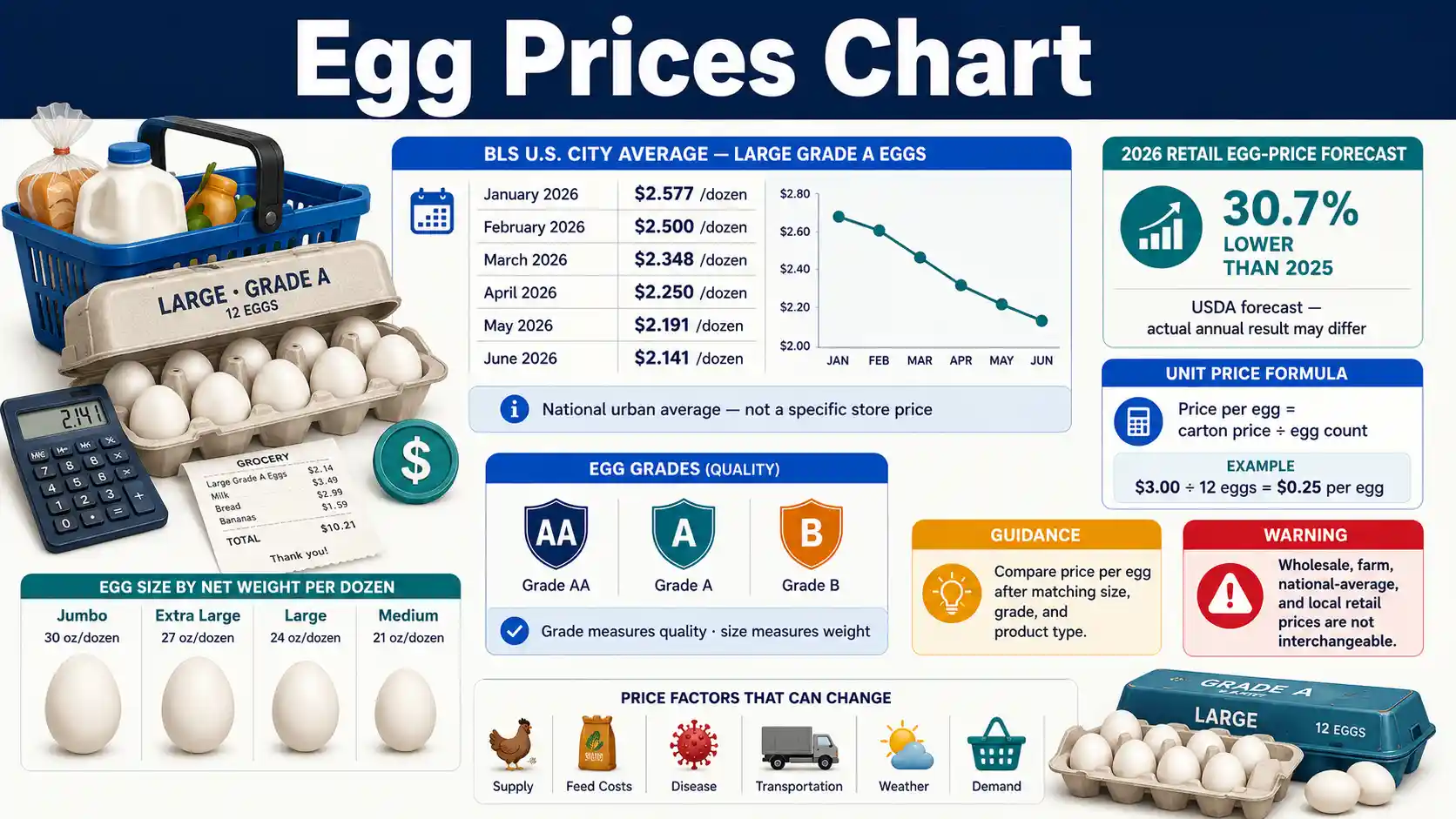
The BLS U.S. city average for large Grade A eggs was $2.141 per dozen in June 2026. Use national averages to understand price levels, then compare your local cartons by price per egg after matching size, grade, and product attributes.
Egg prices can change quickly and differ by region, retailer, carton size, grade, and production claim. A national monthly average is a benchmark, not a live local quote.
June 2026 BLS average
$2.141 per dozen
Large Grade A eggs in the U.S. city average, not seasonally adjusted. A specific store price can differ materially.
June year-over-year
27.9% lower
USDA ERS reported retail egg prices were 27.9% lower in June 2026 than in June 2025.
Best carton comparison
Price per egg
Divide carton price by egg count, then compare like-for-like size, grade, production claim, and promotion status.
Large size standard
24 oz per dozen
USDA size classes are based on minimum net weight per dozen. Size is separate from quality grade.
Direct answers to common egg price questions
What is the latest BLS average egg price used here?
The June 2026 U.S. city average for large Grade A eggs was $2.141 per dozen.
How much is $2.141 per dozen per egg?
$2.141 per dozen equals about $0.178 per egg.
Did U.S. egg prices fall in the first half of 2026?
Yes. The BLS monthly average declined from $2.577 in January 2026 to $2.141 in June 2026.
What does USDA expect for 2026 egg prices?
USDA ERS forecasts retail egg prices to decrease 30.7% in 2026 compared with 2025, with a prediction interval reflecting substantial uncertainty.
Why have egg prices been volatile?
HPAI-related flock losses, production changes, inventories, seasonal demand, promotions, and regional conditions can move egg prices quickly.
How do you calculate price per egg?
Divide the carton price by the number of eggs in the carton.
How do you compare 12 eggs with 18 eggs?
Convert both cartons to price per egg or equivalent price per dozen, then compare products with the same relevant attributes.
Is a national average the same as a grocery-store price?
No. BLS average-price data describe a national urban benchmark, not a quote from a particular store.
Does Grade AA mean larger eggs?
No. Grade describes quality, while size describes weight class.
What is the minimum weight for Large eggs?
USDA market terminology sets Large eggs at a minimum net weight of 24 ounces per dozen.
Are wholesale and retail egg prices interchangeable?
No. Wholesale, farm-level, and retail prices measure different stages of the market and should be labeled separately.
What should I record when tracking egg prices?
Record the date, store or region, carton count, size, grade, production claim, regular or promotional price, and unit price.
U.S. Egg Price Chart by Month, 2026
BLS monthly U.S. city average prices for large Grade A eggs, per dozen. These are national urban averages, not a quote for a specific store, state, brand, or production method.
Swipe horizontally inside the table to view every column.
| Month | Average price per dozen | Change from prior month | Approx. price per egg |
|---|---|---|---|
| January 2026 | $2.577 | — | $0.215 |
| February 2026 | $2.500 | -3.0% | $0.208 |
| March 2026 | $2.348 | -6.1% | $0.196 |
| April 2026 | $2.250 | -4.2% | $0.188 |
| May 2026 | $2.191 | -2.6% | $0.183 |
| June 2026 | $2.141 — Latest monthly observation used on this page | -2.3% | $0.178 |
U.S. dollars per dozen, not seasonally adjusted. Per-egg figures divide the dozen price by 12.
- • June 2026 was $2.141 per dozen, down from $2.191 in May 2026.
- • BLS says average-price data are best for measuring the price level in a particular month; CPI indexes are more appropriate for measuring price change over time.
- • The BLS egg series combines qualifying large Grade A white eggs across conventional and specialty production claims in its sampled outlets.
Download or export
Use the BLS average as a monthly benchmark
The BLS average-price documentation defines the large Grade A egg series and explains that average prices are most useful for describing a monthly price level. BLS recommends CPI indexes when the main question is price change over time.
Retail Egg Price Change by Year
USDA ERS reports annual retail egg price changes and a forecast for 2026. The 2026 value is a forecast, not a completed annual result.
Swipe horizontally inside the table to view every column.
| Year | Retail egg price change | Status | Context |
|---|---|---|---|
| 2022 | +32.2% | Observed | Large increase during the HPAI-era supply shock |
| 2023 | +1.4% | Observed | Annual growth slowed sharply |
| 2024 | +8.5% | Observed | Prices increased again |
| 2025 | +21.9% | Observed | Another large annual increase |
| 2026 | -30.7% — Current USDA 2026 forecast | USDA forecast | Production recovery and fewer HPAI detections support a projected decline |
Annual percent change in USDA ERS retail egg prices; 2026 forecast updated July 24, 2026.
- • USDA ERS forecast values are revised as new CPI, PPI, production, and market information becomes available.
- • A negative annual forecast does not mean every month, region, grade, or egg type will be cheaper than the same month a year earlier.
- • USDA reported June 2026 retail egg prices were 27.9% lower than June 2025 and 0.8% lower than May 2026.
Download or export
The 2026 decline follows several volatile years
The USDA Food Price Outlook reports egg-price increases of 32.2% in 2022, 1.4% in 2023, 8.5% in 2024, and 21.9% in 2025. Its July 2026 outlook projects a 30.7% decrease for 2026 as production recovers, while emphasizing forecast uncertainty.
Egg Carton Unit Price Comparison Chart
Use price per egg or an equivalent price per dozen to compare cartons with different egg counts. The prices below are arithmetic examples, not market quotes.
Swipe horizontally inside the table to view every column.
| Carton | Example shelf price | Price per egg | Equivalent per dozen |
|---|---|---|---|
| 6 eggs | $1.80 | $0.300 | $3.60 |
| 12 eggs | $3.00 | $0.250 | $3.00 |
| 18 eggs | $4.14 | $0.230 | $2.76 |
| 24 eggs | $5.28 | $0.220 | $2.64 |
| 30 eggs | $6.30 | $0.210 — Lowest example unit price | $2.52 |
Price per egg = carton price ÷ egg count. Equivalent per dozen = price per egg × 12.
- • A larger carton is not automatically cheaper per egg; calculate the unit price.
- • Compare like products when grade, size, brand, organic status, cage-free claim, or other attributes differ.
- • Sales, loyalty discounts, coupons, and taxes where applicable can change the effective checkout price.
Download or export
Browser-only educational tool
Egg Carton Unit Price Calculator
Compare two cartons by price per egg and equivalent price per dozen. Match size, grade, and production claim before treating the cheaper unit price as the better like-for-like value.
Carton A
$0.25 / egg
Equivalent dozen: $3.00. Cost for 8 eggs: $2.00.
Carton B
$0.23 / egg
Equivalent dozen: $2.76. Cost for 8 eggs: $1.84.
Lower unit price
Carton B
Unit-price difference: 8.0% relative to the higher unit price.
Carton A: $3.00 ÷ 12 = $0.25 per egg.
Carton B: $4.14 ÷ 18 = $0.23 per egg.
A dozen equivalent: $0.25 × 12 = $3.00.
B dozen equivalent: $0.23 × 12 = $2.76.
USDA Egg Size and Minimum Weight Chart
U.S. egg size classes refer to minimum net weight per dozen, not visual dimensions. Size and quality grade are separate attributes.
Swipe horizontally inside the table to view every column.
| Size class | Minimum net weight per dozen | Approx. minimum average per egg | Buying note |
|---|---|---|---|
| Jumbo | 30 oz | 2.50 oz | Largest standard consumer weight class |
| Extra Large | 27 oz | 2.25 oz | Heavier than Large |
| Large | 24 oz — Large minimum dozen weight | 2.00 oz | Common recipe reference size |
| Medium | 21 oz | 1.75 oz | Smaller than Large |
| Small | 18 oz | 1.50 oz | Less common in many retail displays |
| Peewee | 15 oz | 1.25 oz | Smallest official consumer weight class |
Minimum net ounces per dozen. Average-per-egg figures divide the dozen minimum by 12.
- • USDA market terminology lists Jumbo 30 oz, Extra Large 27 oz, Large 24 oz, Medium 21 oz, Small 18 oz, and Peewee 15 oz per dozen.
- • Individual eggs within a carton can vary while the carton meets the applicable net-weight class.
- • Do not confuse size with grade; grade describes quality characteristics, while size describes weight class.
Download or export
USDA Shell Egg Grade Chart
USDA consumer grades describe shell and interior quality. Grade is not the same as egg size, production system, brand, or retail price.
Swipe horizontally inside the table to view every column.
| Consumer grade | General quality level | What the grade addresses | Price comparison note |
|---|---|---|---|
| Grade AA | Highest consumer grade | Shell and interior quality standards, including albumen and yolk condition | May carry a different price, but grade alone does not determine shelf price |
| Grade A — Common retail quality grade | Very high consumer quality | Meets Grade A or better quality tolerances under the applicable standard | Common retail grade; compare size and unit price too |
| Grade B | Lower consumer grade | Allows more quality defects within specified tolerances | Often used in breaking or processing channels rather than typical retail cartons |
USDA consumer quality grades. Grading service and use of the USDA shield are subject to USDA program rules.
- • USDA quality grade standards evaluate shell condition and interior quality; the final individual quality rating is based on the lowest-rated factor.
- • Only eggs officially graded under USDA supervision are eligible to bear the USDA grademark.
- • Terms such as cage-free, organic, free range, brown, or white describe different attributes and do not replace the grade or size label.
Download or export
Size, grade, and production claims answer different questions
USDA separates egg quality grades from size classes. The USDA shell egg standards describe consumer grades, while size classes are based on weight. Compare price only after deciding which attributes need to match.
What Changes Egg Prices Chart
Egg prices can move because of supply, disease, seasonal demand, transportation, retailer promotions, product attributes, and local market conditions.
Swipe horizontally inside the table to view every column.
| Price driver | Typical mechanism | Direction can be | What to check |
|---|---|---|---|
| Layer flock and egg production | Changes the number of eggs available to the market | Higher or lower | USDA production and market outlook |
| HPAI outbreaks | Can reduce laying flocks and disrupt supply — Major recent supply risk | Often upward during losses | USDA disease and production context |
| Seasonal demand | Holiday and baking demand can alter movement and promotions | Higher or lower | Current retail and wholesale activity |
| Egg type and production claim | Organic, cage-free, free-range, pasture-raised, and specialty products have different cost structures | Product-specific | Compare the same size, grade, and claim |
| Region and retailer | Freight, sourcing, competition, promotions, and local costs vary | Market-specific | Local shelf price and unit price |
| Carton size and promotion | Multipacks and temporary discounts change unit cost | Higher or lower | Price per egg or equivalent per dozen |
Qualitative drivers; effects vary by time, place, product, and market conditions.
- • USDA ERS links recent egg price volatility to HPAI-related flock losses and later production recovery.
- • Wholesale, farm, and retail measures are different price concepts and should not be substituted for one another.
- • A national monthly average cannot predict the exact price at a specific store.
Download or export
Egg Price Comparison Mistakes and Better Checks
A useful egg-price comparison keeps the unit, product attributes, data period, and geographic scope consistent.
Swipe horizontally inside the table to view every column.
| Common mistake | Why it misleads | Better method | Example |
|---|---|---|---|
| Comparing carton prices only | Cartons can contain different numbers of eggs | Convert to price per egg or per dozen — Best unit-price comparison method | $4.14 for 18 eggs = $2.76 per dozen equivalent |
| Treating BLS average price as a store quote | BLS publishes a national urban average | Use it as a benchmark, then check local shelf prices | June 2026 U.S. city average: $2.141 per dozen |
| Comparing different egg sizes as identical | Size classes represent different minimum weights | Compare the same size or account for weight | Large minimum: 24 oz per dozen |
| Ignoring grade and production claim | Quality and production attributes can affect price | Match comparable products | Grade A cage-free versus Grade A conventional |
| Using one month to claim a long-term trend | Egg prices can be volatile | Use a multi-month series and CPI for change analysis | January–June 2026 shows a declining sequence |
| Mixing retail with farm or wholesale prices | They measure different stages of the supply chain — Different price stages are not interchangeable | Label the price concept explicitly | Retail shelf average is not FOB wholesale price |
Comparison checklist for consumer and research use.
- • Always record date, geography, carton count, size, grade, production claim, and whether the price is regular or promotional.
- • For inflation analysis, BLS recommends price indexes rather than average-price levels.
- • For shopping decisions, the local unit price is more actionable than a national benchmark.
Download or export
Limits, special cases, and price context
National average versus local shelf price
A national urban average combines sampled prices across many outlets. Your city, retailer, brand, promotion, and product claim can produce a very different checkout price.
Price level versus inflation rate
Average-price dollars describe a level. A CPI index is designed to measure price change over time, so do not calculate broad inflation conclusions from a single shelf-price series alone.
Product differences
Large Grade A conventional, cage-free, organic, pasture-raised, brown, white, omega-3, and branded eggs are not necessarily like-for-like products.
Forecasts can change
USDA forecasts update as disease conditions, production, wholesale markets, CPI data, and other inputs change. Treat the forecast as a current estimate, not a guaranteed annual outcome.
Frequently asked questions
What was the U.S. average price of eggs in June 2026?
The BLS U.S. city average for large Grade A eggs was $2.141 per dozen in June 2026. A local store price can be higher or lower.
Were egg prices falling in early 2026?
Yes. The BLS monthly average fell from $2.577 per dozen in January 2026 to $2.141 in June 2026.
How much is $2.141 per dozen per egg?
It is about $0.178 per egg because $2.141 divided by 12 is approximately $0.178.
Why did egg prices rise so much in recent years?
USDA ERS identifies HPAI-related losses in egg-layer flocks and reduced production as major drivers of recent price increases.
What does USDA forecast for egg prices in 2026?
As of July 24, 2026, USDA ERS forecasts retail egg prices to decrease 30.7% in 2026 versus 2025, with uncertainty around that estimate.
Is the BLS egg price the price at my grocery store?
No. It is a U.S. city average from sampled urban outlets and should be used as a benchmark rather than a store-specific quote.
How do I compare a 12-count and 18-count egg carton?
Divide each carton price by its egg count, then compare price per egg or multiply that unit price by 12 for an equivalent-dozen price.
Does Grade AA mean an egg is larger than Grade A?
No. Grade describes quality, while size describes weight class. A Grade A egg and a Grade AA egg can be the same size.
How much does a dozen Large eggs weigh under USDA size standards?
The Large size class has a minimum net weight of 24 ounces per dozen.
Are cage-free and organic the same as egg grade?
No. Cage-free and organic describe production or certification attributes; Grade AA, A, or B describes quality under grading standards.
Why can my local egg price differ from the national average?
Retailer sourcing, region, transportation, promotions, carton size, grade, production claim, and local supply conditions can all change the shelf price.
Should I use average prices to calculate egg inflation?
BLS says average prices are best for monthly price levels; CPI indexes are more appropriate for measuring price change over time.
Are wholesale egg prices the same as retail egg prices?
No. Wholesale, farm-level, and retail prices describe different points in the supply chain and can move by different amounts.
What is the fastest way to find the cheaper carton?
Compare unit price per egg after matching size, grade, and product attributes. A lower carton total can still have a higher unit cost.
Can egg prices change quickly?
Yes. Egg prices can react to disease outbreaks, production changes, inventories, seasonal demand, promotions, and regional market conditions.
Sources
These government and public-data resources support the monthly averages, annual trend context, USDA grade terminology, and size standards shown on this page.
U.S. Bureau of Labor Statistics — CPI Average Price Data
https://www.bls.gov/cpi/factsheets/average-prices.htm
Defines the BLS average-price series for large Grade A eggs sold by the dozen and explains that average prices are best used to describe a monthly price level.
USDA Economic Research Service — Food Price Outlook — Summary Findings
https://www.ers.usda.gov/data-products/food-price-outlook/summary-findings
Reports recent retail egg price changes, historical annual changes, HPAI context, production recovery, and the current 2026 egg-price forecast.
USDA Agricultural Marketing Service — Shell Egg Grades, Standards, and Market Terms
https://www.ams.usda.gov/grades-standards/shell-egg-grades-and-standards
Explains U.S. consumer grades and supports standardized shell-egg quality terminology; USDA market terms also define egg size classes by minimum net weight per dozen.
Federal Reserve Bank of St. Louis — BLS Average Price: Eggs, Grade A, Large, per Dozen
https://fred.stlouisfed.org/series/APU0000708111
Publishes the BLS monthly U.S. city average series APU0000708111, including the January through June 2026 observations used in the monthly table.