Finance & Money · Exchange rates and international payments
Currency Conversion Chart
A currency conversion chart shows how to translate a source amount into a target currency by reading the pair direction, applying the correct rate, and accounting for fees, spread, taxes, and recipient deductions.
Exchange rates move and provider quotes differ. Use the exact time-stamped rate and disclosures shown before confirmation; do not treat the hypothetical examples on this page as current transaction prices.
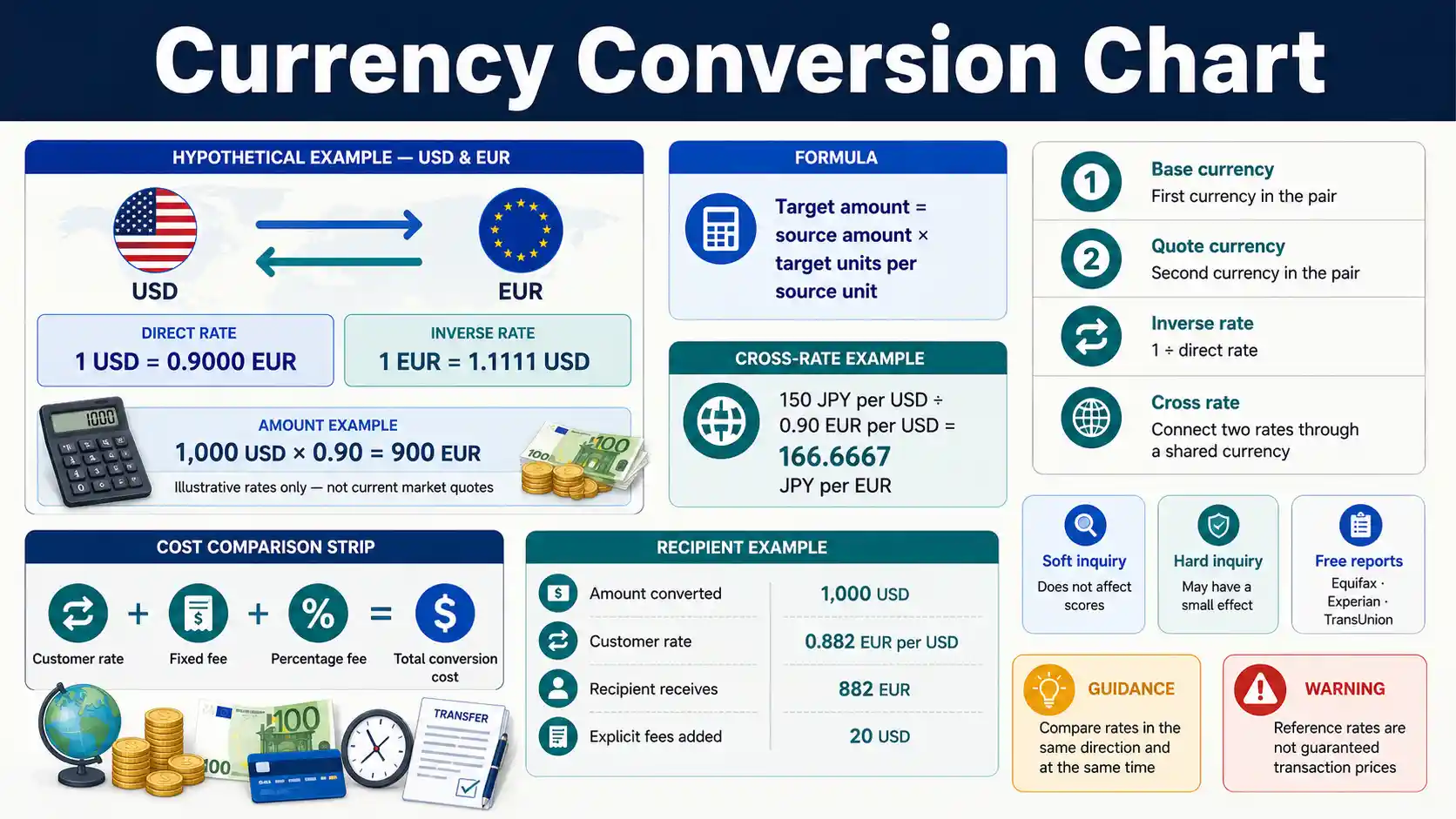
How to use a currency conversion chart
Identify the source currency, target currency, amount, and quote direction. Multiply when the rate states target units per source unit. Invert or divide when the quote is reversed. Compare the final amount paid and received after all listed costs.
Direct conversion
Multiply by target units per source unit
If 1 USD equals 0.90 EUR, multiply the USD amount by 0.90 to estimate EUR.
Inverse rate
Inverse = 1 ÷ direct rate
A rate of 0.90 EUR per USD has an inverse of about 1.111111 USD per EUR.
Total comparison
Rate + fees + taxes + deductions
Compare the complete amount paid with the amount the recipient or merchant actually receives.
Critical limit
Reference rates are not guaranteed quotes
Use a time-stamped customer quote for the exact amount, method, provider, and transaction time.
Direct answers to common currency conversion questions
What is the basic currency conversion formula?
Target amount equals source amount multiplied by target-currency units per source unit.
When should I divide by an exchange rate?
Divide when the rate is written as source-currency units per one target-currency unit.
What is a base currency?
The base currency is the first currency in a pair and represents one unit in the quoted rate.
What is a quote currency?
The quote currency is the second currency in a pair and supplies the units shown by the rate.
How do I reverse an exchange rate?
Calculate the inverse by dividing 1 by the original rate.
How do I calculate a cross rate?
Divide two aligned rates that share the same anchor currency and observation time.
Why does the customer rate differ from a reference rate?
Timing, bid-ask spread, provider pricing, transaction method, and account terms can change the customer rate.
Can a zero-fee conversion still cost money?
Yes. A rate difference can create a cost even when the provider lists no separate fee.
What should a remittance comparison include?
Compare the exchange rate, fees, taxes, total paid, and amount expected to reach the recipient.
Should I round the rate before converting?
No. Keep extra precision during the calculation and round the final amount under the settlement rules.
How current should an exchange rate be?
Use a time-stamped quote that remains valid when the transaction is confirmed.
Does this page provide live exchange rates?
No. The page uses transparent formulas and user-entered rates instead of presenting a potentially stale rate as live.
Currency Conversion Formula Chart
Choose the formula from the way the exchange rate is written. Every example uses hypothetical rates for arithmetic practice, not a live market quotation.
Swipe horizontally inside the table to view every column.
| Task | Rate statement | Formula | Illustrative example |
|---|---|---|---|
| Convert source to target by multiplication | 1 source unit = R target units | Target amount = source amount × R — Multiply for target units per source unit | 100 USD × 0.90 EUR per USD = 90 EUR |
| Convert source to target by division | 1 target unit = R source units | Target amount = source amount ÷ R — Divide when the quote is reversed | 100 USD ÷ 1.111111 USD per EUR ≈ 90 EUR |
| Find the inverse rate | Direct rate = R | Inverse rate = 1 ÷ R | 1 ÷ 0.90 EUR per USD = 1.111111 USD per EUR |
| Find a cross rate through an anchor currency | 1 anchor = A units of currency A and B units of currency B | Currency B per currency A = B ÷ A | 150 JPY per USD ÷ 0.90 EUR per USD = 166.6667 JPY per EUR |
| Measure a direct-quote rate difference | Reference rate and customer rate use the same direction | (Reference − customer) ÷ reference × 100 | (0.90 − 0.882) ÷ 0.90 × 100 = 2% |
| Measure a rate change over time | Old rate and new rate use the same direction | (New − old) ÷ old × 100 | (0.92 − 0.90) ÷ 0.90 × 100 ≈ 2.22% |
R means target-currency units per one source-currency unit unless the row states another direction.
- • Write the currency units beside every rate before choosing multiplication or division.
- • A reversed quote must be inverted before it can be compared with a quote written in the opposite direction.
- • Keep extra decimal places during the calculation and round only the final payable or receivable amount.
Download or export
Official rate series preserve their own quote conventions
The Federal Reserve H.10 release publishes bilateral U.S. dollar exchange-rate observations and states the units used by the series. Read the heading and footnotes before copying a value into a calculation.
Exchange Rate Quote Format Chart
A currency pair contains a base currency and a quote currency. The written order determines what one unit of the base currency buys in the quote currency.
Swipe horizontally inside the table to view every column.
| Quote or term | Meaning | Example | Interpretation rule |
|---|---|---|---|
| Base currency | The first currency in a pair | EUR in EUR/USD | The rate describes one unit of the base currency |
| Quote currency | The second currency in a pair | USD in EUR/USD | The rate is expressed in units of the quote currency |
| EUR/USD = 1.10 — Base and quote order example | One euro equals 1.10 U.S. dollars | 100 EUR × 1.10 = 110 USD | Multiply euros by 1.10 to estimate dollars |
| USD/EUR = 0.909091 | One U.S. dollar equals about 0.909091 euros | 100 USD × 0.909091 ≈ 90.91 EUR | This is approximately the inverse of EUR/USD = 1.10 |
| Reference or indicative rate | A benchmark or point-in-time observation | Central-bank reference series | It may not be an executable consumer transaction rate — Reference rate may not be executable |
| Customer rate | The rate actually offered for a conversion | Card, cash, bank, or transfer quote | Compare it in the same direction and at the same time |
| Buy and sell rates | Different rates for opposite sides of an exchange | Dealer buys one currency and sells another | Use the rate that matches the transaction direction |
Currency-pair notation: BASE/QUOTE = quote-currency units per one base-currency unit.
- • Terms such as direct and indirect quote can depend on the observer’s home currency, so pair notation is clearer.
- • A central-bank reference rate can support analysis without representing the price available at a bank, card network, transfer service, or cash counter.
- • Record the rate timestamp because foreign-exchange markets move and providers can update quotes at different times.
Download or export
Reference rates describe a point in time
The European Central Bank exchange-rate methodology describes reference and spot rates as observations from major trading venues at a particular time. A consumer provider can quote a different executable rate.
Sample Currency Conversion Amount Chart
These values demonstrate multiplication with three hypothetical direct rates. They are not current exchange rates and should not be used for a real transaction.
Swipe horizontally inside the table to view every column.
| Source amount | At 0.90 EUR per USD | At 150 JPY per USD | At 1.35 CAD per USD |
|---|---|---|---|
| 10 USD | 9.00 EUR | 1,500 JPY | 13.50 CAD |
| 50 USD | 45.00 EUR | 7,500 JPY | 67.50 CAD |
| 100 USD | 90.00 EUR — Simple one-hundred-dollar example | 15,000 JPY | 135.00 CAD |
| 500 USD | 450.00 EUR | 75,000 JPY | 675.00 CAD |
| 1,000 USD — Larger amount magnifies rate and fee differences | 900.00 EUR | 150,000 JPY | 1,350.00 CAD |
| 5,000 USD | 4,500.00 EUR | 750,000 JPY | 6,750.00 CAD |
Target amount = USD amount × the stated hypothetical target-currency units per USD.
- • A real provider can apply a different customer rate, fixed fee, percentage fee, tax, receiving fee, or cash-handling charge.
- • Currencies and providers use different display and settlement precision; do not assume every currency settles to two decimal places.
- • Use a time-stamped quote for the exact transaction amount instead of copying these sample values.
Download or export
Inverse and Cross Exchange Rate Chart
Inverse rates reverse one pair. Cross rates connect two currencies through a shared anchor currency when both quotes use consistent units and timing.
Swipe horizontally inside the table to view every column.
| Known rates | Required rate | Calculation | Result |
|---|---|---|---|
| 1 USD = 0.90 EUR | USD per EUR | 1 ÷ 0.90 — Inverse rate formula | 1 EUR ≈ 1.111111 USD |
| 1 EUR = 1.10 USD | EUR per USD | 1 ÷ 1.10 | 1 USD ≈ 0.909091 EUR |
| 1 USD = 0.90 EUR; 1 USD = 150 JPY | JPY per EUR | 150 ÷ 0.90 — Cross rate through USD | 1 EUR ≈ 166.6667 JPY |
| 1 USD = 0.90 EUR; 1 USD = 1.35 CAD | CAD per EUR | 1.35 ÷ 0.90 | 1 EUR = 1.50 CAD |
| 1 EUR = 1.10 USD; 1 GBP = 1.25 USD | EUR per GBP | 1.25 ÷ 1.10 | 1 GBP ≈ 1.136364 EUR |
| 1 USD = 150 JPY; 1 USD = 1.35 CAD | JPY per CAD | 150 ÷ 1.35 | 1 CAD ≈ 111.1111 JPY |
Illustrative rates only. Cross-rate inputs must share the same anchor, quote type, and observation time.
- • Do not divide two rates until their units are aligned; write the currency units as if they were algebraic units.
- • A calculated cross rate can differ from an executable market quote because of timing, bid-ask spreads, liquidity, and provider pricing.
- • Reversing a rounded rate and reversing the original high-precision rate can produce slightly different answers.
Download or export
Currency Conversion Rate, Fee, and Recipient Calculator
Enter a provider quote in either direction. The tool normalizes the quote, calculates recipient proceeds, adds explicit fees to the amount paid, and compares the rate with an optional reference benchmark.
1 USD = rate × EUR
Use the same direction and timestamp.
Use three-letter codes for clarity. The calculator does not validate whether a code is an active official currency. Do not enter account numbers, card numbers, passwords, tax identifiers, or other sensitive information.
Calculation check
The entries form a valid transparent conversion scenario.
Estimated recipient amount
882 EUR
Total paid with added fees
1,020 USD
Normalized direct rate
1 USD = 0.882 EUR
Inverse provider rate
1 EUR = 1.133787 USD
Explicit fees added
20 USD
Percentage-fee amount
10 USD
Reference-rate comparison
- Benchmark recipient amount
- 900 EUR
- Target-currency shortfall
- +18.00 EUR
- Provider-rate difference
- +2.000%
- Estimated total difference
- +40.00 USD · +4.000%
Calculation used
Recipient amount = amount converted × normalized direct provider rate.
Total paid = amount converted + fixed fee + amount converted × percentage fee.
When a reference rate is entered, the tool converts the rate shortfall back to the source currency and adds explicit fees for an educational comparison.
The calculator does not fetch live rates, validate a provider quote, model fees deducted from the converted principal, or include every tax, intermediary charge, cash fee, ATM fee, card fee, or recipient deduction.
Currency Conversion Fee and Spread Chart
This hypothetical comparison converts 1,000 USD to EUR against a 0.90 EUR-per-USD reference rate. Fees are added to the amount paid rather than deducted from the converted principal.
Swipe horizontally inside the table to view every column.
| Scenario | Customer rate | Explicit fees | Recipient gets | Estimated source-currency cost versus reference |
|---|---|---|---|---|
| Reference benchmark | 0.900 EUR per USD | 0 USD | 900 EUR | 0 USD |
| 1% rate shortfall only | 0.891 EUR per USD | 0 USD | 891 EUR | 10 USD |
| 2% rate shortfall only | 0.882 EUR per USD | 0 USD | 882 EUR | 20 USD — Rate difference has a source-currency value |
| 10 USD fixed fee only | 0.900 EUR per USD | 10 USD | 900 EUR | 10 USD |
| 2% explicit fee only | 0.900 EUR per USD | 20 USD | 900 EUR | 20 USD |
| 2% rate shortfall + 10 USD fixed fee + 1% fee | 0.882 EUR per USD | 20 USD | 882 EUR | 40 USD — Fees and rate spread can combine |
Estimated cost = explicit fees + source-currency equivalent of the target-currency shortfall versus the stated reference rate.
- • A reference rate is a comparison benchmark, not a promise that the transaction can be completed at that rate.
- • If fees are deducted from the amount converted, recipient proceeds will differ from this added-fee example.
- • Taxes, intermediary-bank charges, cash commissions, ATM fees, recipient fees, and card-issuer terms may add other costs.
Download or export
Currency Conversion Method Comparison Chart
The visible exchange rate is only one part of total cost. Compare the final amount paid and received under the exact terms of each method.
Swipe horizontally inside the table to view every column.
| Method | Rate to check | Possible additional costs | Best comparison document or screen |
|---|---|---|---|
| Card purchase in foreign currency | Network or issuer conversion rate | Foreign transaction fee, merchant surcharge, or other card terms | Cardholder agreement and posted transaction details |
| Merchant conversion to home currency | Merchant or conversion-service rate | Embedded markup and card fees depending on terms | On-screen local-currency and home-currency totals before acceptance — Compare both currency totals before accepting |
| Cash exchange counter | Customer buy or sell rate for banknotes | Commission, minimum fee, or denomination constraints | Written quote showing cash received and total paid |
| ATM withdrawal | Network or issuer rate | ATM operator fee, issuer fee, foreign transaction fee, and cash-advance treatment under some products | ATM disclosure plus account agreement and posted transaction |
| International remittance | Transfer-provider exchange rate | Transfer fee, taxes, intermediary or recipient charges when applicable | Prepayment disclosure showing rate, fees, taxes, and amount received — Remittance disclosure shows key amounts |
| Bank wire | Bank conversion rate when currencies differ | Outgoing, intermediary, correspondent, and receiving-bank fees | Wire quote, fee schedule, and beneficiary amount estimate |
| Multi-currency account conversion | In-app customer conversion rate | Plan-based fee, weekend adjustment, transfer fee, or withdrawal fee depending on terms | Time-stamped confirmation screen and account pricing schedule |
Compare total paid in the source currency with final amount received in the target currency.
- • For a remittance, the CFPB explains that disclosures generally include the exchange rate, fees and taxes, and expected recipient amount.
- • Declining a home-currency offer does not remove every possible card or ATM fee; the account terms still apply.
- • A rate that appears favorable can cost more after fixed fees on a small transaction or percentage fees on a large transaction.
Download or export
Compare the disclosed recipient amount, not the headline rate alone
The CFPB international money-transfer guide explains that remittance disclosures generally show the exchange rate, fees and taxes, and the amount expected to be received. Use those totals to compare providers.
Common Currency Conversion Mistakes and Corrections
Small unit, timing, and fee errors can materially change the result. These checks keep the arithmetic and transaction comparison consistent.
Swipe horizontally inside the table to view every column.
| Mistake | Why it fails | Correction | What to record |
|---|---|---|---|
| Multiplying by a reversed quote | The rate units do not cancel into the required target currency | Invert the quote or divide by the reversed rate — Correct the quote direction | Full pair notation and units |
| Comparing EUR/USD with USD/EUR directly | The numbers use opposite directions | Invert one rate before calculating a percentage difference | Rate direction for both quotes |
| Treating a reference rate as a guaranteed transaction rate | Reference rates can be point-in-time benchmarks rather than executable offers | Request a customer quote for the exact amount and method | Timestamp, provider, amount, and rate |
| Ignoring fixed fees on a small conversion | A flat charge can represent a large percentage of a small amount | Compare total paid and final amount received | Every fixed fee and tax |
| Ignoring rate spread when the listed fee is zero | Provider pricing can be embedded in the customer rate — Zero listed fee can still include a rate difference | Compare the customer rate with a same-time benchmark in the same direction | Reference rate and customer rate |
| Rounding the rate too early | Repeated rounding can accumulate into a larger amount error | Calculate with more precision and round the final settlement amount | Unrounded rate and final rounding rule |
| Using a stale screenshot or weekend quote | The market or provider may have moved before execution | Use a current, time-stamped confirmation | Date, time, and quote validity |
| Assuming every currency uses two decimal places | Minor-unit and cash-rounding conventions differ | Follow the currency and provider settlement precision | Currency code and final precision |
| Omitting recipient or intermediary charges | The sender total may not equal the beneficiary amount | Review the expected amount delivered and possible deductions | Sender total, recipient total, and listed charges |
| Entering sensitive account details into an educational calculator | The arithmetic does not require private credentials | Use only amounts, codes, rates, and fees — Do not enter sensitive credentials | No account numbers, passwords, or identity data |
A valid comparison uses the same currency pair, direction, transaction amount, method, and observation time.
- • For a real purchase or transfer, retain the quote, disclosure, receipt, and final posted amount.
- • Contact the provider promptly when the rate, fee, recipient amount, or transaction status differs from the disclosure or agreement.
- • Large, regulated, tax-sensitive, or business conversions can require treasury, accounting, legal, or tax advice.
Download or export
Limits, special cases, and when to verify the quote
Live pricing and quote expiry
The page does not fetch live rates. A provider quote can expire, refresh, or change before confirmation, especially when markets are moving.
Fees deducted from proceeds
The calculator treats explicit fees as added to the payment. It does not model a provider, intermediary, or recipient deducting fees from the converted amount.
Currency precision and cash rounding
Settlement precision, minor units, cash denominations, and rounding conventions differ. Follow the provider confirmation rather than assuming two decimals.
Tax and accounting treatment
Businesses, investors, travelers, and remittance senders can face different tax, recordkeeping, functional-currency, and reporting rules. The conversion arithmetic does not determine those obligations.
Stop and verify before confirming when currency codes are wrong, fees are missing, the quote has expired, the recipient details changed, the expected amount is unclear, or a service requests passwords, verification codes, or unrelated sensitive data.
Frequently asked questions
What is the currency conversion formula?
Multiply the source amount by the rate when the rate is written as target-currency units per one source-currency unit. Divide when the quote is written in the reverse direction.
How do I know whether to multiply or divide by an exchange rate?
Write the units beside the rate. Multiply when the unwanted source unit cancels and leaves the required target unit; otherwise invert the rate or divide.
What is the base currency in a currency pair?
The base currency is the first currency in a pair. In EUR/USD, EUR is the base and the rate states how many U.S. dollars equal one euro.
What is the quote currency?
The quote currency is the second currency in a pair. EUR/USD = 1.10 means one euro equals 1.10 U.S. dollars.
How do I calculate an inverse exchange rate?
Divide 1 by the original rate. If 1 USD equals 0.90 EUR, the inverse is about 1.111111 USD per EUR.
How do I calculate a cross exchange rate?
Divide two consistently quoted rates that share an anchor currency. If one USD equals 0.90 EUR and 150 JPY, one EUR equals about 166.6667 JPY.
Why is my bank or card rate different from a reference rate?
Reference rates are benchmarks or point-in-time observations. A customer rate can reflect timing, bid-ask spread, provider pricing, transaction method, and account terms.
Does a zero-fee currency conversion have no cost?
Not necessarily. A provider can charge no separate fee while offering a customer rate that differs from a reference benchmark.
What is a foreign transaction fee?
A foreign transaction fee is a charge that an account provider may apply to an international or foreign-currency transaction, often as a percentage under the account terms.
What information should a remittance quote show?
A remittance disclosure generally shows the exchange rate, provider fees and taxes, and the amount expected to be received, subject to applicable rules and permitted estimates.
Why do cash exchange rates differ from electronic rates?
Cash handling adds inventory, security, transportation, denomination, and operating costs. A cash counter can also publish separate buy and sell rates.
How often do currency exchange rates change?
Foreign-exchange market rates can change continuously while official reference series update on their own publication schedules. Use the timestamp attached to the actual quote.
Should I round the exchange rate before converting?
Keep the rate at higher precision during the calculation and round the final amount according to the currency and provider settlement rules.
Can I compare two rates written in opposite directions?
Yes, but first invert one rate so both quotes use the same base currency, quote currency, units, and observation time.
Does this currency calculator provide live rates?
No. The calculator uses the rate and fees entered by the user so the arithmetic remains transparent and does not present a stale rate as live.
Sources
These official central-bank and U.S. consumer-protection resources support the quote conventions, reference-rate context, conversion-fee guidance, and remittance disclosures.
Board of Governors of the Federal Reserve System — Foreign Exchange Rates — H.10
https://www.federalreserve.gov/releases/h10/current/
Publishes weekly U.S. dollar bilateral exchange-rate observations and identifies the quote convention used for each series.
European Central Bank — Euro Foreign Exchange Reference Rates and Methodology
https://data.ecb.europa.eu/methodology/exchange-rates
Explains that reference and spot rates are point-in-time observations and describes the ECB working-day reference-rate process.
Consumer Financial Protection Bureau — Send Money Abroad With More Confidence
https://www.consumerfinance.gov/consumer-tools/money-transfers/send-money-abroad-with-more-confidence/
Explains that remittance disclosures generally show the exchange rate, fees and taxes, and the amount expected to be received.
Consumer Financial Protection Bureau — Foreign Transaction and Currency Conversion Fees
https://www.consumerfinance.gov/ask-cfpb/what-types-of-fees-do-prepaid-cards-typically-charge-en-2053/
Explains that a foreign transaction or currency conversion fee may be charged as a percentage of an international purchase, withdrawal, or other transaction.