Finance & Money · Debt repayment planning
Debt Payoff Chart
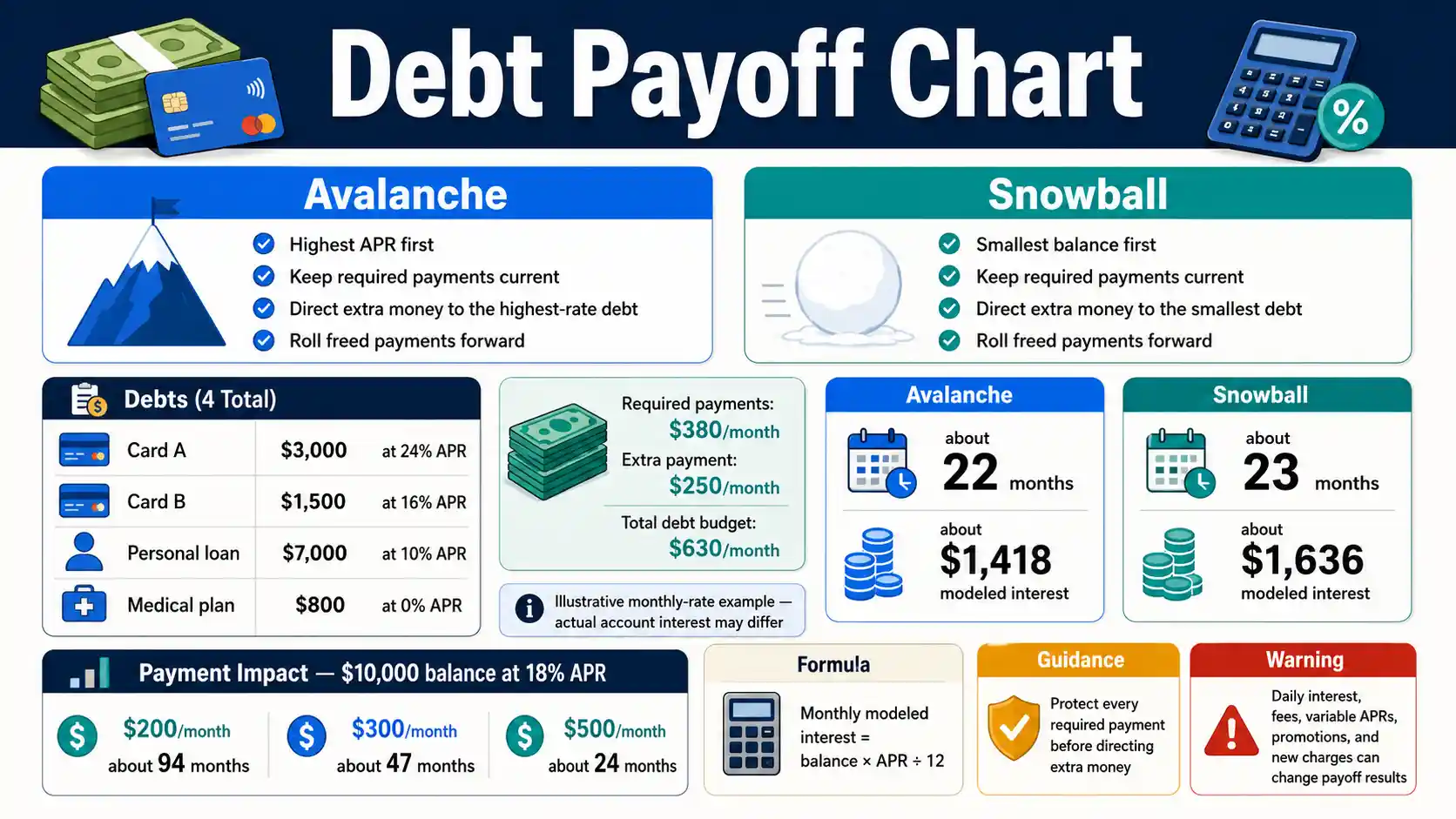
A debt payoff chart compares balances, interest rates, required payments, extra payments, payoff order, and estimated timing. Use it to test a highest-interest-rate plan, a debt snowball plan, or a larger monthly payment before committing to a schedule.
Keep required payments current and use your current statements or creditor terms. The examples here use simplified monthly interest and cannot reproduce daily accrual, variable APRs, fees, promotions, collections, or every loan contract.
How to build a debt payoff plan
List each current balance, APR, required payment, and due date. Protect required payments first. Choose a priority rule for extra money, keep the monthly debt budget consistent, and recalculate when balances, APRs, fees, or income change.
Avalanche rule
Highest APR first
Keep required payments current, then send extra money to the debt with the highest annual percentage rate.
Snowball rule
Smallest balance first
Pay the smallest balance first, then roll its former payment into the next-smallest balance.
Payoff lever
More principal paid sooner
A larger sustainable payment usually shortens payoff time and lowers future interest on ordinary interest-bearing debt.
Critical limit
Use current account terms
Daily interest, variable APRs, fees, promotions, and payoff quotes can differ from a generic monthly model.
Direct answers to common debt payoff questions
What is a debt payoff chart?
A debt payoff chart organizes balances, APRs, required payments, payoff order, and estimated time so you can compare repayment plans.
What is the debt avalanche method?
The avalanche method directs extra money to the highest-APR debt while required payments continue on every other debt.
What is the debt snowball method?
The snowball method directs extra money to the smallest balance first and rolls the freed payment to the next target.
Which debt payoff method usually saves more interest?
With the same payment budget and ordinary fixed-rate assumptions, paying the highest APR first usually reduces the most expensive interest first.
Should I keep paying minimums on non-target debts?
Yes. Keep every required payment current unless the creditor has formally changed the payment terms.
Does paying more each month shorten payoff time?
Yes. A larger payment reduces principal faster when the added amount is applied to the debt and no offsetting fees or new charges are added.
Can I calculate credit card payoff with APR divided by 12?
APR divided by 12 is a useful monthly estimate, but many issuers calculate credit card interest daily under account-specific rules.
Why can minimum-only repayment take so long?
A small required payment leaves more balance outstanding, so interest can continue for many billing cycles.
What if my payment does not cover modeled interest?
A balance will not amortize in a fixed-rate model when the periodic payment does not exceed the interest and fees added for that period.
What should I do if I cannot make the minimum payment?
Contact the creditor promptly, explain what you can afford, and ask about available hardship or repayment options.
Does consolidation erase debt?
No. Consolidation replaces or combines debts, so you still need to compare the new APR, fees, term, payment, and total repayment cost.
Is the current balance always the exact payoff amount?
No. Some loans can require a dated payoff amount that includes accrued interest, fees, or other contract items not shown in the displayed balance.
Debt Payoff Strategy Chart
Keep required payments current, then direct available extra money according to a clear priority rule. The best method is the one you can sustain without missing required payments.
Swipe horizontally inside the table to view every column.
| Method | Extra-payment target | Main advantage | Main tradeoff |
|---|---|---|---|
| Highest-interest-rate method | Debt with the highest APR first — Interest-first priority | Usually reduces the costliest interest first | The first balance may take longer to disappear |
| Debt snowball method | Smallest balance first — Balance-first priority | Creates faster account closures and visible milestones | Can cost more interest than prioritizing the highest APR |
| Equal extra payments | Split extra money across several debts | Feels balanced and simple | Usually slows the strongest mathematical priority |
| Contract-only payments | Pay only each required amount | Requires no extra monthly cash | Can extend payoff time and total interest — Minimum-only payoff can be slow |
| Targeted lump sum | Apply a one-time amount to a chosen debt | Reduces principal immediately | Requires checking emergency savings, fees, and loan terms first |
APR means annual percentage rate. Required payments, fees, and contract terms vary by account.
- • The CFPB describes both the highest-interest-rate method and the snowball method as common debt-reduction strategies.
- • Keep minimum or required payments current on non-target debts unless a creditor has formally changed the payment terms.
- • A strategy comparison does not replace the creditor agreement or a current payoff quote.
Download or export
Highest APR first and snowball solve different priorities
The CFPB debt-reduction guide describes the highest-interest-rate method as a way to attack the costliest debt first and the snowball method as a way to create faster visible progress by eliminating small balances.
Fixed Payment Debt Payoff Chart
This example uses a $10,000 balance, 18% APR, no new charges or fees, and a simplified monthly rate of APR divided by 12. Actual credit card interest can be calculated differently.
Swipe horizontally inside the table to view every column.
| Monthly payment | Approximate payoff time | Approximate interest | Approximate total paid |
|---|---|---|---|
| $200 | 94 months — Longest payoff in this example | $8,622 | $18,622 |
| $250 | 62 months | $5,386 | $15,386 |
| $300 | 47 months | $3,967 | $13,967 |
| $400 | 32 months | $2,628 | $12,628 |
| $500 | 24 months | $1,978 — Lowest interest in this example | $11,978 |
Illustrative monthly-rate amortization only; totals are rounded to the nearest dollar.
- • Increasing the monthly payment reduces the balance faster, which reduces the amount exposed to future interest in this fixed-rate example.
- • Many credit card issuers calculate interest daily using account-specific rules, so a statement payoff estimate can differ from this monthly approximation.
- • New purchases, fees, variable APRs, promotional balances, or missed payments can materially change the result.
Download or export
Debt Payoff Formula Chart
Use these formulas only when the debt can be reasonably modeled with a fixed periodic rate and payment. Credit cards, variable-rate loans, fees, and promotional balances may need account-specific calculations.
Swipe horizontally inside the table to view every column.
| Question | Formula | Inputs | Important condition |
|---|---|---|---|
| Monthly periodic rate | r = APR ÷ 12 | APR as a decimal | Simplified monthly model; actual daily accrual may differ |
| Next balance after one month | B₁ = B₀(1 + r) − P | Starting balance B₀, rate r, payment P | Assumes interest posts before the modeled payment |
| Payment for payoff in n months | P = rB ÷ [1 − (1 + r)^−n] — Target payoff payment formula | Balance B, monthly rate r, months n | For r > 0 and fixed rate |
| Months for fixed payment | n = −ln(1 − rB/P) ÷ ln(1 + r) | Balance B, monthly rate r, payment P | Payment must be greater than rB — Payment must exceed modeled interest |
| Zero-interest payoff payment | P = B ÷ n | Balance B and payoff months n | Applies only when no interest or fees accrue |
| Simple payoff progress | Principal reduction = payment − interest − fees | Current payment, accrued interest, posted fees | Use statement values when available |
B = balance, P = periodic payment, r = periodic interest rate, n = number of payment periods.
- • A payment at or below the modeled interest amount will not amortize the balance in a fixed-rate model.
- • Use the creditor statement or official payoff quote when exact contract terms matter.
- • Do not mix annual percentage rates with monthly rates without converting the rate to the correct period.
Download or export
Avalanche vs Snowball Example Chart
This four-debt example uses a fixed monthly budget of $630: $380 of listed minimums plus $250 extra. Interest is approximated monthly and freed payments roll to the next target.
Swipe horizontally inside the table to view every column.
| Strategy | First targets | Approximate payoff | Approximate interest | What drives the order |
|---|---|---|---|---|
| Highest-interest-rate | Card A 24% → Card B 16% → remaining debts | 22 months | $1,418 — Lower modeled interest | APR first |
| Snowball | Medical plan $800 → Card B $1,500 → Card A $3,000 — Small-balance priority | 23 months | $1,636 | Smallest balance first |
Example starting debts: Card A $3,000 at 24%, Card B $1,500 at 16%, personal loan $7,000 at 10%, medical plan $800 at 0%.
- • Both strategies keep the same total monthly debt budget in this illustration.
- • The highest-interest-rate method saves about $218 of modeled interest and one month in this specific example.
- • Different balances, APRs, minimum payments, fees, or promotional terms can reverse or shrink the difference.
Download or export
Browser-only educational tool
Avalanche vs Snowball Debt Payoff Calculator
Enter balances, APRs, required monthly payments, and one extra monthly amount. The tool keeps the same total payment budget and compares highest-APR-first with smallest-balance-first payoff order.
| Debt | Balance ($) | APR (%) | Required payment ($/month) |
|---|---|---|---|
Starting debt
$12,300
Monthly debt budget
$630
First-month modeled interest
$138
Avalanche
Highest APR first
- Payoff time
- 1y 10m
- Modeled interest
- $1,418
- Payoff order
- Card A → Card B → Medical plan → Personal loan
Snowball
Smallest balance first
- Payoff time
- 1y 11m
- Modeled interest
- $1,636
- Payoff order
- Medical plan → Card B → Card A → Personal loan
Model used
Monthly interest = balance × APR ÷ 12. The calculator applies each entered required payment, then sends the remaining fixed budget to the strategy target and rolls freed payments forward.
Important limitation
Actual cards and loans can use daily interest, fees, variable APRs, promotional balances, payment-allocation rules, or payoff quotes that this simplified model does not reproduce.
This calculator runs only in your browser. Enter amounts, APRs, and payment figures only; no account numbers, login credentials, Social Security numbers, or other sensitive financial data are needed.
Credit Card Statement Payoff Information Chart
A statement can help you compare the required minimum with a faster payoff amount. Read the assumptions because the disclosure is based on the balance and terms used for that statement.
Swipe horizontally inside the table to view every column.
| Statement item | What it tells you | How to use it | Key limitation |
|---|---|---|---|
| Minimum payment | Required amount due for the billing cycle | Pay at least this amount by the due date unless terms were formally changed | Minimum-only repayment can take years — Minimum-only repayment can be slow |
| Minimum-payment payoff estimate | Estimated time and cost if only minimums are paid | Use it to see the long-run effect of minimum-only payments | Future purchases and term changes can alter the estimate |
| Three-year payoff payment | Monthly amount calculated to repay the current statement balance in 36 months — Three-year disclosure can support a target payment | Compare it with your available monthly budget | The estimate assumes no future purchases and uses stated disclosure rules |
| APR by balance category | Rates that apply to purchases, transfers, cash advances, or other balances | Use the rate that belongs to each balance | One account can have multiple APRs |
| Interest charge | Interest posted for the statement period | Track whether interest is shrinking as balances fall | Interest calculation method depends on account terms |
| Due date | Deadline for the required payment | Schedule payment with enough time to post | Late or missed payments can trigger fees or other consequences |
Use the current statement and cardholder agreement for exact account terms.
- • CFPB guidance states that card issuers show how long minimum-only repayment would take and a 36-month payoff amount for the current balance under required assumptions.
- • Paying more than the minimum generally reduces payoff time and interest when interest is accruing.
- • A statement estimate is not a promise when you add new charges or account terms change.
Download or export
Credit card statements show a useful payoff comparison
The CFPB statement-payoff explanation says card issuers show a minimum-payment payoff estimate and an amount designed to repay the current balance in 36 months under the disclosure assumptions. New purchases can change that path.
Debt Consolidation, Hardship, and Relief Comparison Chart
Changing the payment arrangement can change cost, risk, and timing. Compare the new terms against the debts you would replace or modify.
Swipe horizontally inside the table to view every column.
| Option | Potential benefit | Costs or risks to check | Before agreeing |
|---|---|---|---|
| Creditor hardship plan | May temporarily reduce payment, rate, or other terms | Eligibility, duration, account restrictions, and what happens when the plan ends | Get the revised terms and payment dates in writing — Document changed creditor terms |
| Balance transfer | May move revolving debt to a lower promotional APR | Transfer fee, promotional end date, post-promo APR, new purchases, and payment allocation | Calculate payoff before the promotion expires |
| Consolidation loan | Combines several debts into one scheduled payment | Origination fee, APR, loan term, secured versus unsecured status, and total cost | Compare total dollars paid, not only the monthly payment |
| Nonprofit credit counseling | Can help build a budget or debt-management plan | Fees, creditor participation, plan length, and required account changes | Verify services, costs, and counselor credentials |
| Debt settlement | May seek a reduced settlement on some debts | Fees, collection activity, credit damage, lawsuits, taxes, and no guaranteed settlement — Settlement can carry substantial risk | Be cautious of guarantees or instructions to stop communicating with creditors |
| New secured debt to pay unsecured debt | May lower the quoted rate | Puts collateral at risk and can extend repayment | Understand what asset secures the new obligation |
Terms vary by creditor, provider, borrower, debt type, jurisdiction, and account status.
- • CFPB guidance says some creditors may offer alternative repayment arrangements when borrowers contact them early.
- • A lower monthly payment can still cost more overall if the new term is much longer or fees are added.
- • Debt-relief promises that guarantee elimination of debt or demand upfront fees deserve careful scrutiny.
Download or export
Contact the creditor early when a required payment is not affordable
The CFPB guidance for unaffordable credit card bills recommends acting quickly, explaining what you can afford, and asking the card company about available payment options rather than waiting for missed payments to accumulate.
Common Debt Payoff Mistakes and Corrections
A workable payoff plan protects required payments, uses accurate account terms, and avoids creating new high-cost debt while old balances are falling.
Swipe horizontally inside the table to view every column.
| Mistake | Why it can hurt | Safer correction | What to verify |
|---|---|---|---|
| Skipping required payments on non-target debts — Protect required payments | Late fees, delinquency, and account consequences can outweigh the strategy benefit | Keep required payments current while directing extra money to the target | Due date and required amount |
| Using APR divided by 12 as an exact card calculation | Many card issuers calculate interest daily | Use monthly math only as an estimate and compare it with the statement | Issuer interest method and APR category |
| Ignoring promotional or deferred-interest deadlines | A missed deadline can change the interest cost sharply | Track the exact expiration date and payoff requirement — Track promotional deadlines | Promotion terms and remaining promotional balance |
| Choosing a lower monthly consolidation payment without checking total cost | A longer term can increase total dollars paid | Compare APR, fees, term, and total repayment | New loan disclosures and old debt costs |
| Sending every dollar to debt with no cash buffer | A routine emergency can force new borrowing | Balance payoff speed with a realistic emergency reserve | Essential expenses and accessible cash |
| Making new charges while using a fixed payoff estimate | New balances invalidate the original payoff schedule | Recalculate after new charges or stop adding debt where practical | Current balance and new activity |
| Assuming current balance equals payoff amount for every loan | Accrued interest or fees may be missing from the displayed balance | Request a dated payoff quote when closing a loan | Payoff date, interest, fees, and prepayment terms |
| Trusting guaranteed debt-relief claims | No outside company can guarantee every creditor response | Verify the provider and understand fees and risks before signing | Written contract and regulator complaints |
Use account-specific statements, agreements, payoff quotes, and creditor communications when they differ from a generic chart.
- • Contact the creditor promptly when you cannot make the required payment rather than waiting for the account to deteriorate.
- • The fastest payoff plan is not useful if it repeatedly causes missed essentials or new borrowing.
- • Keep records of changed payment arrangements and confirmation numbers.
Download or export
Limits, special cases, and when to verify the plan
Daily and variable interest
Many revolving accounts accrue interest using daily balances, and variable APRs can change. A monthly APR-divided-by-12 estimate will not exactly reproduce those accounts.
Promotional and deferred interest
Promotional APRs and deferred-interest offers can have expiration dates, payment rules, and consequences that require the exact account agreement.
Secured, delinquent, or collected debt
Mortgages, auto loans, tax debts, student loans, judgments, collections, and secured obligations can involve rights, deadlines, collateral, or programs that a generic payoff order cannot evaluate.
Taxes, settlements, and legal consequences
Settlements, forgiven balances, insolvency, bankruptcy, lawsuits, and debt collection can create tax or legal questions. Use qualified professional guidance when those issues apply.
Verify the plan before sending a large payoff when the account has a prepayment penalty, deferred-interest deadline, variable APR, disputed balance, collection status, collateral, or a payoff quote that differs from the balance shown online.
Frequently asked questions
What is the debt avalanche method?
The debt avalanche method directs extra payment to the highest-APR debt while required payments continue on the others. It usually targets interest cost first.
What is the debt snowball method?
The debt snowball method directs extra payment to the smallest balance first, then rolls that freed payment to the next-smallest balance.
Which pays debt faster, avalanche or snowball?
Neither method is always faster in every real account set. With the same payment budget, the highest-interest-rate method often costs less interest, while the snowball can produce earlier account closures.
Should I pay more than the minimum on a credit card?
Paying more than the minimum generally reduces payoff time and interest when interest is accruing. Keep every required payment current first.
Why can a minimum payment take years to repay a card?
A small required payment can leave much of the balance outstanding, so interest continues to accrue. Credit card statements show a minimum-payment payoff estimate under required assumptions.
How do I calculate a payment for a target payoff date?
For a fixed-rate monthly model, use the amortization payment formula with the current balance, monthly rate, and number of months. Use the creditor calculation when the account uses different rules.
Can I use APR divided by 12 for credit card debt?
APR divided by 12 is a useful educational monthly approximation, but many card issuers calculate interest daily. Your statement and agreement control the actual calculation.
Does paying debt early always save interest?
Paying principal earlier usually reduces future interest on ordinary interest-bearing debt, but fees, prepayment terms, promotions, and account-specific rules can change the result.
What should I do if I cannot make the minimum payment?
Contact the creditor as soon as possible, explain what you can afford, and ask about available hardship or repayment options. Do not ignore the bill.
Is debt consolidation the same as debt payoff?
No. Consolidation replaces or combines debts; it does not erase the balance. Compare the new APR, fees, term, payment, and total repayment cost.
Can a zero-percent balance transfer still have a cost?
Yes. A balance transfer can charge a transfer fee, and a promotional APR can expire. Read the promotion and post-promotion terms before transferring debt.
What is a payoff amount?
A payoff amount is the amount required to fully satisfy a debt as of a specified date. It can differ from the displayed current balance because of accrued interest, fees, or other contract terms.
Should I keep emergency savings while paying debt?
A payoff plan should leave enough cash for essential expenses and realistic emergencies. An overly aggressive plan can force new borrowing after an unexpected cost.
Does a debt payoff calculator know my exact card interest?
No. A generic calculator estimates from the inputs and stated assumptions. Daily interest, fees, variable APRs, promotions, payment allocation, and new transactions can change actual results.
When should I consider credit counseling?
Consider reputable credit counseling when you need help building a budget or repayment plan across several debts. Review fees, services, and creditor participation before enrolling.
Sources
These U.S. consumer-protection resources support the payoff-strategy explanations, credit card repayment guidance, interest caveats, hardship steps, and consolidation cautions.
Consumer Financial Protection Bureau — How to Reduce Your Debt
https://www.consumerfinance.gov/archive/blog/how-reduce-your-debt/
Explains the highest-interest-rate and snowball debt-reduction methods and the tradeoff between interest savings and faster visible progress.
Consumer Financial Protection Bureau — Credit Card Minimum Payments and Three-Year Payoff Disclosure
https://www.consumerfinance.gov/ask-cfpb/a-box-on-my-credit-card-bill-says-that-i-will-pay-off-the-balance-in-three-years-if-i-pay-a-certain-amount-what-does-that-mean-do-i-have-to-pay-that-much-if-i-pay-that-much-and-make-new-purchases-will-i-still-owe-nothing-after-three-years-en-36/
Explains that credit card statements show minimum-payment payoff information and a payment designed to repay the current balance in 36 months under stated assumptions.
Consumer Financial Protection Bureau — What Should I Do if I Cannot Pay My Credit Card Bills?
https://www.consumerfinance.gov/ask-cfpb/what-should-i-do-if-i-cant-pay-my-credit-card-bills-en-1697/
Recommends acting quickly, contacting the card issuer, considering nonprofit credit counseling, and watching for debt-relief warning signs.
consumer.gov — Debt Explained
https://consumer.gov/debt/debt-explained
Explains budgeting, contacting creditors before collection, asking about payment plans, and seeking credit-counseling help when needed.
Consumer Financial Protection Bureau — How Credit Card Interest Is Calculated
https://www.consumerfinance.gov/ask-cfpb/how-does-my-credit-card-company-calculate-the-amount-of-interest-i-owe-en-51/
Explains that many issuers calculate credit card interest daily and that paying more sooner can reduce interest when interest is accruing.
Consumer Financial Protection Bureau — What to Know About Consolidating Credit Card Debt
https://www.consumerfinance.gov/ask-cfpb/what-do-i-need-to-know-if-im-thinking-about-consolidating-my-credit-card-debt-en-1861/
Explains that consolidation can involve promotional rates, balance-transfer fees, changing payments, and other terms that must be compared carefully.