Science & Chemistry
Electron Configuration Chart
Compare neutral ground-state configurations, orbital filling order, subshell capacities, noble-gas shorthand, common exceptions, ion configurations, and valence patterns. The chart uses observed configurations where the simple Aufbau prediction and the measured ground state differ.
Electron configuration is a quantum-mechanical orbital-occupancy description. It does not show electrons moving on fixed planetary paths, and introductory filling mnemonics do not replace evaluated ground-state data.
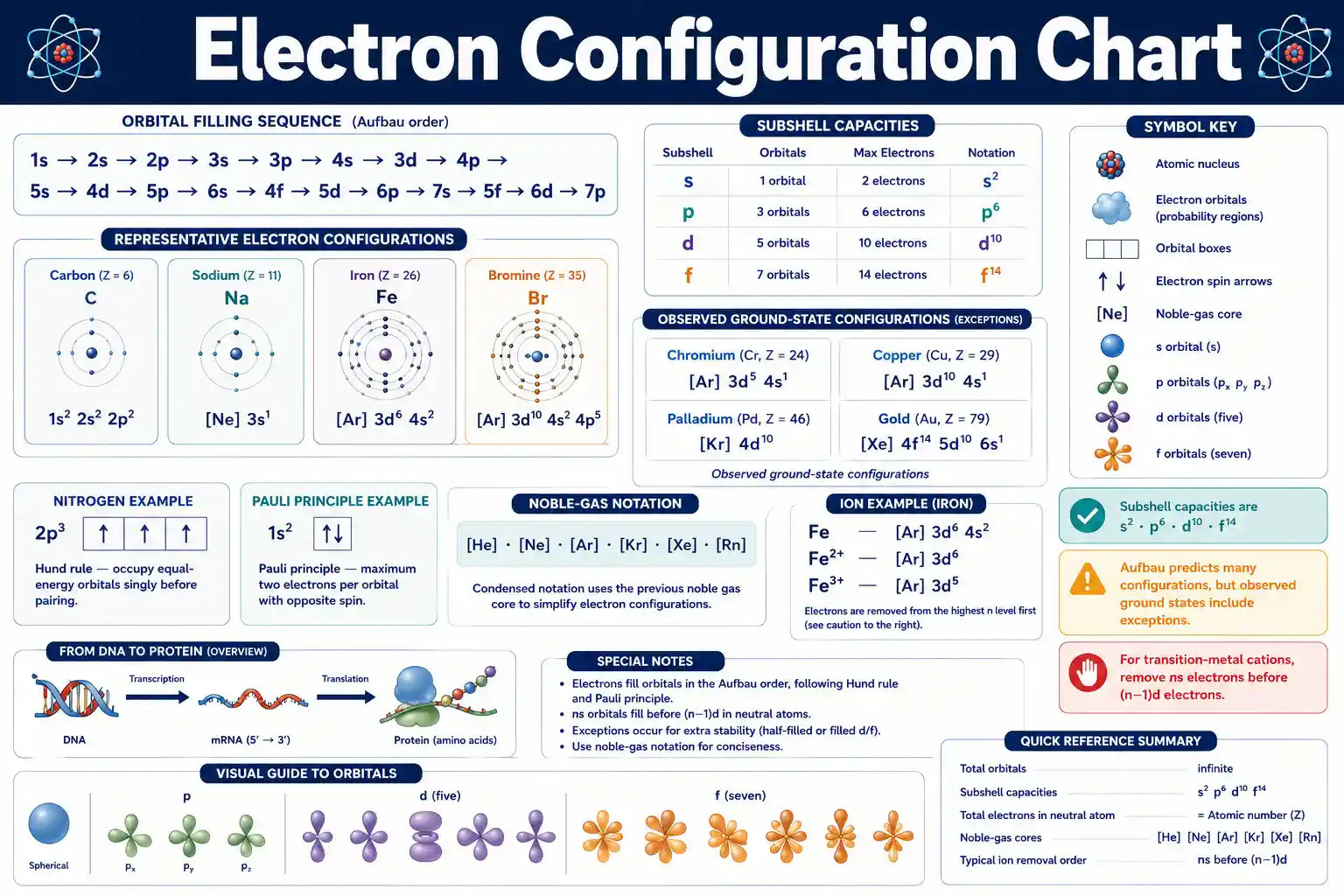
How electron configurations work
An electron configuration states how electrons occupy atomic orbitals. IUPAC defines it as the distribution of electrons over one-electron orbitals subject to the Pauli principle. A neutral atom contains the same number of electrons as its atomic number; an ion has fewer electrons when positively charged and more when negatively charged. See the IUPAC definition.
Each orbital holds at most two electrons. An s subshell contains one orbital, p contains three, d contains five, and f contains seven, so their capacities are 2, 6, 10, and 14 electrons. Hund's rule fills equal-energy orbitals singly before pairing, while noble-gas notation shortens the filled inner core.
Meaning
Electrons in orbitals
Electron configuration records how an atom or ion distributes electrons among occupied orbitals and subshells.
Subshell limits
s² · p⁶ · d¹⁰ · f¹⁴
One orbital holds at most two electrons, giving s, p, d, and f capacities of 2, 6, 10, and 14.
Prediction model
Aufbau + Hund + Pauli
These rules build most introductory configurations, but measured ground states include important exceptions.
Short form
[noble gas] + outer electrons
Noble-gas notation replaces a filled inner core with the preceding noble-gas symbol in brackets.
The usual filling sequence correctly predicts many atoms, but chromium is [Ar] 3d⁵ 4s¹ and copper is [Ar] 3d¹⁰ 4s¹. Those are observed neutral ground states, not errors in the table. NIST's evaluated compilation should take priority over a simplified diagonal-rule prediction. See NIST electron configurations.
Electron Configuration Chart for Elements 1–36
Neutral ground-state configurations from hydrogen through krypton. Chromium and copper show observed configurations that differ from the simplest diagonal-filling prediction.
Swipe horizontally inside the table to view every column.
| Z | Element | Symbol | Ground-state configuration | Noble-gas notation |
|---|---|---|---|---|
| 1 | Hydrogen | H | 1s¹ | 1s¹ |
| 2 | Helium | He | 1s² | 1s² |
| 3 | Lithium | Li | 1s² 2s¹ | [He] 2s¹ |
| 4 | Beryllium | Be | 1s² 2s² | [He] 2s² |
| 5 | Boron | B | 1s² 2s² 2p¹ | [He] 2s² 2p¹ |
| 6 | Carbon | C | 1s² 2s² 2p² | [He] 2s² 2p² |
| 7 | Nitrogen | N | 1s² 2s² 2p³ | [He] 2s² 2p³ |
| 8 | Oxygen | O | 1s² 2s² 2p⁴ | [He] 2s² 2p⁴ |
| 9 | Fluorine | F | 1s² 2s² 2p⁵ | [He] 2s² 2p⁵ |
| 10 | Neon | Ne | 1s² 2s² 2p⁶ | [He] 2s² 2p⁶ |
| 11 | Sodium | Na | 1s² 2s² 2p⁶ 3s¹ | [Ne] 3s¹ |
| 12 | Magnesium | Mg | 1s² 2s² 2p⁶ 3s² | [Ne] 3s² |
| 13 | Aluminium | Al | 1s² 2s² 2p⁶ 3s² 3p¹ | [Ne] 3s² 3p¹ |
| 14 | Silicon | Si | 1s² 2s² 2p⁶ 3s² 3p² | [Ne] 3s² 3p² |
| 15 | Phosphorus | P | 1s² 2s² 2p⁶ 3s² 3p³ | [Ne] 3s² 3p³ |
| 16 | Sulfur | S | 1s² 2s² 2p⁶ 3s² 3p⁴ | [Ne] 3s² 3p⁴ |
| 17 | Chlorine | Cl | 1s² 2s² 2p⁶ 3s² 3p⁵ | [Ne] 3s² 3p⁵ |
| 18 | Argon | Ar | 1s² 2s² 2p⁶ 3s² 3p⁶ | [Ne] 3s² 3p⁶ |
| 19 | Potassium | K | [Ar] 4s¹ | [Ar] 4s¹ |
| 20 | Calcium | Ca | [Ar] 4s² | [Ar] 4s² |
| 21 | Scandium | Sc | [Ar] 3d¹ 4s² | [Ar] 3d¹ 4s² |
| 22 | Titanium | Ti | [Ar] 3d² 4s² | [Ar] 3d² 4s² |
| 23 | Vanadium | V | [Ar] 3d³ 4s² | [Ar] 3d³ 4s² |
| 24 | Chromium | Cr | [Ar] 3d⁵ 4s¹ — Observed chromium exception | [Ar] 3d⁵ 4s¹ |
| 25 | Manganese | Mn | [Ar] 3d⁵ 4s² | [Ar] 3d⁵ 4s² |
| 26 | Iron | Fe | [Ar] 3d⁶ 4s² | [Ar] 3d⁶ 4s² |
| 27 | Cobalt | Co | [Ar] 3d⁷ 4s² | [Ar] 3d⁷ 4s² |
| 28 | Nickel | Ni | [Ar] 3d⁸ 4s² | [Ar] 3d⁸ 4s² |
| 29 | Copper | Cu | [Ar] 3d¹⁰ 4s¹ — Observed copper exception | [Ar] 3d¹⁰ 4s¹ |
| 30 | Zinc | Zn | [Ar] 3d¹⁰ 4s² | [Ar] 3d¹⁰ 4s² |
| 31 | Gallium | Ga | [Ar] 3d¹⁰ 4s² 4p¹ | [Ar] 3d¹⁰ 4s² 4p¹ |
| 32 | Germanium | Ge | [Ar] 3d¹⁰ 4s² 4p² | [Ar] 3d¹⁰ 4s² 4p² |
| 33 | Arsenic | As | [Ar] 3d¹⁰ 4s² 4p³ | [Ar] 3d¹⁰ 4s² 4p³ |
| 34 | Selenium | Se | [Ar] 3d¹⁰ 4s² 4p⁴ | [Ar] 3d¹⁰ 4s² 4p⁴ |
| 35 | Bromine | Br | [Ar] 3d¹⁰ 4s² 4p⁵ | [Ar] 3d¹⁰ 4s² 4p⁵ |
| 36 | Krypton | Kr | [Ar] 3d¹⁰ 4s² 4p⁶ | [Ar] 3d¹⁰ 4s² 4p⁶ |
Superscripts give electron counts in each occupied subshell.
- • These are neutral ground-state configurations.
- • NIST is the reference for observed ground-state configurations; simple filling rules are a model and have exceptions.
Download or export
Subshell and Orbital Capacity Chart
Each orbital can hold at most two electrons. The number of orbitals in a subshell determines its total capacity.
Swipe horizontally inside the table to view every column.
| Subshell | Angular momentum l | Orbitals | Maximum electrons | Typical notation |
|---|---|---|---|---|
| s | 0 | 1 | 2 | s² |
| p | 1 | 3 | 6 | p⁶ |
| d | 2 | 5 | 10 | d¹⁰ |
| f | 3 | 7 | 14 | f¹⁴ |
Maximum electrons = 2 × number of orbitals.
- • Pauli exclusion limits each orbital to two electrons with opposite spin.
- • Subshell capacity does not mean every subshell is filled in every ground state.
Download or export
Aufbau Orbital Filling Order Chart
The common Aufbau sequence is useful for predicting many ground-state configurations, but observed atomic configurations can differ when subshell energies are very close.
Swipe horizontally inside the table to view every column.
| Step | Subshell | Capacity | Cumulative capacity if filled |
|---|---|---|---|
| 1 | 1s | 2 | 2 |
| 2 | 2s | 2 | 4 |
| 3 | 2p | 6 | 10 |
| 4 | 3s | 2 | 12 |
| 5 | 3p | 6 | 18 |
| 6 | 4s | 2 | 20 |
| 7 | 3d | 10 | 30 |
| 8 | 4p | 6 | 36 |
| 9 | 5s | 2 | 38 |
| 10 | 4d | 10 | 48 |
| 11 | 5p | 6 | 54 |
| 12 | 6s | 2 | 56 |
| 13 | 4f | 14 | 70 |
| 14 | 5d | 10 | 80 |
| 15 | 6p | 6 | 86 |
| 16 | 7s | 2 | 88 |
| 17 | 5f | 14 | 102 |
| 18 | 6d | 10 | 112 |
| 19 | 7p | 6 | 118 |
Sequence used as a practical filling model.
- • Do not use this sequence as proof that every observed ground state follows it exactly.
- • For transition-metal cations, electron removal order is not simply the reverse of this list.
Download or export
The superscripts must add to the electron count
Carbon has six electrons, so 1s² 2s² 2p² totals 6. Chloride has 18 electrons because neutral chlorine has 17 and Cl⁻ has gained one. Counting superscripts is the fastest way to catch many configuration mistakes before checking orbital order.
Noble-Gas Core Notation Chart
Bracket notation replaces a completed noble-gas core with its element symbol, making long configurations easier to read.
Swipe horizontally inside the table to view every column.
| Core | Atomic number | Full closed-shell configuration | Example use |
|---|---|---|---|
| [He] | 2 | 1s² | Li = [He] 2s¹ |
| [Ne] | 10 | 1s² 2s² 2p⁶ | Na = [Ne] 3s¹ |
| [Ar] | 18 | [Ne] 3s² 3p⁶ | Fe = [Ar] 3d⁶ 4s² |
| [Kr] | 36 | [Ar] 3d¹⁰ 4s² 4p⁶ | Mo = [Kr] 4d⁵ 5s¹ |
| [Xe] | 54 | [Kr] 4d¹⁰ 5s² 5p⁶ | Au = [Xe] 4f¹⁴ 5d¹⁰ 6s¹ |
| [Rn] | 86 | [Xe] 4f¹⁴ 5d¹⁰ 6s² 6p⁶ | Used as the core for many actinides |
Bracketed symbol means all electrons of that noble-gas ground-state core are included.
- • Use the preceding noble gas, not the nearest noble gas after the element.
- • NIST uses bracketed rare-gas symbols to shorten heavier configurations.
Download or export
Common Ground-State Configuration Exceptions
Several atoms have observed ground states that differ from the simplest Aufbau prediction because nearby subshells have similar energies.
Swipe horizontally inside the table to view every column.
| Element | Simple prediction | Observed ground state | Pattern to remember |
|---|---|---|---|
| Chromium (Cr) | [Ar] 3d⁴ 4s² | [Ar] 3d⁵ 4s¹ | Half-filled 3d in the observed ground state |
| Copper (Cu) | [Ar] 3d⁹ 4s² | [Ar] 3d¹⁰ 4s¹ | Filled 3d in the observed ground state |
| Niobium (Nb) | [Kr] 4d³ 5s² | [Kr] 4d⁴ 5s¹ | Observed redistribution between 4d and 5s |
| Molybdenum (Mo) | [Kr] 4d⁴ 5s² | [Kr] 4d⁵ 5s¹ | Half-filled 4d |
| Ruthenium (Ru) | [Kr] 4d⁶ 5s² | [Kr] 4d⁷ 5s¹ | Observed 4d/5s redistribution |
| Rhodium (Rh) | [Kr] 4d⁷ 5s² | [Kr] 4d⁸ 5s¹ | Observed 4d/5s redistribution |
| Palladium (Pd) | [Kr] 4d⁸ 5s² | [Kr] 4d¹⁰ | Filled 4d; 5s is empty in the ground state |
| Platinum (Pt) | [Xe] 4f¹⁴ 5d⁸ 6s² | [Xe] 4f¹⁴ 5d⁹ 6s¹ | Observed 5d/6s redistribution |
| Gold (Au) | [Xe] 4f¹⁴ 5d⁹ 6s² | [Xe] 4f¹⁴ 5d¹⁰ 6s¹ | Filled 5d in the observed ground state |
Observed neutral ground-state configurations.
- • Treat these as observed configurations, not as a universal “half-filled/full-filled rule.”
- • Heavier atoms can require more detailed relativistic and spectroscopic treatment.
Download or export
Aufbau is a model, not an exception-free law
Subshell energies can be close enough that the lowest-energy many-electron arrangement differs from the simplest mnemonic. NIST lists chromium as [Ar] 3d⁵ 4s¹, copper as [Ar] 3d¹⁰ 4s¹, palladium as [Kr] 4d¹⁰, platinum as [Xe] 4f¹⁴ 5d⁹ 6s¹, and gold as [Xe] 4f¹⁴ 5d¹⁰ 6s¹.
Electron Configuration Finder
Choose atomic number 1–36 to see the observed neutral ground-state configuration used by this chart. Chromium and copper use their measured ground-state exceptions rather than the simplest Aufbau prediction.
Z = 24
Chromium (Cr)
- Ground-state configuration
- [Ar] 3d⁵ 4s¹
- Noble-gas notation
- [Ar] 3d⁵ 4s¹
- Electrons by principal shell
- 2, 8, 13, 1
- Electrons outside listed noble-gas core
- 6
The finder reports neutral atoms only. Ion configurations require adding or removing electrons from the neutral ground state using ion-specific rules.
Common Ion Electron Configuration Chart
Main-group ions often reach a noble-gas configuration. Transition-metal cations generally lose the outer ns electrons before electrons from the (n−1)d subshell.
Swipe horizontally inside the table to view every column.
| Species | Neutral atom | Electrons added / removed | Ion configuration |
|---|---|---|---|
| Na⁺ | [Ne] 3s¹ | Remove 1 from 3s | [Ne] |
| Mg²⁺ | [Ne] 3s² | Remove 2 from 3s | [Ne] |
| Al³⁺ | [Ne] 3s² 3p¹ | Remove 3 from n = 3 | [Ne] |
| O²⁻ | [He] 2s² 2p⁴ | Add 2 to 2p | [Ne] |
| Cl⁻ | [Ne] 3s² 3p⁵ | Add 1 to 3p | [Ar] |
| Ca²⁺ | [Ar] 4s² | Remove 2 from 4s | [Ar] |
| Cr³⁺ | [Ar] 3d⁵ 4s¹ | Remove 4s¹, then 2 from 3d | [Ar] 3d³ |
| Mn²⁺ | [Ar] 3d⁵ 4s² | Remove 2 from 4s | [Ar] 3d⁵ |
| Fe²⁺ | [Ar] 3d⁶ 4s² | Remove 2 from 4s | [Ar] 3d⁶ |
| Fe³⁺ | [Ar] 3d⁶ 4s² | Remove 2 from 4s, then 1 from 3d | [Ar] 3d⁵ |
| Cu⁺ | [Ar] 3d¹⁰ 4s¹ | Remove 1 from 4s | [Ar] 3d¹⁰ |
| Cu²⁺ | [Ar] 3d¹⁰ 4s¹ | Remove 4s¹, then 1 from 3d | [Ar] 3d⁹ |
| Zn²⁺ | [Ar] 3d¹⁰ 4s² | Remove 2 from 4s | [Ar] 3d¹⁰ |
Ground-state electron counts for common monatomic ions.
- • For transition metals, remove electrons from the highest principal quantum number ns subshell before (n−1)d.
- • An ion configuration is not obtained by blindly reversing the neutral filling sequence.
Download or export
Transition-metal ions lose ns electrons before (n−1)d electrons
Iron is [Ar] 3d⁶ 4s², but Fe²⁺ is [Ar] 3d⁶ because the two 4s electrons are removed first. Fe³⁺ is then [Ar] 3d⁵. Copper follows the same removal logic from its observed neutral ground state: Cu⁺ is [Ar] 3d¹⁰ and Cu²⁺ is [Ar] 3d⁹.
Orbital Box Rules Chart
Orbital diagrams add electron spin and orbital occupancy to the configuration notation.
Swipe horizontally inside the table to view every column.
| Rule | Meaning | Example | Common mistake |
|---|---|---|---|
| Pauli exclusion | Maximum two electrons per orbital with opposite spins | 1s² = ↑↓ | Putting three electrons in one orbital |
| Hund rule | Fill degenerate orbitals singly before pairing | 2p³ = ↑ ↑ ↑ | Pairing in one p orbital too early |
| Aufbau principle | Occupy lower-energy orbitals first as a starting model | 1s before 2s before 2p | Assuming the simple order has no exceptions |
| Electron count | Superscripts must sum to the species electron total | Fe: 26 electrons | Forgetting ionic charge changes electron count |
| Degeneracy | p, d, f contain 3, 5, 7 orbitals respectively | d has five boxes | Drawing one box for an entire d subshell |
Arrow direction represents spin projection in orbital-box notation.
- • Orbital boxes are a representation of one-electron orbitals and occupancies, not literal electron paths.
Download or export
Main-Group Valence Configuration Patterns
For representative main-group elements, the outer-shell ns and np pattern tracks the group and helps predict common bonding behavior.
Swipe horizontally inside the table to view every column.
| Group | Outer configuration pattern | Typical valence electrons | Example |
|---|---|---|---|
| 1 | ns¹ | 1 | Na: [Ne] 3s¹ |
| 2 | ns² | 2 | Mg: [Ne] 3s² |
| 13 | ns² np¹ | 3 | Al: [Ne] 3s² 3p¹ |
| 14 | ns² np² | 4 | Si: [Ne] 3s² 3p² |
| 15 | ns² np³ | 5 | P: [Ne] 3s² 3p³ |
| 16 | ns² np⁴ | 6 | S: [Ne] 3s² 3p⁴ |
| 17 | ns² np⁵ | 7 | Cl: [Ne] 3s² 3p⁵ |
| 18 | ns² np⁶ | 8 | Ar: [Ne] 3s² 3p⁶ |
Helium is the main exception to the ns²np⁶ noble-gas pattern because its shell contains only 1s².
- • Transition-metal valence counting is more context dependent because both ns and (n−1)d electrons can participate in chemistry.
Download or export
Principal Shell Capacity and Subshell Chart
A principal shell with quantum number n can contain up to 2n² electrons, but ground-state atoms do not simply fill one shell completely before beginning the next.
Swipe horizontally inside the table to view every column.
| Shell n | Available subshells | Maximum shell capacity 2n² | Important note |
|---|---|---|---|
| 1 | 1s | 2 | Only the s subshell exists |
| 2 | 2s, 2p | 8 | Second-period elements fill these subshells |
| 3 | 3s, 3p, 3d | 18 | 4s begins filling before 3d in the common Aufbau sequence |
| 4 | 4s, 4p, 4d, 4f | 32 | Several n = 4 subshells fill across different periods |
| 5 | 5s, 5p, 5d, 5f, 5g | 50 | The g subshell is part of the mathematical shell even though ordinary ground-state tables focus on lower-l subshells |
| 6 | 6s, 6p, 6d, 6f, 6g, 6h | 72 | Known ground states use only part of this mathematical capacity |
| 7 | 7s, 7p, 7d, 7f, 7g, 7h, 7i | 98 | High-n orbital ordering becomes increasingly complex |
Maximum capacity of a complete principal shell = 2n².
- • The 2n² rule is a shell capacity rule, not a step-by-step filling order.
Download or export
Common Electron Configuration Errors and Corrections
Most configuration errors come from incorrect electron totals, subshell capacities, ion removal order, or treating the Aufbau sequence as exception free.
Swipe horizontally inside the table to view every column.
| Mistake | Why it fails | Better approach |
|---|---|---|
| Write p⁷ | A p subshell has only three orbitals and holds at most six electrons | Move the next electron to the next available subshell |
| Write d¹¹ | A d subshell has five orbitals and holds at most ten electrons | Respect the d¹⁰ capacity |
| Use [Ar] 3d⁴ 4s² for chromium | That is the simplest prediction, not the observed neutral ground state | Use [Ar] 3d⁵ 4s¹ |
| Use [Ar] 3d⁹ 4s² for copper | That is not the observed neutral ground state | Use [Ar] 3d¹⁰ 4s¹ |
| Remove 3d electrons before 4s for Fe²⁺ | Transition-metal cations lose the higher-n 4s electrons first | Fe²⁺ = [Ar] 3d⁶ |
| Forget charge when counting electrons | Ions do not have Z electrons unless neutral | Electron count = Z − positive charge or Z + magnitude of negative charge |
| Choose the next noble gas in shorthand | That would include electrons the atom does not have | Use the preceding noble-gas core |
| Treat orbital boxes as electron trajectories | Orbitals are quantum states, not little planetary paths | Use boxes only to represent occupancy and spin |
| Call every outer-shell electron “the only valence electron” in transition metals | d electrons can participate in transition-metal chemistry | State the valence convention being used |
| Assume excited-state configurations equal ground states | Promoted electrons describe a different electronic state | Label excited states explicitly |
Checklist for neutral atoms, ions, and orbital diagrams.
- • When a reference table and a simple mnemonic disagree, use evaluated observed ground-state data for the atom in question.
Download or export
Ground state and excited state are not interchangeable
A ground-state configuration gives the lowest-energy arrangement for the specified species. An excited state promotes one or more electrons into a higher-energy orbital. When a problem asks for the electron configuration without another qualifier, use the ground state unless the context explicitly describes excitation.
NIST's periodic table incorporates critically evaluated atomic data including ground-state configurations, which makes it a stronger reference than a hand-drawn diagonal mnemonic when exact configurations matter. See the NIST periodic table reference.
Frequently asked questions
What is an electron configuration?
An electron configuration describes how electrons are distributed among atomic orbitals. The superscripts show how many electrons occupy each subshell.
How many electrons fit in s, p, d, and f subshells?
An s subshell holds 2 electrons, p holds 6, d holds 10, and f holds 14.
What is the Aufbau filling order?
A common sequence is 1s, 2s, 2p, 3s, 3p, 4s, 3d, 4p, 5s, 4d, 5p, 6s, 4f, 5d, 6p, 7s, 5f, 6d, 7p. Observed ground states include exceptions.
Why is chromium [Ar] 3d5 4s1?
The observed chromium ground state is [Ar] 3d⁵ 4s¹ rather than the simplest [Ar] 3d⁴ 4s² prediction because the 3d and 4s energies are close and the actual many-electron ground state is lower in energy.
Why is copper [Ar] 3d10 4s1?
Copper has the observed ground-state configuration [Ar] 3d¹⁰ 4s¹. It is another case where the simplest diagonal-filling prediction does not match the measured ground state.
What does noble-gas notation mean?
Noble-gas notation replaces the filled inner-shell configuration with the symbol of the preceding noble gas in brackets, such as Fe = [Ar] 3d⁶ 4s².
How do I find the electron configuration of an ion?
Start from the neutral ground-state configuration, adjust the electron count for charge, and remove or add electrons using the correct orbital order for that ion.
Why are 4s electrons removed before 3d electrons?
Although 4s is occupied before 3d in the usual neutral-atom filling sequence, transition-metal cations generally lose the higher-principal-quantum-number 4s electrons before 3d electrons.
What is Hund rule?
Hund rule says degenerate orbitals are occupied singly with parallel spin before electrons pair in the same orbital.
What is the Pauli exclusion principle?
No two electrons in one atom can have the same complete set of quantum numbers, so one orbital holds at most two electrons with opposite spin.
How many orbitals are in p, d, and f subshells?
A p subshell has 3 orbitals, d has 5, and f has 7.
How do I check an electron configuration?
Add every superscript and confirm the total equals the species electron count, then verify subshell capacities and any known ground-state exception.
Are valence electrons always the electrons in the highest shell?
That shortcut works well for many main-group elements, but transition-metal chemistry can also involve electrons from the partially filled d subshell.
Is the Aufbau rule exact?
No. It is a useful orbital-filling model, but evaluated ground-state configurations show multiple exceptions where near-degenerate subshells redistribute electrons.
Does an electron configuration show where an electron physically is?
No. It specifies orbital occupancy in a quantum-mechanical description; it does not trace a classical path around the nucleus.
What is an excited-state electron configuration?
An excited-state configuration has one or more electrons promoted above the ground-state arrangement. It must be identified separately from the ground state.
Related ChartsLoom references
Use the Atomic Radius Chart to connect electronic structure with periodic size trends, the Codon Chart for molecular-biology notation, or the Density Chart for physical-property reference data.
Sources
International Union of Pure and Applied Chemistry — Gold Book — electron configuration
Defines electron configuration as the distribution of electrons over one-electron orbitals subject to the Pauli principle.
https://goldbook.iupac.org/terms/view/C01248
National Institute of Standards and Technology — Electronic Configurations of the Elements
Provides evaluated neutral ground-state electron configurations and first-cation configurations for elements through uranium.
https://www.nist.gov/pml/atomic-reference-data-electronic-structure-calculations/atomic-reference-data-electronic-8
National Institute of Standards and Technology — Periodic Table of the Elements
NIST periodic table with critically evaluated atomic data including ground-state configuration.
https://www.nist.gov/publications/periodic-table-elements-0
National Institute of Standards and Technology — Ground Levels and Ionization Energies for the Neutral Atoms
Explains NIST ground-state configuration notation and noble-gas abbreviation in atomic data tables.
https://www.nist.gov/pml/ground-levels-and-ionization-energies-neutral-atoms