Family & Parenting
Feelings Chart
Help children name emotions, rate intensity, notice body clues, communicate needs, practice coping skills, and recognize when stronger support is needed.
This chart supports emotional language and everyday regulation. It cannot diagnose anxiety, depression, trauma, ADHD, autism, or another condition. Self-harm, harm threats, inability to stay safe, or immediate danger requires urgent adult and professional help.
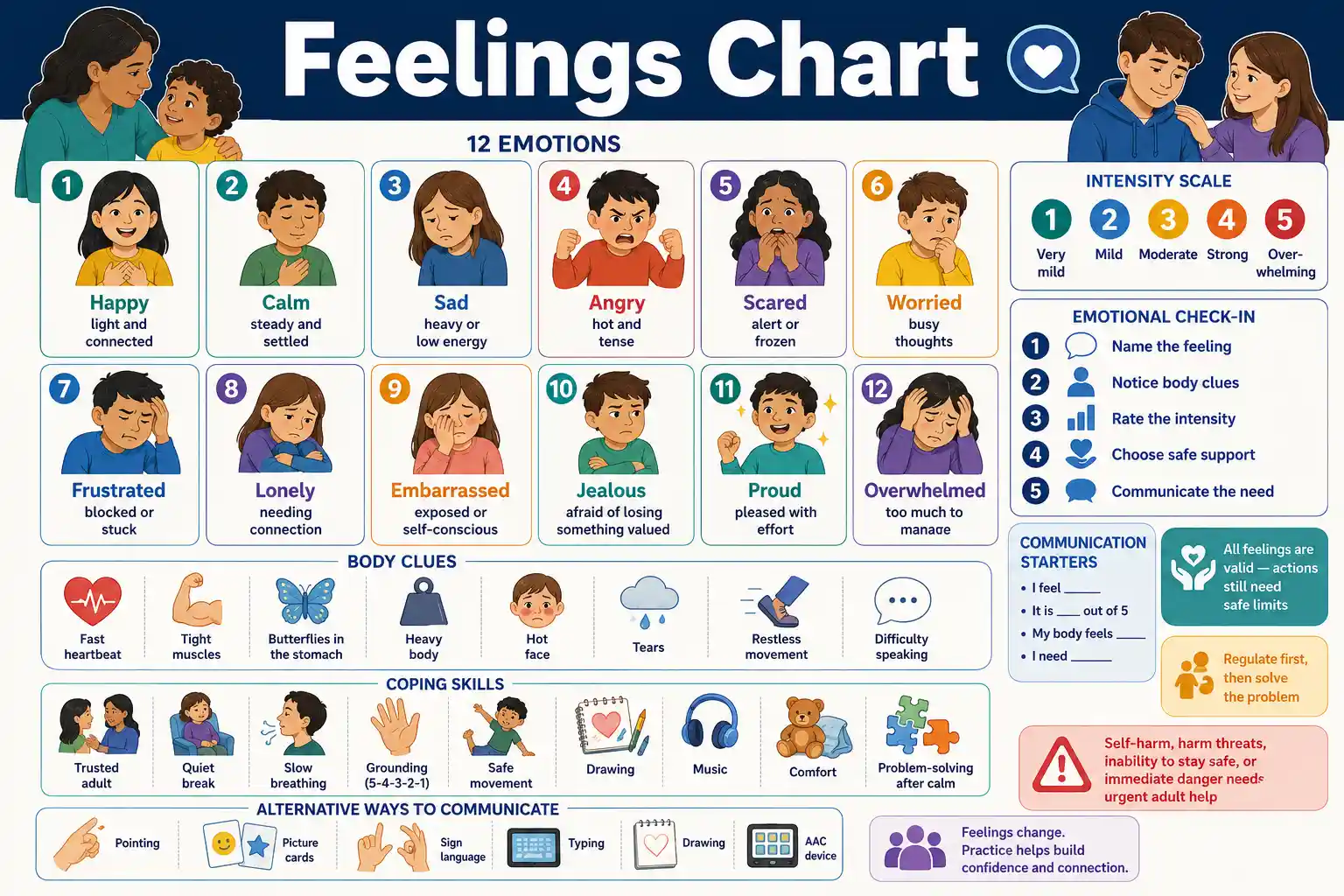
How should a feelings chart be used?
Invite the child to choose or describe a feeling, estimate its intensity, notice body clues, and identify the kind of support that would help. The American Academy of Pediatrics emotion-coaching guidance recommends noticing, naming, acknowledging, and responding to feelings rather than dismissing them.
Start with the feeling
Name without judgment
A feeling is information. Adults can accept the emotion while still limiting unsafe behaviour.
Notice the pattern
Body · intensity · context
Body clues and intensity often reveal when support is needed before a child becomes overwhelmed.
Make a clear request
Feeling + clue + need
A short sentence stem can turn a difficult moment into a request for comfort, space, or help.
Protect safety
Escalate danger promptly
Self-harm, harm threats, severe loss of control, or immediate danger requires urgent adult action.
Direct answers to common feelings questions
What is a feelings chart?
A feelings chart helps a child identify an emotion, rate its intensity, notice body clues, and communicate a need.
Are any feelings bad?
No feeling is morally bad, but actions such as hitting, threatening, or destroying property still require clear safety limits.
What feelings should a preschool chart include?
Start with happy, sad, angry, scared, calm, and excited, then add more precise words as the child learns.
How do I help a child name a feeling?
Describe what you notice and offer a tentative label, such as “I wonder if you feel frustrated.”
What does co-regulation mean?
Co-regulation means an adult helps a child settle through calm presence, reduced demands, predictable limits, and appropriate coping support.
Should I solve the problem during a meltdown?
Regulate first. Flexible thinking and problem-solving usually improve after emotional intensity falls.
Can children feel more than one emotion?
Yes. Mixed feelings such as excited and worried or angry and hurt are common.
Why do feelings show up in the body?
Emotions can change heart rate, muscle tension, breathing, energy, temperature, and stomach sensations.
Can a non-speaking child use a feelings chart?
Yes. Pointing, signs, pictures, typing, gestures, drawing, and AAC are valid ways to communicate feelings.
How often should a family check in?
A brief predictable check-in once or twice daily can build skill without making emotions feel monitored constantly.
When should strong emotions be assessed?
Seek professional advice when symptoms are severe, persistent, developmentally unusual, or interfere with sleep, school, home, play, or relationships.
What if a child talks about self-harm?
Take the statement seriously, stay with the child, reduce access to hazards, and contact local emergency or crisis services.
Core Feelings Chart with Meanings and Needs
Emotion words become more useful when children connect each feeling with a possible message and a safe response.
Swipe horizontally inside the table to view every column.
| Feeling | What it may signal | Common body or behaviour clues | Helpful first response |
|---|---|---|---|
| Happy | Connection, success, comfort, or enjoyment | Smiling, open posture, lively voice | Notice and share the positive moment |
| Calm | Safety, readiness, or balance | Steady breathing, relaxed muscles | Continue the routine or choose the next task |
| Sad | Loss, disappointment, loneliness, or tiredness | Tears, low voice, heavy body | Offer comfort, company, and time |
| Angry | Blocked goal, unfairness, threat, pain, or overload | Hot face, tight fists, loud voice | Set safety limits and regulate before talking — Safety and regulation before discussion |
| Scared | Real or perceived danger or uncertainty | Fast heart, freezing, hiding, clinging | Move toward safety and a trusted adult |
| Worried | Anticipated threat or repeated uncertainty | Busy thoughts, stomach discomfort, checking | Name the worry and choose one controllable step |
| Frustrated | A task or goal feels difficult or blocked | Sighing, quitting, repeated attempts | Pause, break the task down, and ask for help |
| Lonely | Need for connection or belonging | Withdrawal, watching others, low energy | Create one manageable connection opportunity |
| Embarrassed | Fear of judgment after attention or a mistake | Looking away, hiding face, nervous laughter | Use privacy, reassurance, and kind self-talk |
| Jealous | Fear of losing attention, status, or something valued | Comparing, protesting, possessiveness | Name the underlying need without shaming |
| Proud | Achievement, effort, courage, or contribution | Upright posture, sharing work, smiling | Praise specific effort and values |
| Overwhelmed | Demands exceed current coping capacity | Shutdown, agitation, crying, inability to choose | Reduce demands and co-regulate first |
Feelings are information, not proof of one cause. Ask what happened and what the child needs.
- • Children may show one feeling through another behaviour, such as fear appearing as anger.
- • A child can feel several emotions at the same time.
Download or export
Rate intensity without grading the emotion
A one-to-five scale communicates how much support is needed. Low intensity may need simple noticing. Strong intensity may need adult co-regulation, fewer demands, and more time before discussion.
Feelings Intensity Scale from 1 to 5
A shared intensity scale helps children communicate how strong a feeling is and how much adult support they need.
Swipe horizontally inside the table to view every column.
| Level | Plain-language label | Typical experience | Support level |
|---|---|---|---|
| 1 | Very mild | The feeling is present but easy to manage | Notice it and continue |
| 2 | Mild | Some body clues or distraction appear | Use one simple coping skill |
| 3 | Moderate | Thinking or behaviour is clearly affected | Pause, name the need, and get support |
| 4 | Strong | The child may lose flexibility or control | Adult co-regulation and reduced demands |
| 5 | Overwhelming | The child cannot stay organized or safe | Immediate adult support and safety assessment — Urgent safety support |
| Rising | Moving upward | Voice, movement, thoughts, or tension are increasing | Intervene early before the peak |
| Falling | Coming down | Breathing and thinking begin to settle | Keep demands low and allow recovery |
| Recovered | Ready to reflect | The child can listen, plan, and reconnect | Discuss triggers and repair after calm returns |
Intensity describes strength, not whether a feeling is good or bad.
- • Use the same scale consistently at home, school, and therapy when possible.
- • A level 5 with danger, self-harm, or harm threats requires urgent help.
Download or export
Use body clues as early signals
A fast heart, tight muscles, tears, low energy, stomach discomfort, or difficulty speaking can accompany emotions. Check physical needs and health symptoms because the same clue can have many causes.
Body Clues That Can Accompany Feelings
Body awareness can help a child notice an emotion before behaviour escalates, but one body clue can have many causes.
Swipe horizontally inside the table to view every column.
| Body clue | Possible feelings | Check first | Child-friendly prompt |
|---|---|---|---|
| Fast heartbeat | Fear, worry, excitement, anger | Activity, illness, caffeine, pain | Is your heart fast from excitement or worry? |
| Tight jaw or fists | Anger, frustration, stress | Pain, cold, physical effort | What made your muscles tighten? |
| Butterflies or stomachache | Worry, excitement, sadness | Hunger, illness, constipation | What was happening when your stomach changed? |
| Heavy body or low energy | Sadness, disappointment, exhaustion | Sleep, illness, nutrition | Do you need comfort, rest, or help? |
| Hot face or sweating | Anger, embarrassment, fear | Heat, exercise, fever | Did something feel unfair, scary, or embarrassing? |
| Tears | Sadness, anger, relief, joy, overload | Pain or eye irritation | What are the tears trying to tell us? |
| Restless movement | Excitement, anxiety, overload, boredom | Need for movement or sensory input | Would movement help your body settle? |
| Frozen or hard to speak | Fear, shame, overload | Language or communication needs | You can point, draw, or tell me later. — Alternative communication is valid |
Body clues support curiosity; they do not diagnose an emotion or medical condition.
- • Check physical needs and health symptoms before assuming a behaviour is emotional.
- • Some children notice internal body signals less clearly and may prefer pictures or choices.
Download or export
Match the chart to age and communication stage
Young children usually need a few simple faces and adult language. Older children can add mixed emotions, triggers, intensity, needs, and reflection. Pictures, signs, typing, drawing, and AAC are valid alternatives to speech.
Feelings Communication by Age and Stage
Emotional vocabulary and self-regulation develop gradually; adults continue to provide co-regulation even as children gain independence.
Swipe horizontally inside the table to view every column.
| Age or stage | What may be realistic | Useful chart format | Adult role |
|---|---|---|---|
| Infants | Signal comfort, distress, interest, and fatigue through behaviour | Caregiver observation rather than self-rating | Respond consistently and regulate through voice, touch, and routine |
| Ages 2–3 | Choose between a few basic feeling words or pictures | Four to six faces with simple labels | Name feelings and keep limits short |
| Ages 4–5 | Connect feelings with events and simple coping choices | Faces plus body clues and two coping options | Coach language and model repair |
| Ages 6–8 | Use more precise words and a 1–5 scale | Emotion families, intensity, and sentence stems | Ask curious questions without interrogation |
| Ages 9–12 | Describe mixed feelings, triggers, and consequences | Larger vocabulary and private check-in | Respect privacy while monitoring safety |
| Ages 13–18 | Reflect on patterns, values, identity, and relationships | Independent journal or digital check-in | Collaborate, listen, and seek care when functioning declines |
| Limited speech | Communicate through gesture, signs, devices, pictures, or behaviour | Visual choices with accessible symbols — Accessible communication options | Accept the communication method and avoid forcing speech |
| High stress or overload | Temporarily lose access to language or flexible thinking | One-step visual support | Reduce words, demands, and sensory load |
Age ranges are broad guides; communication, culture, disability, and experience affect expression.
- • A chart should expand communication, not test or grade a child.
- • Never require eye contact or spoken language as proof that a child understands.
Download or export
Validate the feeling and limit unsafe behaviour
Emotion coaching does not mean approving every action. An adult can say, “It is okay to feel angry; hitting is not okay,” then help the child settle before solving the problem.
Emotion Coaching Steps for Caregivers
Emotion coaching validates the feeling while preserving clear boundaries around unsafe or harmful behaviour.
Swipe horizontally inside the table to view every column.
| Step | Caregiver action | Example words | Avoid |
|---|---|---|---|
| 1. Notice | Observe voice, face, body, and context | I notice your hands are tight and your voice is loud. | Assuming motive |
| 2. Name tentatively | Offer a possible feeling without insisting | I wonder if you feel frustrated. | You are angry, end of story |
| 3. Validate | Show that the feeling makes sense in context | It is hard when plans change. | Stop crying; it is not a big deal |
| 4. Set safety limits | Block harm and state the boundary calmly | It is okay to be angry; hitting is not okay. — Validate feeling and limit behaviour | Shaming the feeling |
| 5. Co-regulate | Use calm presence, fewer words, and a suitable strategy | Let us breathe or take space together. | Demanding an explanation at the peak |
| 6. Identify the need | Ask what support would help | Do you want comfort, space, or help fixing it? | Offering too many choices |
| 7. Problem-solve | Make a small plan after calm returns | What could we try next time? | Lecturing |
| 8. Repair and reconnect | Address harm and restore the relationship | How can we make this right? | Forced apologies before regulation |
Validation means accepting the emotional experience, not approving every action.
- • Adults can model the same sequence with their own feelings.
- • Shorter language works better during high intensity.
Download or export
Regulate before problem-solving
Movement, quiet space, grounding, comfort, reduced sensory load, or a trusted adult can lower intensity. Practice several options when calm because one coping skill will not suit every child or situation.
Coping Skills Matched to Emotional State
The best strategy depends on the feeling, intensity, environment, and child; no single technique works every time.
Swipe horizontally inside the table to view every column.
| State | Regulate the body | Communicate or connect | Then solve |
|---|---|---|---|
| Worried | Slow exhale, grounding, steady movement | Tell a trusted adult or write the worry | Choose one controllable step |
| Angry | Create distance, release muscle tension, safe movement | Use an I feel statement after calm | Set a boundary or make repair |
| Sad | Rest, cry safely, use comfort or music | Seek company or share the loss | Plan one gentle activity |
| Frustrated | Pause and reset posture or breathing | Ask for one specific kind of help | Break the task into smaller parts |
| Scared | Move toward safety and orient to the room | Name the danger or uncertainty | Check facts with a trusted adult |
| Lonely | Use comforting sensory input or movement | Send a message or join a structured activity | Plan a repeatable connection |
| Overstimulated | Reduce noise, light, language, and demands | Use a visual or signal for a break | Return gradually when ready |
| Excited | Channel energy through movement or a task | Share the excitement appropriately | Plan for transitions and waiting |
| Embarrassed | Slow down and use kind self-talk | Talk privately with a trusted person | Repair only what actually needs repair |
| Overwhelmed | Stop nonessential demands and co-regulate — Reduce demands and co-regulate | Ask an adult to help prioritize | Choose one next action after recovery |
Regulation strategies are educational options, not treatment prescriptions.
- • Practice coping skills when calm so they are easier to access under stress.
- • Do not use breathing exercises if they increase panic or distress; choose another grounding method.
Download or export
Feelings check-in guide
Choose a feeling, intensity, body clue, and preferred support. The guide creates a short regulation plan and communication sentence.
Turn a feeling into a clear request
Sentence stems reduce language demands: “I feel ___,” “It is ___ out of 5,” “My body feels ___,” and “I need ___.” Adults should respond before demanding perfect wording.
Feelings Sentence Stems for Children and Teens
Short sentence frames reduce the language load and help turn emotion into a clear request.
Swipe horizontally inside the table to view every column.
| Purpose | Short sentence stem | Expanded sentence stem | Adult response |
|---|---|---|---|
| Name emotion | I feel ___. | I feel ___ because ___. | Thank you for telling me. |
| Rate intensity | It is ___ out of 5. | My feeling is at ___ out of 5 and rising/falling. | Let us match support to that level. |
| Share body clue | My body feels ___. | I notice ___ in my body. | That clue can help us act early. |
| Ask for space | I need a break. | I need ___ minutes in a safe quiet place. | We will reconnect after the break. |
| Ask for help | Please help me. | I need help with the first step. | Tell me which part feels hardest. |
| Set a boundary | Please stop. | I do not like ___. Please stop. | I will help keep the boundary safe. |
| Seek connection | Stay with me. | I do not need advice yet; I need company. | I can stay and listen. |
| Repair | I want to fix it. | I am sorry for ___. I can repair it by ___. | Let us choose a realistic repair. |
| Report danger | I do not feel safe. | I might hurt myself/someone or cannot stay safe. | I will stay with you and get urgent help. — Urgent adult response |
Children may point to, type, sign, draw, or select a sentence instead of speaking it.
- • Do not require a perfectly worded statement before offering support.
- • Treat statements about self-harm or harm to others as safety information, not misbehaviour.
Download or export
Keep check-ins brief, predictable, and private
A short daily record can reveal patterns in triggers, body clues, coping strategies, sleep, school, and relationships. The chart should never become punishment, surveillance, or a public behaviour score.
Daily Feelings Check-In Chart
A brief check-in can reveal patterns without turning every emotion into a long discussion.
Swipe horizontally inside the table to view every column.
| Check-in item | Question | Record option | How to use the pattern |
|---|---|---|---|
| Feeling | What feeling fits best right now? | Word, face, colour, gesture, or drawing | Look for repeated states rather than one entry |
| Intensity | How strong is it from 1 to 5? | Number, fingers, blocks, or thermometer | Notice rising or falling patterns |
| Body clue | Where do you notice it? | Body outline or short phrase | Identify early warning signs |
| Trigger or context | What happened before it? | Event, person, demand, transition, or unknown | Find predictable stress points |
| Need | What would help right now? | Comfort, space, movement, help, food, rest | Respond to needs before lecturing |
| Strategy | What did you try? | One coping action | Compare strategies over time |
| Outcome | Did the intensity change? | Lower, same, higher | Keep useful strategies and revise others |
| Functioning | Did it affect sleep, school, play, or relationships? | Yes/no plus short note | Persistent impairment warrants professional discussion |
| Safety | Can everyone stay safe? | Safe, needs adult support, immediate danger | Escalate immediately when safety is uncertain — Immediate safety escalation |
Keep entries brief and private; do not use the chart as punishment, surveillance, or public behaviour scoring.
- • A pattern across days is usually more informative than one difficult moment.
- • Respect a child’s privacy while maintaining appropriate safety monitoring.
Download or export
Know when everyday support is not enough
Occasional fear, sadness, anger, and worry are common. The CDC child mental-health guidance explains that severe, persistent symptoms that interfere with home, school, or play deserve assessment. The SAMHSA caregiver warning-sign guide identifies self-harm risk and severe loss of control as urgent concerns.
Emotional Warning Signs and Next Actions
Frequency, severity, duration, developmental context, and impact on daily life determine whether a pattern needs routine, prompt, or urgent help.
Swipe horizontally inside the table to view every column.
| Pattern | Why it matters | Suggested action | Urgency |
|---|---|---|---|
| Occasional strong feeling after a clear event | Normal emotions can be intense and temporary | Support, monitor, and teach coping | Routine |
| Symptoms persist and disrupt school, home, play, sleep, or relationships | Functional impairment may signal a mental-health concern | Discuss with pediatrician or qualified mental-health professional | Prompt |
| Very sad, withdrawn, or unusually irritable for more than two weeks | A sustained change warrants assessment | Arrange professional evaluation | Prompt |
| Frequent panic-like episodes or overwhelming fear | Severe anxiety can impair functioning and safety | Seek timely clinical assessment | Prompt |
| Severe out-of-control behaviour that could cause injury | The child or others may be unsafe | Get immediate adult and professional help | Urgent |
| Talk of self-harm, suicide, killing, or having no reason to live | Statements may indicate immediate risk | Stay with the child and contact emergency or crisis services | Emergency — Emergency response |
| Self-harm behaviour or preparations for harm | Physical safety is at risk | Remove access to hazards and obtain emergency help | Emergency |
| Psychosis-like symptoms, extreme confusion, or inability to recognize reality | The child may need urgent medical assessment | Contact emergency medical services | Emergency |
| Immediate danger, serious injury, overdose, or inability to wake | Life-threatening emergency | Call local emergency services now | Emergency |
This chart cannot assess or diagnose risk. When in doubt about immediate safety, seek urgent professional help.
- • Stay calm, listen directly, and take safety statements seriously.
- • Do not leave a child alone when immediate self-harm or violence risk is present.
Download or export
Common feelings-chart mistakes
Avoid good-versus-bad labels, forced speech, public emotional scoring, excessive questioning, immediate lectures, and using calmness as the only acceptable state. Adapt the tool to communication, sensory, cultural, and privacy needs.
Common Feelings Chart Mistakes and Better Alternatives
A feelings chart should support communication and regulation rather than compliance, diagnosis, or public behaviour control.
Swipe horizontally inside the table to view every column.
| Mistake | Why it fails | Better approach | Adaptation |
|---|---|---|---|
| Labeling feelings as good or bad | Children may hide disapproved emotions | Treat feelings as information and actions as choices | Use comfortable/uncomfortable or low/high energy |
| Forcing one exact emotion word | Feelings can be mixed or uncertain | Offer possibilities and allow “not sure” | Use pictures, colours, or body clues |
| Using the chart only during meltdowns | The skill is unavailable without calm practice | Practice briefly during neutral moments | Add it to a predictable routine |
| Demanding speech or eye contact | This can increase overload and exclude communication differences | Accept pointing, signing, typing, or drawing | Use AAC-compatible visuals |
| Problem-solving before regulation | High arousal reduces flexible thinking | Regulate first and reflect later — Regulate before problem-solving | Use fewer words and lower demands |
| Publicly displaying private emotions | It can cause shame or peer exposure | Keep individual check-ins private | Use anonymous group climate checks |
| Treating every strong feeling as misbehaviour | The underlying need stays hidden | Separate emotion, behaviour, and safety | Validate feeling while limiting harm |
| Using a colour zone as a moral grade | Children may believe calm is the only acceptable state | Describe energy and support needs without judgment | Avoid reward loss for emotional state |
| Assuming a chart replaces professional care | Persistent impairment or danger needs assessment | Use the chart to document and communicate patterns | Share concise observations with clinicians or school staff |
Adapt language, symbols, sensory load, privacy, and expectations to the individual child.
- • Cultural norms influence how emotions are named and displayed.
- • A child should never lose safety, dignity, food, rest, or connection because of a chart result.
Download or export
Frequently asked questions
What is a feelings chart?
A feelings chart is a visual tool that helps a child identify an emotion, notice its intensity and body clues, communicate a need, and choose a safe coping response.
At what age can a child use a feelings chart?
Many children can begin choosing between a few simple feeling faces around ages 2 to 3, while infants rely on caregiver observation and older children can use more detailed vocabulary.
How many emotions should a preschool feelings chart include?
Start with about four to six clear emotions, such as happy, sad, angry, scared, calm, and excited, then expand as the child becomes comfortable.
Are anger and sadness bad feelings?
No. Anger and sadness are normal emotions; the goal is to understand them and keep behaviour safe.
What should an adult say when a child is angry?
Name the possible feeling, validate the situation, set a safety limit, and help the child regulate before discussing solutions.
Why does my child say “I do not know”?
The child may be overwhelmed, unsure, tired, afraid of judgment, or still developing internal-body awareness and emotional vocabulary.
Can a child feel two emotions at once?
Yes. A child can feel excited and worried, angry and hurt, or proud and embarrassed at the same time.
Should I make my child use the chart during a meltdown?
Do not force detailed labeling at peak distress. Use a simple choice or safety cue, then return to the chart after the child is calmer.
What is co-regulation?
Co-regulation is an adult helping a child settle through calm presence, predictable limits, reduced demands, and appropriate sensory or coping support.
Does validating a feeling reward bad behaviour?
No. Validation acknowledges the emotional experience while the adult still blocks hitting, threats, destruction, or other unsafe actions.
Can non-speaking children use a feelings chart?
Yes. A child can point, look, sign, type, use an AAC device, select a picture, or show a body clue instead of speaking.
How often should families use a feelings chart?
Brief predictable check-ins once or twice daily can build familiarity, while extra use should remain supportive rather than intrusive.
When should strong emotions be discussed with a professional?
Seek professional advice when emotional or behavioural symptoms are severe, persistent, developmentally unusual, or interfere with school, home, sleep, play, or relationships.
What should I do if a child talks about self-harm or suicide?
Take the statement seriously, stay with the child, reduce access to hazards, and contact local emergency or crisis services for immediate guidance.
Can a feelings chart diagnose anxiety, depression, ADHD, or autism?
No. A feelings chart can document patterns and support communication, but it cannot diagnose a mental-health or developmental condition.
Should a school display each child’s feelings publicly?
Individual emotional check-ins should usually remain private; public displays can create shame, pressure, or unwanted disclosure.
Sources
These pediatric, public-health, mental-health, and child-communication references support the emotion-coaching, regulation, accessibility, warning-sign, and help-seeking guidance used on this page.
American Academy of Pediatrics — Helping Little People Manage Big Feelings
https://www.healthychildren.org/English/family-life/family-dynamics/Pages/helping-little-people-manage-big-feelings.aspx
Describes emotion coaching as noticing, naming, acknowledging, and responding to a child’s emotional needs.
American Academy of Pediatrics — Healthy Mental and Emotional Development in Children
https://www.healthychildren.org/English/healthy-living/emotional-wellness/Building-Resilience/Pages/healthy-mental-and-emotional-development-in-children-key-building-blocks.aspx
Explains how warm relationships, emotional understanding, routines, play, and support help children build resilience.
American Academy of Pediatrics — Play Activities to Help Children Manage Emotions
https://www.healthychildren.org/English/family-life/power-of-play/Pages/play-ideas-to-help-your-child-manage-emotions.aspx
Offers child-friendly play, art, movement, and labeling activities that support emotional awareness and regulation.
Centers for Disease Control and Prevention — About Children’s Mental Health
https://www.cdc.gov/children-mental-health/about/index.html
Explains that occasional fears and worries are common, while severe, persistent symptoms that interfere with life warrant assessment.
Centers for Disease Control and Prevention — About Mental Health
https://www.cdc.gov/mental-health/about/index.html
Describes childhood and adolescence as periods for learning emotional milestones, social skills, and healthy coping.
National Health Service — Talking to Your Child About Feelings
https://www.nhs.uk/mental-health/children-and-young-adults/advice-for-parents/talk-to-children-about-feelings/
Recommends noticing behaviour, using calm observations, listening without pressure, and choosing appropriate moments to talk.
National Health Service — Helping Your Child with Anger Issues
https://www.nhs.uk/mental-health/children-and-young-adults/advice-for-parents/help-your-child-with-anger-issues/
Provides practical support for recognizing triggers, using movement, and seeking help when anger becomes harmful or persistent.
Substance Abuse and Mental Health Services Administration — For Parents and Caregivers of Children
https://www.samhsa.gov/mental-health/what-is-mental-health/how-to-talk/parents-and-caregivers
Lists warning signs that merit prompt or urgent professional support, including prolonged withdrawal, severe out-of-control behaviour, and self-harm risk.
Substance Abuse and Mental Health Services Administration — Warning Signs of Suicide
https://www.samhsa.gov/mental-health/suicidal-behavior/warning-signs
Identifies youth warning signs such as hopelessness, overwhelming distress, withdrawal, sleep changes, and unusual agitation.
NHS Children’s Services — Emotional Regulation
https://bedslutonchildrenshealth.nhs.uk/services/bedfordshire-and-luton-childrens-speech-and-language-therapy-service/supporting-social-communication-and-interaction/emotional-regulation/
Describes visual supports, adult co-regulation, body-signal observation, and coping choices for children who need communication support.