Animals & Pets · Aquarium planning
Fish Compatibility Chart for Freshwater and Marine Tank Mates
Compare water systems, temperature, pH, adult size, predation, temperament, territory, schooling, tank space, introduction order and warning signs before combining aquarium fish.
This chart cannot guarantee that individual fish will coexist. Confirm the exact species, adult size and current care guidance. Separate fish when persistent aggression, feeding exclusion, injury or breathing distress appears. Read the ChartsLoom Disclaimer.
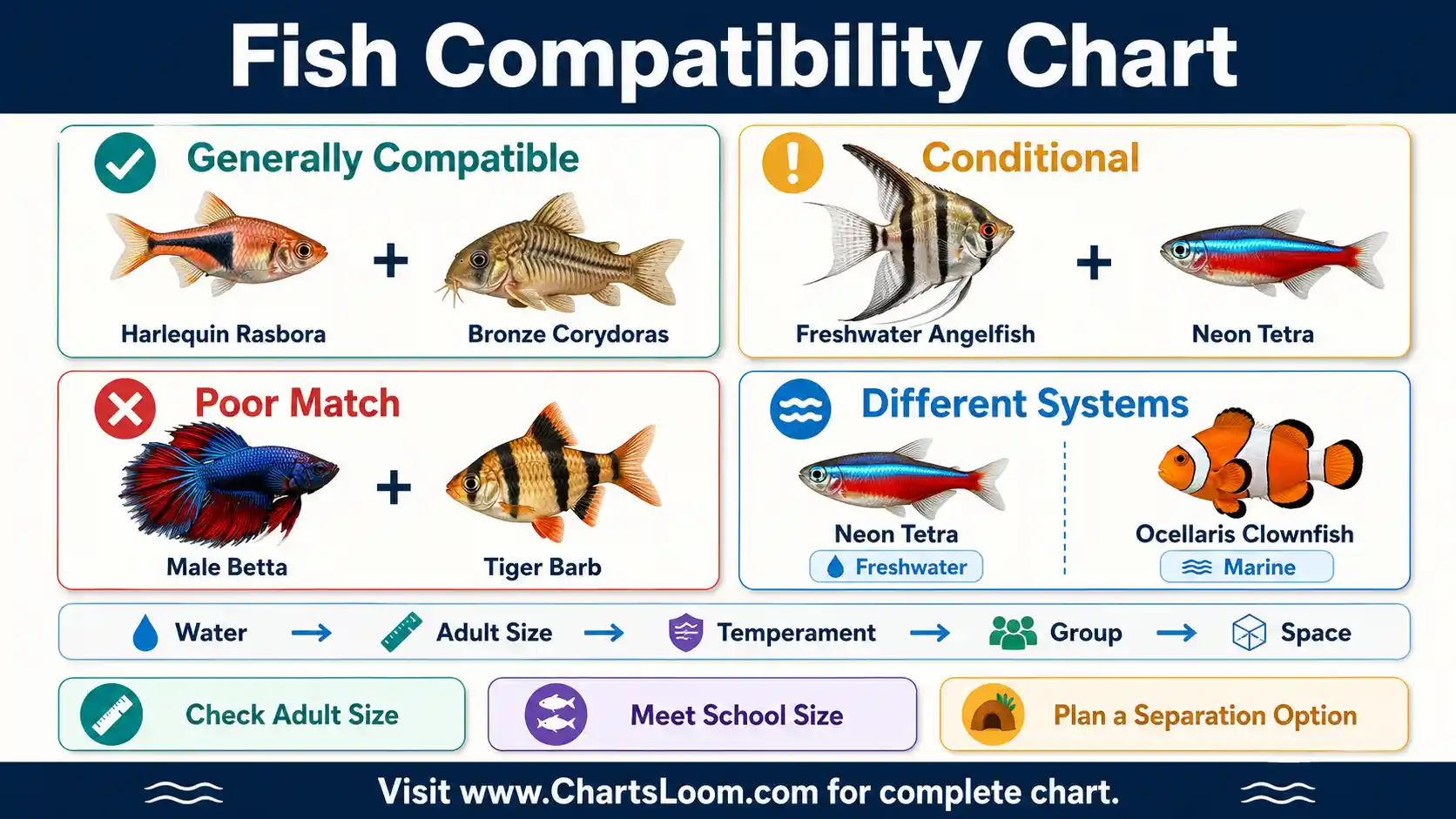
Fish compatibility at a glance
Start by matching freshwater, brackish or marine conditions. Then compare the shared temperature and pH range, adult size and mouth size, temperament, territory, social group, swim zone, feeding pace and final aquarium footprint. Reject the pairing when one decisive factor fails rather than averaging incompatible requirements.
First requirement
Match the water system
Freshwater, brackish and marine fish cannot share an improvised salinity compromise.
Plan for adulthood
Use adult size
A peaceful juvenile may become a predator, territory holder or very large waste producer.
Social requirement
Meet the group size
Schooling and group-living fish can become stressed or aggressive when kept in too few numbers.
Core limitation
Compatible ≠ fully stocked
A workable pair can still exceed filtration, oxygen, territory or swimming-space capacity.
Questions at a glance
What makes fish compatible?
They need overlapping water conditions, manageable behavior and adult-size differences, correct social groups, enough space and no strong predation or fin-damage risk.
Is temperature overlap enough?
No. pH, hardness, salinity, territory, swimming speed, adult size, diet, oxygen and group needs can still make the pairing unsuitable.
Can freshwater and marine fish live together?
No. Their salinity systems are fundamentally different, even when their temperature ranges appear similar.
Can a big fish live with a small fish?
Only when the smaller fish cannot be swallowed or repeatedly intimidated. Use adult size and mouth size, not shop-size juveniles.
Why do schooling fish need groups?
Groups support security and normal behavior. Too few can cause hiding, stress, chasing or redirected fin nipping.
Can a male betta live with other fish?
Sometimes, but avoid fin nippers, similar surface fish and conspicuous long fins, and keep a practical separation option ready.
Can angelfish live with tetras?
Larger tetras can be conditional companions, but small tetras may become prey when the angelfish reaches adult size.
Can goldfish live with tropical fish?
Usually not as a routine plan because temperature, waste production, swimming ability and feeding needs differ.
Do all bottom fish get along?
No. Corydoras are social and peaceful, while rainbow sharks and red-tailed black sharks can defend the same floor territory.
Is one inch per gallon accurate?
No. It ignores body mass, oxygen demand, territory, adult behavior, waste production and aquarium dimensions.
What shows that a pairing is failing?
Persistent chasing, hiding, torn fins, rapid breathing, blocked feeding, weight loss or confinement to one corner requires action.
Can compatibility change over time?
Yes. Growth, maturity, breeding, sex and territory can turn a juvenile pairing into an unsafe adult pairing.
Fish compatibility decision chart
Use these checks together. No single row, including temperature or tank volume, proves that a pairing is safe.
Swipe horizontally inside the table to view every column.
| Compatibility factor | What to compare | Decision standard | Why it matters | Practical response |
|---|---|---|---|---|
| Water type | Freshwater, marine or brackish | Must match | Different salinity systems are not compatible | Reject the pairing |
| Temperature | Species-supported °C range | Needs stable overlap | No overlap forces one species outside its range | Use the shared band only |
| pH | Supported acidity or alkalinity | Needs practical overlap | Large mismatch creates chronic stress | Match fish to established water |
| Hardness | General and carbonate hardness | Often important | Soft-water and hard-water specialists can conflict | Check species-specific guidance |
| Adult size | Full-grown body and mouth size | Plan for adults | Small fish may become prey | Ignore temporary juvenile size |
| Temperament | Peaceful to aggressive | Needs manageable contrast | Aggressive fish can suppress peaceful fish | Avoid severe mismatch |
| Territory | Caves, floor, rockwork or open water | Needs enough distinct space | Overlapping claims cause repeated fighting | Add sight breaks and territories |
| Social group | School, group, pair or single | Meet species need | Too few can increase stress or aggression | Stock the correct group size |
| Fin profile | Long fins or nipping tendency | Avoid risky combinations | Fin nippers can injure slow long-finned fish | Choose different tank mates |
| Swimming speed | Calm, moderate or fast | Should be reasonably balanced | Fast fish can intimidate slow feeders | Provide calm zones and feeding access |
| Swim zone | Top, middle, bottom or all levels | Useful but not sufficient | Same-zone species can compete for territory | Plan vertical and horizontal space |
| Diet | Herbivore, omnivore, carnivore or specialist | Needs compatible feeding | One species may starve or overeat | Use targeted feeding methods |
| Waste production | Bioload relative to size and diet | Must fit filtration | Crowding degrades water quality | Test ammonia, nitrite and nitrate |
| Oxygen and flow | Still water to strong current | Needs overlapping needs | High-flow and low-flow specialists can conflict | Design flow zones carefully |
| Aquarium footprint | Length, width, height and volume | Species-specific | Litres alone do not describe swimming room | Use adult footprint guidance |
| Cover and structure | Plants, caves, wood, rock and open water | Needs can differ | Lack of cover increases stress and disputes | Build habitat before stocking |
| Introduction order | Which fish enters first | Can change territory | Established fish may attack newcomers | Rearrange decor and monitor |
| Disease and quarantine | Health status before mixing | Always relevant | A compatible fish can still introduce disease | Quarantine and observe |
- • Compatibility is multi-factor and species-specific.
- • The strictest conflict should control the decision.
Download or export
Aquarium fish profile chart
Representative adult planning profiles for species included in the checker. Values are broad educational ranges, not product labels or universal guarantees.
Swipe horizontally inside the table to view every column.
| Common name | Scientific name | System | Temperature | pH | Adult size | Temperament | Social need | Starting tank | Key compatibility note |
|---|---|---|---|---|---|---|---|---|---|
| Neon tetra | Paracheirodon innesi | Freshwater | 20–26°C | 5.0–7.5 | 4 cm | Peaceful | School; 6+ | 60 L+ | Small schooling fish; vulnerable to large predatory tank mates. |
| Cardinal tetra | Paracheirodon axelrodi | Freshwater | 23–29°C | 4.5–7.0 | 5 cm | Peaceful | School; 6+ | 75 L+ | Warm-water schooling species that benefits from calm companions. |
| Ember tetra | Hyphessobrycon amandae | Freshwater | 23–29°C | 5.0–7.5 | 2.5 cm | Peaceful | School; 8+ | 45 L+ | Very small and best with other gentle nano fish. |
| Black skirt tetra | Gymnocorymbus ternetzi | Freshwater | 21–28°C | 6.0–7.5 | 6 cm | Assertive | School; 6+ | 75 L+ | Can nip fins when kept in small groups or with slow long-finned fish. |
| Serpae tetra | Hyphessobrycon eques | Freshwater | 22–28°C | 5.5–7.5 | 5 cm | Assertive | School; 8+ | 75 L+ | Active schooling tetra with a known fin-nipping risk. |
| Tiger barb | Puntigrus tetrazona | Freshwater | 22–28°C | 6.0–8.0 | 7 cm | Assertive | School; 8+ | 110 L+ | Fast, social and prone to fin nipping, especially in undersized groups. |
| Cherry barb | Puntius titteya | Freshwater | 22–27°C | 6.0–8.0 | 5 cm | Peaceful | School; 6+ | 60 L+ | Generally peaceful when kept in a balanced group. |
| Harlequin rasbora | Trigonostigma heteromorpha | Freshwater | 22–28°C | 5.0–7.5 | 5 cm | Peaceful | School; 6+ | 60 L+ | Calm schooling fish suited to many peaceful tropical communities. |
| Chili rasbora | Boraras brigittae | Freshwater | 24–28°C | 4.0–7.0 | 2 cm | Peaceful | School; 8+ | 35 L+ | Tiny, timid fish that can be intimidated or eaten by larger species. |
| Zebra danio | Danio rerio | Freshwater | 18–25°C | 6.5–8.0 | 5 cm | Assertive | School; 6+ | 75 L+ | Fast, active swimmer that can unsettle slow or very timid fish. |
| White cloud mountain minnow | Tanichthys albonubes | Freshwater | 14–22°C | 6.0–8.0 | 4 cm | Peaceful | School; 6+ | 60 L+ | Temperate schooling fish; sustained tropical heat is unsuitable. |
| Guppy | Poecilia reticulata | Freshwater | 22–28°C | 7.0–8.2 | 5 cm | Peaceful | Group; 3+ | 55 L+ | Hard-water livebearer; long fins can attract nipping. |
| Platy | Xiphophorus maculatus | Freshwater | 20–26°C | 7.0–8.2 | 6 cm | Peaceful | Group; 3+ | 60 L+ | Generally peaceful livebearer that prefers harder, alkaline water. |
| Molly | Poecilia sphenops | Freshwater | 24–28°C | 7.2–8.5 | 10 cm | Assertive | Group; 3+ | 100 L+ | Active hard-water livebearer; some forms tolerate mildly brackish conditions. |
| Swordtail | Xiphophorus hellerii | Freshwater | 22–28°C | 7.0–8.3 | 12 cm | Assertive | Group; 3+ | 110 L+ | Fast, boisterous livebearer needing swimming room and sensible sex ratios. |
| Male betta | Betta splendens | Freshwater | 24–30°C | 6.0–7.8 | 7 cm | Semi-aggressive | Single; 1+ | 40 L+ | Territorial surface fish; individual temperament varies greatly. |
| Dwarf gourami | Trichogaster lalius | Freshwater | 24–28°C | 6.0–7.5 | 9 cm | Semi-aggressive | Single; 1+ | 75 L+ | Can be territorial with similar-shaped surface fish. |
| Pearl gourami | Trichopodus leerii | Freshwater | 24–28°C | 5.5–8.0 | 12 cm | Peaceful | Pair; 2+ | 150 L+ | Usually calmer than many gouramis but still needs cover and surface access. |
| Freshwater angelfish | Pterophyllum scalare | Freshwater | 24–30°C | 6.0–7.8 | 15 cm | Semi-aggressive | Pair; 2+ | 150 L+ | Tall cichlid that may eat very small fish and become territorial when pairing. |
| Discus | Symphysodon aequifasciatus | Freshwater | 26–30°C | 5.0–7.0 | 18 cm | Peaceful | Group; 5+ | 300 L+ | Warm-water cichlid needing stable conditions and calm companions. |
| German blue ram | Mikrogeophagus ramirezi | Freshwater | 27–30°C | 5.0–7.0 | 7 cm | Semi-aggressive | Pair; 2+ | 75 L+ | Warm-water dwarf cichlid that defends a breeding territory. |
| Bolivian ram | Mikrogeophagus altispinosus | Freshwater | 22–28°C | 6.0–7.8 | 9 cm | Semi-aggressive | Pair; 2+ | 90 L+ | Generally mild dwarf cichlid but territorial around spawning sites. |
| Oscar | Astronotus ocellatus | Freshwater | 23–28°C | 6.0–8.0 | 35 cm | Aggressive | Single; 1+ | 300 L+ | Large predatory cichlid that can swallow smaller fish and produces substantial waste. |
| African mbuna cichlid | Mbuna group | Freshwater | 24–28°C | 7.5–8.6 | 13 cm | Aggressive | Group; 6+ | 200 L+ | Rock-dwelling territorial cichlid usually managed in a dedicated hard-water setup. |
| Bronze corydoras | Corydoras aeneus | Freshwater | 22–27°C | 6.0–8.0 | 7 cm | Peaceful | School; 6+ | 75 L+ | Peaceful bottom-dwelling catfish that should be kept with its own kind. |
| Sterbai corydoras | Corydoras sterbai | Freshwater | 24–28°C | 6.0–7.8 | 7 cm | Peaceful | School; 6+ | 75 L+ | Warm-tolerant corydoras suited to peaceful tropical communities. |
| Kuhli loach | Pangio kuhlii | Freshwater | 24–30°C | 5.5–7.5 | 12 cm | Peaceful | Group; 5+ | 75 L+ | Shy nocturnal loach that needs hiding places and a smooth substrate. |
| Clown loach | Chromobotia macracanthus | Freshwater | 25–30°C | 6.0–7.5 | 30 cm | Peaceful | Group; 5+ | 450 L+ | Large social loach requiring a long, spacious aquarium. |
| Bristlenose pleco | Ancistrus species | Freshwater | 22–28°C | 6.0–8.0 | 15 cm | Peaceful | Single; 1+ | 100 L+ | Usually community-safe, though adults may defend caves from similar bottom fish. |
| Common pleco | Pterygoplichthys species | Freshwater | 23–28°C | 6.5–8.0 | 45 cm | Assertive | Single; 1+ | 500 L+ | Very large waste-producing catfish unsuitable for most home aquariums. |
| Otocinclus catfish | Otocinclus species | Freshwater | 22–27°C | 5.5–7.5 | 5 cm | Peaceful | Group; 6+ | 75 L+ | Gentle social algae grazer that needs a mature aquarium and adequate food. |
| Rainbow shark | Epalzeorhynchos frenatum | Freshwater | 23–28°C | 6.5–8.0 | 15 cm | Semi-aggressive | Single; 1+ | 150 L+ | Territorial bottom fish; avoid similar-shaped bottom dwellers in limited space. |
| Red-tailed black shark | Epalzeorhynchos bicolor | Freshwater | 22–27°C | 6.5–8.0 | 15 cm | Semi-aggressive | Single; 1+ | 150 L+ | Highly territorial toward similar bottom-oriented fish. |
| Fancy goldfish | Carassius auratus | Freshwater | 18–23°C | 7.0–8.4 | 20 cm | Peaceful | Group; 2+ | 150 L+ | Cool-water, slow-swimming fish with high waste production. |
| Common or comet goldfish | Carassius auratus | Freshwater | 16–24°C | 7.0–8.4 | 30 cm | Peaceful | Group; 2+ | 300 L+ | Fast, large cool-water fish that often outcompetes fancy goldfish. |
| Ocellaris clownfish | Amphiprion ocellaris | Marine | 24–27°C | 8.0–8.4 | 11 cm | Assertive | Pair; 2+ | 75 L+ | Pair-forming marine fish that may defend a host area. |
| Royal gramma | Gramma loreto | Marine | 24–27°C | 8.0–8.4 | 8 cm | Assertive | Single; 1+ | 100 L+ | Cave-oriented fish that can defend its chosen shelter. |
| Firefish goby | Nemateleotris magnifica | Marine | 24–27°C | 8.0–8.4 | 9 cm | Peaceful | Single; 1+ | 75 L+ | Timid jumper that may hide when housed with aggressive fish. |
| Blue-green chromis | Chromis viridis | Marine | 24–28°C | 8.0–8.4 | 10 cm | Peaceful | Group; 5+ | 200 L+ | Open-water damselfish often kept in groups, though hierarchy can cause losses. |
| Yellow tang | Zebrasoma flavescens | Marine | 24–28°C | 8.0–8.4 | 20 cm | Semi-aggressive | Single; 1+ | 300 L+ | Active grazer needing substantial swimming room; can challenge similar tangs. |
| Six-line wrasse | Pseudocheilinus hexataenia | Marine | 24–28°C | 8.0–8.4 | 8 cm | Semi-aggressive | Single; 1+ | 100 L+ | Active territorial wrasse that may harass timid or newly introduced fish. |
| Pajama cardinalfish | Sphaeramia nematoptera | Marine | 24–28°C | 8.0–8.4 | 9 cm | Peaceful | Group; 3+ | 120 L+ | Calm marine fish that suits peaceful communities. |
| Yellow watchman goby | Cryptocentrus cinctus | Marine | 24–28°C | 8.0–8.4 | 10 cm | Peaceful | Pair; 1+ | 75 L+ | Bottom-oriented burrow fish that may defend a small territory. |
| Flame angelfish | Centropyge loricula | Marine | 24–28°C | 8.0–8.4 | 10 cm | Semi-aggressive | Single; 1+ | 200 L+ | Territorial dwarf angelfish; reef safety varies by individual. |
| Azure damselfish | Chrysiptera hemicyanea | Marine | 24–28°C | 8.0–8.4 | 7 cm | Semi-aggressive | Single; 1+ | 100 L+ | Small but territorial damselfish that can dominate timid tank mates. |
| Volitan lionfish | Pterois volitans | Marine | 24–28°C | 8.0–8.4 | 38 cm | Aggressive | Single; 1+ | 450 L+ | Large predator that can swallow smaller fish and has venomous spines. |
| Niger triggerfish | Odonus niger | Marine | 24–28°C | 8.0–8.4 | 40 cm | Aggressive | Single; 1+ | 600 L+ | Large active triggerfish requiring robust tank mates and ample space. |
- • Verify the exact species because trade names can be ambiguous.
- • Minimum tank figures are broad starting references and do not calculate total carrying capacity.
Download or export
Interactive reference tool
Fish compatibility checker
Compare two supported aquarium species using water type, temperature, pH, adult size, temperament, fin risk, social needs, territory and a broad tank-volume reference.
Counts are used to flag schooling and group-size issues. They do not calculate biological carrying capacity.
Checker result
Compatibility rating
Generally compatible
Harlequin rasbora + Bronze corydoras
Shared temperature
22–27°C
Shared pH
6.0–7.5
Starting volume
75 L+
Why
- • The listed temperature ranges overlap at 22–27°C.
- • The listed pH ranges overlap at 6.0–7.5.
- • The entered tank volume meets the larger broad starting-volume reference of 75 L.
Next actions
- • Quarantine new livestock, add adequate cover and observe feeding, breathing, chasing and fin condition after introduction.
- • Verify adult size, group size and exact species identity with a reliable care sheet or experienced aquatic professional.
Peaceful fish pairing examples
Examples that are often workable when group size, tank dimensions, water chemistry, filtration and individual behavior are appropriate.
Swipe horizontally inside the table to view every column.
| First fish | Second fish | Planning outcome | Main reason | Management note |
|---|---|---|---|---|
| Harlequin rasbora | Bronze corydoras | Generally compatible | Peaceful species, overlapping tropical water and different swim zones | Keep both in proper groups |
| Harlequin rasbora | Bristlenose pleco | Generally compatible | Calm midwater school plus mostly peaceful bottom fish | Provide wood, caves and adequate floor space |
| Neon tetra | Bronze corydoras | Generally compatible | Similar water band and low aggression | Use groups of at least six |
| Cardinal tetra | Sterbai corydoras | Generally compatible | Warm-water overlap and separate feeding zones | Feed sinking food after midwater fish eat |
| Ember tetra | Otocinclus catfish | Generally compatible | Small gentle fish with compatible tropical range | Use a mature planted aquarium |
| Cherry barb | Bronze corydoras | Generally compatible | Mild behavior and broad overlapping water | Keep cherry barbs in a balanced group |
| Platy | Bristlenose pleco | Generally compatible | Peaceful behavior and useful pH overlap | Confirm the pleco has hiding space |
| Platy | Zebra danio | Generally compatible | Active community fish with a moderate temperature overlap | Use 20–25°C and adequate swimming length |
| White cloud mountain minnow | Common or comet goldfish | Conditional match | Cool-water overlap exists | Goldfish adult size and waste require a very large system |
| Pearl gourami | Harlequin rasbora | Generally compatible | Calm gourami with a peaceful schooling species | Use plants and avoid crowding the surface |
| Pearl gourami | Bronze corydoras | Generally compatible | Different zones and compatible behavior | Provide gentle areas and bottom food |
| Bolivian ram | Harlequin rasbora | Conditional match | Water overlap is broad and the rasboras stay midwater | Give the ram a defined bottom territory |
| Bolivian ram | Bronze corydoras | Conditional match | Both use the bottom but are usually manageable | Provide multiple shelters and watch spawning behavior |
| Discus | Cardinal tetra | Generally compatible | Warm-water overlap and calm behavior | Use healthy, suitably sized tetras and excellent water quality |
| Discus | Sterbai corydoras | Generally compatible | Warm-water corydoras better matches discus temperatures | Maintain oxygen and clean substrate |
| Kuhli loach | Harlequin rasbora | Generally compatible | Peaceful fish in different zones | Keep kuhli loaches in a group with hiding places |
| Kuhli loach | Pearl gourami | Generally compatible | Calm bottom and surface species | Use a covered tank and low-stress aquascape |
| Ocellaris clownfish | Firefish goby | Generally compatible | Different marine niches and manageable adult size | Provide caves and prevent jumping |
| Ocellaris clownfish | Pajama cardinalfish | Generally compatible | Similar marine water with moderate behavior | Allow separate resting and host areas |
| Royal gramma | Pajama cardinalfish | Generally compatible | Cave fish plus calm midwater fish | Provide several caves and avoid crowding |
| Firefish goby | Pajama cardinalfish | Generally compatible | Both are generally peaceful marine fish | Use a secure lid and gentle tank mates |
| Yellow watchman goby | Ocellaris clownfish | Generally compatible | Bottom burrow fish and midwater pair occupy different zones | Protect the goby burrow from collapse |
| Yellow watchman goby | Pajama cardinalfish | Generally compatible | Different zones and peaceful behavior | Provide suitable substrate and calm feeding |
| Blue-green chromis | Pajama cardinalfish | Conditional match | Water and size match but chromis hierarchy can be unstable | Use adequate space and monitor the group |
| Yellow tang | Ocellaris clownfish | Generally compatible | Different body shapes and niches | Use a mature large tank with swimming room |
| Yellow tang | Yellow watchman goby | Generally compatible | Open-water grazer with bottom burrow fish | Meet the tang’s much larger tank requirement |
| Flame angelfish | Ocellaris clownfish | Conditional match | Water matches but both may defend territory | Use mature rockwork and adequate space |
| Royal gramma | Ocellaris clownfish | Conditional match | Usually manageable but both defend small territories | Provide separate caves and host area |
| Cherry barb | Harlequin rasbora | Generally compatible | Similar peaceful community behavior | Maintain each as a full school |
| Otocinclus catfish | Ember tetra | Generally compatible | Gentle nano-community pairing | Ensure mature biofilm and supplemental food |
- • “Generally compatible” still requires monitoring and a separation plan.
- • Pairs do not represent a complete stocking list.
Download or export
Conditional fish pairing examples
These pairings can fail because of individual behavior, territory, fin damage, feeding competition, maturity or narrow environmental overlap.
Swipe horizontally inside the table to view every column.
| First fish | Second fish | Planning outcome | Main concern | Risk-control step |
|---|---|---|---|---|
| Male betta | Guppy | Conditional match | Long fins, bright colors and surface use can trigger conflict | Use a large planted tank and separation plan |
| Male betta | Dwarf gourami | Conditional match | Both are territorial labyrinth fish near the surface | Usually choose one centerpiece species |
| Male betta | Zebra danio | Conditional match | Danios are faster and prefer cooler water | Use a spacious tank and avoid sustained high temperature |
| Freshwater angelfish | Neon tetra | Conditional match | Adult angelfish may eat small tetras | Start with robust groups and plan for predation risk |
| Freshwater angelfish | Cardinal tetra | Conditional match | Larger cardinals reduce but do not remove predation risk | Monitor after the angelfish matures |
| Freshwater angelfish | Bronze corydoras | Conditional match | Behavior is often manageable but temperature and spawning territory matter | Use a tall tank with open bottom routes |
| Dwarf gourami | Harlequin rasbora | Conditional match | Often workable but individual gourami behavior varies | Use plants and observe feeding access |
| Pearl gourami | Tiger barb | Conditional match | Tiger barbs may nip long fins | Use a large barb school or choose non-nipping tank mates |
| Fancy goldfish | Common or comet goldfish | Conditional match | Temperature overlaps but swimming speed and feeding competition differ | House separately when fancy fish are outcompeted |
| Fancy goldfish | Bristlenose pleco | Conditional match | Temperature overlap is limited and plecos may rasp slow fish | Use close monitoring and species-specific advice |
| Rainbow shark | Bristlenose pleco | Conditional match | Both use bottom territory | Provide several caves and a large footprint |
| Red-tailed black shark | Bristlenose pleco | Conditional match | Territory can overlap around caves and wood | Use barriers and separate feeding sites |
| Rainbow shark | Clown loach | Conditional match | Both are active bottom fish and require substantial space | Use a very large tank with multiple refuges |
| Bolivian ram | Sterbai corydoras | Conditional match | Both occupy the bottom and spawning can increase aggression | Use several shelters and monitor during breeding |
| German blue ram | Sterbai corydoras | Conditional match | Warm water matches but floor territory overlaps | Provide defined territories and excellent oxygenation |
| Discus | Freshwater angelfish | Conditional match | Water can overlap but cichlid hierarchy, pathogens and feeding differ | Use expert planning rather than a casual mix |
| African mbuna cichlid | African mbuna cichlid | Specialist setup | Intraspecific and interspecific aggression requires deliberate stocking | Use a dedicated mbuna plan; same-species tool comparison is not sufficient |
| Oscar | Common pleco | Conditional match | Adult sizes can coexist but waste, territory and injury risk are substantial | Use a very large filtered aquarium and monitor closely |
| Ocellaris clownfish | Royal gramma | Conditional match | Both may defend territory | Provide multiple separated shelters |
| Six-line wrasse | Royal gramma | Conditional match | The wrasse may harass cave-oriented fish | Add the wrasse last and prepare removal options |
| Yellow tang | Flame angelfish | Conditional match | Territorial disputes can occur in limited rockwork | Use a large mature aquarium and distinct feeding areas |
| Yellow tang | Azure damselfish | Conditional match | Damselfish may defend a zone despite smaller size | Use substantial rockwork and observe introduction behavior |
| Flame angelfish | Yellow watchman goby | Conditional match | Usually different zones, but the angelfish may dominate feeding | Target-feed the goby and provide a secure burrow |
| Blue-green chromis | Azure damselfish | Conditional match | Both are damselfish with possible hierarchy and territorial conflict | Use a large tank and avoid under-sized groups |
| Niger triggerfish | Yellow tang | Conditional match | Both are large active fish; aggression can change with maturity | Use an expert-designed, very large system |
| Volitan lionfish | Niger triggerfish | Conditional match | Adult size is similar but feeding and aggression remain significant | Use only in a very large specialist predator system |
| Molly | Platy | Generally compatible | Water matches, but both reproduce rapidly and compete for food | Control sex ratios and avoid overstocking |
| Molly | Guppy | Conditional match | Hard-water overlap is useful but activity and fin attention vary | Use a spacious tank and monitor male behavior |
| Swordtail | Guppy | Conditional match | Swordtails can be boisterous around smaller guppies | Provide swimming room and plant cover |
| Tiger barb | Zebra danio | Conditional match | Both are active, but barbs can nip and dominate | Keep full schools in a long aquarium |
| Black skirt tetra | Serpae tetra | Conditional match | Both can nip fins and become rowdy | Use large schools and avoid slow tank mates |
| Clown loach | Common pleco | Conditional match | Both become very large and use the bottom | Requires an exceptionally large footprint and filtration |
- • A conditional match is not a recommendation.
- • Have a practical way to separate fish immediately.
Download or export
Poor fish pairing examples
High-risk examples involving incompatible water, predation, fin damage, severe territorial conflict or unsuitable adult scale.
Swipe horizontally inside the table to view every column.
| First fish | Second fish | Planning outcome | Main conflict | Better decision |
|---|---|---|---|---|
| Male betta | Tiger barb | Poor match | Fin nipping and territorial stress are likely | Choose calm non-nipping companions |
| Male betta | Serpae tetra | Poor match | Serpae tetras can damage long fins | Do not rely on group size to remove all risk |
| Male betta | Black skirt tetra | Poor match | Long fins and a nipping species conflict | Use separate communities |
| Male betta | Fancy goldfish | Poor match | Temperature, swimming style and fin risk conflict | Keep in separate heated and cool-water systems |
| Freshwater angelfish | Chili rasbora | Poor match | The tiny rasbora is prey-sized | Choose larger calm schooling fish |
| Freshwater angelfish | Ember tetra | Poor match | Adult angelfish may swallow very small tetras | Use species too large to fit in the mouth |
| Oscar | Neon tetra | Poor match | The tetra is prey-sized | Use robust adult-size tank mates in specialist systems |
| Oscar | Guppy | Poor match | The guppy is prey-sized and water preferences differ | Do not mix |
| Oscar | Bronze corydoras | Poor match | Predation attempt can injure both fish because corydoras have spines | Do not use small armored catfish as predator tank mates |
| Oscar | Platy | Poor match | The platy is prey-sized | Do not mix |
| African mbuna cichlid | Neon tetra | Poor match | Hard alkaline water and aggression conflict with soft-water tetras | Use a dedicated mbuna setup |
| African mbuna cichlid | Guppy | Poor match | Aggression and specialized rock-territory needs conflict | Use separate systems |
| African mbuna cichlid | Bronze corydoras | Poor match | Water chemistry, territory and harassment risk conflict | Use appropriate Lake Malawi companions |
| Rainbow shark | Red-tailed black shark | Poor match | Very similar territorial bottom fish compete directly | Keep one territorial shark-type fish per setup |
| Fancy goldfish | Tiger barb | Poor match | Barbs may nip slow fancy fins and need warmer water | Use separate cool-water and tropical communities |
| Common or comet goldfish | Discus | Poor match | Temperature, water quality and feeding needs are incompatible | Keep in separate systems |
| White cloud mountain minnow | Discus | Poor match | Cool-water and warm-water requirements do not overlap | Choose one temperature regime |
| Chili rasbora | Oscar | Poor match | Extreme adult-size and predation mismatch | Do not mix |
| Neon tetra | Volitan lionfish | Poor match | Freshwater versus marine plus severe predation mismatch | Different systems are mandatory |
| Ocellaris clownfish | Neon tetra | Poor match | Marine and freshwater salinity requirements conflict | Never combine freshwater and marine fish |
| Firefish goby | Six-line wrasse | Poor match | The wrasse may relentlessly harass the timid firefish | Choose a calmer wrasse or separate tanks |
| Firefish goby | Azure damselfish | Poor match | A territorial damselfish can suppress a timid firefish | Use gentler companions |
| Volitan lionfish | Firefish goby | Poor match | The firefish is prey-sized | Do not mix |
| Volitan lionfish | Pajama cardinalfish | Poor match | The cardinalfish can become prey | Use much larger robust tank mates |
| Niger triggerfish | Firefish goby | Poor match | Severe size, aggression and feeding mismatch | Use a specialist large-fish system |
| Niger triggerfish | Yellow watchman goby | Poor match | The goby is vulnerable to a large active triggerfish | Do not mix |
| Common pleco | Chili rasbora | Poor planning choice | The pleco becomes enormous and overwhelms a nano setup | Choose a small algae grazer instead |
| Clown loach | Ember tetra | Poor planning choice | Adult-size and tank-footprint needs are mismatched | Choose a smaller loach species |
| Molly | Chili rasbora | Poor planning choice | Hard alkaline versus soft acidic preferences conflict | Choose fish suited to the same water |
| White cloud mountain minnow | German blue ram | Poor match | Cool-water and very warm-water ranges do not overlap | Use separate temperature regimes |
| Zebra danio | Discus | Poor planning choice | Temperature, activity and feeding pace differ greatly | Use calmer warm-water companions for discus |
| Common or comet goldfish | Male betta | Poor match | Temperature, flow, feeding and fin interactions conflict | Use separate systems |
- • Do not force a compromise environment.
- • Juvenile size does not remove adult predation or space requirements.
Download or export
Schooling and social-group chart
Minimum broad group references for social species in the checker, with starting tank and compatibility context.
Swipe horizontally inside the table to view every column.
| Species | Social style | Broad minimum count | Starting tank | Compatibility note |
|---|---|---|---|---|
| Neon tetra | School | 6 | 60 L+ | Small schooling fish; vulnerable to large predatory tank mates. |
| Cardinal tetra | School | 6 | 75 L+ | Warm-water schooling species that benefits from calm companions. |
| Ember tetra | School | 8 | 45 L+ | Very small and best with other gentle nano fish. |
| Black skirt tetra | School | 6 | 75 L+ | Can nip fins when kept in small groups or with slow long-finned fish. |
| Serpae tetra | School | 8 | 75 L+ | Active schooling tetra with a known fin-nipping risk. |
| Tiger barb | School | 8 | 110 L+ | Fast, social and prone to fin nipping, especially in undersized groups. |
| Cherry barb | School | 6 | 60 L+ | Generally peaceful when kept in a balanced group. |
| Harlequin rasbora | School | 6 | 60 L+ | Calm schooling fish suited to many peaceful tropical communities. |
| Chili rasbora | School | 8 | 35 L+ | Tiny, timid fish that can be intimidated or eaten by larger species. |
| Zebra danio | School | 6 | 75 L+ | Fast, active swimmer that can unsettle slow or very timid fish. |
| White cloud mountain minnow | School | 6 | 60 L+ | Temperate schooling fish; sustained tropical heat is unsuitable. |
| Guppy | Group | 3 | 55 L+ | Hard-water livebearer; long fins can attract nipping. |
| Platy | Group | 3 | 60 L+ | Generally peaceful livebearer that prefers harder, alkaline water. |
| Molly | Group | 3 | 100 L+ | Active hard-water livebearer; some forms tolerate mildly brackish conditions. |
| Swordtail | Group | 3 | 110 L+ | Fast, boisterous livebearer needing swimming room and sensible sex ratios. |
| Pearl gourami | Pair | 2 | 150 L+ | Usually calmer than many gouramis but still needs cover and surface access. |
| Freshwater angelfish | Pair | 2 | 150 L+ | Tall cichlid that may eat very small fish and become territorial when pairing. |
| Discus | Group | 5 | 300 L+ | Warm-water cichlid needing stable conditions and calm companions. |
| German blue ram | Pair | 2 | 75 L+ | Warm-water dwarf cichlid that defends a breeding territory. |
| Bolivian ram | Pair | 2 | 90 L+ | Generally mild dwarf cichlid but territorial around spawning sites. |
| African mbuna cichlid | Group | 6 | 200 L+ | Rock-dwelling territorial cichlid usually managed in a dedicated hard-water setup. |
| Bronze corydoras | School | 6 | 75 L+ | Peaceful bottom-dwelling catfish that should be kept with its own kind. |
| Sterbai corydoras | School | 6 | 75 L+ | Warm-tolerant corydoras suited to peaceful tropical communities. |
| Kuhli loach | Group | 5 | 75 L+ | Shy nocturnal loach that needs hiding places and a smooth substrate. |
| Clown loach | Group | 5 | 450 L+ | Large social loach requiring a long, spacious aquarium. |
| Otocinclus catfish | Group | 6 | 75 L+ | Gentle social algae grazer that needs a mature aquarium and adequate food. |
| Fancy goldfish | Group | 2 | 150 L+ | Cool-water, slow-swimming fish with high waste production. |
| Common or comet goldfish | Group | 2 | 300 L+ | Fast, large cool-water fish that often outcompetes fancy goldfish. |
| Ocellaris clownfish | Pair | 2 | 75 L+ | Pair-forming marine fish that may defend a host area. |
| Blue-green chromis | Group | 5 | 200 L+ | Open-water damselfish often kept in groups, though hierarchy can cause losses. |
| Pajama cardinalfish | Group | 3 | 120 L+ | Calm marine fish that suits peaceful communities. |
- • More fish also means more bioload and space demand.
- • A minimum count is not automatically the ideal count for every aquarium.
Download or export
Adult size and predation chart
Use adult body size, mouth size, swimming ability and footprint rather than shop-size juveniles.
Swipe horizontally inside the table to view every column.
| Situation | Example | Likely outcome | Why | Planning response |
|---|---|---|---|---|
| 2–3 cm nano fish | Ember tetra, chili rasbora | Avoid fish with mouths large enough to swallow them | Even peaceful large fish can be unsafe | Plan around adult size |
| 4–5 cm small community fish | Neon tetra, guppy, harlequin rasbora | Use with similar or moderately larger peaceful fish | Large cichlids remain a predation risk | Keep full groups |
| 6–10 cm medium community fish | Cherry barb, gourami, dwarf cichlid | Check fin risk and territory | Size alone does not remove aggression | Provide cover |
| 10–15 cm assertive fish | Swordtail, rainbow shark, angelfish | Need footprint and territory checks | May dominate small calm fish | Use adult tank size |
| 15–25 cm large fish | Discus, yellow tang, fancy goldfish | Need high filtration and substantial space | Juvenile tanks become inadequate | Plan the final aquarium first |
| 30 cm+ very large fish | Oscar, common pleco, clown loach, lionfish | Specialist systems only | Small tank mates can become prey | Do not buy for a temporary tank |
| Predator with prey-sized fish | Oscar + tetra | Poor match | Swallowing risk is direct | Choose robust adult-size companions |
| Predator with spined catfish | Oscar + corydoras | Poor match | A swallowing attempt can injure both fish | Avoid the pairing |
| Slow long-finned fish with nipper | Betta + tiger barb | Poor match | Repeated fin damage and stress | Choose calm companions |
| Fast fish with slow feeder | Danio + discus | Poor planning choice | Food competition and activity stress | Match feeding pace |
| Large peaceful fish with tiny fish | Angelfish + chili rasbora | Poor match | Predation can occur despite mild temperament | Use larger schooling fish |
| Similar size but territorial | Rainbow shark + red-tailed shark | Poor match | Direct territory competition | Keep one |
| Similar size and peaceful | Rasbora + corydoras | Often workable | Water and group sizes must still match | Use different swim zones |
| Large marine predator with small marine fish | Lionfish + firefish | Poor match | Prey-size mismatch | Use specialist companions |
| Large active marine fish with timid fish | Triggerfish + firefish | Poor match | Harassment and feeding competition | Use robust large tank mates |
| Adult size unknown at purchase | Common pleco sold as a juvenile | High planning risk | Trade size hides final requirements | Verify scientific name |
| Mixed fancy and common goldfish | Different swimming ability | Conditional | Fancy fish may lose food access | Separate if competition appears |
| School size below minimum | Two or three tetras | Conditional to poor welfare | Insecurity and aggression can increase | Build the school before adding more species |
| Oversized school in small tank | Many active danios | Poor planning | Swimming and oxygen demand exceed space | Use a longer, larger aquarium |
| Bottom fish with large footprint | Clown loach group | Needs exceptional space | Litres without floor length are misleading | Check tank dimensions |
| Tall-bodied fish | Angelfish | Needs vertical clearance | Volume alone may hide inadequate height | Use a suitably tall tank |
| Open-water marine swimmer | Yellow tang | Needs long swimming routes | Rock displacement cannot replace length | Prioritize footprint |
| Burrowing fish | Watchman goby | Needs stable substrate | Tank mate digging can collapse a burrow | Secure rockwork |
| Cave defender | Royal gramma | Needs separate shelters | One cave can become a conflict point | Provide multiple caves |
- • Any fish that fits into another fish’s mouth may be eaten.
- • Armored or spined prey can injure a predator during a swallowing attempt.
Download or export
Temperament and territory chart
Behavior categories are broad. Individual fish, breeding condition, maturity, sex, layout and introduction order can change the result.
Swipe horizontally inside the table to view every column.
| Behavior pattern | Example | Normal need | Compatibility risk | Management step |
|---|---|---|---|---|
| Peaceful school | Neon tetra | Security in numbers | Can be intimidated by boisterous fish | Keep 6+ |
| Assertive school | Tiger barb | Activity directed within group | Fin nipping in small groups | Keep 8+ and avoid long fins |
| Territorial single | Male betta | Controls a surface area | May attack similar fish | One male per tank |
| Territorial bottom fish | Rainbow shark | Defends caves and floor routes | Chases similar bottom fish | Use large footprint and barriers |
| Pair-forming cichlid | Bolivian ram | Defends breeding site | Bottom conflict increases when spawning | Provide multiple territories |
| Group cichlid | Discus | Social hierarchy | Too few can focus aggression | Use a suitable group in a large tank |
| Aggressive rock cichlid | African mbuna | Strong territory and hierarchy | Community fish are often unsuitable | Use a dedicated setup |
| Large predator | Oscar | Consumes smaller animals | Small fish become prey | Use specialist planning |
| Calm surface fish | Pearl gourami | Uses planted upper water | Can be stressed by fast nippers | Choose calm schools |
| Fast open-water fish | Zebra danio | Constant swimming | Can unsettle slow species | Use a long tank |
| Shy bottom group | Kuhli loach | Hides by day | Can miss food in a busy tank | Feed after lights dim |
| Social bottom school | Corydoras | Forages as a group | Single fish may hide | Keep 6+ of compatible species |
| Cave-oriented marine fish | Royal gramma | Defends shelter | Conflict around limited caves | Provide several caves |
| Timid marine jumper | Firefish | Retreats from threats | Aggressive fish cause hiding | Use a secure lid and calm tank mates |
| Damselfish territory | Azure damselfish | Defends rock area | Can dominate peaceful fish | Add cautiously |
| Wrasse patrol behavior | Six-line wrasse | Continuously searches rockwork | Can harass timid fish | Often add last |
| Tang grazing territory | Yellow tang | Active grazer | Challenges similar body shapes | Use ample rock and swimming room |
| Triggerfish maturity | Niger triggerfish | Behavior can harden with age | Juvenile calmness is not predictive | Plan for adult aggression |
| Clownfish host defense | Ocellaris clownfish | Defends host or chosen corner | Pair can chase newcomers | Separate territories |
| Chromis hierarchy | Blue-green chromis | Group forms a dominance order | Weaker fish may be excluded | Observe long-term group stability |
| Livebearer male attention | Guppy, molly, platy | Males pursue females | Poor sex ratio stresses females | Use suitable sex ratios |
| Breeding escalation | Many cichlids | Territory expands around eggs | Previously peaceful pair may attack others | Have a divider or spare tank |
| Introduction-order effect | Territorial fish | Established fish owns the layout | Newcomer receives concentrated aggression | Rearrange decor before introduction |
| Individual variation | Betta, gourami, cichlid | Temperament differs by fish | A chart cannot guarantee behavior | Monitor and separate when needed |
- • Brief display behavior differs from relentless harassment.
- • Persistent exclusion from food or shelter requires intervention.
Download or export
Fin, flow and feeding compatibility chart
Compatible water values are not enough when fin vulnerability, current, feeding speed or diet create chronic stress.
Swipe horizontally inside the table to view every column.
| Trait or need | Example | Compatibility issue | Practical response |
|---|---|---|---|
| Long fins | Male betta, fancy goldfish, angelfish | Vulnerable to nippers and strong flow | Use calm fish and gentle areas |
| Fin-nipping school | Tiger barb | May target long fins | Use a large school and robust companions |
| Fin-nipping tetra | Serpae tetra | Can repeatedly damage slow fish | Avoid long-finned tank mates |
| Fast surface school | Zebra danio | Needs open swimming water | Avoid cramped tanks with slow fish |
| Calm warm-water fish | Discus | Needs gentle competition and high water quality | Avoid hyperactive feeders |
| Bottom forager | Corydoras | Needs sinking food and smooth substrate | Ensure food reaches the bottom |
| Nocturnal bottom fish | Kuhli loach | May feed after other fish settle | Offer food at dusk |
| Algae grazer | Otocinclus | Needs mature biofilm and supplemental diet | Do not add to a new sterile tank |
| Wood-grazing catfish | Bristlenose pleco | Needs plant foods and shelter | Do not assume algae alone is sufficient |
| Large waste producer | Common pleco | Heavy filtration demand | Avoid small community aquariums |
| Slow fancy swimmer | Fancy goldfish | Can lose food to faster common goldfish | Feed separately or house apart |
| Strong open-water swimmer | Yellow tang | Needs high oxygen and long routes | Do not substitute height for length |
| Burrow feeder | Watchman goby | May wait near substrate | Target-feed if faster fish dominate |
| Timid planktivore | Firefish | Can stop feeding under harassment | Choose calm companions |
| Large ambush predator | Volitan lionfish | Swallows prey whole | Never use small tank mates |
| Active predator | Niger triggerfish | Strong feeding response | Use robust compatible fish and tools |
| Surface air-breather | Betta and gourami | Needs unobstructed surface access | Avoid sealing the surface with plants |
| Cool, oxygen-rich fish | White cloud minnow | Sustained heat reduces oxygen margin | Use a temperate community |
| Warm cichlid | German blue ram | Warm water reduces oxygen capacity | Use efficient aeration and clean water |
| High-flow specialist conflict | Fast-current fish with betta | Flow needs differ | Create separate flow zones or avoid mix |
| Feeding-size mismatch | Large pellets with nano fish | Small fish cannot eat properly | Use species-sized foods |
| Herbivore-carnivore mix | Tang with predator | Different feeding schedules | Prevent both starvation and overfeeding |
| Competition at one level | Several bottom species | Food and caves become bottlenecks | Spread feeding and shelters |
| Overfeeding to compensate | Mixed community | Excess food degrades water | Target-feed instead of adding excess |
- • Observe whether every fish reaches appropriate food.
- • Do not solve feeding competition by routinely overfeeding the aquarium.
Download or export
Fish water-parameter overlap examples
Examples showing why temperature, pH and salinity must all be considered before behavior and stocking are evaluated.
Swipe horizontally inside the table to view every column.
| Pair or situation | Temperature overlap | pH overlap | System | Interpretation |
|---|---|---|---|---|
| Harlequin rasbora + bronze cory | 22–27°C | 6.0–7.5 | Freshwater | Broad overlap |
| Cardinal tetra + Sterbai cory | 24–28°C | 6.0–7.0 | Freshwater | Warm community overlap |
| Discus + cardinal tetra | 26–29°C | 5.0–7.0 | Freshwater | Warm, usually soft-water setup |
| Discus + zebra danio | No useful overlap | 6.5–7.0 | Freshwater | Temperature conflict |
| White cloud + German blue ram | No overlap | 6.0–7.0 | Freshwater | Cool versus very warm |
| Platy + guppy | 22–26°C | 7.0–8.2 | Freshwater | Hard-water livebearer overlap |
| Molly + chili rasbora | 24–28°C | No useful overlap | Freshwater | pH and hardness conflict |
| Betta + harlequin rasbora | 24–28°C | 6.0–7.5 | Freshwater | Water works; behavior still needs review |
| Betta + white cloud | 24°C edge only | 6.0–7.8 | Freshwater | Narrow temperature compromise |
| Angelfish + bronze cory | 24–27°C | 6.0–7.8 | Freshwater | Water overlap; territory remains |
| Angelfish + chili rasbora | 24–28°C | 6.0–7.0 | Freshwater | Water overlaps but predation fails |
| African mbuna + neon tetra | 24–26°C | No overlap | Freshwater | Chemistry and aggression conflict |
| Goldfish + platy | 20–23°C | 7.0–8.2 | Freshwater | Narrow thermal overlap; husbandry differs |
| Fancy goldfish + common goldfish | 18–23°C | 7.0–8.4 | Freshwater | Water works; speed differs |
| Clown loach + discus | 26–30°C | 6.0–7.0 | Freshwater | Water works but tank scale is very large |
| Kuhli loach + pearl gourami | 24–28°C | 5.5–7.5 | Freshwater | Broad tropical overlap |
| Rainbow shark + bristlenose pleco | 23–28°C | 6.5–8.0 | Freshwater | Water works; bottom territory conflicts |
| Ocellaris clownfish + firefish | 24–27°C | 8.0–8.4 | Marine | Good water overlap |
| Royal gramma + pajama cardinalfish | 24–27°C | 8.0–8.4 | Marine | Good water overlap |
| Yellow tang + flame angelfish | 24–28°C | 8.0–8.4 | Marine | Water works; territory needs space |
| Lionfish + firefish | 24–27°C | 8.0–8.4 | Marine | Water works but predation fails |
| Clownfish + neon tetra | Temperature can overlap | No salinity match | Different systems | Fundamentally incompatible |
| Marine fish + brackish fish | Species-dependent | Species-dependent | Salinity mismatch risk | Do not improvise |
| Two freshwater fish with no pH overlap | Temperature alone is insufficient | No overlap | Freshwater | Choose fish for established chemistry |
| Narrow 1°C overlap | Technically possible | Check pH too | Any | Low safety margin |
| Broad 4°C overlap | More flexible | Check hardness | Any | Stability still matters |
| Current reading outside overlap | Poor match at present | May still overlap | Any | Do not force a rapid change |
| Stable established water | Prefer matched species | Prefer matched species | Any | Avoid chasing numbers |
| New uncycled aquarium | No safe compatibility decision | Water unstable | Any | Cycle and verify water first |
| Overcrowded aquarium | Oxygen and waste limits dominate | pH may swing | Any | Reduce stocking or enlarge system |
- • Hardness and salinity may remain decisive even when temperature and pH overlap.
- • Stability inside a suitable range is usually preferable to repeated rapid adjustment.
Download or export
Freshwater fish group compatibility matrix
Broad group-level screening only. Read the species tables because one group can include fish with very different adult size and behavior.
Swipe horizontally inside the table to view every column.
| Fish group | Small peaceful community | Active community | Mild cichlids | Aggressive cichlids | Peaceful bottom fish | Territorial bottom fish | Large predators |
|---|---|---|---|---|---|---|---|
| Small peaceful tetras and rasboras | Usually | Usually | Conditional | Poor | Usually | Conditional | Poor |
| Livebearers | Usually | Usually | Conditional | Poor | Usually | Conditional | Poor |
| Danios and active barbs | Conditional | Usually | Conditional | Poor | Conditional | Conditional | Poor |
| Bettas and gouramis | Conditional | Conditional | Conditional | Poor | Usually | Conditional | Poor |
| Angelfish and mild cichlids | Conditional | Conditional | Usually | Poor | Conditional | Conditional | Poor |
| Discus and warm specialists | Conditional | Poor | Conditional | Poor | Conditional | Poor | Poor |
| Corydoras and peaceful loaches | Usually | Usually | Conditional | Poor | Usually | Conditional | Poor |
| Territorial sharks | Conditional | Conditional | Conditional | Poor | Conditional | Poor | Poor |
| Large plecos | Conditional | Conditional | Conditional | Conditional | Conditional | Conditional | Poor |
| Fancy goldfish | Poor | Poor | Poor | Poor | Conditional | Poor | Poor |
| Common and comet goldfish | Poor | Poor | Poor | Poor | Conditional | Poor | Poor |
| African mbuna | Poor | Poor | Poor | Specialist | Poor | Poor | Poor |
| Oscars and large predators | Poor | Poor | Poor | Conditional | Poor | Conditional | Specialist |
| Nano fish under 3 cm | Usually | Conditional | Poor | Poor | Usually | Poor | Poor |
| Cool-water minnows | Conditional | Poor | Poor | Poor | Conditional | Poor | Poor |
| Warm-water dwarf cichlids | Conditional | Poor | Usually | Poor | Conditional | Poor | Poor |
- • “Usually” means conditions can be suitable, not that every species in both groups is compatible.
- • “Specialist” requires a deliberately designed species or biotope plan.
Download or export
Marine fish compatibility examples
Representative marine pairings that consider territory, predation, adult size, swimming space and timid-versus-aggressive behavior.
Swipe horizontally inside the table to view every column.
| First fish | Second fish | Planning outcome | Main reason | Management note |
|---|---|---|---|---|
| Ocellaris clownfish | Firefish goby | Generally compatible | Different niches and manageable behavior | Use a lid and separate shelters |
| Ocellaris clownfish | Pajama cardinalfish | Generally compatible | Water and size match | Allow room around the clownfish host area |
| Ocellaris clownfish | Yellow watchman goby | Generally compatible | Different swim zones | Secure the burrow and rockwork |
| Royal gramma | Pajama cardinalfish | Generally compatible | Cave and midwater niches differ | Provide several caves |
| Royal gramma | Ocellaris clownfish | Conditional match | Both can defend territories | Use separated territories |
| Firefish goby | Pajama cardinalfish | Generally compatible | Both are calm | Avoid aggressive later additions |
| Firefish goby | Six-line wrasse | Poor match | Wrasse harassment can suppress the firefish | Choose a calmer wrasse |
| Firefish goby | Azure damselfish | Poor match | Damselfish territory conflicts with timid behavior | Use gentler companions |
| Yellow tang | Ocellaris clownfish | Generally compatible | Different niches and body shape | Meet the tang tank size |
| Yellow tang | Yellow watchman goby | Generally compatible | Open-water versus bottom habitat | Use a mature large aquarium |
| Yellow tang | Flame angelfish | Conditional match | Territory and feeding can overlap | Provide substantial rock and swimming room |
| Yellow tang | Azure damselfish | Conditional match | Small damselfish can still defend territory | Monitor after introduction |
| Flame angelfish | Ocellaris clownfish | Conditional match | Both can be assertive | Use mature rockwork |
| Flame angelfish | Yellow watchman goby | Conditional match | Feeding dominance is possible | Target-feed the goby |
| Blue-green chromis | Pajama cardinalfish | Conditional match | Chromis hierarchy may be unstable | Watch weaker group members |
| Blue-green chromis | Azure damselfish | Conditional match | Damselfish aggression can escalate | Use a large tank |
| Six-line wrasse | Royal gramma | Conditional match | Territory and chasing risk | Add the wrasse last |
| Six-line wrasse | Yellow watchman goby | Conditional match | Usually different zones but harassment can occur | Observe the goby at feeding |
| Volitan lionfish | Firefish goby | Poor match | Prey-size mismatch | Do not mix |
| Volitan lionfish | Pajama cardinalfish | Poor match | Prey-size mismatch | Use larger robust companions |
| Volitan lionfish | Niger triggerfish | Conditional specialist | Both require very large predator systems | Use expert planning |
| Niger triggerfish | Yellow tang | Conditional specialist | Large active fish with maturity-related aggression | Use a very large aquarium |
| Niger triggerfish | Yellow watchman goby | Poor match | Size and aggression mismatch | Do not mix |
| Niger triggerfish | Firefish goby | Poor match | Severe activity and aggression mismatch | Do not mix |
- • Reef safety and fish-to-invertebrate compatibility require separate checks.
- • Marine systems are especially sensitive to crowding and water-quality instability.
Download or export
Fish introduction and monitoring checklist
A compatible pairing can still fail when the tank is immature, disease is introduced, territory is poorly designed or feeding is not observed.
Swipe horizontally inside the table to view every column.
| Check | When | Why | Action |
|---|---|---|---|
| Confirm scientific name | Before purchase | Trade names can cover different species | Record the exact name |
| Check adult size | Before purchase | Juvenile shop size is misleading | Plan for full growth |
| Check water type | Before purchase | Freshwater, brackish and marine are not interchangeable | Reject mismatched salinity |
| Measure established temperature | Before purchase | A label setting may not equal actual water | Use an independent thermometer |
| Test pH and hardness | Before purchase | Local water can narrow choices | Select fish for the water |
| Review minimum group | Before purchase | Schooling and social needs affect welfare | Buy an adequate group only if capacity allows |
| Review tank dimensions | Before purchase | Length and footprint matter | Measure usable swimming area |
| Review adult bioload | Before purchase | Large fish produce disproportionate waste | Assess filtration and maintenance |
| Build habitat first | Before introduction | Cover and territories reduce stress | Add plants, wood, rock or caves |
| Secure rockwork | Before burrowing fish | Digging can undermine unstable rocks | Place rock on a stable base |
| Use a lid | Before jumpers | Firefish and many freshwater fish can jump | Close gaps around cables |
| Cycle the aquarium | Before livestock | Compatibility cannot overcome ammonia or nitrite | Verify biological filtration |
| Quarantine | Before mixing | Disease can spread to established fish | Use a separate observation system |
| Match food sizes | Before mixing | Small or shy fish can miss food | Plan several food types |
| Plan feeding zones | Before mixing | Top fish can consume all food | Use sinking and targeted foods |
| Plan introduction order | Before mixing | Established territorial fish can dominate | Add aggressive species later when appropriate |
| Rearrange territory | At introduction | Breaks existing ownership cues | Move decor before adding a newcomer |
| Dim lights | At introduction | Can reduce immediate visual stress | Restore normal schedule later |
| Do not pour store water | At introduction | Reduces contaminant transfer | Net or transfer appropriately |
| Observe breathing | First hours | Rapid breathing can signal stress or water problems | Test water and intervene |
| Observe chasing | First hours and days | Brief display differs from relentless pursuit | Separate if access is blocked |
| Observe feeding | First week | A hidden fish may be starving | Target-feed or separate |
| Inspect fins and scales | Daily at first | Damage reveals conflict | Act before injuries worsen |
| Check all swim zones | Daily at first | A fish may be trapped in one corner | Add cover or separate |
| Retest water | After stocking | Bioload can exceed filtration | Track ammonia, nitrite and nitrate |
| Prepare a divider or spare tank | Before risky pairing | Removal must be immediate when needed | Do not wait for injury |
| Reassess at maturity | As fish grow | Behavior and size change | Upgrade or separate early |
| Avoid release | If rehoming | Aquarium species can harm ecosystems | Return, rehome or use responsible disposal guidance |
- • Quarantine setup and duration should fit the species and health risk.
- • Never release aquarium animals or water into natural waterways.
Download or export
Fish compatibility warning signs
Use behavior, feeding and physical condition to distinguish a settling period from a pairing that requires intervention.
Swipe horizontally inside the table to view every column.
| Observation | Possible meaning | Urgency | Immediate check | Response |
|---|---|---|---|---|
| Brief display then separation | Normal boundary testing | Monitor | Fish resumes normal activity | Continue observation |
| Relentless chasing | Territorial or dominance failure | High | Victim cannot rest | Separate fish |
| Fish pinned in one corner | Space exclusion | High | Access to food and cover | Separate or redesign |
| Torn fins | Nipping or fighting | High | Identify aggressor | Separate and address water quality |
| Missing scales or wounds | Physical attack | Urgent | Bleeding and infection risk | Separate and seek aquatic veterinary guidance |
| Rapid breathing | Stress, low oxygen or water problem | Urgent | Temperature, oxygen, ammonia, nitrite | Improve conditions promptly |
| Surface gasping | Low oxygen or toxic water | Urgent | Aeration and water tests | Increase aeration and address cause |
| Hiding continuously | Fear, illness or unsuitable habitat | Moderate | Aggression and water values | Add cover or separate |
| Refusing food | Stress, illness or competition | Moderate to high | Observe targeted feeding | Act if persistent |
| Weight loss | Chronic feeding failure or disease | High | Body condition and feces | Separate and seek advice |
| Color darkening or paling | Stress or social suppression | Moderate | Behavior and water quality | Identify cause |
| Clamped fins | Stress, disease or poor water | High | Test water and inspect fish | Correct environment and seek advice |
| One fish controls all food | Feeding dominance | Moderate | Feed at several locations | Target-feed or separate |
| School breaks apart and hides | Threat or inadequate group | Moderate | Predator and group size | Correct stocking |
| Bottom fish forced upward | Territory loss or oxygen problem | High | Floor aggression and water | Separate or improve environment |
| Surface fish forced downward | Surface territory conflict | Moderate | Labyrinth fish aggression | Create barriers or separate |
| Repeated jumping | Fear, chasing or unsuitable water | Urgent | Lid and aggression | Secure tank and remove cause |
| New aggression at maturity | Adult territorial change | High | Adult size and sex | Rehome or separate |
| New aggression during breeding | Nest or fry defense | High | Territory expansion | Use divider or breeding tank |
| Snail or shrimp disappear | Predation | High for invertebrates | Fish diet and mouth size | Separate remaining invertebrates |
| Small fish disappear | Predation or jumping | Urgent | Predator mouth size and lid | Separate predator and inspect tank |
| Cloudy water after stocking | Bioload or feeding problem | High | Ammonia and nitrite | Test and perform appropriate maintenance |
| Ammonia or nitrite detected | Biological filtration overloaded | Urgent | Stocking and filter | Protect fish and correct cycle |
| Nitrate rises unusually fast | High bioload | Moderate | Feeding and maintenance | Reduce load or increase capacity |
| Territory expands after decor change | New ownership pattern | Monitor | Chasing routes | Adjust layout if needed |
| Fish rubs or flashes | Irritation or disease, not necessarily incompatibility | High | Water and parasite signs | Quarantine and seek diagnosis |
| Only one group member declines | Hierarchy or illness | Moderate | Observe interactions | Separate for assessment |
| All fish decline | System-wide environmental problem | Urgent | Temperature, oxygen and toxins | Treat as a water-quality emergency |
- • Behavior observations do not diagnose disease.
- • Severe wounds, breathing distress or sudden multiple-fish illness warrants professional help.
Download or export
Worked fish compatibility examples
Complete examples showing how water, adult size, behavior, group size and aquarium scale combine into a practical decision.
Swipe horizontally inside the table to view every column.
| Aquarium situation | Proposed fish | Outcome | Decisive factor | Next step |
|---|---|---|---|---|
| 120 L planted freshwater tank | 8 harlequin rasboras + 6 bronze corydoras | Generally compatible | Group sizes, zones and water overlap | Add bottom food and smooth substrate |
| 60 L tropical tank | 1 male betta + 8 tiger barbs | Poor match | Fin nipping and territorial stress | Choose a calm school instead |
| 180 L tall tank | Angelfish + adult cardinal tetra school | Conditional | Predation risk remains | Use suitably sized tetras and monitor |
| 40 L nano tank | Chili rasboras + common pleco | Poor planning | Pleco adult size and waste | Choose a small algae grazer |
| 300 L warm tank | Discus + Sterbai corydoras | Generally compatible | Warm-water overlap | Maintain oxygen and cleanliness |
| 90 L hard-water tank | Platies + guppies | Generally compatible | Chemistry and temperament overlap | Control reproduction |
| 75 L soft-water tank | Mollies + chili rasboras | Poor match | pH and hardness mismatch | Choose one water style |
| 200 L rock tank | African mbuna + neon tetras | Poor match | Water chemistry and aggression conflict | Use a dedicated mbuna community |
| 350 L predator tank | Oscar + neon tetras | Poor match | Direct predation | Use specialist robust tank mates |
| 500 L large-fish tank | Oscar + common pleco | Conditional specialist | Waste and territorial risks | Use very strong filtration and space |
| 150 L community tank | Rainbow shark + red-tailed shark | Poor match | Similar territorial niches | Keep one shark-type fish |
| 150 L goldfish tank | Fancy + common goldfish | Conditional | Feeding and speed mismatch | Separate if fancy fish loses condition |
| 75 L cool tank | White clouds + common goldfish | Conditional | Temperature overlap but adult scale differs | Goldfish will require much more space |
| 90 L tropical tank | White clouds + German blue rams | Poor match | Temperature ranges do not overlap | Choose cool or warm livestock |
| 150 L community tank | Pearl gourami + harlequin rasboras | Generally compatible | Calm fish and water overlap | Use plants and surface access |
| 100 L bottom-heavy tank | Rainbow shark + bristlenose pleco | Conditional | Bottom territory overlap | Use caves and visual barriers |
| 450 L loach tank | 5 clown loaches + small tetras | Conditional | Adult loaches become large | Use appropriately sized schooling fish |
| 75 L new aquarium | Otocinclus + ember tetras | Delay stocking | Otocinclus needs mature food resources | Mature the aquarium first |
| 100 L marine tank | Clownfish pair + firefish | Generally compatible | Different niches | Use a secure lid and caves |
| 120 L marine tank | Firefish + six-line wrasse | Poor match | Wrasse harassment risk | Choose a calmer wrasse |
| 300 L reef tank | Yellow tang + clownfish pair | Generally compatible | Different niches | Meet swimming and grazing needs |
| 200 L reef tank | Flame angelfish + watchman goby | Conditional | Feeding dominance possible | Target-feed the goby |
| 100 L marine tank | Azure damselfish + firefish | Poor match | Territorial versus timid behavior | Choose peaceful companions |
| 450 L predator marine tank | Lionfish + firefish | Poor match | Prey-size mismatch | Do not mix |
| 700 L marine tank | Niger triggerfish + yellow tang | Conditional specialist | Large active fish and maturity changes | Use expert long-term planning |
| Mixed freshwater and marine proposal | Neon tetra + clownfish | Impossible | Salinity systems conflict | Use separate aquariums |
| Technically overlapping pair | Betta + white cloud | Poor planning | Only edge temperature overlap | Avoid a narrow compromise |
| Any crowded aquarium | More fish because the chart says compatible | Unsafe | Compatibility is not carrying capacity | Stop and assess filtration, oxygen and territory |
- • Examples are educational and do not replace exact species care.
- • A compatible pair can still exceed the aquarium’s total carrying capacity when other livestock are included.
Download or export
Important limitations
Trade names can be ambiguous
Several unrelated fish share common names. The scientific name is often needed before size and care ranges can be trusted.
A pair is not a stocking plan
The calculator does not add the oxygen demand, waste, territory and swimming needs of every animal already in the aquarium.
Individual behavior varies
Betta, gourami, cichlid, damselfish and wrasse behavior can differ sharply among individuals and after maturity.
Health problems need diagnosis
Hiding, rapid breathing, flashing or appetite loss can come from water quality or disease rather than compatibility alone.
Fish compatibility FAQs
What makes two aquarium fish compatible?
Compatible fish need overlapping water conditions, manageable adult-size differences, suitable behavior, enough space, appropriate social groups and no strong predation or fin-damage risk.
Does matching temperature prove compatibility?
No. Temperature overlap is only one check. pH, hardness, salinity, adult size, aggression, swimming speed, territory, diet and social needs can still conflict.
Can freshwater and marine fish live together?
No. Their salinity requirements are fundamentally different. Brackish species also need a deliberately managed salinity range rather than an improvised compromise.
Can a large fish live with a small fish?
Sometimes, but any fish that fits into a larger fish’s mouth may be treated as prey. Adult size, mouth size and feeding behavior matter more than current juvenile size.
Why do schooling fish need groups?
Many schooling species use group behavior for security and normal activity. Too few can increase hiding, stress, chasing or redirected fin nipping.
Can male bettas live with community fish?
Some can in carefully planned tanks, but temperament varies. Avoid fin nippers, similar surface-oriented fish and conspicuous long-finned tank mates, and prepare a separation plan.
Can angelfish live with neon tetras?
It is conditional. Water ranges can overlap, but an adult angelfish may eat small tetras, especially fish added after the angelfish has matured.
Can goldfish live with tropical fish?
Usually not as a routine plan. Goldfish prefer cooler water, produce substantial waste and may outgrow or outcompete many tropical community species.
Can cichlids live in a community tank?
Some dwarf and mild cichlids can, but territory and breeding behavior still matter. Oscars and many African mbuna usually need very different, more specialized communities.
Do bottom dwellers always get along?
No. Sharing the bottom can increase conflict when species defend caves or floor territory. Corydoras are social and peaceful, while rainbow sharks and red-tailed black sharks are territorial.
Is one inch of fish per gallon reliable?
No. It ignores body mass, adult size, oxygen demand, swimming space, territory, waste production and filtration. Use species-specific adult requirements instead.
Should I add all compatible fish at once?
Not automatically. The aquarium must be biologically ready, and introduction order can affect territory. Quarantine and gradual, monitored additions are safer.
What signs show a pairing is failing?
Persistent chasing, hiding, torn fins, rapid breathing, blocked access to food, weight loss, color loss, surface gasping and repeated territory exclusion require prompt action.
Can compatibility change as fish grow?
Yes. Juveniles may be peaceful, then become predatory, territorial or much larger as adults. Plan for adult size and adult behavior from the start.
Does the compatibility checker replace expert advice?
No. It is a screening tool based on broad profiles. Confirm the exact species and seek experienced aquatic or veterinary guidance for health, unusual behavior or valuable livestock.
Sources
External URLs are displayed as plain text. Species-specific care, exact adult size and local availability should be checked before purchase.
Merck Veterinary Manual — Providing a Home for Fish
Veterinary overview of aquarium water quality, crowding, territory, filtration, temperature, salinity and environmental stress.
https://www.merckvetmanual.com/all-other-pets/fish/providing-a-home-for-fish
Ornamental Aquatic Trade Association — Customer Care Sheets for Ornamental Aquatic Animals
Species and group care sheets covering aquarium size, social needs, behavior, water conditions, feeding and compatibility cautions.
https://ornamentalfish.org/what-we-do/advice-information/care-sheets/
FishBase — A Global Information System on Fishes
Species reference database used to cross-check scientific names, environmental ranges, adult size and ecological traits.
https://www.fishbase.se/search.php