Animals & Pets
Fish Tank Size Chart
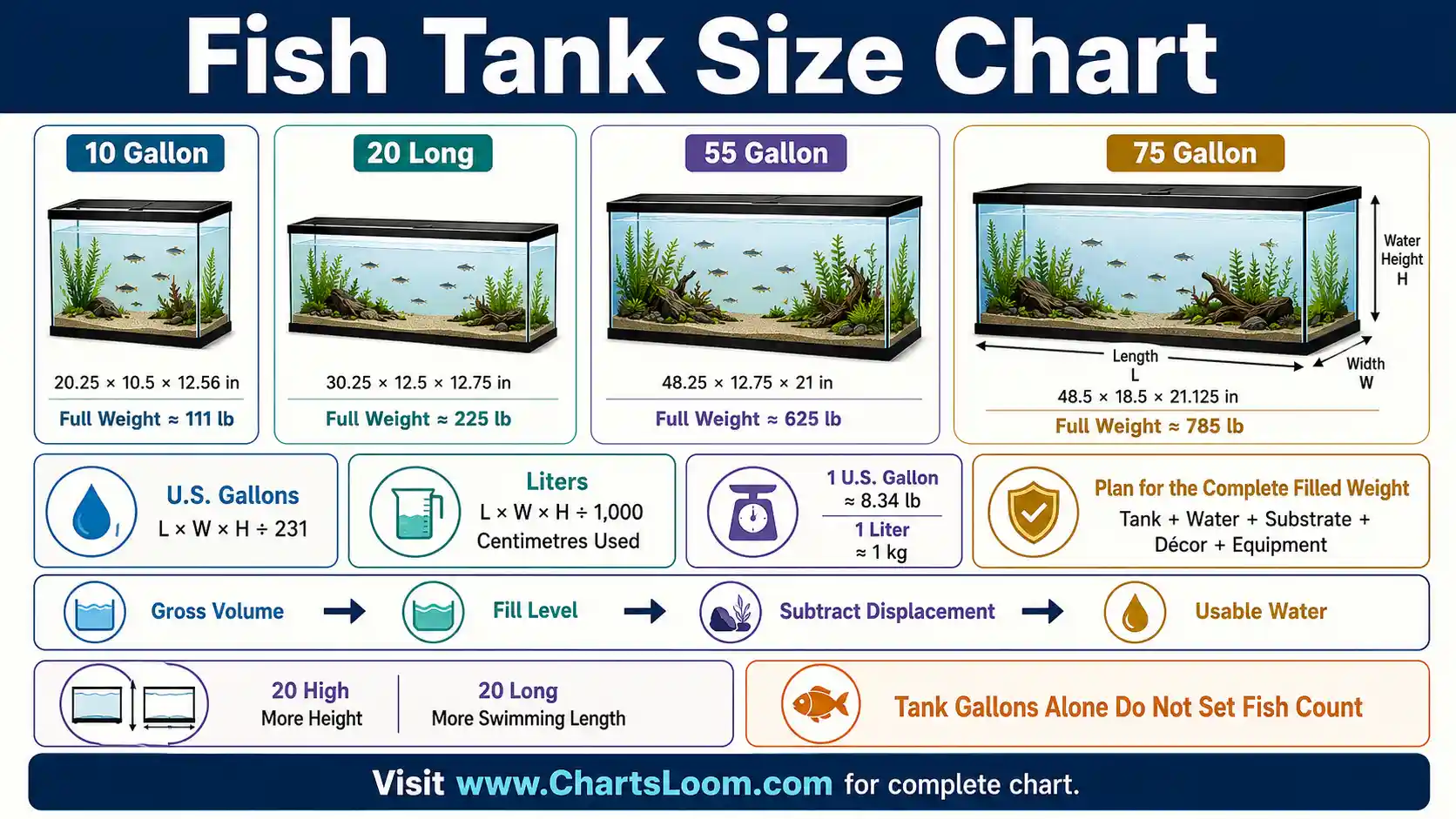
Compare standard aquarium dimensions, metric conversions, footprint, usable water and filled-system weight. Then calculate rectangular, cube or cylindrical capacity from internal measurements.
Quick answer
Use internal water dimensions and plan for the complete load
A tank label is a convenient size class, not an exact refill measurement. Calculate gross geometry from internal dimensions, reduce it for freeboard and displacement, and add glass, substrate, rock, equipment and other vessels when planning support.
Rectangular formula
L × W × water height ÷ 231
Use internal inches for U.S. gallons.
Freshwater weight
About 8.34 lb per gallon
Glass, décor, substrate and equipment add more.
Usable volume
Less than the box volume
Freeboard and displacement reduce actual water.
Stocking
Not gallons alone
Adult size, territory, oxygen, filtration and water quality matter.
Fish tank size questions at a glance
How is rectangular tank volume calculated?
Multiply internal length, internal width and actual water height, then divide cubic inches by 231.
How much does aquarium water weigh?
Freshwater weighs about 8.34 pounds per U.S. gallon or approximately one kilogram per liter.
Why is usable volume lower than nominal size?
Glass, trim, freeboard, substrate, rock, wood and internal equipment reduce water volume.
Can outside dimensions calculate exact gallons?
No. Outside dimensions overstate the internal water space.
Is a 20 Long different from a 20 High?
Yes. They have similar nominal capacity but different length, height, footprint and swimming space.
How heavy is a full 55-gallon tank?
The cited manufacturer chart lists about 625 pounds for its standard 55-gallon model.
Can a household cabinet support a tank?
Do not assume it can. Use a stand rated for the complete filled system and full base footprint.
Can the calculator handle bowfront tanks?
No. Use manufacturer capacity or exact curved geometry.
Does a sump count toward tank volume?
It adds system water and weight but does not add display swimming territory.
Can gallons decide fish count?
No. Use adult species requirements, filtration, oxygen, territory and repeated water tests.
Standard Rectangular Fish Tank Sizes
Manufacturer nominal sizes, outside dimensions and published empty and filled planning weights. Dimensions vary by model and trim.
Swipe horizontally inside the table to view every column.
| Tank size | Nominal capacity | Outside dimensions L × W × H | Empty weight | Published full weight |
|---|---|---|---|---|
| 2½ Mini | 2.5 | 12.188 × 6.125 × 8.125 in | 2.6 lb | 27 lb |
| 5½ | 5.5 | 16.188 × 8.375 × 10.5 in | 7 lb | 62 lb |
| 10 Leader | 10 | 20.25 × 10.5 × 12.562 in | 11 lb | 111 lb |
| 13 Widescreen | 13 | 24.25 × 8.25 × 19.5 in | 20.5 lb | 138 lb |
| 15 | 15 | 24.25 × 12.5 × 12.75 in | 21 lb | 170 lb |
| 15 Column | 15 | 13.75 × 13.625 × 25 in | 19 lb | 154 lb |
| 20 High | 20 | 24.25 × 12.5 × 16.75 in | 25 lb | 225 lb |
| 20 Long | 20 | 30.25 × 12.5 × 12.75 in | 25 lb | 225 lb |
| 29 | 29 | 30.25 × 12.5 × 18.75 in | 40 lb | 330 lb |
| 30 | 30 | 36.25 × 12.625 × 16.75 in | 43 lb | 343 lb |
| 33 Long | 33 | 48.25 × 12.75 × 13.375 in | 46 lb | 382 lb |
| 38 | 38 | 36.25 × 12.625 × 19.75 in | 47 lb | 427 lb |
| 40 Breeder | 40 | 36.188 × 18.25 × 16.938 in | 58 lb | 458 lb |
| 45 | 45 | 36.25 × 12.625 × 23.75 in | 69 lb | 515 lb |
| 55 | 55 | 48.25 × 12.75 × 21 in | 78 lb | 625 lb |
| 60 Breeder | 60 | 48.5 × 18.5 × 16 in | 43 lb | 543 lb |
| 65 | 65 | 36.375 × 18.375 × 25 in | 90 lb | 775 lb |
| 75 | 75 | 48.5 × 18.5 × 21.125 in | 98 lb | 785 lb |
| 90 | 90 | 48.5 × 18.5 × 25.125 in | 135 lb | 1050 lb |
| 125 | 125 | 72.5 × 18.5 × 23.125 in | 177 lb | 1400 lb |
| 150 | 150 | 72.5 × 18.5 × 29.5 in | 281 lb | 1800 lb |
| 210 | 210 | 72.5 × 24.5 × 29.625 in | 343 lb | 2450 lb |
- • Use the exact manufacturer specification for the tank you own or plan to buy.
- • Published full weights may vary with substrate, décor and equipment.
Download or export
Interactive calculator
Calculate tank volume and freshwater load
Enter internal dimensions, actual water fill and estimated displacement. Optional weight fields make the load estimate more useful.
Result
Estimated tank volume and load
24.0 gal · 90.8 L usable
length × width × water height ÷ 231
- • Gross geometric volume: 28.1 U.S. gal (106.2 L).
- • Estimated usable water after fill and displacement: 24.0 U.S. gal (90.8 L).
- • Freshwater reference weight: 200 lb (91 kg).
- • Estimated tank + entered water + substrate/decor load: 275 lb.
- • Footprint: 360 square inches.
- • Use internal measurements and actual water height; curved or tapered tanks need exact shape data.
- • This is a planning estimate, not structural approval for a stand, cabinet or floor.
- • Fish capacity depends on adult species needs, filtration, oxygen, territory and water quality—not gallons alone.
- • Marine water, external filters, sumps, canopies and equipment can increase actual system weight.
What it calculates
Gross geometry, usable water, freshwater weight, footprint and optional estimated system load.
Best inputs
Internal dimensions, actual water height, measured refill volume and manufacturer empty weight.
What it cannot do
Approve a floor or stand, calculate tapered shapes, or choose safe fish stocking from gallons alone.
Bowfront, Corner and Hexagon Tank Sizes
Nominal sizes and bounding dimensions for selected non-rectangular aquariums. A rectangular-box formula overstates many curved or corner shapes.
Swipe horizontally inside the table to view every column.
| Tank size | Nominal capacity | Shape | Bounding dimensions | Empty weight | Published full weight |
|---|---|---|---|---|---|
| 54 Corner | 54 | Corner | 39 × 27.25 × 23 in | 84 lb | 650 lb |
| Mini Bow 1 | 1 | Bowfront | 8.375 × 6 × 11.25 in | 1.75 lb | 10 lb |
| Mini Bow 2.5 | 2.5 | Bowfront | 14.125 × 7.75 × 11.375 in | 4 lb | 25 lb |
| Mini Bow 5 | 5 | Bowfront | 14.75 × 9.5 × 15.125 in | 5 lb | 55 lb |
| 26 Bow | 26 | Bowfront | 24.125 × 14.75 × 20.875 in | 34 lb | 294 lb |
| 46 Bow | 46 | Bowfront | 36.375 × 16.375 × 20.875 in | 53 lb | 550 lb |
| 72 Bow | 72 | Bowfront | 48.375 × 18 × 23 in | 91 lb | 800 lb |
| 8 Hexagon | 8 | Hexagon | 12.188 × 6.125 × 9 in | 2.6 lb | 27 lb |
- • Use manufacturer capacity for bowfront, corner and hexagonal tanks unless you have the exact internal geometry.
- • Do not calculate a curved tank as a full rectangular box.
Download or export
Standard Tank Dimensions in Centimetres
Approximate centimetre and liter conversions from the listed inch dimensions and nominal U.S.-gallon capacities.
Swipe horizontally inside the table to view every column.
| Tank size | Length | Width | Height | Nominal liters |
|---|---|---|---|---|
| 2½ Mini | 31.0 cm | 15.6 cm | 20.6 cm | 9.5 L |
| 5½ | 41.1 cm | 21.3 cm | 26.7 cm | 20.8 L |
| 10 Leader | 51.4 cm | 26.7 cm | 31.9 cm | 37.9 L |
| 13 Widescreen | 61.6 cm | 21.0 cm | 49.5 cm | 49.2 L |
| 15 | 61.6 cm | 31.8 cm | 32.4 cm | 56.8 L |
| 15 Column | 34.9 cm | 34.6 cm | 63.5 cm | 56.8 L |
| 20 High | 61.6 cm | 31.8 cm | 42.5 cm | 75.7 L |
| 20 Long | 76.8 cm | 31.8 cm | 32.4 cm | 75.7 L |
| 29 | 76.8 cm | 31.8 cm | 47.6 cm | 109.8 L |
| 30 | 92.1 cm | 32.1 cm | 42.5 cm | 113.6 L |
| 33 Long | 122.6 cm | 32.4 cm | 34.0 cm | 124.9 L |
| 38 | 92.1 cm | 32.1 cm | 50.2 cm | 143.8 L |
| 40 Breeder | 91.9 cm | 46.4 cm | 43.0 cm | 151.4 L |
| 45 | 92.1 cm | 32.1 cm | 60.3 cm | 170.3 L |
| 55 | 122.6 cm | 32.4 cm | 53.3 cm | 208.2 L |
| 60 Breeder | 123.2 cm | 47.0 cm | 40.6 cm | 227.1 L |
| 65 | 92.4 cm | 46.7 cm | 63.5 cm | 246.1 L |
| 75 | 123.2 cm | 47.0 cm | 53.7 cm | 283.9 L |
| 90 | 123.2 cm | 47.0 cm | 63.8 cm | 340.7 L |
| 125 | 184.2 cm | 47.0 cm | 58.7 cm | 473.2 L |
| 150 | 184.2 cm | 47.0 cm | 74.9 cm | 567.8 L |
| 210 | 184.2 cm | 62.2 cm | 75.2 cm | 794.9 L |
- • Centimetre values are mathematical conversions, not separate manufacturer measurements.
- • One inch equals 2.54 centimetres; one U.S. gallon equals 3.785411784 liters.
Download or export
Outside-Box Volume Compared With Nominal Capacity
The simple outside-box calculation often differs from nominal capacity because glass, trim, freeboard and internal geometry reduce usable space.
Swipe horizontally inside the table to view every column.
| Tank size | Outside box volume | Outside box gallons | Nominal capacity | Difference |
|---|---|---|---|---|
| 2½ Mini | 607 in³ | 2.6 gal | 2.5 gal | +0.1 gal |
| 5½ | 1,423 in³ | 6.2 gal | 5.5 gal | +0.7 gal |
| 10 Leader | 2,671 in³ | 11.6 gal | 10 gal | +1.6 gal |
| 13 Widescreen | 3,901 in³ | 16.9 gal | 13 gal | +3.9 gal |
| 15 | 3,865 in³ | 16.7 gal | 15 gal | +1.7 gal |
| 15 Column | 4,684 in³ | 20.3 gal | 15 gal | +5.3 gal |
| 20 High | 5,077 in³ | 22.0 gal | 20 gal | +2.0 gal |
| 20 Long | 4,821 in³ | 20.9 gal | 20 gal | +0.9 gal |
| 29 | 7,090 in³ | 30.7 gal | 29 gal | +1.7 gal |
| 30 | 7,666 in³ | 33.2 gal | 30 gal | +3.2 gal |
| 33 Long | 8,228 in³ | 35.6 gal | 33 gal | +2.6 gal |
| 38 | 9,039 in³ | 39.1 gal | 38 gal | +1.1 gal |
| 40 Breeder | 11,186 in³ | 48.4 gal | 40 gal | +8.4 gal |
| 45 | 10,869 in³ | 47.1 gal | 45 gal | +2.1 gal |
| 55 | 12,919 in³ | 55.9 gal | 55 gal | +0.9 gal |
| 60 Breeder | 14,356 in³ | 62.1 gal | 60 gal | +2.1 gal |
| 65 | 16,710 in³ | 72.3 gal | 65 gal | +7.3 gal |
| 75 | 18,954 in³ | 82.1 gal | 75 gal | +7.1 gal |
| 90 | 22,543 in³ | 97.6 gal | 90 gal | +7.6 gal |
| 125 | 31,016 in³ | 134.3 gal | 125 gal | +9.3 gal |
| 150 | 39,567 in³ | 171.3 gal | 150 gal | +21.3 gal |
| 210 | 52,621 in³ | 227.8 gal | 210 gal | +17.8 gal |
- • Outside dimensions should not be treated as exact internal water dimensions.
- • Use internal measurements for a closer volume estimate.
Download or export
Fish Tank Footprint and Length-to-Height Comparison
Footprint affects stand sizing, floor loading, swimming length and territorial layout. The same gallon label can describe very different shapes.
Swipe horizontally inside the table to view every column.
| Tank size | Base area | Base area in ft² | Base area in cm² | Length : height |
|---|---|---|---|---|
| 2½ Mini | 75 in² | 0.52 ft² | 482 cm² | 1.50:1 |
| 5½ | 136 in² | 0.94 ft² | 875 cm² | 1.54:1 |
| 10 Leader | 213 in² | 1.48 ft² | 1372 cm² | 1.61:1 |
| 13 Widescreen | 200 in² | 1.39 ft² | 1291 cm² | 1.24:1 |
| 15 | 303 in² | 2.11 ft² | 1956 cm² | 1.90:1 |
| 15 Column | 187 in² | 1.30 ft² | 1209 cm² | 0.55:1 |
| 20 High | 303 in² | 2.11 ft² | 1956 cm² | 1.45:1 |
| 20 Long | 378 in² | 2.63 ft² | 2440 cm² | 2.37:1 |
| 29 | 378 in² | 2.63 ft² | 2440 cm² | 1.61:1 |
| 30 | 458 in² | 3.18 ft² | 2953 cm² | 2.16:1 |
| 33 Long | 615 in² | 4.27 ft² | 3969 cm² | 3.61:1 |
| 38 | 458 in² | 3.18 ft² | 2953 cm² | 1.84:1 |
| 40 Breeder | 660 in² | 4.59 ft² | 4261 cm² | 2.14:1 |
| 45 | 458 in² | 3.18 ft² | 2953 cm² | 1.53:1 |
| 55 | 615 in² | 4.27 ft² | 3969 cm² | 2.30:1 |
| 60 Breeder | 897 in² | 6.23 ft² | 5789 cm² | 3.03:1 |
| 65 | 668 in² | 4.64 ft² | 4312 cm² | 1.46:1 |
| 75 | 897 in² | 6.23 ft² | 5789 cm² | 2.30:1 |
| 90 | 897 in² | 6.23 ft² | 5789 cm² | 1.93:1 |
| 125 | 1341 in² | 9.31 ft² | 8653 cm² | 3.14:1 |
| 150 | 1341 in² | 9.31 ft² | 8653 cm² | 2.46:1 |
| 210 | 1776 in² | 12.34 ft² | 11460 cm² | 2.45:1 |
- • Measure the complete bottom frame or base, not only the visible glass panel.
- • Long and breeder tanks usually offer more horizontal space than tall tanks of similar volume.
Download or export
Freshwater Weight by Tank Volume
Freshwater alone weighs about 8.34 pounds per U.S. gallon, before glass, stand, substrate, rock, wood, equipment or canopy.
Swipe horizontally inside the table to view every column.
| Water volume | Liters | Water weight | Water mass | Water weight in tons |
|---|---|---|---|---|
| 1 gal | 3.8 L | 8.3 lb | 3.8 kg | 0.004 US tons |
| 2 gal | 7.6 L | 16.7 lb | 7.6 kg | 0.008 US tons |
| 3 gal | 11.4 L | 25.0 lb | 11.4 kg | 0.013 US tons |
| 4 gal | 15.1 L | 33.4 lb | 15.1 kg | 0.017 US tons |
| 5 gal | 18.9 L | 41.7 lb | 18.9 kg | 0.021 US tons |
| 6 gal | 22.7 L | 50.0 lb | 22.7 kg | 0.025 US tons |
| 7 gal | 26.5 L | 58.4 lb | 26.5 kg | 0.029 US tons |
| 8 gal | 30.3 L | 66.7 lb | 30.3 kg | 0.033 US tons |
| 9 gal | 34.1 L | 75.1 lb | 34.1 kg | 0.038 US tons |
| 10 gal | 37.9 L | 83.4 lb | 37.9 kg | 0.042 US tons |
| 12 gal | 45.4 L | 100.1 lb | 45.4 kg | 0.050 US tons |
| 15 gal | 56.8 L | 125.1 lb | 56.8 kg | 0.063 US tons |
| 20 gal | 75.7 L | 166.8 lb | 75.7 kg | 0.083 US tons |
| 25 gal | 94.6 L | 208.5 lb | 94.6 kg | 0.104 US tons |
| 29 gal | 109.8 L | 241.9 lb | 109.8 kg | 0.121 US tons |
| 30 gal | 113.6 L | 250.2 lb | 113.6 kg | 0.125 US tons |
| 33 gal | 124.9 L | 275.2 lb | 124.9 kg | 0.138 US tons |
| 40 gal | 151.4 L | 333.6 lb | 151.4 kg | 0.167 US tons |
| 45 gal | 170.3 L | 375.3 lb | 170.3 kg | 0.188 US tons |
| 55 gal | 208.2 L | 458.7 lb | 208.2 kg | 0.229 US tons |
| 60 gal | 227.1 L | 500.4 lb | 227.1 kg | 0.250 US tons |
| 65 gal | 246.1 L | 542.1 lb | 246.1 kg | 0.271 US tons |
| 75 gal | 283.9 L | 625.5 lb | 283.9 kg | 0.313 US tons |
| 90 gal | 340.7 L | 750.6 lb | 340.7 kg | 0.375 US tons |
| 100 gal | 378.5 L | 834.0 lb | 378.5 kg | 0.417 US tons |
| 125 gal | 473.2 L | 1042.5 lb | 473.2 kg | 0.521 US tons |
| 150 gal | 567.8 L | 1251.0 lb | 567.8 kg | 0.625 US tons |
| 180 gal | 681.4 L | 1501.2 lb | 681.4 kg | 0.751 US tons |
| 210 gal | 794.9 L | 1751.4 lb | 794.9 kg | 0.876 US tons |
| 250 gal | 946.4 L | 2085.0 lb | 946.4 kg | 1.042 US tons |
- • One liter of freshwater is approximately one kilogram for planning.
- • Marine water is denser; verify actual system weight for structural decisions.
Download or export
Published Full Tank Weights
Manufacturer full-weight figures include more than nominal water weight and are better planning references than water weight alone.
Swipe horizontally inside the table to view every column.
| Tank size | Empty tank | Nominal water only | Published full weight | Difference from empty + nominal water | Full weight in tons |
|---|---|---|---|---|---|
| 2½ Mini | 2.6 lb | 21 lb | 27 lb | +4 lb | 0.013 tons |
| 5½ | 7 lb | 46 lb | 62 lb | +9 lb | 0.031 tons |
| 10 Leader | 11 lb | 83 lb | 111 lb | +17 lb | 0.056 tons |
| 13 Widescreen | 20.5 lb | 108 lb | 138 lb | +9 lb | 0.069 tons |
| 15 | 21 lb | 125 lb | 170 lb | +24 lb | 0.085 tons |
| 15 Column | 19 lb | 125 lb | 154 lb | +10 lb | 0.077 tons |
| 20 High | 25 lb | 167 lb | 225 lb | +33 lb | 0.113 tons |
| 20 Long | 25 lb | 167 lb | 225 lb | +33 lb | 0.113 tons |
| 29 | 40 lb | 242 lb | 330 lb | +48 lb | 0.165 tons |
| 30 | 43 lb | 250 lb | 343 lb | +50 lb | 0.172 tons |
| 33 Long | 46 lb | 275 lb | 382 lb | +61 lb | 0.191 tons |
| 38 | 47 lb | 317 lb | 427 lb | +63 lb | 0.213 tons |
| 40 Breeder | 58 lb | 334 lb | 458 lb | +66 lb | 0.229 tons |
| 45 | 69 lb | 375 lb | 515 lb | +71 lb | 0.258 tons |
| 55 | 78 lb | 459 lb | 625 lb | +88 lb | 0.312 tons |
| 60 Breeder | 43 lb | 500 lb | 543 lb | -0 lb | 0.272 tons |
| 65 | 90 lb | 542 lb | 775 lb | +143 lb | 0.388 tons |
| 75 | 98 lb | 626 lb | 785 lb | +62 lb | 0.393 tons |
| 90 | 135 lb | 751 lb | 1050 lb | +164 lb | 0.525 tons |
| 125 | 177 lb | 1042 lb | 1400 lb | +180 lb | 0.700 tons |
| 150 | 281 lb | 1251 lb | 1800 lb | +268 lb | 0.900 tons |
| 210 | 343 lb | 1751 lb | 2450 lb | +356 lb | 1.225 tons |
- • The difference can reflect actual water volume, glass geometry and the manufacturer’s test assumptions.
- • Your substrate, rock, wood, sump and equipment can change the total.
Download or export
Rectangular Tank Volume Examples
Gross rectangular volume uses internal length × internal width × internal water height ÷ 231 for U.S. gallons.
Swipe horizontally inside the table to view every column.
| Internal dimensions | Gross U.S. gallons | Gross liters | Freshwater weight | Footprint |
|---|---|---|---|---|
| 12 × 6 × 8 in | 2.5 gal | 9.4 L | 21 lb | 72 in² |
| 16 × 8 × 10 in | 5.5 gal | 21.0 L | 46 lb | 128 in² |
| 20 × 10 × 12 in | 10.4 gal | 39.3 L | 87 lb | 200 in² |
| 24 × 12 × 12 in | 15.0 gal | 56.6 L | 125 lb | 288 in² |
| 24 × 12 × 16 in | 19.9 gal | 75.5 L | 166 lb | 288 in² |
| 30 × 12 × 12 in | 18.7 gal | 70.8 L | 156 lb | 360 in² |
| 30 × 12 × 18 in | 28.1 gal | 106.2 L | 234 lb | 360 in² |
| 36 × 12 × 16 in | 29.9 gal | 113.3 L | 250 lb | 432 in² |
| 36 × 18 × 16 in | 44.9 gal | 169.9 L | 374 lb | 648 in² |
| 36 × 18 × 20 in | 56.1 gal | 212.4 L | 468 lb | 648 in² |
| 48 × 12 × 12 in | 29.9 gal | 113.3 L | 250 lb | 576 in² |
| 48 × 12 × 20 in | 49.9 gal | 188.8 L | 416 lb | 576 in² |
| 48 × 18 × 16 in | 59.8 gal | 226.5 L | 499 lb | 864 in² |
| 48 × 18 × 20 in | 74.8 gal | 283.2 L | 624 lb | 864 in² |
| 48 × 24 × 20 in | 99.7 gal | 377.6 L | 832 lb | 1152 in² |
| 60 × 18 × 20 in | 93.5 gal | 354.0 L | 780 lb | 1080 in² |
| 60 × 24 × 24 in | 149.6 gal | 566.3 L | 1248 lb | 1440 in² |
| 72 × 18 × 20 in | 112.2 gal | 424.8 L | 936 lb | 1296 in² |
| 72 × 24 × 24 in | 179.5 gal | 679.6 L | 1497 lb | 1728 in² |
| 72 × 24 × 30 in | 224.4 gal | 849.5 L | 1872 lb | 1728 in² |
| 84 × 24 × 24 in | 209.5 gal | 792.9 L | 1747 lb | 2016 in² |
| 84 × 30 × 30 in | 327.3 gal | 1238.9 L | 2729 lb | 2520 in² |
| 96 × 24 × 24 in | 239.4 gal | 906.1 L | 1996 lb | 2304 in² |
| 96 × 30 × 30 in | 374.0 gal | 1415.8 L | 3119 lb | 2880 in² |
| 120 × 24 × 24 in | 299.2 gal | 1132.7 L | 2496 lb | 2880 in² |
| 120 × 30 × 30 in | 467.5 gal | 1769.8 L | 3899 lb | 3600 in² |
| 18 × 18 × 18 in | 25.2 gal | 95.6 L | 211 lb | 324 in² |
| 24 × 24 × 24 in | 59.8 gal | 226.5 L | 499 lb | 576 in² |
| 30 × 30 × 24 in | 93.5 gal | 354.0 L | 780 lb | 900 in² |
| 36 × 36 × 24 in | 134.6 gal | 509.7 L | 1123 lb | 1296 in² |
- • Use water height, not outside tank height.
- • Subtract displacement and freeboard to estimate usable water volume.
Download or export
Cylinder and Cube Aquarium Volume Examples
Use π × radius² × water height for a cylinder and side³ for a true cube, then convert cubic inches to gallons.
Swipe horizontally inside the table to view every column.
| Internal dimensions | Shape | Gross gallons | Gross liters | Freshwater weight |
|---|---|---|---|---|
| Cylinder Ø 8 × 10 in | Cylinder | 2.2 gal | 8.2 L | 18 lb |
| Cylinder Ø 10 × 12 in | Cylinder | 4.1 gal | 15.4 L | 34 lb |
| Cylinder Ø 12 × 12 in | Cylinder | 5.9 gal | 22.2 L | 49 lb |
| Cylinder Ø 12 × 18 in | Cylinder | 8.8 gal | 33.4 L | 73 lb |
| Cylinder Ø 14 × 18 in | Cylinder | 12.0 gal | 45.4 L | 100 lb |
| Cylinder Ø 16 × 20 in | Cylinder | 17.4 gal | 65.9 L | 145 lb |
| Cylinder Ø 18 × 18 in | Cylinder | 19.8 gal | 75.1 L | 165 lb |
| Cylinder Ø 18 × 24 in | Cylinder | 26.4 gal | 100.1 L | 220 lb |
| Cylinder Ø 20 × 20 in | Cylinder | 27.2 gal | 103.0 L | 227 lb |
| Cylinder Ø 20 × 30 in | Cylinder | 40.8 gal | 154.4 L | 340 lb |
| Cylinder Ø 24 × 24 in | Cylinder | 47.0 gal | 177.9 L | 392 lb |
| Cylinder Ø 24 × 36 in | Cylinder | 70.5 gal | 266.9 L | 588 lb |
| Cube 8 × 8 × 8 in | Cube | 2.2 gal | 8.4 L | 18 lb |
| Cube 10 × 10 × 10 in | Cube | 4.3 gal | 16.4 L | 36 lb |
| Cube 12 × 12 × 12 in | Cube | 7.5 gal | 28.3 L | 62 lb |
| Cube 14 × 14 × 14 in | Cube | 11.9 gal | 45.0 L | 99 lb |
| Cube 16 × 16 × 16 in | Cube | 17.7 gal | 67.1 L | 148 lb |
| Cube 18 × 18 × 18 in | Cube | 25.2 gal | 95.6 L | 211 lb |
| Cube 20 × 20 × 20 in | Cube | 34.6 gal | 131.1 L | 289 lb |
| Cube 22 × 22 × 22 in | Cube | 46.1 gal | 174.5 L | 384 lb |
| Cube 24 × 24 × 24 in | Cube | 59.8 gal | 226.5 L | 499 lb |
| Cube 28 × 28 × 28 in | Cube | 95.0 gal | 359.7 L | 793 lb |
| Cube 30 × 30 × 30 in | Cube | 116.9 gal | 442.4 L | 975 lb |
| Cube 36 × 36 × 36 in | Cube | 202.0 gal | 764.5 L | 1684 lb |
- • Decorative bowls and tapered vessels are not true cylinders.
- • Use exact internal geometry for structural planning.
Download or export
Usable Water After Displacement
Substrate, rock, wood, internal filters and air space reduce the water held below the nominal label.
Swipe horizontally inside the table to view every column.
| Gross volume | Estimated displacement | Usable water | Usable liters | Freshwater weight |
|---|---|---|---|---|
| 5 gal | 5% | 4.8 gal | 18.0 L | 40 lb |
| 5 gal | 10% | 4.5 gal | 17.0 L | 38 lb |
| 5 gal | 20% | 4.0 gal | 15.1 L | 33 lb |
| 10 gal | 5% | 9.5 gal | 36.0 L | 79 lb |
| 10 gal | 10% | 9.0 gal | 34.1 L | 75 lb |
| 10 gal | 20% | 8.0 gal | 30.3 L | 67 lb |
| 15 gal | 5% | 14.2 gal | 53.9 L | 119 lb |
| 15 gal | 10% | 13.5 gal | 51.1 L | 113 lb |
| 15 gal | 20% | 12.0 gal | 45.4 L | 100 lb |
| 20 gal | 5% | 19.0 gal | 71.9 L | 158 lb |
| 20 gal | 10% | 18.0 gal | 68.1 L | 150 lb |
| 20 gal | 20% | 16.0 gal | 60.6 L | 133 lb |
| 29 gal | 5% | 27.5 gal | 104.3 L | 230 lb |
| 29 gal | 10% | 26.1 gal | 98.8 L | 218 lb |
| 29 gal | 20% | 23.2 gal | 87.8 L | 193 lb |
| 40 gal | 5% | 38.0 gal | 143.8 L | 317 lb |
| 40 gal | 10% | 36.0 gal | 136.3 L | 300 lb |
| 40 gal | 20% | 32.0 gal | 121.1 L | 267 lb |
| 55 gal | 5% | 52.2 gal | 197.8 L | 436 lb |
| 55 gal | 10% | 49.5 gal | 187.4 L | 413 lb |
| 55 gal | 20% | 44.0 gal | 166.5 L | 367 lb |
| 75 gal | 5% | 71.2 gal | 269.7 L | 594 lb |
| 75 gal | 10% | 67.5 gal | 255.5 L | 563 lb |
| 75 gal | 20% | 60.0 gal | 227.1 L | 500 lb |
| 90 gal | 5% | 85.5 gal | 323.6 L | 713 lb |
| 90 gal | 10% | 81.0 gal | 306.6 L | 676 lb |
| 90 gal | 20% | 72.0 gal | 272.5 L | 600 lb |
| 125 gal | 5% | 118.8 gal | 449.5 L | 990 lb |
| 125 gal | 10% | 112.5 gal | 425.8 L | 938 lb |
| 125 gal | 20% | 100.0 gal | 378.5 L | 834 lb |
- • Displacement percentage is an estimate; measure actual refill volume when accuracy matters.
- • Heavy rock can add substantial mass even while reducing water volume.
Download or export
Substrate Volume by Footprint and Depth
Geometric substrate volume helps estimate displacement. Actual bag weight depends on material density, grain size, moisture and compaction.
Swipe horizontally inside the table to view every column.
| Tank footprint | Average depth | Geometric volume | Approximate liters | Equivalent water displacement |
|---|---|---|---|---|
| 12 × 6 in | 1 in | 72 in³ | 1.2 L | 0.3 gal displacement |
| 12 × 6 in | 2 in | 144 in³ | 2.4 L | 0.6 gal displacement |
| 16 × 8 in | 1 in | 128 in³ | 2.1 L | 0.6 gal displacement |
| 16 × 8 in | 2 in | 256 in³ | 4.2 L | 1.1 gal displacement |
| 20 × 10 in | 1 in | 200 in³ | 3.3 L | 0.9 gal displacement |
| 20 × 10 in | 2 in | 400 in³ | 6.6 L | 1.7 gal displacement |
| 24 × 12 in | 1 in | 288 in³ | 4.7 L | 1.2 gal displacement |
| 24 × 12 in | 2 in | 576 in³ | 9.4 L | 2.5 gal displacement |
| 30 × 12 in | 1 in | 360 in³ | 5.9 L | 1.6 gal displacement |
| 30 × 12 in | 2 in | 720 in³ | 11.8 L | 3.1 gal displacement |
| 36 × 12 in | 1 in | 432 in³ | 7.1 L | 1.9 gal displacement |
| 36 × 12 in | 2 in | 864 in³ | 14.2 L | 3.7 gal displacement |
| 36 × 18 in | 1 in | 648 in³ | 10.6 L | 2.8 gal displacement |
| 36 × 18 in | 2 in | 1,296 in³ | 21.2 L | 5.6 gal displacement |
| 48 × 12 in | 1 in | 576 in³ | 9.4 L | 2.5 gal displacement |
| 48 × 12 in | 2 in | 1,152 in³ | 18.9 L | 5.0 gal displacement |
| 48 × 18 in | 1 in | 864 in³ | 14.2 L | 3.7 gal displacement |
| 48 × 18 in | 2 in | 1,728 in³ | 28.3 L | 7.5 gal displacement |
| 48 × 24 in | 1 in | 1,152 in³ | 18.9 L | 5.0 gal displacement |
| 48 × 24 in | 2 in | 2,304 in³ | 37.8 L | 10.0 gal displacement |
| 72 × 18 in | 1 in | 1,296 in³ | 21.2 L | 5.6 gal displacement |
| 72 × 18 in | 2 in | 2,592 in³ | 42.5 L | 11.2 gal displacement |
| 72 × 24 in | 1 in | 1,728 in³ | 28.3 L | 7.5 gal displacement |
| 72 × 24 in | 2 in | 3,456 in³ | 56.6 L | 15.0 gal displacement |
- • A sloped aquascape needs an average depth rather than the deepest point.
- • Do not infer substrate weight from volume without the product density.
Download or export
Fish Tank Stand and Floor Checklist
A stand must support the entire filled system on a strong, level and stable surface. This checklist is planning guidance, not structural certification.
Swipe horizontally inside the table to view every column.
| Check | What to verify | Why it matters | When |
|---|---|---|---|
| Tank base fully supported | Use the support pattern required by the manufacturer | Prevents point loading or frame distortion | Before filling |
| Stand rated for filled system | Include tank, water, substrate, rock, sump and equipment | Nominal gallons alone understate total mass | Before purchase |
| Level front to back | Check with a long level | Reduces uneven loading | Before filling |
| Level side to side | Check across the complete stand | Reduces twisting | Before filling |
| Stable floor | No bounce, sag or movement | A filled aquarium is a concentrated load | Before filling |
| Floor capacity review | Consult a qualified professional for large systems | Calculator is not structural approval | When uncertain |
| Stand footprint | Match the full tank base | Overhang can be unsafe | Before purchase |
| Cabinet top condition | Flat, dry and undamaged | Swelling can reduce strength | Every inspection |
| Fasteners and joints | Tight and corrosion-free | Loose joints can worsen under load | Every inspection |
| Moisture barrier | Protect stand surface where specified | Reduces water damage | During setup |
| Drip loop | Power cords loop below outlets | Reduces electrical risk | During setup |
| GFCI protection | Use appropriate electrical protection | Water and electricity require safeguards | During setup |
| Access clearance | Leave room for hoses and maintenance | Prevents forced lifting or bending | Before placement |
| Door and walkway clearance | Plan delivery path and working space | Large tanks may not fit after assembly | Before purchase |
| Direct sunlight | Avoid prolonged direct sun | Limits heat rise and algae | Before placement |
| Heating and cooling vents | Avoid strong drafts and radiant heat | Improves temperature stability | Before placement |
| Wall clearance | Follow equipment and manufacturer requirements | Allows airflow and hose routing | Before filling |
| Seam inspection | Check silicone and panels for damage | Damage needs evaluation before use | Before filling |
| Leak test | Test safely in an appropriate location | Finds leaks before final placement | Before aquascaping |
| Sump load | Include water and equipment below the display | Total system load spans multiple vessels | During planning |
| Rock support | Place heavy structures securely | Prevents pressure points and collapse | During aquascaping |
| Canopy and lighting | Include top equipment mass | Adds to the stand load | During planning |
| Moving a tank | Drain and remove contents first | Never move a filled aquarium | Before relocation |
| Emergency plan | Know shutoff, towels and livestock containers | Speeds response to leaks or failure | Before stocking |
- • Follow the tank and stand manufacturers’ instructions.
- • Seek qualified structural advice for large or uncertain installations.
Download or export
Why Tank Gallons Alone Cannot Set Fish Count
Carrying capacity depends on adult fish size, surface area, filtration, oxygen, territory, maintenance and water-quality trends—not one universal inches-per-gallon rule.
Swipe horizontally inside the table to view every column.
| Factor | How it affects capacity | Why gallons alone fail | Check |
|---|---|---|---|
| Adult fish size | Use expected adult dimensions, not purchase size | Juveniles grow | Species profile |
| Body shape | Deep-bodied and bulky fish produce more waste | Length alone misses biomass | Species profile |
| Swimming behavior | Active swimmers need horizontal room | Gallons do not describe swim length | Species profile |
| Territory | Cichlids and reef fish may defend areas | Decor and footprint matter | Behavior research |
| School size | Social species may need a minimum group | A tank can fit one fish but not a proper group | Species profile |
| Surface area | Affects gas exchange and some freshwater guidelines | Tall tanks can have limited surface | Length × width |
| Filtration capacity | Biological media must process waste | Capacity grows gradually | Water tests |
| Oxygenation | Warmer and saltier water holds less oxygen | Crowding increases oxygen demand | Temperature and flow |
| Ammonia and nitrite | Should remain controlled by the biofilter | Rising values signal overload | Test kit |
| Nitrate trend | Shows accumulating waste | Maintenance needs vary | Test records |
| Water-change capacity | Large stock requires reliable maintenance | A tank is only as manageable as its routine | Schedule |
| Feeding rate | Overfeeding raises waste load | Food input becomes pollution | Observation |
| Plant mass | Plants can use nutrients but do not erase limits | Nighttime oxygen demand still matters | System type |
| Rock and wood | Reduce water volume but create territories | Usable gallons can be lower | Displacement estimate |
| Sump volume | Adds water and filtration but not display territory | Fish still occupy display space | System design |
| Coldwater species | Often need more oxygen and space | Lower temperature changes biology | Species profile |
| Marine fish | Often require lower stocking density | Saltwater holds less oxygen | Species profile |
| Bottom dwellers | Need suitable bottom area and substrate | Vertical gallons may not help | Footprint |
| Tall fish | Need adequate water height and turning space | Length-only rules fail | Species profile |
| Long fish | Need turning radius and swim length | Small cubes can be unsuitable | Species profile |
| Aggression | Crowding can increase conflict | Territory is not a simple volume ratio | Behavior observation |
| Quarantine | New fish should not be added casually | Disease risk changes stocking plans | Quarantine plan |
| Growth margin | Choose a tank for adult needs | Upgrades may not happen in time | Long-term plan |
| Professional advice | Use aquatic veterinarian or experienced specialist | Complex systems need individual assessment | When uncertain |
- • Use species-specific adult requirements and water-quality monitoring.
- • Add livestock gradually so biological filtration can adjust.
Download or export
Fish Tank Setup and Maintenance Sequence
A practical sequence connects tank sizing with support, water preparation, biological filtration, gradual stocking and repeat testing.
Swipe horizontally inside the table to view every column.
| Step | Action | Reason |
|---|---|---|
| Choose livestock first | Research adult size and behavior | Tank choice follows animal needs |
| Measure available space | Include equipment and maintenance clearance | Prevents unusable placement |
| Check delivery path | Doors, stairs and turns | Large tanks are difficult to reposition |
| Verify stand rating | Use total filled-system load | Water is only part of the mass |
| Level the stand | Front-back and side-side | Reduces uneven stress |
| Leak test | Use a safe test location | Detects problems before setup |
| Rinse substrate appropriately | Follow material instructions | Reduces dust without contaminating media |
| Place heavy décor securely | Support rock and wood | Prevents collapse and point loads |
| Fill with treated water | Remove chlorine or chloramine as needed | Protects fish and biofilter |
| Record actual fill volume | Count buckets or meter water | Improves dosing and maintenance math |
| Cycle biological filtration | Allow waste-processing bacteria to establish | Avoids ammonia and nitrite spikes |
| Test before stocking | Check temperature and water chemistry | Confirms conditions |
| Add fish gradually | Allow filtration to respond | Avoids sudden waste overload |
| Quarantine additions | Reduce disease introduction | Protects established fish |
| Track ammonia and nitrite | Especially in new or changed systems | Finds biofilter stress |
| Track nitrate trend | Connects stocking and maintenance | Guides water-change frequency |
| Observe filter flow | Clean when reduced | Maintains circulation and oxygenation |
| Avoid direct sunlight | Limits heat and algae | Improves stability |
| Keep cords in drip loops | Electrical safety | Water can travel along cords |
| Top off evaporation correctly | Evaporation removes water, not minerals | Prevents concentration drift |
| Water changes | Base amount on stocking and tests | No single percentage fits every tank |
| Record livestock growth | Adult needs may exceed current tank | Supports upgrade planning |
| Recalculate after rescape | Rock and substrate change usable volume | Updates water and load estimates |
| Review total weight | Include added equipment and water reservoirs | System changes alter support load |
- • The tank-size calculator does not replace water testing or species research.
- • Record actual fill volume when possible.
Download or export
Fish Tank Size Worked Examples
Forty examples show how dimensions, shape, displacement, water weight, support and livestock needs change tank-size decisions.
Swipe horizontally inside the table to view every column.
| No. | Scenario | Known information | Interpretation | Action |
|---|---|---|---|---|
| 1 | 10-gallon label on a standard tank | 20.25 × 10.5 × 12.56 in outside | Outside box is not exact internal water volume | Use nominal capacity or internal measurements |
| 2 | 20 High versus 20 Long | Same nominal gallons | Long tank has more horizontal swimming length | Choose shape for livestock behavior |
| 3 | 40 Breeder versus 45 | Similar overall scale | Breeder has wider footprint; 45 is taller | Compare footprint, not gallons alone |
| 4 | 55-gallon setup | Published full weight 625 lb | Water-only estimate understates total | Use rated aquarium stand |
| 5 | 75-gallon setup | Published full weight 785 lb | Nearly 0.4 US ton | Verify floor and stand |
| 6 | 125-gallon setup | Published full weight 1,400 lb | About 0.7 US ton | Seek structural advice if uncertain |
| 7 | 210-gallon setup | Published full weight 2,450 lb | More than 1.2 US tons | Professional planning is prudent |
| 8 | 24 × 12 × 12 in internal box | About 15.0 gal gross | Use water height, not outside height | Then subtract displacement |
| 9 | 36 × 18 × 16 in internal box | About 44.9 gal gross | Geometry may exceed nominal label | Internal shape and freeboard matter |
| 10 | 48 × 18 × 20 in internal box | About 74.8 gal gross | A nominal 75-gallon class | Still verify actual dimensions |
| 11 | 24-inch cube | About 59.8 gal gross | Large volume in compact footprint | Swimming length may be limited |
| 12 | 18-inch cube | About 25.2 gal gross | Cube shape differs from long tank | Match species needs |
| 13 | 12-inch cylinder, 18-inch water height | About 8.8 gal gross | Only valid for a true cylinder | Tapered bowls need another method |
| 14 | 20-inch cylinder, 30-inch water height | About 40.8 gal gross | Tall shape has modest footprint | Consider gas exchange and access |
| 15 | 20-gallon tank with 10% displacement | 18 gal usable water | Décor reduces water volume | Track actual refill amount |
| 16 | 55-gallon tank with 20% displacement | 44 gal usable water | Rock-heavy aquascape changes volume | Do not dose from label alone |
| 17 | 75-gallon tank with 5% displacement | 71.3 gal usable water | Light aquascape still reduces volume | Use measured change volume |
| 18 | Freshwater 10 gallons | 83.4 lb water | Excludes tank and equipment | Total is higher |
| 19 | Freshwater 55 gallons | 458.7 lb water | Excludes glass and hardscape | Published full tank is 625 lb |
| 20 | Freshwater 125 gallons | 1,042.5 lb water | More than half a ton of water | Support planning is essential |
| 21 | 30 × 12 footprint, 2-inch substrate | About 11.8 L geometric substrate volume | Actual weight depends on material | Check bag density |
| 22 | 48 × 18 footprint, 2-inch substrate | About 28.3 L geometric substrate volume | Large substrate displacement | Include in usable-volume estimate |
| 23 | 72 × 24 footprint, 1-inch substrate | About 28.3 L geometric substrate volume | Wide base uses substantial material | Plan load and displacement |
| 24 | Bowfront tank | Curved front panel | Rectangular box overstates volume | Use manufacturer capacity |
| 25 | Corner tank | Triangular or curved footprint | Bounding rectangle is inaccurate | Use exact geometry or nominal capacity |
| 26 | Tank on furniture | Unknown furniture rating | Household furniture is not automatically a stand | Use purpose-designed support |
| 27 | Slight floor slope | Uneven waterline | Can create uneven loading | Level support before filling |
| 28 | Tank near sunny window | Heat and algae risk | Sunlight changes conditions | Choose a stable location |
| 29 | Many juvenile fish | Small current bodies | Adults may exceed space and filtration | Plan for adult size |
| 30 | One territorial fish | Low fish count | Territory can still be inadequate | Research behavior |
| 31 | Tall schooling fish tank | Adequate gallons but short length | School may lack swimming run | Compare length and footprint |
| 32 | Sump added below display | More system water | Display territory does not increase | Count system load separately |
| 33 | Large rock structure | Less water, more solid mass | Weight can rise while water volume falls | Include hardscape mass |
| 34 | Evaporation top-off | Restores water level | Does not remove nitrate or minerals | Still perform water changes |
| 35 | New tank stocked at once | Biofilter not mature | Waste can overwhelm bacteria | Add gradually and test |
| 36 | Filter upgrade | More rated flow | Does not create more territory | Stocking still species-specific |
| 37 | Measured 50 L refill | Known actual water change | More useful than nominal percent | Record the value |
| 38 | Internal filter installed | Displaces water | Usable volume decreases slightly | Update estimate |
| 39 | Canister filter added | Adds external water volume | Also adds equipment and hose weight | Include in system planning |
| 40 | Moving house | Filled aquarium | Unsafe to move while filled | Drain and remove contents |
- • Examples are educational planning aids, not structural or veterinary approvals.
- • Use exact manufacturer data and species-specific care requirements.
Download or export
Important limits
- • Standard dimensions differ among manufacturers, model generations, trim and glass thickness.
- • The calculator models true rectangular boxes, cubes and cylinders only.
- • Freshwater weight is a planning reference; marine water and equipment can increase actual load.
- • This page cannot approve a floor, stand, cabinet, wall anchoring system or electrical installation.
- • Safe fish capacity requires species-specific adult size, social needs, filtration, oxygen, territory and water-quality monitoring.
Frequently asked questions
How do I calculate gallons in a rectangular fish tank?
Multiply internal length, internal width and actual water height in inches, then divide by 231. Use centimeters cubed divided by 1,000 for liters.
Why is calculated box volume different from the tank label?
Outside dimensions include glass and trim, while freeboard, frame geometry and internal equipment reduce water volume. Nominal capacity is a product label, not an exact refill measurement.
How much does one gallon of aquarium water weigh?
Freshwater weighs about 8.34 pounds per U.S. gallon. The complete aquarium weighs more because the tank, substrate, décor, stand, equipment and canopy also add mass.
How much does a 55-gallon fish tank weigh when full?
The cited manufacturer chart lists a standard 55-gallon tank at about 625 pounds full. Your setup can differ with substrate, décor and equipment.
Can I put an aquarium on ordinary furniture?
Do not assume ordinary furniture is safe. Use support designed and rated for the tank’s complete filled-system load and footprint.
Does a taller tank hold more fish than a long tank?
Not automatically. Horizontal swimming length, surface area, territory, filtration, oxygen and species behavior can make a long tank more useful than a taller tank with similar gallons.
How much volume do substrate and rocks remove?
The amount depends on the actual aquascape. A rough displacement percentage can help planning, but recording actual refill volume is more accurate.
Can gallons alone determine how many fish I can keep?
No. Adult fish size, body shape, social group, territory, oxygen, filtration and water-quality trends all matter.
Should I use outside or inside dimensions?
Use internal dimensions and actual water height for volume calculations. Outside dimensions are useful for stand, room and delivery planning.
How do I calculate a cylindrical aquarium?
For a true cylinder, multiply pi by radius squared and actual water height. Convert cubic inches to U.S. gallons by dividing by 231.
How do I calculate a bowfront tank?
Use the manufacturer capacity or an exact shape-specific formula. A rectangular bounding box generally overstates a curved tank’s volume.
Does a sump increase fish capacity?
A sump can add water and filtration capacity, but it does not add swimming length or territory to the display. Stocking remains species- and system-specific.
Why should fish be added gradually?
Biological filtration grows in response to waste. Adding many fish at once can overwhelm the available bacteria and cause ammonia or nitrite to rise.
Can this calculator approve my floor or stand?
No. It estimates geometry and weight for planning. A manufacturer or qualified structural professional must assess actual support safety.
What is the most accurate aquarium volume?
For an installed system, record the actual amount of treated water added after substrate, décor and equipment are in place.
Sources
Authoritative source addresses are displayed as plain text.
Aqueon — Aquarium Dimensions and Empty / Full Weights
Lists nominal aquarium sizes, outside dimensions, empty weights, estimated filled weights and a warning to use an appropriately sized aquarium stand.
https://www.aqueon.com/products/aquariums/-/media/F132B4285FB04BC485B095FCECCF50F0.ashx
U.S. Geological Survey Water Science School — A Million Gallons of Water — How Much Is It?
Provides the freshwater planning conversion of about 8.34 pounds per U.S. gallon and approximately 1 kilogram per liter.
https://www.usgs.gov/water-science-school/science/a-million-gallons-water-how-much-it
Merck Veterinary Manual — Providing a Home for Fish
Explains level and stable support, water weight, water-quality monitoring, gradual stocking, surface-area and volume considerations, filtration and territorial space.
https://www.merckvetmanual.com/all-other-pets/fish/providing-a-home-for-fish